Representative Sheri Biggs of South Carolina has disclosed a purchase of up to $250,000 in Bitcoin exposure via the iShares Bitcoin Trust (IBIT), marking one of the largest single Bitcoin-related buys by a sitting member of Congress.
The Periodic Transaction Report filed with the House shows a transaction in the $100,001–$250,000 range executed on March 4, 2026 and reported in mid‑April, in line with disclosure deadlines under the STOCK Act.
The trade places Biggs among Congress’s most aggressive adopters of Bitcoin investment products, a cohort that already includes Senator David McCormick and Representative Brandon Gill, who have collectively reported hundreds of thousands of dollars in Bitcoin ETF purchases over the past year.
Biggs has previously been identified by crypto advocacy groups as strongly supportive of digital assets, and her latest filing underscores how lawmakers are increasingly gaining direct financial exposure to the sector they help regulate.
The move comes as BTC trades below recent highs but remains a central focus of Washington’s ongoing debate over digital asset regulation and potential federal Bitcoin reserve policy.
Bitcoin price action
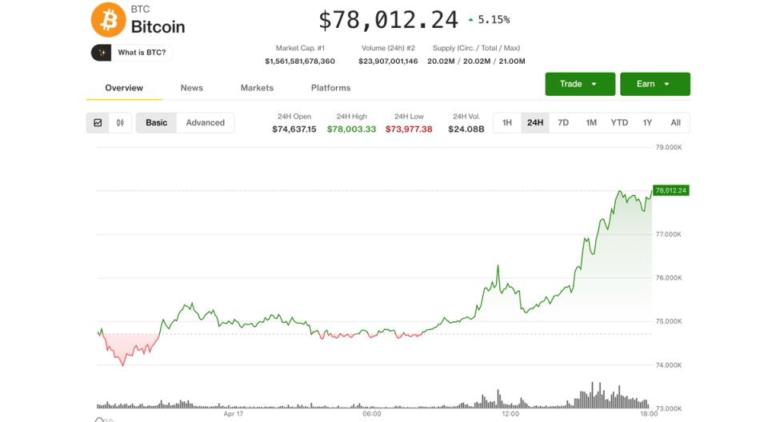
Bitcoin price rose sharply above $77,000 today after Iran announced the Strait of Hormuz had been fully reopened under a ceasefire framework, easing fears of a potential supply shock and triggering a broad risk-on move across global markets.
Iranian Foreign Minister Abbas Araghchi said the key shipping route is open to all commercial vessels for the duration of a 10-day truce tied to de-escalation efforts involving Israel and Hezbollah in Lebanon. The announcement signaled a temporary stabilization in a region that had been on edge for weeks over escalating tensions and threats to energy flows through one of the world’s most critical maritime chokepoints.
President Donald Trump amplified the development on social media, declaring that the “Strait of IRAN is fully open and ready for full passage,” reinforcing expectations that diplomatic momentum could continue. The White House has suggested that broader talks with Tehran remain possible within days, with additional regional meetings under discussion.
Markets reacted quickly. Oil prices fell as the geopolitical risk premium unwound, and equities and crypto moved higher in tandem. BTC pushed back into the $76,000–$78,000 range, a zone that has repeatedly acted as resistance since February’s pullback from earlier highs.
With liquidity thin and positioning crowded, BTC now sits at a key inflection point where continued geopolitical de-escalation could fuel a breakout above resistance, while renewed tensions risk sending price back toward the low-$70,000 range.
Telegram CEO Pavel Durov warned Friday that the European Union’s new age-verification app could become a stepping stone toward broader online identity tracking, days after the European Commission said the system was technically ready for rollout.
In a Telegram post on Friday, Durov cited analysis from security consultant Paul Moore, who said the app is hackable in “under two minutes” after examining its technical design.
“This product will be the catalyst for an enormous breach at some point,” Moore said in an X post on Thursday, adding that the system could be tricked so the age check isn’t properly tied to the actual user or their device.
Durov argued that the security concerns went beyond age checks and could, over time, be used to justify broader identity verification across online services in Europe.
The criticism reflects a wider debate over how age verification is being built into online platforms, as regulators in multiple regions push similar systems, raising concerns over security and digital identity infrastructure.
System promoted as being “completely anonymous”
The European Commission released the first version of its age-verification blueprint in July 2025, with the aim of letting users prove they are over 18 without disclosing other personal information.
The age verification framework was developed as an open-source project designed to preserve privacy and support future interoperability with European Digital Identity Wallets.
Source: Ursula von der Leyen
In a statement on Tuesday, EC President Ursula von der Leyen said the EU’s age verification app is “technically ready,” describing the tool as “completely anonymous” and claiming users can prove their age without revealing personal data or being tracked.
However, after researchers said the system can be bypassed in minutes, it’s unclear whether its privacy and security promises will hold up in real use.
Related: Signal push notifications could present privacy vulnerability, says Durov
According to Durov, the app is “hackable by design,” suggesting it was built in a way that makes it easy to break in practice, which he argues could later be used to justify stronger identity checks.
Source: Pavel Durov
“The EU bureaucrats needed an excuse to silently start turning their ‘privacy-respecting’ age verification app into a surveillance mechanism over all Europeans using social media,” the Telegram CEO said.
Durov has emerged as a major advocate of free speech and digital privacy. He remains under judicial investigation in France over allegations tied to illegal activity facilitated through Telegram, including organized crime, fraud and the platform’s alleged failure to cooperate with authorities.
Magazine: How crypto laws changed in 2025 — and how they’ll change in 2026
Cointelegraph is committed to independent, transparent journalism. This news article is produced in accordance with Cointelegraph’s Editorial Policy and aims to provide accurate and timely information. Readers are encouraged to verify information independently. Read our Editorial Policy https://cointelegraph.com/editorial-policy
Crypto-linked stocks surged Friday, led by a sharp rally in beaten-down digital asset treasury firms, as progress toward ending the Iran war jolted risk assets, sending bitcoin BTC$78,172.24 to a two-month high of $78,000.
U.S. President Donald Trump said in a Truth Social post that Iran committed to keeping open the Strait of Hormuz, a key artery for global energy markets.
“Iran has just announced that the Strait… is fully open and ready for full passage,” Trump said in a Truth Social post, adding that peace talks between the countries were progressing. Reports that the U.S. is considering unfreezing $20 billion in Iranian assets and Trump’s remarks about acquiring Iran’s enriched uranium further boosted sentiment.
As the headlines helped calm fears of a prolonged energy shock, crude oil tanked 13% to near $80 per barrel.
Risk-on signal
“The reopening of the Strait of Hormuz is the risk-on signal the global markets have been waiting for,” said Matt Mena, senior crypto research strategist at digital 21shares.
“By removing one of the most significant geopolitical chokepoints in the world, Iran has effectively uncorked a massive wave of liquidity and investor confidence,” he added. “With oil nose diving below $85 for the first time in a month, inflation fears may finally come to an end.”
Bitcoin BTC$78,172.24 climbed to $78,000, breaking out from a two-month range that capped prices since early February and up nearly 5% over the past 24 hours.
The move rippled across the broader cryptocurrency prices higher, with major altcoins ether (ETH), Solana (SOL) and XRP (XRP) posting 4%-5% gains.
Looking at crypto-related equities, the biggest winners were crypto treasury firms — companies that hold digital assets on their balance sheets — which had been heavily battered in recent months.
Trump-family-backed American Bitcoin (ABTC) jumped more than 21%, while Strategy (MSTR) surged 13%. Strive (ASST) and ProCap (BRR) added around 10%-11% as investors rotated back into high-beta bitcoin exposure.
Similar moves played out across altcoin-linked equities. Forum Markets (FRMM), an Ethereum-focused treasury firm that pivoted to tokenization, climbed 19%, while Solana-linked names like Solmate (SLMT) and Upexi (UPXI) gained 12%-11%.
Other digital asset-related stocks also advanced: Coinbase (COIN) rose more than 6%, Galaxy (GLXY) gained 8%, and Bullish (BLSH) rose 4.5%.
Just after the noon hour on the East Coast, the Nasdaq and S&P 500 were each higher by about 1.4%, both jumping to new record levels.
Stablecoin issuer Tether, the company behind USDt (USDT), said Thursday it will back a $150 million recovery program for the Drift Protocol decentralized exchange (DEX) following an exploit of the platform in April.
The recovery plan for the $280 million Drift Protocol exploit includes $127.5 million from Tether, with the rest coming from undisclosed partners, according to Tether’s announcement. Tether said:
“Rather than relying on upfront capital alone, the structure links funding and recovery to ongoing trading activity on the Drift platform, allowing user balances to be restored as the exchange returns to normal operations.”
The Drift Protocol platform will “contribute directly” to the ongoing recovery of user funds as the platform resumes normal trading activity.
The top 10 crypto assets stolen from the Drift Protocol in the exploit. Source: Quill Audits
Drift will also transition its settlement asset from Circle’s USDC (USDC) dollar-pegged stablecoin to Tether’s USDt as part of the platform’s relaunch.
Cointelegraph reached out to Tether but did not receive a response by the time of publication.
The recovery program highlights a growing trend of crypto industry companies collaborating to restore user funds and help platforms resume normal operations after major hacks or cybersecurity attacks that cause hundreds of millions of dollars in losses.
Related: Drift sends onchain message to wallets tied to $280M exploit
Circle comes under fire for not freezing funds after Drift Protocol attack
Crypto industry executives, cybersecurity researchers and blockchain security firms criticized Circle for not freezing the USDC wallets linked to the Drift Protocol exploiter, despite having a window of several hours to intervene.
The exploiter used Circle’s Cross-Chain Transfer Protocol (CCTP), a native bridge that allows tokens to be transferred to other blockchain networks, to transfer over $232 million USDC from the Solana network to the Ethereum network, according to onchain sleuth ZachXBT.
Source: ZachXBT
The funds were transferred in more than 100 transactions, he said, adding, “Despite the attacker laundering funds over six consecutive hours across Circle’s own native bridge, no USDC was frozen. The attacker has been linked to North Korea by Elliptic.”
Circle’s stock sank by about 10% on April 9, following criticism over the company’s failure to freeze the funds from the hack and downgraded forecasts from market analysts. The NYSE-traded shares have since clawed back that decline, increasing about 20% as of yesterday’s close, according to Yahoo Finance data.
Magazine: Are DeFi devs liable for the illegal activity of others on their platforms?
Cointelegraph is committed to independent, transparent journalism. This news article is produced in accordance with Cointelegraph’s Editorial Policy and aims to provide accurate and timely information. Readers are encouraged to verify information independently. Read our Editorial Policy https://cointelegraph.com/editorial-policy
PayPoint and Handepay have officially surpassed £100million in total funding delivered to UK merchants and retailers. The achievement follows a record year for business lending, as independent businesses increasingly turn to flexible finance solutions to fuel growth and manage daily trading.
During the 2025/26 financial year alone, total funding reached £33million. This represents a significant 39 per cent year-on-year increase from the £23million delivered in the previous financial year.
Flexible finance over traditional lending
The funding solution is delivered in partnership with YouLend. It provides both PayPoint and Handepay customers with seamless access to cash advances, enabling them to act quickly on business opportunities without the delays or rigidity often associated with traditional lending channels.
According to the firms, demand has been strongest across the hospitality, grocery and convenience, and health and beauty sectors—industries where speed, flexibility, and cashflow are particularly critical. Businesses are utilizing the funding to invest in new stock, upgrade equipment, refresh their physical premises, and maintain resilience through both seasonal peaks and quieter trading periods.
Unlike traditional finance models, repayments for these cash advances are automatically aligned to the merchant’s daily card takings. This structure is designed to give business owners greater confidence and control over their cashflow as they scale their operations.
A core proposition for independent businesses
Mark Latham, managing director of Handepay & Merchant Rentals
Since its initial launch in 2020, the lending service has evolved into a core component of both Handepay and PayPoint’s broader business proposition.
Mark Latham, managing director of merchant services at PayPoint, commented on the significance of the £100million milestone.
“Surpassing £100million in funding is a significant milestone and reflects the real, everyday impact this support is having on independent businesses across the UK,” Latham stated. “The strong growth we’ve seen over the past year shows just how important it is for our customers to have access to fast, flexible funding they can rely on.”
He added: “At Handepay and PayPoint, our role goes far beyond payments. We’re focused on being a genuine partner to our customers – providing not only the tools to take payments, but the financial support and flexibility they need to grow, adapt and succeed.”
Established in 2006 and later acquired by PayPoint plc in 2021, Handepay currently supports over 21,000 SME merchants, processing over £4.6 billion in card transactions through its acquiring relationships with EVO, Lloyds, and Worldpay.
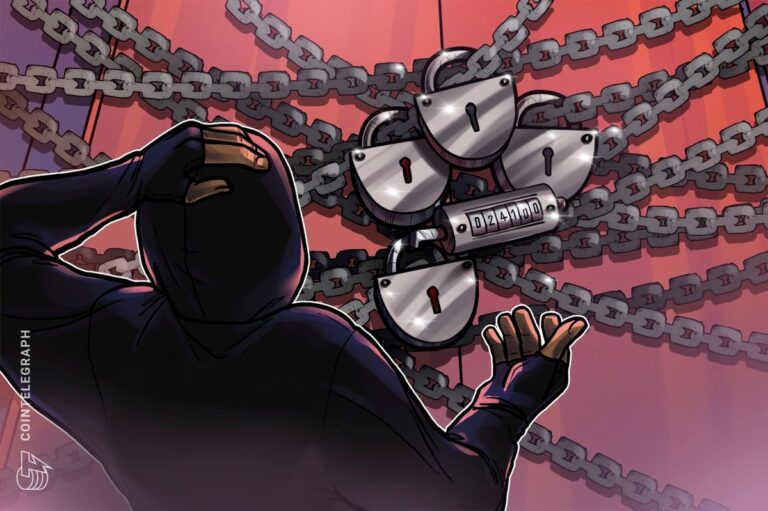
The frequency of kidnap and ransom attempts on prominent cryptocurrency executives has skyrocketed in recent years.
Referred to, perhaps crudely, in the crypto community as a “$5 wrench attack,” these attempts to extract millions from crypto bigwigs have spurred politicians to mitigate risk.
Policymakers in France are currently working on safeguards, including a prevention platform announced at Paris Blockchain Week yesterday. In the private sector, insurance companies are offering bespoke coverage to crypto execs, which includes awareness and prevention training.
With kidnap and ransom attacks on the rise, the crypto wealthy are adopting new tactics and practices to stay secure.
Why are crypto execs targets?
Ransoming wealthy crypto holders is not a new problem. Cypherpunk and early Bitcoin adopter Jameson Lopp keeps a Github repository of such attacks. While not exhaustive, it has recorded at least 316 since 2014.
Rigel Walsh, a software developer at Swan Bitcoin, was already giving lectures on the topic in 2019, covering different attack vectors, from impersonation to home invasion and kidnapping.
According to Lopp’s repository, 79 ransom attacks occurred in 2025, while already in 2026, media have reported 27 attacks on crypto holders.
This type of crime is hardly exclusive to the crypto-rich, but the nature of digital assets and the industry itself makes crypto executives and investors particularly vulnerable.
Christian Ogden Davies, global head of distribution and innovation at Relm Insurance, told Cointelegraph that some of the new crypto-rich “don’t have big risk infrastructure around them.”
Traditionally, as an organization grows, “you usually then have more people come into your organization like a CEO that’s experienced and maybe a chief risk officer or a chief legal officer, and then they start to look at insurances and how that kind of impacts them.”
As revenue increases, “you might have asset managers and wealth managers who turn around and go, ‘have you talked about or looked at your own personal security?’”
“Instead, in crypto, some people go from zero to hundreds of billions of net worth in weeks or months.”
This lack of concern, or at least attention, to personal security follows them into the very social and friendly space that is crypto. Davies said that crypto is one of the only sectors where “you’ll have five CEOs of competing firms go and sit down for dinner and […] see how things are going.”
Crypto is also highly liquid. Despite the increased amount of attention on crypto, be it through government monitoring and sanctions or private security and analysis services, crypto criminals can still cash out fairly easily.
Davies said that, while countries like North Korea and Iran have been sanctioned heavily, state-connected actors like hacker group Lazarus have still been able to get away with stolen funds. “If you have the right avenue and exit venue for it, you can still make it liquid.”
Related: Bitrefill links Lazarus Group to employee laptop hack, stolen funds
Legal and cultural elements may play a role in eliciting criminal attacks on crypto holders. France, and Paris in particular, has become a hotbed of ransom attacks on the crypto-rich. It “eclipses every other region by a country mile” in terms of crypto ransom attacks, said Davies.
One of the most high-profile attacks was the 2025 kidnapping and ransom of Ledger wallet co-founder David Balland. His colleague and co-founder, Eric Larchevêque, has reportedly said that French law, namely a requirement that entrepreneurs register their names and addresses, is at least partly to blame.
Then there’s the cultural draw. Davies said, “everyone loves Paris […] It’s a beautiful city and it just attracts lots of visitors as well. Whether you’re an A-list celebrity, musician, actor, film star, you want to go out and hang in Paris and go and eat [at] the restaurants and stuff. If you’re a crypto exec, you do the same thing. If you’re an investment banker, you do the same thing. So you do have a lot of high concentration of visiting wealth to that area.”
Overall, the lack of security has created a new reality that “everyone has kind of had to wake up to very violently.”
Crypto execs spend more on personal security
And woke up they have. Spending on personal security among crypto executives has skyrocketed.
In 2024, American crypto exchange Coinbase spent $6.2 million on executive protection for its CEO Brian Armstrong. According to TechCrunch, this was more than the combined security costs of executives for JP Morgan, Goldman Sachs and Nvidia.
Larchevêque pays over $50,000 a month for security for himself and his family. He has cameras and weapons in his home and has reportedly lobbied for crypto executives to be allowed to carry firearms for their protection.
Related: Spain arrests suspect in 2025 kidnapping of Ledger co-founder
There have also been government-level efforts to address the problem. Yesterday at Paris Blockchain Week, Jean-Didier Berger, minister delegate to the interior minister of France, said his office had launched a prevention platform which has already drawn thousands of sign-ups. The platform will improve security coordination, which Berger said he’ll be working on with Interior Minister Laurent Nuñez in the coming weeks.
At Paris Blockchain Week, police reportedly had a strong presence. In a post on X, The Block’s head of growth Tim Copeland said some conference attendees had police escorts through Paris.
Source: Tim Copeland
Insurance companies have also seen a surge in interest. Ben Davis, who runs a crypto-centric insurance brokerage in the UK, Native Broking, told Reuters last year, “Two years ago, kidnap and ransom wasn’t really a big problem. No one really wanted to talk about it. Now 100% of our clients are talking about it.”
Christian Ogden Davies told Cointelegraph that Relm started offering a K&R (kidnap and ransom) policy after massive client interest. “The reason we launched it is because we’re being asked by so many people for it.”
The product offers security expertise and remuneration of funds to clients should they find themselves in a situation where they need to pay a ransom. But much of the policy, and of mitigating possible ransom attacks generally, is making sure the client knows how to avoid that situation altogether.
“There’s initial training and education of the people first. Try not to get yourself in that situation. This is what you say. This is what you don’t say. This is who you speak to, how you speak, how you engage.”
“Don’t turn left down that dark alley. It might be a shortcut, but just take that normal route.”
Magazine: Will the CLARITY Act be good — or bad — for DeFi?
Cointelegraph Features publishes long-form journalism, analysis, and narrative reporting produced by Cointelegraph’s in-house editorial team with subject-matter expertise. All articles are edited and reviewed by Cointelegraph editors in line with our editorial standards. Research or perspective in this article does not reflect the views of Cointelegraph as a company unless explicitly stated. Content published in Features does not constitute financial, legal, or investment advice. Readers should conduct their own research and consult qualified professionals where appropriate. Cointelegraph maintains full editorial independence. The selection, commissioning, and publication of Features and Magazine content are not influenced by advertisers, partners, or commercial relationships. This content is produced in accordance with Cointelegraph’s Editorial Policy.
Trusted Editorial content, reviewed by leading industry experts and seasoned editors. Ad Disclosure
Founding partner at Castle Island Ventures Nic Carter has laid out what he sees as three plausible paths for Bitcoin as the industry moves toward post-quantum cryptography: freeze vulnerable early coins, leave them untouched and accept the consequences, or pursue a legal “salvage” process that avoids a protocol-level confiscation.
The debate matters because, in Carter’s framing, roughly 1.7 million BTC in old pay-to-pubkey outputs could become exposed if Bitcoin eventually deprecates elliptic curve signatures and a cryptographically relevant quantum computer arrives.
The Third Option In Bitcoin’s Satoshi Coin Battle
In a post on X, Carter argued that the Overton window around quantum risk has shifted quickly. What was recently treated as a fringe concern, he wrote, is now increasingly being discussed as an eventual engineering and governance problem for Bitcoin itself. “The thing about the PQ transition is, it’s impossible as a Bitcoiner to claim that this protocol is cutting edge technology if Bitcoin, a monetary system predicated entirely on cryptography, is a laggard,” he wrote, adding that betting the fate of the network on the hope that the technology does not advance would be both reckless and embarrassing.
From there, Carter sketched the upgrade path he expects. After a soft fork, Bitcoin would likely move through an intermediate phase in which users could sign with existing ECC-based schemes or with new post-quantum signatures. Eventually, he wrote, legacy signatures such as ECDSA and Schnorr would be disallowed entirely. That transition, in his telling, is the easy part. The harder question comes later: what to do with coins that never migrate.
He framed that dispute as a clash between two camps already taking shape. On one side are institutions, custodians, exchanges, and fiduciaries that would view a freeze of non-migrated coins as the only acceptable option. Carter’s argument is that these actors cannot tolerate the risk that dormant holdings, including Satoshi’s coins, might suddenly be recovered by a hostile quantum-capable party and dumped into the market or otherwise used to destabilize Bitcoin.
On the other side are hardcore Bitcoiners and ideological purists who see any such freeze as a fundamental breach of the system’s monetary and political principles. Carter described their position in stark terms: “Satoshi set 21 million as the monetary parameter, and no one alive has the authority to arbitrarily modify that to 19.x million. Bitcoin doesn’t engage in selective ‘irregular state changes’ like Ethereum did after the DAO was hacked in 2016. Even after 850k BTC were lost to Mt Gox, nothing was done at the protocol layer to recover the funds.”
Carter said he believes the freeze camp is more likely to win than many Bitcoiners assume, largely because the structure of the market has changed since the 2015-2017 blocksize wars. In his view, today’s Bitcoin is far more concentrated in corporate entities, ETF issuers, custodians and large asset managers, giving “economic nodes” much more leverage than they had a decade ago. He also noted that some influential technical figures have already taken the side of freezing vulnerable coins if a genuine threat emerges.
Still, Carter’s preferred outcome is neither a freeze nor a laissez-faire approach. His “secret third thing” is a legal salvage framework. Under that scenario, a US quantum leader such as Google, IBM or another domestic firm would build the first cryptographically relevant quantum computer and, under court authority, recover the vulnerable coins into trust-like structures rather than take ownership outright.
“It would go like this,” Carter wrote. “A US firm, whether it’s Google, or IBM, or one of the other quantum leaders… acquires a CRQC first, and contracts with the US government to lawfully recover the 1.7m p2pk coins. They do not obtain ownership of these coins, but are rather appointed by a court as a neutral receiver or court-authorized custodian, tasked with securing and returning the assets to their rightful owners where possible and otherwise holding them in trust pending judicial disposition.”
In Carter’s ordering, lawful salvage is the best result, a freeze is second-best, and a no-freeze outcome ranks far behind. “If Bitcoin really does freeze the coins, then something about Bitcoin will truly have died,” he wrote. “It would survive, but it will be forever changed.”
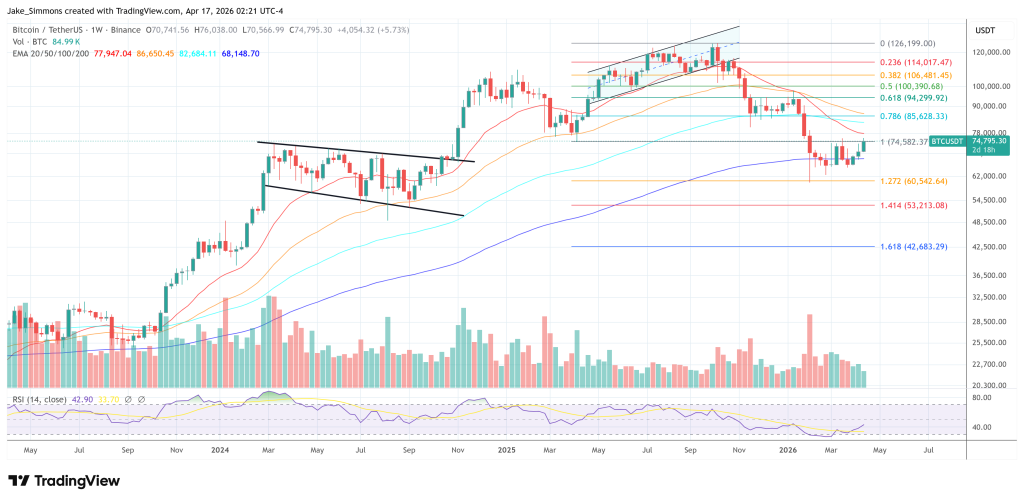
At press time, Bitcoin traded at $74,795.
Bitcoin close above the 1.0 Fib, 1-week chart | Source: BTCUSDT on TradingView.com
Featured image created with DALL.E, chart from TradingView.com
Editorial Process for bitcoinist is centered on delivering thoroughly researched, accurate, and unbiased content. We uphold strict sourcing standards, and each page undergoes diligent review by our team of top technology experts and seasoned editors. This process ensures the integrity, relevance, and value of our content for our readers.
Circle Internet Group is facing a class action lawsuit led by a Drift Protocol investor claiming it failed to freeze funds stolen in a $280 million exploit of the protocol on April 1.
The lawsuit was filed by Drift investor Joshua McCollum on behalf of over 100 members in a US district court in Massachusetts on Wednesday, which accused Circle of allowing the attackers to transfer about $230 million worth of USDC (USDC) from Solana to Ethereum via Circle’s Cross-Chain Transfer Protocol (CCTP) over several hours without intervention.
“Circle permitted this criminal use of its technology and services,” attorneys representing McCollum wrote, adding: “These losses would not have occurred, or would have been substantially reduced, had Circle taken timely action.”
The suit accuses Circle of aiding and abetting conversion as well as negligence. Mira Gibb, the law firm representing McCollum and other Drift investors, is seeking damages, with the final amount to be determined at trial.
The case touches on a legal grey area around crypto companies that retain control over user funds. While such companies may have the technical ability to intervene or freeze assets, they often cite regulatory constraints or the lack of immediate legal authority as reasons for inaction — leaving accountability unclear as exploits unfold in real-time.
Source: James Seyffart
McCollum’s lawyers pointed out that Circle froze 16 USDC wallets in connection with a sealed US civil case about a week before the Drift incident to argue that Circle had the technical capacity to do the same.
Cointelegraph reached out to Circle for comment, but didn’t receive an immediate response.
Crypto analytics firm Elliptic suspected the exploit was committed by North Korean state-backed hackers, who made over 100 transactions via Circle’s bridging technology during US working hours, where the stablecoin company is based.
Related: Ukraine arrests FBI-wanted cybercrime suspect, seizes $11M in assets
The funds were converted into Ether (ETH) and sent through the Tornado Cash privacy protocol to launder the proceeds and obscure the trail.
Circle was put in a lose-lose position: ARK Invest
While Circle faced backlash for the inaction, ARK Invest’s director of research for digital assets, Lorenzo Valente, argued on Thursday that it made the right decision, arguing that freezing funds without a legal order opens the door for arbitrary discretion.
“Every future freeze is now a judgment call. Every non-freeze is a political statement. Why freeze the Drift hacker but not that sketchy Nigerian fraud wallet? Why this protester but not that one?”
While Valente sided with Circle’s decision, he speculated that the stolen funds will likely fund North Korea’s nuclear weapons program:
“Whether Circle got it right comes down to how much you weigh rule-of-law principles vs concrete harm. Reasonable people disagree.”
Magazine: Are DeFi devs liable for the illegal activity of others on their platforms?
Cointelegraph is committed to independent, transparent journalism. This news article is produced in accordance with Cointelegraph’s Editorial Policy and aims to provide accurate and timely information. Readers are encouraged to verify information independently. Read our Editorial Policy https://cointelegraph.com/editorial-policy
Foundation, one of the better-known Ethereum-based non-fungible token (NFT) marketplaces of the 2021 boom, is shutting down after the sale that was supposed to keep it operating fell apart.
Kayvon Tehranian, Foundation’s founder and CEO, took to X on Wednesday to announce the marketplace’s closure following a failed acquisition by the digital art distribution platform Blackdove.
Although Tehranian did not directly mention Blackdove, he said the original goal of the sale was to ensure the platform would continue operating under new ownership. “That’s no longer possible,” he said, adding that Foundation is not in a position to bring the marketplace back online.
Foundation later said the site would briefly return so users could delist NFTs, in a message signed by the Blackdove team.
Source: Foundation
The shutdown underscores the ongoing decline in NFT trading activity since the 2021 boom, as lower liquidity has left fewer independent marketplaces able to survive.
Foundation rose in the 2021 boom
Foundation was launched in early 2021, capturing a massive year for tokenized digital art, when some NFTs sold for as much as $69 million apiece.
According to Blackdove, the platform facilitated more than $230 million in primary sales for artists around the world, hosting NFT sales for artists like Jen Stark, James Jean and Reuben Wu.
Foundation also became a venue for digital art by US whistleblower Edward Snowden, whose NFT piece “Stay Free” sold for about 2,200 Ether (ETH) in 2021, worth roughly $5 million at the time.
Source: CozomoMedici
As broader NFT activity cooled after peaking in 2022, platforms like Foundation faced shrinking liquidity and fewer sustainable transaction flows. Blackdove initially announced Foundation’s acquisition in early 2025, with the platform announcing transitioning ownership a year later.
NFT market consolidation deepens
Foundation’s closure adds to a growing list of NFT platforms that have shut down or pivoted away from trading digital art recently, with the sector’s market cap falling back to pre-hype levels seen in 2021 as of February 2026.
Mint Blockchain, an NFT-linked infrastructure network built on Ethereum, also announced Friday that it has ceased operations and instructed users to withdraw assets.
This year alone, at least two other NFT platforms announced they were winding down operations, including Gemini exchange-backed Nifty Gateway and the social NFT platform Rodeo.
Top 10 NFT marketplaces by volume. Source: DefiLlama
MakersPlace shut down amid declining NFT activity last year, while X2Y2 wound down and pivoted away from NFTs. Crypto exchange Bybit has also closed its NFT marketplace as trading volumes fell.
Related: Yuga Labs settles lawsuit against artists accused of copying its NFTs
OpenSea has remained the dominant NFT marketplace despite the broader downturn, accounting for more than 73% of all activity across the sector at publishing time, with competition from rivals such as Blur, according to DefiLlama.
Despite the sharp decline in NFTs, some industry figures, including Animoca Brands chairman Yat Siu, predicted that the sector could recover and reach new all-time highs.
Magazine: Your guide to surviving this mini-crypto winter
Cointelegraph is committed to independent, transparent journalism. This news article is produced in accordance with Cointelegraph’s Editorial Policy and aims to provide accurate and timely information. Readers are encouraged to verify information independently. Read our Editorial Policy https://cointelegraph.com/editorial-policy
The marketing landscape in early 2026 can be defined by a paradox: marketers have never had more data, yet they have rarely felt less certain. Between the diminishing returns of saturated digital “walled gardens” and the volatility of customer acquisition costs, the instinct to pivot back to the physical world has never been stronger. Out-of-home (OOH) is currently experiencing an institutional shift, not because of nostalgia, but because it offers a high-trust, fraud-free environment that digital channels increasingly struggle to replicate.
However, a fundamental hurdle remains for the modern marketing leader. It isn’t a lack of conviction – most recognize that real-world presence builds brand authority that a mobile banner cannot. The true barrier is what can be defined as the “Brand Confidence Gap.”
The Anatomy of the Gap
The Brand Confidence Gap is the distance between a marketer’s belief in a channel’s efficacy and their ability to defend that investment in the boardroom. For the last decade, marketing departments have been conditioned by the immediate feedback loops of performance marketing. We have been trained to demand direct, linear attribution for every cent spent. While this model thrives in a digital auction, it has created a structural bias against brand-building channels that compound over time rather than clicks.
The OOH industry has historically struggled to bridge this gap. Rather than providing the strategic tools necessary to justify a buy upfront, the sector often attempted to mimic digital’s homework, promising granular real-time measurement that the medium was never designed to provide. This created a cycle of disappointment: marketers would take a chance on a campaign, only to find themselves unable to explain the specific math of the swing to their CFO.
In an unpredictable economic climate, this lack of defensibility leads to hesitation. Marketers stay within the confines of digital ecosystems, where ROI is visible, even as the actual business impact shrinks.
The Shift from Attribution to Rationale
Closing the Confidence Gap requires a fundamental shift in how we approach media planning. The answer is not more complex post-campaign reporting; it is more rigorous intelligence on the front end.
In any high-stakes investment, confidence is born during the strategy phase. Real-world advertising is no longer just about “buying boards”; it is about mapping an Ideal Customer Profile (ICP) to physical environments with the same precision used in search or social. When a media plan is built on the foundation of where a specific audience actually lives, works, and moves, the risk of the investment changes.
By utilizing data intelligence to identify these high-value environments before a dollar is spent, marketers replace gut feel with a data-driven rationale. This provides the boardroom armor necessary to defend a budget. When the strategy is sound and the audience alignment is proven upfront, the need for a post-campaign dashboard to prove that the buy worked becomes secondary to the strategic logic that justified it in the first place.
The Execution Gap: Strategy’s Silent Killer
Even when the Confidence Gap is closed, brands often fall into the “Execution Gap.” OOH is one of the oldest media channels, and it often operates like it. The medium is hyper-fragmented, with inventory spread across hundreds of vendors, each with their own contracts, wildly varying formats, and unforgiving lead times.
The industry was built for specialized media buyers who have spent decades navigating these manual processes. It was not built for the modern marketing leader who manages five other channels and needs to move at the speed of a digital deployment. When a marketer tries to coordinate a multi-city campaign only to encounter a dozen different sets of technical requirements and a four-week lead time for a static unit, the friction can become a deterrent.
This operational friction is more than just an inconvenience; it is a strategic liability. To treat the real world as a core pillar of a marketing program, the execution must be as streamlined as the digital channels it complements.
Moving Beyond Experimental Budgets
We are currently seeing a “Great Migration” of capital toward the real world. In late 2025 and early 2026, there has been a notable shift among B2B tech, AI, and DTC firms. These brands are no longer treating OOH as an experiment or a secondary reach vehicle. Instead, they are viewing physical inventory as strategic infrastructure, a moat that protects brand equity against the volatility of the digital auction.
This shift suggests that the most sophisticated marketers have realized that in a world of bot fraud and “scroll-blindness,” physical presence is the last remaining unskippable medium. They are consolidating fragmented media spend and securing long-term placements to ensure their brand remains a constant in an otherwise unpredictable market.
Professional Defensibility
Ultimately, the Confidence Gap is as much about professional security as it is about strategic ROI. Marketers are tasked with moving their businesses forward while navigating a landscape where they are held accountable for every dollar. No leader wants to feel like they are “lighting money on fire” on a channel they cannot explain or defend.
The path forward for the industry lies in empowering the marketer. It involves recognizing that the instinct to place a brand in the real world – in front of the right people, in the right environments – is correct. The challenge is to provide the data intelligence and strategic guidance to make that instinct defensible.
When we remove the friction of execution and replace relationship-based buying with audience-based planning, the real world stops being a hard channel to use. It becomes a scalable, defensible, and essential engine for growth. The transition from digital-only to a balanced, real-world strategy is not just a trend; it is a maturation of the marketing function. It is time to close the gap between what we know works and what we are confident enough to execute.