The TRON founder accused the Trump-linked DeFi project of hiding a ‘trap door’ in its token contract.
The long-simmering conflict between TRON founder Justin Sun and World Liberty Financial (WLFI) erupted into an all-out public war on Sunday, with both sides hurling accusations on X.
Sun, who invested $75 million in the DeFi venture affiliated with the Trump family, published a lengthy statement accusing WLFI of embedding a hidden blacklisting function in the WLFI token smart contract, a mechanism he said gives the project “unilateral power to freeze, restrict, and effectively confiscate the property rights of any token holder, without notice, without cause, and without recourse.”
“This is a trap door marketed as an open door,” Sun wrote.
The dispute dates back to September 2025, when WLFI blacklisted a wallet containing more than 500 million of Sun’s WLFI tokens after on-chain analysts flagged transfers routed through HTX, Sun’s crypto exchange.
WLFI responded within hours, dismissing Sun’s allegations and threatening legal action.
“Justin’s favorite move is playing the victim while making baseless allegations to cover up his own misconduct,” the project’s official account posted. “We have the contracts. We have the evidence. We have the truth. See you in court pal.”
Sun fired back minutes later, demanding that whoever was operating the account identify themselves. “As the largest investor in this project, I demand that those responsible come forward by name, instead of hiding in the shadows.”
The feud follows days of scrutiny over WLFI’s treasury operations.
Sun went on to allege that governance votes cited to justify the project’s actions “were not conducted through a fair or transparent process” and that “the outcomes were predetermined.”
He accused the team of extracting fees, implanting backdoor controls, and “treating the crypto community as a personal ATM.”
Sun was careful to separate the WLFI operators from President Trump himself, opening his statement by reaffirming support for Trump and directing criticism at “the bad actors at WLFI.”
Since the September 2025 blacklist, WLFI has fallen roughly 76% from its all-time high of $0.30 to around $0.079, per CoinGecko, hitting an all-time low just yesterday. The token tanked 18% on its first day of trading and has barely recovered since.
Bitcoin’s fifth halving is roughly two years away, and the mining sector is heading into it with far less margin for error than in 2024, as higher costs, tighter energy markets and clearer regulation reshape the industry.
At the last halving in April 2024, Bitcoin (BTC) traded at around $63,000 as rewards fell from 6.25 BTC to 3.125 BTC per block, according to Coingecko. In April 2028, at the next halving, miners face higher input costs for half the new coins, as rewards drop to 1.5625 BTC. That looks tougher in a world of record hashrate, higher energy prices and more selective capital.
Energy security has also become a strategic concern after geopolitical shocks jolted fuel and power markets, while regulators from Washington to Europe move from ad-hoc guidance to formal regimes for custody and licensed institutional platforms.
Those pressures are forcing miners to behave less like pure Bitcoin proxies and more like energy and infrastructure companies, monetizing reserves, cutting costs and rethinking capital allocation ahead of the April 2028 Halving.
The shift is also changing how investors assess the sector, with capital increasingly flowing toward operators that can secure long-term power and build infrastructure that extends beyond mining alone.
Balance sheets show tougher pre-halving cycle
Miners are already adjusting. MARA Holdings sold more than 15,000 Bitcoin in March to reduce leverage, Riot Platforms sold over 3,700 BTC in the first quarter, Cango sold 2,000 BTC to pay down Bitcoin-backed debt, and Bitdeer said its Bitcoin holdings had fallen to zero as of Feb. 20.
Bitcoin Hashrate 2026. Source: CoinWarz
Behind those sales is a broader reset in how miners think about hardware, power and capital. The 2028 halving arrives in “an environment that looks almost nothing like 2024,” Juliet Ye, head of communications at Cango, told Cointelegraph.
She pointed to a widening efficiency gap that is “forcing real decisions around fleet upgrades” and a shift toward long-term energy contracts across multiple regions rather than chasing cheaper tariffs.
“There is less room in the middle now,” she said. “Operators with scale and diversification will be fine. Those without will find the next halving very difficult.”
GoMining struck a similar note. CEO Mark Zalan told Cointelegraph that “capital discipline now matters more than hashrate maximalism” and that new deployments now have to clear tougher return thresholds.
Related: Mining companies move deeper into AI, HPC as MARA may sell Bitcoin
From a mining pool’s perspective, some of the underlying dynamics remain familiar even as the pressure grows. “There is actually very little fundamental difference between this mining cycle and previous ones,” Alejandro de la Torre, co-founder and CEO of Stratum V2 pool DMND, told Cointelegraph. “The same dynamics repeat.”
He expects mining hotspots to reach their peak, then realign, as “no region keeps dominance for long,” opening the door for more decentralization as mid-size miners expand into new energy partnerships.
Related: Genius Group liquidates Bitcoin treasury to pay $8.5M of debt
Business models shift beyond pure block rewards
The economics around the next halving are also shifting away from pure block rewards, which is a “thinner business than it used to be,” Zalan said. He predicted stronger operators will look closer to power and data center businesses, and earn additional revenue through curtailment, grid services and heat reuse.
Cango is already building toward that model. “The facilities that will matter in five years are the ones that can do more than one thing,” Ye said, using mining to fill capacity while positioning sites to toggle between AI workloads and hashpower.
Bitcoin Halving Countdown. Source: CoinGecko
Regulation, once viewed mainly as an overhang, is increasingly part of the investment case. Zalan pointed to more specific rules on custody and banking access in the United States, alongside the European Union’s Markets in Crypto Assets (MiCA) regime and new exchange-traded funds (ETFs), derivatives and settlement rails out of Hong Kong, arguing “capital moves faster when those rules are clear and usable.”
Zalan said that backdrop is shaping both how miners finance themselves and how institutions position for the next issuance cut. He said he does not believe the market has “fully priced the next halving,” arguing that scarcity will meet a “much stronger ecosystem around Bitcoin by the time 2028 arrives.”
Ye sees investors already re-rating miners that lock in high-performance compute contracts, with those operators trading at “more than double the revenue multiple of pure-play miners,” while de la Torre believes supporting large established operators is “no longer the only logical path.”
If the 2024 cycle rewarded miners that rode Bitcoin’s price strength, the run into 2028 may favor operators that can manage debt, lock in power and build infrastructure that earns beyond block subsidies.
Magazine: AI agents will kill the web as we know it: Animoca’s Yat Siu
Cointelegraph is committed to independent, transparent journalism. This news article is produced in accordance with Cointelegraph’s Editorial Policy and aims to provide accurate and timely information. Readers are encouraged to verify information independently. Read our Editorial Policy https://cointelegraph.com/editorial-policy
Elon Musk’s AI company filed a federal lawsuit seeking to block Colorado’s AI law before it takes effect on June 30.
The case reflects a broader conflict over whether states or the federal government should regulate artificial intelligence.
The company faces separate lawsuits and investigations tied to Grok’s image-generation tools.
Elon Musk’s artificial intelligence company, xAI, has filed a federal lawsuit seeking to block Colorado from enforcing a new law regulating high-risk AI systems.
In court documents filed on Thursday, Musk’s lawsuit targets Colorado Senate Bill 24-205, scheduled to take effect on June 30, which requires developers of AI systems to disclose risks and take steps to prevent algorithmic discrimination in areas such as employment, housing, healthcare, education, and financial services.
According to the complaint, the company argues the measure would force developers to modify how AI systems operate and could restrict how models generate responses.
“SB24-205 is decidedly not an anti-discrimination law. It is instead an effort to embed the State’s preferred views into the very fabric of AI systems,” attorneys for xAI wrote. “Its provisions prohibit developers of AI systems from producing speech that the State of Colorado dislikes, while compelling them to conform their speech to a State-enforced orthodoxy on controversial topics of great public concern.”
The lawsuit asks a federal court to declare the law unconstitutional and block its enforcement, which xAI says violates the First Amendment by forcing changes to Grok’s outputs to align with the state’s views on diversity and equity. The lawsuit also argues that SB24-205 improperly regulates activity beyond Colorado, and is too vague to enforce fairly, and favors AI systems that promote “diversity” while penalizing those that do not.
“By requiring “developers” and “deployers” to differentiate between discrimination that Colorado disfavors and discrimination that Colorado favors, SB24-205 compels Plaintiff xAI—a “developer” under the law—to alter Grok, forcing Grok’s output on certain State-selected subjects to conform to a controversial, highly politicized viewpoint,” the lawsuit said. “But the State “may not compel [xAI] to speak its own preferred messages.”
The legal challenge comes amid a growing conflict between technology companies and government officials over how artificial intelligence should be regulated. Several states, including Colorado, New York, and California, have introduced rules addressing risks posed by generative AI tools. At the same time, the Donald Trump administration has moved to establish a national AI regulatory framework.
The lawsuit also arrives as scrutiny of xAI’s chatbot Grok continues to increase.
Several lawsuits filed in 2026 accuse the company of allowing Grok to generate non-consensual deepfake images. In March, a class-action complaint filed by three Tennessee minors alleged that Grok produced explicit images depicting them without consent. The city of Baltimore also sued, claiming Grok generated up to 3 million sexualized images in a matter of days, including thousands depicting minors.
xAI did not immediately respond to a request for comment by Decrypt.
Daily Debrief Newsletter
Start every day with the top news stories right now, plus original features, a podcast, videos and more.
Bitcoin BTC$70,938.91 traded lower Sunday as geopolitical risks resurfaced after U.S. Vice President JD Vance said peace talks involving Iran held in Pakistan had failed.
But beyond the macro noise, crypto-specific drivers continued to point toward a potential move toward $88,000 and higher, though outcomes remain dependent on how broader risk conditions evolve.
Bullish flows
Starting with market flows, sentiment has remained constructive. Strategy, the world’s largest publicly listed bitcoin holder, said it purchased $330 million worth of bitcoin last week, lifting its total holdings to 766,970 BTC. Some estimates suggest Strategy’s STRC-related activity has added roughly 8,000 bitcoin so far this week.
If that wasn’t enough, U.S.-listed spot bitcoin ETFs—widely seen as a proxy for institutional demand—recorded net inflows of $787 million this week, according to data from SoSoValue. That marks the strongest weekly inflow since early March. Since then, these funds have attracted nearly $2 billion in cumulative investor capital.
“These are not yet massive flows in absolute terms, but the direction and persistence matter: with MicroStrategy buying and ETFs absorbing supply, downside risk is structurally capped as long as these flows and the technical picture hold,” said Markus Thielen, founder of 10x Research, in a note to clients on Sunday.
Thielen’s base case is now a rally toward $88,000, driven not only by flows but also by oversold signals from technical indicators such as stochastic oscillators, along with improving risk appetite across related markets, including mining equities and broader equities.
Publicly listed miners such as TeraWulf (WULF), Bitdeer Technologies (BITDEER), and IREN Limited have climbed between 10% and 30% this month. Broader U.S. equities have also rebounded, with the S&P 500 rising 4%, while AI-heavyweights such as Nvidia gained around 6%.
“The recent performance of bitcoin miners, particularly those pivoting toward AI hosting, signals that the market is rotating back into the AI capex and growth theme, with Iran-related risk increasingly looking like a sideshow,” Thielen said.
“Taken together, this shifts our base case firmly to the upside, with $88,000 as our primary near-term target. The confluence is rare: technicals are constructive, flows are positive and broadening, and the market is demonstrating a clear willingness to look through geopolitical noise,” he noted,
Other widely tracked indicators of demand are also flashing supportive signals. For instance, the Coinbase Premium Index – which measures the price gap between bitcoin on Nasdaq-listed Coinbase and offshore exchange Binance – has climbed to 0.0586%, its highest level since October, according to data from Coinglass.
The move suggests relatively stronger buying pressure from U.S. investors compared with offshore markets, a dynamic often associated with bullish phases in crypto markets.
Clarity act
Matt Mena, senior crypto research strategist at 21Shares, said the potential passage of the Clarity Act later this quarter provides a “well-defined structural path” for further upside in crypto markets. The legislation, which aims to establish clearer jurisdictional boundaries between the SEC and the CFTC and to define when a digital asset is a security or a commodity, is widely viewed as a key regulatory milestone that could reduce long-standing uncertainty for bitcoin and the broader crypto sector.
Polymarket traders are currently pricing in a 65% probability that the Clarity Act will be signed into law this year. While the bill passed the House in July 2025, it is currently stalled in the Senate.
“With the potential passage of the Clarity Act later this quarter, the structural path for a significant expansion is well-defined. Reclaiming $73,000 clears the runway for a $75,000 test, which would likely provide the firepower for a rapid move through $80,000 toward the $90,000 corridor. Combined with a neutral inflation backdrop, a $100,000 milestone by the end of Q2 remains a possible outcome,” he said in an email.
Inflation and on-chain dynamics
On the macro front, recent inflation data came in broadly mixed but leaned softer on underlying pressures. The consumer price index (CPI) rose 0.9% month-on-month, lifting the annual rate to 3.3%, largely driven by a 10% jump in energy prices.
However, core CPI – which strips out food and energy – rose just 0.2% on the month and 2.6% year-on-year, both 0.1 percentage points below expectations. The print suggests that underlying price pressures remain contained even as headline inflation is distorted by volatile energy costs.
For markets, that distinction matters. If inflation continues to moderate beneath the surface, the Federal Reserve may be able to look through temporary energy-driven spikes and maintain a more flexible policy stance later this year. A steady or more accommodative rate path typically supports liquidity conditions, which tends to benefit risk assets such as equities and cryptocurrencies, including bitcoin.
Lastly, Vikram Subburaj, CEO of India-based FIU-registered Giottus exchange, pointed to supply dynamics which suggests prices are unlikely to face any resistance between $70,000 and $80,000.
“Supply distribution data indicates that only about 1 percent of circulating Bitcoin lies between $72,000 and $80,000. This suggests that a sustained break above current resistance could lead to relatively faster price discovery due to thinner overhead supply,” he said in an email.
Taken together, these factors suggest that while geopolitical risks continue to dominate headlines, underlying crypto market structure remains supportive of potential upside in bitcoin—assuming broader risk conditions do not materially deteriorate.
The AI market is projected to grow from $390 billion in 2025 to $3,497 billion by 2033. Meanwhile, the best crypto to buy in 2026 search intensifies because the tokens that convert that growth into returns will produce the cycle’s biggest winners.
BTC holds $70,900 and ETH trades at $2,187. However, returns from those caps require months and macro cooperation from bases already measured in the hundreds of billions. Pepeto has raised more than $8.8 million with a confirmed Binance listing approaching. Notably, the early wallets acted before the crowd had reason to look because this entry has a higher ceiling with a working exchange behind it.
Best Crypto to Buy in 2026 Gains Attention as AI Sector Targets 797% Growth by 2033
AI Growth and the Complete System Built to Capture What the Sector Produces
Pepeto
The search for real returns led wallets past every meme promise and straight to the project where utility already runs. Pepeto stands apart because it operates as a complete system that links code review with market feeds to follow whale positioning, read crowd emotion, and highlight entries before they go public.
Wallets can review any contract using the danger scanner and receive a clear rating instantly. This places Pepeto among the few tokens with genuine utility focused on protecting capital rather than generating noise. The chain portal sends holdings across Ethereum, BNB Chain, and Solana at zero cost. Moreover, PepetoSwap settles every trade without charging anything.
SolidProof already endorsed every contract, so security is established. More than $8.8 million has been raised at $0.000000186 per token. The cofounder who built the original Pepe coin leads the project. Additionally, 185% APY staking grows each wallet balance nonstop. The best crypto to buy in 2026 search led here because this is the entry where verified products and a confirmed listing sit behind every token.
One of the most positioned tokens in this cycle is Pepeto. Furthermore, the Pepeto complete system could deliver the kind of ROI that established caps cannot match at their current distance from listing level returns.
Ethereum (ETH)
ETH trades at $2,187 with Santiment confirming social sentiment dropped to levels last seen before the 2025 rally from $1,470 to $4,900 (CoinGecko). The $270 billion cap means reaching $3,650 delivers 61% over months. However, this is a gain that depends on the sentiment reversal confirming, a timeline the best crypto to buy in 2026 presale compresses.
Bitcoin (BTC)
BTC holds $70,900 with exchange reserves at a seven year low and VanEck CEO calling this the bottom of the halving cycle (Crypto.news). Even reaching $140,000 delivers 92% over the full year from a $1.4 trillion cap. Still, this is a strong return that takes quarters and massive institutional inflows to achieve.
Conclusion
AI sector growth targeting $3.5 trillion by 2033 confirms the biggest opportunity in a generation, and the tokens converting that growth into real utility will capture the largest returns.
The search for the best crypto to buy in 2026 led here because early wallets acted before the crowd had reason to look. Consequently, entering Pepeto through the Pepeto official website now means joining the wallets that found it first because a working exchange puts the ceiling higher than any token trading on promises alone. The pricing disappears permanently when the confirmed Binance listing opens. Furthermore, this entry has a higher ceiling because real products already sit behind every token.
Click To Visit Pepeto Website To Enter The Presale
FAQs:
What is the best crypto to buy in 2026 as the AI market targets $3.5 trillion?
The best crypto to buy in 2026 includes ETH for DeFi recovery, BTC for long term holding, and Pepeto for presale entry with a confirmed Binance listing and 100x potential.
How does AI sector growth affect crypto entries?
AI market growth from $390 billion to $3.5 trillion creates demand for tokens with real trading tools, making every project with working AI utility and confirmed listings more relevant.
Is Pepeto the best crypto to buy in 2026 before the Binance listing?
Pepeto raised more than $8.8 million with the Pepe cofounder and a confirmed listing, offering presale entry through the Pepeto official website where one listing delivers what ETH and BTC need months to match.
Oil futures surged on Hyperliquid after President Donald Trump ordered a naval blockade of the Strait of Hormuz, a major global supply chokepoint. The move came after Iran refused to give up its nuclear ambitions during peace talks in Islamabad earlier in the day.
Perpetual futures tied to WTI crude oil jumped to $96.40, up 7% on the day, extending early gains. Brent futures rose 6% to $96.
Notably, WTI futures registered $1.53 billion in trading volume, making it the third-most-traded instrument on the platform behind BTC and ETH. The data highlights growing investor preference for price discovery on decentralized blockchain platforms, especially when traditional markets are closed.
This blockade news couldn’t have come at a worse time, as mid-April marks a critical period for the oil market, when the large-scale drawdown of strategic petroleum reserves coordinated by the International Energy Agency begins to approach its limit.
Those emergency releases, initiated after the war broke out on Feb. 28, have been offsetting a supply shortfall of roughly 4.5 to 5 million barrels per day caused by disrupted flows through the Strait of Hormuz, but as these buffers run down in the coming weeks, that gap risks widening sharply to roughly 10 to 11 million barrels per day if normal supply is not restored.
If this scenario materializes, it would amount to “a supply shock without precedent in the modern oil market,” the House of Saud recently said. The IEA’s Chief, Fatih Birol, warned last week that the oil supply shock could be worse in April than in March.
The impact on markets would likely be immediate, with oil benchmarks gapping higher on Monday amid tighter supply expectations, equities facing renewed risk-off pressure amid inflation concerns, and volatility rising across both traditional and crypto markets as traders reassess global growth assumptions.
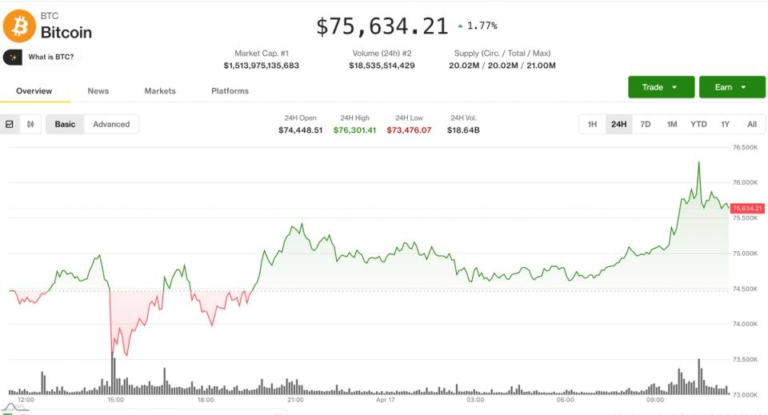
Bitcoin, which is considered a leading indicator for risk assets by some traders, is already under pressure. As of writing, it changed hands near $71,000, down nearly 3% on the day, according to CoinDesk data.
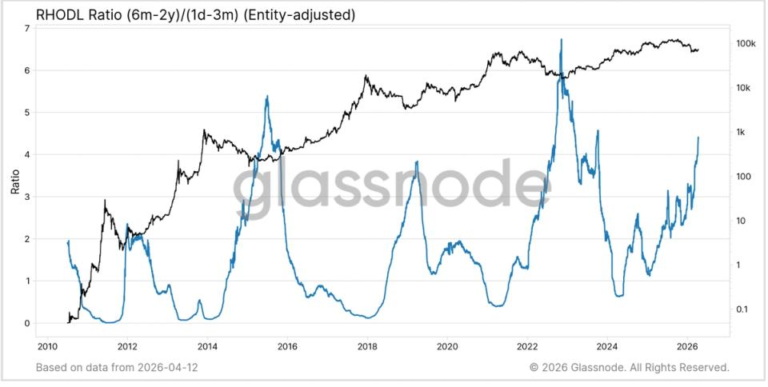
Accumulation reached multiple times new supply, tightening liquidity and strengthening long-term bullish pressure.
Michael Saylor Signals Bitcoin Expansion Amid Market Volatility
Strategy (Nasdaq: MSTR) is drawing renewed market attention after executive chairman Michael Saylor signaled potential accumulation activity on April 12. The development highlights how social media cues from corporate leaders can influence cryptomarket sentiment. Traders increasingly monitor such signals as indicators of institutional demand cycles.
Saylor, a long-time bitcoin advocate, hinted at expansion without explicitly confirming new purchases. He stated on social media platform X: “Think Bigger.” The post aligns with Strategy’s existing holdings of 766,970 BTC, valued at approximately $54.47 billion. Market participants often interpret such messaging as a precursor to additional acquisitions.
The timing of the message coincides with heightened geopolitical tension impacting crypto markets. Bitcoin fell 2.5% as the U.S. Navy entered the Strait of Hormuz to address Iranian naval mines. Such developments often trigger risk-off sentiment across global markets, including digital assets. The pullback near $71,000 reflects how macro instability can influence short-term BTC pricing dynamics.
Strategy’s internal metrics illustrate how the firm may be positioned to respond during market weakness. The company reported a 3-month return of negative 18% and a one-year return of negative 53% for MSTR. Despite equity pressure, enterprise value reached $60.9 billion, exceeding its $44.6 billion market capitalization. The dashboard indicated BTC reserves of $54.46 billion alongside 766,970 bitcoin holdings.
Balance sheet positioning and acquisition velocity indicate Strategy is executing a high-conviction accumulation strategy amid constrained bitcoin issuance. The firm disclosed last week that purchases reached 2.2 times newly mined supply, delivering a year-to-date increase of 24,675 BTC. Liquidity buffers remain notable, with $2.25 billion in USD reserves against $8.25 billion in debt, while net leverage holds at 11%. This pace of accumulation suggests Strategy is absorbing a significant share of incremental bitcoin supply entering the market. Such sustained demand can compress available liquidity over time, reinforcing supply-side pressure. Market participants suggest continued institutional inflows at this scale could accelerate price discovery to the upside.
Jurrien Timmer, director of global macro at Fidelity Investments, characterizes the current market environment as “another wild ride,” where each week seems to deliver headlines stranger than the last.
Yet despite the volatility, his overarching message is that conditions are not nearly as dire as they might appear, and he remains relatively constructive on the outlook for markets.
Timmer argues that markets, broadly speaking, are “pricing in some form of resolution” to the current geopolitical tensions, particularly around Iran, “sooner rather than later,” he told CoinDesk in an interview.
Oil ‘backwardation’
While crude prices surged above $100 a barrel, the futures curve remains in backwardation, with contracts further out trading roughly $40 below the front month. That structure signals that markets view the current supply disruption as a short-term bottleneck rather than a prolonged crisis, according to Timmer.
Elsewhere, market behavior reinforces this cautiously optimistic view. The S&P 500, which at one point was down about 9%, has recovered to a drawdown closer to 1%.
Credit spreads remain contained, suggesting that systemic stress is limited. Even in traditionally defensive assets, the signals are nuanced. Gold and bonds, which are typically less correlated, have been moving together more closely, a dynamic Timmer attributes in part to global capital flows.
Countries facing constraints in moving energy through the Strait of Hormuz, he notes, may be raising liquidity by selling highly liquid assets such as gold and U.S. Treasuries, creating unusual correlations.
The crypto market got a much-needed lift Tuesday after U.S. President Donald Trump announced a two-week ceasefire with Iran. Oil prices plunged more than 17% on the news and equity markets also gained. WTI has since bounced back to trade around $100.
Bitcoin’s $65,000 support
Bitcoin BTC$70,779.17 adds another layer to this shifting landscape, behaving more like gold, while gold has, at times, traded with characteristics more akin to BTC.
When bitcoin reached $126,000 last October, fast-moving capital rotated out of crypto and into gold, a shift visible in exchange-traded fund (ETF) flows. Now, however, with bitcoin already down 50–60% from its peak, Timmer sees fewer “paper hands” left in the market.
Selling pressure has largely been absorbed, while gold, after a strong run, appears more vulnerable to a pullback. Despite this, he remains bullish on both assets. Bitcoin, in particular, looks technically interesting to him, with the $65,000 level acting as solid support.
He sees the potential for a base to form, though he emphasizes that a catalyst will be needed to drive the next leg higher.
The world’s largest cryptocurrency was trading in the low $70,000s at the time of publication.
‘Priced for success’
Timmer believes equities are effectively priced for success, with only single-digit drawdowns despite significant geopolitical uncertainty. A key reason, he argues, is the strength of corporate earnings.
Importantly, Timmer points out that the broader backdrop before the Iran conflict was already constructive. The U.S. Supreme Court’s rollback of tariffs had improved the policy environment, and fears of an AI-driven market bubble had not materialized. In fact, he sees investor skepticism, particularly toward AI and software valuations, as a healthy sign. In a true bubble, investors stop asking hard questions; today, they are doing the opposite. That scrutiny, in his view, has helped prevent the market from overshooting.
Still, the situation in the Middle East remains fluid, and the range of possible outcomes is wide. A worst-case scenario, in which Iran escalates by targeting energy infrastructure across the Gulf, could be highly destabilizing. With roughly 20% of global oil supply passing through the Strait of Hormuz, a prolonged disruption could lead to a stagflationary shock, combining elevated inflation with weaker growth.
Timmer nevertheless believes markets have developed a more measured response to geopolitical shocks. After a series of “false alarms,” including last year’s tariff-related selloff, which saw the S&P 500 drop 21% from its highs, investors are less prone to panic. There is now a “show-me” attitude, where weak hands are less easily shaken out.
This backdrop remains constructive, Timmer argues, supported by what he describes as a strong mid-cycle economic expansion. However, he highlights several risks that investors should actively manage.
One is concentration risk, particularly in the so-called “Magnificent Seven” technology stocks. Interest rate risk is another key concern. The 10-year Treasury yield is approaching 4.5% and could move toward 5%, a development that has occurred even amid geopolitical uncertainty. Rising yields, rather than falling, are an important signal that investors should monitor closely.
The real risk
Ultimately, Timmer frames periods of volatility not just as challenges but as opportunities. He encourages investors to act as providers of liquidity rather than takers. Those who panic during turbulent periods become price takers, while disciplined investors with long-term perspectives can step in as price makers. At Fidelity, he notes, this means leaning into volatility, providing liquidity, and rebalancing portfolios when others are retreating.
While acknowledging that geopolitical events are inherently unpredictable, Timmer emphasizes that remaining on the sidelines out of fear is not a viable strategy. Instead, a well-diversified portfolio, combined with a willingness to engage during periods of stress, can offer the best path forward.
Read more: Oil shock, Iran war risk keep crypto investors on sidelines: Grayscale
At the SuiteConnect London event , Oracle NetSuite introduced major new additions to its AI Connector Service. The updates are specifically designed to help corporate finance teams apply artificial intelligence more effectively while simultaneously maintaining strict governance and control over sensitive financial data and workflows.
Evan Goldberg, founder and executive vice president at Oracle NetSuite
The expansion introduces new capabilities that allow customers to connect their preferred, third-party AI models directly to NetSuite data in a secure, governed manner.
Evan Goldberg, founder and executive vice president at Oracle NetSuite, emphasised the importance of flexibility for modern businesses.
“We are committed to providing the most intelligent, extensible, and AI-ready system,” Goldberg stated. “A strong data foundation is critical, but we also have to meet our customers where they are. Many are already working with AI assistants, and these extensions of the NetSuite AI Connector Service make it even easier and more intuitive to securely connect their own AI to their data and workflows.”
Introducing the AI Connector Service Companion
A key feature of the rollout is the new NetSuite AI Connector Service Companion. This tool essentially helps external AI assistants understand complex financial data, permissions, and specific NetSuite workflows, allowing customers to use AI more reliably across operations.
Key capabilities include:
No prompt engineering required: Customers gain access to a curated Prompt Library containing more than 100 finance-specific prompt templates that are already aligned to NetSuite’s data structures and terminology.
Standardised AI usage: ‘Skills’ provide supported AI models with reusable, NetSuite-specific instructions to ensure consistent outputs across different teams and workflows.
Role-based governance: Preconfigured access patterns map AI capabilities directly to specific NetSuite roles—such as CFO, Controller, or Accounts Payable Analyst—helping to reduce risk and ensure that sensitive data remains restricted.
Additionally, the update includes expanded access to the NetSuite Analytics Warehouse, enabling users to run broader forecasting and cross-system analysis using historical and third-party data.
Yoto scales globally with NetSuite
Alongside the product news, NetSuite highlighted its ongoing collaboration with Yoto, the London-founded children’s audio platform. Yoto, which recently surpassed £100million in annual revenue in 2025, is using NetSuite’s AI-powered ERP system to consolidate its financial and operational data.
Founded in 2017, the company has expanded rapidly across the UK, US, Canada, Australia, and France. As it scaled, Yoto found that its disconnected legacy systems made it difficult to manage growing operations or maintain visibility across the business.
Ben Averis, chief financial officer at Yoto, explained the decision to upgrade.
“As a fast-growing global business, we needed systems that could keep pace with our growth and support increasingly complex operations,” Averis said. “We chose NetSuite because it is a system capable of scaling and supporting the ambitions we have as a company. NetSuite has helped us operate more efficiently, plan more effectively, and make faster, more confident decisions by giving us a single source of truth for all financial and operational data.”
Yoto is now utilising the NetSuite AI Connector Service to securely connect its unified data to a third-party large language model. By defining exactly what the AI can see and do via role-based access, the company can safely automate financial tasks and drive global business outcomes.
Revolutions leave behind artifacts — not always weapons or flags, but the quieter objects that carried a message before anyone knew how far it would travel. A wheat-pasted broadside on a Los Angeles overpass. A hand-lettered cardboard sign held up in the snow outside a Tokyo office building. A newspaper headline, pulled from the front page of The Times of London and encoded permanently into a piece of software that would go on to challenge the architecture of global finance.
The works gathered in Relics of a Revolution at the Bitcoin 2026 Conference in Las Vegas trace a specific lineage of dissent — one that connects street-level protest to the birth of Bitcoin itself. Mear One (b. 1971, Santa Cruz, CA) has spent nearly four decades using the walls of Los Angeles as a medium for political and economic confrontation. He pioneered the Melrose graffiti art movement in the late 1980s, was the first graffiti artist to exhibit at the 01 Gallery on Melrose and at 33 1/3 Gallery in Silverlake — where Banksy would later debut his first North American show — and in 2004 joined Shepard Fairey and Robbie Conal on the Be the Revolution tour, a nationwide series of anti-war street art interventions during the Bush administration. His work was part of the landmark Art in the Streets exhibition at the Los Angeles Museum of Contemporary Art in 2011 and resides in the permanent collections of the Laguna Art Museum among others. From anti-Gulf War broadsides in the early 1990s through the Occupy Wall Street encampments of 2011, Mear One has been making work that insists the root problem is the system itself — not the politicians or the policies, but the underlying architecture of money and power.
I sat down with Mear One ahead of his panel at Bitcoin 2026 to talk about protest, art, broken systems, and why the revolution is not over, or how to exit a loop.
BMAG: Mear One, you started writing on walls in Los Angeles in the mid-1980s, at a moment when graffiti was still broadly criminalized and the idea of it entering museum collections would have seemed far-off. By the early 1990s, you were making large-scale political work — anti-Gulf War broadsides, pieces confronting economic power structures head-on. What was driving you to use the street as a political medium at that point, and who were you trying to reach?
Mear One: Graffiti is the voice of the dissatisfied soul, and back then it was a vehicle to reach the masses before the internet took off & social media ever existed. When you illegally spray paint your ideas in the public realm it resonates with the urbanite caught in traffic, angers the city officials whose dilapidated walls we scribe like a big middle finger to their failed policies. Conscious art speaks to conscious people, and the act of vandalism carries with it an energy that helped instigate a movement which was lacking. The streets were our meeting ground, and getting away with it kept us all anonymous, permissionless.
BMAG: There’s a phrase that circulates in bitcoin culture — “all wars are banker’s wars.” The Genesis Block itself contains a newspaper headline about a bank bailout. When you look back at the work you were making during the Gulf War era and later during Occupy Wall Street, how much of it feels like it was pointing toward the same structural critique that bitcoin would eventually encode into its protocol?
Mear One: Quite honestly, when I discovered bitcoin it immediately reminded me of the graffiti, hip hop, and punk rock culture I grew up in, it mirrored the revolutionary necessities I was communicating through my art. I think we all desire an ideology or movement that speaks to and offers a solution to the endless new world order slave trap that so many have become accustomed to. And it turns out the architects who created this current economic matrix are the same builders of our prison schools, creators of our bankers’ wars. Satoshi knew this. Humans don’t really have world war issues with one another, these issues stem from economic and political power struggles outside of our fundamental human desires like freedom, love, a spiritual connection to a higher purpose. My goal as an artist is to always experience freedom, to set myself free from the system, this is the basis of my art, philosophy and resistance.
BMAG: In 2004, you joined Shepard Fairey and Robbie Conal on the Be the Revolution tour — taking anti-war, anti-corporate street art across the country during the Bush administration. That was four years before the financial collapse, and three years after 9/11 had already been used to justify unprecedented expansions of surveillance, military spending, and executive power. What did that experience teach you about using art as a tool for economic and political resistance, and how did it shape your thinking when the crash actually arrived?
Mear One: Be the Revolution with Robbie and Shepard was more so an outlet to express my angst and dismay of American politics at the time. Fighting wars for foreign resources to sell for profit exacerbating this hierarchy of haves and have nots still weighs heavy on my philosophical heart.
But when the financial crash hit in 2008 my revolutionary lens shifted drastically, and for the first time in my life I became interested in learning how the system of money actually operates, what money is, and seeking to articulate through my art a more accurate definition of the new world order culminating in my most controversial work to date False Profits.
“You cannot dismantle the master’s house with the master’s tools.” Subversive art, subliminal art, illegal art, art that punches you in the gut with facts and satire using a spray can, paint brush, wheat pastes, music, comedy, film, whatever tools are in your creative kit, art is the most effective way to create change. I think great art stands the test of time for its quality of being somewhat psychic, narrating the cause before the effect is widely understood by the masses, before it’s too late.
BMAG: Street art is ephemeral by nature — it gets buffed, painted over, torn down, rained on. Some of your protest works from the Occupy era and earlier have survived. What does it mean to you that objects made in that spirit of urgency — work created to be temporary — are now being shown in a gallery context as historical artifacts?
Mear One: They’re still relevant, ironically, because nothing’s changed! Same circumstance, different puppets. These works point out a condition that is ongoing within our human story, and it’s important as Bitcoiners to pay memory to our past struggles and the remedies which we choose to solve them. In this spirit of urgency these Relics of Revolution are calling out for exactly that – the time for change is always now!
BMAG: You were making anti-war street art during the first Gulf War. Now, more than thirty years later, we’re watching another military escalation in the Middle East — this time with Iran. The machinery looks different, the justifications sound different, but the economic architecture underneath it is remarkably similar. For a generation that came of age watching 9/11 become the justification for two decades of war and then watched the 2008 crash reveal that the financial system underwriting it all was itself a fraud — when you see this cycle repeating, does it feel like confirmation of something you’ve been saying on walls for decades, or does it feel like failure — that the message didn’t land?
Mear One: Like you said, all wars are bankers wars. And for hundreds of years we’ve been fed a false narrative about who our enemy is. There’s a lot of truths I’ve tried to point out through my art and it has made my life much harder for it. I’ve been criticized, censored, nearly cancelled, had my life threatened, labelled all sorts of heinous things. But I resisted, I was unapologetic, and I continue to do my work unfazed. Sometimes it feels like I’m standing on the street corner pointing up in the sky, screaming at the top of my lungs about the chemtrails, and everyone just thinks I’m crazy – it’s always like that in the beginning – but people are waking up. It’s not easy to do art that points out what’s wrong with the system. But it’s also not easy to be honest with yourself and accept the mediocre mundane pointless reality that is the social norm. The reward in doing this is to see a movement like bitcoin spawning and like-minded people sharing the joy and vigor for revolution.
BMAG: There’s an argument — and it runs deep in Bitcoin thinking — that wars are not really fought over ideology or territory but over monetary control. That every major conflict is ultimately about protecting or resetting an economic order that benefits the people waging it. Your work has been making that case visually since the 1990s. How do you articulate that connection between war and money to someone who hasn’t thought about it that way?
Mear One: I create an allegory that consists of the main factors, I am challenged to present it in its most digestible form; yet this is complicated subject matter so this challenge causes me to include subliminal psychedelic mythological archetypes and symbolism all coming together to assist in this complicated narrative, not only to create something visually compelling, but to give the subject matter a focus and a place to become a discussion amongst people. Through narrative art you can introduce ideas that people struggle with in the abstract.
BMAG: The 2008 crash, the bailouts, Occupy, and now what looks like another cycle of inflation, debt, and military spending — do you see Bitcoin as the first real exit from that loop, or just the latest attempt to build something outside a system that keeps absorbing its opposition?
Mear One: I’m a non-dogmatic being by nature. Bitcoin to me is the first wave in new technology that might steer us away from the fiat slave system. But I’m not convinced that it is the be-all and end-all for our current predicament. As we observe Wall Street attempting to hijack bitcoin all the while in-fighting amongst internal ideologues rages on, all that noise obscures bitcoin’s original ethos. These are its problems that are being worked out. I’m much more a believer in innovation and I welcome many more new inventions to enter our realm. I think that the monetary reality needs to run its course though, and what eventually follows I hope is a spiritual revolution. I see bitcoin as a crowbar in an emergency break the glass situation where it is necessary for the next iteration of where we’re heading into the 2030s. I do believe that is towards a state of ultimate freedom where the concept of money itself will become obsolete as we migrate closer to rebuilding a new world.
BMAG: How did you first encounter Bitcoin, and was there a specific moment where it clicked for you as connected to the same values and frustrations that had driven your street practice for decades?
Mear One: Back in 2009 I ran into a mathematician at a coffee shop in my neighborhood, we struck up conversation over my art and he hipped me to bitcoin for the first time. I never saw myself as one who would invest money into money, so it was just an interesting idea in the back of my mind. As I deepened my education into what money is through Occupy and to the creation/fallout of my London mural in 2012, my path eventually led my lady and I to our first bitcoin conference down in Mexico at Anarchapulco. We were introduced to a tribe of anarchists who shared similar sentiments on politics and lifestyle. I had millions of questions, everyone had answers, and like a sponge I absorbed this knowledge. I rocked two live art pieces for the community, which I auctioned off. Those collectors helped me set up my first wallet (shout out EDGE) as well as the transactions in exchange for my proof-of-work. That’s when it clicked for me, when I earned my first coins.
BMAG: Your work is in a show called Relics of a Revolution. Do you think the revolution it’s referencing is over, still happening, or something that hasn’t fully begun yet?
Mear One: Revolution is a daily occurrence, it is one of the inevitable aspects of life that you either take part in or it’s gonna take a part of you. Revolution literally means a cycle that we experience in different seasons across different cultures, time and space. There’s a variety of revolutions currently taking place. What’s great about bitcoin is it somehow is able to connect and bridge to them all at once because ultimately it seeks what we all desire – freedom from the system.
BMAG: This exhibition is called Relics of a Revolution, and it includes your protest works alongside an original copy of The Times from January 3, 2009 — the newspaper whose headline Satoshi embedded in the Genesis Block. That newspaper is the moment a diagnosis became a protocol — the moment the frustration that Mear One had been painting on walls and that Kolin would later carry on a sign in Tokyo was encoded into something that could not be buffed, censored, or bailed out. When you see your work displayed alongside that artifact, what do you want someone walking through this exhibition to take away — someone who may know Bitcoin as a price ticker but doesn’t know the history of why it exists?
Mear One: Collect these works of art! And I don’t mean that facetiously. Every great art movement had their Medicis, those whose power and influence defined the style & ideas of a generation. All the works you see here in the gallery is art denominated in bitcoin, created by artists whose works are inspired by the philosophical principles underlying the greatest bitcoin artwork of them all, the Genesis Block. Like bitcoin, art is the greatest store of value. But cultural preservation of these fine art assets of freedom by accomplished artists requires the patronage of those with passion for these aesthetic visions. Currently we face WW3, economic destruction, trade & agriculture collapse. Bitcoin cuts that circuit of suffering & punishment. Our ultimate fight is with the controllers of money and their bullshit fiat institutions, rendering their scheme obsolete and irrelevant.
This is Part II of a three-part interview series accompanying the Relics of a Revolution exhibition. Part I features Kolin Burges. Part III, featuring Afroman, is forthcoming.
Fix the money. Fix the world.
Mear One will be painting live in the BMAG art gallery throughout Bitcoin 2026, April 27–29, at The Venetian Resort, Las Vegas, and will appear on a speaking panel moderated by Dennis Koch titled “Looking at Bitcoin Art Through a Protest Lens.” A unique print by Mear One entitled The Magician is available exclusively through BMAG. Preview Mear One’s historic protest works included in the Relics of a Revolution exhibition in the BMAG B26 auction HERE.
The Bitcoin Museum & Art Gallery (BMAG) is the curatorial and cultural programming division of BTC Inc and the Bitcoin Conference. Since 2019, the BMAG conference art gallery has facilitated more than 120 BTC in art and collectible sales. Learn more about BMAG at museum.b.tc. Follow BMAG on twitter @BMAG_HQ. Bundle your Bitcoin 2026 pass with a stay at The Venetian and get your fourth night free. Use code AFTERS for a free After Hours Pass, or get your pass alone here.