
Home Blog Page 452

Flying Tulip Adds Withdrawal Circuit Breaker After DeFi Exploits

0

Flying Tulip, a decentralized finance (DeFi) platform founded by DeFi developer Andre Cronje, has added a circuit breaker that can delay or queue withdrawals during abnormal outflows, as April DeFi losses climbed amid a string of major exploits. 

According to Flying Tulip’s documentation, the mechanism is designed to slow funds leaving the protocol if outflow capacity is exceeded, giving the team time to investigate suspicious activity and limiting how much an attacker could drain in a worst-case scenario.

Flying Tulip said the circuit breaker works differently across products. In the first version of the circuit breaker, used in its Perpetual PUT product, withdrawals can revert and users must retry later. In the second version, used in Flying Tulip’s stable asset and settlement currency, ftUSD, withdrawals are queued and become claimable after a delay instead of being rejected outright.

Flying Tulip said the circuit breaker is built with a “fail-open” design, meaning transactions would still be allowed if the safety mechanism itself were to malfunction. The platform said users can track the feature through a dedicated status page. 

The design adds a new layer of protection for the DeFi platform as recent industry exploits exposed risks that extend beyond smart contract code. 

Circuit breaker definition. Source: Flying Tulip

Recent exploits put broader security failures in focus

The added attention to outflow controls comes as recent exploits underscored vulnerabilities tied to signers, infrastructure and collateral design rather than only smart contract bugs. 

Amir Hajian, a digital assets researcher at trading firm Keyrock, said the biggest failures in April were increasingly linked to operational and infrastructure weaknesses, including compromised multisigs, configuration flaws and key leaks. 

The new mechanism deployed by Flying Tulip is designed to slow abnormal outflows and give the protocol time to respond when losses stem from failures outside of the smart contract itself. 

Related: Phishing, deepfakes, supply chain attacks to fuel 2026’s biggest crypto hacks: CertiK

Hajian highlighted April’s DeFi losses, which reached over $600 million in the first 18 days of the month, with two incidents accounting for 95% of the damage. 

On April 2, Solana-based decentralized exchange Drift Protocol suffered an exploit, with estimated losses at about $280 million. On April 19, liquid restaking platform Kelp was exploited for about $293 million, prompting lending protocol Aave to freeze rsETH markets on V3 and V4. 

Magazine: 53 DeFi projects infiltrated, 50M NEO tokens could be ‘given back’: Asia Express

Cointelegraph is committed to independent, transparent journalism. This news article is produced in accordance with Cointelegraph’s Editorial Policy and aims to provide accurate and timely information. Readers are encouraged to verify information independently.

New research: Crypto users are increasingly relying on self-custody solutions to send, receive, and grow assets

0

A survey of 3,172 U.S. crypto holders reveals an emerging shift in how people manage digital assets, despite persistent misconceptions among non-users.

Tangem, the Swiss hardware wallet maker and leader in active self-custody solutions, today published From Storage to Participation: The Rise of Active Self-Custody, an independent research report commissioned by Tangem and developed by Protocol Theory, an independent global consumer research and strategic insight firm. Drawing on data from over 3,172 U.S.-based crypto users, the report examines how market participants engage with active self-custody products.

“Self-custody is no longer just about protection — users want to actively manage, grow, and spend their assets without giving up control,” said Darya Karpukova, CCO of Tangem. “Active Self-Custody bridges security and everyday utility, and this report confShare

According to the report, cold wallet users are not just passive long-term holders; they are among the most active participants in the market. Cold wallet users are 1.83x more likely to be active traders than passive holders. Only 9% of cold wallet users are passive holders, compared to 25% of centralized exchange users. Short-term traders are the most likely cohort to use a cold wallet (46%), versus just 11% of passive owners. Cold wallet users are also 20 percentage points more likely to hold stablecoins than CEX users (48% vs. 28%), and 12 percentage points more likely to hold altcoins and other non-core assets, reflecting a more diversified, active approach to asset management.

“Self-custody is no longer just about protection — users want to actively manage, grow, and spend their assets without giving up control,” said Darya Karpukova, CCO of Tangem. “Active Self-Custody bridges security and everyday utility, and this report confirms what our own data has been telling us for some time.”

Active Self-Custody describes a mode of participation in which users engage across three core functions — Store, Grow, and Spend — while maintaining direct control over their assets. The report argues that self-custody is evolving from a passive protection tool into the control layer of the crypto ecosystem: the foundation through which assets are secured, deployed in DeFi, and spent, all without surrendering ownership to a third party.

Tangem says it is also seeing this pattern reflected in its own business performance. In 2025, the company reported $61.3 million in revenue, up 102% year-over-year, and a 50% increase in monthly active users driven by in-app utility, suggesting that demand for more active forms of self-custody is growing.

Despite these patterns among existing users, the report also finds that a substantial gap remains at the broader market level.

“What the data shows is a persistent gap between how self-custody is perceived by non-users and how it is used in practice,” said Jonathan Inglis, Founder & CEO of Protocol Theory. “Cold wallets are still widely associated with passive storage, even as their role increasingly extends across storing, growing, and spending. That gap in understanding is limiting perceived relevance and slowing broader adoption.”

More broadly, the report highlights a central paradox: self-custody is widely valued, yet poorly understood. The data suggest that demand isn’t the barrier; education and experience are, pointing to significant room for growth in adoption as the tools become more intuitive.

  • 66% of users consider self-custody important, and 46% fear major exchange breaches, yet 88% still store assets on centralized exchanges, and only 33% use a cold wallet
  • The top barriers to cold wallet adoption are perceived lack of need (32%) and the belief that cold wallets are only relevant for large holdings or long-term storage, ahead of cost (17%) and complexity (19%)
  • Cold wallet adoption rises by 53 percentage points between users with no wallet knowledge and those with expert knowledge, indicating that familiarity is a major driver of adoption
  • Familiarity with cold wallets (67%) trails centralized exchanges (97%) and hot wallets (86%) by a wide margin

Pantera Capital Urges Satsuma To Dump All Bitcoin As Shares Collapse 99%

0

Pantera Capital is urging Satsuma Technology to liquidate its remaining bitcoin holdings and return capital to shareholders after a steep collapse in the company’s share price.

The crypto investment firm, led by Dan Morehead, is among a group of investors pushing for a full wind-down of Satsuma’s bitcoin position, which totals about 646 BTC, valued near $50 million at current prices. Pantera’s DAT Opportunity Fund holds roughly 6% to 7% of the company, according to Bloomberg reports.

The pressure follows a sharp decline in both Bitcoin and Satsuma’s equity. Shares have fallen more than 99% from their peak in June 2025, when the stock traded near 14 pounds. The stock was recently changing hands near 21 pence, leaving the company’s market value below the value of its bitcoin holdings.

Satsuma confirmed it has received requests from shareholders to return capital. Executive Chairman Ranald McGregor-Smith said the company is reviewing options while balancing the interests of all investors. The firm did not name specific shareholders behind the requests.

The situation marks a reversal for a strategy that gained traction during the last crypto rally. In August 2025, Satsuma raised about £164 million, or $221 million, through a convertible note backed by several digital asset firms, including Pantera Capital, ParaFi Capital, Kraken, and Digital Currency Group. The company positioned itself as an AI-driven bitcoin treasury vehicle, joining a wave of firms allocating balance sheets to digital assets.

Bitcoin’s volatility over the last 6 months 

Market conditions shifted soon after. Bitcoin climbed above $126,000 before falling to near $60,000 earlier this year, cutting into the value of corporate treasury holdings tied to the asset. The drawdown exposed the risks of leveraged or concentrated bitcoin strategies, particularly for firms that raised capital near market highs.

Satsuma’s challenges extend beyond market losses. The company has faced leadership turnover in recent months. A director exited in February, followed by the departure of CEO Henry Elder in March. The changes added to investor concerns about governance and strategic direction.

Tensions between Satsuma and investors have been building since late 2024, when the company sold a large portion of its bitcoin holdings to repay noteholders who declined to convert debt into equity. The move drew criticism from some backers and led to calls for management changes.

Now, investors are pushing for a more direct approach. By selling the remaining bitcoin and distributing proceeds, they aim to preserve value that remains after the equity collapse. The proposal would mark an end to Satsuma’s bitcoin treasury strategy less than a year after it began.

Editorial Disclaimer: We leverage AI as part of our editorial workflow, including to support research, image generation, and quality assurance processes. All content is directed, reviewed, and approved by our editorial team, who are accountable for accuracy and integrity. AI-generated images use only tools trained on properly license material. In Bitcoin, as in media: Don’t trust. Verify.

Pantera wants Satsuma (SATS) to dump its bitcoin as shares crash 99%

0

Digital asset investment firm Pantera Capital is urging London-listed Satsuma Technology (SATS) to liquidate its remaining bitcoin holdings and return cash to shareholders, marking a sharp turning point for a strategy that once drew strong investor enthusiasm, Bloomberg reported on Thursday.

Pantera’s DAT Opportunity Fund, which owns about 6.7% of the company, is among those pushing for a full wind-down of Satsuma’s roughly $50 million bitcoin position (646 BTC) with SATS having lost 99% of its value since peaking at 14 pounds ($18.90) last June.

Satsuma acknowledged receiving requests for capital returns but did not disclose which investors were involved. Executive Chairman Ranald McGregor-Smith said the firm is reviewing options to address these demands while balancing the interests of all shareholders, according to Bloomberg.

In August 2025, Satsuma raised 164 million pounds ($221 million) through an oversubscribed convertible note backed by major crypto investors including Pantera, ParaFi, Kraken, and Digital Currency Group.

Bitcoin then surged past $126,000 before falling 50% to $60,000 by early February, eroding confidence in corporate treasury strategies tied heavily to digital assets.

The collapse in Satsuma’s share price has left its market value below that of its 646 BTC holdings. Leadership turmoil has compounded the decline, with a director exiting in February and CEO Henry Elder stepping down in March.

SATS traded at 21 pence ($0.28) on Thursday, a drop of 12.5% on the day.

Neither Satsuma not Pantera immediately responded to CoinDesk’s request for comment.

More than 100 crypto firms urge Senate to act on market structure bill markup

0

A coalition of U.S. crypto companies and trade groups called on the Senate Banking Committee to proceed with a markup of the Clarity Act, a bill that would create a federal framework for crypto markets.

In a letter to Chairman Tim Scott, Ranking Member Elizabeth Warren Subcommittee Chairwoman Cynthia Lummis and Ranking Member Ruben Gallego, the group argued that action by government agencies alone cannot deliver stable rules.

The letter cites the risk of returning to “regulation by enforcement,” referring to a series of court cases brought by the Securities and Exchange Commission (SEC) and the Commodity Futures Trading Commission (CFTC) that defined policy under President Joe Biden.

More than 100 signatories are backing the effort. These include high-profile companies including Coinbase, Circle Internet, Kraken, Ripple, Andreessen Horowitz, Paradigm, Consensys, Anchorage Digital and Galaxy Digital alongside developer groups, state blockchain associations and university chapters of Stand With Crypto.

The coalition flagged six priorities for lawmakers to address. These include preserving consumer rewards tied to payment stablecoins, defining oversight roles for the SEC and CFTC, and protecting developers who build non-custodial tools.

It also called for disclosure rules that are easier to follow and a federal standard that avoids a patchwork of state laws.

Other major jurisdictions, such as the European Union, have already enacted comprehensive cryptocurrency frameworks, and the group warned that the absence of U.S. legislation risks pushing investment, jobs and development offshore.

“America needs clear, comprehensive rules for digital asset markets. It is a global race to the top, and it is important for the U.S. to lead,” Ji Hun Kim, CEO of the Crypto Council for Innovation, in an email.

“The Senate Banking Committee can build on years of bipartisan work and the GENIUS Act’s success by advancing legislation that delivers regulatory clarity, robust consumer protections, and strong safeguards for developers. A markup will move us closer to durable rules that ensure the U.S. sets the global standard for digital asset markets,” Kim said.

The Committee has not scheduled a markup.

$3,000 Ether Depends On More Than Just Strong Spot ETH ETF Inflows

0

Key takeaways:

  • The spot ETH ETFs recorded ten consecutive days of net inflows, totaling $633 million.
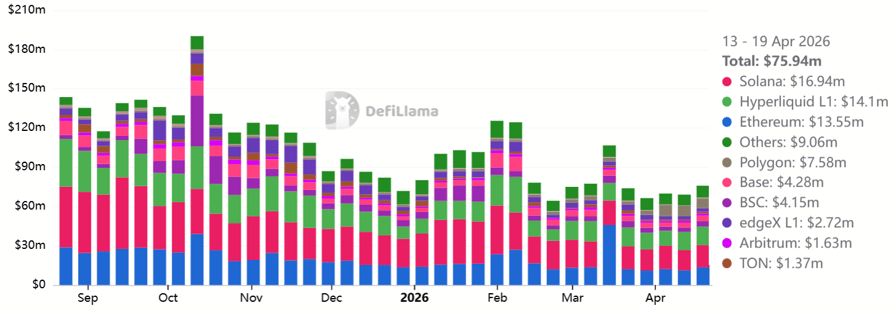
  • Weekly DApps revenue on the Ethereum network fell to $13 million, following a broader decline seen in Solana and BNB Chain.

Ether (ETH) struggled to trade above $2,400 on Thursday, but consistent inflows into Ethereum spot exchange-traded funds (ETFs) reflect the bulls’ attempt to regain momentum. Ether’s price rallied alongside Bitcoin’s (BTC) recovery to $79,000, prompting traders to question whether ETH will attempt a run to $3,000.

Spot ETH ETF daily net flows, USD. Source: SoSoValue

On Wednesday, the ETH spot ETFs completed 10 consecutive days of net inflows, totaling $633 million. This shows that traders are gradually reclaiming confidence after ETH abruptly fell by 42% between Jan. 28 and Feb. 6. The cryptocurrency market crash reduced interest in decentralized applications (DApps), which proved especially burdensome for ETH investors.

Weekly DApps revenue by chain, USD. Source: DefiLlama

DApp revenues on the Ethereum network dropped to $13 million per week in April, nearly 50% lower than six months prior. However, the decline in decentralized exchange (DEX) volumes has also plagued other major competitors to a similar extent, including Solana, BNB Chain, and Hyperliquid. The aggregate weekly blockchain DApps revenue has fallen to $73 million, down from $130 million in October 2025.

Ethereum well-positioned to capture demand for DApps

Despite recent bullish momentum, ETH is down 22% year-to-date in 2026, while the broader cryptocurrency market capitalization is down 14%. Ether’s underperformance may be interpreted as a buying opportunity, especially as the Ethereum network remains the leader in total value locked (TVL) and its layer-2 solutions have gained significant market share in DEX volumes.

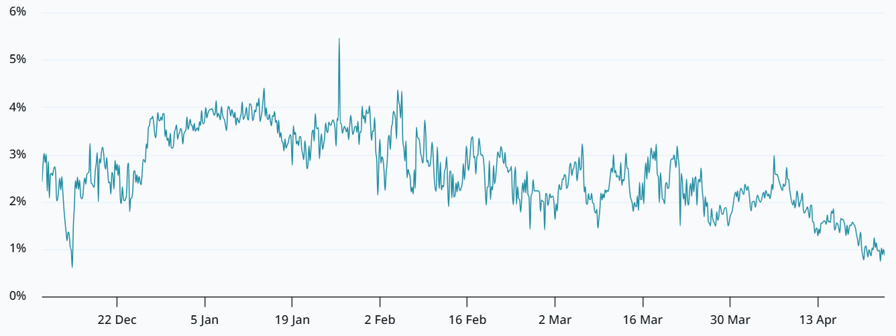
Regardless of the ETF inflows, the demand for bullish leveraged ETH positions has plummeted to its lowest level in four months.

ETH 2-month futures basis rate. Source: Laevitas

The annualized ETH monthly futures premium relative to regular spot markets (basis rate) dropped to 1% on Thursday, well below the 4% neutral threshold. Still, it is incorrect to assume that professional traders are bracing for downside solely due to a lack of confidence in derivatives markets. The uncertain macroeconomic environment might explain trader skepticism, especially after major tech companies’ quarterly earnings disappointed investors.

IBM (IBM US) shares dropped nearly 10% on Thursday due to investor concerns regarding increased competition from the artificial intelligence sector, according to Yahoo Finance. In parallel, Morgan Stanley trimmed its price target on Oracle (ORCL US) due to uncertainty in the margin profile and buildout costs of the company’s expanding investment in AI computing data centers.

Related: BlackRock drives 7-day Bitcoin ETF inflow streak as BTC nears $80,000

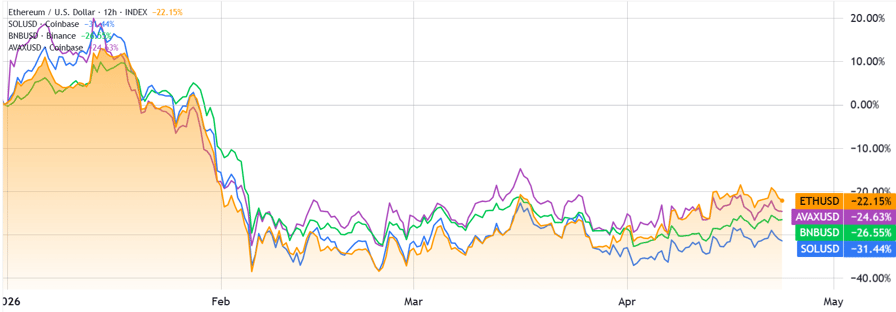
ETH vs. BNB, SOL, AVAX. Source: TradingView

Ether’s potential bullish momentum likely depends on reduced risk aversion toward cryptocurrencies, as its price chart relative to some competitors shows striking similarities. The recent spot Ether ETF inflows, while relevant, are not enough to justify a decoupling, especially as activity in the DApps sector has yet to show signs of improvement.

There is no indication that ETH is bound for $3,000, but the Ethereum network seems well-positioned to capture an eventual pickup in demand for decentralized computation.

This article is produced in accordance with Cointelegraph’s Editorial Policy and is intended for informational purposes only. It does not constitute investment advice or recommendations. All investments and trades carry risk; readers are encouraged to conduct independent research.

Altana and Maersk partner to create first-of-kind global digital trade network

0

The partnership introduces an AI-powered “Product Passport” system across the Maersk Gemini Cooperation — the operational alliance covering ocean freight across 7 East-West trade routes.

Maersk and Altana today announced a partnership to build the first digital trade network within a major global logistics infrastructure. The initiative brings AI-powered trade compliance, enforcement, and facilitation into Maersk’s Gemini Cooperation, with the goal of accelerating trusted commerce at global scale.

“This is a game-changer for international trade in a time of uncertainty. Together, Maersk and Altana will promote this instrument as a new paradigm for trusted trade.” – Lars Karlsson, Global Head of Trade and Customs Consulting at Maersk.Share

The initiative transforms the Gemini Cooperation from a physical logistics infrastructure into a digital trade network for East-West commerce — enabling goods to move with pre-cleared, product-level identity markers, or “Product Passports,” that can be recognized by customs authorities across 12 key international ports, which together move 70% of global trade.

The announcement comes as global trade undergoes a structural transformation driven by shifting regulations and alliances, increasing the need for product-level visibility and traceability. Since its launch in February 2025, the Gemini Cooperation, operated by Maersk and Hapag-Lloyd, has set a new standard for physical trade reliability, with schedule performance exceeding 90% across 29 mainliner and 29 shuttle services on East–West trade routes.

This partnership builds on Altana’s existing work for trade enforcement with customs agencies worldwide, creating a public-private model for end-to-end product traceability and the flow of verified, compliant global commerce. The Maersk partnership will be powered by Altana’s passport manager — a new capability launching today that directly connects importers and logistics providers to customs authorities around the world. The Gemini Cooperation is its first deployment at global network scale.

Altana’s passport manager enables government entities across the world to receive and act on Product Passports. Similar to Global Entry for travelers, the Product Passport creates a Global Entry for Goods — turning customs entries into record-keeping events, rather than the start of a risk and compliance process.

With Altana’s passport manager, customs authorities across the Gemini Cooperation’s trade lanes receive the following benefits:

  • An AI-powered clearance platform for goods: Communicate with importers, understand extended value chains, and make risk and compliance determinations using Altana’s agentic recommendations. As a result, verified shipments move faster and enforcement resources can focus on high-risk trade rather than processing volume.
  • Federated data model, purpose-built for sovereignty: Altana’s passport manager is built on a federated data model — allowing Maersk to share product passports with local customs authorities, without the customs authorities’ data being shared back.
  • Customized to local trade regulations: After customs authorities simply add a Product Passport ID field at the item level in their customs entry, they can retrieve a shipment’s compliance status relative to local trade regulations. Customs authorities can make their own risk and compliance determinations, with Altana AI suggesting recommendations.

“A global Product Passport for Goods is the innovation needed to elevate international trade towards an ecosystem of trust — connecting and transforming major trade routes into digital trade corridors,” said Lars Karlsson, Global Head of Trade and Customs Consulting at Maersk. “This is a game-changer for international trade in a time of uncertainty. Together, Maersk and Altana will promote this instrument as a new paradigm for trusted trade.”

“The global trade system was built to manage shipments at a border — but today’s regulations are network-shaped and demand product-level verification across entire value chains,” said Evan Smith, CEO and Co-Founder of Altana. “With Maersk, we’re building an agentic digital layer on top of the world’s most reliable physical logistics network to meet that moment. Product Passports are Global Entry for Goods: pre-validated compliance that lets trusted trade flow while giving every nation the enforcement tools they need, on their own terms.”

Fold (FLD) Launches Bitcoin Bonus Program For Employers Through Fold Business Platform

0

Fold Holdings has launched a new Bitcoin Bonus Program that lets employers offer recurring bitcoin-denominated bonuses without changing payroll systems, positioning it as the first product under its new Fold Business platform.

Employers set bonus amounts in dollars on their normal payroll schedule, while Fold handles conversion to bitcoin, custody, vesting and delivery through the Fold app.

Fold describes the Bitcoin Bonus Program as an employer-grade bonus vehicle that can function both as a benefit and as a retention tool. 

The company says employees can track and hold their bitcoin over time, turning what is often a spent-on-arrival cash bonus into a longer-term asset. Vesting schedules are built into the program, which allows companies to tie bonus access to tenure or performance.

Under the model, companies designate a recurring USD bonus or allocation in line with existing payroll cycles, and Fold executes real-time conversion to bitcoin at distribution. Fold also provides custody and administers vesting, so employers avoid direct exposure to digital-asset handling or additional compliance workflows. 

Early Fold adopters and target segments

Steak ’n Shake is the flagship partner and is offering the Bitcoin Bonus Program to thousands of hourly workers across its more than 10,000-person U.S. workforce. Simple Mining, a bitcoin mining hosting company in Iowa, is directing 1 percent of employee pay into bitcoin through the program, redeemable at year-end, to align staff with the asset they support for clients. 

The Bitcoin Bonus Program is the first step in a broader B2B strategy for Fold Business, which aims to add payroll, corporate bitcoin treasury services, corporate cards and other enterprise tools built on bitcoin rails. 

Last September, Fold announced a partnership with Stripe and Visa to launch a Bitcoin-only credit card designed to simplify Bitcoin rewards for everyday spending. The card offers up to 3.5% back in Bitcoin, combining instant rewards with additional earnings for users who pay through a Fold Checking Account. It also included up to 10% Bitcoin back at selected major retailers and aims to remove the complexity of traditional crypto reward systems. 

Fold, listed on Nasdaq under the ticker FLD, already offers a consumer app, debit card, credit card and bitcoin gift card products, and views workplace bitcoin benefits as a next growth channel. 

As of early Thursday trading, FLD shares changed hands near the mid‑$1 range with a market capitalization of about $73 million.

Crypto-Aligned Fellowship PAC Bets Big on Texas Senate Race

0

The crypto-aligned Fellowship political action committee (PAC), led by stablecoin issuer Tether’s head of government affairs, reported spending more than $3 million on advertising related to US Senate and House races, with the majority going toward to support a Texas Republican candidate.

In a Tuesday filing with the US Federal Election Commission (FEC), Fellowship PAC disclosed that it had spent $1.75 million in support of Texas Attorney General Ken Paxton. The Republican is facing off against incumbent Senator John Cornyn in a May 26 runoff to determine who will become the party’s candidate for the 2026 US Senate race.

Fellowship PAC expenditure report on Ken Paxton. Source: FEC

In addition to Paxton, the PAC reported spending $350,000 on advertising for Mike Collins in Georgia’s Senate race, $350,000 on Barry Moore in Alabama’s Senate race, and $250,000 and $350,000 on Blake Miguez and Julia Letlow, respectively, for House and Senate races in Louisiana. All expenditures went through the Nxum Group, a marketing company co-founded by former White House crypto adviser and Tether US CEO Bo Hines.

Fellowship launched in September, claiming to have more than $100 million from undisclosed investors aligned with the crypto industry. Although the PAC has since reported $11 million in contributions to the FEC, no other filings or public records showed backers associated with crypto.

Crypto-backed PACs like Fellowship and Fairshake are expected to influence the results of the 2026 US midterm elections through spending on media and advertising to support candidates they consider “pro-crypto.” Fairshake and its affiliates reported spending more than $131 million in 2024, possibly influencing voters in key battleground states.

Related: Texas Lt. Gov. calls for study of crypto, prediction markets

Paxton’s time as Texas Attorney General was plagued by corruption allegations, leading to his impeachment in the state’s House of Representatives in 2023 — he was later acquitted by the Texas Senate. Either Paxton or Cornyn will likely face off against Democratic candidate James Talarico in November’s US Senate election.

Kalshi suspends and fines Texas candidate over insider trading 

As US state primaries continue and the general election approaches, many prediction market users are betting on the outcomes of events related to big and small races, including some candidates themselves.

On Wednesday, prediction markets platform Kalshi announced financial penalties and bans on three candidates in Minnesota, Texas and Virginia after they were found to have placed bets on their respective races. The Texas candidate, Ezekiel Enriquez, “purchased less than $100 worth of contracts related to his own candidacy” for Texas’ 21st Congressional District, according to Kalshi.

“Under the terms of the settlement, Kalshi suspended Enriquez from direct or indirect access to Kalshi for a period of 5 years and imposed a financial penalty of $784.20,” said the company.

Magazine: How to fix suspected insider trading on Polymarket and Kalshi

Cointelegraph is committed to independent, transparent journalism. This news article is produced in accordance with Cointelegraph’s Editorial Policy and aims to provide accurate and timely information. Readers are encouraged to verify information independently.

Bitcoin Created An Imperfection And The Price Will Crash Lower To Fill It

0

Trusted Editorial content, reviewed by leading industry experts and seasoned editors. Ad Disclosure

Bitcoin’s recent price has carried the price action into a zone that one analyst believes was never meant to hold. The cryptocurrency climbed to $78,000 over the weekend and even pushed above $79,380 in the past 24 hours. 

Technical analysis shows that in doing so, it left behind an unresolved imperfection, which is a price imbalance that markets have a well-documented tendency to revisit. 

The Weekend Rally Left Behind A Debt

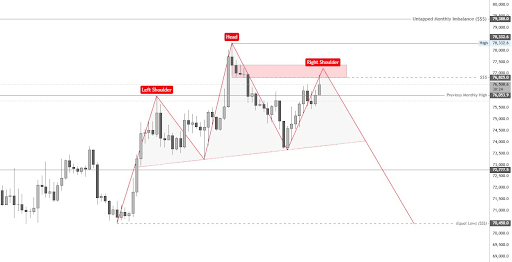
Crypto analyst Minga, writing on X, identified a dynamic playing out on Bitcoin’s 4-hour candlestick timeframe chart. According to the analyst, BTC is currently in the process of filling the imbalance created over the weekend. The development visible on Minga’s chart is the formation of a head-and-shoulders pattern, which is one of the most reliable bearish reversal signals in technical analysis. 

The left shoulder and the head have already formed, and Bitcoin is now in the process of completing the right shoulder. The analyst identified a rejection zone between $76,800 and $77,400, which is shown on the chart below in red, as the area where that right shoulder is most likely to top out.

Bitcoin
Source: Chart from Minga on X

If this formation completes, it would signal a change from upward momentum into distribution, where larger players begin offloading positions. The neckline of this pattern sits around the mid-$73,000 region, which also coincides with a rising trendline that has supported price in recent sessions.

Where Does Bitcoin Go From Here?

This technical analysis proposes that the current push higher might only be a retest, and once the right shoulder is complete, the structure calls for a breakdown. The important level to watch on the way down is the previous monthly high, currently sitting at $76,053. 

According to Minga, a rejection at the $76,800 to $77,400 red box must be followed by a break below that monthly high on the subsequent revisit. Should the pattern play out as the analyst projected, the chart points toward two notable downside reference points. The first reference point is the equal low level around $70,450, which is labeled on the chart above as a liquidity target. 

Failure to break below the previous monthly high at $76,053 would invalidate the bearish scenario and give us another push toward the highs to take out the Monthly FVG above $79,000.

The second reference point is an untapped monthly imbalance of $79,388, which represents the opposing scenario. If Bitcoin instead breaks above $78,332 and acceptance is established above that level, the monthly fair value gap becomes the next logical target to the upside.

At the time of writing, Bitcoin is trading at $77,640, just above the rejection zone between $76,800 and $77,400.

Bitcoin
BTC trading at $77,371 on the 1D chart | Source: BTCUSDT on Tradingview.com

Featured image from Pixabay, chart from Tradingview.com

Editorial Process for bitcoinist is centered on delivering thoroughly researched, accurate, and unbiased content. We uphold strict sourcing standards, and each page undergoes diligent review by our team of top technology experts and seasoned editors. This process ensures the integrity, relevance, and value of our content for our readers.