Aave, one of the largest decentralized lending platforms, effectively froze Tuesday after all its major lending protocols ran out of available funds, leaving users unable to withdraw billions of dollars in crypto, DeFi Warhold said as he explained what the 100% utilization means.
Roughly $5 billion in stablecoins USDT and USDC are effectively locked, Warhold added, saying the protocol has no liquidity to pay out those assets .
The crisis began April 18, following a $292 million exploit of the Kelp DAO rsETH bridge. The attacker used forged cross-chain messages to mint unbacked rsETH, which was then deposited into Aave as collateral to borrow nearly $200 million in WETH. As news of the “bad debt” spread, a classic bank-run dynamic took over, causing a total of $6.6 billion to exit the protocol in under 24 hours.
When asked for comment on the crisis, Aave founder Stani Kulechov told CoinDesk via WhatsApp: “I do not have anything useful to say.”
For a lending protocol to hit 100% utilization across all markets at once is the “equivalent of a full stop. It actually means no liquidity available for withdrawals. Liquidations can’t be processed” and therefore $3 billion in USDT and $2 billion in USDC “are stuck with no clean exit,’ DeFi Warhol said.
What’s worse, the analyst added, “if prices move, bad debt compounds with no mechanism to cover it.” DeFi Warhol said that this is the worst situation for a lending protocol to be in because “when liquidations cannot execute, the protocol has no way to protect itself against further bad debt.”
Aave is in serious trouble
Natalie Newson, a senior blockchain security researcher at CertiK, said that Aave is in serious trouble.
“100% utilization doesn’t just mean a lack of liquidity; it means the protocol’s self-defense systems are down.”
Liquidations require liquidity to work because without it, undercollateralized positions can’t be closed and bad debt just keeps piling up, leaving the protocol in a situation it will not be able to recover from without outside help, she said.
“Aave didn’t get hacked. It got stuck due to the fallout from someone else’s bridge failure, and that difference should worry everyone working in this area,” Newson said. “The KelpDAO exploit didn’t just affect one protocol; it put the entire DeFi system to the test at the same time.”
Newson agreed with DeFi Warhol that those who did nothing wrong are now left dealing with the risks. She also said that the interconnectivity that makes DeFi powerful is the same feature that turns a single point of failure into a large-scale disaster.
A known risk scenario
Aave’s risk framework explicitly anticipated 100% utilization, with former Aave Risk Manager Alex Bertomeu-Gilles saying in 2020 that at that level, “no liquidity is left” and the situation becomes “problematic” because depositors are unable to withdraw their funds.
Technical analyst and crypto author Duo Nine was the first to highlight that Aave had hit 100% utilization.
“When the rsETH exploit happened and AAVE incurred bad debt, whales like Justin Sun, MEXC exchange, and others immediately withdrew billions from AAVE,” the analyst said. “Initially, the ETH market hit 100% utilization, meaning you could not withdraw your ETH from AAVE.”
That soon spread to USDT and USDC pools as over $6 billion in assets left the protocol within hours. “As whales took out their money, USDT and USDC also hit 100% utilization,” Duo Nine said.“These markets are now also stuck with money locked.”
Tempo also announced it’s launching a Stablecoin Advisory.
DoorDash is working with stablecoin-focused blockchain Tempo to build stablecoin-powered payouts to merchants and Dashers across more than 40 countries, Tempo announced in an X post today, April 21.
The delivery giant, which has been a Tempo design partner since the project was first announced in September 2025, is now moving into production, targeting faster and cheaper settlements across a three-sided marketplace that previously relied on fragmented regional rails.
Alongside the DoorDash news, Tempo, which is incubated by Stripe and Paradigm, announced that it’s launching Stablecoin Advisory, a consulting practice staffed by payments specialists, banking experts, and engineers to help other enterprises navigate the same path.
The advisory service covers use case scoping, solution architecture, and direct engineering support, with access to Tempo’s network of custody, compliance, and on/off-ramp partners.
Tempo also shared development updates from its other design partners today in the same X post. ARQ (formerly DolarApp, backed by Sequoia and Founders Fund) is migrating its cross-border payment infrastructure to Tempo to serve over 2 million customers across Mexico, Colombia, Argentina, and Brazil, with $10 billion in annualized volume.
Coastal Financial is pairing its existing institutional compliance messaging with stablecoin settlement on Tempo to cut cross-border transfers from days to minutes for its network of fintech clients.
Meanwhile, per today’s X post, Stripe — one of the two firms behind Tempo alongside Paradigm — is using the network as core blockchain infrastructure for its stablecoin money management capabilities, enabling millions of businesses to hold, send, and receive stablecoins across more than 100 countries.
Last week, Tempo unveiled Tempo Zones, private execution environments where only transaction counterparties see the details. The feature is designed for enterprises with use cases like payroll and treasury settlement, and directly based on requirements from Tempo’s design partners.
The announcements reflect a broader shift in institutional appetite for stablecoin infrastructure.
Also last week, Singapore’s Gulf Bank recently launched a Solana USDC mint and redeem service for high-net-worth clients, underscoring that traditional financial institutions are moving beyond pilots into live products.
On the retail user side, yesterday, self-custodial wallet Tangem announced the global rollout of its Visa-powered payments tool, which lets users spend USDC via virtual Visa cards.
This article was written with the assistance of AI workflows. All our stories are curated, edited and fact-checked by a human.
The fleet card market is experiencing its most significant change since proprietary fuel networks were introduced. For decades, closed-loop ecosystems have supported commercial value, customer loyalty, and fuel efficiency. Restricting transactions to specific
locations and products has allowed issuers to manage data and margins effectively.
The maturation of open-loop EMV schemes such as Visa and Mastercard marks a turning point for the fleet industry. The main challenge is integrating open-loop solutions while preserving the strengths of existing models. The current trend favours enhancing
proprietary networks rather than fully replacing them.
An effective fleet payment strategy requires understanding the diverse commercial realities within the fleet ecosystem, rather than favouring open or closed-loop models. The needs of a global oil major differ from those of an independent reseller or telematics
provider. Stakeholders should recognise that the best issuing approach depends on their specific role in the value chain.
Oil Companies: Protecting the Core While Extending the Reach
Oil companies spent decades developing advanced closed-loop acceptance networks. These networks serve as strategic distribution channels, supporting fuel-margin optimisation and returns on infrastructure investments. Proprietary networks also enable tailored
pricing, brand loyalty programs, and detailed fuel controls that generic payment cards cannot provide.
Historically, open-loop schemes have posed risks for oil companies, including loss of routing control, margin dilution from interchange fees, and weaker customer relationships. Allowing fleet drivers to use cards anywhere reduces incentives to stay within
a specific brand’s network.
Customer expectations have evolved. Fleet operators now seek a single payment solution for both fuel and non-fuel expenses, with acceptance beyond proprietary networks for services such as maintenance, tolls, parking, and accommodation. They also expect
integrated digital reporting and consolidated invoicing to simplify administration.
Retailers can strengthen their closed-loop assets by selectively adding open-loop capabilities. A hybrid model enables scheme-enabled spending outside proprietary networks, increasing wallet share and providing richer behavioural data. Fuel transactions
remain optimised within the closed-loop network, preserving brand loyalty and healthy margins, while the open-loop component captures additional mobility spend.
Modernising Independent Issuers’ Legacy Stack
Many independent fleet card issuers, beyond the oil majors, have built acceptance consortia and proprietary transaction platforms. Despite commercial success, they often rely on legacy infrastructure developed before real-time APIs, cloud-native architectures,
and EMV standards.
These issuers must futureproof their technology by upgrading security standards, adapting to new regulations, and meeting customer expectations for real-time digital services. As fleet operators integrate payment data with telematics and ERP systems, independent
issuers must ensure their platforms remain connected and relevant.
Modernising the closed-loop model does not require abandoning it. Leading platforms now support closed-loop optimisation while embedding open-loop readiness from the start. This modular approach lets issuers activate scheme capabilities when commercially
viable, avoiding the risks of sudden migration. The goal is to maintain the proprietary network as a competitive advantage, not a technical silo.
Payments as a Data Engine for Fleet Service Providers
A third segment is emerging: fleet service providers such as telematics companies, fleet and maintenance management providers, and route optimisation specialists who have not traditionally participated in payments. For these businesses, these changes create
new revenue streams and enable them to strengthen customer relationships.
Unlike legacy operators, these providers do not have proprietary fuel networks to protect. Their advantage is control over fleet workflows and data. By adopting open-loop issuing through established schemes, they gain immediate global acceptance and lower
infrastructure costs. They can generate revenue from interchange and receivables interest without building a physical merchant network.
The main strategic benefit for this segment is data integration. Combining payment data with telematics and operational analytics shifts the value proposition from transaction processing to predictive intelligence. Spend anomalies can trigger maintenance
alerts, fuel efficiency can be benchmarked in real time, and ESG tracking can be automated across mobility spend. In this model, the payment instrument serves as a data engine supporting the provider’s core software.
The Path Toward Architectural Flexibility
The fleet sector is diverse, and technology strategies must reflect this reality. A uniform shift to open-loop payments risks eroding unique value propositions and established ROI models. Ignoring payment scheme evolution, however, risks customer loss
and displacement by more agile digital competitors.
The shift toward scheme-enabled capabilities aligns with industry trends such as global acceptance and embedded finance. However, fleet payments are unique and require line-item controls, product category restrictions, and complex tax-reclaim reporting
that standard cards rarely provide.
Success in the next phase of the market will depend on prioritising architectural flexibility. This means preserving the high-margin strengths of closed-loop networks while selectively leveraging the reach of open-loop schemes. By building modular, future-ready
infrastructure, issuers can transform transactions into operational intelligence and remain central to the fleet ecosystem, regardless of changes in energy or payment landscapes.
European financial firms and technology groups are urging lawmakers to speed up changes to rules governing distributed ledger technology, warning the region risks falling behind the U.S. in digital finance.
In a joint letter, 39 signatories including Boerse Stuttgart Group, Nasdaq and fintech associations across several European Union (EU) countries asked the European Commission and Parliament to separate the digital ledger technology (DLT) pilot regime from a broader legislative package under review.
They argue that handling the rules on their own would allow quicker updates, Bloomberg reports. The DLT pilot, in place since 2023, lets firms test how tokenized versions of assets like shares and bonds can trade and settle using blockchains.
It sits within a wider set of 18 financial laws now moving through the EU’s legislative process, a path industry groups say could take years.
The coalition is pushing for practical changes, including expanding the types of assets allowed, raising transaction limits to 150 billion euros ($176 billion) and removing expiry dates on licenses. These changes, they argue, would give firms room to build real markets rather than small trials.
The letter comes as the U.S. shapes laws regulating the space, including the Genius Act, meant to help bring crypto further into mainstream finance.
The European Commission has signaled it prefers to pass the full legislative package together as part of its broader plan to mobilize savings into investment.
A new report commissioned by Coinbase sounds a cautious, but urgent, alarm: Quantum computing won’t break crypto tomorrow, but the industry can’t afford to wait.
The 50-page paper, authored by an independent advisory board that includes prominent cryptographers and academics like Dan Boneh of Stanford University, Justin Drake of the Ethereum Foundation and Sreeram Kannan of Eigen Labs, concludes that while today’s blockchains remain secure, a future “fault-tolerant quantum computer” capable of breaking widely used encryption is increasingly plausible, and preparation must begin now.
In recent months, concerns around quantum risk have moved further into the mainstream. Google researchers have published estimates suggesting that a sufficiently advanced quantum computer could one day break Bitcoin’s cryptography.
Major crypto ecosystems have already started mapping out their responses. The Ethereum Foundation has proposed new types of digital signatures that are designed to be safe against quantum computers, while Solana and others are experimenting with quantum-resistant wallet designs.
The report stresses that current quantum machines are far from powerful enough to crack the cryptography underpinning Bitcoin, Ethereum and other networks. Breaking standard encryption would require vast computational overhead, a milestone still considered a major engineering challenge.
Still, the authors caution against complacency.
“We have high confidence that a large-scale, fault-tolerant quantum computer will eventually be built,” the report states, adding that the timeline is uncertain but “clearly on the horizon.”
That uncertainty is exactly the problem, with estimates ranging from “a few years to a decade or more” and no reliable way to predict breakthroughs.
The urgency is reflected in guidance from the U.S. National Institute of Standards and Technology (NIST), which recommends migrating to quantum-resistant cryptography by 2035, a timeline the report suggests may even prove optimistic.
“Waiting for it to be urgent is not a good idea,” the Coinbase paper says, emphasizing that transitions across blockchains, wallets and exchanges could take years to execute safely.
Some assets may be more vulnerable than others. For example, Bitcoin wallets that have already revealed their public keys could be targeted, while those still protected behind hash functions may be safer in the short term.
The good news: Quantum-resistant cryptography (PQC) already exists and is being standardized by NIST.
The bad news: It’s not an easy swap.
Post-quantum digital signatures can be tens to hundreds of times larger than current ones, which could dramatically increase blockchain data costs and reduce throughput. One estimate in the report suggests that replacing today’s signatures with quantum-proof alternatives could expand block sizes by up to 38 times.
There are also usability challenges, from migrating millions of wallets to deciding what to do with “lost” or inactive funds that never upgrade.
Rather than a single solution, the report outlines multiple transition strategies, including hybrid systems that combine existing cryptography with post-quantum updates or allow a gradual switch when needed.
For now, the authors recommend flexible approaches that avoid sacrificing current security or performance while enabling a rapid upgrade later.
“The time to begin preparing for it is now,” the report concludes.
Payments is an industry full of big claims about what comes next, but product teams usually deal with something more concrete: regulation, infrastructure, customer needs and the limits of what systems can actually support.
Much of the work inside fintech sits in that gap, especially at companies building the technology behind issuing and acquiring.
In this week’s In Profile, Robin Anderson, head of product management at Tribe Payments, discusses his career in fintech, the realities of building products in payments, and how he views the industry’s current fixation with technologies like AI and digital currencies.
Robin Anderson, head of product management at Tribe Payments
Tell us more about your company and its purpose
Tribe Payments is a payments technology company that provides issuer and acquirer processing, alongside a platform that helps banks, fintechs and merchants build and scale payment products.
At a practical level, what we’re really doing is taking away a lot of the friction that still exists in payments. Too much of the industry is held back by legacy infrastructure, which makes it harder to launch new products or adapt quickly.
We’ve built our platform to give clients more control, so that they can move faster, test things properly, and evolve their propositions without being constrained by the underlying technology.
Put simply, we want to make it easier for our clients to build payment experiences that actually match how people use money today.
What are some of your recent achievements you’d like to highlight?
Over the past 18 months, a big focus for us has been expanding internationally. Opening our Singapore and Dubai offices were both important steps – not just in terms of footprint, but in being closer to clients in regions where payments innovation is moving very quickly.
Alongside that, we’ve continued to invest heavily in the platform itself. A lot of the work has been around helping clients move beyond basic card programmes into something more complete; whether that’s issuer processing, digital banking capabilities, or more flexible product setups.
A good example of that is how we’ve been developing our risk and compliance capabilities. One of the biggest challenges in payments right now is balancing speed with increasingly complex regulatory requirements, especially as more transactions move onto real-time rails.
We’ve been addressing that through our Risk Monitor capabilities, which are designed to carry out fraud and compliance checks in real time, without slowing the payment down. This is really important, because historically there’s been a trade-off between speed and control, and that’s becoming less acceptable as expectations rise.
We’ve also seen strong growth in the range of clients we work with. That mix – from established financial institutions to fast-scaling fintechs – is useful because it forces us to stay flexible. The needs are very different, and the platform has to reflect that.
How did you get into the fintech industry?
My route into what became a career in fintech really started in payments. I was managing a co-operative grocery store in Northampton at the time, but I wanted to get back into technology, given my background in software development. I applied for a Technical Support role on Barclaycard’s ecommerce product, ePDQ, and got it. During the onboarding process, a conversation about my management experience led to me moving into a team leader role instead.
It wasn’t planned, but it gave me early exposure to both the technical and operational sides of payments, which shaped everything that followed.
It’s been over 20 years now, but I still catch myself facing up the shelves at Morrisons after I’ve picked something up – some habits stick!
What’s the best thing about working in the fintech industry?
It’s become a bit of a cliché, but the pace of change really is what makes fintech interesting. Payments sit right at the centre of everyday behaviour, so expectations shift quickly. New methods emerge, different regions influence each other, and what feels cutting-edge one year can become standard very quickly.
That constant movement keeps the industry fresh. It means you’re always learning, always adapting, and always thinking about how to turn broader market shifts into products and experiences that make sense for real users and businesses.
What frustrates you most about the fintech industry?
Probably when hype starts to replace clear product thinking. The industry can be quick to rally around new technologies, but sometimes slower to ask the basic questions: what problem does this solve, who is it for, and does it actually improve anything?
We saw that with the ‘metaverse’ conversation back in 2021/22 – plenty of enthusiasm, but not much clarity on why it mattered for people who just wanted to pay for something simply and securely.
For me, innovation only really counts when it’s tied to a real customer need and a clear outcome.
How have your previous roles influenced your career
Each role has shaped a different part of how I think about product. Barclaycard gave me the foundations: product management, delivery discipline, agile ways of working, and the confidence to operate in large, complex organisations. It was a strong environment for learning how to build and deliver properly.
At Network International, that became more commercial. I spent more time thinking about value propositions, creating clear market strategies, and making sure product decisions are anchored in customer need and business outcomes. I also had the benefit of working alongside a number of people in the industry I deeply respect, remain close to and continue to learn from.
Tribe has broadened things for me further. I arrived with a strong acquiring, ecommerce and gateway background, but it pushed me much further into acquirer processing, POS and card-present payments, and later into issuer processing and digital banking as my remit expanded. That helped me evolve from being seen primarily as ‘the ecommerce guy’ into a broader product leader across multiple parts of the payments and fintech ecosystem
If I look at my progression overall: Barclaycard taught me how to build and deliver; Network International taught me how to position and commercialise; and Tribe has pushed me to think more holistically as a product leader.
What’s the best mistake you’ve ever made?
Early in my career, I assumed that if something was genuinely useful, people would immediately understand its value, but that’s not always the case. I was quite focused on the product itself then, and not enough on how it was communicated. I think that’s a common experience in product leaders, particularly those with a technical mindset.
A former boss (somebody I still try to learn from when I can) taught me that good product thinking and good storytelling aren’t separate things; they’re part of the same job. Not as a marketing spin, but as a way of clearly expressing why something matters, to whom, and in what context. That changed how I think about value propositions, product advocacy, and ultimately how you turn good product work into real commercial impact.
What has the future got in store for your company?
The focus is really on scaling what we’ve built, both geographically and in terms of capability. That means continuing to expand into key markets like APAC, but it’s also making the platform more flexible and easier to work with as clients’ needs evolve.
We’re also seeing more demand from businesses that don’t just want individual components, but something more joined-up – combining issuing, acquiring and banking capabilities in a more integrated way. That’s where we’re spending a lot of time, because it’s where our clients are heading.
What are the next key talking points or challenges for your industry as a whole?
One of the biggest challenges is balancing speed with responsibility. There’s a lot of pressure to innovate quickly, but payments also rely heavily on trust, security and compliance. Getting that balance right isn’t easy, particularly for newer players.
At the same time, there’s still a significant amount of legacy infrastructure across the industry, and modernising that is necessary, but it’s complex and takes time.
And more broadly, differentiation is becoming harder. As more capabilities become standardised, the question shifts from ‘can you do payments?’ to ‘what makes your product genuinely better or more useful?’ That’s where I think the industry will need to focus.
Most XRP investors are back in profit, increasing the chance for a rally to $2.24, but bulls must first hold the price above $1.40.
XRP’s (XRP) 28% rebound from its macro low at $1.12 pushed it above its realized price. In other words, the average XRP holder is no longer in the red.
Is this enough fuel for the bulls to push the altcoin’s price to $2.24?
Key takeaways:
XRP trades above its cost basis
Data from TradingView shows the XRP/USD pair trading at $1.44, up 1.6% over the last 24 hours and 5% over the last seven days.
This means XRP is holding above its realized price, the average cost of all coins based on when they last moved, currently at $1.41, according to data from Glassnode.
The average XRP holder returning to profit after unrealized losses provides meaningful financial relief for many holders, signaling a bullish outlook.
Related: XRP price bottom signals emerge after the altcoin holds key support level
Historically, breaking above this level shifted market sentiment from “fear,” reducing sell pressure from underwater holders and encouraging holding.
The chart below shows that when the price reclaimed its realized price after hovering below it for a few months in mid-2024, it rallied 460% to $2.90 from $0.52.
XRP realized price. Source: Glassnode
Holding above $1.40 is crucial for the bulls to ensure a potential upward breakout.
On the upside, the key levels of resistance to watch out for are the 111-day moving average (MA) at $1.57, the 200-day MA at $1.88 and the 365-day MA at $2.22, based on XRP’s technical pricing model.
XRP technical pricing model. Source: Glassnode
XRP’s symmetrical triangle targets $2.40
XRP has been consolidating within a symmetrical triangle for more than two months, as shown in the chart below.
The XRP/USD pair must break and close above the upper trend line of the triangle at $1.46 to continue the upward trajectory.
The measured target of the pattern, calculated by adding the triangle’s height to the breakout point, is $2.24, 55% above the current price.
Technical analyst and trader ChartNerd said the moving averages between $1.35 and $1.40 “need to be held” to keep the bullish outlook in play.
XRP/USD daily chart Source: X/ChartNerd
As Cointelegraph reported, buyers will have to achieve a daily candlestick close above the upper trendline of a descending parallel channel at $1.60 to confirm a potential trend change.
This article is produced in accordance with Cointelegraph’s Editorial Policy and is intended for informational purposes only. It does not constitute investment advice or recommendations. All investments and trades carry risk; readers are encouraged to conduct independent research before making any decisions. Cointelegraph makes no guarantees regarding the accuracy or completeness of the information presented, including forward-looking statements, and will not be liable for any loss or damage arising from reliance on this content.
The United Kingdom is revisiting its payments rulebook to support the adoption of new fintech and payment technologies such as stablecoins and tokenization.
In a Tuesday announcement, HM Treasury and Economic Secretary to the Treasury Lucy Rigby said the government will consult on reforms for payment services and electronic money rules.
The Treasury said the changes are meant to create a single framework for traditional and tokenized payments, including stablecoins and tokenized deposits. It also said it plans to bring forward legislation to reduce administrative burdens for companies seeking to offer stablecoin payment services.
The Treasury also named former Financial Conduct Authority veteran Chris Woolard as digital markets champion for its Wholesale Financial Markets Digital Strategy, where he will support efforts to drive adoption of tokenized digital assets.
Woolard highlighted the growing role of digitization in financial markets, emphasizing that collaboration and a dialogue between the private and public sectors will best support the UK’s global competitiveness as a leader in digital markets.
The package comes as the UK continues to develop its broader crypto regulatory framework, with legislation expected to take effect in 2027.
A package of comprehensive measures targeting digital markets
The new package was unveiled during UK Fintech Week in London, a series of industry events supported by organizations such as Innovate Finance, the independent industry body for the UK fintech sector.
A key part of the plan is bringing stablecoins and tokenization more deeply into the payments system, including through regulatory reform as a core measure.
Source: Lucy Rigby
“This will mean establishing a single, coherent framework for both traditional and tokenised payments, including both stablecoins and tokenised deposits,” the announcement said.
Related: BIS warns dollar stablecoins could strain banks and policy
The Treasury also said it wants to reduce administrative burdens for companies seeking to offer stablecoin payment services in a move to “cement the UK as a world-leading destination for digital assets.”
UK will seek how to adapt payment regulations to AI agents
Another part of the package is the government’s decision to explore how payment regulation should apply when AI agents make transactions on behalf of consumers or businesses.
Philip Belamant, co-founder of Zilch, an FCA-authorised consumer credit fintech listed among key stakeholders, said that AI will “fundamentally change how people interact with money,” shifting payments to something that is managed in the background.
“As this becomes a reality, it’s critical that regulation evolves to support innovation while maintaining strong consumer protections,” he said.
Magazine: How crypto laws changed in 2025 — and how they’ll change in 2026
Cointelegraph is committed to independent, transparent journalism. This news article is produced in accordance with Cointelegraph’s Editorial Policy and aims to provide accurate and timely information. Readers are encouraged to verify information independently. Read our Editorial Policy https://cointelegraph.com/editorial-policy
Strategy co-founder Michael Saylor has hinted at another large Bitcoin purchase, just a week after the company disclosed that it bought around $1 billion of Bitcoin in the second week of April.
Strategy disclosed last Monday that it acquired 13,927 Bitcoin for $1 billion between April 6 and 12, at an average price of $71,902 per coin, posting “Think ₿igger” the day before the filing.
However, Saylor posted “Think Even ₿igger” on X on Sunday along with a chart of Strategy’s purchase history, something he has historically done to hint at another purchase announcement.
It comes just days after the Bitcoin treasury company proposed to increase the frequency of dividend payments to stockholders in the hopes of stabilizing the price and growing demand.
Source: Michael Saylor
In a video presentation to shareholders shared by Saylor on Friday, Strategy CEO Phong Le said the company hopes to pay dividends twice a month — on the 15th and again at the end of each month — for a total of 24 a year at the current rate of 11.5%.
“What do we think this will do, it should stabilize the price, dampen cyclicality, drive further liquidity and grow demand,” Le said.
A preliminary proxy filing was sent to the US Securities and Exchange Commission on Friday. The definitive proxy filing is expected on April 28, when voting opens to approve or reject the measure. Voting closes on June 8 at the annual shareholder meeting, with the new schedule expected to start mid-July if approved.
Strategy is proposing to pay semi-monthly dividends on $STRC, instead of monthly. No change to the annual dividend obligations or dividend rate. These proposed changes are intended to stabilize price, dampen cyclicality, drive liquidity, and grow demand. pic.twitter.com/jHFRaDz6oP
Le said one of the main reasons for the proposed change was to address a drop in demand after investors were no longer eligible for the upcoming dividend, which cooled buying activity and slowed the pace of new share sales.
“If we were to move forward with paying STRC to semi-monthly, we would be in category 1, the only preferred in the world that pays semi-monthly dividends. We think this is unique and this is attractive,” he added.
The company went through dozens of iterations before settling on the semi-monthly schedule and had considered weekly and even daily dividend record dates. The NASDAQ stock exchange, which lists Strategy’s stock, follows industry rules requiring a minimum gap of ten days between the record date and the payment date, according to Le.
Related: Strategy’s Michael Saylor signals impending Bitcoin purchase
Strategy has the largest Bitcoin (BTC) stash among publicly traded companies with 780,897 coins, worth $58.2 billion, according to Bitbo. It’s also one of the most frequent buyers with regular weekly purchases.
The company’s stock (MSTR) jumped 11.8% on Friday to $166.52. It’s still down more than 47% over the past year, according to Google Finance.
Strategy’s Bitcoin buying comes despite the company sitting on significant unrealized losses on its holdings. Earlier this month, Strategy reported in its first-quarter financial results that its unrealized losses on digital assets amounted to $14.46 billion.
Magazine: Will the CLARITY Act be good — or bad — for DeFi?
Cointelegraph is committed to independent, transparent journalism. This news article is produced in accordance with Cointelegraph’s Editorial Policy and aims to provide accurate and timely information. Readers are encouraged to verify information independently. Read our Editorial Policy https://cointelegraph.com/editorial-policy
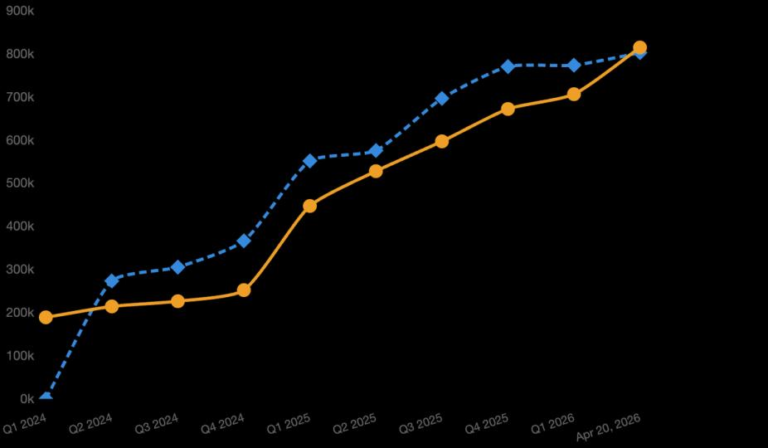
Strategy (MSTR), now holds more bitcoin BTC$75,839.29 than BlackRock’s iShares Bitcoin Trust (IBIT) for the first time since Q2 2024.
The world’s largest publicly traded BTC holder recently announced its third-largest bitcoin purchase on record, acquiring 34,164 BTC and bringing its total holdings to 815,061 BTC.
IBIT currently holds 802,824 BTC, leaving Strategy ahead by more than 12,000 BTC. While the gap is not anything meaningful in relative terms, it is symbolically important given IBIT’s rapid growth since launch. IBIT became the fastest ETF in history to reach $70 billion in assets, while IBIT ranks among BlackRock’s top revenue drivers.
Strategy held 189,150 BTC at the start of Q1 2024. IBIT surpassed it by early Q2 with roughly 273,000 BTC, compared with Strategy’s 214,400 BTC, a lead which it consistently maintained until now.
However, the two vehicles are fundamentally different. Strategy is an operating company that uses financial engineering, including at-the-market (ATM) equity issuance, convertible debt, and perpetual preferred securities, to accumulate bitcoin in a leveraged manner. IBIT, by contrast, is a spot ETF designed to passively track bitcoin’s price, offering investors straightforward exposure without leverage or corporate risk.
IBIT has gained around 55% since listing in January 2024, while Strategy has risen roughly 250%, driven by its leveraged structure.
Notably, Strategy accelerated accumulation during the recent market downturn, as bitcoin fell over 50% from its October all-time high, while adding nearly 80,000 BTC in 2026.
The perpetual preferred equity STRC has been a key differentiator for Strategy, providing a scalable source of capital that has funded a significant portion of its recent bitcoin accumulation.
Meanwhile, IBIT’s holdings remained relatively stable, with only a modest decline in assets under management.