Galaxy Digital (GLXY) narrowed its first-quarter loss as a shift in business mix and tighter financial management outweighed a decline in cryptocurrency prices.
The company lost $216 million, or 49 cents a share, less than the 59 cents estimated by analysts. Revenue dropped to $10.2 billion from $12.9 billion in the year-earlier quarter.
The company is increasingly focusing on the growing demand for data centers, and this month delivered its first data hall at the Helios campus in Texas to CoreWeave (CRWV), marking the start of revenue under a long-term lease tied to artificial intelligence workloads.
“Adjusted gross profit remained broadly stable, reflecting a shift in the business mix as recurring fee revenue and transaction income continue to scale and provide greater resilience in softer market conditions,” the company said in a statement. “Disciplined expense management during the quarter helped narrow the adjusted EBITDA loss, underscoring a focus on operating efficiency in more challenging environments.”
The Helios facility is set to deliver 133 megawatts of computing power by the end of the second quarter. The company also secured approval for an additional 830 megawatts of power at the site, bringing total capacity to more than 1.6 gigawatts.
GLXY shares fell for a second day, and were recently 0.84% lower at $24.84.
Developers behind a new wallet product say they have found a way to tackle quantum computing risks using a smart contract layer that runs alongside Bitcoin without requiring any change to the network itself.
Postquant Labs unveiled Quip Network’s post-quantum bitcoin BTC$76,882.32 wallet Tuesday, the company told CoinDesk in an email. The product runs on Arch Network, a system that lets developers build smart contracts anchored directly to Bitcoin rather than on a separate chain or through wrapped tokens.
Quip uses that infrastructure to add a post-quantum signature scheme called WOTS+, short for Winternitz One-Time Signature, on top of Bitcoin’s existing security. WOTS+ is a tested cryptographic technique that does not rely on the elliptic curve math a quantum computer could break.
By using a “Layer 2” — shorthand for a separate network built on top of Bitcoin that processes transactions and settles back to the main chain—developers can add features without changing Bitcoin’s base layer.
“The Bitcoin community has delayed a fix for years, despite Satoshi himself discussing the quantum problem,” Postquant Labs CEO Colton Dillion said in a statement to CoinDesk. “Developers say any protocol upgrade could take 5 to 10 years, but with Quip’s approach, we provide similar protection immediately.”
Bitcoin’s quantum readiness
The launch arrives in the middle of an active fight over how Bitcoin should respond to quantum risk.
Prominent developer Jameson Lopp and five others proposed BIP-361 two weeks ago, which would phase out quantum-vulnerable addresses on a fixed five-year timeline and freeze coins that fail to migrate, including the roughly 1.1 million bitcoin attributed to pseudonymous creator Satoshi Nakamoto.
Paul Sztorc’s controversial eCash hard fork would copy Bitcoin’s chain and ship seven sidechains including a quantum-resistant one, funded partly by reassigning Satoshi-pattern coins on the new ledger to investors.
Both proposals have drawn pushback from the community.
Quip’s pitch is that neither approach is necessary. The setup requires no soft fork, no consensus change, no community vote. A soft fork is a Bitcoin upgrade that tightens existing rules so older software still works, but it still needs broad miner and node support to activate. Bitcoin’s last major soft fork was Taproot in 2021. The next one, if it happens, could take years.
Technical trade-offs
The three approaches actually disagree on something specific. Lopp’s argument is that Layer 2 protection like Quip’s is insufficient because Bitcoin mainnet public keys still leak the moment a user broadcasts a transaction, giving a future quantum attacker a target.
There are a few caveats, however. The wallet app launches next week rather than today. A third-party audit is underway but not complete. Quip’s quantum-resistant accounts already exist on Ethereum and Solana, but the Bitcoin deployment is new and Arch Network is still relatively early infrastructure.
Postquant Labs CTO Dr. Richard Carback, a long-time collaborator with eCash inventor Dr. David Chaum who now advises the project, said the approach narrows the window for a quantum attack to as little as two blocks, roughly 20 minutes.
(David Chaum’s eCash is the original digital cash protocol from 1983, the academic foundation for ‘blind’ signatures and privacy-preserving electronic money. It predates Bitcoin by 25 years and has nothing to do with Bitcoin or the eCash proposal by Sztorc.)
Sztorc’s argument is that incremental patches are exactly why Bitcoin needs a clean fork with quantum resistance built in from the start. The Layer 2 approach, which now includes Quip and Blockstream’s hash-based signature work on the Liquid Network, argues both other positions overreact to a threat that better infrastructure can handle without changing Bitcoin itself.
Which approach wins depends partly on how fast quantum computers actually arrive. The Bitcoin holders most worried about quantum risk have historically been the same group most resistant to wrapped or smart-contract-anchored products.
Bitcoin miner Core Scientific plans to scale its Texas operations into a large artificial intelligence-focused data center campus with up to 1.5 gigawatts of gross power capacity.
In a Monday announcement, the company said it is developing its Pecos, Texas, site into a high-density colocation hub designed to support AI workloads amid rising demand for computing infrastructure. Of the planned capacity, about 1 GW is expected to be available for leasing.
“We continue to leverage our deep in-house expertise to differentiate how we build and scale next generation artificial intelligence infrastructure,” Adam Sullivan, CEO of Core Scientific, said.
As part of the transition, roughly 300 megawatts currently used for Bitcoin mining at the site are being repurposed for data center operations, Core Scientific said. The company added that the first data hall has completed foundational work and is moving into vertical construction, with initial capacity expected in early 2027.
Core Scientific shares are up 44% YTD. Source: Yahoo! Finance
The company has also secured an additional 300 megawatts of power under contract with its utility provider, while outlining plans for further expansion through a behind-the-meter solution.
Aside from Core Scientific, other miners are also exploring alternative revenue streams as mining margins tighten, with a focus on AI. In February, MARA Holdings acquired a 64% stake in French infrastructure company Exaion, expanding into AI services. Other miners, including Hive, Hut 8, TeraWulf and Iren, are also repurposing mining facilities into data centers.
Related: CoreWeave shows how crypto-era infrastructure quietly became AI’s backbone
Core Scientific acquires 200 acres
To support the buildout, Core Scientific said it has acquired more than 200 acres of land in the area.
Last week, the company also announced plans to raise $3.3 billion through senior secured notes due 2031 to fund data center expansion across Georgia, Texas, North Carolina and Oklahoma. The move follows a separate $1 billion credit facility secured from Morgan Stanley in March.
Core Scientific has historically generated most of its revenue from mining digital assets, but has been increasing its focus on infrastructure services. The company operates facilities across several US states, including Texas, Georgia and North Carolina.
Related: Core Scientific Q4 Earnings Miss Moves Shares Lower
NYDIG to buy idle New York smelter
As Cointelegraph reported, Alcoa is close to selling its long-dormant Massena East smelter in upstate New York to Bitcoin mining firm NYDIG, with the deal expected to close by the middle of the year. The plant has sat unused since 2014, when it was shut down due to high energy costs and global competition.
Earlier this year, Century Aluminum also sold its Hawesville smelter in Kentucky for $200 million to crypto miner TeraWulf, which plans to convert it into a high-performance computing and AI facility.
Magazine: Bitcoin will not hit $1M by 2030, says veteran trader Peter Brandt
Cointelegraph is committed to independent, transparent journalism. This news article is produced in accordance with Cointelegraph’s Editorial Policy and aims to provide accurate and timely information. Readers are encouraged to verify information independently.
With Genesis Capital fully deployed, the protocol looks to shift from governance-determined capital outflows to rules-bound expenses capped at a fixed percentage of revenue.
Sky, the decentralized finance (DeFi) lending protocol formerly known as MakerDAO, is moving to overhaul how its treasury allocates net revenue now that the founding phase of capital deployment has formally ended.
In a forum post, founder Rune Christensen laid out the rationale for simplifying the Treasury Management Function (TMF), arguing that the recent transfer of Genesis Capital to Grove marks Sky’s permanent exit from the Genesis Capitalization phase. Genesis Capital was the bootstrap funding mechanism Sky used to seed new agents during the expansion of its Sky Agent Network.
The “irregular, governance-determined capital deployments” of the founding period are over, the post said, leaving behind a set of expenses that are rules-bound, predictable, and capped as a fixed percentage of revenue.
The proposal would simplify the TMF from a five-step conditional waterfall into a four-step structure with fixed allocations across Security and Maintenance, Aggregate Backstop Capital, the Smart Burn Engine, and USDS Staking Rewards.
It would also retire several legacy mechanisms, including the Net Revenue Ratio, phase-based distinctions, activity-based staking reward tiers, and Short Term Trading provisions.
The treasury overhaul comes as Sky scales rapidly. USDS supply has climbed to roughly $11.6 billion, making it the third-largest stablecoin, after the Sky community authorized up to $2.5 billion for deployment through stablecoin incubator Obex earlier this year and launched native USDS on Avalanche via the SkyLink bridge in April.
S&P Global Ratings, which last year assigned Sky a “B-” issuer credit rating, has flagged governance and capital position as the protocol’s key constraints.
Tightening the rules around how revenue is split between security buffers, backstop capital, SKY buybacks, and staking rewards is consistent with the post-Endgame push to make Sky’s expense base more predictable.
This article was written with the assistance of AI workflows. All our stories are curated, edited and fact-checked by a human.
Already noted for embracing digital assets, the U.S. Commodity Futures Trading Commission is also leaning into artificial intelligence to pick up the slack after slashing more than a fifth of its workforce, Chairman Mike Selig said in an interview with CoinDesk.
Selig, who is set to appear at Consensus 2026 in Miami next week, said AI and automation can make up for the personnel cuts under President Donald Trump’s campaign to reduce federal staffing. He said the agency — on its way to become a leading U.S. regulator for the crypto sector — is pushing toward using the technology to review registration applications and even help in market surveillance.
The CFTC registration process currently relies on the manual submission of documents, Selig said, so “we’re building out systems to automate that, to make it much more efficient.” “AI tools can be used to review the applications, flag certain things for the staff, make their jobs easier, make it much faster for them to provide feedback and also reject certain things that aren’t materially complete,” he said. “We can see something come in with blank space or inadequate descriptions or things that are clearly wrong, picked up by AI, and it can reject those or put them at the back of the line.”
Selig said his staff is currently being trained on using Microsoft’s Copilot for the first time, but the agency is also building some “in-house” tools for “reviewing swap data, reviewing for market-surveillance purposes; We have tools now that can help us reach conclusions about certain trades and all of that. So we’re embracing technology.”
The chairman has been at the helm of the U.S. derivatives regulator for four months, and it has leapt into the fray on emerging technologies, including the oversight of both crypto and the prediction markets.
Crypto taxonomy
Even in the absence — so far — of a new crypto law from Congress, one of Selig’s major initiatives has been embracing oversight of the industry. To that end, he said the most important action taken to-date was the joint guidance alongside the Securities and Exchange Commission to set out a “taxonomy” for digital assets — a system of definitions for how each subset of crypto will fit into the range of regulatory jurisdictions.
“That is a massive development that is going to allow market participants, software developers and consumers to engage with crypto systems and crypto assets with confidence that they’re not tripping into the securities laws,” he said, though the interpretive guidance doesn’t yet carry to full force of permanent policy. “Now we have clarity,” he said. “We understand what our responsibility is at the CFTC, and we will be taking action to police fraud, manipulation, insider trading in crypto markets, and we think that’s going to have a huge impact, in addition to the clarity for consumers and users of the asset class.”
Prediction markets
But his prediction-markets foray, involving the businesses such as Kalshi, Polymarket, Crypto.com, Coinbase and Gemini, has been the most immediately contentious. Selig’s unbending stance that the CFTC is the only relevant regulator of these firms has put him at odds with the states who have challenged the companies for running afoul of state gaming laws — especially in the sports betting realm. He’s sued several states, most recently including New York, defending the agency’s “exclusive jurisdiction.”
Late last week, the CFTC joined in a Department of Justice case against a U.S. Army Special Forces soldier who is accused of placing prediction-market bets on the military action in Venezuela that he took part in. Gannon Ken Van Dyke, a master sergeant among the Army’s vaunted green berets, was arrested and charged with using confidential government information and fraud, plus the CFTC’s own complaint against him for insider trading.
“We are on the case and continue to watch for news,” Selig said of his agency’s enforcement stance on prediction markets. “We will be taking action against bad actors in our markets, and we’re taking this very seriously. It’s not lip service, and market participants should be on notice.”
Read More: U.S. CFTC’s Selig says AI has helped make up for staffing cuts at key crypto watchdog
US-listed spot Bitcoin exchange-traded funds posted their first net outflows in nine sessions as BTC slipped below $77,000 on Monday.
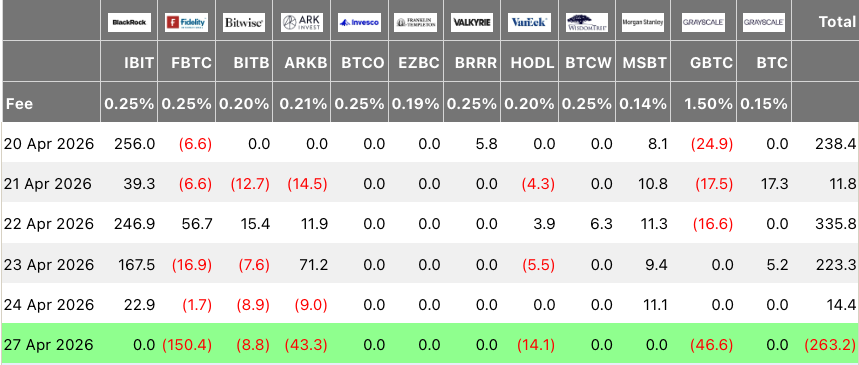
Bitcoin ETFs saw $263 million in net outflows on Monday, marking the first outflows since mid-April, according to SoSoValue data.
The losses came after spot ETFs drew $2.1 billion in inflows since April 13 as BTC rose about 10% over the period, according to CoinGecko.
Daily spot Bitcoin ETF inflows from April 13, 2026. Source: SoSoValue
Alongside Bitcoin’s run, the Crypto Fear & Greed Sentiment Index on Monday moved into “Neutral” territory for the first time in three months, clocking a score of 47. However, the index flipped back to “Fear” on Tuesday as BTC failed to extend its rally above $80,000.
Fidelity’s Bitcoin ETF leads outflows at $150 million
The majority of Monday’s losses came from the Fidelity Wise Origin Bitcoin Fund (FBTC), which saw $150 million in outflows, according to Farside.
The Grayscale Bitcoin Trust ETF (GBTC) and the ARK 21Shares Bitcoin ETF (ARKB) followed with about $47 million and $43 million, respectively.
Daily spot Bitcoin ETF inflows by issuer from April 20, 2026. Source: Farside
BlackRock’s iShares Bitcoin Trust ETF (IBIT) and the Morgan Stanley Bitcoin Trust ETF (MSBT) recorded flat flows after multi-day inflow streaks.
Related: Bitcoin leads $1.2B weekly inflows into crypto investment products
Negative sentiment also extended to spot Ether ETFs, which posted $50.5 million in outflows on Monday. XRP and Solana ETFs recorded zero inflows.
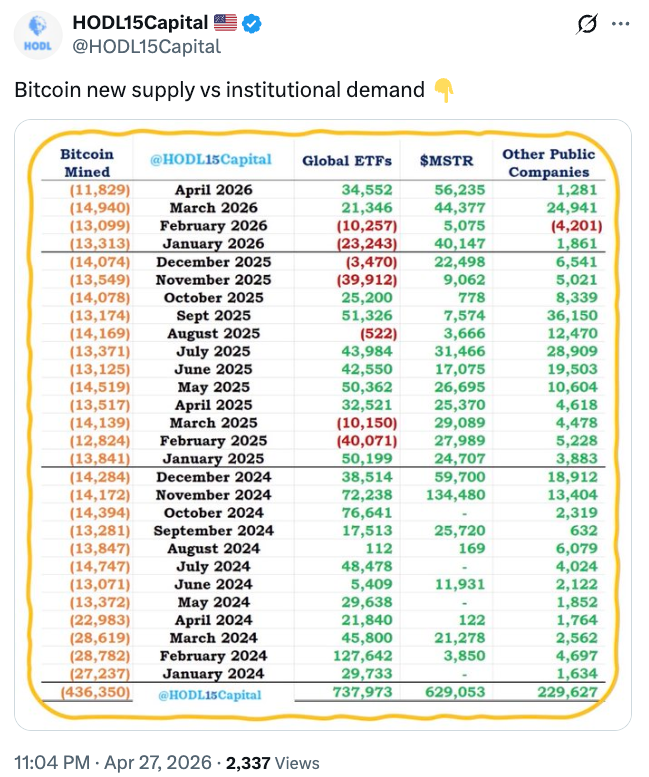
Bitcoin’s rally in April came as institutional demand far outpaced mining supply.
Michael Saylor’s Strategy has purchased 56,235 BTC in April so far, while global ETFs added another 34,552 BTC on behalf of their clients over the same period.
This compares with 11,829 BTC estimated to have been mined so far this month, according to HODL15Capital data.
Source: HODL15Capital
CryptoQuant analyst XWIN Japan said Bitcoin’s sharp decline over the past few days was likely not driven by spot supply-demand imbalance, but by a “classic liquidity event” triggered by forced liquidations of leveraged long positions.
In earlier analysis, CryptoQuant said a rejection of the $80,000 level would signal overhead supply at that level, potentially extending the drawdown for both ETF investors and short-term whales.
Magazine: Your guide to surviving this mini-crypto winter
Cointelegraph is committed to independent, transparent journalism. This news article is produced in accordance with Cointelegraph’s Editorial Policy and aims to provide accurate and timely information. Readers are encouraged to verify information independently.
In 2025, the global fintech market generated approximately $650 billion in revenues, representing a growth rate of about 21 percent year over year from 2024, and around 23 percent annually over the past four years. This materially outpaced the broader $15 trillion financial-services industry, which has expanded more modestly at a 6 percent annual rate. Despite this growth, fintechs have captured only about 4 percent of total financial-services revenues, underscoring both the progress and the substantial room for growth that remains.
Scale and speed vary markedly across geographies and verticals. North America, with fintech revenues of about $310 billion, remains the biggest market, while payments (about $250 billion in revenue) remains the largest vertical. The fastest growth is in Latin America (40 percent average annual growth over the past five years), driven by a rapid expansion in lending, which has grown at about 50 percent annually since 2021.
Total capital invested has increased by about 40 percent since 2023, particularly among later-stage, scaled fintechs with proven economics; although total deal volumes remain below peak levels.
In 2025, fintech IPOs also returned to prominence, with 31 new listings. In fact, of the top 100 IPOs globally in 2025, fintechs accounted for about 12 percent of total market capitalization. Bolstered by the likes of Adyen, Nubank, and Robinhood, the total market capitalization of listed fintechs has reached $850 billion, its highest level ever.
Earlier-stage investment has recovered more slowly, and growth equity has declined, creating a barbell-shaped investment profile. Capital is increasingly concentrated in a small number of firms—often driven by AI or digital assets—as well as the most compelling early-stage challengers, while midstage players face real challenges in finding the capital needed to grow. Meanwhile, scaled fintechs are leveraging their balance sheets to drive consolidation, accounting for more than 50 percent of acquisitions in the sector.
US President Donald Trump has softened his stance on prediction markets just days after he bemoaned the surging interest and popularity of the betting platforms.
“I don’t know. I know some people who are very smart. They like it,” Trump told reporters in Florida on Saturday after he was asked about his earlier comments, in which he said he didn’t support prediction markets. “They disagree, but they like it.”
“A lot of other countries are doing it, and when the other countries do it, we get left out in the cold if we don’t do it,” he said.
Trump speaking to reporters in Florida before departing for Washington, DC. Source: YouTube
Trump’s latest comments came after he told reporters at the White House on Thursday that he was “not happy” with prediction markets in response to a question about well-timed bets on events linked to the Iran war.
“Well, you know, the whole world, unfortunately, has become somewhat of a casino,” Trump said on Thursday. “And you look at what’s going on all over the world and Europe, and every place they’re doing these betting things. I was never much in favor of it. I don’t like it conceptually, but it is what it is.”
“I think that I’m not happy with any of that stuff, but they have all these different sites of predictive markets. It’s a crazy world. It’s a much different world than it was,” he added.
Prediction markets such as the popular Polymarket and Kalshi have surged in use over the past year, with the two platforms together seeing a record $23.6 billion in trading volumes in March, according to Token Terminal.
Related: CFTC sues New York over bid to apply gambling laws to prediction markets
Trump’s son Donald Trump Jr. invested in Polymarket in August and joined the company’s advisory board. He is also an adviser to rival Kalshi, taking on the role in January 2025.
President Trump could also soon have an interest in prediction markets. His company, Trump Media, said in October that it would roll out prediction markets in partnership with Crypto.com on its flagship social media site, Truth Social.
Trump divested his stake in Trump Media upon entering office, transferring his shares to a trust for which Trump Jr. is the sole trustee.
Magazine: Should users be allowed to bet on war and death in prediction markets?
Cointelegraph is committed to independent, transparent journalism. This news article is produced in accordance with Cointelegraph’s Editorial Policy and aims to provide accurate and timely information. Readers are encouraged to verify information independently.
Bitcoin BTC$76,316.36 pulled back to $76,500 from above $79,000 earlier this week, stalling the rally from late-March lows below $65,000. Those expecting a swift return to form may want to take note that recent economic releases do not support a big bullish move.
The most important is the University of Michigan’s Survey of Consumers, which showed the consumer sentiment index falling to an all-time low of 49.8 this month, largely driven by inflationary pressures tied to the Iran conflict.
Inflation expectations also moved sharply higher, with the one-year gauge surging to 4.8% in April from 3.8% the previous month. Long-term expectations (five to 10 years) have risen to 3.5%, the highest reading since October 2025.
This is an excerpt from CoinDesk newsletter ‘Daybook.’Sign up here, if you haven’t already.
Inflation expectations can become self-fulfilling, which is why central banks like the Federal Reserve monitor them closely and try to anchor them. The sharp rise, therefore, could limit the Fed’s ability to signal interest-rate cuts or liquidity easing in the near term, as additional monetary easing risks reinforcing inflationary pressures. That hawkish tilt could, in turn, cap upside or slow gains in BTC and other risk assets.
“For the Federal Reserve, the long-term expectations move is the more dangerous data point. It is the variable the central bank watches most closely when assessing whether inflation psychology is becoming unanchored, and a one-month shift of this size raises the bar for any near-term easing pivot, even as the real economy weakens at the margin,” analysts at Bitfinex said.
The Fed is expected to keep its benchmark interest rate steady between 3.5% and 3.75% this Wednesday.
In the meantime, traders are also pricing in a potential Bank of Japan rate increase in June.
“Rate hikes this month are looking improbable, according to current market opinion. Financial bets suggest we may see more than two rate increases in the eurozone and the U.K. before year-end. A June hike is almost fully priced in. We are now lacking clarity in the data to make good decisions, and that is the main impediment,” Timothy Misir, head of research at BRN, said in an email.
On the crypto-specific side, sustained ETF inflows remain crucial to keeping spot BTC supported on dips.
Meanwhile, coordinated industry efforts to contain fallout from the KelpDAO exploit have helped DeFi tokens hold up better than the broader market. The CoinDesk DeFi Select Index gained 0.5% over 24 hours, decoupling from the CoinDesk 20’s 1.5% decline. Stay alert!
Read more: For analysis of today’s activity in altcoins and derivatives, see Crypto Markets Today . For a comprehensive list of events this week, see CoinDesk’s “Crypto Week Ahead.”
What’s trending
Today’s signal
BTC’s hourly price swings in candlestick format with moving average lines. (TradingView)
The chart shows bitcoin’s hourly price swings in candlestick format since late March.
BTC has dived out of an ascending trendline (white dashed line) that guided its upward trajectory since early this month. Moreover, prices are trading at a discount to their 50- and 200-hour averages.
That configuration points to uptrend exhaustion and scope for a deeper price pullback. The bullish case would reassert itself if prices reclaim both moving averages.
Google is ready to make another multi-billion-dollar investment in Anthropic, as the Claude developer continues to seek computing power to sustain its growth.
According to Bloomberg, which first reported the development, on April 24, the tech giant will invest $10 billion immediately, at the $350 billion valuation Anthropic hit in February.
An additional $30 billion is set to follow if Anthropic meets specific performance targets. It is not yet clear what these milestones are.
Google has invested in Anthropic previously, but this latest tie-up comes just a few weeks after the two companies — in tandem with silicon maker Broadcom — for the supply of multiple gigawatts of next-generation Google TPU AI chips.
The new deal also comes only days after the generative AI vendor agreed to a similar extension of its partnership with Amazon, with Amazon pumping $5 billion into Anthropic immediately, with $20 billion more to follow.
Related:Meta Taps Solar Energy to Power Data Centers
Google’s continued backing will come as no surprise, given that it has significantly increased its involvement in Anthropic since its first $300 million investment in February 2023. Another $2 billion followed in October of the same year, and Google may hold as much as a 14% stake in Anthropic.
While not commenting directly on the latest Google deal, Anthropic has made no secret of its need for more compute capacity as demand for Claude Code and Claude Cowork in particular continues to accelerate.
“Our users tell us Claude is increasingly essential to how they work, and we need to build the infrastructure to keep pace with rapidly growing demand,” CEO Dario Amodei said in a statement on April 20. Failure to keep pace with this demand has already led to a number of Anthropic outages at peak times this year.
Anthropic’s continued need to build out its infrastructure was also behind a multi-year deal with neocloud vendor CoreWeave in early April, and it is set to bring more capacity online later this year.