The US-Iran war lay behind risk assets’ cold feet, with oil taking center stage amid the ongoing blockade of the Strait of Hormuz.
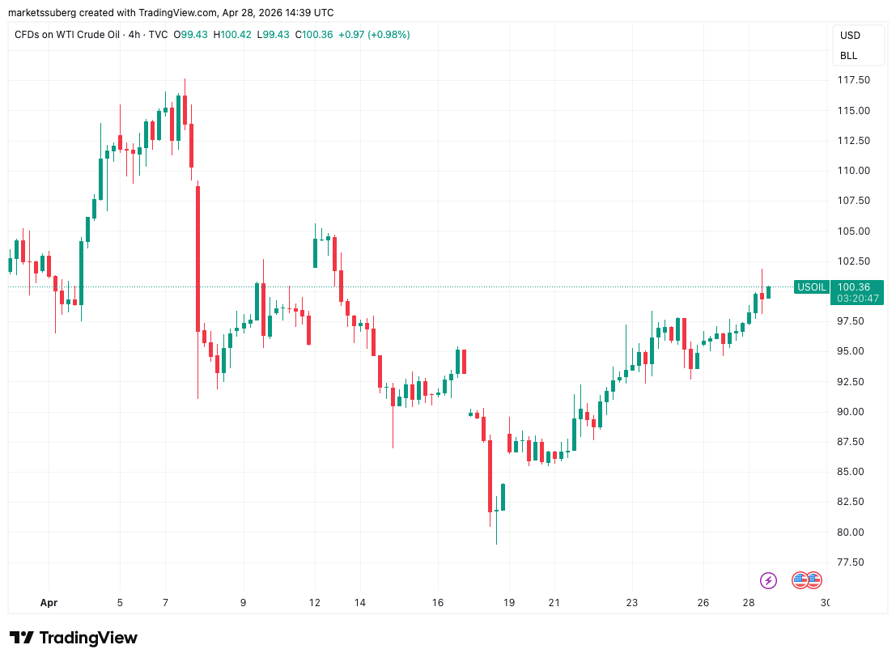
WTI crude oil returned to $100 per barrel on the day, as US President Donald Trump continued to keep markets guessing on the outcome of the Hormuz impasse.
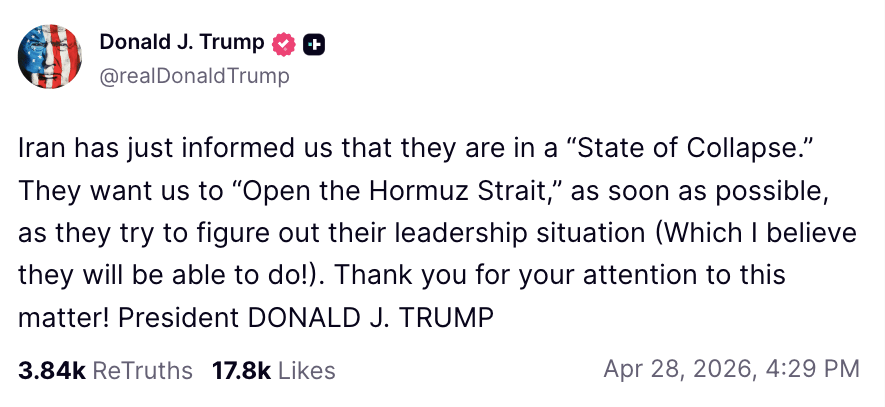
“Iran has just informed us that they are in a ‘State of Collapse,’” he wrote in a post on Truth Social.
“They want us to ‘Open the Hormuz Strait,’ as soon as possible, as they try to figure out their leadership situation (Which I believe they will be able to do!).”
Source: Truth Social
Commenting, trading resource The Kobeissi Letter noted the ongoing impact on Asian countries, with Iran rapidly running out of oil storage capacity.
“Asia’s energy crisis will soon intensify even further,” it predicted in a post on X.
Crypto sources also drew attention to the impact of oil on market mood, among them onchain analytics platform Glassnode.
“Disruptions in the Strait of Hormuz persist due to stalled US-Iran talks, tightening supply and spooking markets across the board,” it told X followers on the back of the WTI jump.
CFDs on US WTI crude oil four-hour chart. Source: Cointelegraph/TradingView
BTC price breakout hopes fade into monthly close
BTC price action thus continued to shy away from attacking $80,000 after sealing a weekly candle close above a key resistance trend line.
Related: Bitcoin price set for best gains since Q4 2024 with $77.5K monthly close
Instead, the two recent visits to $73,000 made market participants wary of calling a “double bottom” formation too early.
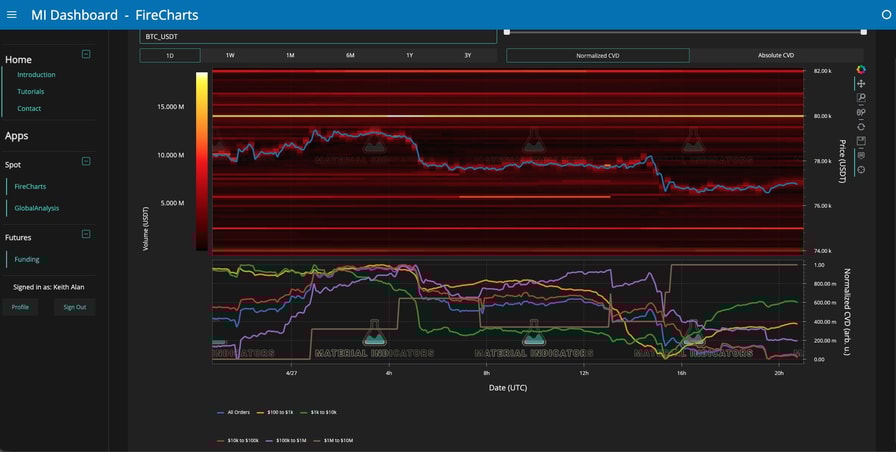
“So far, $BTC bulls aren’t showing much enthusiasm for a robust double bottom bounce. Expecting to see volatility increase as we move to and through the monthly close,” trading resource Material Indicators commented.
An accompanying chart showed exchange order-book liquidity and whale orders, with only the largest class of investors stepping in to buy.
BTC/USDT order-book liquidity data with whale orders. Source: Material Indicators/X
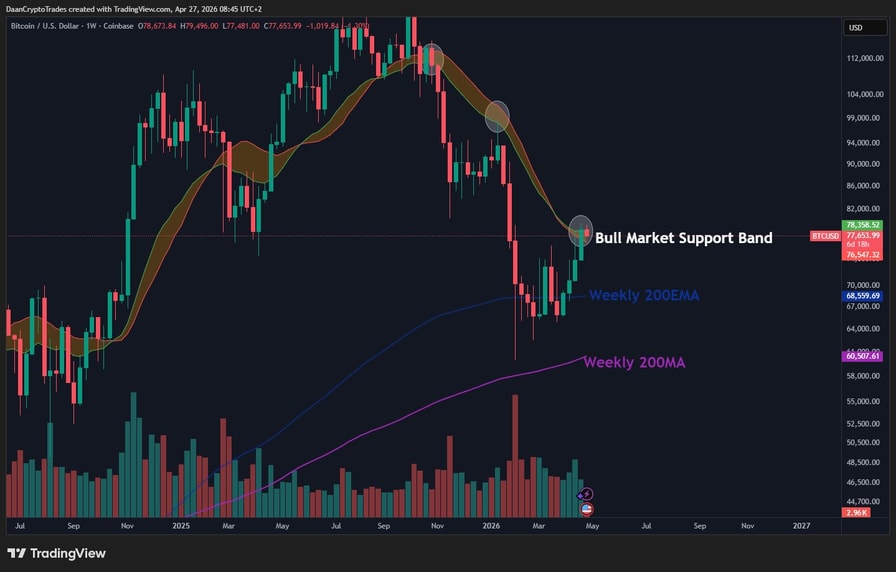
Others also demanded more proof that bulls could crush the multiple resistance levels immediately above spot price, including the bear market support band.
“We’ll need to see follow up to actually confirm a proper breakout though. But at least the bulls are putting in an effort for now,” trader Daan Crypto Trades wrote on X.
BTC/USD one-week chart with bull market support band, moving averages. Source: Daan Crypto Trades/X
This article is produced in accordance with Cointelegraph’s Editorial Policy and is intended for informational purposes only. It does not constitute investment advice or recommendations. All investments and trades carry risk; readers are encouraged to conduct independent research.
Trusted Editorial content, reviewed by leading industry experts and seasoned editors. Ad Disclosure
Blockchain for Europe has called for targeted reforms to the European Union’s (EU) landmark crypto framework in a new report, seeking to boost the global competitiveness of Euro-denominated stablecoins.
Euro Stablecoins On The ‘Regulatory Laffer Curve’ Downside
On Monday, Blockchain for Europe, an organization that represents international Blockchain industry players in the EU, said that while the EU’s Markets in Crypto Asset Regulation (MiCA) has established a framework that makes euro-pegged stablecoins safe, it has also made them less competitive than their US-denominated rivals.
In its report titled “Reforming MiCA for Euro Stablecoins,” the industry group observes that the absence of regulation hinders market development. Conversely, excessively stringent regulations may prove ineffective, as they risk driving the targeted economic activity to less regulated or more welcoming jurisdictions.
“If compliant projects do not ultimately locate domestically, then regulation fails to achieve its objectives,” Blockchain for Europe affirmed, adding that a framework’s goal is to have a regulated but strong local industry.
The report noted that euro-pegged stablecoins account for less than 1% of global stablecoin volume, far below the level the euro’s broader role in global markets would suggest.
Under this premise, the group argues that the ground-breaking, comprehensive legislation has placed Europe on the “downward-sloping part of the regulatory Laffer curve,” as skepticism prevails among European policymakers regarding the trajectory of euro electronic money tokens (EMTs).
Last year, the European Central Bank (ECB) and the European Systemic Risk Board (ESRB) expressed concerns about financial instability risks, pushing for stricter regulations, including a ban on multi-issuance stablecoins in the bloc.
Nonetheless, the European Banking Authority (EBA) addressed these concerns in November, asserting that MiCA already has safeguards against potential risks posed by the tokens.
Reforming MiCA To Boost The European Market
Blockchain For Europe suggested multiple reforms to improve the regulated European stablecoin market and maximize MiCA’s positive impact on the industry, the Savings and Investment Union, European citizens, and businesses.
To achieve this, the industry group proposed allowing remuneration of euro-denominated EMTs with adequate regulation to ensure liquidity, arguing that there is no justification for such a ban.
In addition, the industry group suggested removing or reducing the minimum bank deposit requirement, replacing the 30% and 60% thresholds with a principle-based approach to reserve composition. This would allow issuers to allocate across high-quality liquid assets without forcing concentrated exposure to bank deposits.
They also proposed broadening and diversifying the eligible reserve asset suite and introducing a more proportionate and risk-based transparency regime for EMTs to reduce concentration risk, improve market functioning, and avoid raising barriers to entry.
Meanwhile, the report listed enabling calibrated access to central bank infrastructure and providing clarity and a “workable framework” for cross-border stablecoin usage as potential reforms to support the token’s competitiveness.
Europe Eyes Centralized Crypto Oversight
Blockchain for Europe’s report comes as the European Central Bank backs a proposal to shift oversight of key financial markets, including crypto, from national authorities to a centralized supervisory authority.
As reported by Bitcoinist, the ECB has supported the European Commission (EC)’s plan to integrate the EU’s capital market through a centralized entity, the European Securities and Markets Authority (ESMA), to enhance competitiveness and harmonize regulation.
The EU initially proposed the plan, led by France and Germany, during MiCA’s development, but ultimately scrapped the plan. Notably, multiple nations and industry participants have opposed the measure.
In November, the Secretary General of Blockchain for Europe, Robert Kopitsch, argued that a shift towards a more centralized supervisory model should happen in the future based on “concrete” evidence gathered from MiCA’s initial years, and pointed out that local regulators have more direct and frequent interactions with firms.
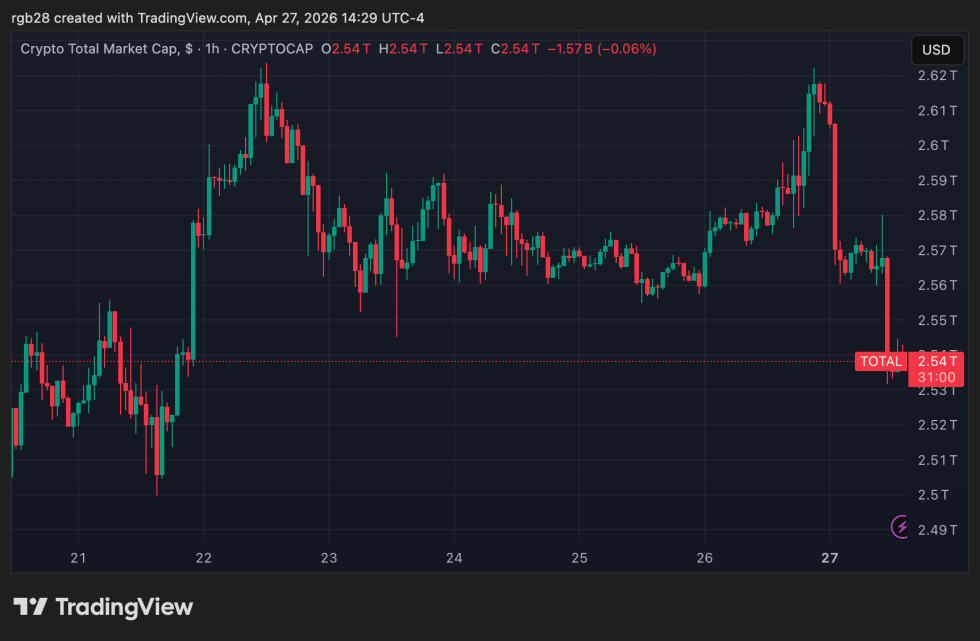
The total crypto market capitalization is at $2.54 trillion in the one-week chart. Source: TOTAL on TradingView
Featured Image from Unsplash.com, Chart from TradingView.com
Editorial Process for bitcoinist is centered on delivering thoroughly researched, accurate, and unbiased content. We uphold strict sourcing standards, and each page undergoes diligent review by our team of top technology experts and seasoned editors. This process ensures the integrity, relevance, and value of our content for our readers.
Something fundamental is changing in how commerce works. It’s happening right now, at the intersection of artificial intelligence and blockchain payments, and most people haven’t fully registered what it means yet.
AI agents – software systems that can perceive, decide, and act autonomously – are beginning to transact. They’re paying for APIs, settling invoices, and interacting with infrastructure in ways that traditional payment rails were never designed to handle. The credit card, the bank login, the merchant onboarding flow: all of it is friction that agents can’t navigate the way humans do.
Ask yourself: how many agents do you think you’ll have? Three, five -it’s a common answer. Ten. I have 200.
By the numbers -if you have 10 or 20 agents per human, you’re between 70 to 140 billion agents in the world. Universally, most people will agree: there’s going to be more AI agents than there are humans. – Yat Siu, Animoca
What comes next -the rails, regulatory frameworks, and business models – is precisely what Consensus 2026 is convening to figure out. When 15,000+ of the world’s most influential crypto, AI, and finance minds gather at the Miami Beach Convention Center from May 5 to 7, agentic commerce will be one of the defining conversations of the week.
“That’s assisted checkout, not true agentic payments”
Christian Catalini, MIT professor and founder of the Cryptoeconomics Lab, draws a line most people in the industry haven’t drawn yet.
“Most agents today operate just as LLMs paired with a credit card,” he says. “That’s assisted checkout, not true agentic payments.”
“Real agentic payments begin when the AI is the counterparty,” Catalini explains. “The actual test for programmable rails isn’t whether an agent can pay – it’s whether it can do things no human-facing rail allows: atomic settlement against delivery, per-second payment streaming, or transacting with a counterparty that has no KYC footprint.”
That’s not a near-future scenario. It’s a near-term engineering problem. And Consensus is where the engineers, investors, and policymakers working on it will be in the same room.
The internet was built for humans. Agents need something different
Google Cloud is not a company known for hedging its bets on technology cycles. Its presence at Consensus 2026 – and its active investment in blockchain payment rails – is as clear a signal as any that agentic commerce is being taken seriously at the highest levels of the technology industry.
“The convergence of agentic AI, blockchain payments, and commerce is still in its early stages, but momentum is building,” says Rich Widmann, Google Cloud’s Global Head of Strategy for Web3. “Google is actively participating in open protocols like x402 and deepening partnerships across the Web3 ecosystem to help bring these use cases to scale.”
Widmann is direct about where the friction lies: “The biggest friction points center on the fact that most products are still built for humans, not agents. Sign-ups, logins, and manual onboarding create barriers that slow agentic commerce down.”
The rails race: x402, MPP, and the fight for the agentic stack
If AI agents are going to transact at scale, they need payment infrastructure designed for them from the ground up. Two protocols are emerging as early contenders for that role, and both will have a presence at Consensus 2026.
x402, the open payment protocol built on HTTP and championed by Coinbase, is designed to allow agents to pay for API access and digital services with stablecoins in a single, frictionless flow. Erik Reppel, x402’s founder and Head of Engineering at Coinbase, will be at Consensus making the case for why open, interoperable rails are the right foundation for the agentic economy.
MPP (Machine Payments Protocol), developed by Tempo and backed by Stripe, offers another vision for how agents can negotiate and settle payments autonomously. The presence of both protocols at the same event – in front of 15,000 developers, investors, and enterprise decision-makers -makes Consensus the de facto arena where the early standard-setting debate gets played out.
Also in the room: Stefano Bury, head of Virtuals Protocol, one of the leading platforms for deploying autonomous AI agents, and Chi Zhang, co-founder of Kite, whose team is building at the intersection of agent infrastructure and decentralized payments.
CoinDesk University: From Theory to Implementation
For attendees who want to go beyond the mainstage debates and into the mechanics of how to actually build and deploy agentic payments, CoinDesk University offers a structured, three-day curriculum that takes participants from first principles to advanced implementation -no prior crypto experience required.
Day 1 lays the foundation. Afternoon workshops walk attendees through setting up a stablecoin wallet and business dashboard with Circle, then pivot to session on compliance, followed by back-to-back workshops on using OpenClaw and x402.
Day 2 goes deeper into the stack, with sessions on building a full agentic infrastructure, managing agentic economy risks, and the increasingly urgent question of how to prove human identity in an AI-saturated world. By Day 3, the curriculum reaches masterclass territory: workshops on deploying AI trading bots with stablecoins, trading on prediction markets with autonomous agents, and a capstone Agentic Masterclass that brings the full arc together.
The format is intentionally immersive. Each day pairs hands-on workshops with mainstage sessions, networking lunches, and “No Dumb Questions” Q&A sessions.
The window is open. It won’t be open forever
Agentic commerce is not a future state. It is an early-stage present, moving faster than most industries have had time to notice. The protocols being debated at Consensus 2026 could become the rails that trillions of dollars in machine-to-machine transactions run on. The regulatory frameworks being discussed could define what’s permissible for a decade.
The people in the room at the Miami Beach Convention Center from May 5 to 7 will be the ones who had a voice in how this unfolds. Everyone else will be working with what they decided.
Join 15,000+ builders, investors, and industry leaders at Consensus 2026, May 5–7, Miami Beach. Register now at consensus.coindesk.com
Sports-focused blockchain Chiliz is expanding its roster of over 70 fan tokens to Solana and Base, the Ethereum layer-2 network developed by Coinbase (COIN).
Chiliz rolled out its own layer-1 network in 2023 to host the trading of its tokens, but is transitioning to what it calls “omnichain distribution,” according to an announcement on X on Tuesday.
“By using an Omnichain Fungible Token (OFT) standard, fan tokens will exist on each supported chain with a unified supply, eliminating the need for wrapped tokens or fragmented liquidity pools,” Chiliz said.
Fan tokens are digital assets that represent membership of a community such as a sports team’s fan base. Chiliz has developed over 70 such tokens, including tokens for some of Europe’s soccer giants like Paris Saint-Germain, Barcelona, Manchester City and Juventus. These teams use tokens to farm engagement from fans who are not in the stadium, by giving holders the chance to win exclusive rewards and voting rights on minor issues such as the colour of the players’ warm-up kit.
Chiliz said it hopes that expansion to Solana and Base will give these tokens a major trading volume boost ahead of this summer’s FIFA World Cup. Chiliz already offers tokens representing the Argentina and Portugal teams with more expected to be unveiled in June.
Read More: SportFi’s next act: onchain markets built around match-day results
As stablecoins move further into mainstream financial discussion, attention is starting to turn from simple payments use cases to questions around yield, risk and how digital dollars connect to the wider economy.
For companies working in this area, the challenge is not just putting assets on-chain, but building structures that can link crypto liquidity with real-world credit markets in a way that is credible and sustainable.
In this week’s In Profile, John O’Connor, CEO of RealFi, which builds yield-bearing stablecoin infrastructure backed by real-world credit and fixed income, talks about the role digital assets could play in real-world finance.
John O’Connor, CEO of RealFi
Tell us more about your company and its purpose
RealFi is building infrastructure to make stablecoins productive. Today, a large share of stablecoin capital sits idle, functioning as digital cash but not contributing to economic activity. Or worse, any yield is directly correlated to crypto markets and highly volatile.
Our purpose is to bridge that gap by connecting global on-chain liquidity with real-world credit markets. Through USDr, we enable users to access yield derived from instruments like private credit and fixed income, rather than speculative crypto-native sources.
At the same time, we direct capital toward businesses that are underserved by traditional financial systems. The objective is twofold: improve capital efficiency for stablecoin holders and expand access to financing for businesses that need it. We see this as a necessary step in the evolution of digital assets from passive stores of value into active components of the global financial system.
What are some of your recent achievements you’d like to highlight?
Over the past year, our focus has been on building the foundational infrastructure for USDr and validating the model behind productive stablecoins. This includes establishing partnerships across credit origination, risk management and distribution, as well as developing the architecture that allows on-chain capital to be deployed into real-world assets in a controlled and transparent way.
We have also spent significant time refining our approach to risk, ensuring that yield is derived from diversified and cash-flow-generating sources rather than short-term market dynamics. Another key milestone has been preparing for our mainnet launch, which represents the transition from concept to live deployment. Importantly, we have been deliberate in how we scale, prioritising sustainability and credibility over speed, which we believe is essential in rebuilding trust in yield-bearing products.
How did you get into the fintech industry?
My route into fintech was not linear. I started in advertising technology, working in business development and product roles, before moving into blockchain as part of the early Cardano ecosystem. That was a formative experience, as it exposed me to both the potential and the limitations of early-stage financial infrastructure. From there, I moved into roles that focused on applying blockchain in real-world contexts, including leading operations in Africa and working on large-scale deployments like national digital identity systems.
What drew me into fintech more broadly was the opportunity to rethink how financial systems operate at a structural level. Rather than optimising existing processes, fintech allows you to redesign how capital moves, how access is granted and how trust is established. RealFi is a continuation of that trajectory, focused on making digital asset infrastructure usable in practical, economically meaningful ways.
What’s the best thing about working in the fintech industry?
The most compelling aspect of fintech is its ability to reshape fundamental financial primitives. You are not just improving user interfaces or marginal efficiencies, you are rethinking how money, credit and ownership function. That creates an environment where innovation can have a direct and measurable impact on people’s lives. Your economic identity, for example bank account eligibility, can often be determined by geography. DeFi begins to rebalance that.
It also sits at the intersection of multiple disciplines, from technology and economics to regulation and user behaviour, which makes it intellectually demanding. In digital assets, there is an additional opportunity in building systems that are global by default. You can design infrastructure that is accessible across borders and operates with a level of openness that traditional systems struggle to achieve.
For me, that combination of technical challenge and real-world impact is what makes the space compelling.
What frustrates you most about the fintech industry?
A recurring frustration is the gap between innovation and discipline. The industry is very effective at generating new ideas, but less consistent when it comes to building sustainable systems around them. This is particularly evident in areas like yield, where short-term incentives have often taken precedence over long-term viability. Another challenge is fragmentation.
Different regulatory regimes, technical standards and market practices can make it difficult to scale solutions globally, even when the underlying technology supports it. There is also a tendency to over-index on narratives rather than fundamentals, which can distort how products are evaluated. For fintech to mature, there needs to be a stronger alignment between innovation, risk management and regulatory clarity. Without that, it becomes harder to build the kind of infrastructure that institutions and users can rely on over time.
How have your previous roles influenced your career?
My previous roles have consistently reinforced the importance of execution and real-world applicability. Working on Cardano in its early stages provided a strong foundation in building and scaling blockchain ecosystems. Moving into operational roles, particularly in Africa, shifted that perspective toward implementation, where success is defined by whether systems actually work in practice, not just in theory.
Delivering a national digital identity solution at scale highlighted the importance of aligning technology with government, regulatory and user requirements. Across each role, the common thread has been translating complex technology into usable infrastructure. That has shaped how I approach RealFi. We are focused on solving concrete problems, such as capital inefficiency and access to credit, rather than building abstract systems. It has also informed our emphasis on partnerships, as meaningful adoption typically requires coordination across multiple stakeholders.
What’s the best mistake you’ve ever made?
One of the more valuable mistakes in my career was underestimating how long it takes for new financial infrastructure to gain traction. Early on, I assumed that once the technology was in place, adoption would follow relatively quickly. In reality, financial systems are deeply embedded and require trust, regulatory alignment and behavioural change before they shift.
That experience changed how I think about building in this space. It reinforced the importance of patience, sequencing and focusing on the right entry points rather than trying to do everything at once. With RealFi, that has translated into a more deliberate approach to scaling, where we prioritise robustness and credibility over rapid expansion. In retrospect, that mistake helped clarify that success in fintech is less about speed and more about building systems that can integrate into existing financial structures over time.
What has the future got in store for your company?
The immediate focus is the launch and scaling of USDr, which represents our entry point into the market. Beyond that, the priority is distribution and integration. We are working to embed yield-bearing stablecoins into platforms that already manage significant flows of digital dollars, including fintech lenders and financial service providers. The goal is to make productive capital a default feature rather than a separate product.
Over time, we expect to expand the range of underlying assets and deepen our credit infrastructure, while maintaining a disciplined approach to risk. This will allow us to bring lenders and borrowers closer into the system, enabling better rates and more aligned returns. Traditional banking and DeFi models still tend to keep users at arm’s length. We are in a position to change that.
More broadly, we see RealFi evolving into a bridge between on-chain capital and real-world financial markets.
What are the next key talking points or challenges for your industry as a whole?
One of the central questions for the industry is how stablecoins evolve beyond payments into broader financial infrastructure. That includes defining how yield is generated, how risk is managed and how these products fit within regulatory frameworks. Another key challenge is rebuilding trust, particularly in areas where users have experienced losses due to unsustainable models. There is also an ongoing need for regulatory clarity, especially as digital assets intersect more directly with traditional financial systems.
Finally, interoperability between on-chain and off-chain markets remains a structural issue. For digital assets to reach their full potential, there needs to be seamless integration between blockchain infrastructure and existing financial rails. Addressing these challenges will determine whether the industry remains niche or becomes a foundational layer in global finance.
The global economic environment is changing fundamentally. By 2033, the multibillion-dollar FinTech Investment Market will no longer be characterized by speculative businesses, but rather by the integration of sophisticated technology solutions into the banking, financial services, and insurance (BFSI) industries. This change has been driven in large part by changes in how these technology solutions are deployed (moving away from outdated physical systems to more nimble cloud-based and hybrid networks)
DataIntelo has reported that the global FinTech Investment market was valued at $150B in 2023 and will grow to an estimated $600B by 2032, representing a CAGR of 16%.
Current Market Context (2026 State)
A reduction (Flight to Quality): The majority of investors are not making anymore investments in digital wallets and are instead investing more in companies that possess positive unit economics (making a profit on a per customer basis) as opposed to companies simply growing in their number of users.
Infrastructure vs. Interface: Investment in “front-end” applications (neobanks) is moving to “back-end” infrastructure (API first platforms, cloud native banking cores, Interoperable payment rails)
The Convergence Era: The lines between FinTech and traditional banks are starting to blur and as such, investment growth in the next few years will see FinTechs obtain banking licenses and traditional banks acquiring the technology platforms to operate like software companies
Market Valuation and Growth Projections (2024–2033)
current growth cycle is largely characterized by B2B infrastructure. The main drivers behind this continued growth include, but are not limited to the following:
Modernization of legacy core banking systems. This involves large-scale migrations of traditional banking and financial services business-to-business operations to digital-first environments.
Embedded finance. This refers to the integration of financial services into technical ecosystems that do not provide financial services primarily.
Institutional adoption of DeFi. Adoption of decentralized finance principles by traditional financial institutions and the subsequent implementation of these principles into regulated banking models.
Structural Analysis: The Mechanics of BFSI Deployment
Deployment mode is the technical foundation of all fintech investments.
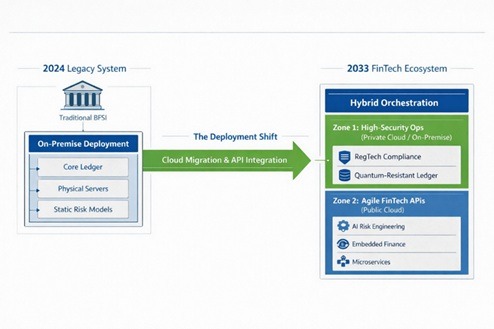
Deployment in today’s banking, financial services, and insurance (BFSI) environment can be classified according to three main structural logics:
1. Cloud-Native and Public Cloud Deployment
Banks and other financial institutions are making the transition from their on-premises IT infrastructure to a public cloud model for a number of reasons. Most importantly, this allows them to scale their operations easily, deploy microservices (like real-time fraud detection systems and automated credit scores), and sidestep the financial and time costs associated with maintaining physical servers.
2. On-Premise for High-Security Compliance
A sizable proportion of FinTech investments are deployed on-premises due to the growing trend of “Cloud” based systems, due to increased regulatory and data sovereignty requirements. The technical architecture used in this case is based on ‘Private Clouds’, which provide modern software and an in-house, local piece of hardware; thus providing the security of having both instances co-located together.
3. Hybrid Orchestration
The Latest Evolution in Investment Trends: Hybrid Deployment – Using On-Premise Hardware as Core Ledger Management and Public Cloud Technology for Customer-facing AI & Analytics.
The concept of Dual Track Mechanical Logic enables optimal security and performance.
The BFSI Integration: Deep Dive into Functional Logic
The BFSI sector’s interest in FinTech investment is currently concentrated in three technical domains:
Processing Transactions at Extremely High Rates
Investment is being made into developing low-latency engineering systems. As Finance Companies (BFSI) compete against nimble FinTech businesses, the ability to process transactions in less than a millisecond has become an engineering requirement. As part of this requirement, there is a great deal of research and development going into distributed ledger technology (DLT) and hardware-based processing acceleration.
Use of Artificial Intelligence (AI) for Engineering Risk
In insurance and banking, the use of machine learning models for the purpose of predictive risk assessment is a major focus area. Machine learning models differ from traditional static models because they use information that is available in real-time to dynamically modify interest rate, premium, and credit limit decisions.
Establishing Cybersecurity Infrastructure
The decentralization of deployment options is significantly expanding the attack surface for financial institutions. Therefore, a large proportion of FinTech investment goes into Zero Trust Architecture (ZTA). ZTA refers to the mechanical implementation of identity-based networking and automated threat response.
Outlook for the Future: Moving Toward 2033
By the end of 2033, there will be no significant difference between a “Bank” and a “Technology Company.” The Banking, Financial Services, and Insurance (BFSI) sectors will function as modular ecosystems where financial products will be “installed” as updates to software.
Key growth indicators to monitor include:
The emergence of regulatory technology (RegTech) provides real-time automated tools to track and manage changes to regulatory compliance.
Investments in quantum-resistant encryption will enable organizations to build hardware capable of protecting against future generations of computing technologies.
Green FinTech includes using blockchain technology more efficiently through the application of energy-efficient protocols and environmental social governance (ESG) algorithms..
Top Investment Verticals
If you are composing a document addressing the actual destination of funding, then consider focusing upon four areas of concentration:
Embedded Finance: This represents the “invisible” integration of financial products/goals/services into non-financial products/platforms such as being able obtain real-time insurance or credit for construction through a single mobile application. Current estimates project this will reach hundreds of billions in total volume by end-of-year.
Agentic AI/Autonomous Finance: This represents the next evolution of AI beyond chatbots and is defined as systems that do not only provide recommendations but also perform independent execution of transactions, manage portfolios and monitor compliance independently through help of investment funding via private equity.
Tokenized Real Estate and Stablecoins: With ongoing development and maturity of legislative measures such as GENIUS Act (U.S.) and MiCA (E.U.), there is a subsequent influx of pension and institutional capital flowing into tokenizing RWA (real world assets) including residential real estate and U.S. treasury securities.
Regulatory Technology (RegTech): With global regulatory agencies tightening their controls and implementing new legislation, AI-based compliance systems and implementing cyber-security measures will become the two types of investments necessary for mitigating fraud and maintaining compliance with regulations.
Conclusion
The FinTech sector is experiencing a “Deployment Revolution” at this time. BFSI professionals are shifting their perspective from whether to adopt new technologies to how they will deploy those technologies. The technical structural analysis indicates that the institutions that win the race to 2033 will be those able to effectively deploy hybrid solutions on high-speed, secure and cloud-agile platforms.
Regional Market Intelligence and Research Support
This comprehensive FinTech investment Market study by DataIntelo provides in-depth insights into market size, deployment models, component segmentation, application trends, regional performance, and competitive positioning through 2033.
For additional industry research and technology market intelligence, readers may also explore complementary datasets available at
https://dataintelo.com/ Read Full Report: https://dataintelo.com/report/fintech-investment-market
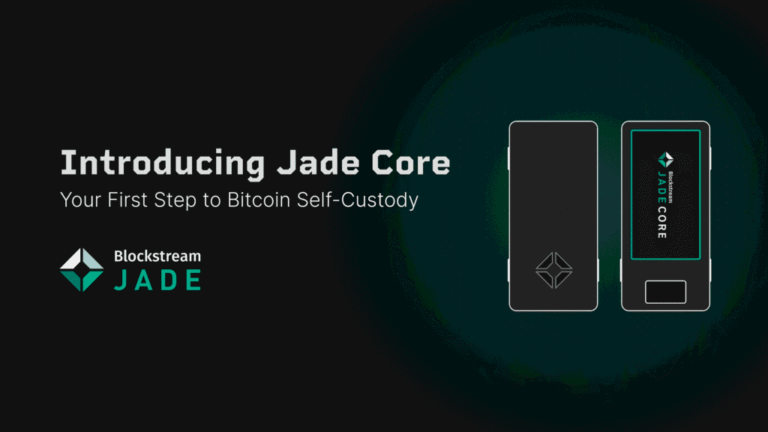
Blockstream has introduced Jade Core, a new hardware wallet designed to expand access to Bitcoin self-custody through a simplified user experience.
The device builds on the company’s existing Jade lineup and retains its open-source security model while targeting a broader base of users.
The launch reflects a shift in hardware wallet design as providers seek to reduce barriers tied to self-custody. Many existing solutions have focused on experienced users, with complex setup processes and technical requirements.
Jade Core addresses this gap through guided onboarding and tighter integration with Blockstream’s mobile and desktop applications.
The device supports Bluetooth pairing and enables users to manage transactions across platforms without relying on custodial services. Private keys remain stored on the device, and all transaction signing occurs offline. This architecture reduces exposure to online threats while preserving user control over assets.
Jade Core includes several core security features tied to Blockstream’s existing framework. These include open-source hardware and firmware, allowing users and developers to audit the system. The device also incorporates Blind Oracle PIN protection, which uses encrypted authentication to guard against unauthorized access, including cases involving physical compromise.
Users can verify device authenticity during setup, a feature designed to address supply chain risks in hardware wallets. The device display has been updated to support clearer transaction verification, reducing the risk of user error during transfers.
Blockstream said Jade Core is part of their broader effort to expand direct ownership of Bitcoin. The company has emphasized counterparty risk tied to centralized exchanges, particularly following a series of failures and security incidents across the digital asset sector. Hardware wallets have gained traction as users seek greater control over funds.
According to Blockstream executives, Jade Core aligns with a wider product strategy that connects retail-facing tools with institutional infrastructure. The company aims to support both individual users and larger market participants through a unified ecosystem built on Bitcoin-native technology.
The release comes at a time when demand for self-custody solutions continues to grow alongside Bitcoin adoption. By reducing complexity without altering core security assumptions, Blockstream is positioning Jade Core as an entry point for users transitioning away from custodial platforms.
Jade Core expands competition in the hardware wallet market, where usability and security remain key differentiators. As adoption increases, providers face pressure to deliver tools that balance ease of use with strong protections tied to open and verifiable systems.
Amboss has activated RailsX, a Lightning-native exchange layer that allows users to trade bitcoin against stablecoins without relinquishing custody, marking a shift in how dollar-denominated liquidity can move across Bitcoin infrastructure.
The launch introduces two trading pairs, USDT-L and USDC-L, issued by Speed Wallet, and opens them to peer-to-peer trading across the Lightning Network. Trades route through existing Lightning channels and settle atomically within seconds, with no centralized order book or intermediary holding user funds.
The release moves stablecoin functionality on Lightning beyond experimentation. While the concept of dollar-pegged assets on Bitcoin’s second layer has circulated for years, implementation has remained limited. Speed Wallet has operated wrapped stablecoins within its own ecosystem for roughly 18 months, providing a closed-loop proof of concept.
RailsX extends that model to the broader network, allowing any compatible node to access the same infrastructure.
Amboss and Thunderhub
RailsX will integrate with Thunderhub, a Lightning node management interface, which serves as the routing layer for these trades. Users execute swaps directly from their own nodes, maintaining control of private keys throughout the transaction lifecycle. Settlement occurs through Lightning’s existing payment channels, removing reliance on bridges or external chains.
Amboss said that RailsX is an extension of its existing Rails product, which focuses on Lightning liquidity provisioning. Together, the two systems form a combined liquidity and trading layer: users can allocate capital to channels, earn yield, and trade against that liquidity without transferring assets to an exchange.
The absence of an order book alters how price discovery occurs. Instead of matching bids and asks in a centralized system, trades execute through routed liquidity across the network. This design mirrors how Lightning processes payments, though applied to asset exchange rather than simple transfers.
Speed Wallet provides issuance and backing for USDT-L and USDC-L, with the assets designed to remain fully reserved. The company’s role introduces a hybrid structure: while trading remains self-custodial and peer-to-peer, stablecoin issuance still depends on a centralized entity.
The development arrives as demand for stablecoin liquidity continues to expand across crypto markets, particularly in regions where dollar access remains constrained. By embedding stablecoin trading within Bitcoin’s payment rails, RailsX offers a pathway for Lightning to compete with alternative ecosystems that have dominated stablecoin activity.
Whether RailsX can scale depends on liquidity depth and node participation. Early trading activity will test whether a routing-based exchange can support consistent pricing and volume without centralized coordination.
For now, the launch represents a functional step toward integrating stablecoin utility into Bitcoin’s native infrastructure.
Visa (V) is working with blockchain-based stablecoin infrastructure firm WeFi, to help establish the “last half mile” that can provide users with robust onchain payments and banking services, the companies said on Tuesday.
WeFi, which is co-founded by former Tether OG Reeve Collins, describes its platform as “an orchestration layer between decentralized finance (DeFi) and regulated payment infrastructure, designed to support use cases such as cross‑border spending and on‑chain value storage,” according to a press release.
“We’re upgrading the plumbing and offering essentially people bank accounts, because they’ll soon have their IBAN numbers, and we’re getting the various licenses around the world to operate appropriately,” Collins said in an interview.
As the platform scales, the plan is to partner with more banks and institutions, with a view towards the underbanked of the world, Collins said.
The rollout will take place region by region, starting with selected markets in Europe, Asia and Latin America. Expansion into additional markets will depend on local regulatory approvals and issuing partnerships.
“The partnership with Visa really closes that last half mile of onchain banking infrastructure,” Collins said.
“This collaboration demonstrates how Visa’s global network interacts with onchain models, while operating within established regulatory frameworks and the reliability consumers and merchants expect,” said Mathieu Altwegg, Head of Product & Solutions in Europe at Visa, in a statement.
Galaxy Digital (GLXY) narrowed its first-quarter loss as a shift in business mix and tighter financial management outweighed a decline in cryptocurrency prices.
The company lost $216 million, or 49 cents a share, less than the 59 cents estimated by analysts. Revenue dropped to $10.2 billion from $12.9 billion in the year-earlier quarter.
The company is increasingly focusing on the growing demand for data centers, and this month delivered its first data hall at the Helios campus in Texas to CoreWeave (CRWV), marking the start of revenue under a long-term lease tied to artificial intelligence workloads.
“Adjusted gross profit remained broadly stable, reflecting a shift in the business mix as recurring fee revenue and transaction income continue to scale and provide greater resilience in softer market conditions,” the company said in a statement. “Disciplined expense management during the quarter helped narrow the adjusted EBITDA loss, underscoring a focus on operating efficiency in more challenging environments.”
The Helios facility is set to deliver 133 megawatts of computing power by the end of the second quarter. The company also secured approval for an additional 830 megawatts of power at the site, bringing total capacity to more than 1.6 gigawatts.
GLXY shares fell for a second day, and were recently 0.84% lower at $24.84.