Wisconsin has joined the growing number of U.S. states being sued by the Commodity Futures Trading Commission as that agency insists on its jurisdiction over prediction markets trading at firms such as Kalshi and Crypto.com.
Several states have gone after those businesses, accusing them of violating state gaming laws via the betting taking place on the growing platforms, but CFTC Chairman Mike Selig has led a legal pushback against states including New York, Arizona, Illinois and Connecticut. He’s argued that the derivatives regulator, which he leads as the sole member of what’s meant to be a five-member commission, has “exclusive jurisdiction” over the trading of event contracts that he argues are an emerging form of the same kinds of derivatives activity long handled by the CFTC.
Last week, Wisconsin sued Kalshi, Coinbase, Polymarket, Robinhood and Crypto.com for running unlicensed gambling operations in the state — echoing the claims made against the industry elsewhere.
Selig has now responded in the U.S. District Court for the Eastern District of Wisconsin, said he’s trying to send a message: “If you interfere with the operation of federal law in regulating financial markets, we will sue you.”
Also last week, New York sued Coinbase and Gemini over their prediction markets businesses, and days later, the CFTC responded with its own lawsuit against the state.
Arizona has been pursuing a criminal case against Kalshi, but a court there paused the prosecution earlier this month, with the judge arguing that the federal agency is likely to be successful making its case that the U.S. law will preempt state gambling laws.
Read More: U.S. CFTC adds New York to string of states its suing to stop prediction market pushback
In 2009, two former Yahoo engineers built a simple status-update app in California to provide affordable, ad-free and private communications. This application would evolve to become WhatsApp, the world’s leading messaging platform that removes the cost barrier from cross-border communication and is so simple to use that anybody with a mobile device has downloaded the app.
Today, more than three billion people use it every month, sending an estimated 150 billion messages daily. It is the world’s default way to communicate – and that includes people who work in financial services.
Unfortunately, regulators never designed their record-keeping rules around consumer messaging apps, which is a major problem because bankers are running deals on WhatsApp. Their employers often have no record of what was said or what was sent. US regulators have already levied more than $3billion in fines over this single failure – and the UK’s Financial Conduct Authority is watching closely.
We spoke with Dima Gutzeit, founder and CEO of LeapXpert – a Gartner-recognised Visionary in Digital Communications Governance and Archiving – to find out the true scale of the problem and what it means for UK financial institutions.
LeapXpert provides governed business communication infrastructure that lets organisations use consumer messaging channels while capturing every message in a compliant, auditable archive. It works with regulated and non-regulated enterprises in more than 45 countries.
Dima Gutzeit, founder and CEO, LeapXpert
Dima, what exactly are ‘off-channel communications’ and why should UK banks be worried?
It is a term for business conversations that happen on personal devices and consumer apps – WhatsApp, iMessage, Signal – outside the recorded phone lines and official email systems that regulators require banks to keep. A trader messages a client to sound out pricing. A relationship manager chases a signature on iMessage. A junior drops an update into a group chat because that is where the team actually talks. None of it reaches the bank’s archive. The bank cannot supervise what it cannot see, and it cannot produce records when a regulator asks. It has become the default way business gets done, and most firms have no visibility into it.
The US has already handed out more than $3 billion in fines. What happened?
Since 2021, the SEC and CFTC have fined more than 60 Wall Street firms for a single failure: staff conducted business on personal messaging apps and the firms could not produce the records. JPMorgan paid $200million. Morgan Stanley, Goldman Sachs, Bank of America, Citigroup, Barclays, Deutsche Bank, UBS and Credit Suisse all followed. Morgan Stanley went further, docking bonuses and dismissing senior bankers. The regulators made clear this was not a technicality. It was a record-keeping failure at an industrial scale.
Where does the UK stand right now when it comes to regulating WhatsApp messages?
The Financial Conduct Authority has been watching the US enforcement wave closely. CEO Nikhil Rathi and his senior team have warned repeatedly that record-keeping under SYSC and MiFID II applies to every channel a banker uses for regulated business, not just the ones the compliance team happens to monitor. FCA Market Watch bulletins have flagged unrecorded communications as a live concern. Coverage in the financial press confirms it is now a board-level issue for UK lenders. The only questions are which firm goes first and how large the number will be in the press release.
Most banks already have policies banning WhatsApp for business. Why is that not enough?
Because bans do not change behaviour, they just push it underground. Clients expect to be reached where they already are. A hedge fund manager in Mayfair does not want to install a second app to talk to his broker. A corporate treasurer in Frankfurt will message on the channel she uses with everyone else. When the bank says no, the banker either loses the relationship or moves the conversation to a personal phone that the firm cannot see. Many of the US firms that were fined had written policies prohibiting the use of WhatsApp. Enforcement found those policies were routinely ignored, often by managing directors and senior executives. Policy without capture is not compliance. It is a paper trail for the regulator to follow when something goes wrong.
What if a bank can absorb the fine – is there a bigger risk at play?
The fine is the headline, but it is rarely the worst of it. Once a regulator identifies off-channel failures, it raises immediate questions about what else has gone unsupervised. Were there insider-dealing conversations the firm never captured? Client complaints that were never logged? Pricing discussions that should have triggered surveillance alerts? The record-keeping breach becomes the thread that unravels wider compliance failures.
Beyond the regulator, there is the client. When a disputed transaction ends up in court, and the bank cannot produce a complete record of what was discussed, its position is significantly weakened. Institutional clients – pension funds, sovereign wealth funds, asset managers – increasingly expect their counterparties to demonstrate robust data governance. A bank that cannot account for its own conversations is a bank that becomes harder to do business with. The reputational damage compounds long after the fine is paid. It’s so hard to win back clients’ trust. It can take years to recover, and some firms never do.
What does a workable alternative actually look like?
You let bankers use the channels clients prefer – and you govern the conversations at the point of exchange. The technology exists and is already deployed at global institutions. Messages on WhatsApp, iMessage, WeChat, Signal and other consumer apps are routed through a governed infrastructure that preserves a full, immutable record without changing the user experience. The banker sends a message. The client receives it on their normal app. The firm keeps the record. But capture alone is not enough. Governed infrastructure means the platform is actively working in real time, before, during and after every message is sent.
Before a message leaves the organisation, data loss prevention controls scan it for sensitive information – account numbers, personal identifiers, confidential deal terms – and block or flag it before it reaches the recipient. Attachments and links are checked for malware so that a compromised file shared on WhatsApp does not become the entry point for a wider breach. These are not retrospective alerts. They operate at the moment of exchange, which means the risk is neutralised before damage is done.
During conversations, the platform monitors for potential conflicts of interest. If a relationship manager is communicating with a counterparty that sits on the firm’s restricted list, the system flags it. Compliance teams gain visibility that would be impossible if those same conversations were happening on a personal device outside the office
Capture is one thing – what happens to the data once it is inside the platform?
This is where governed messaging moves well beyond archiving. Once conversations are captured, the data becomes a strategic asset for the organisation, not just a regulatory obligation.
LeapXpert Signals analyses communication patterns across the entire messaging estate in real time. It surfaces shifts in client sentiment, flags unusual engagement patterns and identifies emerging risks before they escalate. If a key client’s tone changes markedly over a series of messages, or if communication frequency with a particular counterparty spikes unexpectedly, the platform brings it to the attention of the relevant team. For compliance, this means proactive and real-time surveillance rather than reactive investigation. For the business, it means early warning on relationships that may be deteriorating.
Our AI-powered client intelligence tool, Maxen, takes this further. It transforms raw conversation data into actionable intelligence: mapping client relationships across the organisation, identifying deal signals, and suggesting next steps based on what has actually been discussed. A senior banker can see at a glance which client relationships are strengthening, which are going quiet, and where follow-up is overdue. The insight comes directly from the conversations themselves, not from a CRM that relies on manual entry.
There is also a critical principle at stake: data ownership. When an employee leaves the firm, the client relationships they managed do not leave with them. Every conversation, every document shared, every commitment made on a consumer messaging channel remains with the organisation. The institutional knowledge stays inside the building. For banks that have watched senior bankers depart and take entire client books with them, often with no record of what was discussed or promised. This changes the dynamic entirely.
What should UK compliance heads and board members be doing right now?
Stop treating this as a future problem. LeapXpert’s Silent Data Crisis report shows most regulated firms still have no archive of what staff are saying on consumer apps. UK banks have watched the US enforcement cycle unfold from a distance. Ungoverned WhatsApp is dangerous. Firms that act now will spend a fraction of what their US peers spent, without the forensic reviews, the remediation programmes, or the press releases.
At the end of the day, it’s not just about whether to govern these channels, but how much value a firm is leaving on the table by failing to do so. The conversations are already happening. The data is already flowing. The only question is whether the bank can see it.
Robinhood (HOOD) reported a sharp decline in crypto trading revenue for the first quarter of 2026, even as growth in other parts of its business pushed overall revenue higher.
Crypto-related revenue fell 47% from a year earlier to $134 million, down from $252 million in the same period of 2025, according to its earnings release.
The drop came as customer activity shifted toward other trading products. Transaction-based revenue rose modestly to $623 million from $583 million a year ago. A key driver was a surge in so-called event contracts, which brought in a large share of “other transaction revenue” that climbed 320% year over year to $147 million.
Robinhood said users traded a record 8.8 billion event contracts during the quarter, reflecting growing interest in prediction markets. These products let users place bets on the outcome of real-world events, similar to forecasting whether interest rates will rise or who might win an election.
Total revenue increased 15% to $1.07 billion, compared with $927 million a year earlier. Net income increased 3% year-over-year to $346 million.
Adjusted earnings per share came in at $0.38, slightly above $0.37 in the prior-year period, but missing analyst estimates of $0.39.
The results show how Robinhood is working to reduce its reliance on crypto trading, which can swing sharply with market sentiment. Like Coinbase (COIN), which is set to report earnings on May 7, the company has been expanding into new areas such as derivatives and prediction markets to smooth out revenue.
Robinhood also reported strong growth in net interest revenue and subscription products, including its Gold service, as it builds a broader financial ecosystem.
Shares of HOOD fell 6% in post-market trading. The company said it will host an earnings call at 5 p.m. ET.
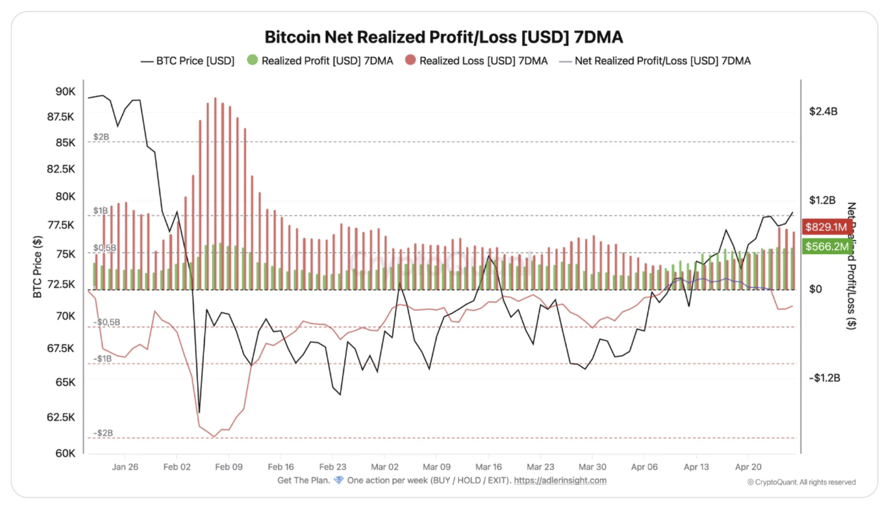
Bitcoin’s (BTC) Coinbase Premium Index has turned negative at -0.008 for the first time in three weeks, signaling a sharp reduction in US spot market demand and aligning with BTC’s current price drop. The signal held across hourly readings through the next 48 hours, showing consistent selling pressure from US-based buyers. The shift comes as the net weekly average of BTC realized losses climbed to $829 million, suggesting reduced investor conviction.
Crypto trader Ardi highlighted a break in both trendline support and the $77,300 liquidity zone. The trader linked the move to weakening spot demand, noting that the premium has posted consecutive red readings for the first time since BTC was near $67,000.
Ardi said that price action during the Federal Open Market Committee (FOMC) meeting window could remain volatile, with rapid moves in either direction. Traders could place focus on the $74,500–$75,500 range as a key downside area tied to demand exhaustion.
Onchain data adds to this view. Crypto analyst Darkfost noted that the weekly realized losses reached $829 million on a seven-day average, compared to $566 million in realized profits. The net realized profit briefly turned positive on April 9, then reversed within two weeks.
Bitcoin net realized profit/loss [USD] 7DMA. Source: CryptoQuant
The share of supply in profit stands at 64%, a level that has not historically supported sustained upside. This indicates weaker conviction among holders despite the recent rebound.
Related: Bitcoin price hits one-week low as $100 oil sparks fresh Asia crisis fears
Bitcoin sell volumes at Binance reach $828 million
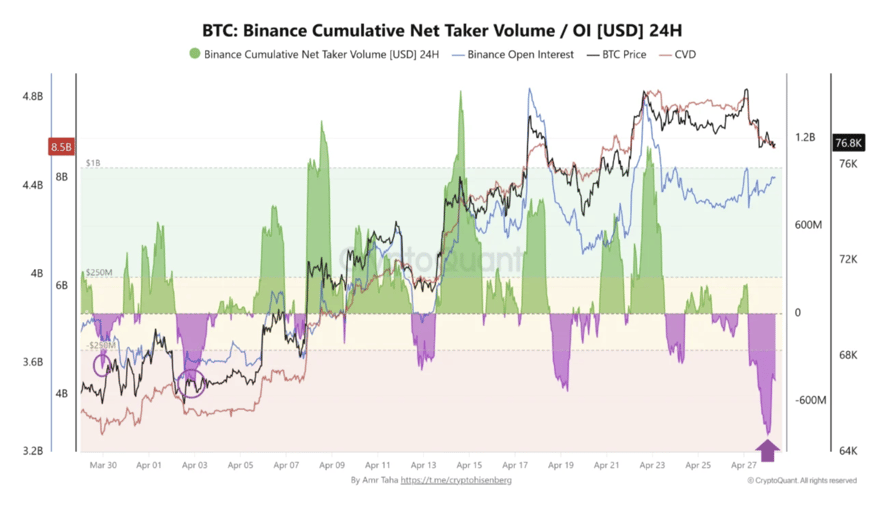
Derivatives data shows strong sell-side activity on Binance. Crypto analyst Amr Taha noted that the 24-hour cumulative net taker volume dropped by $828 million on April 27, the lowest reading since late March.
BTC cumulative net taker volume on Binance. Source: CryptoQuant
Negative net taker volume indicates that the market’s sell orders exceed its buy orders. The Binance taker buy/sell ratio has also fallen to 0.89, a level last recorded on March 29.
That earlier reading aligned with a local pivot when Bitcoin tested $66,000, then recovered by 15% over the past 30 days.
The current readings place both metrics back near prior exhaustion zones. Taha described the setup as closer to a short-term capitulation than a larger trend breakdown.
Related: Can Bitcoin hit $250K this year? Traders say it may be time to ‘sell in May’
This article is produced in accordance with Cointelegraph’s Editorial Policy and is intended for informational purposes only. It does not constitute investment advice or recommendations. All investments and trades carry risk; readers are encouraged to conduct independent research.
At TSAM London, Nick Taplin from NeoXam centered on two topics that are currently top of mind for financial professionals: AI and the growing complexities of private markets. Noting that AI is a universal subject, clients are keen to understand how NeoXam will incorporate the technology into their products while ensuring compliance with existing AI policies
Beyond AI integration, there’s significant demand for solutions addressing private markets, specifically, how firms can get a comprehensive, “whole of book” view of their assets. As more people move into areas like private equity and private credit, they are finding it difficult to manage unstructured data and achieve a consistent, holistic view across all asset classes.
NeoXam is addressing this by developing tools that use AI to extract structured, usable data from unstructured values. Additionally, their products include a data model designed to harmonize all these different assets for processes ranging from data management to accounting and reconciliation. Taplin stressed that they work closely with clients to replicate and integrate their existing operational processes into NeoXam’s automated systems.
NeoXam’s automation offering is making a real difference by replacing what used to be heavy, manual workloads, particularly in data management and reconciliation. Taplin highlighted some powerful results: major fund administrators have been able to handle an additional 25,000 reconciliations without needing to increase their headcount.
By completely automating tens of thousands of manual processes every day, staff can be redeployed to more valuable, high-impact tasks, such as investigating significant data breaks, engaging with counterparties, and offering better customer service. For customers who engage now, Taplin estimated that most implementations occur within six to nine months, meaning improvements should be noticeable before the end of the year.
Billionaire investor Paul Tudor Jones said bitcoin BTC$76,882.32 stands out as the strongest hedge against inflation, citing its fixed supply as a key advantage over traditional assets like gold.
“Bitcoin is unequivocally the best inflation hedge that there is — more than gold,” Jones said in an interview with Invest Like the Best podcast published Tuesday. He pointed to the largest crypto’s capped supply. Unlike gold, whose supply increases each year, bitcoin has a hard limit on the number of coins that can be created, making it scarcer by design, he said.
Jones framed bitcoin’s appeal through the lens of past market cycles. During periods of aggressive monetary and fiscal stimulus, such as after the March 2020 pandemic crash, he said inflation trades tend to emerge as central banks inject liquidity into the system.
“When you saw all the interventions… you just knew that the inflation trades were going to take off,” he said, adding that bitcoin was the most compelling opportunity at the time.
His bullish view on bitcoin contrasts with a more cautious stance on equities. Jones warned that stock markets are stretched, with valuations that historically point to weak future returns.
At the same time, a wave of upcoming initial public offerings — such as SpaceX and artificial intelligence firms like OpenAI and Anthropic — and reduced share buybacks could increase equity supply, putting additional pressure on prices.
“If you buy the S&P at this current valuation, the 10-year forward returns [are] negative,” he said. “It’s going to be really hard to make money from here.”
While he stopped short of calling the current environment a full-blown bubble, he noted that the ratio of U.S. stock market capitalization to GDP remains near historic extremes, echoing levels seen before major downturns such as the dotcom bubble.
“In 1929 we were, I think at the top, at 65% [stock market capitalization to GDP] and then in ’87 we got to about 85%-90%, in 2000 we got 270%,” he noted.
“And now we’re at 252%, so you can just imagine,” he said. “We’re clearly so leveraged in equities in this country.”
Because of that, a major stock market correction may have broader ramifications on the economy, government budget deficit and the bond market, according to Jones.
“10% of our tax revenues are capital gains. They go to zero,” he said. “So you can see the budget deficit blowing up. You see the bond market getting smoked.”
You can see this kind of negative self-reinforcing effect,” he concluded. “It’s troubling.”
Nvidia on Tuesday launched a multimodal open model that combines vision, speech and language, aiming to help enterprises save time with agents that can provide faster, smarter responses by reasoning across modalities.
Nemotron 3 Nano Omni is the vendor’s latest iteration of its open source family of models. The model removes the need for separate perception models for video, audio, image and text. It combines vision and audio encoders (neural network modules that process complex inputs and capture the most key features of the data) within its 30B mixture-of-experts architecture. This combination enables the AI system to achieve higher throughput than Nvidia’s other Omni models, leading to lower costs and better inference efficiency, the vendor said.
The model is another way Nvidia is trying to extend its dominance in AI hardware into models and services. While the vendor currently leads the AI market in hardware with its ubiquitous GPUs, emphasizing its Nemotron open models may help it to remain on top, especially as its biggest customers — including Google, Microsoft and AWS — have their own chips and are ramping up production. Other customers, such as OpenAI, are partnering with Nvidia competitors like Cerebras and Broadcom, and some foreign customers, notably DeepSeek, are shifting to local chipmakers such as Huawei.
Related:China Moves to Block Meta’s $2B Acquisition of AI Startup
“This is happening at the backdrop of Nvidia’s biggest customers doing everything they can to eat away at the margins that Nvidia is making in hardware right now,” said David Nicholson, an analyst at Futurum Group. “Over the long haul, they’re not going to be able to maintain the hardware margins that they have right now.”
However, Nvidia is also trying to help enterprises be more efficient by helping agents understand context across modalities. The vendor is promising a system that integrates diverse files and methodologies, making it easier for enterprises to build agents.
“The idea that we’re going to give you this environment where when you create an agent, it will automatically understand how to communicate with all of these other pieces of the entire infrastructure stack,” Nicholson said. “It’s one step further in the direction of an intelligently engineered system that delivers efficiency that is hard to get when you don’t have control over all the components.”
Being Efficient
The model can work next to proprietary models and other Nemotron open models to power agentic workflows such as computer use agents, document intelligence and audio and video understanding. With computer use agents, Nemotron 3 Nano Omni powers the perception loop for agents navigating the computer screen and reasoning about its content.
Related:AWS Bets on Frontier Agents as the Next Era of Enterprise AI
With document intelligence, the model can interpret documents, charts, tables, and screenshots, and reason over both visual and textual content. With audio and video understanding, the model maintains the context of both modalities within a single reasoning stream.
Obstacles
The challenge, though, is that it is unclear whether Nvidia envisions this model or system for a specific enterprise size and whether its hyperscale customers will benefit from using it.
Nicholson noted that some Nvidia customers have their own accelerators. “I don’t know if Nvidia is thinking that this is going to be a hyperscale cloud provider strategy that they’ll be able to use.”
Moreover, while the model is open source and Nvidia provided weights, training techniques and training sets, it is unclear if enterprises outside the Nvidia stack environment will use it.
“That’s not very likely,” Nicholson said. “Most of this will be deployed within an entire Nvidia stack environment.”
Nevertheless, developers will still experiment with the model, said Chirag Shah, a professor at the University of Washington’s Information School.
“When you make something like this open source, it makes all those developers quickly try it out, start integrating into their existing solutions, and when it works well, they’re going to want to use Nvidia as their infrastructure partner,” he said.
Trusted Editorial content, reviewed by leading industry experts and seasoned editors. Ad Disclosure
Bitcoin is holding above $76,000 as the market pushes against resistance and bulls attempt to build the momentum needed for the next leg higher. The price is constructive but not yet decisive, and an Arab Chain report has just identified a behavioral shift among Bitcoin’s most structurally significant sellers that changes the supply picture behind the current consolidation.
The number of miner deposit transactions on exchanges has fallen to approximately 8,138 — one of the lowest readings on record. To understand why that matters, it helps to recall what the data looked like just months ago.
In late 2025, deposit transactions surged above 100,000 at times — a level of activity that reflected miners actively moving Bitcoin to exchanges, behavior historically associated with selling intent and profit-taking. Every spike above that threshold represented freshly mined coins entering the liquid market and adding to the sell-side overhead that recovering prices must absorb.
That dynamic has fundamentally changed. Since the beginning of 2026, the trend has moved persistently lower. The sharp spikes have disappeared. The peaks have flattened. The miners who were flooding exchanges with deposits just months ago have pulled back to a pace that barely registers against where they were.
Bitcoin, attempting to clear resistance above $76,000, is doing so in a market where the group that supplied the most consistent overhead pressure has nearly gone silent.
The Miners Have Stepped Back. The Question Is Whether They Stay Back.
The Arab Chain report connects the transaction decline directly to the current price environment. With Bitcoin trading around $77,000, the data is describing a market where one of its most consistent historical sources of sell-side pressure has effectively withdrawn. Miners are not just depositing less frequently — they are transferring smaller amounts when they do move, reflecting a behavioral shift that goes beyond routine portfolio adjustments into something closer to a deliberate change in strategy.
The report identifies two possible explanations for that shift, and both carry different implications for how long it persists. The first is expectation-driven: miners believe prices will move higher and are holding current production in anticipation of selling at better levels. The second is conviction-driven: miners have reduced their selling intent structurally and are accumulating rather than distributing, regardless of short-term price movements.
Either explanation produces the same near-term consequence. With miner deposit transactions at record lows, the overhead supply that recovering Bitcoin prices typically must fight through is significantly reduced. The path from $77,000 toward the $82,200 short-term holder cost basis — the breakeven zone for recent buyers — faces less resistance from this particular source than it has at any comparable point in recent memory.
The constructive framing the report offers is measured and conditional. Reduced miner selling pressure is a positive structural factor in the short term — but its durability depends on whether market demand holds at current levels or continues to grow. If demand weakens, the reduced miner activity offers support. If demand strengthens, the combination of reduced overhead and growing inflows creates the conditions the market has been building toward.
Bitcoin Holds Breakout Level as Price Tests Short-Term Strength
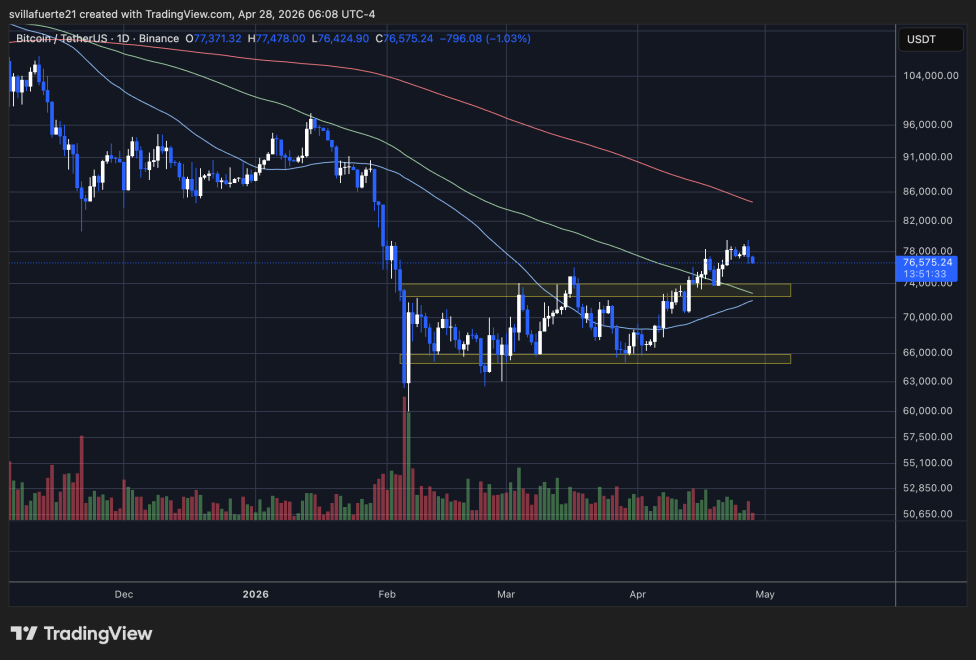
Bitcoin is consolidating near $76,500 after recently breaking above the $73,000–$74,000 resistance zone, which had capped price throughout March. That level now acts as support, marking a clear structural shift from range-bound compression to early-stage recovery. The breakout was clean, but follow-through is beginning to stall as price approaches the $78,000–$80,000 supply region.
BTC consolidates above the $75K level | Source: BTCUSDT chart on TradingView
The 50-day moving average has turned upward and is providing dynamic support below the current price, reinforcing the short-term uptrend. Meanwhile, the 100-day moving average sits just above and is beginning to flatten, acting as immediate resistance. The 200-day moving average remains downward sloping overhead, indicating that the broader trend has not fully transitioned back to bullish.
Price structure shows higher lows since the February capitulation near $63,000, confirming steady accumulation. However, recent candles reflect hesitation, with smaller bodies and wicks forming near resistance — a sign of balance between buyers and sellers.
Volume supports this interpretation. The recovery phase has occurred on moderate participation compared to the capitulation spike, suggesting controlled accumulation rather than aggressive expansion.
A break above $78,000 would open the path toward $82,000, where previous breakdown pressure originated. Failure to hold above $74,000 risks a return to the mid-range structure.
Featured image from ChatGPT, chart from TradingView.com
Editorial Process for bitcoinist is centered on delivering thoroughly researched, accurate, and unbiased content. We uphold strict sourcing standards, and each page undergoes diligent review by our team of top technology experts and seasoned editors. This process ensures the integrity, relevance, and value of our content for our readers.
Stablecoin monthly transfer volume fell by nearly 20% over the past 30 days, even as the market’s total supply and holder count continued to rise.
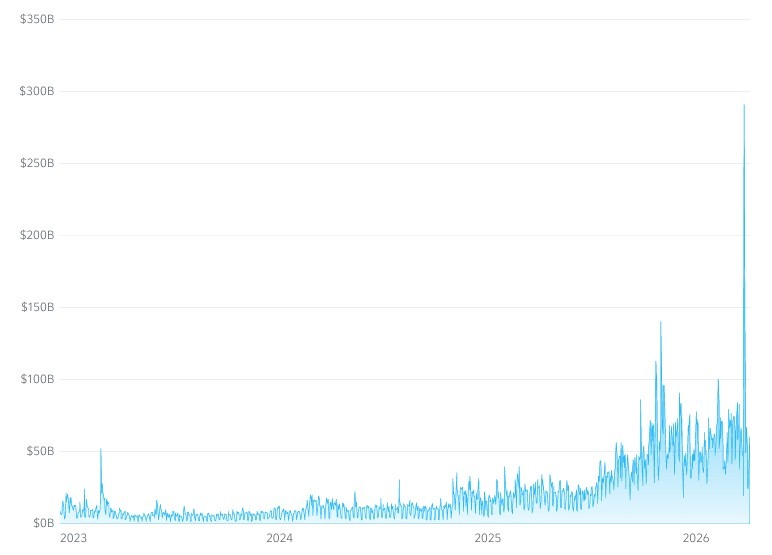
According to data from RWA.xyz, 30-day stablecoin transfer volume dropped 19.18% to $8.31 trillion as of April 28, while stablecoin market capitalization rose 2.06% to $305.29 billion over the same period. The number of stablecoin holders also increased by 2.32% to 246.94 million, while monthly active addresses edged up 0.26% to 51.28 million.
The divergence suggests that stablecoin growth is not translating evenly into onchain activity. While more capital appears to be sitting in dollar-denominated crypto assets, fewer dollars are being moved across blockchains compared with 30 days earlier.
The 30-day net flows were led by Tether’s USDT, which added $3.6 billion, followed by Circle’s USDC with $2 billion and MakerDAO’s DAI with $1.2 billion. Ethena’s USDe saw the largest net outflow at $1.1 billion, while Paxos’ PYUSD recorded $509 million in net outflows.
30-day stablecoin net flows as of April 28, 2026. Source: RWA.xyz
Stablecoin momentum cools after stronger network activity
The decline in broader stablecoin transfer volume comes after stronger stablecoin activity was flagged on some of the major blockchain networks for stablecoins.
In its Q2 Signals Report, asset manager Fidelity cited Coin Metrics data showing that Ethereum’s stablecoin transfer values had recently exceeded historical averages, with transfer value over the past 12 months surpassing $18 trillion.
Aggregate stablecoin transfer volume. Source: Fidelity
Fidelity said the trend suggested network utility persisted even as crypto prices remained under pressure. The company said the increase may signal that stablecoins are being used for payments, settlement and onchain access to the dollar, regardless of broader market sentiment.
Related: Stablecoin inflows rebound to $1.7B as Washington battles over yield rules
Solana showed a similar, though smaller, trend. Citing Coin Metrics data, Fidelity showed that Solana consistently processed over $5 billion in stablecoin volume, while its 30-day average transfer volume increased from $6.7 billion to $7.2 billion as of March 31.
Fidelity said the data suggest that Solana may be moving toward more mainstream financial activity after being closely associated with memecoin trading.
Magazine: AI-driven hacks could kill DeFi — unless projects act now
Cointelegraph is committed to independent, transparent journalism. This news article is produced in accordance with Cointelegraph’s Editorial Policy and aims to provide accurate and timely information. Readers are encouraged to verify information independently.
Stancer, a European digital payments fintech already active in France, is officially expanding into the Italian market. The move follows the iliad Group‘s recent launch of its cloud activities in the country through Scaleway just a month prior.
Stancer’s Italian operations will be spearheaded by general manager Alberto Rescigno, who will oversee the company’s market entry, consolidation, and the gradual establishment of a local team.
Democratising digital payments
The fintech’s core mission is to make payment infrastructures across Europe more accessible and immediate. The offering is tailored directly for SMEs, freelancers, and e-commerce operators, providing omnichannel solutions that cover both online payments and in-person transactions via smartphone using Tap to Pay.
Stancer differentiates its approach through simplicity and accessibility, deliberately eliminating fixed fees, long-term commitments, and rigid subscriptions. Instead, the company provides transparent and competitive pricing, an easy onboarding process, and the ability to manage all payments from a single unified platform.
Why Italy?
Italy presents a highly strategic market for the fintech. According to the Community Cashless Society 2026 index, cashless transactions in Italy have surpassed €500billion since 2015, accounting for 46.5 per cent of Italians’ total consumption. Furthermore, as of 2024, the sector generated €17.7billion in revenues and €9.4billion in added value.
“Italy is a particularly attractive market, combining the growth of digital payments with an economic fabric in which micro, small and medium-sized enterprises account for 99.9% of all non-financial sector businesses: a segment that broadly matches the businesses we target,” explained Rescigno.
Rescigno noted that current market solutions are often designed for large players, trapping smaller businesses in fixed fees and long-term contracts that fail to accommodate irregular or seasonal revenue volumes. “Stancer’s offering fits into this context and is designed to provide an alternative, with flexible, simple and transparent services that respond concretely and effectively to the needs of Italy’s entrepreneurial fabric.”
European infrastructure and scale
A major selling point for the fintech is that it operates on a fully European infrastructure. Its proprietary payment technology was developed entirely in-house and is hosted directly on the iliad Group’s data centres.
George Owen, CEO of Stancer, highlighted the critical importance of this setup regarding security.
“This allows all data to remain in Europe and therefore be subject exclusively to the European regulatory and supervisory framework, in full compliance with GDPR and the highest protection standards,” Owen stated.
Currently, Stancer processes over 250,000 transactions daily, handles more than 7.6 million recurring subscription payments every month, and collects over €1.7billion annually for its clients.
Future plans for the region
Looking ahead, Stancer aims to progressively build its presence in Italy through active digital acquisition. The company also plans to establish targeted local partnerships with key stakeholders—including banks, trade associations, and technology platforms—as it seeks to cement itself as one of Europe’s leading players in digital payment services.