Crypto markets are trading cautiously, with the Fed widely expected to hold rates steady tomorrow.
Crypto markets are stuck in neutral as traders weigh a closed Strait of Hormuz, hawkish dissent at the Bank of Japan, and Jerome Powell’s final Fed meeting, all falling within the same 48-hour window.
Bitcoin is trading at $76,360, down 0.7% over 24 hours, after failing twice in the past week to reclaim $80,000, per CoinGecko data. Ether ticked up 0.3% to $2,299, though the second-largest cryptocurrency is still marginally lower over the past seven days.
BTC Chart
The total crypto market capitalization slipped 0.5% to $2.64 trillion.
The macro situation dominated heading into Tuesday’s session. WTI crude futures for June delivery traded 3% higher near $100 per barrel as traders weighed Iran’s offer to reopen the Strait of Hormuz only if the U.S. lifts its blockade. The chokepoint has been closed since February 28, triggering one of the most significant energy shocks in modern history.
The Bank of Japan kept its benchmark interest rate unchanged at 0.75% earlier today, though the decision was not unanimous, with three members calling for a hike. The yen rose while Bitcoin remained under pressure. The Federal Reserve’s two-day FOMC meeting kicks off today, with markets pricing in a near-certainty that rates will remain unchanged. Tomorrow’s decision marks Jerome Powell’s last meeting and press conference as Fed Chair before his term ends on May 15, with Kevin Warsh expected to take over.
ETF Flows
The structural ETF bid that anchored the recent consolidation broke on Monday. U.S. spot Bitcoin ETFs logged $263 million in net outflows on April 27, ending a nine-day streak that pulled in roughly $2.11 billion through April 24, per SoSoValue data.
Cumulative net inflows since launch now sit at $58.30 billion, with total ETF net assets at $101.23 billion as of April 27, equivalent to roughly 6.5% of Bitcoin’s market cap.
Altcoin Movers
MemeCore (M) is today’s biggest loser, dropping 15% over the past 24 hours and 21% on the week to $3.38, per CoinGecko.
Privacy token Zcash (ZEC) fell 5.6% on the day to $334 but remains 8.4% higher over seven days, while Hyperliquid’s HYPE slid 3.8% to $40 but eked out a 2.7% weekly gain. Stellar’s XLM is up 8.8% on the week despite today’s pullback.
Among the top 10, XRP, TRON and Solana slipped by 0.3% to 0.8%, while Dogecoin bucked the broader weakness with a 1.8% gain.
Looking ahead, near-term price action hinges on whether the Fed’s tone on Wednesday is dovish enough to offset oil-driven inflationary pressures and geopolitical tensions.
Ether (ETH) analysts have mapped out key ETH price levels to watch over the next few weeks, with a focus on the $2,000 psychological level.
Key takeaways:
Dropping below the 200-day simple moving average at $2,220 could confirm more downside for Ether.
ETH faces stiff resistance at $2,400, a level that must be reclaimed by the bulls.
Ether price stuck between two key levels
Data from TradingView showed the ETH/USD pair trading below $2,300, down 5% over the last two days and erasing all gains made over the weekend.
This meant that the price remained wedged between the 100-day exponential moving average at $2,350 and the 100-day simple moving average (SMA) at $2,220, as shown in the chart below.
This suggested that Ether could consolidate within these trend lines for a few more days before a decisive move.
Telegram trading resource Technical Crypto Analyst said that after losing the support trendline at $2,300, “we can probably expect Ethereum to drop, and it might even hit the lower support level in the next few days,” adding:
“A solid breakdown with good volume would confirm this.”
The analyst was referring to two immediate support zones: the $2,200 area, where the 50-day and 100-day SMAs converge, and the psychological level at $2,000.
“ETH has dropped below the $2,300 level,” said fellow analyst Ted Pillows in a Tuesday post on X, adding:
“The next crucial support zone is $2,200 which could be a level for a short-term bounceback.”
A key buy zone to watch below that is the $1,800-$1,750 area, which aligns with the multi-year low reached on Feb. 6.
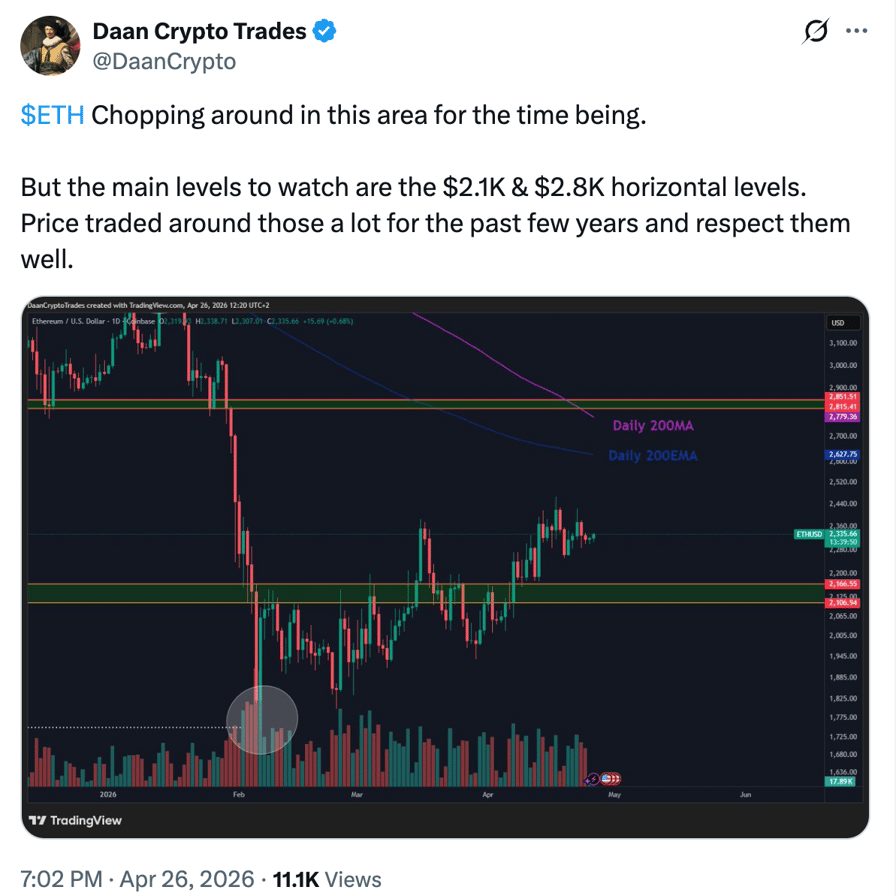
In a recent post on X, trader Daan Crypto Trades said that the key levels to watch were $2,100 as support and the resistance at $2,800, which ETH price has “respected” well over the past few years.
ETH/USD daily chart. Source: X/Daan Crypto Trades
As Cointelegraph reported, a daily close below the moving averages around $2,200 would bring the next line of defense at $2,000 into focus.
Ethereum price must reclaim $2,400 to continue recovery
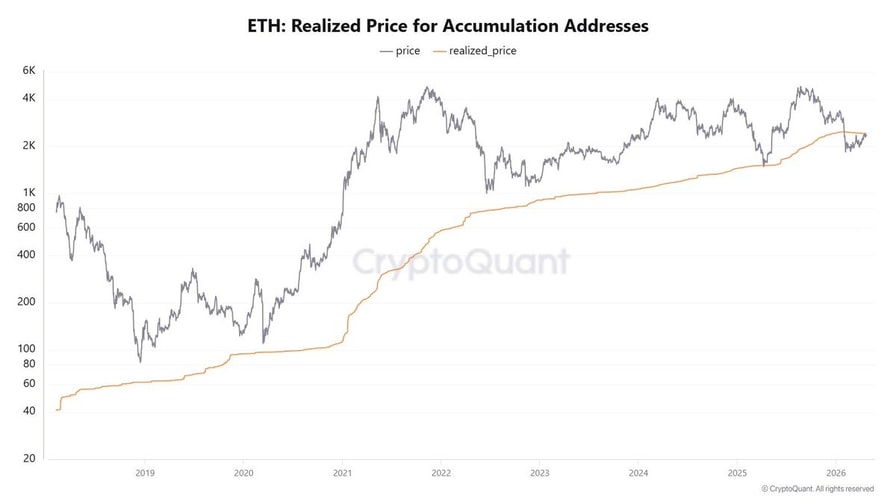
As Cointelegraph also reported, Ether’s bullish case hinges on flipping the resistance at $2,400 into support, where the realized price currently is.
“This is a very important psychological factor,” CryptoQuant analyst CW8900 said in a recent X post, adding:
“Breaking through that line signifies that whales are transitioning to a profitable position.”
ETH realized price. Source: CryptoQuant
With whales back in a profitable position, it would “provide grounds for their buying power to become stronger,” the analyst added.
Related: Ethereum’s EEZ could pull other blockchains into its orbit
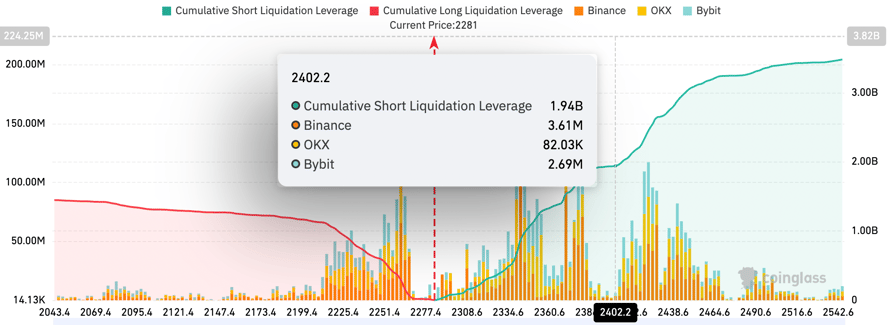
Meanwhile, Ether’s liquidation map reveals that a break above $2,400 would trigger over $1.94 billion in short liquidations across all exchanges.
ETH exchange liquidation map. Source: CoinGlass
This means a significant amount of bearish bets risk liquidation on a move higher, opening the way to a sharper upward cascade if the recovery resumes.
This article is produced in accordance with Cointelegraph’s Editorial Policy and is intended for informational purposes only. It does not constitute investment advice or recommendations. All investments and trades carry risk; readers are encouraged to conduct independent research.
Meta entered into a new agreement to deploy millions of general-purpose chips from Amazon, as part of the social media giant’s AI expansion efforts.
Under the deal, Meta will gain access to AWS’s Graviton line of processors, which are specifically designed for agentic AI.
While tools such as large language models rely on GPUs for training, the rise of agentic AI is increasing demand for high-performance CPUs that support inference and compute-intensive tasks such as orchestration and memory management.
Amazon said its latest Graviton chips feature a cache five times larger than the previous generation, enabling faster data processing and greater bandwidth — both key to agentic workflows.
The agreement joins growing industry momentum to secure the infrastructure needed to support both current and next-generation AI systems.
“This isn’t just about chips; it’s about giving customers the infrastructure foundation … to build AI that understands, anticipates and scales efficiently to billions of people worldwide,” Nafea Bshara, vice president at Amazon, said in an April 24 blog post.
Related:Nvidia Nemotron 3 Nano Omni Powers Enterprise AI Agents
“As we scale the infrastructure behind Meta’s AI ambitions, diversifying our compute sources is a strategic imperative,” Santosh Janardhan, head of infrastructure at Meta, said in the statement. “Expanding to Graviton allows us to run CPU-intensive workloads behind agentic AI with the performance and efficiency we need at our scale.”
The deal is one of many signed over the past few months as AI vendors race to secure next-generation AI infrastructure.
Earlier this month, OpenAI and Anthropic both expanded partnerships with Amazon to ramp up deployment of the tech giant’s in-house Trainium chips.
In February, Meta made a chip deal with AMD worth $100bn, as well as an expanded deal with Nvidia to use more of its chips.
In April, the Facebook parent company also expanded its partnership with Broadcom to support the design and development of chips for AI-specific applications.
Stalled progress on the CLARITY Act and hiccups in AI industry revenue weighed heavily on Bitcoin traders’ sentiment.
Global instability and US economic concerns may add further downside pressure on Bitcoin price.
Bitcoin (BTC) retreated below $76,000 on Tuesday, erasing gains from the prior week. This movement followed a 1% decline in the tech-heavy Nasdaq 100 Index after OpenAI reported a shortfall in its revenue and user growth targets. While the AI industry may be a factor in Bitcoin’s decline, crypto market regulations and macroeconomic indicators are also contributing.
Nasdaq 100 futures (left) vs. Bitcoin/USD (right). Source: TradingView
The Nasdaq 100 Index traded down 1% on Tuesday as AI infrastructure companies displayed weakness following a Wall Street Journal report that ChatGPT developer OpenAI announced lackluster sales and user metrics for 2025. Shares of Nvidia (NVDA US), Oracle (ORCL US), and CoreWeave (CRWV US) fell more than 2%.
The downturn in technology stocks can also be attributed to routine profit-taking, as the Nasdaq 100 Index reached an all-time high on Monday. Traders adopted a more cautious approach ahead of quarterly earnings reports from Microsoft (MSFT US), Google (GOOGL US), Amazon (AMZN US), and Meta (META US) on Wednesday, with Apple (AAPL US) following on Thursday.
Tech valuations, oil prices and shaky real estate markets
Brent crude oil spiked to $110 as US-Iran negotiations stalled over nuclear enrichment, threatening traffic through the Strait of Hormuz. Meanwhile, China’s major cities experienced significant declines in real estate, with existing home prices dropping 7.4%. In the US, although the S&P Case-Shiller Index rose 0.3%, over half the country saw price decreases.
In addition to the current macroeconomic factors, Bitcoin traders are skeptical about stalled progress on the CLARITY Act. Despite the pro-crypto stance from the Trump administration, the expected advancements have not fully materialized. If the market perception of crypto regulation improves, it could serve as the necessary catalyst to drive institutional demand back into Bitcoin.
Related: Acting AG Todd Blanche confirms ‘code is not a crime’ in DOJ pivot
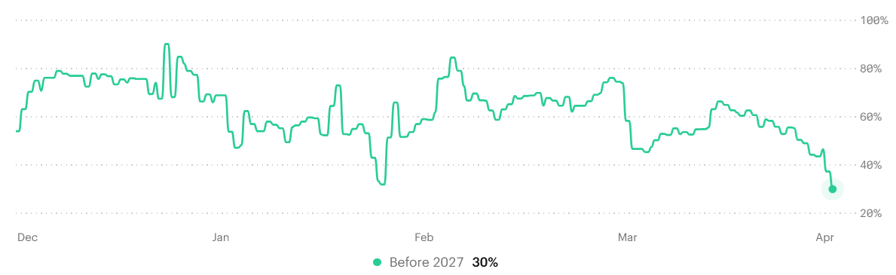
Odds of crypto market structure legislation approval by 2027. Source: Kalshi
Traders are currently pricing in lower odds of the CLARITY Act’s approval. This crypto market structure bill cleared the House of Representatives in July 2025 but has since stalled in the Senate Banking Committee.
While it is impossible to pinpoint the exact drivers behind the Bitcoin price correction to $76,000, the lack of momentum in US-Iran negotiations, weakness in real estate markets, and negative regulatory pressure have likely undermined investor confidence. These factors, alongside the downturn in technology stocks on Tuesday, have created a challenging environment for Bitcoin.
This article is produced in accordance with Cointelegraph’s Editorial Policy and is intended for informational purposes only. It does not constitute investment advice or recommendations. All investments and trades carry risk; readers are encouraged to conduct independent research.
Online payments firm Block has launched proof-of-reserves for its corporate Bitcoin treasury and two of its flagship products, Cash App and Square, joining a growing list of crypto companies proving their holdings onchain.
“People shouldn’t have to trust that their bitcoin is there, they should be able to verify it,” the Jack Dorsey-led company said in a post to X after announcing the proof-of-reserves feature and other new offerings in Las Vegas on Monday.
Block said anyone can “independently confirm Block’s holdings” through on-chain signatures. “Reserves are actively controlled, not just historically observed,” it added.
Source: Block
The proof-of-reserves seeks to verify the 8,883 Bitcoin, worth $681.4 million, marked on Block’s balance sheet — the 14th-largest Bitcoin holding among corporate treasuries.
Proof-of-reserves became more widely adopted after the collapse of FTX in November 2022 as a transparency measure to assure customers that holdings were fully backed, secure and not at risk of misuse.
Binance, Kraken, OKX, Bitfinex and Bitget are among the largest crypto trading platforms that have adopted proof-of-reserves disclosures.
Strategy’s Saylor once said proof-of-reserves is a ‘bad idea’
Strategy, the biggest corporate holder of Bitcoin in the world, has not issued any proof-of-reserves.
In May 2025, Strategy executive chairman Michael Saylor flagged proof-of-reserves as a security risk when asked why his company doesn’t adopt the measure, arguing that it exposes sensitive information.
“It actually dilutes the security of the issuer, the custodians, the exchanges and the investors,” Saylor said at the time. “It’s not a good idea. It’s a bad idea.”
Display of Bitcoin proof-of-reserves for Block’s Bitcoin treasury, Cash App and Square. Source: Block
Block also launched a Bitkey hardware wallet with a touchscreen to verify transactions while rolling out a feature on Cash App allowing certain users to have payments automatically converted into Bitcoin.
Related: ‘Historical average’ could push Bitcoin bottom at $57K level: Analyst
Block is also offering 5% Bitcoin cash back rewards at Square merchants and has raised customer withdrawal limits fivefold to $10,000 per day and $25,000 per week.
Dorsey is one of the biggest advocates seeking to push Bitcoin payments into the mainstream.
He previously said Bitcoin payments must see wide adoption to uphold Satoshi Nakamoto’s original vision of Bitcoin as an electronic peer-to-peer cash system.
Magazine: Adam Back says current demand is ‘almost’ enough to send Bitcoin to $1M
Cointelegraph is committed to independent, transparent journalism. This news article is produced in accordance with Cointelegraph’s Editorial Policy and aims to provide accurate and timely information. Readers are encouraged to verify information independently.
Stake, the MENA region’s leading digital real estate investment platform, has entered into a strategic partnership with ACE & Company, a Swiss-headquartered global investment group managing over $2.0billion in assets. Together, the firms are developing liquidity solutions and a secondary transfer facility for investors utilizing Stake’s products.
Initially, the agreement will focus exclusively on Stake’s real estate portfolio within the UAE. These assets are currently held through Prescribed Companies, which operate as Special Purpose Vehicles (SPVs) within the Dubai International Financial Centre (DIFC).
Building a more liquid marketplace
By combining Stake’s innovative access model with ACE & Company’s two decades of experience in private market investing and secondary transactions, the partnership seeks to create a more liquid, transparent, and efficient marketplace.
Through the planned secondary infrastructure framework, investors are expected to benefit from:
Greater flexibility in managing their fractional real estate holdings.
Improved visibility and transparency around market pricing.
Clearer and more reliable pathways to liquidity.
The broader market also stands to benefit from this institutionalized framework, gaining enhanced stability, stronger price discovery, and a scalable source of long-term capital.
The new secondary framework operates entirely within Stake’s existing regulatory permissions, which are approved by the Dubai Financial Services Authority (DFSA). The DIFC’s established private markets framework, specifically its Prescribed Company regulations, provided the necessary legal infrastructure to enable this innovative model.
Confidence in UAE fundamentals
Manar Mahmassani, co-founder and Co-CEO of Stake
The joint venture reflects both firms’ deep confidence in the long-term fundamentals of the UAE. Even amid heightened regional uncertainty, the UAE continues to attract sustained global investor interest through its economic resilience, political stability, and high-quality infrastructure.
Manar Mahmassani, co-founder and Co-CEO of Stake, emphasized the strategic importance of building mature market infrastructure during this period.
“The UAE has always rewarded those who invest in it with conviction, and that’s exactly what this partnership represents,” Mahmassani said. He noted that while Stake launched during the COVID-19 crisis when Dubai’s property industry was at a low point, the underlying market fundamentals remained sound.
Sherif El Halwagy, partner and co-Founder at ACE & Company
“Today, the world is watching the region, and we want to be unambiguous about where we stand: we are long Dubai, and we are long the UAE,” he added. “This is not the moment to retreat: it’s the moment to build the institutional infrastructure this market deserves.”
Sherif El Halwagy, partner and co-Founder at ACE & Company, echoed this sentiment.
“Drawing on almost two decades of experience in offering liquidity to investors across private markets ecosystems via secondaries, we see a tremendous opportunity in real estate secondaries in the UAE,” El Halwagy stated. “This partnership reflects our conviction in the country’s long-term fundamentals and our disciplined approach to capital deployment in high-quality assets.”
As fractional ownership continues to gain mainstream traction globally, both Stake and ACE & Company believe that robust secondary infrastructure will play a critical role in supporting the sector’s sustainable expansion in the UAE and beyond.
Bitcoin (BTC) is trading roughly 40% below its October 2025 record high near $126,000 despite its ongoing recovery.
BTC/USD daily chart. Source: TradingView
Still, some of the cryptocurrency’s loudest bulls, including billionaire investor Tim Draper and Fundstrat’s co-founder Tom Lee, have not backed down from their $250,000 year-end prediction, a target that would require more than a threefold rally from current levels.
Is that realistic, or is Bitcoin’s latest drawdown a warning that the cycle has already peaked?
Key takeaways:
Bitcoin’s selloff may resume due to a bearish continuation setup.
Halving and midterm election fractals appear bearish for the BTC price in 2026.
Veteran trader warns of more BTC price decline
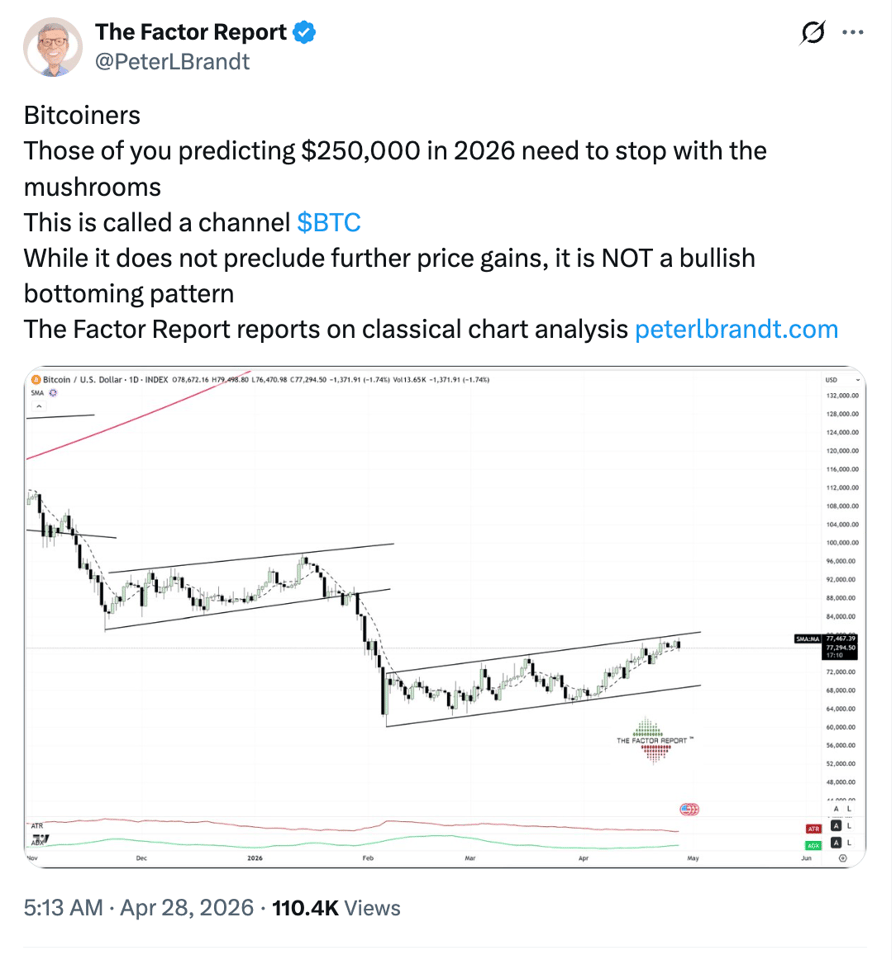
Peter Brandt, a veteran futures market trader, highlighted a channel pattern on the Bitcoin daily chart, which could keep BTC’s odds of rising toward $250,000 this year low.
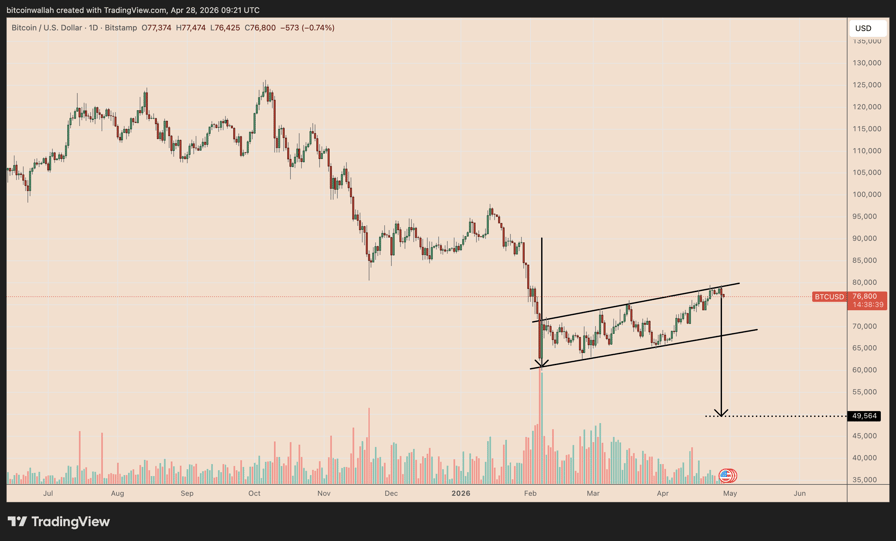
As of Tuesday, BTC was showing signs of a pullback after testing the upper boundary near $79,500 as resistance. The cryptocurrency risks declining toward the flag’s lower boundary around the $69,000 level by May if the correction persists.
Those of you predicting $250,000 in 2026 need to stop with the mushrooms This is called a channel
While it does not preclude further price gains, it is NOT a bullish bottoming pattern
Source: X
Looking broadly, the channel appears like a bear flag pattern. A break below its lower trend line may push the BTC price under $50,000 if the technical setup plays out as intended.
BTC/USD daily chart. Source: TradingView
Bitcoin halving fractals show the bear market is midway
BTC’s price cycles have historically followed a clear pattern tied to its halvings every four years.
Cycle peaks have consistently occurred 12 to 18 months after the event. In 2012, the peak arrived in 12 months. The 2016 halving saw its top in 17 months, while the 2020 halving peaked after 18 months.
The April 2024 halving fits this timeline. Bitcoin hit its all-time high of $126,000 in October 2025, roughly 17–18 months later.
Bitcoin price performance since halving
Now, in late April 2026 (over 24 months post-halving), BTC trades around $77,000, down 38%–40% from that peak. This alignment suggests the 2025 high may represent the cycle top, casting doubt on new highs for the remainder of 2026.
Bitcoin sell-off may resume in May
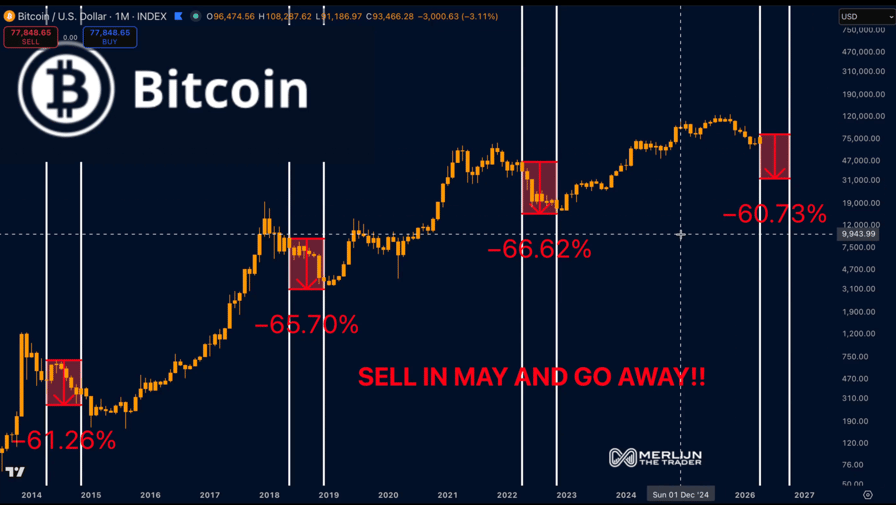
A chart by analyst Merlijn The Trader is adding to the cautious narrative, pointing to a recurring “Sell in May” pattern in US mid-term election years.
For instance, BTC dropped 61% in 2014, 65% in 2018, and 66% in 2022, each beginning around May of the election years.
BTC/USD one-month chart. Source: TradingView/Merlijn The Trader
Applying a similar framework to 2026, Merlijn projected a potential decline of over 60%, which would place BTC near the $30,000 level.
In a February report, Capital Group analysts Matt Miller and Chris Buchbinder said midterm elections often raise uncertainty over congressional control and policy direction. As campaign rhetoric heats up in the spring, investors tend to cut risk, slow buying, and brace for volatility.
That backdrop weakens the case for Bitcoin reaching $250,000 by year-end, even though several analysts, including those from Bernstein, see room for a more modest rebound toward the $100,000–$150,000 range.
This article is produced in accordance with Cointelegraph’s Editorial Policy and is intended for informational purposes only. It does not constitute investment advice or recommendations. All investments and trades carry risk; readers are encouraged to conduct independent research.
Anti-Money Laundering enforcement has overtaken securities violations as the leading regulatory threat facing crypto companies, according to CertiK, with the United States Department of Justice and Financial Crimes Enforcement Network imposing $900 million in AML-related fines during the first half of 2025.
The shift marks a sharp break from the US Securities and Exchange Commission-led enforcement cycle that defined earlier years of crypto regulation. SEC crypto-specific penalties collapsed 97% in penalty value year over year, dropping from $4.9 billion in 2024 to $142 million in 2025, according to a Tuesday report by blockchain security auditor CertiK.
Transaction monitoring and licensing failures are now drawing penalties that rival or exceed many earlier crypto securities cases. The DOJ’s February 2025 settlement with OKX reached $504 million, while KuCoin paid $297 million in January 2025, both for operating unlicensed money transmitting businesses and Bank Secrecy Act violations.
Notable AML-related penalties in 2025. Source: CertiK
The surge in AML enforcement highlights regulators’ growing focus on compliance controls and financial surveillance, with penalties increasingly targeting operational failures rather than disclosure-related violations. The shift reflects both a change in US administration policy and a broader reassessment of the SEC’s jurisdictional approach to digital assets, according to the report.
Related: AMLBot says social engineering drove 65% of crypto cases it probed in 2025
Sanctions-related crypto volume grew over 400% year-over-year in 2025, driven primarily by Russia-linked networks and state-aligned stablecoin infrastructure, forcing regulators across all major jurisdictions to prioritize transaction monitoring and cross-border financial crime compliance over token classification disputes.
European AML fines surged 767% over the same period, while Asia-Pacific regulators increasingly favor license revocations and business improvement orders over monetary penalties.
Broader regulatory trends
The enforcement pivot coincides with broader global regulatory trends documented in the report. Stablecoin regulations, for example, are moving from design to implementation across major jurisdictions, with binding frameworks now operational from the Guiding and Establishing National Innovation for US Stablecoins (GENIUS) Act to the Markets in Crypto Assets (MiCA) regime.
Prudential standards for custodians and exchanges are tightening, with requirements now covering capital adequacy, asset segregation, liquidity management and recovery planning.
The Basel Committee’s cryptoasset prudential standard, scheduled for implementation from Jan. 1, 2026, subject to local adoption, has also created what the report calls a “structural divide” for institutional adoption. Group 2 assets, including Bitcoin and Ether, face near-100% capital charges, making them economically difficult for banks to hold on the balance sheet, while Group 1 assets, such as tokenized traditional instruments and qualifying stablecoins, receive standard risk weighting.
Related: Pierre Rochard warns US regulators over Bitcoin gap in Basel rewrite
A CertiK research team spokesperson told Cointelegraph that banks managing digital assets under the oversight of regulators such as Singapore and the EU are already subject to this adjusted enforcement.
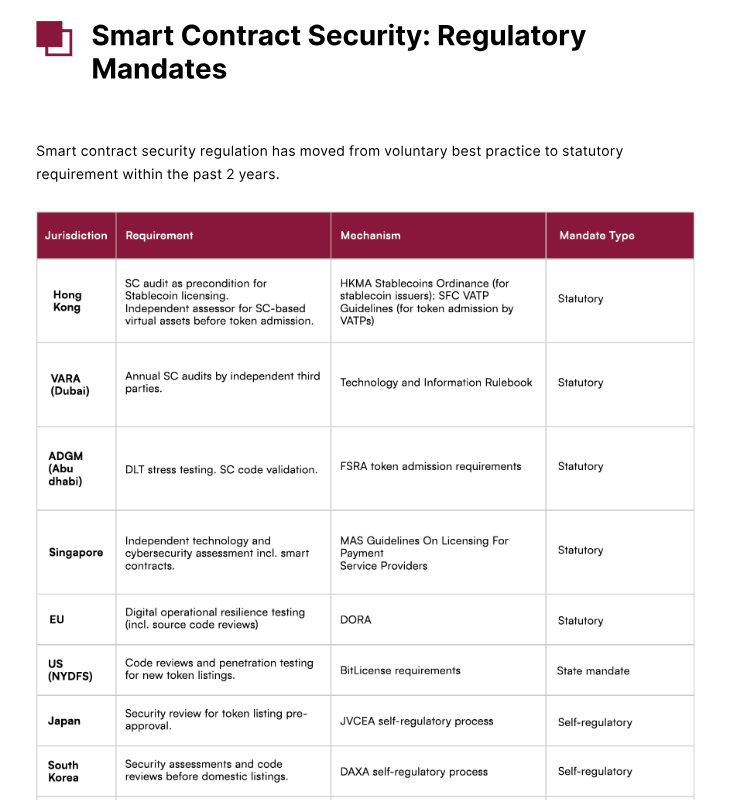
CertiK said smart contract security assessments are increasingly being folded into licensing and compliance expectations across major markets, with security audits moving from voluntary best practice to statutory or quasi-statutory requirement across major jurisdictions within two years.
That push for mandatory audits comes as regulators grapple with identifying accountability in decentralized finance. A European Central Bank working paper published in March, for example, found that governance in major DeFi protocols remains highly concentrated, complicating efforts to determine who should fall under MiCA oversight.
CertiK’s analysis of the top 100 exploited protocols found that 80% had never undergone a formal security audit before a breach, and those unaudited protocols accounted for 89.2% of total value lost. At the same time, the report says infrastructure compromises such as private key theft and access control failures drove 76% of 2025 losses by value, as the threat landscape moved beyond code exploits.
The spokesperson said that current regulatory audit requirements are in line with Web2 frameworks and that authorities generally delegate identifying relevant threats to supervised entities. While regulators may require yearly testing or various operational resilience efforts, such as source code reviews, they seldom prescribe a specific scope to avoid restricting the reach of such evaluations, they said.
Magazine: Singapore isn’t a ‘crypto hub’ — it’s something better: StraitsX CEO
Cointelegraph is committed to independent, transparent journalism. This news article is produced in accordance with Cointelegraph’s Editorial Policy and aims to provide accurate and timely information. Readers are encouraged to verify information independently.
The miner locked in fixed borrowing costs and extended maturity, but a shrinking BTC treasury and loan-to-value triggers leave little room for error if prices slide.
Polymarket is seeking approval from the Commodity Futures Trading Commission (CFTC) to bring its main prediction market back to U.S. users.
The company has discussed lifting its ban on U.S.-based traders with CFTC officials in recent weeks, Bloomberg reported Tuesday, citing sources familiar with the talks. The ban has been in place since Polymarket reached a 2022 settlement with the agency and moved its main exchange overseas.
The CFTC cleared a separate U.S.-only Polymarket platform last November after the company acquired a registered exchange. That site has yet to fully launch.
Prediction markets let users trade contracts tied to future events, such as elections, sports games or economic data. These markets have drawn increasing scrutiny from various states, which argue these function as unlicensed gambling operations.
The CFTC would need to vote before it could remove Polymarkt’s U.S. block. That process may be simpler now because four commission seats are vacant, leaving Chairman Michael Selig as the only sitting commissioner.
Selig has in the past defended that states do not have the ability to police prediction markets, whose authority falls under the CFTC’s purview.
The talks also come after authorities accused a soldier of using a Virtual Private Network (VPN) to access Polymarket’s international exchange and make more than $400,000 from trades based on classified information.










.png?prefix=media%2Fcontent)