Home Blog Page 402

Aave Partially Unfreezes WETH After Kelp Bridge Exploit

0

After attackers deposited rsETH from an exploited Kelp bridge and borrowed Wrapped ETH, Aave had frozen WETH across multiple markets.

Aave announced earlier today, April 21, that it has unfrozen wrapped ETH (WETH) reserves on its Ethereum Core V3 market, just over 24 hours after locking down WETH across multiple markets in response to the $290 million Kelp bridge exploit.

“WETH reserves on the Ethereum Core V3 market have been unfrozen and users can supply WETH to Ethereum Core V3 again,” Aave wrote on X this morning. WETH is a tokenized version of ETH compatible with decentralized finance smart contracts.

Late evening ET on April 19, Aave had frozen WETH reservers across its Core, Prime, Arbitrum, Base, Mantle, and Linea markets. “This action prevented new borrows against WETH collateral and contained the risk of stress spreading to other reserves, including stablecoins,” and April 20 incident report co-authored by Aae and LlamaRisk explained.

As The Defiant has reported, this year’s largest DeFi exploit so far happened on April 18, when a hacker exploited a vulnerability in liquid restaking protocol Kelp’s LayerZero bridge to forge a cross-chain message, releasing 116,500 KelpDAO Restaked ETH (rsETH), worth over $290 million, without any real tokens being sent.

The attacker deposited most of the rsETH as collateral on Aave and borrowed roughly $190 million in WETH across Ethereum and Arbitrum.

Aave’s risk team froze rsETH across all its markets within hours, then froze WETH itself on April 20 to stop the crisis from spreading further. Users had been unable to withdraw WETH or supply new deposits since.

As of April 21, WETH supply on Ethereum Core V3 is open again, though WETH’s loan-to-value ratio remains at zero, meaning it cannot be used as collateral for new borrowing. WETH on Ethereum Prime, Arbitrum, Base, Mantle, and Linea remains frozen, Aave noted on X.

The decision drew criticism from Spark’s head of strategy, who argued on X that the current interest rate configuration turns the unfreeze into a near-risk-free looping opportunity for holders of liquid staking and restaking tokens (LSTs and LRTs, which represent staked or restaked ETH positions) — keeping WETH locked up and making withdrawals even harder for ordinary depositors.

Depending on how Kelp ultimately allocates losses from the exploit, Aave faces between $124 million and $230 million in bad debt, per the protocol’s April 20 incident report. The Aave DAO holds $181 million in its treasury as of April 20, and says it has already received indicative commitments from ecosystem participants to help cover potential shortfalls.

Kelp is the second-largest liquid restaking protocol in DeFi per DefiLlama data, with $1.55 billion in total value locked across sixteen chains.

This article was written with the assistance of AI workflows. All our stories are curated, edited and fact-checked by a human.

Where regulation, technology and criminal behaviour are heading

0


  • How will the UK Fraud Strategy 2026–2029 reshape the responsibilities and expectations of banks, fintechs, telcos, and online platforms?

  • What early‑warning intelligence do organisations need to detect criminal innovation faster, and why aren’t current data‑sharing models delivering it yet?

  • How can identity systems evolve quickly enough to counter synthetic IDs, AI‑driven impersonation, and deepfake‑enabled attacks?

  • What governance, controls, and technology investments are required to secure instant payments without compromising customer experience or economic growth?

  • Where do emerging risks in digital assets, DeFi, and quantum‑accelerated threats intersect with mainstream AML and fraud obligations, and how should organisations prepare now?


The UK is entering a decisive new phase in its fight against financial crime, with the forthcoming Fraud Strategy 2026–2029 signalling a fundamental shift in how the country intends to disrupt criminal activity, safeguard consumers, and accelerate national resilience. This webinar will unpack the early implications of this system‑wide approach, exploring how the convergence of technology, regulation, and criminal innovation is reshaping expectations across banking, fintech, telco, online platforms, and law enforcement. Attendees will gain clarity on the threats growing fastest, from real‑time payment exploitation to synthetic identities, and why a coordinated national response has become essential. 

As fraud rapidly evolves into a hyperconnected, cross‑channel threat, organisations must rethink how they detect early signals, share intelligence, and collaborate at speed. The session will explore the structural vulnerabilities criminals are exploiting today and the operational gaps that still prevent earlier intervention. By analysing patterns across payments flows, digital identity, crypto markets, and online environments, the webinar will show how industry and government can work together to strengthen defences long before harm occurs. These insights set the stage for deeper cross‑sector conversations happening at NextGen FinCrime on 8 July. 

Technology is also transforming both sides of the equation. Criminals are increasingly using AI‑generated identities, deepfakes, and real‑time manipulation to bypass legacy controls, while defenders now have access to predictive analytics, behavioural biometrics, tokenisation, and cloud‑native fraud platforms that can radically improve detection and response. This webinar will highlight where innovation is accelerating risk, and where it creates opportunity. These themes directly connect to the event’s dedicated sessions on identity, AI‑driven prevention, and the emerging risks in crypto and DeFi that will define the next decade. 

Ultimately, this webinar offers a strategic preview of the issues, insights, and cross‑industry expertise that will be explored in depth at NextGen FinCrime. By drawing on the themes of collaboration, intelligence‑sharing, regulation, and future threat landscapes, the session provides essential context for anyone shaping fraud, security, compliance, or digital strategy. For leaders seeking to understand not just what’s changing now, but what must change next, NextGen FinCrime will bring together the UK’s most influential voices in financial crime prevention, and this webinar is your front‑row seat to what’s coming. 

Sign up for this Finextra webinar on 9 June, ahead of NextGen FinCrime on 8 July in London, to hear our panel of experts discuss early‑warning intelligence that organisations need to detect criminal innovation faster, and why current data‑sharing models aren’t delivering it yet? 

XRP And The CLARITY Act: The Latest Updates Investors Should Know

0

Trusted Editorial content, reviewed by leading industry experts and seasoned editors. Ad Disclosure

XRP pundit X Finance Bull has provided key updates about the CLARITY Act that investors should be aware of. The pundit had earlier highlighted how key the crypto bill is for XRP, predicting that it could lead to massive growth for the token.

XRP Pundit Gives Key Updates On CLARITY Act

In an X post, X Finance Bull alluded to statements by key political figures indicating progress on the CLARITY Act. This includes White House crypto advisor Patrick Witt, who said that a compromise between the banks and the crypto industry on the stablecoin yield text. Witt also mentioned that they are looking to close out the remaining issues. 

The XRP pundit further highlighted Senator Mark Warner’s statement about how they have made more progress in four days than in four months. Senator Cynthia Lummis also said that the clash on stablecoin rewards was 99% resolved. 

Meanwhile, Senator Bill Hagerty and Coinbase’s Chief Policy Officer (CPO) Faryar Shirzad both expect the CLARITY Act’s markup to happen this month, although that is looking unlikely. The XRP pundit alleged that the crypto provisions are in good shape and that what remains is political negotiation over community bank deregulation, housing packages, and ethics provisions regarding U.S. President Donald Trump’s involvement in crypto. 

X Finance Bull also claimed that issues around DeFi and commodity classifications have been settled, which is a positive for the CLARITY Act’s advancement. The XRP pundit highlighted that time is of the essence. He alluded to Galaxy Research’s statement that the crypto bill must pass within weeks. 

At the same time, Senator Lummis has warned that failing to pass the bill now will mean they will need to wait until 2030. The XRP pundit noted how the advancement of the CLARITY Act could serve as a tailwind for every crypto asset under a regulatory cloud. 

CLARITY Act Markup May Be Delayed

According to a Punchbowl report, Senator Thom Tillis has told the Senate Banking Committee Chair Tim Scott that the panel should not plan to advance the CLARITY Act this month. Senator Tillis, alongside Senator Angela Alsobrooks, has been mediating between the banks and the crypto industry to resolve the clash over stablecoin rewards. 

Senator Tillis said that the negotiators need more time to finalize a compromise between the banks and the crypto industry on stablecoin yield. The senator suggested that they could now look to a May markup for the crypto bill rather than an April markup. Amid this potential delay for the crypto bill, X Finance Bull has stated that the crypto bill could serve as a bullish catalyst for XRP. He declared that those who bought early and did not get shaken out are going to “eat good.”

XRP
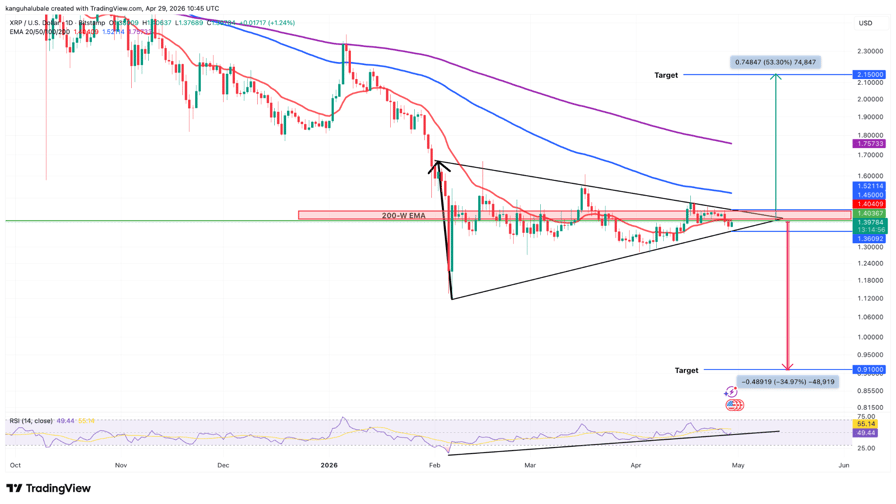
XRP trading at $1.43 on the 1D chart | Source: XRPUSDT on Tradingview.com

Featured image from Adobe Stock, chart from Tradingview.com

Editorial Process for bitcoinist is centered on delivering thoroughly researched, accurate, and unbiased content. We uphold strict sourcing standards, and each page undergoes diligent review by our team of top technology experts and seasoned editors. This process ensures the integrity, relevance, and value of our content for our readers.

New York Attorney General Sues Coinbase, Gemini Over Unlicensed Prediction Markets

0

New York AG Letitia James filed suit against Coinbase and Gemini, alleging their prediction market platforms constitute illegal gambling operations lacking state licenses.

New York Attorney General Letitia James sued Coinbase Financial Markets, Inc. and Gemini, Titan LLC on April 21, 2026, alleging both platforms illegally operated unlicensed gambling operations through prediction market offerings in New York.

The AG’s investigation found that Coinbase and Gemini’s prediction markets —which allow users to bet on sports, entertainment, and election outcomes —violate New York state gambling laws by operating without Gaming Commission licenses. The suit seeks court orders requiring both companies to pay fines, forfeit illegal profits, and provide restitution to customers.

The AG’s complaint highlights that both platforms allow New Yorkers ages 18 and older to access the prediction markets, despite New York law requiring participants in mobile sports betting to be at least 21 years old. The AG cited research showing early exposure to gambling increases risks of depression, anxiety, and financial stress, noting the platforms lack necessary consumer protections.

By operating unlicensed, Coinbase and Gemini bypass tax obligations that licensed casinos and mobile sports betting platforms must pay, which fund public schools, youth sports programs, and problem gambling treatment in New York.

Sources: New York State Attorney General

This article was generated automatically by The Defiant’s AI news system from publicly available sources.

Fintech Landscape in the Caribbean: Antigua and Barbuda in 2026

0

The following is a fintech and wider digital and economic development of the two-island Caribbean nation of Antigua and Barbuda in 2026.

Antigua and Barbuda’s fintech evolution in 2026 reflects a small two-island state navigating the intersection of tourism dependency, financial services and digital ambition. While its scale is modest, its trajectory is increasingly aligned with a broader Caribbean shift towards digital finance, resilience and economic diversification.

Antigua and Barbuda, with a population of shy of 100,000 people, has an economy valued at approximately $2.0 billion. Tourism accounts for over 60 per cent of gross domestic product (GDP) and employment, complemented by financial services, construction and a small agricultural sector. Its GDP per capita is around $20,000, placing the country among the higher-income economies in the Caribbean.

Digital economic transformation: resilience through diversification

Antigua and Barbuda’s digital transformation is closely tied to its broader economic strategy of reducing reliance on tourism and enhancing resilience. This is notable considering following the disruptions of recent years.

Government priorities have focused on expanding digital infrastructure and connectivity, promoting e-government services, supporting entrepreneurship and digital innovation, and strengthening the financial services sector.

Internet penetration exceeds 90 per cent, and mobile usage is widespread, providing a strong foundation for digital adoption.

The government has also explored opportunities in digital assets and fintech, positioning the country as a potential hub for innovation within the Eastern Caribbean.

Financial services sector: regional integration and digital shift

The capital of Antigua, St John’s with St John’s Cathedral in the background. IMAGE SOURCE GETTY

The country’s financial hub is St. John’s, where banking, offshore financial services and regulatory institutions are concentrated. The largest banks in the country are: ACB Caribbean (Antigua Commercial Bank), Eastern Caribbean Amalgamated Bank (ECAB), Caribbean Union Bank (CUB), and CIBC FirstCaribbeane.

Antigua and Barbuda’s financial services sector operates within the framework of the Eastern Caribbean Currency Union (ECCU), with the Eastern Caribbean Central Bank (ECCB) overseeing monetary policy and financial stability.

Digital transformation has accelerated in recent years, driven by both regional initiatives and local adoption. Key developments include:

  • DCash (Central Bank Digital Currency or CBDC) – The ECCB has continued to develop and refine DCash, one of the world’s first retail CBDCs, aimed at improving payment efficiency and financial inclusion across member states.
  • Expansion of digital payments infrastructure – Efforts have focused on increasing the adoption of electronic payments, reducing reliance on cash and enhancing transaction efficiency.
  • Regulatory frameworks for fintech and digital assets – Authorities have explored regulatory approaches to fintech innovation, including digital assets, while maintaining compliance with international financial standards.
  • Promotion of financial inclusion and digital services – The ECCB and local regulators have supported initiatives to expand access to financial services, particularly for underserved populations.

Financial inclusion: high access, evolving digital usage

Antigua and Barbuda benefits from relatively high levels of financial inclusion. Estimates suggest that approximately 90 per cent of adults have access to a bank account, reflecting a well-developed banking system.

However, the focus has shifted from access to increasing digital adoption, improving payment efficiency, and expanding financial services offerings.

Digital payments, mobile banking and online financial services are becoming more prevalent, particularly among younger populations and businesses.

Challenges remain in expanding digital literacy, encouraging adoption of new technologies such as CBDCs, and enhancing access for small businesses and informal sectors

Fintech ecosystem: small but strategically positioned

Antigua and Barbuda’s fintech ecosystem is relatively small, with an estimated 40 fintech and digital financial service providers, many of which operate within the broader Eastern Caribbean region.

Key players across fintechs and wider financial services digital include: ECAB Online (digital banking services through Eastern Caribbean Amalgamated Bank), Caribbean Credit Card Corporation (supporting payment processing and financial services) and WiPay (regional digital payments provider operating across the Caribbean).

These entities highlight a key characteristic of the ecosystem: regional integration and collaboration, rather than standalone domestic scale.

Conclusion: small state, strategic direction

Antigua and Barbuda’s fintech journey is defined by pragmatism and regional alignment. While scale remains limited, the country is positioning itself within a broader Caribbean ecosystem. This is demonstrating that even small states can leverage fintech to build resilience, inclusion and future-ready financial systems.

Here Is Why The Bitcoin Price Upside Could Be Capped at $84K

0

Market analysts said Bitcoin’s (BTC) latest rally to $78,000 means that the “uptrend has began,” but the upside could be capped at $84,000, based on several key metrics.

Key takeaways:

Bitcoin profitability suggests BTC rally “has begun” 

Bitcoin’s recent price recovery toward $76,000 has pushed it more than 26% above its sub-$60,000 multi-year low reached on Feb. 6.

This was accompanied by an increase in the Spent Output Profit Ratio (SOPR), which hit an eight-month high of 2.87, after dropping as low as 0.62 in early February.

Related: Bitcoin risks losing $70K as Strategy’s STRC slips below $100

SOPR is a metric used to show whether Bitcoin investors have made a profit or loss compared to when they first held Bitcoin. This ratio has historically marked the short-term bottom for BTC when it hits its lowest point.

“The $BTC SOPR Ratio shows that $BTC has already broken out of the bottom and is rising,” CryptoQuant analyst CW8900 said in a Tuesday post on X, adding:

“The bottom for $BTC was formed last February. The rally is already in progress.”

Bitcoin SOPR. Source: CryptoQuant

Similarly, Bitcoin’s Net Unrealized Profit/Loss (NUPL), the difference between total profits and losses currently held by investors, has flipped positive for the first time since early January.

This suggests that the downtrend for Bitcoin has ended, and the “real rally of this cycle has begun,” CW8900 said in another X post.

Bitcoin NUPL. Source: CryptoQuant

This structurally resembles conditions seen in early stages of previous bull markets, where the NUPL recovered from extended periods below zero as Bitcoin embarked on a sustained rally.

1.1 million BTC at $84,000 could trigger sell-off

According to Bitcoin’s cost basis distribution data, investors hold approximately 1.1 million BTC at an average cost of $84,000, creating a potential resistance zone. This concentration suggests many investors may sell at break-even, potentially stalling Bitcoin’s upward momentum.

Bitcoin cost basis distribution chart. Source: Glassnode

As Cointelegraph reported, Bitcoin’s immediate resistance is at $78,000, where the true market mean currently sits.

The US spot Bitcoin ETF cost basis at $83,100 is seen as the next key hurdle. 

BTC: Average cost basis of US spot ETFs. Source: Glassnode

Analyst AlphaBTC said the BTC/USD pair might rise higher to fill the CME gap at $84,000, which was created at the start of February.

BTC/USD four-hour chart. Source: AlphaBTC

As Cointelegraph reported, a close above the $76,000-$78,000 resistance zone would confirm that the buyers are in control, clearing the path for a potential rally to $84,000.