Commonwealth Bank of Australia has deployed an agentic AI system designed to help detect emerging fraud and scam patterns in transaction and payments data and generate the rules needed to help intercept them.
Editorial
This content has been selected, created and edited by the Finextra editorial team based upon its relevance and interest to our community.
The bank says it has a range of AI capabilities embedded in its fraud protection systems, which monitor more than 80 million signals each day, including transactions, card and online payments and interactions with digital channels.
James Roberts, executive GM, fraud and scams, CommBank, says: “When suspicious patterns are identified, the system quickly assesses their severity, analyses context, and proposes new detection rules to help intercept them.
“The new agent goes beyond traditional AI by not only rapidly identifying new threats but also determining how it can seek to disrupt them.”
The agent has also contributed to developing or updating three quarters of CommBank’s card fraud rules.
“The technology allows us to identify unusual events in highly complex patterns of activity at far greater speed and scale, helping us detect emerging threats sooner and update our controls faster,” says Roberts.
Bitcoin (BTC) rebounded 32% to a 10-week high of $79,500 on April 22 from its sub-60,000 multi-year low. But recent buyers took advantage of the rally to exit as the price has since corrected to $76,000 on Thursday, with $80,000 proving a tough barrier to break.
Key takeaways:
Bitcoin sell pressure risk exists around $80,000, a resistance level that may delay the bulls.
As Cointelegraph reported, Bitcoin failed to break above $80,000 as its rebound fell short of a bull market comeback.
This is due to the resistance zone between the True Market Mean at $78,000 and the Short-Term Holder (STH) cost basis at $79,000, which continues to cap upward momentum, as recent buyers used this range to exit near breakeven.
“This behavior is a textbook pattern in bear markets, where price approaches the breakeven level of the most price-sensitive cohort, the incentive to exit positions overwhelms incoming demand, exhausting upside momentum,” Glassnode said in its latest Week Onchain newsletter, adding:
“With this rejection confirming overhead resistance, the mid-term bias tilts toward further downward pressure.”
Bitcoin STH cost basis model. Source: Glassnode
Bitcoin’s cost basis distribution data shows that investors hold about 475,301 BTC at an average cost of $77,800-$80,880, reinforcing the significance of this resistance zone.
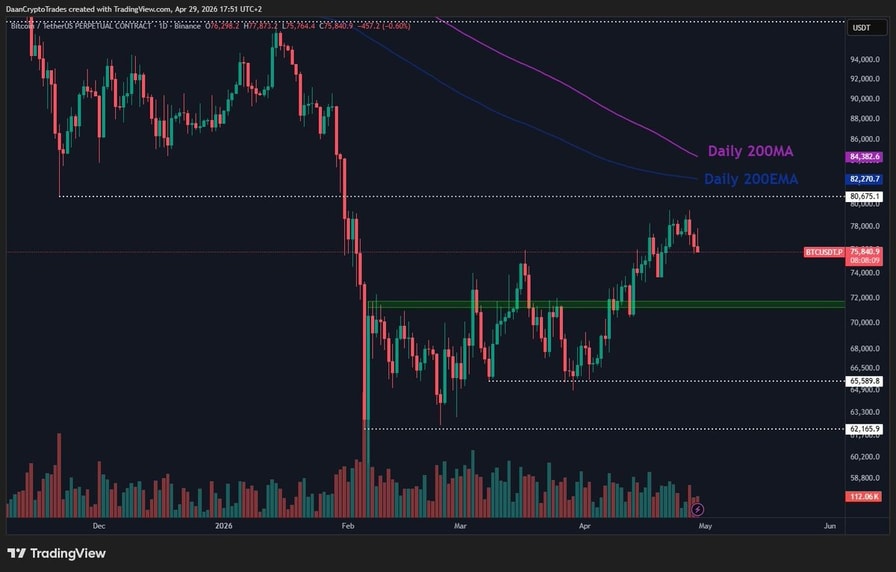
Traders say the BTC/USD pair must flip the resistance at $80,000 into support to target higher highs toward $84,000.
After reclaiming the 50-day and 100-day simple moving averages, BTC/USD has sent “one bottoming signal after another firing on higher timeframes,” technical analyst SuperBitcoinBro said in a Wednesday post on X, adding:
“But I agree it needs to get past 80K.”
Daan Crypto Trades said the $80,000 level remains the “main level for the bulls in the short/mid term.”
BTC/USD daily chart. Source: X/Daan Crypto Trades
As Cointelegraph reported, Bitcoin breaking $80,000 would signal that the bulls are still in control, paving the way for the next big resistance at $84,000.
BTC selling by short-term holders halts rally
Additional onchain data shows “heavy distribution” by short-term holders, as these investors booked profits on Bitcoin’s recent rally to $80,000.
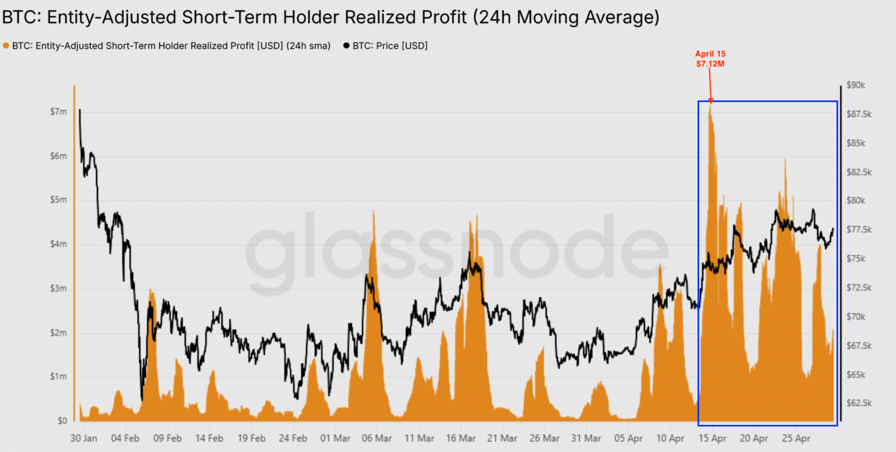
The 24-hour SMA of STH Realized Profit shows that as the price approached the $80,000 level, recent buyers realized profits at a rate of $4 million per hour.
The 24-hour SMA of STH Realized Profit is a real-time measure of how aggressively recent buyers are realizing gains.
The metric spiked as high as $7.2 million per hour on April 15, about roughly “four times the base level that had established itself since mid-April, confirming that short-term holders seized the rally as a distribution opportunity,” Glassnode said, adding:
“The buy side simply lacked sufficient liquidity to absorb this wave of profit realization, capping momentum and triggering the subsequent rejection.”
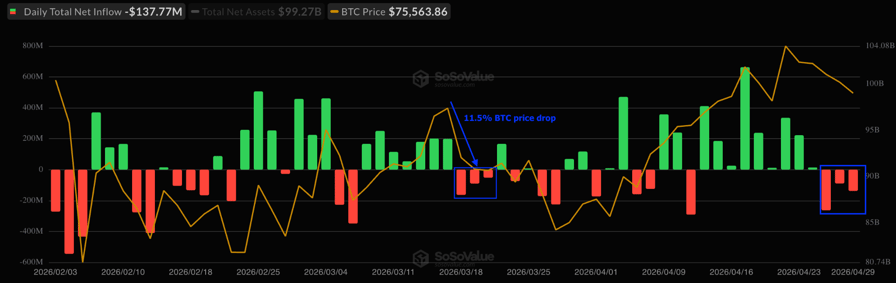
More selling pressure came from US spot Bitcoin exchange-traded funds, which have recorded outflows for three consecutive days, totaling $390 million.
This marked the longest outflow streak since March 20, when a three-day outflow streak accompanied an 11.5% BTC price drop after rejection at $76,000.
Spot BTC ETF flows chart. Source: SoSoValue
Analysts at Wise Advise said that the return to spot BTC ETF outflows after a nine-day inflow streak is the first sign that “the local top may be in.”
This article is produced in accordance with Cointelegraph’s Editorial Policy and is intended for informational purposes only. It does not constitute investment advice or recommendations. All investments and trades carry risk; readers are encouraged to conduct independent research.
Trusted Editorial content, reviewed by leading industry experts and seasoned editors. Ad Disclosure
Sometimes, on-chain data speaks loudly enough that traders stop to pay attention. That is precisely what happened this week, when analyst Ali Martinez pointed to an interesting trend in XRP whale behavior. Crypto analyst Ali Martinez revealed that 1.10 billion XRP were moved by whale accounts over the past week, using Santiment data to show a drop in the supply held by large wallets.
Reading The 1.1 Billion XRP Move
According to Martinez, who shared the finding on X alongside a Santiment chart, approximately 1.10 billion XRP was sold or redistributed by whales over the course of a single week. The chart shows whale holdings declining sharply from a peak of roughly 8.84 billion XRP down to approximately 7.66 billion, with the highest drop recorded on April 21 before flattening out.
That kind of drop shows a coordinated trend of selling or redistribution among large XRP holders. This is why the wording “sold or redistributed” matters. On-chain balance changes can show that whales reduced their holdings, but they do not always reveal the final motive behind the movement. Some tokens may have been transferred to exchanges and some may have been moved into smaller wallet addresses.
The market impact of the move on XRP’s price action cannot be dismissed, as the price has weakened over the past week. Data from CoinGecko shows a 7-day decline of about 3.7% at the time of writing. That makes the whale movement more sensitive because large holder distribution during a weak price phase can increase caution among traders.
What Comes Next After This?
The question raised by the whale data is what happens next for XRP ashe altcoin is currently trading at $1.37, pinned below the $1.4 resistance that a few analysts have identified as the important level for the next directional move.
Another question is whether XRP can absorb this supply movement without losing more ground. XRP has already fallen more than 60% over the past nine months and is only starting to reduce its corrections in April. Technical analysis of liquidity zones shows that there are liquidity pockets in both bullish and bearish directions, which means it could resolve in either way in the coming days.
Nonetheless, the altcoin is about to close April in the green, which would be its first green monthly candle since September 2025. That matters because it would show that buyers are finally beginning to slow the broader downtrend. It also gives a clear level to watch heading into May, as a green monthly close could improve retail sentiment around the cryptocurency.
Therefore, the 1.1 billion XRP movement from whales should be treated as more of a warning signal and not a final verdict. If XRP finds stability around $1.37 and closes April on a bullish note, and whale balances stop falling, then the move may end up as redistribution.
Price turns downward | Source: XRPUSDT on Tradingview.com
Featured image created with Dall.E, chart from Tradingview.com
Editorial Process for bitcoinist is centered on delivering thoroughly researched, accurate, and unbiased content. We uphold strict sourcing standards, and each page undergoes diligent review by our team of top technology experts and seasoned editors. This process ensures the integrity, relevance, and value of our content for our readers.
Kraken is introducing curated portfolio bundles combining cryptocurrency with traditional U.S. equities and ETFs through its xStocks offering.
Kraken announced the launch of Crypto + xStocks bundles on Thursday, April 30, enabling users to build diversified multi-asset portfolios combining digital assets with tokenized representations of traditional U.S. equities and ETFs in a single portfolio. The new product has geo restrictions and, as with xStocks separately, bundles are not available in the United States.
The bundles are automatically rebalanced and designed to simplify portfolio construction for investors seeking exposure across both crypto and traditional stock markets. Per Kraken’s blog post, example of bundles include S&P 500 + Bitcoin and Big Tech + Crypto.
The offering leverages Kraken’s xStocks infrastructure to provide curated portfolios that blend crypto’s growth potential with equity market stability. Users can access the bundles through Kraken’s platform with a single tap, addressing investor demand for streamlined multi-asset allocation tools.
Source: Kraken
This article was generated automatically by The Defiant’s AI news system from publicly available sources.
Crypto-based prediction market Polymarket has tapped blockchain analytics firm Chainalysis to monitor trading activity and enforce its market rules, as it works to address concerns about insider trading and market integrity.
Chainalysis brings a suite of tools, including investigative software and onchain monitoring systems, to flag suspicious behavior, based on a model designed to identify patterns consistent with traders acting on non-public information, the firms announced on Thursday.
The move comes amid growing scrutiny of prediction markets. Critics have argued that platforms like Polymarket could be vulnerable to insiders — such as political operatives or corporate employees — placing informed bets before information becomes public. In traditional finance, such activity is illegal and closely monitored. In crypto-based markets, enforcement has been less clear.
Polymarket’s response is to lean into the transparency of blockchain. Because every trade is recorded onchain, activity can be traced and analyzed after the fact. By layering Chainalysis’ data tools on top, the company aims to detect suspicious trades in real time and, if needed, share evidence with regulators.
In simple terms, Polymarket is bringing in a kind of digital police force. The goal is to show that even in a decentralized environment, rules can be enforced. The broader aim is to reposition Polymarket as a credible financial platform rather than a crypto betting site.
“Polymarket was built onchain because transparency matters, and our platform shows what markets can look like when trades are open, traceable, and accountable by design,” said CEO Shayne Coplan.
Coplan has argued that prediction markets serve a broader purpose than speculation. He described them as “a very useful thermometer of the world,” where prices reflect the probability of real-world outcomes, at an event in New York this week.
Still, that usefulness depends on trust. If users believe markets are being skewed by insiders, prices become less reliable. That risk has grown as Polymarket has expanded, gaining mainstream attention during events like elections and attracting both retail traders and institutional interest.
Coplan has emphasized building something durable, focusing on products that “last” instead of chasing short-term trends.
The following is a fintech and wider digital and economic development of the Caribbean nation of Barbados in 2026.
Barbados’ fintech story is one of careful reinvention. Long known for its strength in tourism, offshore financial services, and even being the home of singer Rihanna, the island nation is now repositioning itself within a more digital, compliance-driven and innovation-oriented global economy. The shift is deliberate. It is less about disruption and more about building a resilient, modern financial ecosystem that can compete internationally.
With a population of less than 300,000 people, Barbados’ economy is valued at approximately $7billion with a gross domestic product (GDP) per capita of around $18,000. Tourism and international business services form the backbone of economic activity, alongside a growing professional services and ICT sector. These facts place Barbados among the more developed economies in the Caribbean, all according to the World Bank.
Digital economic transformation
Barbados’ digital transformation is closely tied to its broader economic strategy of repositioning its financial services sector in response to global regulatory changes and shifting market dynamics.
Government priorities, aligned with national development strategies, have focused on expanding digital infrastructure and connectivity, promoting innovation in fintech and digital services, enhancing regulatory frameworks for international business, and supporting entrepreneurship and digital skills development
Internet penetration exceeds 90 per cent and mobile usage is widespread, providing a strong base for digital adoption.
Barbados has also sought to position itself as a trusted jurisdiction for digital finance, balancing innovation with compliance, particularly in areas such as digital assets and cross-border financial services. The country exemplifies a regional trend where fintech is increasingly seen as a pathway to economic diversification and global competitiveness.
Financial services sector
The Parliament Building, completed in 1874, is a masterpiece of Gothic Architecture, built of local coral limestone and strategically placed in the heart of Bridgetown. IMAGE SOURCE GETTY
Barbados’ financial services sector is mature and well-regulated, with strong links to international markets. However, digital transformation has accelerated between 2024 and 2026, driven by both regulatory initiatives and private-sector investment.
The Central Bank of Barbados (CBB) has played a central role in shaping this transition. Key initiatives include:
First, with respect to digital payments expansion, the CBB has been active in promoting the adoption of electronic payments, encouraging businesses and consumers to move away from cash-based transactions. Notably, BiMPay, the new national instant payment system (IPS), is planning to go live on the 12 June this year.
Initiated in 2021, this is part of the wider Barbados payments modernisation project, initiated in 2021. Other examples of the implementation of this includes promoting regional integration, such as testing the Caribbean Payments System (CAPSS) for regional, local-currency transactions.
Second, with respect to fintech regulatory frameworks, the country has strengthened its regulatory environment for fintech and digital financial services. This has ensured alignment with international standards while enabling innovation.
Third, related to earlier with CAPSS, the country has also been involved in a central bank digital currency (CBDC). This is mainly in the participation in regional CBDC initiatives. As part of the Eastern Caribbean region’s broader digital currency experimentation, Barbados has engaged in discussions around CBDC frameworks and interoperability, learning from initiatives such as DCash (the digital version of the Eastern Caribbean Dollar (DXCD) that was launched in 2021).
These initiatives reflect a regulatory philosophy focused on stability, transparency and gradual innovation, rather than rapid disruption.
Financial inclusion and fintech
The country’s financial hub is Bridgetown, where domestic banks, international business companies and regulators are concentrated. One of the largest banks is FirstCaribbean International Bank, a major regional player providing retail, corporate and increasingly digital financial services.
Barbados benefits from relatively high levels of financial inclusion, with approximately 90 per cent of adults holding a bank account.
As a result, the focus has shifted from access to increasing digital adoption, enhancing user experience, and expanding financial services offerings. Digital payments, mobile banking and online financial services are becoming more prevalent, particularly among younger consumers and businesses.
However, opportunities remain in digital financial literacy, access to credit for small and medium enterprises (SMEs), and serving the underserved communities in the country.
Barbados’ fintech ecosystem is relatively small but increasingly connected, with an estimated 60 fintech companies and digital financial service providers operating across payments, digital banking and financial infrastructure.
Key players include the likes of Bitt, which is a pioneer in digital currency and blockchain solutions, involved in CBDC projects across the Caribbean. In terms of other fintechs in the country non-Barbados HQed they include the likes of WiPay, Trinidad & Tobago-founded fintech providing digital payment solutions for businesses across the region. Another example is CaribPay.
In addition, organisations such as the Barbados Fintech Association play a critical role in supporting the ecosystem.
In summary
Barbados’ fintech journey is defined by strategy rather than speed. This year, the country is steadily modernising its financial system, leveraging digital innovation to enhance competitiveness and resilience. While scale remains limited, Barbados is positioning itself as a credible player in the global digital finance landscape. This is demonstrating how small economies can adapt and thrive in a rapidly evolving financial world.
Bitcoin (BTC) may undergo a massive rally, based on a recurring gold chart pattern, with gains of up to 180% over the next 12 months.
Key takeaways:
BTC is up nearly 40% versus gold since March after falling for seven months in a row.
Similar BTC/XAU recoveries have historically coincided with Bitcoin bottoms in US dollar terms.
BTC may hit $167,250 within a year
The bullish signal comes from the Bitcoin-to-gold ratio (BTC/XAU), which tracks BTC’s performance relative to gold in US dollar terms. Historically, sharp rebounds in this ratio have aligned with major Bitcoin cycle bottoms, often preceding strong upside.
In 2015, a BTC/XAU bottom preceded a roughly 250% Bitcoin rally within a year.
Similar reversals in 2019 and 2022 came before gains of around 140% each. Excluding 2020’s 1,460% liquidity-driven boom, the pattern points to an average one-year BTC gain of about 180% after BTC/XAU bottoms.
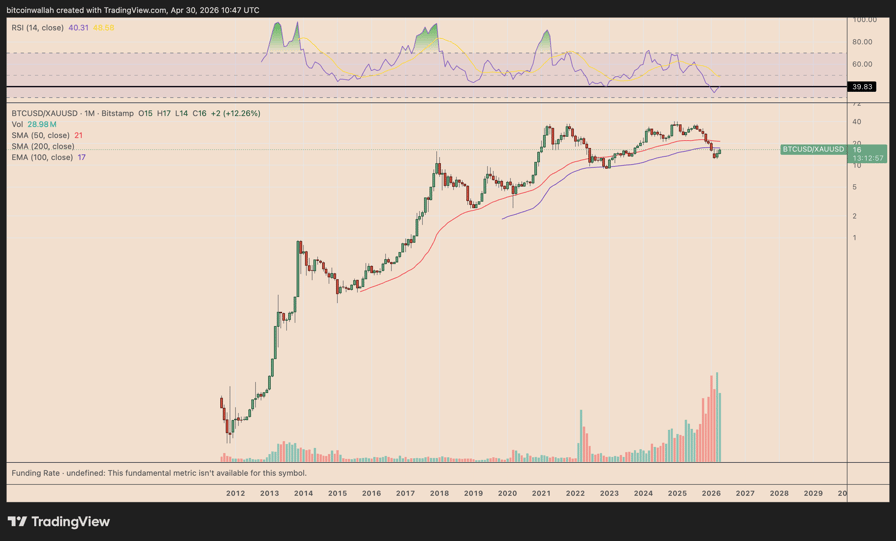
BTC/XAU monthly chart. Source: TradingView
As of 2026, the BTC/XAU ratio has climbed about 40% since February’s lows. The BTC/USD rate has jumped 32.65% in the same period.
“Bitcoin versus gold is about to close a second month in the green after 7 red candles in a row,” said Nik Bhatia, founder of macro research firm The Bitcoin Layer, adding that “the bounce is in.”
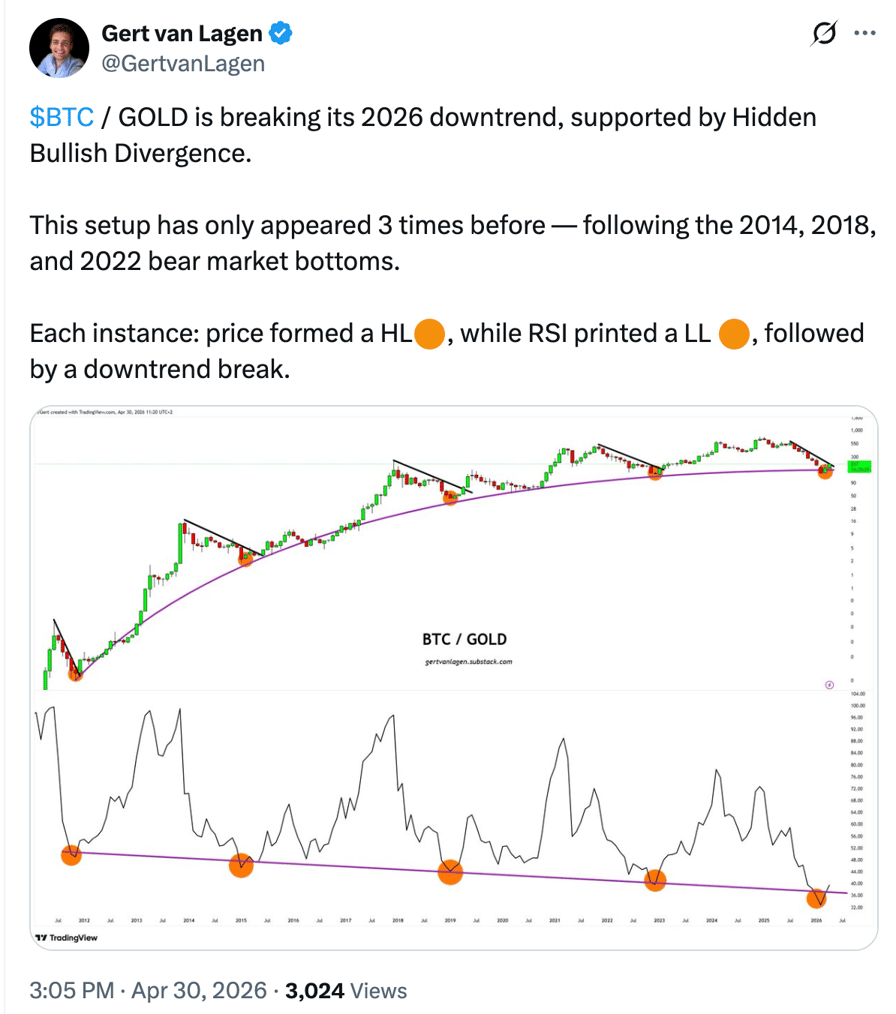
Macro strategist Gert van Lagen spotted a “hidden bullish divergence” pattern that appeared following the 2014, 2018, and 2022 bear market bottoms.
Source: X
In its April report, meanwhile, Fidelity Investments said Bitcoin has entered “an accumulation phase” while outperforming gold.
A 180% repeat of past cycles puts the BTC price target at $167,250 by April 2027, if the BTC/USD and BTC/XAU February lows are confirmed as bottoms.
Multiple analysts, including Bernstein’s Gautam Chhugani, have projected BTC’s price to reach the $150,000 mark in 2026, driven largely by a potential capital rotation from gold.
In April, Matt Hougan, chief investment officer of crypto asset manager Bitwise, said Bitcoin can become bigger than the gold market’s $30 trillion capitalization.
Key trend line puts bullish outlook in doubt
BTC/XAU remains below its 100-month exponential moving average (100-month EMA, the purple line), a level that previously marked major bottoms in March 2020 and December 2022.
BTC/XAU monthly chart. Source: TradingView
Its January breakdown was the first clear loss of this support. Staying below it risks trapping bulls and delaying Bitcoin’s relative recovery against gold.
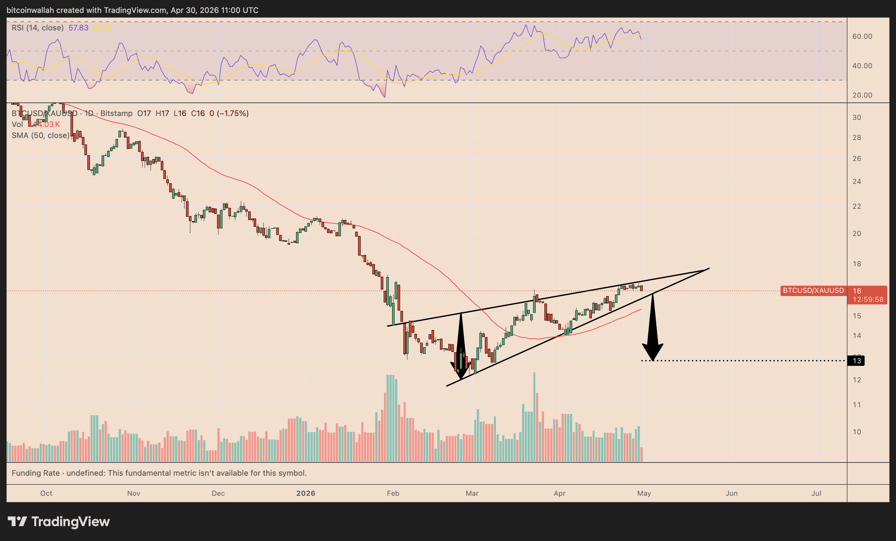
In the short term, BTC/XAU also faces resistance from a rising wedge on the daily chart.
BTC/XAU daily chart. Source: TradingView
The bearish reversal setup points to a potential 20% drop in Bitcoin’s gold-denominated value, based on the wedge’s measured move.
Related: Bitcoin eyes $75K after ‘most hawkish’ FOMC as oil hits highest since 2022
Macro conditions, such as elevated US bond yields and rising oil prices, may also disrupt historical patterns. As Cointelegraph reported, Bitcoin derivatives show traders are cautious as the Fed holds interest rates and BTC price consolidates.
This article is produced in accordance with Cointelegraph’s Editorial Policy and is intended for informational purposes only. It does not constitute investment advice or recommendations. All investments and trades carry risk; readers are encouraged to conduct independent research.
Coinbase’s (COIN) asset management arm said Thursday it’s rolling out a credit fund tied to stablecoin markets, with plans to offer investors onchain access through a tokenized share class.
The fund, called the Coinbase Stablecoin Credit Strategy (CUSHY), targets institutional investors seeking yield from lending activity tied to digital assets.
Investors will have the option to hold shares onchain through tokenization specialist Superstate’s platform. The fund will be available on Ethereum, Solana, and Base, Coinbase’s blockchain built on Ethereum.
The fund reflects a growing overlap between traditional credit markets and crypto infrastructure. Transactions in stablecoins — cryptocurrencies with prices pegged to fiat money — have surged in recent years as more financial activities migrate onto blockchains. The supply of stablecoins doubled to $300 billion in the past two years, while monthly transaction volume tripled to $1.2 trillion.
“Stablecoins are the bedrock of the next financial era,” said Anthony Bassili, president of Coinbase Asset Management. “With CUSHY, we are fusing the efficiency of digital rails with the rigor of traditional credit.”
Fund tokenization trend
The move also highlights a broader trend: Asset managers are starting to treat tokenization as an extension of existing products for broader distribution, a shift that could bring more traditional finance activity to the blockchain environment.
CUSHY’s tokenized share class is powered by FundOS, Superstate’s platform for bringing investment funds onchain. Rather than building custom token structures, asset managers can use FundOS to issue and manage blockchain-based shares alongside traditional ones.
That approach is gaining traction. Invesco, an asset manager with more than $2 trillion in assets under management, recently became the first large asset manager to adopt the platform, underscoring a move toward shared infrastructure rather than one-off tokenization efforts.
“We are the connective tissue between onchain demand and managers who have highly sophisticated institutional experience,” said Jim Hiltner, co-founder of Superstate.
Superstate said it expects several more asset managers to adopt the platform in the coming months, suggesting early momentum beyond initial partners.
Superstate CEO Robert Leshner said the partnership will allow the fund to expand across multiple blockchain networks and into decentralized finance (DeFi) use cases.
Ecommpay, the inclusive global payments platform, has published the first part of a new report titled ‘Beyond the Black Box: Why human-centric fraud demands ecosystem-wide transformation’.
The report brings together insights from various fraud, compliance, and regulation experts to examine fraud through the lens of systemic human vulnerability and the current misplacement of resources, regulation, and tools. Ultimately, it aims to support businesses that rely on the successful operation of e-commerce, including merchants and FinTechs active within the space.
Three uncomfortable truths
Through interviews with industry experts, the Ecommpay report identified three “(very) uncomfortable truths” regarding the current state of e-commerce fraud protection:
Current fraud prevention creates competitive disadvantage and market distortion.
Fraud prevention technology and regulation are not built to address the human vulnerabilities that have now become the primary attack vector.
Regulatory frameworks contain inherent conflicts that cannot be resolved at the institutional level.
The report explicitly highlights that while fraudulent attacks have shifted away from technical exploitation and toward human manipulation, the industry and regulatory response frameworks remain heavily anchored in technical and institutional solutions.
The need for ecosystem-wide change
Willem Wellinghoff, chief compliance officer and UK chair of Ecommpay
Willem Wellinghoff, chief compliance officer and UK chair of Ecommpay, emphasized the escalating nature of the threat.
“Fraud is an increasing threat, with the number of cases and the financial losses growing year-on-year,” Wellinghoff stated. “The challenge is that the methods criminals employ to defraud consumers and businesses continue to evolve, and regulation and technology struggle to maintain pace or get ahead. More needs to be done to bring about real, meaningful change.”
Ecommpay hopes the findings will stir merchants and FinTechs into action, urging them to join forces with competitors, industry bodies, regulators, and the government to bring about the change the ecosystem desperately needs.
Actionable steps for merchants
While broad, global change will require significant collaboration, Wellinghoff noted that there are steps e-commerce merchants can take immediately.
“Discussing fraud prevention with payment providers and taking a detailed look at internal systems is the best place to start, to quickly identify weaknesses and opportunities for improvements,” Wellinghoff explained.
The report outlines seven key fraud protection steps for e-commerce merchants:
Discuss fraud prevention with your payment provider.
Audit your own systems.
Educate your customers on the risk of fraud so they can protect themselves.
Train staff to recognise attempted fraud.
Stay up to date with the changing fraud landscape.
Monitor for unauthorised use of your brand and report fraudulent websites.
Report suspected fraudulent transactions directly to your payment service providers (PSPs).
Wellinghoff added that effective fraud prevention is not a “one-off tick-box exercise”. It requires ongoing monitoring, deep knowledge of the rapidly evolving landscape, and the continual development of internal solutions and processes to meet changing demands.
Founded in 2012 and headquartered in London, Ecommpay offers global and local acquiring and comprehensive payment processing, utilizing in-house fraud detection solutions to help merchants protect themselves and their customers.
For CJ Konstantinos, the case for Bitcoin-backed mortgages is personal. In 2019, he paid 100 Bitcoin for a house. That bitcoin is now worth roughly $7.6 million and he says he can’t sell his house for more than $500,000.
At the time, it was the kind of transaction most people in traditional finance would have called reckless. Now, Konstantinos runs Peoples Reserve and speaks at the world’s largest Bitcoin conference to explain why doing it again — this time through structured bitcoin lending products — makes sense for a growing number of holders.
“Bitcoin found me and smacked me up the head,” Konstantinos said Wednesday during a panel titled “From HODL to Home: Bitcoin-Backed Loans Meet Mortgages” on the Nakamoto Stage at Bitcoin 2026 in Las Vegas.
The session brought together executives from SALT Lending and Peoples Reserve to discuss a market they argue is at an inflection point: using Bitcoin as collateral to buy homes, without ever selling the asset.
The conversation covered hard financial mechanics, but it kept returning to something more fundamental. A home, Konstantinos said, is not just a real estate transaction. It is where you start a family. It is where you feel safe. That framing set the tone for a discussion that tied Bitcoin’s technical properties to one of the most human financial needs.
Bitcoin is making home ownership easier
Hunter Albright, chief revenue officer at SALT Lending, said the numbers in the housing market tell a stark story. It has become harder to buy a first home, he noted, pointing to data showing a growing share of first-time U.S. homebuyers are now over the age of 40. That kind of statistic is evidence that traditional mortgage finance is not working for a wide segment of the population.
At the same time, Albright said, a large pool of wealth sits in Bitcoin — idle, in the view of its holders, yet untapped as a financial tool. SALT, which is approaching a decade of Bitcoin-backed lending, has identified four use cases it sees in its customer base: access, for borrowers who need a bridge into traditional finance; advantage, the ability to move fast and close on a loan within roughly 24 hours; agility, the option to buy a new home before an existing property sells; and acceleration, using Bitcoin-backed credit to build wealth over time.
Konstantinos made the collateral case in terms of monetary history. Gold works as collateral, he said, but it is physical and hard to move. U.S. Treasuries are strong but carry inflation risk tied to an expanding supply.
Bitcoin, he argued, takes the best of both: it is finite, it settles on chain, and it can move billions across the world without the friction of physical settlement.
“You have a small group of men deciding what the price of money is,” he said of the current interest rate system. “You can’t finagle the current situation.” His argument was that Bitcoin collateral, by reducing lender risk, creates structural conditions for lower borrowing costs and, in turn, more accessible housing.
Albright reinforced that thesis from the lender side. Bitcoin, he said, “changes the game” for capital markets access. Because the collateral is strong and liquid, firms that lend against it can raise money at attractive rates and pass better terms to customers.
SALT has also built technology that can swap Bitcoin collateral into stablecoins during volatile markets, which he framed as a mechanism for protecting both sides of the transaction.
Both panelists acknowledged that these products have historically served wealthier clients — what Konstantinos called “gold people,” old-money families, and traditional finance investors. But they said the next wave is broader.
“Bitcoin solves my problem,” Konstantinos said, describing how a new class of users is coming to the market. Albright echoed that framing, saying Bitcoin is bringing strategies once available only to private banking clients down to anyone who holds the asset.
The panel also touched on a structural shift Albright sees in the broader economy: a move from labor-based income to asset-based income. In that world, the ability to borrow against what you own — without selling it — becomes less a luxury and more a financial foundation.