Home Blog Page 392

These Data Points Suggest Ether Price Could Soon Rally to $3K

0

Ether (ETH) has rebounded more than 25% from its February low below $1,800, and a mix of technical and onchain signals suggests the recovery may still have more room to run in May.

Key takeaways:

  • Ether’s technicals favor the bulls with a $3,000 ETH price target. 
  • ETH  is holding a support zone that has previously triggered 22%–27% price rebounds.
  • Ether’s spot taker CVD remains positive, suggesting confidence among buyers.

ETH price charts target $3,000

Ether’s technical setups on multiple time frames support the bull case for ETH price as April comes to a close. 

The ETH/USD pair has been forming a bull flag chart pattern on the daily chart since early April, as shown below. 

Related: Ethereum to $60K? It’s a ‘generational play’ for ETH bull Tom Lee, says analyst

A bull flag pattern is a bullish continuation pattern that forms after the price consolidates inside a down-sloping range following a sharp price rise.

The flag will resolve once the price breaks above the upper trend line at $2,350 and could rise by as much as the previous uptrend’s height. This places the upper target for ETH price just above $3,000, about 33.5% above the current price.

ETH/USD daily chart. Source: Cointelegraph/TradingView

Meanwhile, an ascending triangle on the eight-hour chart suggests that ETH was preparing for a significant upward move. 

A break above the upper trend line of the triangle at $2,400 would validate the pattern, opening the way for a rally toward the measured target of the triangle at $3,305. Such a move would bring the total gains to 46%.
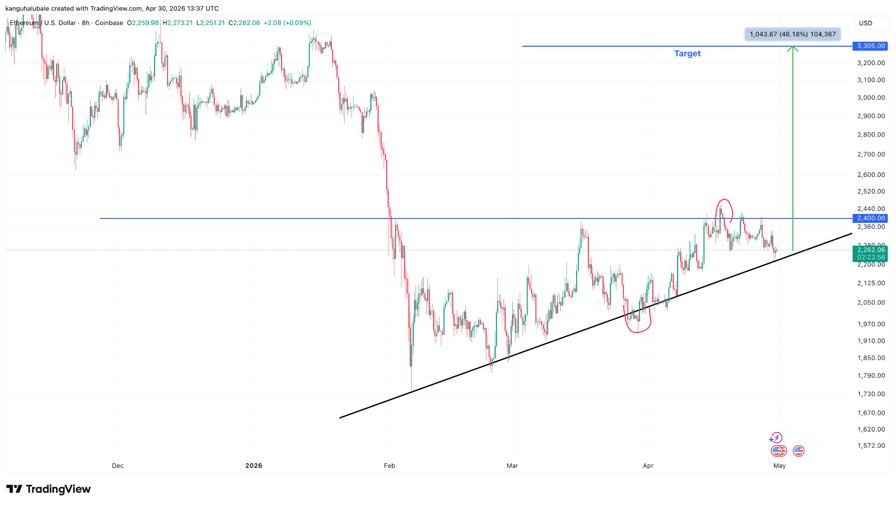
ETH/USD daily chart. Source: Cointelegraph/TradingView

Other technical setups suggest ETH’s price could climb toward $3,000-$6,000 in the coming months.

ETH price sits on strong support around $2,000

Since early February, ETH/USD has been forming higher lows, with the price consistently respecting a multi-month support trend line. 

Each rebound from this trend line has preceded 22%–27% price rallies, often driving ETH back toward or even beyond the high formed after the last rebound. The current setup mirrors those prior cycles.
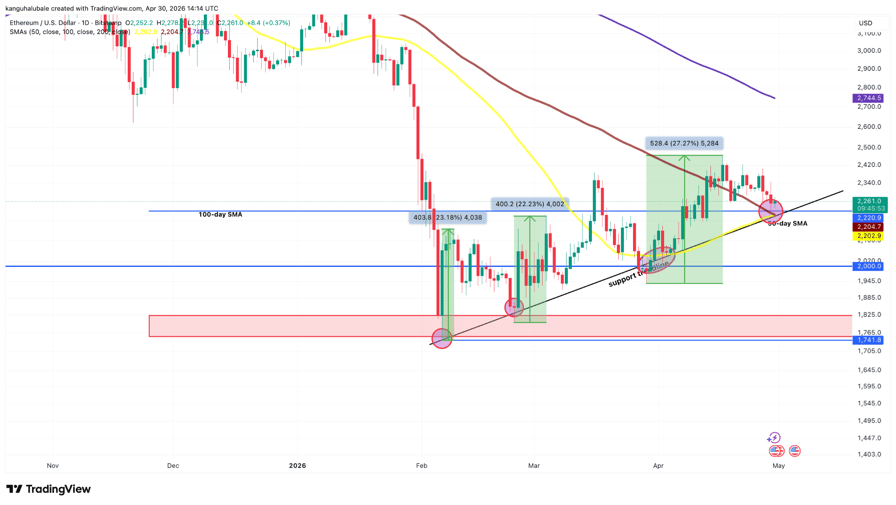
ETH/USD daily chart. Source: Cointelegraph/TradingView

Ether is now consolidating near the trend line support around $2,000-$2,200, which also coincides with the 50-day (yellow wave) and 100-day SMAs (brown), a key dynamic support level in ongoing uptrends.

Meanwhile, UTXO realized price distribution (URPD) data shows that Ether is sitting on a significant support zone between $1,980 and $2,178, where investors acquired 7.4 million ETH.
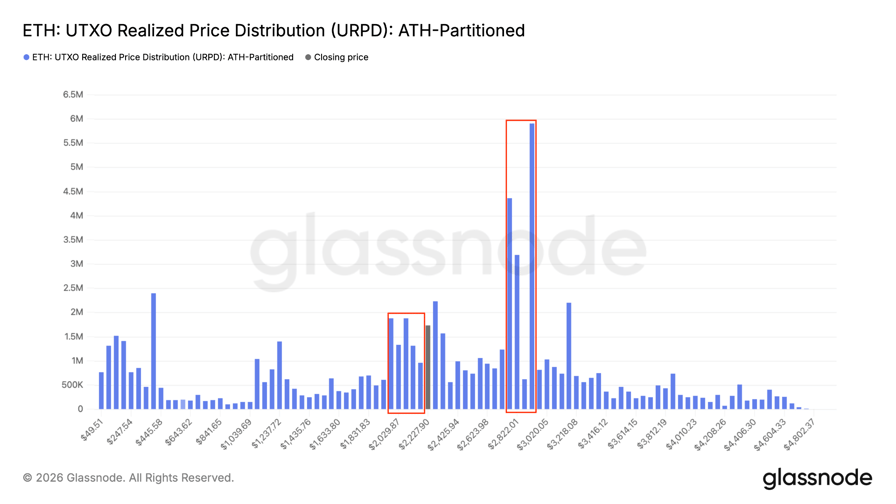
ETH URPD all-time high partitioned. Source: Glassnode

A rebound from this range increased the odds of Ether’s price rising higher to beat resistance at $2,400, toward the next major resistance at $2,800-$3,000, where investors acquired approximately 14 million ETH.

Ether’s spot taker CVD signals high buyer volumes

Ether’s 90-day spot taker cumulative volume delta (CVD) shows that buy-orders (taker buy) have become dominant again. CVD measures the difference between buy and sell volume over three months.

The metric remained in the neutral zone between mid-February and mid-March, as ETH/USD consolidated within the $1,800-$2,200 range. 

The CVD flipped positive (green bars in the chart below) on March 15 as the price broke above the $2,200 resistance and has remained positive since. This indicates optimism among traders, as they’re actively positioning for further gains.

If the CVD remains green, it means buyers are not backing down, which could set the stage for another wave of upward movement, as seen in historical rallies. A similar occurrence in 2024 accompanied an 85% price rally. 
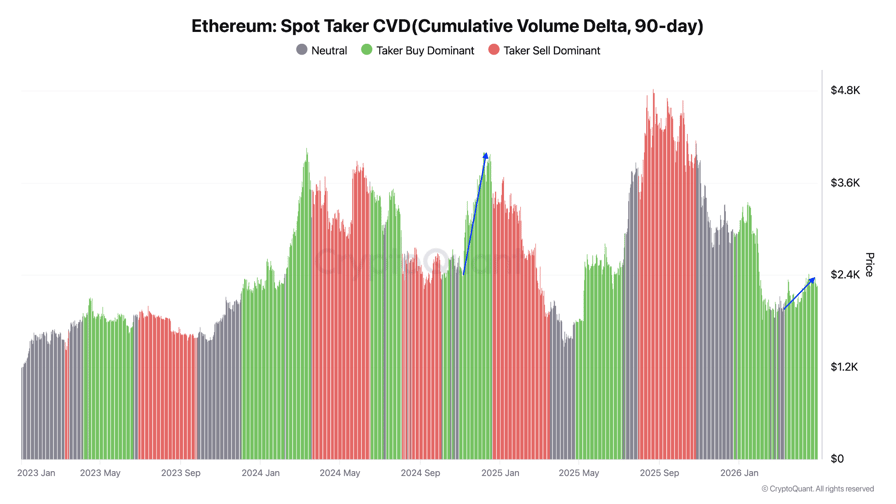
ETH spot taker CVD. Source: CryptoQuant

Meanwhile, Ether’s taker buy volume jumped to over $1 billion on Wednesday, suggesting bulls took advantage of the drop below $2,300 to buy more, data from CryptoQuant shows.

“The move below the $2,300 zone today nonetheless reignited interest among traders,” CryptoQuant analyst Darkfost said in a QuickTake note on Thursday, adding:

“This suggests that market participants still appear willing to bet on a more constructive short term outlook for Ethereum.”
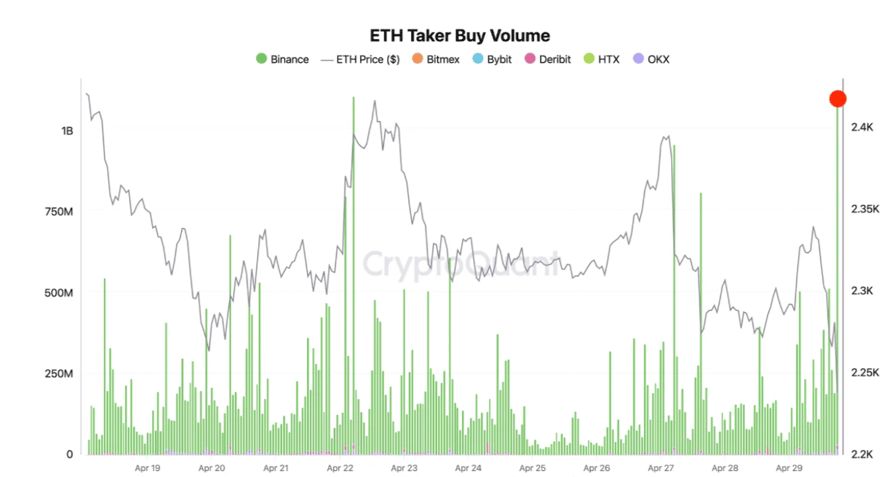
ETH taker buy volume. Source: CryptoQuant


This article is produced in accordance with Cointelegraph’s Editorial Policy and is intended for informational purposes only. It does not constitute investment advice or recommendations. All investments and trades carry risk; readers are encouraged to conduct independent research.

South Korea Seeks 20-Year Sentence for Delio CEO Over $169M Crypto Fraud

0

South Korean prosecutors have requested a 20-year prison sentence for the CEO of crypto deposit service Delio, calling the scale of alleged fraud against thousands of investors “massive.”

During closing arguments at the Seoul Southern District Court on Thursday, prosecutors asked the court to sentence Jeong Sang-ho under the Act on Aggravated Punishment of Specific Economic Crimes, citing what they described as deliberate deception and false promotion that left nearly 2,800 victims without access to their funds, according to the Korean news agency Yonhap.

“The defendant’s active deceptive acts and false promotion have resulted in numerous victims, and the scale of the damage is massive,” prosecutors reportedly said, adding that Jeong was “exacerbating their suffering by evading responsibility and maintaining an uncooperative attitude.”

Delio operated a crypto deposit service that promised investors high-interest returns on coins deposited for a fixed period. On June 14, 2023, the platform abruptly suspended withdrawals, freezing customer assets worth 250 billion Korean won ($169 million). A Seoul court declared the company bankrupt in November 2024.

Related: Dunamu, Hana Financial take blockchain remittance system live with POSCO

Delio CEO acknowledges harm done to investors

Jeong’s legal team acknowledged the harm caused. “We are aware of the victim’s suffering and feel a deep sense of responsibility,” his attorney reportedly said, adding that Jeong would seek to compensate victims if acquitted.

Jeong was indicted in April 2025 on charges of embezzling $169 million in crypto assets from victims over roughly two years, between August 2021 and June 2023.

The first-instance verdict is scheduled for July 16.

Related: Kbank teams with Ripple on overseas blockchain remittance trial

South Korea launches crackdown on exchanges

The news comes amid South Korea’s launch of a regulatory crackdown on crypto exchanges. Earlier this month, the country fined Coinone, the country’s third-largest exchange, and ordered a partial business suspension over Anti-Money Laundering failures.

The action marks the second such crackdown in a few months, following a $24 million fine and six-month partial suspension handed to Bithumb in March for similar Anti-Money Laundering failures. The pressure on exchanges intensified after Bithumb mistakenly sent customers 620,000 Bitcoin, worth around $42 billion at the time, instead of 620,000 Korean won.

Magazine: South Korea gets rich from crypto… North Korea gets weapons

Cointelegraph is committed to independent, transparent journalism. This news article is produced in accordance with Cointelegraph’s Editorial Policy and aims to provide accurate and timely information. Readers are encouraged to verify information independently.

Can Bitcoin Still Lock in its Best Monthly Gains Since April 2025?

0

Bitcoin (BTC) rebounded above $76,000 at Thursday’s Wall Street open while traders stayed bearish on the short-term BTC price outlook.

Key points:

  • Bitcoin’s Coinbase Premium Index flips negative as analysis warned the January breakdown could repeat.
  • BTC price action is already at risk of repeating a bear flag breakdown to new macro lows.
  • The April monthly close should still offer Bitcoin’s best gains in a year.

Bitcoin Coinbase Premium risks repeating bearish history

Data from TradingView showed 1% daily gains after initial pressure over high oil prices and a hawkish US Federal Reserve meeting the day prior.

BTC/USD one-hour chart. Source: Cointelegraph/TradingView

With US stocks treading water, Bitcoin market participants saw little reason to flip bullish on shorter time frames. 

Among the concerns was the Coinbase Premium — the difference in price between Coinbase’s BTC/USD and Binance’s BTC/USDT pairs.

“Bitcoin’s ripping higher… but the selling on Coinbase is getting DEEPER by the minute,” X user Against Wall Street wrote. 

A negative Coinbase Premium implies insufficient demand for Bitcoin during US trading hours, with price action normally suffering as a result. 

In January, a relief bounce on BTC/USD combined with a steepening negative Premium, and the pair ultimately broke to new macro lows.

Bitcoin Coinbase Premium Index. Source: CryptoQuant

“We’ve seen this exact movie before, and spoiler alert: everybody already knows how it ends,” Against Wall Street continued, referring to January’s events.

As Cointelegraph reported, then, as now, price formed a so-called “bear flag” construction on the daily chart — a warning to buyers that a breakdown could occur.

BTC teases best monthly price gains since April 2025

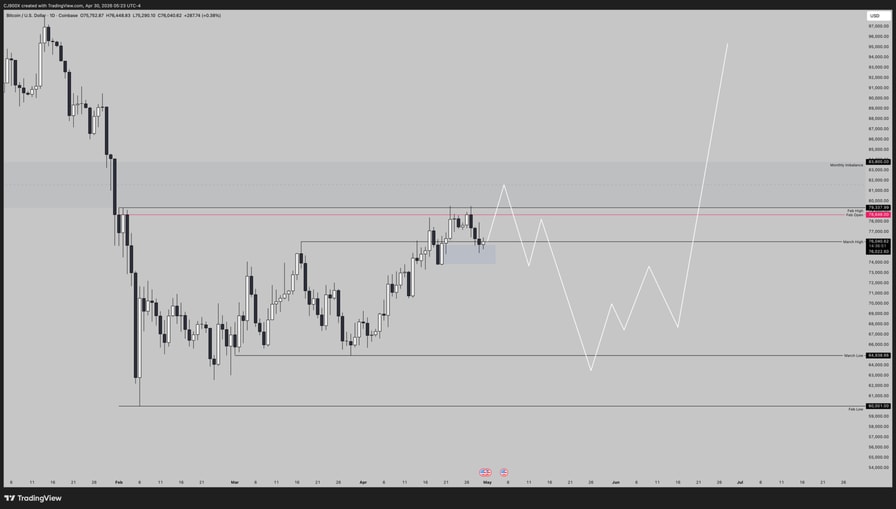
Other traders also felt the need for caution, with trader CJ seeing little sign of a long-term floor already being in place.

Related: Bitcoin, stocks risk ‘months’ of losses as Kevin Warsh Becomes Fed chair

A chart uploaded to X on the day included a potential target of $65,000.

“I think even if we are putting in a bottom here, we *at least* see something like this,” they commented. 

“This would be my bullish outlook. I’m ultimately waiting on April close to refine.”

BTC/USD one-day chart. Source: CJ/X

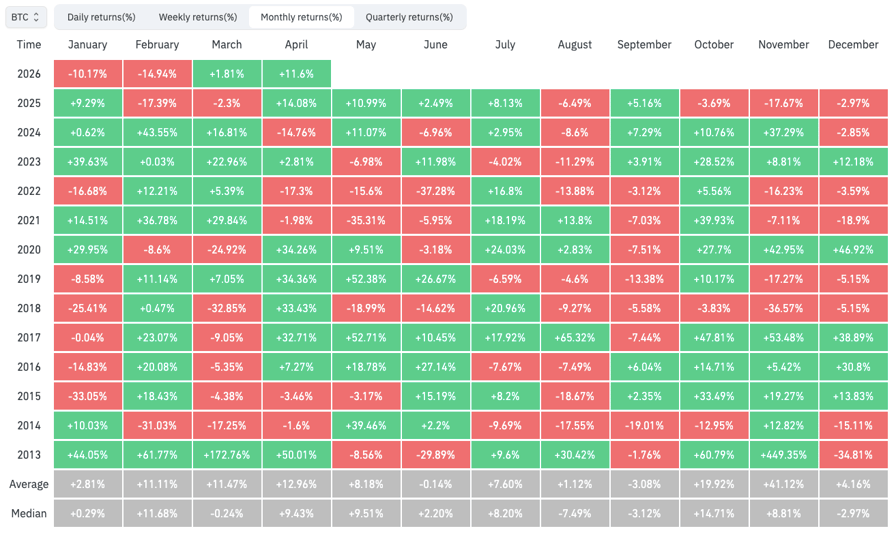
The monthly close was set to offer 11.6% gains for April at the time of writing — still Bitcoin’s best performance in a year, per data from CoinGlass.

BTC/USD monthly returns (screenshot). Source: CoinGlass

This article is produced in accordance with Cointelegraph’s Editorial Policy and is intended for informational purposes only. It does not constitute investment advice or recommendations. All investments and trades carry risk; readers are encouraged to conduct independent research.

Crypto Hacks Hit $630M In April as DeFi Dominates Losses

0

The cryptocurrency industry has seen a sharp spike in hacks in April, with losses topping $600 million in the worst month for crypto hacks in more than a year.

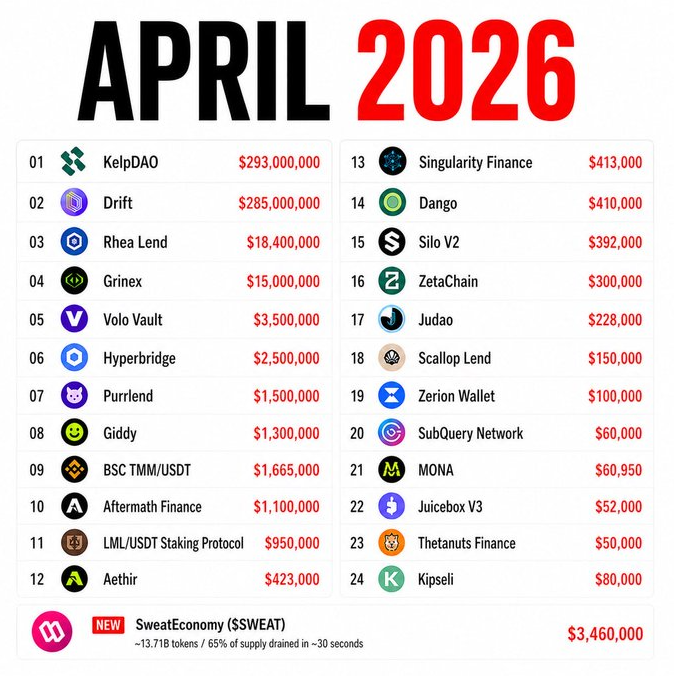
According to DeFiLlama, the total value hacked in April so far amounted to $629.7 million, the highest since $1.47 billion in February 2025. With KelpDAO’s $293 million hack and Drift Protocol’s $280 million exploit accounting for 82% of the monthly losses, decentralized finance (DeFi) has taken the unwanted crown as the most targeted sector over the past month.

Source: DeFiLlama

The concentration of losses in a handful of large DeFi incidents shows how a small number of attacks can still overwhelm broader security improvements across the sector. The causes of the hacks also revealed that the biggest risks are increasingly tied to bridges, privileged access and operational failures, rather than simple smart contract bugs alone.

Related: Russia-linked crypto exchange Grinex halts trading after $14M hack

April DeFi hack losses surge

One of the latest attacks involved the DeFi derivatives platform Wasabi Protocol, which at the time of writing had been drained of around $5.5 million across Ethereum, Base, Blast and Berachain networks in an ongoing exploit, according to Certik.

Recent attacks also include the move-to-earn crypto platform Sweat Economy, which reportedly lost $3.46 million, or about 65% of its liquidity pool, in under 30 seconds. The protocol later said stolen funds were frozen on MEXC shortly after the incident, with recovery efforts underway.

Source: Jussy

Aftermath Finance, a Sui blockchain-based decentralized trading platform, was also among the recent DeFi hacks, suffering an exploit on its perpetuals platform. According to Blockaid, the attacker drained about $1.1 million in USDC across 11 transactions in roughly 36 minutes.

Related: Andre Cronje says DeFi is ‘no longer DeFi’ as builders debate circuit breakers

Chainalysis says attackers are exploiting off-chain systems, not smart contract bugs

April’s spike in crypto exploits reflects a shift toward more sophisticated, multi-stage attacks targeting offchain infrastructure rather than smart contract vulnerabilities, Yaniv Nissenboim, head of security solutions at Chainalysis, told Cointelegraph.

“What connects these incidents is that well-resourced attackers are finding novel ways to exploit the seams between on-chain protocols and the offchain systems they depend on,” Nissenboim said.

These entry points include compromised remote procedure call (RPC) nodes, breaches of cloud key management systems and long-running social engineering campaigns, he said. In many cases, on-chain transactions still appear fully legitimate, even as infrastructure or human-access layers are already compromised.

Nissenboim said that real-time monitoring and automated safeguards are becoming critical, citing anomalies such as abnormal minting patterns and cross-chain inconsistencies that can be detected instantly. In one case, rapid detection helped prevent a second theft of roughly $95 million during the KelpDAO incident, he added.

The worst month for DeFi on record?

Cyvers co-founder Meir Dolev told Cointelegraph April’s spike was driven by a small number of “precision strikes,” as attackers increasingly target high-liquidity protocols. He said the month ranks among the worst for DeFi hacks in five years, with losses driven by social engineering and cross-chain complexity.

Hacken was more assertive in its assessment, saying April marked the worst month on record for DeFi losses, driven largely by breaches involving Kelp and Drift. The firm attributed the attacks to actors linked to the Democratic People’s Republic of Korea (DPRK), which has been widely associated with crypto theft campaigns targeting exchanges and DeFi protocols.

Related: North Korea tied to heists worth $578M in April after Kelp DAO exploit

According to Standard Chartered’s analysts led by Geoffrey Kendrick, KelpDAO’s incident is a sign of DeFi’s growing resilience rather than a fatal failure for the sector.

“While the recent KelpDAO theft and its impact on AAVE have raised questions around continued DeFi banking growth, we expect growth to remain on track as a maturing DeFi industry puts solutions in place to reduce vulnerabilities,” the bank said in a Wednesday research note seen by Cointelegraph.

Magazine: AI-driven hacks could kill DeFi — unless projects act now

Cointelegraph is committed to independent, transparent journalism. This news article is produced in accordance with Cointelegraph’s Editorial Policy and aims to provide accurate and timely information. Readers are encouraged to verify information independently.

Agentic Marketing Platform for Enterprises Valued at $2.75B

0

Hightouch, the startup that has developed an agentic AI marketing platform for enterprise customers, said it raised $150 million in new funding.

The Series D funding round values the company at $2.75 billion — more than double its $1.2 billion valuation from its previous fundraise in February 2025.

The San Francisco-based company’s growth reflects the ongoing automation of various elements of marketing among enterprises. According to Hightouch, many organizations that have embraced AI to date have been left disappointed.

“Most AI solutions haven’t actually changed how marketing works. Instead, they generate vast amounts of mediocre content that doesn’t really get used,” Kashish Gupta, co-CEO of Hightouch, said in a statement. “We built Hightouch to rethink marketing end-to-end, so AI agents can operate directly on trusted data.”

One of the core problems identified by Hightouch is that brand context and proprietary data play a far bigger role in marketing than in, for example, engineering, which lends itself to more structured code. Generally, workflows are more complex in marketing, but to date, many AI agents have failed to address this.

Related:Glean’s Model Aims to Redefine Enterprise Search With AI

Most of the top marketing platform vendors — including Salesforce, HubSpot, Amazon and Adobe — have integrated AI into their systems.

Hightouch’s approach has been to build its platform on top of what it describes as a “comprehensive enterprise context layer,” which connects with a customer’s existing resources — such as design tools, photo libraries and content management systems. In doing so, the vendor claims this avoids the “slop” that many associate with AI.

By taking this brand context into account alongside customer data, the startup’s agents can thoroughly research audiences and generate relevant creative, running campaigns across advertising, email, text and the web, according to Hightouch.

This approach fueled a swift rise to prominence, with the vendor counting a number of high-profile names among its customer portfolio, including pizza giant Domino’s, PetSmart and gambling company DraftKings.

Hightouch recently stated an annual recurring revenue of $100 million, a rise of $70 million in less than two years, and employs about 380. Hightouch said it will use the latest investment to further expand the capabilities of its agentic marketing platform.

Leading the latest investment round, made public on April 29, were the Growth Equity division at Goldman Sachs Alternatives and Bain Capital Ventures, with other participants including Iconiq Capital, Sapphire Ventures and Amplify Partners.

Related:AWS Launches Managed Agents with OpenAI Partnership

Breaking down Sui (SUI)

0

In today’s newsletter, Josh Olszewicz from Canary Capital introduces Sui blockchain and discusses its potential impact on Web3 adoption and optimization for consumer applications.

Special alert: Are you going to Consensus Miami? Don’t miss the closed-door, Wealth Management Day on May 6. There is a special side event, dedicated to advisors. Attendance is complimentary for credentialed advisors. A CRD number is required to apply.

Happy reading.


Breaking down

The Sui (pronounced “swee” like sweet) network is emerging as one of the more differentiated Layer-1 blockchains in the current market cycle, combining novel architecture with a design philosophy aimed squarely at consumer-scale applications. A Layer-1 blockchain is the base layer of a network, where transactions are recorded, validated and finalized. While often grouped alongside other high-throughput chains, Sui takes a distinct approach to execution, data ownership and tokenomics, differences that may prove meaningful for long-term adoption and investor positioning.

Launched in 2023 by Mysten Labs, Sui is a delegated proof-of-stake (DPoS) Layer-1 blockchain built using the Move programming language. Its core innovation lies in an object-based data model that enables parallel transaction execution, allowing the network to process transactions simultaneously rather than sequentially. This architecture is designed to deliver high throughput and low latency, improved scalability without reliance on rollups (transaction batching) and native support for complex, asset-centric applications.

Unlike traditional blockchains, where every transaction competes for global consensus, Sui distinguishes between owned objects, which can be processed independently, and shared objects, which require consensus. This selective execution model reduces bottlenecks and enhances efficiency at scale.

Sui’s design is optimized for consumer-facing Web3 use cases, including gaming, digital identity and social applications. By minimizing execution friction and improving user experience through features like zero-knowledge (zk)-based logins and passkeys, the network aims to bridge the gap between Web2 usability and Web3 ownership. The broader implication is straightforward: if Web3 adoption is ultimately driven by applications rather than speculation, architectures like Sui’s may be structurally advantaged.

Beyond its base layer, Sui expands into a broader infrastructure stack. It includes an execution layer for smart contracts and asset logic, decentralized storage via Walrus for verifiable data, programmable encryption through Seal for access control and confidential compute with Nautilus to support hybrid on- and off-chain applications. Together, these components form a full-stack Web3 environment within the Sui ecosystem, reducing reliance on centralized infrastructure providers.

On the consensus side, Sui uses a dual-layer architecture. Narwhal handles data availability, while Bullshark provides transaction ordering and finality. This design enables the network to maintain high throughput without compromising security.

The total SUI token supply has a fixed maximum cap of 10 billion tokens, with no ongoing inflation beyond that cap. Key features include gradual token release through long-term vesting schedules, staking rewards distributed from pre-allocated supply rather than new issuance and an intentionally limited early circulating supply to reduce sell pressure.

Sui has shown steady growth across several key metrics. Transactional activity has remained consistent and active addresses have increased. Total Value Locked (TVL), or how much notional value is inside of the ecosystem, has expanded alongside the growth of decentralized finance (DeFi) protocols and stablecoin integrations. TVL peaked in October 2025 at around $2 billion and has since declined to $600 million, reflecting the broader pullback in assets across the sector.

Ecosystem growth has been driven by the expansion of DeFi platforms, the integration of major stablecoins to improve liquidity and usability and incentive programs paired with emerging consumer applications that increase engagement. Examples include Scallop, a DeFi hub focused on stablecoin lending and yield generation; Run Legends by Talofa Games, a move-to-earn fitness RPG where users walk and run in real life to battle and earn rewards; and FanTV, a TikTok-style social media platform.

One way to assess Sui, and crypto networks more broadly, is through a “network P/S ratio” (market cap divided by fees). This metric reflects investor expectations for future growth and the relationship between current usage and valuation. However, unlike traditional equities, fees are volatile, only accrue to validators and token holders who stake their SUI and are highly sensitive to incentives and subsidies. As a result, valuation should be contextualized alongside user adoption, transaction trends and ecosystem expansion.

Sui is also beginning to intersect with traditional financial infrastructure. The launch of SUI-linked investment products, including exchange-traded vehicles with staking exposure, signals growing institutional interest. This trend mirrors broader crypto market evolution, where access, yield and regulatory wrappers have unlocked pathways for sophisticated institutional access and capital deployment.

Sui represents a distinct approach within the Layer-1 landscape, combining parallelized execution and object-based architecture, a non-inflationary, vesting-driven token model and a growing ecosystem of consumer and DeFi applications.

For investors, the key question is not simply whether Sui can compete on throughput, but whether its design translates into sustained user adoption and economic activity. If it does, the network’s architecture and token structure could position it as a meaningful component in the construction of the next phase of Web3 growth.

Generations of the Internet

Web1: Information online | Web2: Platforms and social interaction | Web3: Ownership, composability, and programmable value

For more additional learning and a unique networking opportunity, Canary Capital is partnering with 3iQ, Digital Ascension Group, and Bitnomial, for an exclusive event on May 4 in Miami. Learn more.

– Josh Olszewicz, portfolio manager, Canary Capital


Keep Reading

Spain Leads EURC Stablecoin Adoption Across Europe: Brighty

0

Spain appears to be the strongest retail market for Circle’s euro-pegged stablecoin EURC on crypto banking platform Brighty, according to company data.

Spain led EURC usage by a wide margin in 2025 and the first quarter of 2026, accounting for about 36% of transactions and 25% of volume, according to Brighty data seen by Cointelegraph.

“For Spanish users, EURC functions essentially as a standard euro on a card with no exchange rate friction when transacting against USDC,” Brighty co-founder Nick Denisenko said.

Brighty’s top countries by EURC and USDC transaction count share and volume share. Source: Brighty

The platform data offers an early look at how euro stablecoins may be used in European retail payments, as euro tokens remain small next to US dollar-pegged stablecoins like Tether’s USDt and Circle’s USDC, even as policymakers seek to expand the euro’s role in stablecoin markets.

Spain leads EURC retail usage shift

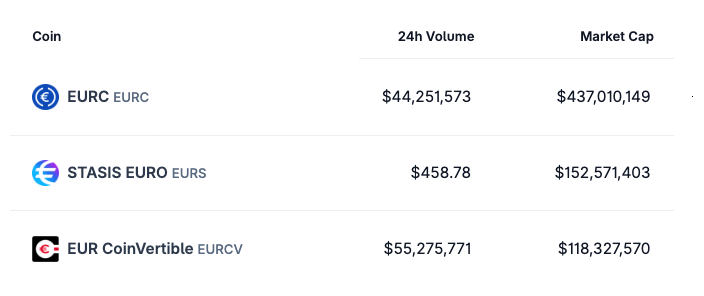
Issued by Circle Internet Financial Europe, the Paris-based arm of USDC issuer Circle, EURC is the largest euro-pegged stablecoin on the market. It currently accounts for about 49% of the $887 million euro-pegged stablecoin market cap, according to CoinGecko

According to Brighty, Spain shows the clearest retail-oriented usage of EURC, with relatively low average transaction sizes compared with other markets, at roughly 49 euros ($57) per payment.

Top three stablecoins by market cap as of April 30. Source: CoinGecko

Brighty data indicates EURC activity in Spain is increasingly linked to small-value payments such as peer-to-peer transfers and daily spending. This contrasts with more fragmented usage patterns in other European countries.

France and Europe’s high-value EURC stablecoin split

Italy ranked second in EURC activity, accounting for 15.5% of Brighty’s EURC transactions and 18% of volume, suggesting a mix of retail and higher-value users.

Germany followed closely, accounting for around 13% of transactions and 19% of volume, with the average payment size of 105 euros ($123).

France stood out with a much higher average transaction size of around 171 euros ($186), more than three times Spain’s level, suggesting usage tied to larger transfers rather than everyday payments.

Why Spain?

According to Brighty’s Denisenko, the data suggests Spain shows the clearest retail-oriented EURC usage on its platform, which reflects higher user familiarity with crypto and stronger institutional readiness among local banking institutions.

“When we engage with counterparts at major Spanish banks, we consistently observe a remarkably high degree of competence even among frontline staff — which is not something one takes for granted elsewhere,” Denisenko said.

Related: European banks tap Fireblocks for MiCA-compliant euro stablecoin

He added that Spanish users were among the earliest adopters of EURC on Brighty, adding that they also show particularly active engagement with stablecoin-based yield features, reinforcing consistent retail-level usage.

Denisenko added this combination of early adoption, payment-style usage and broader institutional awareness has made Spain the clearest early hub for euro stablecoin activity under European-wide Markets in Crypto-Assets Regulation (MiCA) framework.

Magazine: Singapore isn’t a ‘crypto hub’ — it’s something better: StraitsX CEO

Cointelegraph is committed to independent, transparent journalism. This news article is produced in accordance with Cointelegraph’s Editorial Policy and aims to provide accurate and timely information. Readers are encouraged to verify information independently.

Anchorage Digital and M0 team up to power next wave of regulated stablecoins

0

Anchorage Digital, the U.S’ first federally chartered crypto bank, has tapped M0 as its core technology provider, a move designed to turn the custodian into a primary engine for institutions looking to mint and manage regulated stablecoins.

San Francisico-based Anchorage seeks to expand its issuance platform through M0, and opens the door to a broad range of firms looking to launch U.S.-regulated stablecoins, according to a press release.

M0 (pronounced “M Zero”), is a flexible protocol that allows global institutions to mint fully configurable stablecoins, which also works with the likes of Stripe, Moonpay and MetaMask.

“It might not sound like the sexiest topic, but we have been building modular infrastructure for stablecoins for three years now,” said M0 CEO Luca Prosperi, in an interview. “This means we are supporting anyone who wants to launch and manage their own stablecoin, whether it is a crypto project, protocol, fintech, payment provider, exchange and many more.”

The arrival of the GENIUS Act means stablecoins in the U.S. are becoming a regulated instrument. M0 has already partnered with several regulated players that are using the firm’s contracts, but with Anchorage the regulation-focused relationship is “a bit deeper,” Prosperi added.

“By partnering with M0, we’re extending our issuance platform to support that growth, while maintaining the regulatory, operational, and security standards our partners rely on,” said Anchorage CEO Nathan McCauley, in a statement.

Gemini shares surge on potential prediction market challenge to Kalshi, Polymarket, Hyperliquid

0

Gemini Space Station (GEMI), the crypto exchange run by Cameron and Tyler Winklevoss, received U.S. Commodity Futures Trading Commission (CFTC) approval for a derivatives clearinghouse (DCO) license, allowing it to enter regulated derivatives and crypto’s fastest-growing, most-contested sector, prediction markets.

The approval allows Gemini to clear and settle trades in-house instead of depending on external providers, giving it greater control over how its prediction market products function and scale.

Gemini shares climbed about 7% following the announcement.

Prediction markets have become one of crypto’s fastest-growing areas, with trading volume increasing over 300% in 2025 to $63.5 billion, and Hyperliquid, a DeFi derivatives platform, is getting ready to compete with incumbents such as Kalshi and Polymarket. Wall Street is also in, as Roundhill Investments is expected to roll out the first U.S. exchange-traded funds (ETFs) tied to prediction markets on May 5, while two other asset managers are preparing similar products.

The approval builds on the crypto firm’s December 2025 debut of a prediction marketplace via another affiliate, Gemini Titan, which received a designated contract market (DCM) authorization from the CFTC.

With DCM and DCO licenses in place, Gemini is positioned to offer a full-stack trading ecosystem spanning sport, crypto, futures, options, and event-based contracts, the company said. Gemini also expressed intentions to expand into crypto futures, options and perpetuals for U.S. users.

“Today marks a major milestone in Gemini’s marketplace expansion,” Cameron Winklevoss said in the statement, framing the development as part of a broader push toward a “super app” for financial services.

In February, Gemini made public its plans to enter the prediction markets sector and focus solely on the U.S. when it announced its exit from the U.K., European Union and Australia, which included a staff reduction of roughly 25%.

“The reality is that America has the world’s greatest capital markets and America has always been where it’s at for Gemini,” the founders said, adding that their “thesis is that prediction markets will be as big or bigger than today’s capital markets.”

A Polymarket-linked bet on the weather in France forecasts a major data issue

0

A few weeks ago, abnormal temperature spikes at a Météo-France station near Paris-Charles de Gaulle (CDG) triggered a criminal complaint and an investigation. According to French media reports, the readings were linked to Polymarket bets that generated tens of thousands of dollars in gains. Whether the full mechanics are ultimately proven exactly as suspected is almost beside the point. The real story is simpler: a market that settles money on a single physical observation is only as strong as the data chain underneath it.

Most commentators focus on how to prevent this specific incident from recurring. But the more important question is why anyone should be surprised it happened at all.

When everything becomes tradable, everything becomes a target

The same week this story broke in France, Polymarket announced the launch of perpetual futures contracts on crypto, equities, and commodities, with up to 10x leverage and no expiration date. Kalshi confirmed a similar product days later.

A temperature bet in Paris and a leveraged Bitcoin perp look like they belong to different worlds. They do not. Both are expressions of the same underlying movement: markets are expanding into every domain where an outcome can be observed, measured, and settled. Prediction markets started with elections and sports, then moved to weather, then to 5-minute crypto price windows, and now to continuous derivatives on any asset class. The trajectory has been consistent for years.

As these markets multiply, so does the surface area for manipulation. The CDG incident is not an isolated curiosity. It is what happens when financial incentives meet fragile data infrastructure.

The oracle problem, in the physical world

In decentralized finance, the “oracle problem” refers to the difficulty of feeding reliable real-world data into systems that execute financial contracts automatically. The discussion tends to be abstract, focused on API redundancy and cryptographic verification of data feeds.

What happened at CDG, whatever the investigation ultimately concludes, is the oracle problem in its most concrete and physical form. A financial market worth real money was settling against the output of a single instrument at a single location, with no cross-referencing, no redundancy, and no anomaly detection. As a meteorologist, I can say that a sudden three-degree spike at a single station, occurring in the early evening and absent from every neighboring observation, would immediately raise questions in any operational forecasting context. The fact that it did not trigger any automated safeguard before the financial settlement is what should concern us. This vulnerability is not specific to Polymarket.

Weather derivatives on the CME, parametric insurance contracts, agricultural index products, catastrophe bonds with parametric triggers: every one of these instruments depends on the integrity of observational data. And the vast majority still rely on surprisingly thin data pipelines. The industry has spent decades refining pricing models and regulatory frameworks. It has invested almost nothing in determining what certifies the data that triggers the payout.

The real infrastructure race

If every measurable risk is going to become a continuously priced, tradable instrument, and I believe the direction is now irreversible, then the critical bottleneck is not the trading platform, the blockchain or the regulatory approval. It is the data certification layer.

Who measured the temperature? With what instrument? When was it last calibrated? How many independent sources corroborate the reading? Who can audit the chain of custody? These questions are not glamorous, and they will never attract the attention that a new trading product does. But they are the load-bearing structure. Without answering them, you end up with what we saw at CDG: a system that can be compromised by someone with a heat source and a bus ticket to Roissy.

The companies that will define the next decade of parametric and prediction markets are not the ones building the most impressive trading interfaces. They are the ones building the trust layer between the physical world and financial settlement: certified, multi-source, tamper-evident data infrastructure. The plumbing is unglamorous. It is also the only thing that makes the rest of the architecture credible.

Fifteen years from now, insurance will undergo a similar evolution

The traditional insurance model works as follows: an event occurs, a claim is filed, an adjuster visits, a negotiation unfolds, and a payment is made weeks or months later. This model is a product of a world where we could not observe, measure, and verify losses in real time. It was designed for informational scarcity.

That scarcity is ending. Satellite imagery now resolves at sub-meter precision. IoT sensor networks provide continuous environmental monitoring. Weather models assimilate observations in near-real time. Settlement can execute onchain in seconds. The infrastructure for continuous, parametric, self-executing risk transfer is being assembled, and the pace is accelerating.

Within fifteen years, if your vineyard suffers a late frost, you will not call your broker. A parametric contract, priced in real time against a continuously updated risk surface, will automatically settle the morning after the event. The payout will reach your account before you finish inspecting the vines.

That product will be systematically cheaper, faster, and more transparent than traditional indemnity insurance. Not because it covers a different risk, but because the transaction cost structure collapses entirely. No adjusters, no claims handlers, no moral hazard investigations, no 18-month settlement cycles. When you remove that much friction from risk transfer, you do not improve the existing product. You replace the architecture.

Prediction markets, perpetual contracts, weather derivatives and parametric insurance: these are not separate industries evolving in parallel. They are stages along the same trajectory: the progressive financialization of every observable risk, priced continuously, settled instantly, and available to anyone willing to pay the market price.

The CDG incident may have involved tens of thousands of dollars. Its real significance lies in its role as an early signal. The future of risk transfer will depend entirely on the quality and integrity of the data underneath, and right now, that layer is dangerously underdeveloped.