Home Blog Page 387

SBF withdraws motion for retrial but leaves option open for after appeal ruling

0

Sam Bankman-Fried, founder of collapsed crypto exchange FTX, has withdrawn his request for a retrial over doubt he would get a fair hearing in a letter to the judge overseeing his case.

Bankman-Fried, who is serving a 25-year sentence after being convicted on seven counts of fraud and conspiracy tied to FTX’s 2022 collapse, said he may renew the motion after his direct appeal and a related request for reassignment are decided.

The motion for a new trial was filed by his mother, Barbara Fried, claiming new evidence in the case would justify a reset.

Bankman-Fried said he largely drafted the motion himself while detained at the Metropolitan Detention Center in Brooklyn, with limited assistance.

Although clarifying he is the “author of the letter” to the judge, he did consult his lawyers and his parents “since it concerns them both,” he said.

“They made editorial and organizational suggestions, some of which I incorporated into the motion,” Bankman-Fried said. “They also helped print it, as I no longer had access to a word processor. I also shared earlier drafts with a New York attorney who was originally hired to represent me on the Rule 33 Motion before I decided to represent myself; they had no significant input into the ultimate motion.”

A Rule 33 motion is a formal request to a federal court for a new trial based on new evidence or in the interest of justice.

The appeal is currently before the U.S. Court of Appeals for the Second Circuit. During oral arguments in November, his attorney, Alexandra Shapiro, argued that the trial was “fundamentally unfair,” including limits placed on what Bankman-Fried could present to the jury.

U.S. military runs a Bitcoin (BTC) node, sees crypto as ‘power projection’ vs China

0

A four-star U.S. Navy admiral has told Congress the military is running a live node on the Bitcoin network and testing it for national security purposes.

Admiral Samuel Paparo, commander of U.S.-Indo-Pacific Command (INDOPACOM), made the disclosure at a House Armed Services Committee hearing on Wednesday, a day after telling the Senate Armed Services Committee that Bitcoin has “incredible potential” as a tool for American “power projection.” He also said it has great potential as tool for national security.

The House comments were the first public confirmation by a sitting US combatant commander that the military is directly participating in the Bitcoin peer-to-peer network.

“We have a node on the Bitcoin network right now,” Paparo said, responding to questions from Rep. Lance Gooden. “We’re not mining Bitcoin. We’re using it to monitor, and we’re doing a number of operational tests to secure and protect networks using the Bitcoin protocol.”

A Bitcoin node is a computer that stores the full history of the blockchain and enforces the network’s rules, relaying validated transactions across the peer-to-peer network. Unlike mining, it does not earn rewards and does not require specialized hardware.

Running a node is how participants in Bitcoin verify the network state independently rather than trusting third parties. There are an estimated 15,000 to 20,000 publicly reachable full nodes on the network as of early 2026, with the real number likely higher because many operate behind firewalls.

One node out of tens of thousands poses no threat to Bitcoin’s independence or its resistance to any single party controlling it.

But a US military combatant command running that node is notable because Bitcoin’s design has long been framed as a defense against takeover attempts by powerful governments, and INDOPACOM is the command responsible for US military operations across the Indo-Pacific, including the theater of strategic competition with China.

NatWest Group Brings Financial Education to the Workplace to Close the Investment Confidence Gap

0

NatWest Group is expanding the scope of its free Financial Foundations education programme to help demystify investing for the UK public.

The banking group has announced plans to extend the initiative to reach 50,000 individuals across workplaces, charities, and community groups throughout 2026. To support this ambitious scale-up, NatWest Group is training an additional 300 colleagues to become facilitators, bolstering an existing nationwide network of around 400 staff members who currently deliver the practical, in-person workshops.

Demystifying investments in the workplace

A brand-new investment-focused workshop will be available nationwide starting in May 2026. This new module has been specifically designed to help more people understand the basics of investing and build their financial confidence.

The launch builds upon the bank’s existing programme, which already covers essential financial skills:

The expansion aligns with a growing appetite for employer-supported financial literacy. According to a March 2026 survey of 5,000 UK adults commissioned by NatWest Group:

  • Almost six in ten (58 per cent) of respondents would be likely to take part in a financial education session on investing if their employer offered it.

  • Younger adults under 35 are twice as likely to believe that employers bear a responsibility for delivering financial education compared to those aged 35 and over (9 per cent versus 4 per cent).

Industry and government support
Paul Thwaite, NatWest Group CEO

To mark the launch, NatWest Group CEO Paul Thwaite attended the inaugural Financial Foundations investment workshop at digital transformation specialists Barcode Warehouse in Newark, Nottinghamshire.

“A strong economy needs financial confidence and capability – the knowledge and skills that help people and families budget, save, invest and plan for the future,” Thwaite said. “This is a vital part of our economic infrastructure and is often overlooked.”

Thwaite added that while household saving and investment decisions play a critical role in the broader economy, too many people feel uncertain or entirely excluded from the tools required for long-term financial planning.

The launch coincides with a growing national focus on financial literacy, complementing new FCA reforms that aim to make investment guidance more accessible and bridge the UK’s long‑standing advice gap.

Lucy Rigby KC MP, Economic Secretary to the Treasury, welcomed the initiative: “Financial literacy matters to the health of people’s finances, and to the health of our economy. I’m delighted to see NatWest Group committing to extend their financial education and literacy programme to give people access to new and improved financial skills.”

Building on a strong foundation

The Financial Foundations programme has already demonstrated significant traction. In 2025, the bank delivered 1,500 workshops to more than 31,000 participants. Feedback from the programme indicates that:

This latest expansion is a core component of NatWest Group’s five-point ‘Growing Together’ plan, which aims to help build the conditions for UK-wide growth by boosting financial confidence among families and young people.

In addition to group workshops, NatWest Group also offers free, confidential one-to-one Worksite Financial Health Checks (FHCs). Delivered by trained senior personal bankers, these sessions are available to employees of business customers—regardless of who they bank with—to provide personalised support and help individuals confidently work toward their financial goals.

Taurus Integrates ZIGChain to Expand Digital Asset Wealth Generation Opportunities for Financial Institutions

0

Taurus, a leading digital asset infrastructure provider for financial institutions, today announced support for ZIGChain in Taurus-PROTECT, its institutional-grade custody platform.

As an asset-agnostic and blockchain-agnostic infrastructure provider, Taurus enables financial institutions to access a broad range of digital assets and blockchain networks through a single platform. Taurus already supports more than 30 blockchain protocols, and the addition of ZIGChain extends that coverage to a Layer 1 network built with the Cosmos SDK and designed for wealth-generation protocols and on-chain investment strategies.

ZIGChain is also the first Layer 1 blockchain purpose-built for Shariah-compliant institutional investment products, designed to serve the $4 trillion+ global Islamic finance market. The integration marks the first time a bank-grade European custodian has natively supported an Islamic-finance-compliant chain.

With this integration, Taurus now supports the native custody of ZIG on ZIGChain. For banks, financial institutions, and professional investors, this provides secure access to the ZIGChain ecosystem through Taurus-PROTECT, within a framework designed for security, governance, and operational resilience.

“At Taurus, we are committed to giving financial institutions secure access to the digital asset ecosystem through infrastructure that remains both asset-agnostic and blockchain-agnostic,” said Bashir Kazour, Managing Director at Taurus.

“With support for ZIGChain in Taurus-PROTECT, we continue to broaden the range of networks available to clients, while maintaining the high standards they expect from Taurus,” Bashir added.

“This integration with Taurus is a significant step for ZIGChain’s institutional reach,” said Abdul Rafay Gadit, Co-founder and Head of Global Markets of ZIGChain.

“Taurus has built a best-in-class custody infrastructure trusted by banks and financial institutions across the globe, and having ZIGChain supported natively within Taurus-PROTECT means institutional players can now access investment opportunities in our ecosystem through a framework they already trust. This is how real wealth-generation opportunities make it onto the institutional agenda, through the right infrastructure, with the right partners,” Abdul Rafay added.

The article “Taurus Integrates ZIGChain to Expand Digital Asset Wealth Generation Opportunities for Financial Institutions” was first published on AlexaBlockchain. Read the complete article here: https://alexablockchain.com/taurus-integrates-zigchain/

Read Also: MoneyGram, Pairpoint and eToro Back Midnight’s Privacy Blockchain Before Mainnet

Disclaimer: The information provided on AlexaBlockchain is for informational purposes only and does not constitute financial advice. Read complete disclaimer here.

Image Credits: Taurus, Shutterstock, Canva, Wiki Commons

Russia Advances Key Crypto Bill, Eyes July 1 Implementation

0

Trusted Editorial content, reviewed by leading industry experts and seasoned editors. Ad Disclosure

Russia has advanced a key crypto bill on its first reading, as part of its efforts to establish a framework and fully bring the digital assets market out of the shadows in the next few months.

Russia Moves To Regulate Crypto Market By Summer

On Tuesday, the State Duma, the lower house of Russia’s legislature, advanced a key bill to legalize cryptocurrencies and establish a framework to regulate the digital assets in the country’s market.

According to the state news agency TASS, lawmakers passed the bill “On Digital Currency and Digital Rights” on its first reading, with 327 deputies voting in favor. The Russian government first introduced the draft in December 2025, seeking to establish the regulatory framework by summer 2026.

After clearing its first review, the bill still needs to clear the second and third readings in the State Duma. Then, it would proceed to the Federation Council, the upper chamber of the Federal Assembly, for consideration before reaching the President’s desk for signature. If passed, the bill will take effect on July 1, 2026, except for provisions with different effective dates, TASS reported.

The draft will recognize digital assets as property and grant the Central Bank of Russia (CBR) the authority to license, regulate, and oversee the local crypto market. Under the proposed legislation, only licensed professional participants supervised by the Bank of Russia will be allowed into the market.

“No anonymous exchanges or ‘black’ brokers. Exchanges, brokers, and depositories will receive licenses, and the Central Bank will monitor compliance. Transactions conducted through underground platforms will automatically be at risk of being blocked and of losing funds,” Kaplan Panesh, deputy chairman of the State Duma Committee on Budget and Taxes, explained.

The bill also defines the entities authorized to facilitate the circulation of crypto assets in the country, including exchanges, brokers, trust managers, and digital depositories holding the relevant licenses from the central bank.

The proposed draft establishes rules and requirements for authorized entities, and a simplified access procedure for entities already operating under the CBR’s experimental legal regime. It also introduces a simplified procedure for banks and brokers wanting to dive into crypto.

Discussing the regulation of crypto mining activities using Russian information infrastructure facilities, the deputy highlighted that “It is now a legal activity, but with clear rules: the use of only Russian infrastructure, and the reporting of equipment and currency produced.”

Digital Assets Allowed For Cross-Border Settlements

Notably, the bill will prohibit the use of crypto for paying for goods, services, or labor within the country, the report noted. However, it will allow its use for cross-border settlements to bypass sanctions restrictions.

“We have a national currency—the ruble—and it must remain the sole legal tender,” Deputy Panesh emphasized. “But we are making an exception for foreign trade. This allows Russian companies to settle accounts with foreign counterparties using cryptocurrency, bypassing sanctions restrictions. In effect, we are creating a legal instrument for cross-border settlements.”

The legislation will also introduce a tiered system that would limit the investor’s access depending on classification, aiming to “protect ordinary people from losing all their savings in a volatile market.”

As Bitcoinist previously reported, non-qualified investors would be limited to purchasing up to 300,000 rubles annually, worth around $3,800, in the most liquid cryptocurrencies after passing a knowledge test. Meanwhile, qualified investors would be able to purchase unlimited amounts of any digital asset after passing a risk-awareness test.

Panesh noted that the digital asset market in Russia has been in a gray area for years, creating risks for both citizens and the economy, adding that the legislation marks a crucial step for the local market.

“Now we are clearly defining: digital currency is property. This means it can be defended in court, included in the bankruptcy estate, and taken into account in divorce proceedings. This is a crucial step for the legal protection of millions of people who already own such assets,” he concluded.

crypto, bitcoin, btc, btcusdt

Bitcoin (BTC) trades at $78,955 in the one-week chart. Source: BTCUSDT on TradingView

Featured Image from Unsplash.com, Chart from TradingView.com

Editorial Process for bitcoinist is centered on delivering thoroughly researched, accurate, and unbiased content. We uphold strict sourcing standards, and each page undergoes diligent review by our team of top technology experts and seasoned editors. This process ensures the integrity, relevance, and value of our content for our readers.

Crypto dips despite breakout signals, with traders leaning bearish: Crypto Markets Today

0

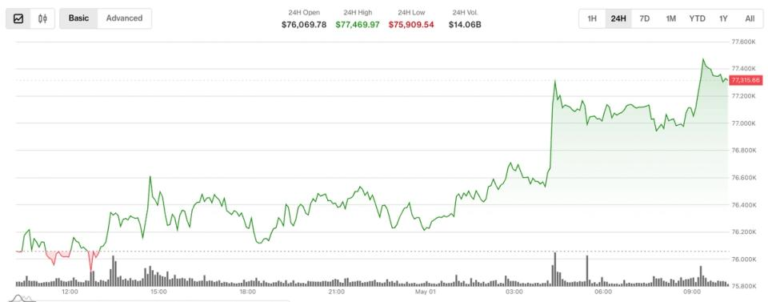
The crypto market fell Thursday, with bitcoin losing 0.7% since midnight UTC to trade recently at $77,600.

The decline comes after the largest cryptocurrency hit its highest point since January on Wednesday before sellers stepped in just beneath the $80,000 level of resistance.

Oil prices rose by 1.5% to $103 per barrel overnight following reports that the U.S. had seized three Iranian tankers in Asian waters, leading to a drop in risk asset prices.

Ether (ETH) lost 2.5% and now trades at $2,320 having tested $2,500 over the weekend.

The broader market remains optimistic, with bitcoin appearing to have broken out of a two-month range to the upside. It had languished between $63,000 and $75,000 since early February.

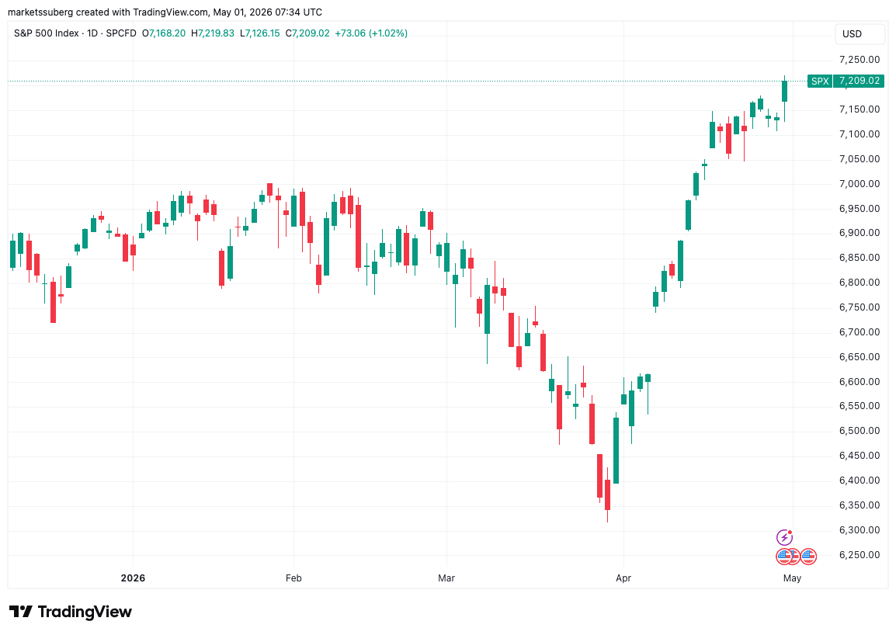
U.S. stock futures are down on Thursday with S&P 500 and Nasdaq 500 futures both losing 0.5% apiece overnight.

Derivatives positioning

  • While bitcoin’s futures open interest (OI) slipped to 775K BTC from a record near 800K BTC on Wednesday, it remains at historically elevated levels. Negative perpetual funding rates suggest leveraged bets remain tilted to the bearish side.
  • This combination is rare. As a result, some analysts are calling BTC’s current advance a “most hated” rally, suggesting it could accelerate if bearish traders are forced to unwind their positions.
  • Open interest in DOGE has climbed above 14 billion tokens, a level seen only once since October. However, the token’s funding rates are skewed positive, suggesting growing demand for bullish bets.
  • BCH, LINK and LTC are other coins with declining OI pointing to an outflow of capital from the market.
  • The cumulative volume delta (CVD) signals caution, showing that more trades have been initiated by sellers hitting bids than by buyers lifting offers over the past 24 hours across most major altcoins, including XRP, SOL and ETH. Meanwhile, BTC, M and CRO are the only assets with positive CVD readings. This suggests the broader market is not yet fully participating in bitcoin’s rally.
  • Bitcoin and ether’s 30-day implied volatility indices continue to stay flat around the recently hit 2.5-month lows. In other words, calm prevails even as the U.S.-Iran ceasefire talks head nowhere and oil markets remain disrupted.
  • On Deribit, BTC and ETH puts continue to be pricier than calls in a sign of lingering downside concerns. Over the past 24 hours, demand has been concentrated in BTC call options, bullish bets, at strikes from $80,000 to $85,000.

Token talk

  • CoinDesk’s DeFi Select Index (DFX) is the worst-performing benchmark on Thursday, having lost 2.7% since midnight UTC, while the bitcoin-dominant CoinDesk 20 (CD20) is down by 1.1%.
  • CoinMarketCap’s “Altcoin Season” index fell to 32/100 on Thursday, its lowest in 10 days, as investors showed a preference for bitcoin after Wednesday’s attempt to break $80,000.
  • One token to buck Thursday’s bearish price action was spark (SPK), which increased by more than 70% after it was listed on Upbit, South Korea’s largest cryptocurrency exchange.
  • Privacy coin monero (XMR) rose by 3.3% since midnight, outperforming its peers DASH and ZEC, which are both in the red.
  • DeFi tokens morpho and aave led the sector’s move to the downside, losing 4.6% and 2.8%, respectively, as negative sentiment continues to plague the industry following the weekend’s $290 million KelpDAO exploit.

IOG Unveils Cardano 2030 Scaling Plan: 27 Million Monthly Transactions With Leios

0

Trusted Editorial content, reviewed by leading industry experts and seasoned editors. Ad Disclosure

Input Output Global (IOG), the company behind Cardano’s core blockchain development, shared new details on Wednesday about how it plans to steer the network through the rest of the year. 

The update lays out key proposals and a broader 2030-focused roadmap aimed at scaling Cardano’s transaction capacity from roughly 800,000 transactions per month today to as many as 27 million per month. 

Cardano Ecosystem Prep For Leios

IOG framed the next phase as part of the 2026/27 cycle, with a key priority on moving the Cardano Leios upgrade from an early-stage prototype into readiness for mainnet deployment. 

The work is organized around progressing through what it calls Software Readiness Levels 5 to 8, a framework intended to ensure the upgrade is not only built, but tested and hardened step by step. 

Rather than focusing on a single outcome, the firm’s statement describes three main objectives that shape the engineering and validation process. A large portion of the effort will go into what IOG calls a “Release Candidate.” In the company’s description, this is the critical path for Leios.

That work also involves major changes under the hood, including a substantial rewrite of consensus components and bringing the Leios block structure into what IOG refers to as the Dijkstra ledger era.

On the verification side, the Cardano developer points to completing the conformance test suite against an Agda formal specification and then integrating the update into the primary node implementation.

Beyond getting to a release candidate, IOG also highlights “High Confidence,” which focuses on validation rather than just completion. The company says the approach will combine parameter exploration with continuous load testing, along with adversarial testing on the public testnet. 

In practical terms, that means studying timing parameters and size limits, then building a parameter graduation plan as the system matures. 

Expecting Higher TVL And More Adoption

The third objective is “Hard-fork Enabling Leios,” which IOG describes as work within its own control to make the hard fork possible. Importantly, the firm behind Cardano’s growth stresses that this objective is not defined by the hard fork itself happening on mainnet, but by finishing the preparatory work required for it. 

That includes stabilizing client interfaces, producing implementation-independent technical documentation, and coordinating developer workshops to ensure the wider ecosystem is ready. 

Additional elements include a mainnet parameter graduation plan, contingency procedures, and preparation of updated guardrails script and rationale documents for governance. In IOG’s framing, the success criteria are centered on completing these enablement tasks, not on the timing of the mainnet activation.

The company also links the upgrade to broader Cardano network growth, pointing to downstream effects such as increased total value locked (TVL) and improvements in revenue and adoption. 

The idea is that expanding throughput capacity for the whole Cardano network can support fee revenue growth as the Reserve diminishes, strengthening long-term sustainability. IOG’s Carlos Lopez de Lara noted: 

We have been researching and prototyping Leios for years. The science is done. Now we deliver it. When this ships, Cardano’s throughput story changes permanently. 

Cardano
The daily chart shows ADA’s attempt to break toward $0.30 for the first time since February. Source: ADAUSDT on TradingView.com

At the time of writing, Cardano’s native token, ADA, was trading at $0.25, having recorded gains of 2% and 4% over the last 24 hours and seven days, respectively. 

Featured image from OpenArt, chart from TradingView.com

Editorial Process for bitcoinist is centered on delivering thoroughly researched, accurate, and unbiased content. We uphold strict sourcing standards, and each page undergoes diligent review by our team of top technology experts and seasoned editors. This process ensures the integrity, relevance, and value of our content for our readers.

Polymarket and Kalshi Are Both Set to Launch Perp Trading

0

Polymarket announced early access for perpetual futures trading, while The Information reported that Kalshi is planning a similar product launch.

The two largest prediction market platforms by trading volume are both moving into perpetual futures trading, per reports arriving within hours of each other on Tuesday, April 21.

Polymarket’s move is official. The on-chain prediction marketplace posted on X Tuesday evening: “Perps are coming to Polymarket.” The platform is accepting early access sign-ups for the product, which will allow traders to take leveraged long or short positions on assets including BTC, stocks, and gold without a fixed expiration date.

Separately, The Information reported on Tuesday morning that Kalshi plans to launch crypto trading, beginning with perpetual futures, citing people familiar with the matter.

According to the report, Kalshi will start with crypto perps and may expand to perps tied to other asset classes over time.

Perp trading has exploded in popularity over the past year, notably on decentralized platforms, mostly led by Hyperliquid. But centralized platforms, led by Binance, still dominate in terms of volumes and open interest, per CoinGecko data.

Monthly perp DEX combined volume and OI. Source: DefiLlama

Commodity Futures Trading Commission Chairman Michael Selig said last month that the agency plans to allow regulated perpetual futures in the United States, to attract trading volume back from offshore platforms.

The Information’s report notes that Kalshi recently secured a CFTC margin trading license, positioning it to offer the product.

The move would put both Polymarket and Kalshi in more direct competition with both centralized and on-chain exchange platforms, several of which, like Coinbase, have begun adding prediction markets.

Combined monthly trading volumes on Kalshi and Polymarket last month reached over $23 billion, an all-time high. Since the start of this year, both platforms have consistently seen near or over $2 billion in trades each week, per Token Terminal data.

Regulatory Questions

The launches come amid rapid regulatory change for the sector. The CFTC launched a sweeping review of prediction markets in March, after Chair Selig clarified that the agency thinks such platforms should be regulated federally, not by each state. At the same time, both platforms continue to face state-level legal pressure, as gambling is a state-regulated activity in the U.S. and multiple states have alleged that the platforms need gambling regulator licenses to operate in the state.

This article was written with the assistance of AI workflows. All our stories are curated, edited and fact-checked by a human.

Coinbase backer Blockchain Capital hunts $700 million for new funds

0

Cryptocurrency venture capital company Blockchain Capital is raising $700 million for two new funds, Bloomberg reported on Thursday.

The San Francisco-based firm is raising for its seventh early-stage fund and second growth fund, which are expected to be completed in the next five to six months, according to the report, citing a person familiar with the matter.

The firm did not respond to CoinDesk’s request for comment.

Blockchain Capital, run by two co-founders and managing partners, Bart Stephens and Brad Stephens, has previously raised around $1 billion for crypto investment, with digital asset giants such as Coinbase, Circle and Tether in its portfolio.

The company’s last major raise came in 2023 when it drew $580 million for its sixth early-stage fund and one late-stage fund.

Blockchain Capital’s limited partners largely come from a traditional financial (TradFi) background, including university endowments, sovereign wealth funds, U.S. pension plans and the like. The firm manages already manages $2 billion in fee-bearing assets and a total portfolio worth more than $6 billion, according to Bloomberg.

What’s Your Favourite Thing About Vegas?

0

At Fintech Meetup in Las Vegas, we asked attendees a simple question: “What’s your favourite thing about Vegas?”. The responses, ranging from the practical to the celebratory, revealed that while the city is famous for its spectacle, it’s the atmosphere and the chance to mix work with unwinding that professionals enjoy most. A common theme was the sheer physical experience and energy of the city.

One attendee joked that their favorite thing was getting in “tens of thousands of steps at the end of every day,” highlighting the massive scale of the conference environment while others simply loved the constant, vibrant atmosphere, noting that “there’s always something to do” and a “lot of energy in the city.”

Many also appreciated Las Vegas’ unique visuals, whether it was loving how tacky it is or simply enjoying “the strip and just like the decorations and exploring around.”

While one attendee confessed they don’t love the city itself and would rather be outside exploring the mountains or the Grand Canyon, the majority celebrated the overall culture. A key takeaway for many was the city’s capacity for fun, summed up as the good vibes where everyone has a good time.