Home Blog Page 388

Bitcoin Stalls Below $77K As Spot Volumes, Leverage Decline

0

Bitcoin’s (BTC) attempt to trade above $77,000 have failed multiple times over the past week, despite traders managing a one-day breakout to $79,500. Data show short-term holders taking profits as the rally peaked, sending 150,000 BTC to exchanges since April 15. 

Crypto analyst Darkfost noted the continued fragility among short-term holders (STHs), or wallets holding BTC for less than 155 days. As the price rose over the past two weeks, BTC transfers from these wallets to exchanges increased.

Three consecutive sessions saw 65,000 BTC, 54,600 BTC and 39,000 BTC sent to exchanges and these flows may have prevented Bitcoin from overtaking the resistance level at $80,000.

BTC short-term holder supply to exchanges. Source: CryptoQuant

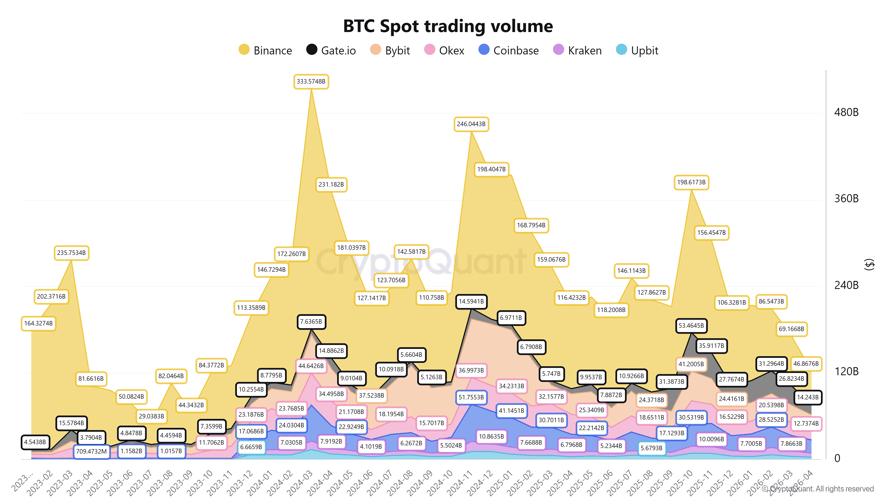
Spot volumes also declined sharply. BTC activity has dropped to levels last seen in September 2023, near the end of the previous bear phase. Binance recorded a monthly decline of about $25 billion in volume. Gate.io also saw a $13 billion drop, while OKX volumes fell by roughly $6 billion.

This indicates weaker investor conviction to build spot exposure at current price levels. Darkfost explained, 

“This contraction in volumes therefore reflects a temporary loss of interest in Bitcoin. While declining spot volumes can suggest negative short-term momentum, these phases of apathy are also often where new opportunities begin to emerge.”

BTC spot trading volume. Source: CryptoQuant

Related: Bitcoin Coinbase Premium threatens bear flag repeat with BTC price at $76K

Bitcoin needs fresh demand from leveraged traders

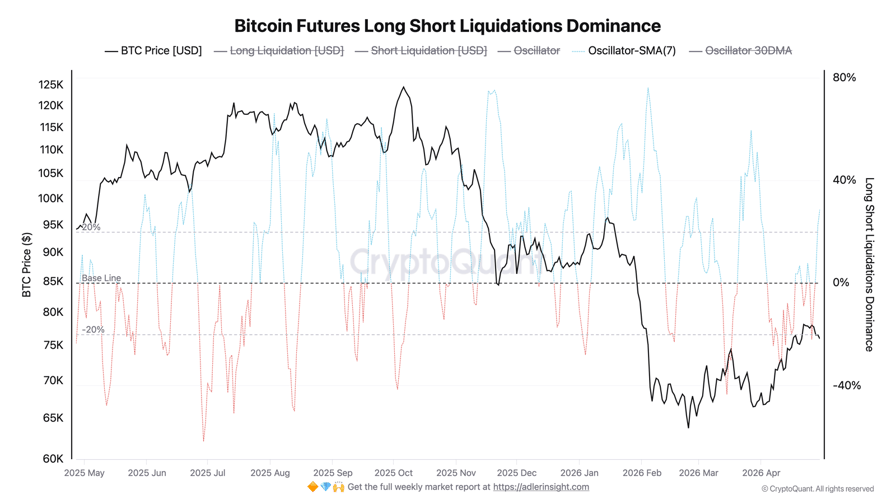
Bitcoin researcher Axel Adler Jr. highlighted a shift in liquidation pressure, with the seven-day oscillator turning positive and reaching +28.7 by April 30. Both the long and short positions have been squeezed more frequently, with total crypto liquidations reaching $604 million over the past 24 hours.  

Bitcoin futures long-short liquidations dominance. Source: CryptoQuant

The shift supports the price in the near term. The 30-day average remains slightly negative, keeping the broader bias tied to prior long liquidations.

Open interest shows where traders’ urgency may be lacking. The seven-day average dropped to about 292,000 BTC from above 300,000 BTC. Around 8,000–9,000 BTC in leverage has been removed over the past 10 days, with daily changes still negative.

The price continues to press against $77,000, with no rise in participation. A stronger move higher would likely require open interest to increase and spot volumes to expand, signaling new capital entering the market rather than futures positions being forced to close.

Related: Bitcoin analysts explain why BTC price can’t take out $80K

This article is produced in accordance with Cointelegraph’s Editorial Policy and is intended for informational purposes only. It does not constitute investment advice or recommendations. All investments and trades carry risk; readers are encouraged to conduct independent research.

Spot Vol Drops To Lowest Since Oct ’23

0

Trusted Editorial content, reviewed by leading industry experts and seasoned editors. Ad Disclosure

On-chain data shows the Bitcoin spot volume has observed a notable decline, something that could make the market more sensitive to flow shifts.

Bitcoin Spot Volume Has Gone Through A Decline Recently

As highlighted by on-chain analytics firm Glassnode in an X post, the Bitcoin Spot Volume has declined to multi-year lows. The “Spot Volume” here refers to an indicator that measures, as its name suggests, the total amount of the cryptocurrency (in USD) that’s becoming involved in trading activity on the various centralized spot exchanges.

When the value of the metric rises, it means the investors are ramping up their spot trading activity. Such a trend suggests interest in the cryptocurrency is increasing.

On the other hand, the indicator observing a decline implies investors may be shifting their attention away from the asset as the number of tokens becoming involved in spot trades is going down.

Now, here is the chart shared by Glassnode that shows the trend in the Bitcoin Spot Volume over the last few years:

Bitcoin Spot Volume

The value of the metric seems to have been heading down in recent days | Source: Glassnode on X

As displayed in the above graph, the Bitcoin Spot Volume witnessed a sharp spike following the price crash at the start of February, but the elevated trading activity lasted only temporarily as the metric soon plunged back to low levels.

Since then, the indicator has continued to move down, implying investors have been disengaging with the market. Interestingly, the downtrend has maintained despite the price recovery that BTC saw in April.

Recently, the Spot Volume dropped to its lowest levels since October 2023, showcasing just how low trading interest around the cryptocurrency has become. “Such low volume environments often coincide with reduced market depth and heightened sensitivity to flow shifts,” noted the analytics firm.

In some other news, the Bitcoin Coinbase Premium Gap has assumed a significantly negative level, as CryptoQuant community analyst Maartunn has pointed out in an X post. The Coinbase Premium Gap keeps track of the difference between the BTC prices listed on Coinbase (USD pair) and Binance (USDT pair).

As the below chart shows, the indicator’s value has plummeted to a value of -$30 recently, suggesting that BTC has been trading at a discount on Coinbase as compared to Binance.

Bitcoin Coinbase Premium Gap

The trend in the BTC Coinbase Premium Gap over the last few days | Source: @JA_Maartun on X

Bitcoin going for a lower rate on Coinbase naturally implies that users of the platform have been applying a higher amount of selling pressure than Binance traders. Alongside the recent Coinbase selling, BTC has observed a retrace, a potential sign that American institutional entities, the platform’s largest users, could be involved.

BTC Price

At the time of writing, Bitcoin is trading around $76,400, down 1.5% over the past week.

Bitcoin Price Chart

Looks like the price of the coin has declined over the last few days | Source: BTCUSDT on TradingView

Featured image from Dall-E, chart from TradingView.com

Editorial Process for bitcoinist is centered on delivering thoroughly researched, accurate, and unbiased content. We uphold strict sourcing standards, and each page undergoes diligent review by our team of top technology experts and seasoned editors. This process ensures the integrity, relevance, and value of our content for our readers.

Anchorage Digital Partners with M0 on US Stablecoin Issuance Stack

0

The partnership aims to make it easier for companies, including fintechs and paying firms, to issue compliant stablecoins in the United States.

Anchorage Digital has partnered with stablecoin infrastructure provider M0 to offer a combined issuance stack aimed at companies looking to launch U.S.-regulated stablecoins, according to an announcement today, April 30.

Under the deal, M0 handles the modular infrastructure layer — stablecoin design, interoperability, and integration — while Anchorage, known as the federally chartered crypto-focused bank, provides the regulated backend: issuance, custody, and reserve management. The pitch to prospective clients is a single pre-integrated stack that reduces the time and cost of getting a stablecoin to market, per the announcement.

The partnership is targeted not just at traditional financial institutions but at fintechs, payment platforms, and app developers that want to embed digital dollars directly into their products — a segment Anchorage says is driving a new wave of issuance demand.

“By partnering with M0, we’re extending our issuance platform to support that growth, while maintaining the regulatory, operational, and security standards our partners rely on,” said Nathan McCauley, co-founder and CEO of Anchorage Digital.

GENIUS-Ready

The timing of the announcement aligns with the regulatory landscape in the U.S., where issuers are preparing to be compliant with the landmark U.S. stablecoin bill, the GENIUS Act. While it still has yet to go into effect, the bill was signed into law last summer, as The Defiant reported. The new framework requires that stablecoin issuers meet particular requirements around reserves and licensing, and Anchorage is explicitly preparing and positioning itself to do so.

The announcement builds on Anchorage’s growing stablecoin footprint, in particular. The firm launched a new regulated offering dubbed Stablecoin Solutions earlier this year. The crypto bank also serves as the issuer of Tether’s U.S.-focused stablecoin, USAT, and recently received a $100 million investment from the USDT issuer.

This article was written with the assistance of AI workflows. All our stories are curated, edited and fact-checked by a human.

Los ataques de bots impulsados por IA se multiplicaron por 12.5, según el Informe Bad Bot de Thales

0

La automatización basada en inteligencia artificial acelera la actividad de máquinas en internet, supera a la humana y redefine el funcionamiento de la web

  • Los bots ya dominan internet y representan más de la mitad del tráfico total; de ese volumen, el 40% es malicioso.
  • La inteligencia artificial vuelve cada vez más difusa la frontera entre actividad legítima y maliciosa, y desplaza el foco del desafío de seguridad hacia la intención más que la identidad.
  • Las API y los sistemas de identidad son los principales objetivos: los atacantes evitan las defensas de las interfaces visibles y abusan de la lógica de negocio a gran escala.

©Thales Thales presentó hoy el Informe Bad Bot 2026: “Bad Bots in the Agentic Age”, que muestra un cambio estructural en el funcionamiento de internet, donde la automatización impulsada por inteligencia artificial se consolida como un componente central de la infraestructura digital moderna.

El estudio identifica tres transformaciones principales: la aparición de los agentes de IA como una nueva categoría de tráfico en internet, el predominio de la actividad automatizada por sobre la interacción humana y la rápida expansión de los ataques dirigidos a interfaces de programación de aplicaciones (API) y sistemas de identidad, que funcionan como base de los negocios digitales.

La IA redefine el tráfico de internet y la seguridad El informe demuestra que la inteligencia artificial incrementa el volumen de actividad de bots y transforma su naturaleza. . En 2025, los ataques de bots impulsados por IA se multiplicaron por 12,5 en comparación con el año anterior.

De forma más significativa, los agentes de IA comienzan a consolidarse como una tercera categoría de tráfico, junto con los bots “buenos” y los “maliciosos” tradicionales, al interactuar directamente con aplicaciones y API para obtener datos y ejecutar tareas. Este cambio difumina la frontera entre automatización legítima y maliciosa, lo que dificulta cada vez más determinar la intención detrás de cada interacción.

“La inteligencia artificial está transformando la automatización: ya no es algo que las organizaciones solo intentan bloquear, sino también gestionar”, señaló Tim Chang, vicepresidente global y gerente general de Seguridad de Aplicaciones en Thales. “El desafío ya no pasa por detectar bots, sino por entender qué hace cada bot, agente o automatización, si responde a una intención de negocio y cómo interactúa con sistemas críticos”.

Esta evolución amplía una brecha creciente de visibilidad. Gran parte de la actividad impulsada por IA hoy no puede verificarse o distinguirse del tráfico legítimo, lo que deja a las organizaciones con una visión incompleta del riesgo real.

Los bots superan cada vez más a los humanos en internet

El informe muestra una consolidación del dominio de la automatización en la web. En 2025, los bots representaron más del 53% del tráfico total de internet, frente al 51% del año anterior, mientras que la actividad humana cayó al 47%. Esto refleja un cambio estructural: los bots dejaron de estar asociados a campañas puntuales, como el raspado de datos o el robo de credenciales, para convertirse en una presencia constante en los entornos digitales.

Las API y los sistemas de identidad, nuevo foco de ataque

A medida que los servicios digitales dependen cada vez más de las API para sus funciones centrales, los atacantes siguen ese mismo camino. El informe indica que el 27% de los ataques de bots ya se dirige a las API, donde logran evitar las interfaces visibles e interactuar directamente con sistemas internos a velocidad de máquina.

Estos ataques suelen parecer legítimos: utilizan autenticaciones válidas y solicitudes que no presentan anomalías, pero explotan la lógica de negocio, extraen información sensible o manipulan flujos de trabajo a gran escala. El impacto es especialmente fuerte en sectores de alto valor. Los servicios financieros concentraron el 24% de los ataques de bots y el 46% de los incidentes de toma de cuentas, lo que muestra cómo la automatización se utiliza para monetizar directamente los ciberataques.

Una nueva era de interacción dominada por máquinas

A medida que avanza la adopción de la inteligencia artificial, el informe concluye que internet se vuelve cada vez más un entorno dominado por máquinas. Los bots ya no son solo herramientas de ataque: participan activamente en los sistemas digitales, influyen en patrones de tráfico, impactan en métricas de negocio e interactúan en tiempo real con las plataformas. En este escenario, la capacidad de gestionar la automatización a escala se vuelve clave para sostener la seguridad, el rendimiento y la confianza.

El desafío de la automatización sin control

El informe concluye que los enfoques tradicionales de seguridad, centrados en identificar y bloquear bots, ya no resultan suficientes en un entorno donde la automatización es ubicua y muchas veces legítima. Las organizaciones deben avanzar hacia modelos de gobernanza que combinen visibilidad, aplicación de políticas y análisis de comportamiento para diferenciar entre automatización aceptable y maliciosa. Esto implica definir qué agentes de IA pueden interactuar con los sistemas, implementar controles en el nivel de API e identidad, y diseñar defensas capaces de adaptarse a la evolución de los bots.

Para más información y recomendaciones, puede descargar el informe completo y participar del seminario web sobre tecnologías para la detección y mitigación de bots maliciosos.


Bitcoin Risks Decline After Futures-Driven April Rally: CryptoQuant

0

Bitcoin could be setting up for a multimonth price decline, after a rally in April driven mainly by futures traders while spot demand declined, according to the crypto analytics firm CryptoQuant.

Bitcoin gained around 20% in April, rising from $66,000 to a peak of $79,000 in a rally “driven entirely by growth in perpetual futures demand,” CryptoQuant said in a report on Thursday. 

Meanwhile, spot demand for Bitcoin contracted throughout the rally, “indicating that the market’s marginal buyer was speculative, not fundamental,” it said.

“The divergence between rising price and contracting spot demand is one of the clearest on-chain signals that price gains are speculative rather than structural,” CryptoQuant added.

Bitcoin is trading around $77,000 at the time of writing, rising 2.1% over the past 24 hours. CryptoQuant said Bitcoin’s correction from $79,000 last month is consistent with rallies led only by strong futures demand.

Current demand for Bitcoin mirrors a pattern at the start of the 2022 bear market, when futures demand surged while spot demand dropped, a setup that “ultimately preceded a sustained price decline.”

Source: CryptoQuant

Related: Bitcoin price hits one-week low as $100 oil sparks fresh Asia crisis fears

“History suggests this setup carries meaningful downside risk as Bitcoin remains in a bear market regime,” CryptoQuant said.

The report is in contrast with a note on Tuesday from Bitwise chief investment officer Matt Hougan, which said the Bitcoin treasury company Strategy has been the “single biggest factor” in Bitcoin’s recent rally.

“There have been multiple drivers of the recent rally, including strong buying from ETFs [exchange-traded funds], $3.8 billion since March 1, and renewed purchases by long-term holders. But Strategy has been the single biggest factor,” Hougan argued.

CryptoQuant added that its Bull Score Index, which analyzes market and network activity to gauge market sentiment on a scale of 100, fell from 50 to 40 in April despite the price increase.

“The Bull Score returning back to 40 indicates conditions are ‘getting bearish’ and places the market in the same range that historically preceded continued price weakness,” CryptoQuant said.

Magazine: Bitcoin will not hit $1M by 2030, says veteran trader Peter Brandt

Cointelegraph is committed to independent, transparent journalism. This news article is produced in accordance with Cointelegraph’s Editorial Policy and aims to provide accurate and timely information. Readers are encouraged to verify information independently.

Bitcoin Price Action Favors Bears But Profit Taking Overwhelms Each Rally

0

Bitcoin (BTC) traders pushed the price to $77,400, but data suggests profit-taking may thwart the bull’s goal of turning the $77,000 to $80,000 zone into support. 

Orderbook data from TRDR shows over $130 million in asks extending from $76,700 to $79,300. 

BTC/USDT Binance perps orderbook. Source. TRDR.io

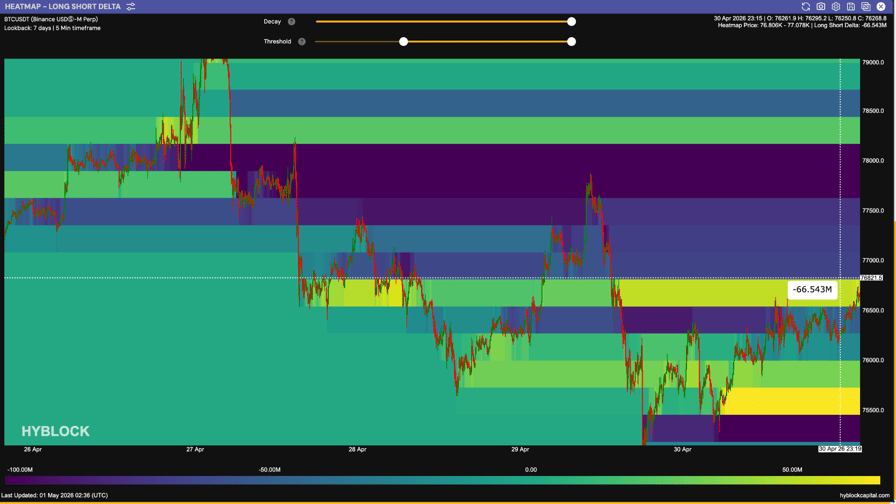
Given Bitcoin’s negative futures funding rate and the small negative long-short delta (-$1.47 million at the time of writing), bulls have a slight edge in the short-term.

The situation could shift further in their favor if the BTC price pushes into short liquidity starting at $76,800, where there is a -$66.5 million to -$189 million negative delta, meaning short positions face a significantly higher risk of forced closure.

BTC/USDT long-short-delta. 7-day lookback. Source: Hyblock

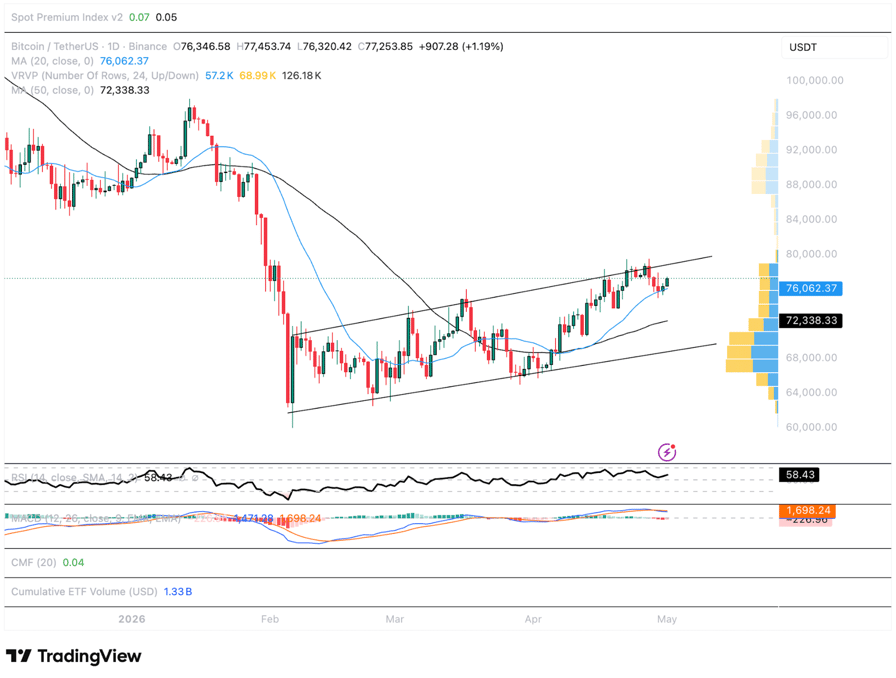
From a technical analysis perspective, the current price action saw Bitcoin lock in $75,000 as support through a confirmed support-resistance flip, and it also traded back above the 20-day moving average ($76,067) after falling below it on Wednesday and Thursday. 

Related: Repeat Bitcoin profit taking near $77K suggests rally is losing steam

In the short-term, the most desirable outcome for bulls would be a repeat of this week’s price action, where, in this case, BTC rallies through the channel trendline resistance at $79,000, followed by another SR-flip to confirm $80,000 as support. 

BTC/USDT 1-day chart. Source: TradingView

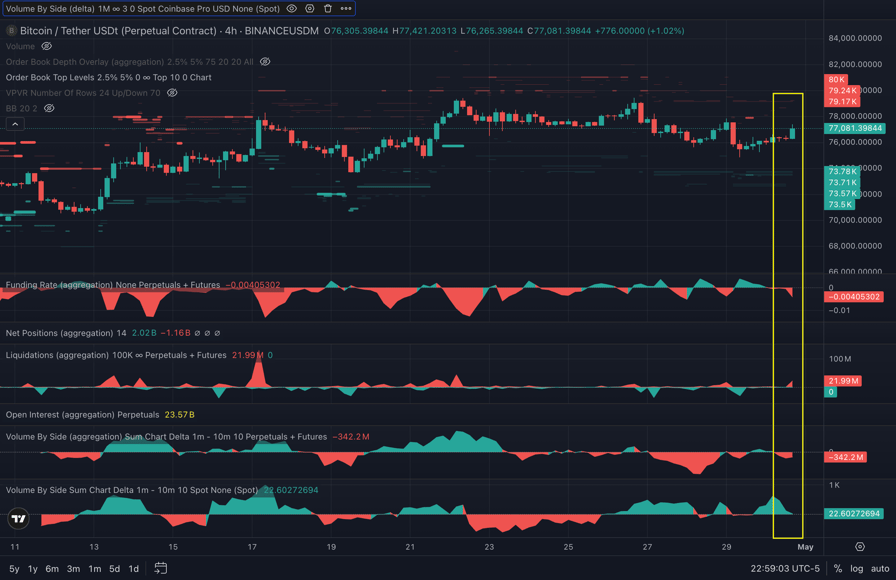
Beyond the expected profit-taking kicking in at $77,000, a volume spike in either spot or perpetual futures markets is the missing ingredient to absorb the selling and extend BTC’s breakouts. 

As shown in the TRDR chart below, the bulk of BTC’s intraday moves stem from liquidations and the absence of sustained spot volume and long leverage, resulting in rallies that lack duration.  

BTC/USDT perps (Binance), 4-hour chart. Source: TRDR.io 

This article is produced in accordance with Cointelegraph’s Editorial Policy and is intended for informational purposes only. It does not constitute investment advice or recommendations. All investments and trades carry risk; readers are encouraged to conduct independent research.

Crypto hacks continue as Wasabi Protocol drained of $4.5 million in admin key compromise

0

DeFi can’t stop bleeding, and Wasabi Protocol is the latest to find out why.

The protocol, a perpetuals trading platform built on Ethereum and Base, was drained of about $4.55 million on Thursday after attackers compromised its deployer key, security firm Blockaid said in an X post.

The hack is the latest in a month that has produced over $605 million in DeFi losses across at least 12 incidents. The attack closely mirrors the Drift Protocol exploit on April 1, when North Korea-linked attackers used a compromised admin key to drain $285 million from the Solana-based perpetuals exchange.

The mechanics operated through an externally owned account, or EOA, called wasabideployer.eth, which held the sole ADMIN_ROLE in Wasabi’s permission system.

An EOA is a wallet controlled by a private key, as opposed to a smart contract. Whoever holds the key controls the wallet. Once the attacker had access to the deployer key, they gave themselves admin privileges with zero delay by calling grantRole on the permission contract.

Their helper contract then upgraded Wasabi’s perp vaults and Long Pool to malicious implementations that drained the balances, Blockaid said.

The exploit relied on a standard known as Universal Upgradeable Proxy Standard (UUPS), which allows a smart contract to change its underlying code while keeping the same address.

UUPS is widely used because it lets developers fix bugs without migrating users. The downside is that if an attacker controls admin permissions, they can replace the contract’s logic with anything they want, including code designed to steal funds.

Wasabi had no timelock or multisig protecting the admin role, Blockaid said. A timelock forces a delay between when an admin action is announced and when it executes, giving users time to react. A multisig requires multiple signers to approve a change. Wasabi had neither, leaving a single key holding full control over the protocol.

Compromised contracts include Wasabi’s wWETH, sUSDC, wBITCOIN, wPEPE, and Long Pool vaults on Ethereum, plus its sUSDC, wWETH, sBTC, sVIRTUAL, sAERO, and sBRETT vaults on Base, according to Blockaid.

Users holding Wasabi LP tokens were urged to revoke any active approvals to the vault contracts because the underlying assets backing those tokens had either been drained or remained at risk.

A month of exploits

In the case of Drift, the attackers also exploited a single-key admin setup with no governance timelock, listing a fake token as collateral and raising withdrawal limits to drain real assets in roughly 12 minutes.

Three weeks later, on April 19, Kelp DAO lost $292 million when an attacker exploited a single-verifier configuration in the protocol’s LayerZero bridge, releasing 116,500 unbacked rsETH that was then used as collateral to borrow real ether (ETH) from Aave.

The cumulative DeFi loss total for 2026 has now passed $770 million across more than 30 reported incidents. April alone accounts for the majority of that figure.

Smaller breaches this month have hit CoW Swap ($1.2 million), Grinex ($13.74 million), Resolv Labs ($23 million), Volo Protocol ($3.5 million), among others.

What ties them together is not a new vulnerability. Each incident produces the same post-mortem language about lessons learned, but the next exploit usually arrives before the lessons get implemented.

Wasabi has not yet issued a public statement on the incident.

UPDATE (April 30, 11:34 UTC): General edits throughout. Moves Drift Protocol exploit to third paragraph.

Visa Expands Stablecoin Pilot To 9 Chains As Usage Hits $7B

0

Trusted Editorial content, reviewed by leading industry experts and seasoned editors. Ad Disclosure

Visa has announced an expansion for its stablecoin pilot, with the payments processing giant adding Arc, Polygon, and three other blockchains.

Visa Has Added Five New Blockchains To Its Stablecoin Pilot

As revealed in a press release, Visa has expanded its global stablecoin settlement pilot with five new blockchains. The pilot enables issuers and acquirers to settle payments in stablecoins rather than traditional banking rails.

Stablecoins are digital assets that are tied to a fiat currency. Since these tokens run on the blockchain, they come with all the benefits that the technology allows, including cheap and fast settlements. This fact has made them gain popularity as a mode of payments, particularly in the cross-border case, and has attracted attention from giants like Visa.

The card payment firm noted:

Over the past year, stablecoins have evolved from a promising innovation to a practical way to move money globally, and Visa’s settlement pilots are helping partners streamline operations.

These fiat-tied cryptocurrencies are available on a range of blockchains. Earlier, Visa’s pilot included four of these networks: Ethereum, Solana, Avalanche, and Stellar. With the new expansion, Arc, Base, Canton, Polygon, and Tempo have also become part of the company’s program.

Rubail Birwadker, Global Head of Growth Products and Strategic Partnerships at Visa, said:

Expanding our stablecoin settlement pilot program to more blockchains means our partners can choose the networks that best fit their needs, while relying on Visa to provide a common settlement layer across all of them.

In the press release, Visa also shared an update on how the pilot is doing in terms of numbers. Compared to the last quarter, the annualized settlement run rate has gone up by 50%, reaching the $7 billion milestone. Visa’s push into stablecoins has come as this class of digital assets has seen regulatory momentum around the world, with perhaps the most important development being the signing of the GENIUS Act in the United States.

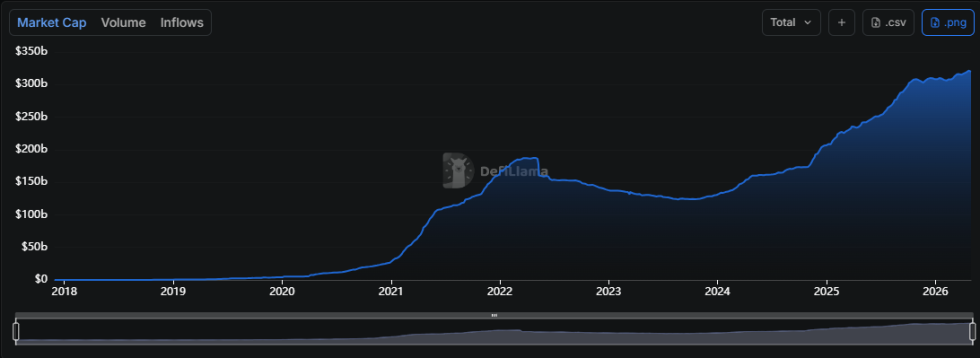
The global adoption has given resilience to the sector amid the downturn in the wider cryptocurrency market, with the total market cap associated with the fiat-pegged tokens even setting a new all-time high in mid-April, according to data from DefiLlama.

Stablecoins

How the stablecoin market cap has changed over the last few years | Source: DefiLlama

From the chart, it’s visible that the stablecoin market cap has followed a slight uptrend since October. In the same period, Bitcoin has gone down roughly 40% instead. Currently, the total valuation of the stables is sitting at about $319.8 billion, shy just $1.5 billion of the record.

Bitcoin Price

At the time of writing, Bitcoin is floating around $76,000, down 1.8% in the last seven days.

Bitcoin Price Chart

The price of the coin seems to have gone down recently | Source: BTCUSDT on TradingView

Featured image from Dall-E, chart from TradingView.com

Editorial Process for bitcoinist is centered on delivering thoroughly researched, accurate, and unbiased content. We uphold strict sourcing standards, and each page undergoes diligent review by our team of top technology experts and seasoned editors. This process ensures the integrity, relevance, and value of our content for our readers.

MegaETH Token Debuts at $2 Billion Valuation

0

MEGA is live on Binance, Coinbase, and 11 other venues a week after the Ethereum Layer 2 network cleared its first performance milestone.

Ethereum Layer 2 network and ‘real-time’ blockchain MegaETH’s long-awaited MEGA token began trading on Thursday, with simultaneous spot listings across 13 major centralized exchanges and on-chain access via the network’s decentralized exchanges.

MEGA briefly traded above $0.22 in early price discovery before selling off, falling to roughly $0.15 by mid-morning U.S. East Coast time, according to CoinGecko data. MEGA’s market cap stands near $170 million, and its fully diluted valuation is around $1.5 billion, well below the $6 billion peak its pre-market perpetuals on Hyperliquid notched last October.

MEGA Chart

Around 1.13 billion tokens, or 11.3% of MEGA’s 10 billion fixed supply, are in circulation at launch.

How Early Backers Fared

The token generation event (TGE) marks the first liquidity event for participants in MegaETH’s three community-led raises, all of which are in profit at current prices, though each has a different vesting schedule that limits how much can be sold today.

Echo round buyers, who paid $0.02 per token in MegaETH’s $10 million December 2024 raise, are sitting on roughly 8.5x paper gains. Only 20% of their allocation unlocks at TGE, followed by a one-year cliff and a three-year vesting period.

Fluffle NFT minters paid 1 ETH (about $2,700 at the time) to mint a soulbound NFT in February 2025, with the first 5,000-NFT installment raising $13.29 million. Each Fluffle entitles its holder to a share of the 2.5% supply allocation, or roughly 50,000 MEGA per NFT, currently worth about $8,500. Half unlocks at TGE, with the rest vesting linearly over six months.

Sonar ICO participants, who bid more than $1 billion for $50 million worth of tokens at a $0.0999 clearing price last October, are up roughly 70%. ICO buyers chose between a full unlock at TGE or a one-year lock at a discount.

The TGE caps a seven-day countdown that began April 23, when 10 Mega Mafia-incubated applications cleared MegaETH’s first key performance indicator of 100,000 transactions each across a 30-day window. MegaETH had tied the TGE to one of three on-chain milestones rather than a fixed calendar date when it unveiled its tokenomics ahead of mainnet.

The other two KPIs, a $500 million USDM circulating supply and three apps generating $50,000 in daily fees for 30 consecutive days, remain unmet. USDM circulation currently sits at roughly $62.9 million, or about 13% of the target, according to MegaETH’s public Road to TGE dashboard.

What MEGA Does

MEGA functions as the bidding currency for MegaETH’s proximity markets, the system that lets market makers and applications pay to colocate near the sequencer for sub-millisecond latency. The MegaETH Foundation has committed to using yield from USDM, the chain’s native stablecoin built in partnership with Ethena, to fund ongoing MEGA buybacks.

MegaETH’s mainnet went live in February with major DeFi protocols, including Aave, deployed at launch. The Ethereum Layer 2 network, which markets itself as a ‘real-time’ blockchain capable of more than 100,000 transactions per second with sub-10 millisecond block times, currently hosts about $355 million in DeFi deposits, with Aave accounting for the bulk of total value locked, per DefiLlama data.

Backers include Ethereum co-founders Vitalik Buterin and Joe Lubin, as well as Dragonfly Capital. The project has raised more than $100 million across the 2024 Echo round, the Fluffles soulbound NFT mint, the Sonar ICO, and prior venture funding.

This article was written with the assistance of AI workflows. All our stories are curated, edited and fact-checked by a human.

Bitcoin Could Be Trading Below Fair Value, According To Most Crypto Investors

0

Trusted Editorial content, reviewed by leading industry experts and seasoned editors. Ad Disclosure

Short-term holders have nearly stepped away from the market. Data from CryptoQuant shows that the realized cap UTXO age bands for one-week to one-month holders dropped to 3.91% — a level last seen in October 2023, when Bitcoin was changing hands near $27,000.

That quiet, behind-the-scenes signal is now drawing attention from analysts who say it points to something bigger: Bitcoin may be deeply undervalued.

Bitcoin: Sentiment Has Shifted Sharply Since December

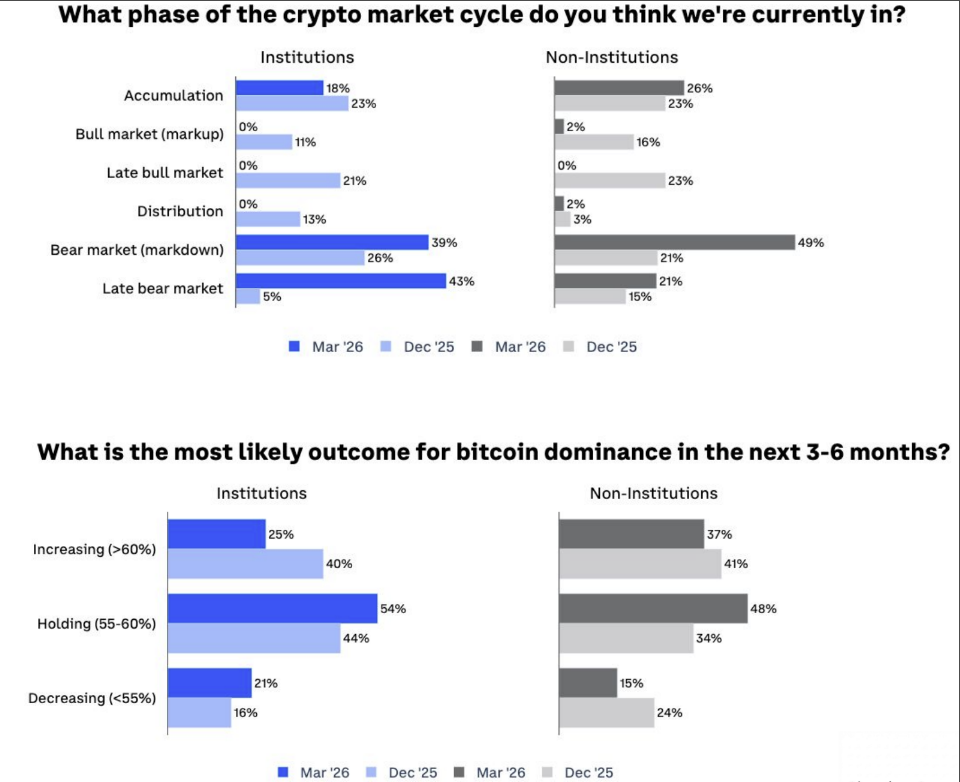
A joint survey by Coinbase Institutional Research and Glassnode polled 91 global investors between March 16 and April 7. The group included 29 institutions and 62 non-institutional participants. What they found marks a clear break from where things stood just months ago.

About 82% of institutional respondents and 70% of non-institutional respondents now classify the current market as a late bear or markdown phase. Back in December, only around one-third held that view. The shift happened fast.

Valuation opinions were just as pointed. Roughly 75% of institutions and 61% of non-institutions said Bitcoin is undervalued at current prices. Very few flagged it as overpriced.

Bitcoin market sentiment survey. Source: Coinbase

Expectations around Bitcoin dominance also changed. The share of institutions expecting dominance to climb fell from 40% to 25%. A majority — about 54% — now expect it to hold near its current level of 58.1%, while 21% think it will slide.

Onchain Metrics Back The Undervaluation Argument

The survey findings don’t stand alone. Onchain data tells a similar story.

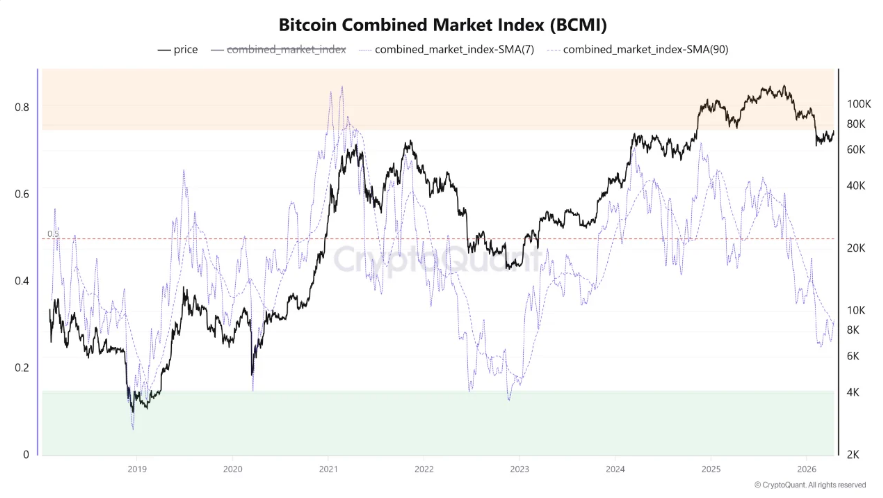
Analyst Woominkyu’s Bitcoin Combined Market Index, known as the BCMI, pulls together four separate metrics: MVRV, NUPL, SOPR, and investor sentiment.

BTCUSD currently trading at $76,589. Chart: TradingView

MVRV compares market value against realized value. NUPL tracks net unrealized profit and loss across all holders. SOPR measures whether coins are being sold at a gain or a loss. Together, they give a broad picture of both price and behavior.

Source: CryptoQuant

The BCMI recently moved from 0.26 to 0.37 — a range that has historically lined up with periods of deep undervaluation. Its 90-day average is still trending lower, which signals that selling pressure hasn’t fully dried up.

But Woominkyu said the data suggests downside is becoming limited relative to long-term upside, and that the market is entering what he called a “value-accumulation zone.”

Analyst Crypto Dan made a similar observation in March. Based on the UTXO age band drop, he said Bitcoin is approaching undervalued territory, though a final bottom has not been confirmed.

Historical Patterns Point Toward A Potential Cycle Low

Reports indicate that whenever the one-week to one-month UTXO age band has hit levels like this since 2021, Bitcoin has typically found a cycle low within three to six months. That pattern doesn’t guarantee a repeat, but it gives the current setup some historical weight.

Featured image from MetaAI, chart from TradingView

Editorial Process for bitcoinist is centered on delivering thoroughly researched, accurate, and unbiased content. We uphold strict sourcing standards, and each page undergoes diligent review by our team of top technology experts and seasoned editors. This process ensures the integrity, relevance, and value of our content for our readers.