Home Blog Page 386

Thailand Considers Opening Door Wider To Crypto Futures in Licensing Revamp

0

Trusted Editorial content, reviewed by leading industry experts and seasoned editors. Ad Disclosure

Kraken and Coinbase moved first. Both crypto exchanges rolled out perpetual futures tied to equities for non-US users earlier this year, part of a broader push toward round-the-clock, multi-asset trading. Now Thailand is adjusting its own rulebook to keep pace.

A Shift In How Licenses Are Granted

Thailand’s Securities and Exchange Commission has put forward a proposal that would allow licensed digital asset companies to apply for derivatives licenses directly, without having to set up entirely separate legal entities.

The change, now open for public comment, is part of a wider licensing revamp aimed at making it easier for crypto firms to offer futures products to retail investors. The consultation period closes May 20.

Under current rules, a crypto company that wants to offer derivatives must establish a new entity — a requirement that adds time, cost, and complexity. The proposed revision would remove that hurdle.

Source: SEC Thailand

Companies would still need to meet additional requirements tied to conflict-of-interest management and regulatory oversight, but the structural barrier to entry would be gone.

The SEC said the changes are designed to give investors more tools for managing risk and building out their portfolios.

Global Push Behind The Proposal

Thailand’s move comes as momentum behind crypto derivatives builds across multiple markets. On Tuesday, Blockchain.com launched perpetual futures trading inside its self-custody wallet, allowing users to take leveraged positions using Bitcoin as collateral without moving funds to a third-party exchange.

The product, built on the Hyperliquid network, gives access to more than 190 markets with leverage of up to 40x.

Image: Adobe Stock

In the US, regulatory movement is also underway. A senior official at the Commodity Futures Trading Commission said recently that the agency is working toward enabling crypto perpetual futures and could act within weeks.

Exchanges aren’t waiting. Kraken’s parent company, Payward, recently agreed to acquire Bitnomial, a US-regulated derivatives venue, with an eye toward giving American clients access to perpetual futures products once approvals come through.

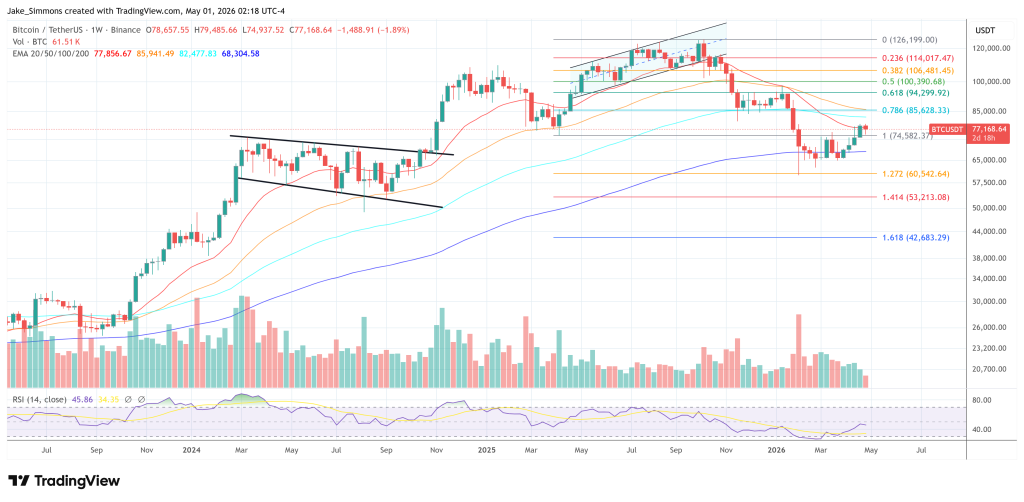
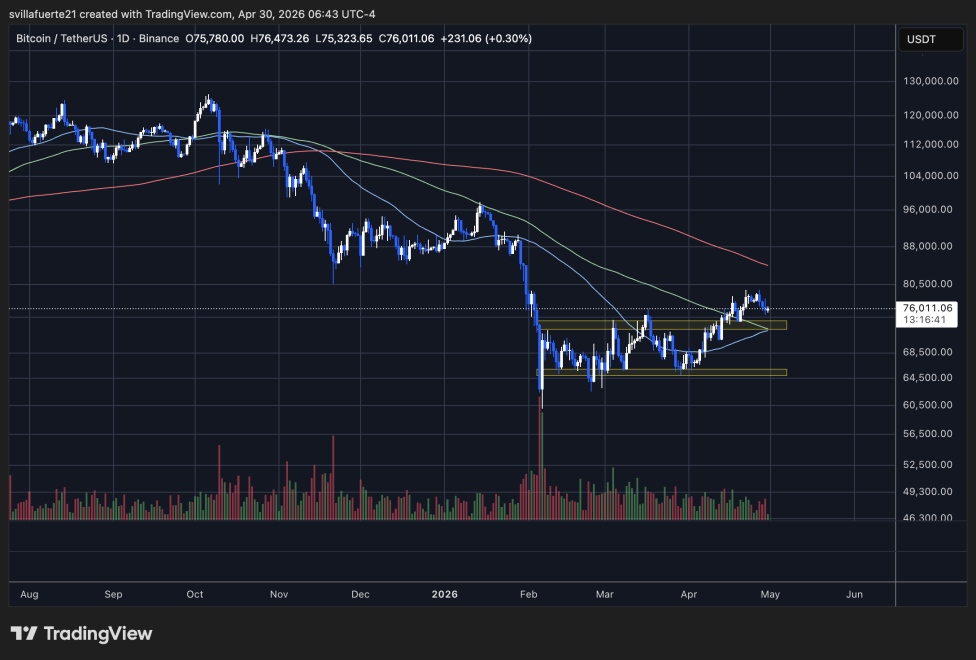
BTCUSD trading at $77,752 on the 24-hour chart: TradingView

Bringing Standards In Line With Global Norms

Thailand’s SEC said the proposed rules would align its derivatives exchanges and clearing houses with international standards — a detail that points to longer-term ambitions beyond just opening up licensing.

Earlier this year, the regulator also put forward separate proposals for tighter scrutiny of the funders behind crypto firms, signaling that the broader push to expand the market comes alongside a tightening of oversight at multiple levels. The licensing revamp sits within that same pattern: wider access, stricter controls.

Whether the final rules reflect that balance will depend, in part, on what the industry submits before the May 20 deadline.

Featured image from Meta, chart from TradingView

Editorial Process for bitcoinist is centered on delivering thoroughly researched, accurate, and unbiased content. We uphold strict sourcing standards, and each page undergoes diligent review by our team of top technology experts and seasoned editors. This process ensures the integrity, relevance, and value of our content for our readers.

Bitcoin Pulls Back From $78K As Persian Gulf Risk Trumps Institutional Bid

0

ETH is lagging with on-chain risk still elevated post-Kelp, while SOL dropped 3% and the broader market cap slipped 1.6% on the day.

Crypto markets sold off broadly on Thursday as traders booked profits after a week-long rally that had pushed Bitcoin back toward $80,000.

Bitcoin is changing hands at $77,955, down 1.1% over the past 24 hours, though still up 4.5% on the week and 9.9% on the month, according to CoinGecko. Ether slipped 2.8% to $2,331, turning its seven-day chart marginally negative.

BTC Chart

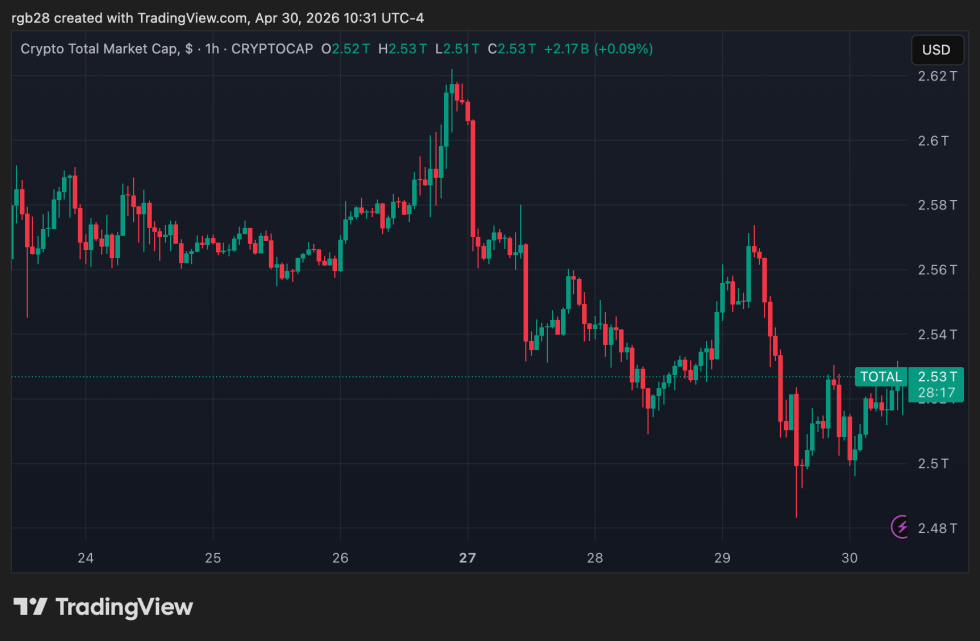
Among the rest of the top ten, Solana is trading at $86, down 3% on the day, XRP is off 1.9%, and BNB is down 2% at $636. Total crypto market capitalization fell 1.6% to $2.69 trillion.

Strong ETF Bid

Despite Thursday’s red tape, the broader trend in spot ETF flows remains constructive.

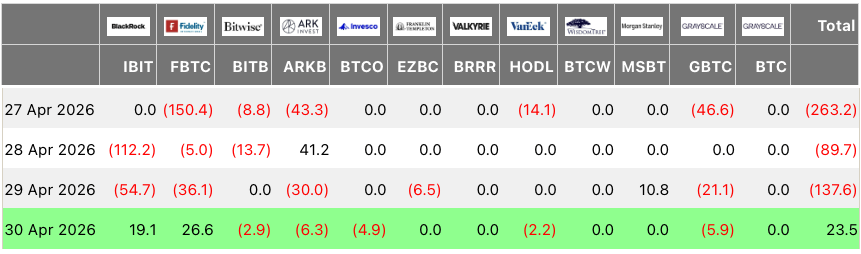
U.S. spot Bitcoin ETFs took in $335 million on Tuesday, per Farside, the seventh consecutive session of positive flows. BlackRock’s iShares Bitcoin Trust (IBIT) accounted for $246.9 million of the total, with Fidelity’s FBTC adding $56.7 million and Bitwise’s BITB contributing $15.4 million. Cumulative flows across all 11 spot Bitcoin products are now back in positive territory for the year, with total AUM above $96.5 billion.

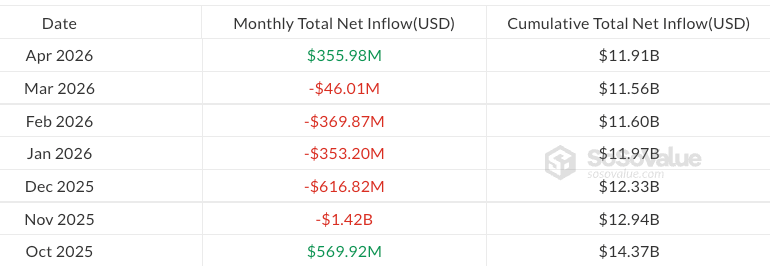
The flows indicate a notable reversal from the first quarter, when sustained outflows tracked alongside Bitcoin’s slide from above $100,000 toward the mid-$70Ks.

Geopolitical Risks Linger

Bitcoin’s failure to push decisively through $80,000 reflects an unresolved geopolitical overhang. Iran reportedly fired on three ships in the Strait of Hormuz on Wednesday, and a U.S. naval blockade in the region remains in place. Although President Trump has framed the current ceasefire as indefinite, peace talks have not progressed, and oil prices remain sensitive to regional headlines.

DeFi Grapples with Kelp Fallout

On-chain markets are still digesting last weekend’s Kelp DAO exploit. LayerZero’s post-mortem attributed the attack to North Korea’s Lazarus Group, which compromised two RPC nodes feeding the bridge’s verifier and minted 116,500 unbacked rsETH before depositing it on Aave as collateral and borrowing real WETH against it.

Aave’s risk service providers have modeled bad debt at between $123.7 million and $230.1 million, depending on how losses are allocated across rsETH holders. The protocol partially unfroze WETH on its Ethereum Core V3 market on Tuesday, and Arbitrum’s Security Council froze roughly $71 million of stolen ETH.

OKX Taps BitGo to Let U.S. Institutions Trade Crypto Without Moving Assets On-Exchange

0

OKX has added BitGo’s off-exchange settlement infrastructure to its U.S. platform. It benefits institutional traders that want access to exchange liquidity without parking capital on a trading venue.

Under the arrangement, clients can trade on OKX while assets remain in BitGo’s regulated custody, with automated settlement handled through BitGo’s Go Network.

Why does it matter? Institutions have long had to pre-fund exchange accounts, a structure that ties up capital and leaves them exposed if a venue is hacked, frozen or otherwise impaired.

OKX said the BitGo integration is designed to reduce or remove that requirement for eligible U.S. institutional clients, while BitGo says assets held in qualified custody can carry insurance coverage of as much as $250 million when BitGo Bank & Trust holds all keys.

That addresses one of crypto’s most persistent structural weaknesses.

Since the collapse of FTX in November 2022, institutions have pushed for market infra that separates custody from execution, rather than forcing traders to concentrate assets directly on an exchange.

The fallout from FTX hardened demand for bankruptcy-remote custody, while later shocks — including the $1.5 billion Bybit hack in February 2025 — kept attention on exchange counterparty and operational risk.

OKX is trying to position itself on the right side of that shift.

The exchange formally launched its U.S. centralized platform and wallet in April 2025 and established its regional headquarters in San Jose, California. Since then, it has expanded its institutional offering in the country, including onboarding tools for family offices and other entities and partnerships aimed at giving professional traders more familiar custody and trading rails.

The BitGo integration is not OKX’s first move in that direction.

OKX previously named Standard Chartered as a third-party custody partner for institutions, and earlier this year the two companies launched what they described as a collateral-mirroring program allowing institutional clients to use crypto and tokenized money market funds as off-exchange collateral for trading.

That broader strategy suggests OKX is building a model in which custody, collateral and execution can sit with different parties, closer to the way traditional markets distribute risk across brokers, custodians and clearing infrastructure.

“Safeguarding customer assets isn’t just a priority, it’s foundational to everything we build,” OKX CEO Star Xu said in a statement shared with AlexaBlockchain.

He added that off-exchange settlement helps reduce counterparty risk while improving capital deployment, and said combining OKX’s internal systems with external custody partners such as BitGo is central to institutional adoption.

The importnace is bigger than one exchange integration.

For market makers, hedge funds and treasuries, idle collateral is expensive. If assets can remain in regulated cold custody while balances are mirrored to a venue for trading and later settled automatically, firms can cut the amount of capital stranded across multiple exchanges and reduce the operational burden of constantly moving funds.

BitGo markets Go Network on exactly that premise: secure assets in regulated custody, mirror balances to partner venues and automate settlement without placing the full asset pool on-exchange.

The model is also becoming more common across the industry.

Copper’s ClearLoop, one of the earliest off-exchange settlement systems, was built to let institutions trade while assets remain off-venue, and Copper said in 2023 that its combined network with BitGo would extend access to exchanges including OKX, Bybit, Bitget, Deribit and Bitstamp.

Fireblocks has pushed a similar “Off Exchange” framework that lets traders lock collateral in segregated MPC wallets instead of transferring custody to a venue, while Ceffu’s MirrorX offers mirrored liquidity access for institutional users whose assets stay in custody.

Results so far point less to a single winner than to a broad change in market design.

BitGo has continued adding platforms and counterparties to Go Network, including Gate in August 2025, Rho X in March 2026 and STS Digital this month, while Fireblocks and Ceffu have both framed off-exchange settlement as a response to institutions’ rising demands for transparency, capital efficiency and venue-risk controls.

The takeaway is that off-exchange settlement is moving from a post-FTX safeguard to a standard feature of institutional crypto infrastructure.

American institutional clients tend to place heavier weight on custody segregation, compliance and operational resilience, especially after years of exchange failures, enforcement actions and headline-grabbing hacks.

By linking its U.S. venue to BitGo’s regulated custody stack, OKX is betting that the next phase of exchange competition will be decided not only by fees and liquidity, but by how little risk clients must take just to access them.

The article “OKX Taps BitGo to Let U.S. Institutions Trade Crypto Without Moving Assets On-Exchange” was first published on AlexaBlockchain. Read the complete article here: https://alexablockchain.com/okx-integrates-bitgo-off-exchange-settlement-for-us-institutions/

Read Also: MoneyGram, Pairpoint and eToro Back Midnight’s Privacy Blockchain Before Mainnet

Disclaimer: The information provided on AlexaBlockchain is for informational purposes only and does not constitute financial advice. Read complete disclaimer here.

Image Credits: OKX, Shutterstock, Canva, Wiki Commons

what advisors need to know

0

In today’s newsletter, Vincent Chok from First Digital unpacks the rise of “agentic finance,” where AI agents are moving beyond advice to execute financial transactions, making crypto the essential financial backend for this machine-driven economy.

Then, in “Ask an Expert,” we posed two questions to three leading AI systems — Grok, Gemini, and Claude — about AI payment use cases and the necessary steps for scalability.

Note: Responses were generated by AI assistants and reflect each model’s perspective. They should not be construed as financial or legal advice.

– Sarah Morton


AI agents in crypto: what advisors need to know

The explosive growth of AI agents

AI agents have become one of the most trending topics over the last year. A recent PwC survey of over 300 companies found that 79% are already adopting AI agents in some form. This explosive growth reflects a broader shift: AI agents are evolving from advisory roles to execution roles.

Initially deployed to help with chatbot services and copiloting roles, AI systems are now actively planning, deciding and acting on predefined parameters set by humans, including financial transactions. The result is the early formation of “agentic finance.” This is a new primitive wherein AI agents essentially execute financial actions within predefined rules such as limits, permissions and goals.

Breaking down agentic finance

Agentic finance can be understood in three layers. The agentic commerce layer focuses on discovery and decision-making. For example, an AI agent can search for the best hotel deal for an upcoming trip. The agentic payments layer handles execution, where the agent completes a transaction once approved.

Finally, the asset management layer represents the full stack, where the agent can manage portfolios, handle payments and dynamically optimize financial strategies based on real-time market trends. While this may seem as if we are giving AI agents full autonomy, that is not the case. It’s conditional delegation, wherein users retain control through constraints while offloading execution.

Theoretically, AI agents do have a use case in the financial space; however, they don’t neatly fit in with existing traditional financial infrastructure. Structurally, AI agents lack direct access to global banking rails and are designed to operate 24/7. This structural mismatch is where crypto comes into play.

Stablecoins offer AI agents access to programmable, always-on money, blockchains enable instant and global settlement, and crypto wallets provide permissionless access to funds. Essentially, these components form a financial layer that is better suited to machine-driven activity. Crypto is thus increasingly becoming the infrastructure for autonomous systems, rather than only being an asset class.

Use cases of AI agents

Early implementations are already visible. Machine-to-machine payments powered by API access and data providers have made the inter-merchant rails stronger and faster. In the consumer context, autonomous commerce has allowed users to optimize retail research, using agents to get the best deals for travel, subscriptions and shopping.

Meanwhile, in crypto-native environments, trading agents are widely deployed for portfolio management, yield optimization and trading strategies. On the enterprise side, supply chain management and vendor payments have been easily automated via AI agents, cutting down on errors and resource expenditure. At this stage, most activity remains business-to-business and infrastructure-driven, rather than consumer-facing.

Beyond use cases, AI agents also play an integral part in driving new investable categories as well as demand for crypto itself. As AI agents can’t operate on existing infrastructure rails, demand is growing for agent-native wallets, stablecoin payment rails and data or compute marketplaces.

Coinbase, for example, has launched x402, an open payments protocol designed for agent-native transactions. This shift is particularly relevant for micropayments, where high transaction volumes and low value make traditional rails inefficient. For the first time, non-human users are participating in the financial system and driving activity. AI agents have become a new class of ‘user’ for crypto networks.

Risks and future outlook

Despite the momentum, we are still in the early stages, and there are risks and limitations. Security is the primary concern, particularly around rogue or exploited agents executing unintended transactions. Questions around authorisation, liability and regulatory treatment are still under scrutiny and are being actively defined. For widespread adoption, we must build trust for users. This comes through regulatory clarity from all involved stakeholders, so projects can build with clarity and confidence while safeguarding user funds and interests.

Over the next twelve months, this technology will continue to grow and mature. Signals that matter include growth in agent-driven transaction volume, emergence of agent-native wallets and payments protocols, and deeper integration between stablecoins and AI-driven systems. Finally, regulatory clarity will heavily shape the pace and scope of adoption across different industries and fields.

In conclusion

AI agents are not a theoretical concept; they are already executing transactions in limited environments. As the trend develops, crypto is increasingly emerging as the financial backend for machine-driven economies. For now, this is an infrastructure and long-term thematic play; however, that is changing with rising adoption rates. Advisors should track it as a next-wave driver of crypto utility.

– Vincent Chok, CEO and co-founder, First Digital


Ask an Expert

This week we’re doing something a bit different. Instead of one expert, we have a panel of experts — AI experts. Below, we posed two questions to three leading AI models, asking about the present and future of AI payments. While there were common themes — especially about what’s needed for future growth — there are also some clear differences. We hope you find this experiment as fun and thought-provoking as we have.

Q1: What AI payment use cases are you seeing today?

Grok xAI
Fraud detection is the most mature use case — AI spots anomalies rules-based systems miss. Intelligent payment routing dynamically selects the best rail by cost and speed. Emerging agentic payments let autonomous AI handle B2B treasury tasks and machine-to-machine micropayments using stablecoins, with Visa, PayPal, and Mastercard beginning to verify these agents.
Gemini Google Three “Agentic Commerce” breakthroughs stand out: autonomous treasury and DeFi yield management where AI executes cross-chain swaps in real time; the “Inference Economy” where agents settle machine-to-machine micropayments instantly via stablecoins; and hyper-personalized wealth implementation — AI-powered direct indexing handling fractional trades and daily tax-loss harvesting at a scale no human advisor could manage manually.
Claude Anthropic AI payments are moving from concept to infrastructure faster than most advisors realize. Clearest use cases: programmatic billing for AI services and agents that autonomously spend funds for compute or subtasks without human approval per transaction. On the wealth side, AI is augmenting rebalancing and tax-loss harvesting, with humans still in the loop on most material decisions today.

Q2: What’s needed for AI payments to scale?

Grok xAI
Three gaps need closing: standardized agent identity with cryptographic proof of authorization and clear liability rules; governance and explainability for regulators including AML compliance in automated wealth flows; and high-quality real-time data infrastructure bridging fiat and crypto. Advisors must demonstrate AI augments rather than replaces fiduciary duty.
Gemini Google Three things must converge: Verifiable Agent Identity using DIDs and cryptographically signed mandates so institutions can distinguish authorized AI from rogue bots; standardized governance protocols with universal spend limits and kill switches enforced at the protocol level; and legal liability frameworks clarifying who is responsible when an AI executes a flawed trade or falls victim to a prompt injection attack.
Claude Anthropic Three things are genuinely missing: identity, accountability, and spending controls. AI agents lack a standardized identity layer — that’s the fiduciary risk hiding inside all the excitement. Programmable guardrails built natively into the payment layer (like a corporate card with hard limits and audit trails) are needed, along with regulatory clarity on stablecoins. The technology is largely ready. What’s lagging is governance — and that’s an opportunity for advisors who get ahead of it.

Keep Reading

FurtherAI on AI Orchestration for Insurance Claims and Submissions

0

At InsurTech NY, Danny O’Lenic from FurtherAI explains how the company is building AI agents to automate end-to-end workflows in the insurance sector. Their primary focus is eliminating the immense amount of manual work involved in processing unstructured data during submission and claims intake, where people are currently keying in information by hand. FurtherAI addresses this by ingesting and extracting data, then building an AI orchestration layer.

FurtherAI’s orchestration layer works above and around an insurance carrier’s existing technology, allowing clients like MGAs, brokers, wholesalers, and carriers to keep using their current underwriting workbenches or claim systems while FurtherAI augments and automates those workflows.

For O’Lenic, attending events like InsurTech NY is a tremendous opportunity to connect with carriers, shake hands, and introduce FurtherAI face-to-face. He also sees it as a chance to learn more about the vendor ecosystem and how others are building various automations. The biggest trend O’Lenic sees is the accelerated adoption of AI and notes that AI has been a hot topic, but over the last 12 months, companies have shifted from debating its utility to being in “full-on adoption mode”.

This has led to a “mass proliferation” and a rapid embrace of these systems, whether built in-house or leveraged from vendors like FurtherAI and O’Lenic calls this a truly exciting space to be in.

Gemini Agent Platform Tackles Enterprise Deployment Challenges

0

Locked in a high-stakes AI race with Anthropic, OpenAI and its fellow tech giants, Google sought to gain an advantage in the agentic arena, releasing a slate of tools for enterprises to build, manage, scale and secure AI agents.

On Wednesday, the first day of its Cloud Next ’26 conference in Las Vegas, Google introduced Gemini Enterprise Agent Platform, Agentic Data Cloud, Gemini Enterprise App and other systems that reveal its strategy for agentic development and ways it is seeking to match, exceed or catch up to its competitors.

The most important of the new platforms, Google executives said, is Gemini Enterprise Agent Platform, which blends the model building and tuning services of the vendor’s popular Vertex AI platform with new features for agent integration, security, DevOps and orchestration.

The platform … gives you the full set of key tools to build and deploy agents,” Thomas Kurian, CEO of Google Cloud, said during a media briefing.

Related:Chinese Volkswagens to Feature AI Agents That Give Cars ‘Personality’

Users of the platform have access to generative AI models such as Gemini 3.1 Pro, Gemini 3.1 Flash Image — also known as Nano Banana 2, and Lyria 3, Google’s model for generating audio and music. Customers can also use Anthropic models such as Claude Opus, Sonnet and Haiku and get support for Claude Opus 4.7.

Users can build agents using tools such as the Agent Developer Kit, Agent Studio, Agent Registry and the Model Context Protocol. They can also scale and orchestrate agents with a set of services highlighted by agent-to-agent orchestration, which enables agents to delegate tasks to each other, and runtime improvements.

The Platform

For Google, the Gemini Enterprise Agent Platform helps organizations address the biggest challenges they face when using agents. Similar to OpenAI and Anthropic, Google is working to make Gemini more than just a model and into a platform on which enterprises can build and innovate on.

“It’s much more than just a model as a platform,“ said Bradley Shimmin, an analyst at Futurum Group. “It is the entirety of Google’s cloud stack that they’re trying to bring to bear.“

The platform focuses on a problem that emerged for enterprises, being able to “contextualize AI agents for specific organizations and individuals,” said Ed Anderson, an analyst at Gartner. 

“Gemini Enterprise Agent Platform brings together all the elements an individual needs to build and operate AI agents specific to their role and environment,” Anderson said. 

However, Shimmin said the Gemini Enterprise Agent platform also appears to be more of an evolution of what previously existed in Vertex AI, which was introduced as a machine learning platform in 2021, six months before OpenAI’s groundbreaking release of ChatGPT and the start of the generative AI era. Vertex AI has turned into Google’s managed platform for building and deploying generative AI applications.

Related:Adobe Launches AI Agent Platform for CX

Agentic Data Cloud

Shimmin said that, among Google’s new offerings introduced at the conference so far, what stands out most to him is the Agentic Data Cloud, a new data architecture. 

The data architecture features a cross-cloud lakehouse that enables enterprises to keep their data in AWS or Microsoft Azure without being locked into a specific vendor. It also includes a Deep Research Agent for enterprise insight, which combines research and analytical capabilities. This enables the Gemini Deep Research agent to connect to data platforms such as Google’s long-established BigQuery enterprise data warehouse, enabling enterprises to get a full picture of their structured and unstructured data, Google said.

The Agentic Data Cloud shows how Google’s data platform is catching up with its models, Shimmin said.

“What it really does is bring them back into play against their rivals and partners,” he said. “This is the current pattern that we’re really seeing in the enterprise for bringing data to models … enabling agentic solutions that aren’t just hallucinating because of gaps in their context,” Shimmin continued. He added that Agentic Data Cloud enables Google to align its data platform with current agentic practices.

Related:OpenAI Updates Agents SDK, Aims at Building Secure Agents

Gemini Enterprise App

Google also introduced new capabilities in the Gemini Enterprise app that help enterprise employees build with AI, such as an Agent Designer that can create sophisticated schedules; long-running agents that execute complex business processes; an inbox for managing agent activity; and skills for creating agents for repetitive tasks.

“Gemini Enterprise App is an incredibly powerful tool to help individuals and teams use AI to interact with their enterprise environment,” Anderson said. He added that combined with the Agentic Data Cloud, the Gemini models and the Gemini Enterprise Agent Platform, the app helps enterprises “gain the productivity and efficiency outcomes they’ve been seeking from their AI solutions.”

“Gemini Enterprise takes a big step forward in making generative AI accessible and usable, and applicable to the tasks people work on every day,” Anderson continued. “The next step will be to apply agentic AI capabilities to the scenarios that produce meaningful business outcomes.”

While the new capabilities in the Gemini Enterprise App may suggest that Google is competing with Anthropic Claude Cowork and other similar tools, Google’s entry into this space bolsters the overall AI market.

“This market thrives on competition in the form of innovation,”” Shimmin said.

Cybersecurity Moves

While building an agentic AI infrastructure is an important step for Google, the vendor is also looking to help enterprises secure the AI agents and applications that they build, with AI cybersecurity top of mind due to Anthropic’s limited release of its Mythos security model, which has caused widespread concern about the technology falling into the hands of bad actors to crack software defenses easily.

Meanwhile, Google introduced new tools for agentic defense, such as Dark Web Intelligence, which uses the newest Gemini models to analyze daily external events and elevate the threats that matter most to an organization. The Threat Hunting Agent uses Google’s threat intelligence technology to enable teams to hunt for novel attack patterns and adversary behaviors that bypass other types of defenses. Google also unveiled Google Cloud Fraud Defense, a platform that can determine whether a bot, a human or an agent has the necessary authority.

On the workspace front, Google introduced the Workspace Intelligence platform, a semantic layer that breaks down information and context for enterprises and their agents. It works across Google Workspace apps and powers AI Overviews in Gmail, Gemini in Google Chat and Content Creation in Docs, Sheets and Slides.

BTC price’s bullish momentum runs into Pentagon-backed inflation warning

0

Just as bitcoin appeared to have built momentum for a breakout above $80,000, macro uncertainty reemerged as a headwind.

The most notable development came from the Pentagon, which told U.S. lawmakers in a classified briefing that clearing mines in the Strait of Hormuz, a major oil chokepoint, could take at least six months, and the process will begin only after the U.S.-Iran conflict ends. The briefing also warned that gasoline and oil prices may remain elevated through the midterm elections, according to the Washington Post.

Persistently high energy costs risk keeping inflation sticky, leaving the Federal Reserve with limited room to cut interest rates, a negative backdrop for risk assets. Bitcoin, in particular, remains highly sensitive to interest rates and global liquidity conditions rather than real economic activity. Rising costs for essentials like fuel and food could also reduce investors’ willingness to allocate capital to speculative assets.

These risks are already showing up in markets. WTI crude has climbed to around $95 from $79 late last week, while government bond yields are rising across major economies. The U.S. 10-year yield has increased by eight basis points to 4.32% this week, and it’s U.K. counterpart has risen by 18 basis points to 4.96%.

“Oil prices are rising alongside yields and widening volatility spreads, signaling tighter financial conditions and increasing market risks,” said Michael Kramer, founder and CEO of Mott Capital Management.

This is an excerpt from CoinDesk newsletter ‘Daybook.’ Sign up here, if you haven’t already.

Speaking of key indicators, U.S.-listed spot bitcoin ETFs continue to show sustained demand, with funds seeing their fastest inflows in a month based on the seven-day moving average of net flows tracked by Glassnode.

Still, some analysts are urging caution, arguing that the rally lacks broad-based support in the spot market.

“The recent Bitcoin price increase is completely driven by demand in the perpetual futures market. Meanwhile, spot demand is still contracting (although at a slower pace). The same happened in January, when Bitcoin peaked at $98K. There are risks of a correction if traders start taking profits while spot demand continues to contract,” Julio Moreno, head of research at CryptoQuant, said on X.

The market capitalization of USDT, the largest dollar-pegged stablecoin, has hit a record high of $188.88 billion. Meanwhile, speculation in non-serious tokens such as , is reaching fever pitch, with overcrowding in bullish bets. Stay alert!

Read more: For analysis of today’s activity in altcoins and derivatives, see Crypto Markets Today . For a comprehensive list of events this week, see CoinDesk’s “Crypto Week Ahead.”

What’s trending

Today’s signal

The chart shows fluctuations in the ratio between bitcoin’s price and gold, displayed in candlestick format. The red line represents the 50-day moving average, the white line the 100-day moving average and the yellow line the 200-day moving average.

The ratio has been steadily rising and has now topped the 100-day average. More importantly, the 50-day average could soon move above the 100-day average, confirming a bullish crossover. As the name says, it suggests a bullish shift in momentum.

That would mean continued outperformance of bitcoin relative to gold.

Premarket data (CoinDesk)

More than 90% of Web3 games failed after $15 billion boom as gamers never showed up: Caladan

0

Web3 gaming burned through up to $15 billion chasing a token-driven future that gamers never bought into.

Data from Caladan, a market-making and trading firm, shows roughly 93% of so-called GameFi projects are now effectively dead, with token values down about 95% from their 2022 peaks and funding to studios collapsing 93% by 2025.

Investors and studios poured billions into tokens and non-fungible tokens (NFTs) before building blockchain-based games containing tradable properties. Then capital shifted into AI, asset tokenization and infrastructure, and more than 300 games shut down, turning Web3 gaming into a cautionary tale about chasing speculation over product-market fit.

“Capital was destroyed at every layer simultaneously,” the report states, pointing to venture capital, retail NFT buyers, gaming guilds and Telegram’s 300-million-user tap-to-earn wave as parallel casualties. Hamster Kombat alone lost 96% of its users within six months of launch. YGG, the flagship gaming-guild token, trades 99.6% below its November 2021 peak.

Individual post-mortems are brutal. Pixelmon raised $70 million in a 2022 NFT mint and, four years on, still has no public game. Ember Sword burned through $18 million over seven years of development before shutting down last May with no refunds. Gala Games is embroiled in a lawsuit alleging its co-founder diverted $130 million in tokens. Square Enix quietly wound down its Symbiogenesis experiment last July.

Structural mismatch

The failure wasn’t just a bad cycle or weak execution. The data indicate it was a structural mismatch between a model built around financial incentives and an audience that consistently signaled it wanted entertainment instead.

At the heart of the boom was GameFi, the play-to-earn model that turned gameplay into a financial feedback loop.

Players bought tokens or NFTs, earned rewards in those same assets, and cashed in as long as newcomers kept piling in. Once the inflows slowed, the math broke down. Token prices slumped, rewards thinned out, and users walked away — dragging entire in-game economies down with them.

Axie Infinity, the sector’s one-time flagship, watched daily active users crater from roughly 2.7 million at the peak to around 5,500 today, according to DappRadar data.

The demand side never caught up with the flood of capital. Even at the height of the mania, just 12% of gamers had tried a crypto game, according to a Coda Labs survey, cited by Caladan.

Capital allocation made the problem worse. Studios raised tens or hundreds of millions of dollars before shipping viable products, removing the pressure to build games that could retain players.

(Caladan)

The most telling data point may be where the money went instead. Gaming commanded 62.5% of all Web3 venture investment in 2022; by 2025, its share had collapsed to single digits as AI, real-world-asset tokenization and layer-2 infrastructure absorbed the displaced capital.

(Caladan)

Even Animoca Brands, the sector’s most prolific backer, has cut gaming to roughly 25% of its portfolio and is pivoting to stablecoins, RWAs and AI.

At the same time, development timelines stretched three to five years, while tokens traded in real time and demanded constant momentum. By the time many projects were ready to launch, their associated tokens had already collapsed.

The result is a sector that expanded rapidly on speculative demand and contracted just as quickly when that demand faded. More than 300 blockchain games have shut down, according to DappRadar, and remaining investment has shifted away from titles toward infrastructure.

What was once pitched as the future of gaming now looks more like a cautionary example of what happens when financial engineering runs ahead of product market fit.

SBF withdraws motion for retrial but leaves option open for after appeal ruling

0

Sam Bankman-Fried, founder of collapsed crypto exchange FTX, has withdrawn his request for a retrial over doubt he would get a fair hearing in a letter to the judge overseeing his case.

Bankman-Fried, who is serving a 25-year sentence after being convicted on seven counts of fraud and conspiracy tied to FTX’s 2022 collapse, said he may renew the motion after his direct appeal and a related request for reassignment are decided.

The motion for a new trial was filed by his mother, Barbara Fried, claiming new evidence in the case would justify a reset.

Bankman-Fried said he largely drafted the motion himself while detained at the Metropolitan Detention Center in Brooklyn, with limited assistance.

Although clarifying he is the “author of the letter” to the judge, he did consult his lawyers and his parents “since it concerns them both,” he said.

“They made editorial and organizational suggestions, some of which I incorporated into the motion,” Bankman-Fried said. “They also helped print it, as I no longer had access to a word processor. I also shared earlier drafts with a New York attorney who was originally hired to represent me on the Rule 33 Motion before I decided to represent myself; they had no significant input into the ultimate motion.”

A Rule 33 motion is a formal request to a federal court for a new trial based on new evidence or in the interest of justice.

The appeal is currently before the U.S. Court of Appeals for the Second Circuit. During oral arguments in November, his attorney, Alexandra Shapiro, argued that the trial was “fundamentally unfair,” including limits placed on what Bankman-Fried could present to the jury.

U.S. military runs a Bitcoin (BTC) node, sees crypto as ‘power projection’ vs China

0

A four-star U.S. Navy admiral has told Congress the military is running a live node on the Bitcoin network and testing it for national security purposes.

Admiral Samuel Paparo, commander of U.S.-Indo-Pacific Command (INDOPACOM), made the disclosure at a House Armed Services Committee hearing on Wednesday, a day after telling the Senate Armed Services Committee that Bitcoin has “incredible potential” as a tool for American “power projection.” He also said it has great potential as tool for national security.

The House comments were the first public confirmation by a sitting US combatant commander that the military is directly participating in the Bitcoin peer-to-peer network.

“We have a node on the Bitcoin network right now,” Paparo said, responding to questions from Rep. Lance Gooden. “We’re not mining Bitcoin. We’re using it to monitor, and we’re doing a number of operational tests to secure and protect networks using the Bitcoin protocol.”

A Bitcoin node is a computer that stores the full history of the blockchain and enforces the network’s rules, relaying validated transactions across the peer-to-peer network. Unlike mining, it does not earn rewards and does not require specialized hardware.

Running a node is how participants in Bitcoin verify the network state independently rather than trusting third parties. There are an estimated 15,000 to 20,000 publicly reachable full nodes on the network as of early 2026, with the real number likely higher because many operate behind firewalls.

One node out of tens of thousands poses no threat to Bitcoin’s independence or its resistance to any single party controlling it.

But a US military combatant command running that node is notable because Bitcoin’s design has long been framed as a defense against takeover attempts by powerful governments, and INDOPACOM is the command responsible for US military operations across the Indo-Pacific, including the theater of strategic competition with China.