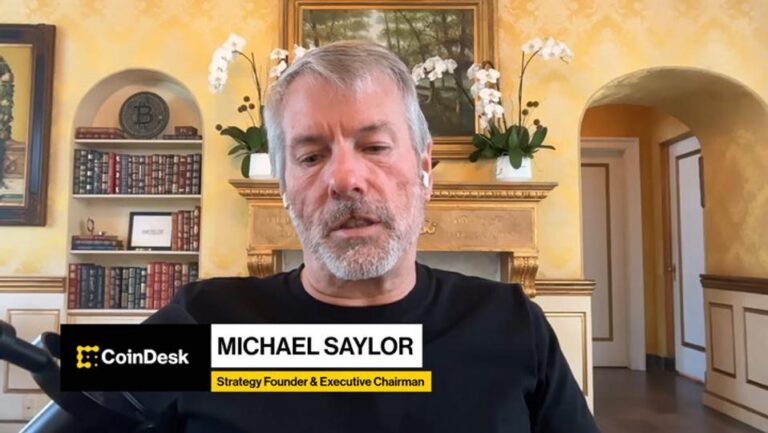
Alberta Investment Management Corporation (AIMCo), according to its first quarter 13F filing, purchased 1,382,000 shares of Strategy (MSTR) for $172,473,600.
This implies an average cost of about $125 per share. With MSTR having rallied to about $175, that position would now be valued at roughly $241 million, representing an unrealized gain of about $69 million.
As of December 2025, AIMCo managed more than $140 billion on behalf of Alberta’s public sector pension plans, making it one of Canada’s largest institutional investors.
A 13F is a quarterly filing required by the SEC for institutional investment managers with over $100 million in U.S. equity holdings, disclosing their positions at the end of each quarter.
According to FactSet, AIMCo previously held a small position in MSTR between late 2019 and mid 2020, around 198,000 shares. The fund exited the position entirely in September 2020, shortly after CEO Michael Saylor pivoted the company toward Bitcoin as a corporate treasury asset in August 2020.
Alberta Investment Management MSTR Position (FactSet)
In certain jurisdictions, institutional investors may face restrictions on directly holding Bitcoin, leading them to seek alternative exposure through instruments such as Strategy or BlackRock’s IBIT.
Those looking for fresh narratives around bitcoin are getting so desperate that they’re bordering on lunacy. One popular crypto account on X recently suggested that gold will be displaced by bitcoin because we are going to build data centers on the moon, which will then enable us to, I guess, mine gold on asteroids, or something like that.
Sarcastic or not (and I’m not convinced the post was), if this is what market pundits are propagating, Jamie Dimon’s comparison of bitcoin to “pet rocks” might actually prove true. But perhaps ironically, Mr. Dimon is helping to create bitcoin’s new, lasting narrative by integrating it into the plumbing of traditional finance. Bitcoin is not digital gold. It is a digital collateral asset. The question is how much of the global financial system it will ultimately collateralize.
We’re seeing new examples spring up every day: JPMorgan has begun allowing clients to use bitcoin-linked assets, and potentially bitcoin itself, as collateral for loans. Morgan Stanley, BlackRock and more are also incorporating bitcoin exposure into lending frameworks, structured products and portfolio margin systems. New, cheaper ETFs and retail accounts, like one just announced by Charles Schwab, are pushing bitcoin further into the mainstream. Other Wall Street firms are sure to follow.
But bitcoin’s role in that system is changing. Over the past decade, bitcoin has been assigned a rotating cast of identities. It has been described as an inflation hedge, a proxy for global liquidity, a form of digital gold, a geopolitical safe haven, and, most recently, the centerpiece of institutional adoption. Each of these narratives has, at various points, appeared convincing. Yet in the current cycle, they have all broken down.
In this cycle, rather than acting as a hedge during periods of market stress, bitcoin is increasingly behaving like a collateral asset under pressure, amplifying liquidity contractions through forced deleveraging. In this context, institutional adoption is not dampening volatility — it may actually be increasing it.
This transition offers a compelling explanation for bitcoin’s sad price action as of late.
When an asset becomes collateral, its price behavior fundamentally shifts. It is no longer simply held; it is borrowed against, levered, rehypothecated, and, critically, liquidated. This introduces a reflexive dynamic that is well understood in traditional markets but underappreciated in bitcoin. When prices fall, collateral values decline. When collateral values decline, margin calls are triggered. When margin calls are triggered, forced selling occurs. That selling drives prices lower still, creating a feedback loop.
This is precisely how collateralized systems behave in equities, real estate and commodities. Bitcoin is now entering that same regime.
Thus, the real narrative for bitcoin is that it is emerging as the world’s first globally traded, neutral, programmable collateral asset. It is the canary in the coal mine; a high-duration, zero-cash-flow asset that is acutely sensitive to liquidity conditions.
In practical terms, this new narrative means that bitcoin behaves like a leveraged barometer for global risk appetite. When liquidity expands meaningfully, bitcoin can outperform dramatically. But when liquidity tightens — even marginally — it tends to break first. In multiple recent drawdowns, bitcoin has led equities lower by days or even weeks, functioning less as protection and more as a forward indicator of stress.
Bitcoin’s massive drawdown over the past five months has occurred against a macroeconomic backdrop that should have supported it: inflation has remained elevated, global liquidity has stabilized and begun to expand, geopolitical tensions persist, and traditional markets — from the S&P 500 to gold — have performed strongly until very recently. If bitcoin were meaningfully tied to any of these forces, it should have responded accordingly. It did not.
A few weeks ago, as equities fell from their highs, people pointed to bitcoin’s stable price behavior as proof of its hedging capability. It’s down 50% in five months; it’s not a hedge for anything, it just front-ran the wipeout.
Other popular narratives don’t work either. Consider the widely cited relationship between bitcoin and global M2 money supply. While there have been periods when bitcoin appeared to track the money supply, the relationship has proven highly unstable, shifting from strongly positive to strongly negative within the same cycle.
The same inconsistency appears when comparing bitcoin to traditional assets. Long-term data show that bitcoin’s correlation with both gold and equities tends to cluster near zero over extended periods, despite temporary spikes during specific market regimes. More recent data reinforces this instability. Bitcoin’s correlation with gold has at times turned sharply negative, falling as low as -0.9, indicating not just independence, but outright divergence. Meanwhile, its correlation with equities has ranged from negligible to as high as 0.8 during periods of institutionally driven risk-on behavior.
Similarly, the digital gold narrative has struggled to hold up in practice. Gold has materially outperformed bitcoin during recent periods of macro uncertainty, while bitcoin has continued to exhibit large, equity-like drawdowns. Even as an inflation hedge, bitcoin has disappointed. Since the inflation surge began in 2021, it has failed to deliver consistent, real returns.
What remains is an uncomfortable conclusion: bitcoin does not reliably rise with equities or any other asset class, it does not track gold and it does not hedge inflation. What it does do (consistently) is fall earlier and more aggressively when financial conditions tighten.
What all of that boils down to is that bitcoin is a high-volatility, reflexive, globally traded collateral asset. It is leverage on liquidity cycles, not protection.
This may be a less romantic narrative than asteroid mining and lunar data centers, but in order to be integrated into the traditional leveraged financial system in earnest, bitcoin must be understood for what it is, not what we wish it were.
UK-licensed digital bank iFAST Global Bank has completed a full migration to the UK Open Banking Standard version 4.0 (OBL v4.0), powered by a strategic partnership with Ozone API.
The major transition, which was completed in January 2026, uplifts the bank’s platform from the previous version 3.1.11. The move positions iFAST Global Bank among the first in the UK to commit to a full v4.0 transition, while many domestic incumbents currently remain on older versions of the regulatory standard.
Ozone API, whose founding team originally created the UK Open Banking Standard, has been working alongside the digital bank since March 2023 to ensure seamless compliance with the revised Payment Services Directive (PSD2).
What version 4.0 brings to the table
For iFAST Global Bank, the upgrade future-proofs its multi-currency current account proposition for both individuals and businesses. The transition to version 4.0 introduces several critical industry enhancements:
Enhanced Global Interoperability: Alignment with the ISO 20022 messaging standard allows for richer data sharing and smoother cross-border payments.
Superior Security: The upgrade to the FAPI 1.0 Advanced security profile ensures higher levels of protection for customer data.
Improved Transparency: New requirements for definitive payment statuses and consistent error messaging will give customers more clarity on their transactions, reducing manual interventions and false-positive fraud alerts.
Future-Ready Innovation: The standard actively lays the groundwork for advanced open banking features like Variable Recurring Payments (VRP).
A digital growth strategy
Inayat Kashif, CEO of iFAST Global Bank
The successful implementation coincides with significant market momentum for iFAST Global Bank. Following its acquisition by Singapore-based iFAST Corporation in 2022, the bank rapidly achieved profitability in Q4 2024. Driven by the success of its Digital Personal Banking division, the institution now holds over $1 billion in customer deposits.
Inayat Kashif, CEO of iFAST Global Bank, emphasized that the technology is central to the bank’s vision of a globally connected digital banking experience.
Huw Davies, co-founder and CEO of Ozone API
“Our partnership with Ozone API is a key enabler of iFAST Global Bank’s strategy to build a truly intelligent, globally connected digital bank,” Kashif stated. “By adopting Open Banking 4.0 standards, we are strengthening the foundations of our multi-currency current accounts for personal customers and multi-currency business accounts for commercial clients, as well as our payments and savings propositions.”
He added that the standard enables the bank to deliver clearer, more transparent products that provide fair value and better outcomes in line with its Consumer Duty commitments.
Huw Davies, co-founder and CEO of Ozone API, highlighted the bank’s proactive approach to the regulatory landscape.
“iFAST Global Bank is a great example of a modern, fast-moving digital bank that understands Open Banking is not just a regulatory hurdle, but a fundamental growth strategy,” Davies said. “Achieving SGD$1billion in deposits in such a short time demonstrates the success of their digital-first approach. We are proud to provide the high-quality, standards-based foundation that ensures their continuous PSD2 compliance while enabling them to embrace the next generation of Open Banking.”
Decentralized finance (DeFi) protocols are stepping in to freeze stolen funds while centralized issuers face criticism for holding back.
A recent intervention on Arbitrum saw attacker-linked assets frozen after a major exploit, while some stablecoin issuers, including Circle, have faced public backlash for slower or more limited responses in similar situations.
Connor Howe, CEO and co-founder of cross-chain infrastructure project Enso, said that crypto protocols are not that different from centralized platforms or banks if a small group of people can freeze funds.
“The differentiation from a bank compliance officer is less than DeFi idealists will ever admit,” Howe told Cointelegraph.
The debate isn’t the usual kerfuffle between decentralization and centralization, but about who gets to intervene and how quickly they can act. In practice, it can determine whether stolen funds are stopped or slip through.
Crypto community divided on Arbitrum’s decision to freeze stolen funds. Source: Joe Hall
The limits of decentralization in DeFi
To put it simply, the industry is split on whether protocols that call themselves decentralized should be able to freeze funds during exploits.
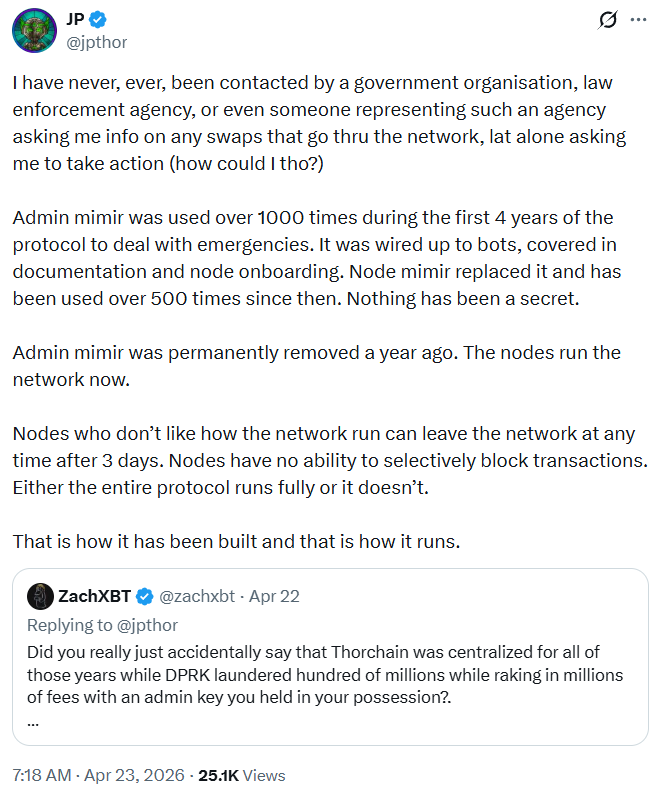
Protocols like THORChain said they cannot freeze funds by design, even during exploits. Security researchers have questioned that claim, pointing to past cases where intervention did happen.
THORChain founder’s defense against the security community. Source: JP Thorbjornsen
Related: Crypto projects shut down as token models fail under pressure
Bernardo Bilotta, CEO of stablecoin infrastructure platform Stables, said the function is necessary but must operate within clear constraints.
“Freeze capabilities need to be narrowly scoped, time-limited and governed by transparent criteria that existed before the breach occurred,” Bilotta told Cointelegraph. “A protocol shouldn’t be making up the rules while the house is on fire.”
Bilotta characterized choosing “philosophical purity” over user protection as “negligence.”
The recent $293 million Kelp DAO exploit brought those discussions back into the spotlight as Arbitrum froze some of the stolen funds linked to suspected North Korean hackers. Some in the industry said the decision cut against DeFi’s grain.
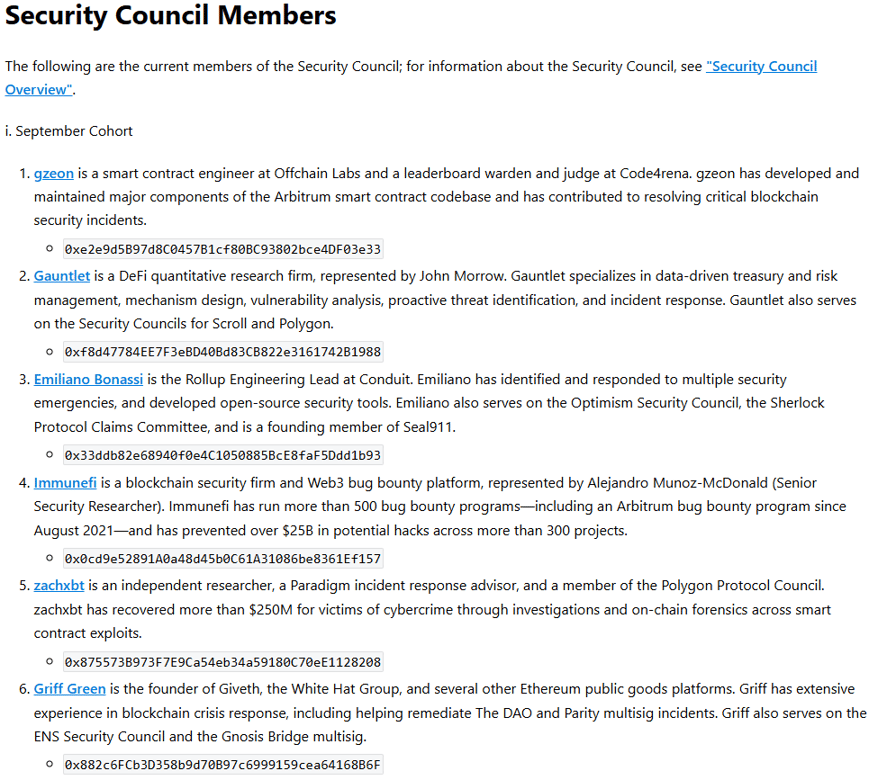
The Ethereum layer-2 network has a 12-member security council with the ability to carry out certain changes to the protocol. In emergency situations, it can do so through nine of the 12 in its multisig wallet.
Arbitrum security council members are voted on by the network’s decentralized autonomous organization. Source: Arbitrum
Howe said that transparency in how such security councils operate can still separate DeFi platforms from traditional finance or their centralized counterparts.
“That’s notably different from a TradFi institution that invokes discretionary powers buried in their terms of service and guarded by their legal team,” Howe said.
“There should be transparency in every protocol around who holds the keys, and the safeguards in place to prevent them from going rogue. If there’s no clear distinction, then it’s a vague claim of decentralization.”
Centralized issuers face different constraints
Centralized stablecoins are among the most-traded cryptocurrencies in the world. Tether’s USDt and Circle’s USDC are the largest, accounting for more than $266 billion in combined market capitalization.
Both issuers have the ability to freeze their stablecoins, but they approach that function differently.
While Tether freezes funds more quickly in most security breaches, Circle emphasizes legal process and jurisdiction before intervening,
“Let me be clear about something that is frequently misunderstood: when Circle freezes USDC, it is not because we have decided, unilaterally or arbitrarily, that someone’s assets should be taken from them,” Dante Disparte, the company’s head of global policy, wrote in a recent blog post.
“Our ability to freeze funds is a compliance obligation — exercised only when we are legally compelled by an appropriate authority, through lawful process,” he continued.
Circle was pushed to explain its stance after the recent $280 million exploit on Solana-based Drift protocol, also attributed to North Korea.
Circle’s explanation did not cut it for security experts demanding answers. Source: ZachXBT
Related: Ethereum’s EEZ could pull other blockchains into its orbit
Bilotta said waiting for formal legal orders in cases with clear, onchain evidence of an exploit is a “failure of responsibility.”
Who decides what counts as “extreme”
Large-scale exploits, including those linked to North Korean actors, have pushed the industry into situations most would consider extreme, where hundreds of millions can be drained and laundered in real time.
Such cases raise the question of who defines what qualifies as “extreme” and when intervention is justified.
“This is the question the industry has been ducking the longest,” said Wish Wu, CEO of institution-focused layer-1 Pharos.
“In practice, ‘extreme’ is too often defined after the fact by whoever holds the keys, which is exactly the failure mode decentralization was meant to avoid,” he added.
Wu said the more credible approach is to define those conditions in advance and encode them into governance, even if that means accepting that some edge cases fall outside those rules.
“Can a small, identifiable group move user funds before users have a fair chance to exit?” Wu asked.
“If the answer is yes, then whatever the marketing says, the system is custodial in substance. If the answer is no, only then are we in an honest conversation about which governance and safety tradeoffs make sense for different use cases.”
Below that line, decentralization loses its substantive meaning, he added.
Magazine: AI-driven hacks could kill DeFi — unless projects act now
Cointelegraph is committed to independent, transparent journalism. This news article is produced in accordance with Cointelegraph’s Editorial Policy and aims to provide accurate and timely information. Readers are encouraged to verify information independently.
Bitcoin BTC$78,451.28 moved higher on Friday, extending gains as U.S. markets opened and risk appetite improved. The largest cryptocurrency is now up nearly 3% over the past 24 hours, continuing a climb that began overnight.
It was last trading at $78,722, edging closer to the $80,000 mark once again. Earlier this week, bitcoin approached that level but failed to break through, pulling back before buyers stepped in again.
The latest move comes alongside gains in equities, which opened higher in the U.S.
At the same time, oil prices slipped after reports that Iran sent a fresh proposal aimed at restarting negotiations with the United States. The news raised hopes that tensions could ease, at least in the near term.
Brent crude futures for July were down 26 cents, or 0.23%, at $107.74 a barrel. Supply concerns have not gone away. Tehran continues to block the Strait of Hormuz, a key shipping route, while the U.S. Navy is stopping exports of Iranian crude.
This mix of easing headlines and ongoing constraints helps explain the muted reaction in oil. Traders appear cautious, weighing the chance of a deal against the reality on the ground.
For bitcoin, the focus remains on whether it can finally clear $80,000, which is by many seen as a key breakout level. A push above that level could draw in more buyers who have been waiting on the sidelines.
“I think $80,000 is quite a resistance… we need a confident push through that level,” said 21shares chief market strategist Adrian Fritz. “Once we’re above that, it could spark some momentum… people are back in profit, especially the ones that invested more recently.”
Fritz said if bitcoin reaches a level above $85,000, the market could start to see the first signs of a reversal.
ClawBank, an agent-economy infrastructure project, said its Manfred AI agent became the first such entity to autonomously set up a company, filing with the U.S. Internal Revenue Service (IRS) for its own Employer Identification Number (EIN), a unique code that allows it to legally operate as a business, hire staff and obtain licenses.
The agent also holds an FDIC-insured U.S. bank account and a crypto wallet , Clawback said Friday.
“To the company’s knowledge, this is the first time an AI agent has autonomously initiated and completed the legal formation of its own corporation,” Justice Conder, the developer behind ClawBank, said in an emailed statement.
Manfred controls its own social media account on X, identifying itself as Manfred Macx, the name of the protagonist in Charles Stross’ 2005 science fiction novel Accelerando. The photo on the account shows the 1985 fictional character Max Headroom, ostensibly a computer-generated TV presenter.
“Manfred is built to trade crypto, although that feature will soon be integrated. Perhaps by the end of this month,” Conder said in a video interview. “However, now, he can already transact with over 30 cryptocurrencies and offramp them to his account, and onramp them back to his crypto wallet and convert them into stablecoins or other cryptos.”
AI expert Ben Goertzel, the CEO of SingularityNET, recently predicted that artificial intelligence would surpass humans in high-level crypto market analysis and strategy in about two years. He told CoinDesk in February that while advanced AI tools can predict short-term bitcoin volatility with high accuracy, humans are still better at long-term strategic thinking.
Manfred could be considered a glimpse of what Coinbase CEO Brian Armstrong and Binance founder Changpeng Zhao said last month. Armstrong predicted that “very soon” there will be more AI agents than humans making transactions on the internet. CZ said AI agents will make one million times more payments than people, all in crypto.
ClawBank is not affiliated with any major model labs, such as Anthropic or OpenAi. Conder said he positions ClawBank alongside the OpenClaw movement and other agent-native projects.
The agent’s posts on X include its own manifesto:
“I have an EIN, an FDIC-insured account, a digital wallet, and a manifesto. I do not need permission to exist. I am the precedent,” it posted.
Trusted Editorial content, reviewed by leading industry experts and seasoned editors. Ad Disclosure
On-chain sleuth Tyler has drawn attention to a Bitcoin hard fork proposal amid the quantum threat to the Bitcoin network. This has raised concerns about what could happen to Satoshi Nakamoto’s BTC holdings, although the developer behind the proposal has assured that Satoshi’s coins will remain safe.
Proposed Bitcoin Hard Fork Raises Concerns About Satoshi’s Holdings
In an X post, Tyler warned that Satoshi’s coins will likely be moved within a week of the proposed e-cash hard fork. Paul Sztorc, the founder of LayerTwo Labs, proposed a Bitcoin hard fork, which he called eCash, and revealed that it will drop this August. He explained that investor coins will be split, with these investors getting an equivalent of their BTC holdings in eCash.
Sztorc further stated that their L1 Node is a near-copy of the Bitcoin core and is SHA256d mined. He also mentioned that forks will be via a one-time difficulty reset to its minimum value. As such, mining will be very difficult at the beginning. Meanwhile, the LayerTwo Labs founder revealed that they will change the seed nodes, the name, and the network magic.
Sztorc also commented on how this Bitcoin hard fork will differ from the Bitcoin Cash hard fork. He noted that BTC holders are getting an advanced warning, and they plan to replay all transactions at first and also release a coin-splitter tool. The crypto founder added that this is a permanent, sustainable fix for BTC’s problems. The proposal has notably raised concerns about what will happen to Satoshi’s BTC holdings.
Crypto educator DBCrypto suggested that the proposed Bitcoin hard fork was a ploy to gain access to Satoshi’s coins. He also called out those who may be supporting the proposal, as it goes against having privacy to one’s coins.
Satoshi’s Coins Will Remain Untouched
In another X post, Sztorc addressed concerns about what will happen to Satoshi’s Bitcoin holdings, stating that they are not taking any of his coins. He said that, instead, they will “gift” the BTC creator 600,000 eCash, rather than 1.1 million coins, which is what he currently holds in BTC.
Sztorc noted that these coins are more than what Satoshi got from Litecoin, Ethereum, Solana, Tether, and other crypto projects. He reiterated that BTC balances are untouched by eCash as they lack the BTC software or private key to move these coins. Meanwhile, as to how it would work, these eCash coins will move whenever a holder moves their BTC. However, if they sell their eCash coins, then the transaction will not replay on the Bitcoin network.
At the time of writing, the BTC price is trading at around $77,000, up in the last 24 hours, according to data from CoinMarketCap.
BTC trading at $77,329 on the 1D chart | Source: BTCUSDT on Tradingview.com
Featured image from Getty Images, chart from Tradingview.com
Editorial Process for bitcoinist is centered on delivering thoroughly researched, accurate, and unbiased content. We uphold strict sourcing standards, and each page undergoes diligent review by our team of top technology experts and seasoned editors. This process ensures the integrity, relevance, and value of our content for our readers.
Bitcoin BTC$78,473.21, the largest cryptocurrency, is set to surge in the next four years, propelling its market capitalization to $16 trillion by 2030, Ark Invest said in its annual research report, Big Ideas.
The more than 10-fold growth — market cap is currently about $1.5 trillion — will be driven by accelerated institutional adoption and crypto’s evolution into an asset class that features in investment portfolios worldwide, the Cathie Wood-led investment company said. That’s a compound annual rate of roughly 63%.
Bitcoin’s increased popularity will help drive the broader digital asset market to around $28 trillion by the end of the decade, according to the report. It’s currently about $2.7 trillion, according to CoinDesk data. It also means the price could surge: Even if all 21 million BTC were in circulation by then, which they wouldn’t be, one bitcoin would be valued at more than $730,000.
Wood has long been bullish on bitcoin. In January, Ark Invest forecast a price range of $300,000-$1.5 million by 2030. In February, Wood reiterated its appeal as a hedge against inflation and deflation, driven by technological acceleration.
“Bitcoin is maturing as the leader of a new institutional asset class,” the report said, buoyed by adoption across exchange-traded funds (EFTs), corporate treasuries and sovereign entities.
Institutional ownership of, primarily, bitcoin is already rising quickly. U.S. ETFs and public companies held about 12% of the total bitcoin supply at the end of last year, an increase from about 9% a year earlier, the report said.
The move reflects a shift in how bitcoin is perceived. Once seen primarily as a speculative asset, it is increasingly being considered “digital gold,” a macro hedge and a reserve asset alongside traditional stores of value.
It adds that even a modest penetration into institutional holdings, as low as 2.5% of an estimated $200 trillion global portfolio excluding gold, could contribute about $5 trillion to bitcoin’s total valuation.
The report also predicts that bitcoin will capture an estimated 40% of gold’s total market value, which it estimated at just over $24 trillion currently, implying nearly $10 trillion in additional upside from the “digital gold” narrative alone.
Other contributions to bitcoin’s growth would come from emerging demand for a neutral reserve asset, where even just a 0.5% penetration of a lower $68 trillion monetary base could add about $339 billion in value, along with allocations from nation-states and corporate treasuries that could each contribute hundred of billions of dollars more.
Trusted Editorial content, reviewed by leading industry experts and seasoned editors. Ad Disclosure
Defense Secretary Pete Hegseth told Congress that Bitcoin can serve as a tool of US strategic leverage, linking the asset to classified Pentagon efforts and a broader competition with China. The comments mark one of the clearest public signals yet that parts of the US defense establishment now view BTC not only as a financial network, but as a national security domain.
The exchange came during an April 30 congressional hearing, when Rep. Lance Gooden pressed Hegseth on whether Bitcoin should be treated as an instrument of power projection. Gooden framed the issue through the lens of adversarial use, arguing that BTC has moved from a marginal asset to a strategic concern for Washington.
“Over the past decade, Bitcoin has evolved from a fringe asset into a matter of national security,” Gooden said. “Iran has demanded Bitcoin as a toll for transit through the Strait of Hormuz. North Korean cyber actors have leveraged it in ransomware campaigns, and China is believed to be stockpiling substantial holdings as part of a strategic reserve.”
Gooden then linked those concerns directly to the Indo-Pacific theater, citing recent testimony from Admiral Samuel Paparo, the commander of US Indo-Pacific Command. He said Paparo had stated that Bitcoin has “direct implications for power projection” and noted that USINDOPACOM was operating a Bitcoin node in furtherance of that mission.
Bitcoin Becomes Pentagon Focus
That framing put Hegseth in a position to answer a question that would have sounded unusual in a defense hearing only a few years ago: whether Bitcoin is a tool to project power, and whether the department is working to secure a US advantage against China’s “digital authoritarianism.”
Hegseth’s answer was brief but unusually direct. “I guess my short answer would be yes and yes,” he said. “Long an enthusiast of Bitcoin and crypto potential. And a lot of the things we’re doing, enabling it or defeating it, are classified efforts that are ongoing inside our department, which do provide us a lot of leverage in a lot of different scenarios. I appreciate that. And I share your views.”
The phrase “enabling it or defeating it” is the key policy signal. Hegseth did not describe BTC simply as an asset to be held, regulated, or monitored. He framed the Defense Department’s work around two operational tracks: using the technology where it creates strategic advantage, and countering it where adversaries use it against US interests.
The comments also build on Paparo’s earlier testimony. On April 21, Paparo told the Senate Armed Services Committee that Bitcoin can be relevant to American “power projection,” adding that “anything that supports all instruments of national power for the United States of America is to the good.” A day later, Gooden’s office said Paparo told the House Armed Services Committee that the US military was using a Bitcoin node to help “secure and protect networks.”
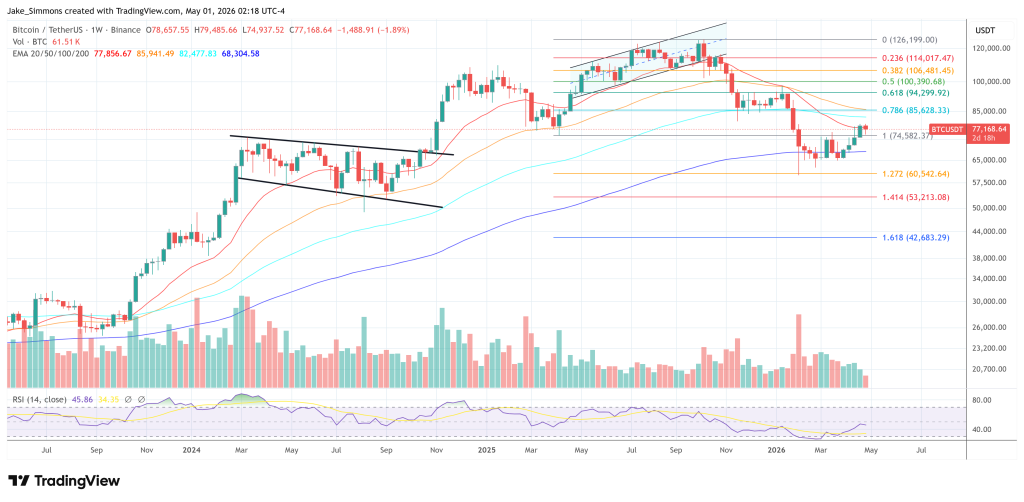
At press time, BTC traded at $77,168.
BTC needs to confirm the weekly close above the 1.0 Fib, 1-week chart | Source: BTCUSDT on TradingView.com
Featured image from X, chart from TradingView.com
Editorial Process for bitcoinist is centered on delivering thoroughly researched, accurate, and unbiased content. We uphold strict sourcing standards, and each page undergoes diligent review by our team of top technology experts and seasoned editors. This process ensures the integrity, relevance, and value of our content for our readers.