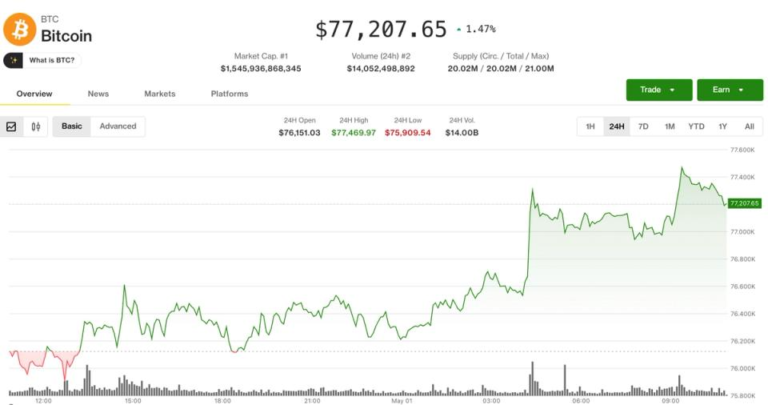
Shares of Strategy (NASDAQ: MSTR) surged roughly 9% on Friday as Bitcoin clawed back to the $78,000 level.
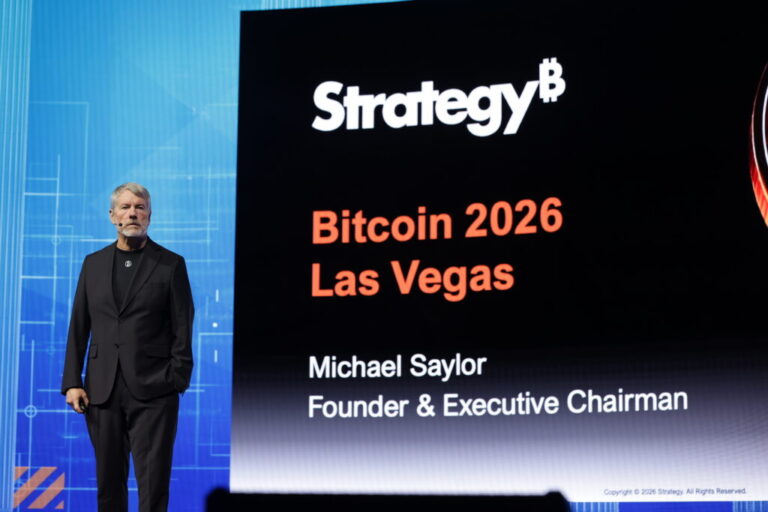
This movement comes just days after Executive Chairman Michael Saylor delivered a headline-grabbing keynote at the Bitcoin 2026 conference in Las Vegas.
MSTR climbed above $180 per share during Friday’s session, building on a prior close near $165. The move tracked Bitcoin’s intraday advance, which pushed BTC to $78,961 as of Friday afternoon, according to Bitcoin Magazine Pro data.
The rally is building up a welcome reprieve for MSTR investors who have endured a brutal stretch — the stock remains down more than 70% from its November 2024 all-time high above $457.
The price action comes amid a broader recovery in Bitcoin that has been grinding higher since a sharp pullback to the mid-$60,000s earlier this year. Bitcoin surged past the $78,000 mark last week as well, propelled by short liquidations and improving macro sentiment following reports of progress in U.S.-Iran diplomatic negotiations.
Polymarket contracts on May 1 BTC pricing showed 100% confidence the asset would finish in the $78,000–$80,000 range.
As a leveraged proxy for Bitcoin, MSTR tends to amplify BTC’s moves in both directions. Strategy currently holds approximately 818,334 Bitcoin on its balance sheet — roughly 3.9% of all Bitcoin that will ever exist — acquired at an average cost of around $66,385 per coin.
Saylor: Strategy’s STRC is booming
The stock pop also comes on the heels of fresh enthusiasm generated by Saylor’s keynote at the Bitcoin 2026 conference in Las Vegas last week.
Rather than focusing on Bitcoin price targets or more Bitcoin purchases, Saylor’s pitch centered on STRC — Strategy’s Bitcoin-backed preferred stock — and a sweeping thesis that digital credit is poised to cannibalize trillions of dollars in the legacy credit market.
“The world’s $300 trillion credit market is a much bigger opportunity than the world’s roughly $2 trillion Bitcoin market, and Strategy has built the first product to bridge the two,” Saylor argued during the keynote.
STRC, which pays an 11.5% monthly variable dividend and trades on Nasdaq, has grown to approximately $8.5 billion in notional value in under nine months — larger, Saylor claimed, than the entire existing universe of monthly-paying preferred securities combined.
“This is going viral,” he told the audience.
BlackRock’s iShares Preferred & Income Securities ETF has already taken a roughly $210 million position in STRC.
Saylor said STRC has financed the acquisition of approximately 77,000 BTC year-to-date in 2026, roughly ten times the net inflow of all U.S. spot Bitcoin ETFs combined over the same period.
The crypto market ticked higher on Friday. Bitcoin BTC$78,080.66 rose 1.25% since midnight UTC to trade at $77,250, and the CoinDesk 20 Index (CD20) added 0.7% with 14 members in the green.
The increase comes after bitcoin found support at $75,000, a price it had earlier found difficult to climb above, on Wednesday. It has now been trapped between $75,000 and $80,000 since April 19. Negative funding rates on futures exchanges indicate that traders are generally positioned for a decline.
U.S. equity index futures were little changed. Nasdaq 100 futures cooled after the week’s Big Tech earnings, while S&P 500 futures are marginally in the black, up 5 points.
Precious metals fell, with gold and silver losing 1% and 0.7%, respectively, and the altcoin market is a mixed bag; AXS and HYPE rose by around 3%, but DeFi tokens MORPHO and AAVE are both in the red.
Derivatives positioning
Open interest in bitcoin futures holds at $19 billion, roughly unchanged week-over-week, with speculative activity showing little conviction.
Funding rates are broadly negative across multiple venues at around -2% annualized, except on Deribit, which saw a spike to 37%. The three-month annualized basis sits at 1.5%, also flat on the week, pointing to continued institutional caution.
Options sentiment leans bullish: put/call volume over the past 24 hours is 58% in favor of calls, and the one-week delta skew has eased to 8.6% from 9.5%, indicating moderating demand for downside protection.
The implied volatility term structure is in contango, with the front-end around 29% rising to ~45% at the March ’27 tenor, suggesting the market is pricing longer-dated uncertainty rather than immediate tail risk.
CoinGlass data shows $149 million in 24-hour liquidations, with a 30-70 split between longs and shorts. BTC ($50 million) and ETH ($29 million) led in terms of notional liquidations.
The Binance liquidation heatmap indicates $75,400 as a core liquidation level to monitor in the event of a price drop.
Token talk
The CoinDesk Memecoin Index (CDMEME) was the best-performing benchmark, surging by 1.8%, followed by the CoinDesk Computing Select Index (CPUS), which added 1.4%.
CoinDesk’s DeFi Select Index (DFX) lagged its peers, and was recently unchanged despite broader market optimism.
Monad (MON) led the altcoin market on Friday, rallying by 6.7% over 24 hours. There were also notable gains for PENDLE, RAY and TAO, all up between 4.2% and 5.35%.
The same can’t be said for WLFI$0.05554, the DeFi token linked to President Donald Trump’s family. That dropped by more than 2.6% since midnight following a governance vote on token lock-ups. It has now lost more than 77% since it was introduced in September.
CoinDesk’s Overnight Rate (CDOR), which tracks lending and borrowing rates on Aave, has returned to normal market conditions after the KelpDAO hack, a sign of strength in the DeFi sector.
AI demand is accelerating faster than the systems, infrastructure and organizations needed to sustain it.
Demand is surging everywhere.
Cloud revenue is up 35% year over year. Worldwide cloud revenue for Q1 2026 is expected to be up $35 billion from this time last year, reaching $129 billion, according to Synergy Research Group.
That includes AWS, Google Cloud and Microsoft, which together hold 63% of the world market.
Intel cited “tremendous” AI demand for driving $13.6 billion in first-quarter revenue, with demand continuing to exceed supply across its business. CEO Lip-Bu Tan noted on an April 23 earnings call that CPU-based architectures remain the backbone of AI computing in production, particularly for the company’s Xeon server CPUs.
Meta, too, is making sure it’s getting what it needs, saying this week that it’s increasing its spending to meet its technology infrastructure requirements for future data center expansion and supply chain deals.
Related:Anthropic Launches New Security Tool for Enterprises
AI adoption is also expanding across CX, retail and the supply chain.
But infrastructure is falling behind.
Microsoft’s AI surge is exposing data center capacity gaps, while constraints on power, cooling and land are emerging, driving interest in new models like floating and space-based data centers and alternative energy sources as workloads grow more complex and actual and forecast demand continues to outpace available capacity.
And inside the enterprise, it’s getting messy as AI adoption continues to accelerate faster than governance, creating new layers of cost, security risk and tool sprawl. Without stronger oversight, companies risk overspending on AI while losing visibility into how it’s being used.
Taken together, the pattern is hard to ignore. AI is no longer limited as much by what the technology can do, but by the structures around it, from the infrastructure required to run it to the systems needed to manage it and the organizations trying to keep up.
That’s where the next set of challenges and opportunities will come from.
Also in AI This Week
Beyond those constraints, this week’s coverage highlights how AI is starting to reshape decision-making, operations and the workforce across the enterprise.
Agentic Marketing Platform for Enterprises Valued at $2.75B: Hightouch has raised $150 million, highlighting growing momentum for AI-native vendors reshaping enterprise marketing workflows.
Bed Bath & Beyond CEO: AI Will Lead to ‘Significant Reduction in Headcount’: The home goods retailer’s warning signals ongoing uncertainty around how AI will impact jobs across core business functions.
Related:Record $1.1B Seed Funding for Reinforcement Learning Startup
Analysts Hail AI Training Partnership Between Stellantis and Microsoft: Stellantis’ expanded partnership with Microsoft points to the growing importance of workforce training as AI adoption scales.
AWS Unveils Agentic AI Supply Chain Tool: The company is pushing agentic AI into operations, combining multiple tools to centralize data and decision making across supply chains.
Humanoid Bots to Start Airport Pilot in Japan: Early deployments of humanoid robots in airport operations highlight both progress and challenges of real-world robotics adoption.
CFOs Lean on AI, ‘Synthetic Audiences’ to Decode Consumer Behavior: Organizations are increasingly using AI to simulate and examine customer behavior in real time, signaling new approaches to CX and retail analytics.
On stage, co-founder and CEO JP Richardson opened by talking about the company’s derailment at the New York Stock Exchange in May 2024, when Exodus flew 130 employees, friends, and family to Manhattan only to learn the night before that regulators had pulled its listing.
He described the reversal as a rule change at “the 11th hour” that left a room of supporters stunned and forced the company back into private status despite having, in his telling, followed the playbook.
That episode ended months later after the U.S. election, when Exodus finally listed on NYSE American in January with the same team, ticker, and business, but under a new administration more open to digital asset companies.
Richardson framed that saga as proof that Exodus can absorb political and regulatory shock while holding to a single principle: money belongs under user control.
Exodus, founded in 2015 in Omaha, built a self-custodial wallet that stores keys on user devices and routes swaps across multiple liquidity providers, offering access to Bitcoin and other assets without ever holding customer funds in company accounts.
Fixing the “pub test” and app sprawl
The CEO argued that crypto still fails normal users on basic usability. He recounted an early experience helping a friend download four different wallets and write a 12-word seed phrase on a cocktail napkin, a ritual he said still defines too many products a decade later. Richardson called this the “pub test”: if a friend in a bar cannot safely set up a wallet without resorting to napkins, the industry has missed the mark.
He extended that critique to chain tribalism, insisting that consumers do not care whether payments settle on Solana, Ethereum, Arbitrum, or Base as long as the experience works.
To make the point concrete, he asked the audience to pull out their phones and count how many apps they use for money. The typical screen, he said, shows a bank app, person-to-person payment apps, a brokerage account, and often a separate crypto wallet.
He cast this fragmentation as a structural problem that leaves consumers juggling providers who do not share their interests.
Exodus wants to replace that cluster with “one app” that holds digital assets, connects to card networks, and routes payments while keeping users in self-custody.
Owning the rails: Monavate, Baanx and Exodus Pay
A central reveal at the summit was the closing of the Monavate and Baanx UK acquisitions, a move that shifts Exodus from “renting the rails to owning them,” in Richardson’s phrase.
Monavate and Baanx supply regulated card issuing, acquiring, and processing infrastructure in the UK and EU, including BIN sponsorship, Visa and MasterCard membership, and fraud systems that already support crypto brands such as Ledger and MetaMask.
Exodus previously agreed to acquire their parent, W3C Corp, in a roughly $175 million deal aimed at building an on-chain payments stack; the company later enforced a $70 million secured loan against that group in UK receivership to protect its position.
With those assets, Exodus gains the ability to issue and process cards directly rather than acting as a program that rides on third-party rails.
CFO James Gernetzke said the combined platform now supports six layers of activity, from the core wallet and swap engine to stablecoin issuance, card programs, and banking rails, giving Exodus “owner economics” on each step of a transaction.
On stage, he walked through a £100 purchase example, explaining that where Exodus once retained a fraction of the economics as a client of Monavate and Baanx, it now captures a larger share through interchange, processing fees, and interest on float.
Richardson and Gernetzke both made it clear that Exodus is trying to grow past a trading‑centric model after a peak year in 2025, when it generated $121.6 million in revenue and $11 million in adjusted EBITDA on a base of roughly 1.5 to 1.6 million monthly active users.
In early 2026, the limits of that dependence on crypto cycles came into sharper focus: preliminary first‑quarter results show revenue falling to $22.7 million from $36.0 million a year earlier, a $36.4 million net loss on digital assets, and a 22% quarter‑over‑quarter drop in exchange volume to $1.18 billion, even as monthly active users held at 1.5 million and funded users slipped to 1.4 million.
Gernetzke described the tight correlation between trading revenue and Bitcoin’s price as a ceiling the company needs to break.
Exodus Pay, now live in all 50 states, is the clearest expression of that strategy. Embedded in the core wallet, it lets users spend USD‑backed stablecoins, Bitcoin, and other assets anywhere Visa or Apple Pay works, while keeping keys in self‑custody and turning every checkout into interchange, processing, and float income.
Later in the Summit at a fireside chat, Richardson cast that stack as infrastructure not only for today’s users but for AI agents that will execute autonomous payments across the same rails.
Bitcoin will have to flip the $80,000 level into support to continue its up move to $84,000.
Several major altcoins are finding buyers at lower levels, but they will have to overcome the overhead resistance to start a new up move.
Bitcoin (BTC) has risen above $78,000, extending upon its 11.87% rally in April, per CoinGlass data. The recovery in April was supported by solid buying in the US spot BTC exchange-traded funds, which saw $1.97 billion in inflows, according to SoSoValue data.
The rally is expected to encounter selling in the zone between the True Market Mean at $78,000 and the Short-Term Holder (STH) cost basis at $79,000. Analysts are closely monitoring the $80,000 level, which needs to be flipped into support for confirmation that bulls remain in control.
Crypto market data daily view. Source: TradingView
CryptoQuant is not convinced that BTC’s rally could extend further. In a recent report, the crypto analytics firm said that BTC’s up move in April was fuelled mainly by futures traders, while spot demand contracted. That suggests “the market’s marginal buyer was speculative, not fundamental.” CryptoQuant warned in an X post that the exact setup had “preceded the next leg down” in 2022.
Could BTC and the major altcoins break above their overhead resistance levels? Let’s analyze the charts of the top 10 cryptocurrencies to find out.
Bitcoin price prediction
BTC turned up from the 20-day exponential moving average ($75,814) on Thursday, indicating buying on dips.
The relief rally is expected to face selling pressure at $79,500, but if buyers pierce the overhead resistance, the uptrend is expected to gain momentum, and the BTC/USDT pair may rally to $84,000.
The 20-day EMA is the crucial support to watch out for on the downside. If the BTC price turns down from the current level or the overhead resistance and breaks below the 20-day EMA, it may start a deeper correction to the 50-day simple moving average ($72,362) and then the support line.
Ether price prediction
Ether (ETH) is finding support near the 50-day SMA ($2,207), indicating that bulls are viewing the dips as a buying opportunity.
The flattening 20-day EMA and the relative strength index (RSI) just above the midpoint suggest weakening momentum. If the ETH price turns down and breaks below the 50-day SMA, the next stop is likely to be the support line.
Instead, if the price remains above the 20-day EMA, the bulls will attempt to drive the ETH/USDT pair to $2,465 and then to the ascending channel’s resistance. The next trending move is expected to begin on a close above the resistance line or below the support line. Until then, the pair may remain inside the channel.
XRP price prediction
XRP (XRP) remains stuck inside the $1.27 to $1.61 range, signaling buying on dips and selling on rallies.
The 20-day EMA ($1.39) has started to turn down gradually, and the RSI is near the midpoint, indicating a slight edge to the bears. If the XRP price remains below the moving averages, the likelihood of a drop to the $1.27 support increases.
Buyers are likely to have other plans. They will attempt to thrust the price above the moving averages. If they succeed, the XRP/USDT pair may rally to the downtrend line of the descending channel pattern, then to the $1.61 resistance. A trend change will be signaled on a close above the $1.61 level.
BNB price prediction
BNB (BNB) slipped below the moving averages on Tuesday, but the bears have failed to build upon their advantage. That suggests demand at lower levels.
The bulls are attempting to push the BNB price back above the moving averages. If they manage to do that, the BNB/USDT pair may rise to $654 and then to the $687 overhead resistance.
On the other hand, if the price turns down and breaks below $610, it signals that the sellers remain in control. The pair may then tumble toward the $570 support, where the buyers are expected to step in.
Solana price prediction
Buyers are attempting to sustain Solana (SOL) above the $82.65 level but the bears continue to exert pressure.
If the $82.65 level cracks, the SOL/USDT pair may decline to $76. Buyers are expected to defend the $76 level with all their might, as a close below it may start the next leg of the downward move to $67.
On the contrary, if the SOL price rises above the moving averages, it suggests that the pair may remain inside the $82.65 to $90.73 range for some time. A close above $90.73 opens the gates for a retest of the $98 overhead resistance.
Dogecoin price prediction
Dogecoin (DOGE) is showing strength, as bulls prevented the pullback from dipping below the $0.10 level on Thursday.
That increases the likelihood of a rally to the $0.12 overhead resistance, where the bears are expected to mount a strong defense. If the price turns sharply lower and breaks below the moving averages, it suggests the DOGE/USDT pair may remain within the $0.09 to $0.12 range for a while longer.
Alternatively, if buyers overcome the $0.12 obstacle, it suggests that the pair may have bottomed out in the near term. The DOGE price may rise to $0.14 and later to $0.16.
Hyperliquid price prediction
Hyperliquid (HYPE) fell below the 50-day SMA ($39.84) on Thursday but the long tail on the candlestick shows buying at lower levels.
The bulls are striving to push the HYPE price above the 20-day EMA ($40.85). If they manage to do that, the HYPE/USDT pair may rally toward the $43.76-$45.77 overhead resistance zone. A close above the zone clears the path for a rally to $50.
Contrary to this assumption, if the price turns down and breaks below $38.70, it signals that the bears are selling on rallies. That may start a deeper pullback to $37.77 and subsequently to $34.45.
Related: Did Dogecoin bottom first? DOGE price poised for 20% gains as whales return
Cardano price prediction
Cardano (ADA) has been clinging to the moving averages, indicating that the bulls have kept up the pressure.
That improves the prospects of a break above the downtrend line. If that happens, the ADA/USDT pair may surge to $0.32 and later to $0.37, signaling a potential short-term trend change.
This bullish view will be invalidated in the near term if the ADA price turns sharply lower and breaks below $0.22. Such a move suggests that the pair may remain inside the descending channel for a few more days.
Bitcoin Cash price prediction
Bitcoin Cash (BCH) bounced off $443 again, indicating that the bulls are aggressively defending the level.
There is minor resistance at the 50-day SMA ($453), but it is likely to be crossed. The BCH/USDT pair may then soar to $486, at which point bears are expected to sell aggressively. However, if buyers overcome the barrier, the pair may rally to $520.
Contrary to this assumption, if the BCH price turns sharply lower from $486 and breaks below the moving averages, it suggests that bears remain sellers on rallies. That may keep the pair range-bound between $419 and $486 for some time.
Monero price prediction
Monero (XMR) bounced off the 20-day EMA ($366) on Wednesday, indicating a positive sentiment.
The upsloping 20-day EMA and the RSI in positive territory indicate that the path of least resistance is upward. If buyers push and maintain the XMR price above the $406 resistance, the rally may reach the $500 level.
Conversely, if the price turns sharply lower from the overhead resistance and breaks below the moving averages, it suggests that the XMR/USDT pair may remain range-bound between $302 and $406 for some time.
Crypto venture capitalist (VC) funding plunged to a near two-year low in April as investors pulled back from crypto start-ups and early-stage companies.
Crypto VC funding fell to $659 million across 63 funding rounds in April, down 74% from the $2.6 billion seen across 84 rounds in March, according to Cryptorank data. This brings the total year-to-date investments to $5.64 billion so far in 2026.
The April total was the lowest monthly fundraising sum since July 2024, when crypto projects raised $622 million across 132 rounds.
The drop suggests venture investors became more selective as crypto markets remained under pressure following months of weaker liquidity and risk appetite.
Monthly VC funding has been declining since October 2025, when crypto projects raised $3.84 billion across 127 funding rounds. The global crypto market cap has since fallen by 37%, according to CoinGlass data.
Crypto fundraising, US dollars, three-year chart. Source: Cryptorank
Decentralized finance (DeFi) protocols attracted the most deal activity in April, with 12 funding rounds, according to CryptoRank. Blockchain services and artificial intelligence-linked crypto projects followed with eight rounds each.
Related: Switzerland’s Crypto Valley funding rose 37% in 2025 as TON led deals
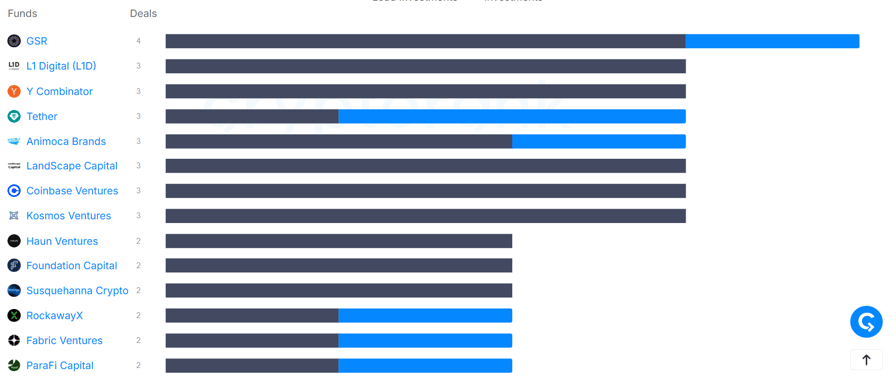
GSR emerges as most active investor of the month
Crypto market maker GSR’s VC wing was the most active investor of the past month, with four investment rounds, including a $3.5 million seed round in DeFi protocol Legend Trade on Wednesday, a $4 million seed round in DeFi protocol 3F on April 23, a $1 million pre-seed round in Enhanced Finance on April 9 and an undisclosed investment in real-world asset tokenization protocol Libeara on April 8.
Zurich-based digital asset-focused investment manager L1 Digital (L1D) was second with three investments, including a $5 million seed round in crypto exchange Exponent on Thursday, an $18 million strategic investment in infrastructure provider Squads on Wednesday and a $7.5 million Series A investment into blockchain services company Oh on April 8.
Most active investors by deal count for April, 2026. Source: Cryptorank
Y Combinator, Tether, Animoca Brands, landScape Capital, Coinbase Ventures and Kosmos Ventures also participated in three deals each during the month.
Magazine: How crypto laws changed in 2025 — and how they’ll change in 2026
Cointelegraph is committed to independent, transparent journalism. This news article is produced in accordance with Cointelegraph’s Editorial Policy and aims to provide accurate and timely information. Readers are encouraged to verify information independently.
Japanese financial conglomerate SBI Holdings plans to acquire a stake in Bitbank, one of the country’s largest crypto exchanges.
The Tokyo-based broker submitted a letter of intent to Bitbank Co., Ltd. regarding the purchase of the exchange’s shares with the goal of turning it into a consolidated subsidiary, according to an announcement on Friday.
SBI frames the Bitbank move as part of its broader strategy to expand its crypto footprint and strengthen its position ahead of potential regulatory changes in Japan.
Japan’s cabinet approved a draft amendment last month that would classify cryptocurrencies as financial products, bringing crypto assets under the Financial Instruments and Exchange Act, which is used for stocks and other securities. If passed during the current parliament session, the law could take effect as early as fiscal 2027.
SBI already absorbed Bitpoint, a regulated Japanese crypto exchange that offers spot trading and has offered an onchain bond from which investors can receive rewards in XRP.
The move is also part of SBI’s broader regional expansion push, having disclosed plans to acquire a majority stake in Singapore-based Coinhako, a MAS-regulated digital asset platform in February.
SBI has also commenced a Visa partnership to launch credit cards that automatically convert spending rewards into crypto (BTC, ETH, or XRP), enabling users to accumulate digital assets through everyday purchases, according to a separate announcement on Friday.
Tether, issuer of the largest stablecoin by market capitalization, said first-quarter net profit was $1.04 billion and excess reserves increased to a record $8.23 billion.
The company did not provide year-earlier or fourth-quarter figures. It reported a net profit of more than $10 billion for all of 2025.
The amount of the dollar-pegged USDT in circulation remained stable, with total token-related liabilities of about $183 billion as of March 31, the firm said in its quarterly report. The company’s total assets are just under $192 billion, it said.
The report was released at a time of increasing global demand for stablecoins as they find uses outside crypto trading as a mechanism for international payments. Just this week, Visa announced expansion of its stablecoin settlement pilot to nine blockchains, adding Base, Polygon, Canton Network, Arc and Tempo to existing support for Ethereum, Solana, Avalanche and Stellar.
Excess reserves, up from $6.3 billion at end-2025, were supported by “continued profitability and a reserve base concentrated in short-duration, high-quality liquid instruments,” the company said.
USDT is the third-largest cryptocurrency, behind bitcoin BTC$78,446.20 and ether (ETH), with a market capitalization of just under $190 billion.
The majority of Tether’s reserves are held in U.S. government-backed instruments and short-term liquidity facilities, the firm said, adding that it is the 17th-largest holder of U.S. Treasuries globally. Tether has become a top 10 buyer of U.S. Treasuries over the past two years, surpassing Taiwan, Israel and the UAE.
Its physical gold holdings are roughly $20 billion and its bitcoin reserve is approximately $7 billion, it said.
The Ethereum Foundation has sold another 10,000 ether (ETH) in an over-the-counter deal to Tom Lee’s BitMine (BMNR), continuing a string of treasury sales this year.
In a post on X on Friday, the organization said it finalized the sale at an average price of $2,292.15 per token, implying proceeds of roughly $22.9 million. The counterparty was BitMine Immersion Technologies, a repeat buyer that has increasingly acted as a key institutional accumulator of ETH from the foundation.
The latest transaction follows a similar March deal in which the foundation sold 5,000 ETH to BitMine at about $2,042 per ETH, raising roughly $10.2 million.
Like prior sales, the Ethereum Foundation said proceeds will go toward core operations & activities, including protocol research and development, ecosystem growth and community grants, a longstanding funding model for the organization.
The foundation added that the transaction is part of its formal treasury management strategy, under which ETH holdings are periodically converted into fiat to maintain operating runway and reduce market impact. These deals are typically executed OTC to avoid disrupting spot markets.
Bitmine, which is helmed by Fundstrat’s Tom Lee, continues to participate in these transactions, which underscores its growing role as one of the largest corporate ETH holders. The firm has now taken part in multiple direct purchases from the foundation this year, highlighting a deepening relationship between the network’s primary steward and a major institutional buyer.
The onchain transfer for the latest sale is expected to originate from an Ethereum Foundation-controlled multisig wallet, in line with its recent push for greater transparency around treasury activity.
Read more: Bitmine to buy 10,000 ether for $23.9 million from the Ethereum Foundation
Trusted Editorial content, reviewed by leading industry experts and seasoned editors. Ad Disclosure
XRP, since the beginning of this year, has seen major developments that have put the leading altcoin and network in the spotlight of the crypto and financial sector. One of the key developments this year that is taking the wave in the sector is Raktuken Pay’s move to integrate XRP into its payment ecosystem, making a notable step toward mainstream adoption.
Rakuten Pay Move Triggers Fresh Optimism For XRP
In a move that underscores mainstream adoption, Rakuten Pay has integrated XRP into its payment solution. The development demonstrates an increasing effort to connect digital assets with routine transactions, which could allow consumers to make payments more quickly and effectively.
Related Reading: Coinbase Is Pulling Institutional Investors Into XRP And This Is How They’re Doing It
After this integration, Rakuten is now introducing a new bridge between loyalty rewards and digital assets, as its users of Rakuten Wallet can now convert their points into XRP. Such a decision allows millions of users to enter the digital asset industry without making direct fiat transactions by turning ordinary incentives into a doorway for crypto exposure.
According to the report, this conversion will also foster spot trading in-app and spending across +5 million Merchant locations. With 44 million Rakuten Pay users and $23 billion in loyalty points now redeemable for XRP, this integration is one of the biggest retail implementations using XRP as a payment method to date.
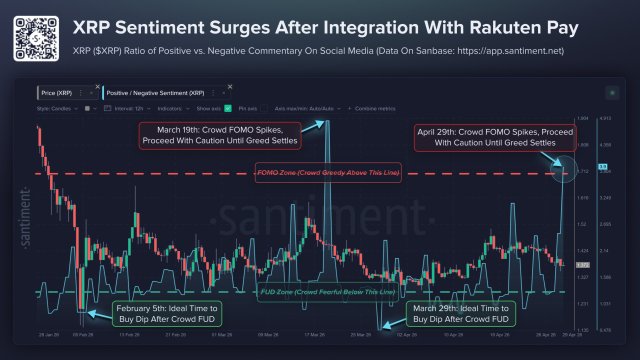
Since this move, sentiment around the altcoin has significantly flipped positive. Leading on-chain platform Santiment reported that the asset is seeing its second-highest level of optimistic sentiment on social media in the last 2 years, partly because of the recent integration of XRP with Rakuten.
Source: Chart from Santiment on X
By integrating the token with a well-known points system, the action demonstrates the expanding trend of integrating blockchain functionality into well-known consumer platforms. Furthermore, it could expand the practical use cases of the altcoin beyond trading and speculation as traditional platforms continue to explore blockchain-based solutions.
A Turnaround In Sight For The Asset
Santiment stated that traders are demonstrating excitement due to the fact that XRP is experiencing further adoption. As the asset finds increasing use cases outside of its traditional role in cross-border payments, adoption is gradually growing around it.
Related Reading: XRP Traders Scale Back Leverage As Ratio Drops On Binance – What This Means
As far as prices go, these events do not typically lead to a major price outbreak instantly. Instead, it is often seen after the initial wave of euphoria when FOMO (Fear of Missing Out) has calmed down, which tends to see the bullish outcome.
XRP investors and traders have been waiting a long time for a turnaround in price action since the altcoin fell from recent highs. Specifically, the asset’s value has declined by approximately-55% over the past 9 months, making one of its steepest drops in years.
With patience after the euphoria subsides, Santiment noted that these types of key integrations with major financial companies offer a clear picture of what drives prices over the long term. In the meantime, this trend may present a good buying opportunity as markets usually move opposite to the direction the crowds lean.
XRP trading at $1.37 on the 1D chart | Source: XRPUSDT on Tradingview.com
Featured image from Freepik, chart from Tradingview.com
Editorial Process for bitcoinist is centered on delivering thoroughly researched, accurate, and unbiased content. We uphold strict sourcing standards, and each page undergoes diligent review by our team of top technology experts and seasoned editors. This process ensures the integrity, relevance, and value of our content for our readers.