The contracts traded just 1.6% apart on average when both markets were active, and traded near $92 and $94 most recently, translating to a more than 300% upside from the IPO price.
That fourfold premium also means Unitree could have a blockbuster debut and still leave leveraged bulls nursing steep losses.
“Unitree can open at twice its IPO price and still liquidate a third of long exposure,” Allium said.
An opening around $45, double the IPO price, would still be about 52% below the current perp price and could liquidate roughly 33% of long exposure, the analysts said. At the other extreme, a $128 opening price (nearly 6x from the IPO price) could liquidate an estimated 53% of the short positions, the report said. If shares open at around where the perps trade, nothing moves, and neither side is liquidated.
Positioning on Trade.xyz, the bigger market of the two, is almost evenly split, with $6.5 million long and $6.6 million short. However, smaller traders are more bearish: bets below $50,000 are 70% short by value.
“Any open away from today’s price forces one side of this market out,” Allium said.
Read more: Hyperliquid is taking crypto perps deep into DeFi’s ‘money LEGO’ land
Stocks tied to bringing traditional financial assets onto blockchains are taking a hit Friday morning after the anticipated “innovation exemption” for tokenized securities trading gets delayed.
Bullish (BLSH), the crypto exchange that owns CoinDesk and is acquiring transfer agent Equiniti as it builds infrastructure for issuing and servicing tokenized securities, dropped 9% in the early session, reversing gains on its second-quarter earnings report.
Securitize (SECZ), BlackRock’s tokenization partner and the issuer of its BUIDL fund, fell more than 5% extending its Thursday 27% plunge after missing earnings. Now the stock trades 60% off its late June-early July high following its public debut.
Crypto exchange Coinbase (COIN), which pursues its own tokenized-stock plans and recently picked Abu Dhabi as its offshore tokenization hub, declined 3%.
Circle (CRCL) also dropped 4.2%. While the company is best known as the issuer of the USDC stablecoin, Circle also has a growing footprint in tokenized U.S. Treasuries through USYC, which has the largest market share with roughly $3 billion in assets.
CoinDesk reported late Thursday that the SEC is set to further delay the innovation exemption, which was expected to make it easier for firms to offer trading in tokenized securities. Concerns from both the White House and Wall Street about the proposal’s legal footing and potential impact on markets have held up the plan.
Cointelegraph is committed to providing independent, high-quality journalism across the crypto, blockchain, AI, and fintech industries.
All news, reviews, and analyses are produced with full journalistic independence and integrity. For more details on our standards and processes, please read our Editorial Policy.
Stablecoin payments company RedotPay delayed a planned $1 billion U.S. IPO to deal with legal issues, Bloomberg reported Friday, citing people familiar with the decision.
The listing, initially planned for this year, is unlikely to take place before 2027, the people told the financial news organization.
“Our strategy continues to focus on global regulatory compliance and business growth,” a RedotPay spokesperson told CoinDesk via Telegram. “This week we obtained a money transmitter license in the U.S. We are preparing to launch our product in the U.S.”
The spokesperson declined to comment on the IPO plan, which emerged in February. Hong Kong-based RedotPay is said to have tapped JPMorgan, Goldman Sachs and Jeffries for the potential listing.
RedotPay, which describes itself as the world’s largest stablecoin payment card issuer, faces a $470 million lawsuit lodged by Binance in Hong Kong alleging that it poached roughly 470,000 users when both firms had an agreement. Under the accord, the crypto exchange allowed its customers to use Binance Pay funds on RedotPay to convert crypto to fiat currency. Binance filed a parallel case in Singapore.
The RedotPay spokesperson said the company, which hit unicorn status in September, reported a record-high 8.5 million users as of July.
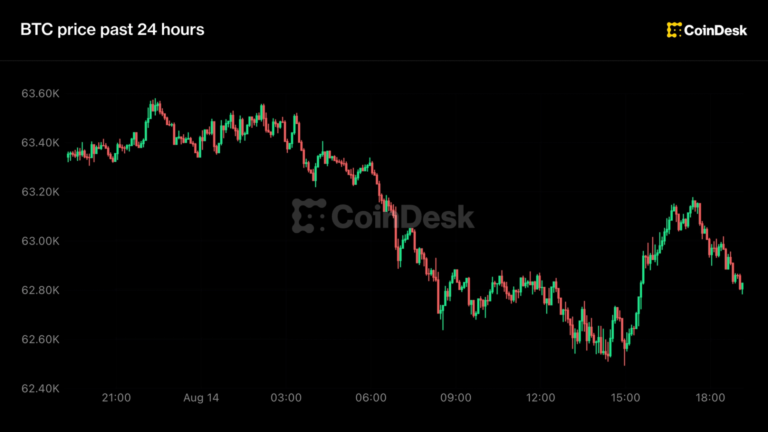
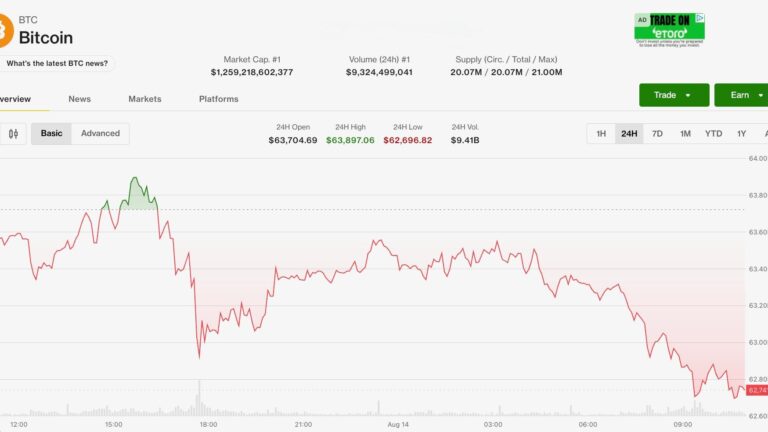
Bitcoin BTC$63,083.31 dropped below $63,000, losing 1.14% since midnight UTC as a second day of outflows from spot exchange-traded funds and a lack of bullish catalysts weighed on the crypto market.
Spot bitcoin ETFs experienced the first back-to-back days of outflows since late July with $192 million exiting the products, according to SoSoValue.
The largest cryptocurrency is now trading at its lowest point since Aug. 3 having wiped out all of last week’s rally. Ether ETH$1,883.88 is down by 0.73% since midnight, while a portion of the altcoin market continues to show resilience, outperforming crypto majors.
U.S. equities were boosted on Thursday by producer price inflation data, which cooled to 4.7%, below forecasts. The S&P 500 and Nasdaq 100 both rallied following the report, and futures on the indexes remain marginally in the black.
Derivatives positioning
Futures churn continues: While the crypto market is under pressure, the long-short taker ratio in futures remains balanced, with longs accounting for half of the flow. 24-hour volume growth is again outpacing open interest (OI) growth by a wide margin. That’s a sign of churn rather than fresh positioning.
BCH sees heaviest fresh shorting: Futures tied to Bitcoin Cash BCH$206.01 are the biggest OI gainer of the past 24 hours, adding 10% to 1.64 million tokens as the spot price drops 3%. That combination points to short positions being built up. Deeply negative annualized funding rates support that interpretation. The 24-hour OI-adjusted cumulative volume delta (CVD) is negative too, signaling that shorts are trading more aggressively via market orders rather than passive limit orders. Together, these signals point to positioning for a deeper selloff in the token.
BTC OI rises alongside falling price: Bitcoin is another OI gainer, with the tally rising over 3% to 765,000 BTC alongside a negative CVD. Annualized funding rates, however, still hold mildly positive.
HBAR shows the clearest bearish tilt: The token’s 24-hour CVD is the most negative among the top 25 coins, with funding rates around -20%, pointing to a market clearly dominated by bears. More broadly, all the top 25 are showing negative CVD.
Bitcoin volatility cools: BTC’s 30-day implied volatility index, BVIV, fell back below 36%, erasing a spike to nearly 39% earlier this week. That points to continued investor interest in overwriting strategies — approaches aimed at generating extra yield on top of spot holdings. Ether’s equivalent index, EVIV, is showing the same pattern.
Options positioning stays mixed: On Deribit, BTC calls at the $70,000, $69,000 and $67,000 strikes rank among the five most-traded bets. For ETH, puts at the $1,700 and $1,780 strikes ranked higher instead.
Token talk
Ether.fi (ETHFI) is the standout performer over the past 24 hours, rallying by 11.5% after adding tokenized stocks and DeFi loans to its neobank platform. The token gave back some of the gains on Friday, dropping 3.3%.
Cosmos ATOM$1.5021 also experienced upside. The token surged by more than 10% in 24 hours and trading volume jumped by 232% to $51 million despite the absence of a clear news catalyst.
Fetch.ai FET$0.1339 and monero (XMR) extended their positive weeks, rising 0.55% and 0.81%, respectively, since midnight UTC.
NEAR, MORPHO, TAO and JUP all lost around 2% since midnight as cautious sentiment remains the dominant theme across the crypto market.
The moves followed CoinDesk’s report late Thursday that the Securities and Exchange Commission (SEC) was set to further delay its anticipated “innovation exemption,” which is expected to make it easier for companies to offer trading in tokenized securities. Concerns from the White House and Wall Street over the proposal’s legal footing and potential market impact have held up the plan.
Adding to the uncertainty, the SEC canceled a meeting scheduled for Friday where commissioners planned to consider whether to propose new rules creating a tailored offering regime for certain investment contracts involving crypto assets.
The impact wasn’t limited to stocks. The innovation exemption had also been expected to provide some regulatory relief for trading through decentralized finance venues, meaning the delay reaches beyond publicly traded tokenization companies. Uniswap’s UNI (UNI), the native token of the decentralized exchange, fell 7% over the past 24 hours, making it the weakest performer in the CoinDesk 20 Index both Friday and this week.
For comparison, the Nasdaq 100, S&P 500 and bitcoin BTC$62,993.69 were all mostly flat during the day.
A ‘speed bump,’ not the end of the tokenization trade
The setback could stretch out the timeline for U.S. tokenization, but it doesn’t necessarily change the longer-term story, according to Owen Lau, managing director and senior analyst at Clear Street.
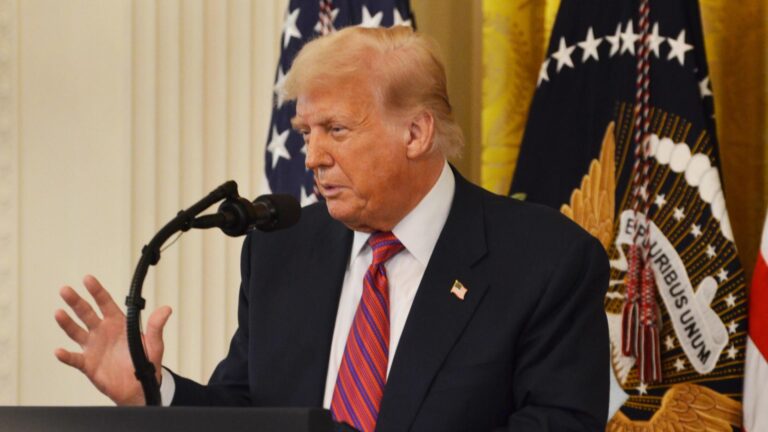
President Donald Trump is expected to be in attendance when the administration’s new innovation committee — a crowd of crypto CEOs and leaders of prediction market and AI companies — sits for a White House meeting on Wednesday, said people briefed on the planning.
The chief executives of companies such as Coinbase, Ripple, Gemini, Robinhood, Polymarket and Kalshi are members of the new Innovation Advisory Committee at the Commodity Futures Trading Commission, but before they attend their first committee meeting on Thursday, the crypto CEOs will gather for the White House meeting, said the people, who asked not to be named, and participants have been told Trump is planning to attend.
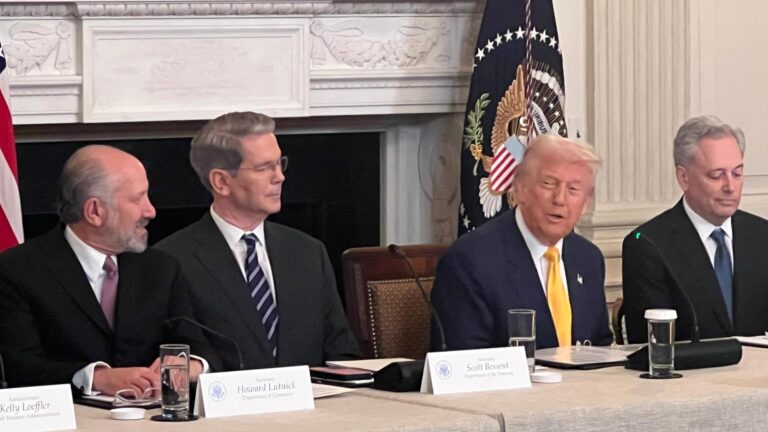
The meeting, expected to be held at the Eisenhower Executive Office Building next door to the White House, is meant to get a policy dialogue started in some of the leading arenas for U.S. innovation. The roster at that meeting was also expected to include CFTC Chairman Mike Selig and other advisers, the people said. One of them added that Treasury Secretary Scott Bessent and Secretary of Commerce Howard Lutnick may attend.
White House spokespeople didn’t immediately respond to requests for comment on the plans.
A federal bank regulator has granted World Liberty Trust Co. a conditional bank charter, it announced Friday.
The Office of the Comptroller of the Currency, the U.S. banking agency that grants federal charters, said in a letter posted to its website that World Liberty could operate fiduciary and other trust company-related activities as a national trust bank.
“This preliminary conditional approval is granted based on a thorough evaluation of all information available to the OCC, including the representations and commitments made in the application and by the Bank’s representatives,” the letter said.
Final approval won’t be granted until the company meets additional “preopening requirements,” the letter said.
According to the letter, World Liberty Trust Company will focus on services tied to World Liberty Financial’s USD1 stablecoin.
“The bank plans to issue USD1, a fiat currency-backed stablecoin, to institutional clients on a nationwide basis, assuming this role from BitGo Bank & Trust, National Association (BitGo), the current exclusive issuer and custodian for USD1,” the letter said. “The bank plans to provide its digital asset custody services as a fiduciary, primarily to USD1 customers and other institutional clients.”
UK Reform leader Nigel Farage will face an investigation that had been briefly paused following his resignation from Parliament after winning a by-election on Thursday with no major party candidates participating.
As of Friday, the UK Parliamentary Commissioner for Standards website showed that Farage was currently under investigation for “failure to register an interest” related to the Reform leader receiving millions of dollars’ worth of donations and gifts from two figures tied to the crypto industry. The investigation was halted in July after Farage resigned as a member of Parliament, but resumed following his reelection as Clacton’s MP.
The commission will probe cryptocurrency billionaire Christopher Harborne giving Farage $6.7 million as well as the Reform leader’s staff and security funded by George Cottrell, a convicted fraudster tied to a crypto casino. Should the investigation determine that Farage violated parliamentary rules, he faces a possible suspension from parliament, which could trigger another by-election.
Under UK parliamentary rules, new members must register all current financial interests within a month of their election, as well as any benefits received in the 12 months prior. Farage initially called Cottrell’s donation a “reward” for campaigning for Brexit and later described both men’s contributions as “gifts” given “on an unconditional basis.”
Source: Nigel Farage
The by-election triggered by Farage’s resignation in July saw the Reform leader winning with 63% of the vote, defeating satirical candidate Count Binface’s 27%. None of the other major parties participated in the race, which then-Labour leader and UK Prime Minister Keir Starmer called a “desperate stunt” by Farage. Andy Burnham has since become prime minister.
Related: Reform UK chair calls for probe into SBF-linked donation: Report
UK mulling permanent ban on crypto “gifts”?
Amid Farage’s political scandal, Labour lawmakers reportedly proposed that a moratorium on crypto donations implemented in March be made permanent as part of measures to address the potential influence of foreign actors.
According to the International Bar Association, unincorporated associations are allowed to give more than $675 directly to UK politicians, offering a loophole for companies with business in the country to be used as “conduits for foreign or dark money.”
Magazine: Inside the fake crypto startup that fooled North Korean IT workers
Cointelegraph is committed to independent, transparent journalism. This news article is produced in accordance with Cointelegraph’s Editorial Policy and aims to provide accurate and timely information. Readers are encouraged to verify information independently.