Bank Leumi, Israel’s largest bank, will offer cryptocurrency trading to customers from early 2027 becoming the first Israeli bank to announce such a service.
Customers of Leumi and its mobile banking unit, Pepper, will be able to buy, hold and sell bitcoin BTC$62,907.12, ether ETH$1,879.78 and solana (SOL) through a section of the Leumi Trade app, according to a Friday announcement.
Galaxy Digital (GLXY) will provide trading and services through GalaxyOne Institutional, its platform for banks and asset managers. Leumi has also signed an agreement to use Galaxy’s custody infrastructure, formerly known as GK8, to support the offering.
The tie-up gives Galaxy a banking partner in Israel and places Leumi among a growing group of financial institutions bringing crypto access inside customer platforms. By embedding trading within its capital-markets app, the bank is betting that clients will favor a regulated banking interface over standalone crypto exchanges.
Maya Ravia, Leumi’s head of strategy, described digital assets as an increasingly integral part of the global financial system. Galaxy Israel CEO Lior Lamesh said early movers among banks would help define finance’s shift toward open, programmable infrastructure.
The companies did not disclose commercial terms, fees or customer eligibility requirements. CoinDesk has reached out to Bank Leumi for further comments.
The Blockchain Association urged the US Supreme Court to hear Custodia Bank’s challenge to the Federal Reserve’s denial of its application for a master account, which would give the crypto-focused bank direct access to the Fed’s payment system.
In an amicus brief filed Wednesday, the industry group argued that federal law requires the central bank to make its payment services available to eligible nonmember banks and that the Fed should not have broad discretion to deny access.
The association said the appeals court’s decision effectively gives the Fed veto power over state-chartered banks by allowing it to withhold services needed to operate independently. It also linked Custodia’s case to alleged crypto debanking under “Operation Choke Point 2.0,” arguing that federal regulators discouraged banks from serving the digital asset industry.
Custodia, a Wyoming-chartered bank focused on digital assets, applied for a Fed master account in 2020, seeking direct access to the central bank’s payment services without relying on an intermediary bank.
The Federal Reserve Bank of Kansas City denied Custodia’s application in 2023, and the Tenth Circuit Court of Appeals later ruled that the regional Fed bank had discretion to reject its request. In March, the appeals court voted 7-3 against rehearing the case, leaving the Supreme Court as Custodia’s only remaining avenue for review.
The Blockchain Association said the Tenth Circuit interpreted the Fed’s authority too broadly, potentially allowing it to deny payment-system access to eligible state-chartered banks serving the crypto industry.
Blockchain Association backs Custodia’s Supreme Court petition. Source: US Supreme Court filing
Related: Goldman Sachs CEO backs ‘not perfect’ CLARITY Act as vote expected soon
Crypto companies push deeper into US banking
Custodia’s challenge comes as other crypto companies are gaining greater access to the US banking system, including federal charters and, in one case, direct access to Federal Reserve payment rails.
In March, Kraken Financial became the first crypto banking unit to receive a limited-purpose master account from the Federal Reserve Bank of Kansas City, giving it direct access to Fedwire. The approval contrasts with Custodia’s rejection by the same regional Fed bank in 2023.
In April, Coinbase received conditional approval from the Office of the Comptroller of the Currency (OCC) to establish a national trust company, bringing its custody business under federal oversight without allowing it to take retail deposits or operate as a commercial bank.
Circle received final OCC approval for its national trust bank in July, while Kraken parent Payward applied for its own national trust company charter the following month. The OCC also conditionally approved national trust bank applications from Ripple, BitGo, Fidelity Digital Assets and Paxos in December.
The trend has drawn resistance from traditional banking groups. The Independent Community Bankers of America opposed Coinbase’s approval in April, arguing that crypto companies are seeking the benefits of bank charters without being subject to the full regulatory framework applied to traditional banks.
Magazine: Bitcoin will never fall below $60K again: Nansen founder
Strategy MSTR$92.22 has pushed back against MSCI’s proposed methodology for identifying “non-operating companies,” which could result in the largest bitcoin treasury company being removed from the index provider’s global equity indexes.
Strategy said on X, “Digital assets are assets. Index providers should measure markets, not decide which assets companies are allowed to own,” Strategy said. “MSCI’s proposal puts it out of step with regulators, markets, and its own customers. Bitcoin doesn’t need MSCI. Neither does Strategy.”
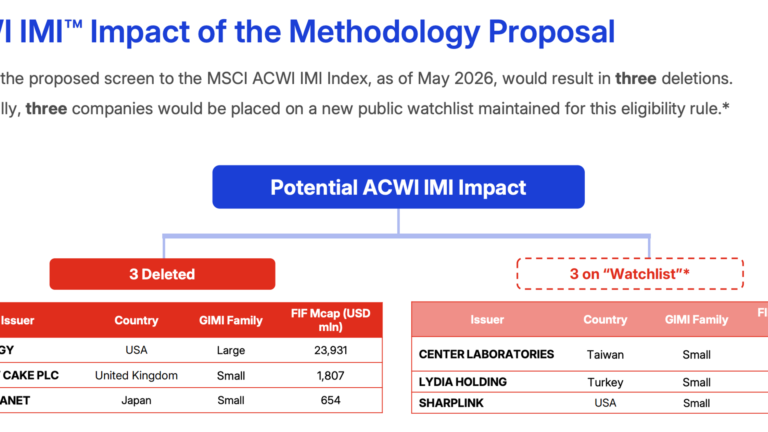
The latest consultation replaces an earlier proposal focused specifically on companies with significant digital asset holdings. Applying the new financial-ratio screen using May 2026 data would have resulted in the removal of Strategy, Metaplanet and uranium holder Yellow Cake from the MSCI ACWI IMI.
The response follows Strategy’s formal objection in December 2025 to MSCI’s previous proposal, which would have excluded companies whose digital assets represented at least 50% of total assets.
Strategy argued at the time that it is an operating company, not an investment fund or passive bitcoin vehicle, pointing to its software business, active treasury operations and bitcoin-backed credit instruments. It described the 50% threshold as arbitrary and urged MSCI to maintain neutral index standards.
MSTR is lower by 4.3% on Friday as bitcoin dips to $62,600.
World Liberty Financial, the cryptocurrency project backed by the Trump family, delayed plans to sell a token related to a resort in the Maldives, Bloomberg reported on Friday.
The token was planned to go on sale next year, giving investors a share of revenue from loans financing the Trump-branded resort, but this has been pushed back due to the Iran war disrupting travel in the region, according to the report, citing people familiar with the matter.
World Liberty Financial tapped real-world asset (RWAs) platform Securitize in February to help represent loan interests tied to the resort’s development as a digital token that could be traded onchain.
It is unclear when the token will now be listed.
The venture is part World Liberty Financial’s plans in tokenization, the representation of RWAs on blockchains in token form. WLFI is exploring this concept not just in real estate, but in commodities like oil and gas.
A World Liberty Financial spokesperson declined to comment, according to Bloomberg’s report. The company did not immediately respond when contacted by CoinDesk for additional comment.
The protocol’s native token WLFI rose by 2.7% on the news before giving back all of the gains and returning to parity. It is now down by 88.5% from its record high in September, 2025.
Scan the news and there are plenty of reasons for worry: continued U.S.-Iran escalation risks, mounting sovereign debt and rising bond yields among them. Crypto carries its own set of concerns, including regulatory disappointments, weak demand and hack risks.
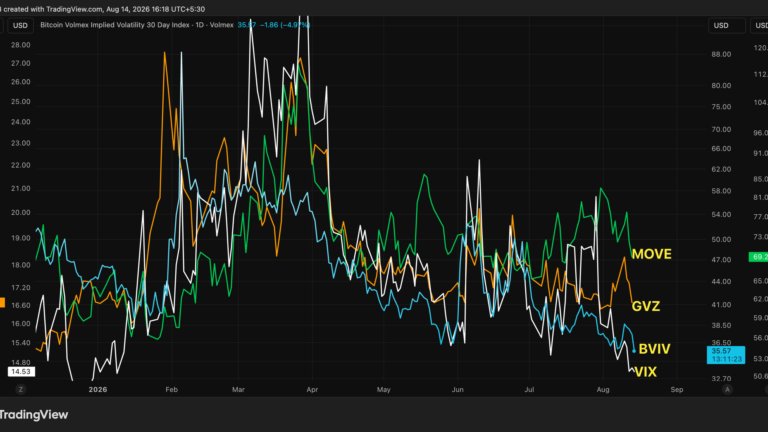
Yet crypto, stocks, bonds and even commodity markets remain sanguine. That is clear from implied-volatility readings across these markets. Implied volatility is a measure of expected price turbulence, and is calculated from the demand for options and other derivatives used to hedge against wild swings and uncertainty.
Bitcoin’s 30-day implied volatility index, BVIV, has dropped back to a 2026-low near 36%, reversing the minor pop to nearly 38% earlier this week, according to data source TradingView. The same is true for ether, the second-largest digital asset market value.
Wall Street’s VIX index, often called a “fear gauge” tracking uncertainty and volatility in the S&P 500, has declined to the lowest level since January. The Treasury market equivalent, MOVE, is also under pressure, hovering near the lower end of its multi-month range of 66% to 84%. Even gold and oil volatility indexes are falling.
Cointelegraph is committed to providing independent, high-quality journalism across the crypto, blockchain, AI, and fintech industries.
All news, reviews, and analyses are produced with full journalistic independence and integrity. For more details on our standards and processes, please read our Editorial Policy.
If it fails that, it moves to an exclusion screen that uses five ratios – operating asset intensity, expense intensity, cash flow, fair value intensity, and capital dependence – to make the final call.
A company becomes ineligible for index inclusion if it fails four out of the five test ratios.
MSCI’s description of the so-called non-operating companies not fit for index inclusion reads like a checklist of bitcoin treasury firms without naming one.
Companies that “create value by accumulating and holding non-operating assets,” generate little cash from actual operations, and depend on outside capital rather than their own business to grow, MSCI explained. Companies not currently in the index face the stricter thresholds based on their latest single filing.
An earlier consultation, opened in October 2025, targeted “digital asset treasury” firms, specifically those holding 50% or more of assets in bitcoin or other cryptocurrencies. That proposal named 39 companies, triggering crypto market volatility and industry backlash. The proposal was ultimately deferred.
Nothing is decided yet
MSCI has invited feedback from market participants through Sept. 30, and the results will be announced roughly two weeks later, on Oct. 16.
It has said that any resulting changes would be folded into the November 2026 index review, if the proposal is adopted at all.
Cointelegraph is committed to providing independent, high-quality journalism across the crypto, blockchain, AI, and fintech industries.
All news, reviews, and analyses are produced with full journalistic independence and integrity. For more details on our standards and processes, please read our Editorial Policy.
The City of Baltimore and its mayor, Brendan Scott, filed lawsuits against Kalshi and Polymarket over allegations that the companies violated local gambling laws.
In a Thursday notice, the Baltimore mayor’s office said that the two prediction market companies operated “illegal, unlicensed sports-betting platforms” and misled users about the ”legality and regulatory status of their products.” The lawsuits are centered on claims disputing Kalshi’s and Polymarket’s characterization of event contracts, arguing that the trades amount to unlawful wagers under state laws.
“These companies are running sportsbooks without licenses and betting that a new label will put them above the law,” said Scott. “It won’t. Baltimore will not let multibillion-dollar companies put profits over people and harm our communities through illegal gambling.”
Notably, the city’s complaint against Kalshi included Robinhood, Webull and Coinbase as partners with the prediction market platform. All companies were accused of deceptive practices by marketing sports contracts as something that can ”lawfully be purchased and traded in Maryland.”
The legal action against prediction market companies was the latest conflict between US state and federal authorities, and many experts expect it to end with an appeal to the Supreme Court. The US Commodity Futures Trading Commission (CFTC), under Chair Michael Selig, and companies have argued that event contracts on prediction markets amount to “swaps” within its purview, while both Baltimore lawsuits and other state-level authorities dispute that claim.
“City-specific action runs counter to the CFTC’s established framework for regulating prediction markets,“ a Polymarket spokesperson told Cointelegraph in response to the lawsuit. “As courts have recognized, prediction markets on CFTC-registered exchanges are governed by federal law, not a patchwork of state and local rules.”
Related: Judge stays CFTC’s case against US soldier over prediction market bets
Cointelegraph is committed to independent, transparent journalism. This news article is produced in accordance with Cointelegraph’s Editorial Policy and aims to provide accurate and timely information. Readers are encouraged to verify information independently.