Home Blog Page 362

NFTs Attempt Another Comeback as Blue Chips Surge

0

Bored Apes, Mutant Apes, Pudgy Penguins, Azuki and Doodles are all up double digits on the month.

The NFT sector has posted its strongest 30-day performance in months, with Yuga Labs’ flagship collections soaring and Azuki, Doodles, and Meebits catching bids.

The global NFT market cap sits at $1.87 billion after topping $2 billion over the weekend for the first time in three months, according to CoinGecko.

Yuga Ecosystem Leads

Bored Ape Yacht Club’s floor is 9.49 ETH, or roughly $21,715, up 15% on the week and 79% over the past 30 days. Meanwhile, Mutant Ape Yacht Club is up 26% on the week and 112% on the month. Otherdeed Expanded and Otherdeed for Otherside, the metaverse land tied to the Yuga ecosystem, are up 66.2% and 37.4% over 30 days, respectively.

While there is no clear catalyst for the move, Yuga Labs recently settled its long-running trademark suit against artist Ryder Ripps and partner Jeremy Cahen.

Other Ethereum blue chips are also participating. Azuki is at 1.09 ETH, up 28% on the week and 61% on the month, while Doodles is up 30% and Clone X is up 28% over 30 days. Meebits, the pixel-art collection that Yuga acquired from Larva Labs and subsequently sold, is up 28% on the month.

CryptoPunks Maintain Top Spot

CryptoPunks remain the largest collection by market cap, with the floor at 30.94 ETH, or about $70,805, up 16% on the week and 7.6% on the month. The relatively muted 30-day performance likely reflects the collection’s much higher starting base.

Pudgy Penguins, the third-largest collection, has rallied harder, with the floor at 5.05 ETH, up 15% on the week and 25% on the month. The collection has been a focal point for crypto-native consumer IP this cycle, with parent Igloo Inc. launching its browser-based Pudgy World metaverse in March and a mobile racing title that briefly topped Apple’s App Store rankings last year.

Canary Capital’s proposed spot PENGU ETF, which would also hold up to 15% of assets in Pudgy Penguins NFTs, remains pending at the SEC.

This article was written with the assistance of AI workflows. All our stories are curated, edited and fact-checked by a human.

DeepSeek-V4 Could Change Global AI Model Race

0

DeepSeek’s newly launched AI model shows how the Chinese startup’s focus on open source and lower costs could help China advance in the geopolitical AI race, especially as the vendor begins to break its reliance on U.S. AI chip giant Nvidia.

DeepSeek released DeepSeek-V4 in preview on April 24. The open source model can process longer prompts than previous DeepSeek models. It’s also the startup’s most significant release since its R1 launch in January 2025, which shocked the AI market with its reasoning capability and low price. 

DeepSeek-V4 comes in two versions: V4-Pro and V4-Flash. V4-Pro is larger with 1.6 trillion total parameters, and V4-Flash is a high-speed version of the model with 284 billion parameters. The model versions are efficient in long-context scenarios, supporting context lengths of up to 1 million tokens, according to DeepSeek. The long context length makes V4 models comparable to Google Gemini and Anthropic’s Claude. The models are designed for long-horizon reasoning, coding and agentic workflows.

Related:Google Could Invest Another $40B in Anthropic

DeepSeek’s V4 release highlights the vendor’s commitment to open source. While the fact that the vendor is from China could discourage some enterprises, the model’s cost adds appeal for enterprises concerned with recent price increases from other model makers. 

The Cost Factor

V4-Pro costs $1.74 for input per million tokens and $3.48 for output per million tokens. V4-Flash costs $0.14 for input and $0.28 for output. Compared with Gemini 3.1 Pro, Gemini 3.1 Pro costs $2 for input and $12 for output. GPT 5.5 costs $5 for input and $30 for output, and Claude Opus 4.7 is $5 for input and $25 for output. 

“The token pricing is a third of the frontier labs’ pricing,” said Kashyap Kompella, CEO of RPA2AI Research. “That kind of pricing can change buying behavior.”

He added that while DeepSeek’s models might trail behind frontier models from OpenAI, Google or Anthropic by three to six months, the lag does not matter if the cost gap is also significant.

“Enterprises do not always need the absolute best model for all use cases,” Kompella said. “They need good enough performance, predictable cost and control. DeepSeek is forcing Western frontier labs to innovate on cost, not only on model capabilities.”

Moving Away from Nvidia

The V4 series also marks a significant shift for DeepSeek, as the models are optimized for inference on Chinese chipmaker Huawei’s Ascend supernode. Previous DeepSeek models such as V3 were trained on Nvidia H800 chips, but V4-Flash is reported to be partially trained on Huawei hardware, while V4-Pro still relied on Nvidia due to its massive compute needs.

Related:Canadian, German AI Startups Join Forces to Challenge US Dominance

The relationship between DeepSeek and Huawei helps both DeepSeek and the Chinese chipmaker, which has not gotten much traction on its own Pangu series of models, said Lian Jye Su, an analyst at Omdia, a division of Informa TechTarget. 

“Being able to support DeepSeek now natively, showcasing pretty reasonable performance, is a very advanced achievement,” Su said. “It does allow China to gain a bit more respect from other vendors.” He added that China-friendly countries will be more open to adopting other products from China, “given that now China seems to be able to fight through all the restrictions and the limitations and now emerging stronger as compared to 12 months ago.” 

However, Huawei is still behind Nvidia and the broader global AI ecosystem in chip fabrication and software development, Su noted.

The Commitment to Open Source

DeepSeek’s adherence to open source also matters on the geopolitical front. While U.S. vendors such as Meta and OpenAI previously embraced open source, they have since largely departed from it. Open source could be DeepSeek’s best differentiator.

“Open source helps them attract developers, build trust and create an ecosystem,” Kompella said, adding that open source is also helpful for the Chinese market. Other Chinese vendors — such as Alibaba, Kimi, Qwen and Minimax — also offer open-weight models. 

Related:GPT-5.5 Boasts Coding Advancements, But Falls Short of Opus 4.7

“Open source fundamentally is just a commercial strategy,” Su said. He added that, for DeepSeek, open source is built into the vendor’s approach, and it is more than just a strategy to   entice the market before eventually becoming a closed model provider. 

On the geopolitical front, open source also offers China an opening in price-sensitive markets outside the U.S., Kompella said. 

“It also lets China influence global AI markets without needing to own every application layer,” he said.

Furthermore, with DeepSeek beginning to shed its reliance on Nvidia chips, it furthers the Chinese government’s intent to reduce its dependence on Nvidia and other Western vendors.

However, the Western market is still wary of Chinese vendors, Su said.

“There are now significant reservations in the Western camp about adopting any open source solution from China,” he said. “There is a large pushback from large enterprises, especially those in critical industries, not choosing or avoiding Chinese models entirely, mainly because of scrutiny from governments.”

Nevertheless, for enterprises already using Huawei’s products, V4 models might be worth considering, Su added.

Moreover, for some enterprises, DeepSeek’s low-cost models and inclination toward open source may be enough, which could influence the AI race.

“The global AI race is about who can deliver intelligence at scale, at low cost, on a sovereign technology stack,” Kompella said.

White House Says Major Bitcoin Reserve Announcement Is Coming

0

Trusted Editorial content, reviewed by leading industry experts and seasoned editors. Ad Disclosure

The White House is preparing a major announcement on the US Strategic Bitcoin Reserve, according to crypto advisor Patrick Witt, who said the administration has made what he described as a “breakthrough” on the executive-branch side of the policy.

US Strategic Bitcoin Reserve May Get An Update Soon

Speaking Monday at the Bitcoin 2026 conference in Las Vegas, Witt said the government has been working through the legal and operational details needed to formalize how federally held Bitcoin should be protected and treated on the balance sheet. His comments point to a near-term policy move from the administration, even as lawmakers continue working on legislation to codify the reserve in statute.

“The President signed the Strategic Bitcoin Reserve Executive Order last year, and we’ve gone to work in figuring out exactly the machinations necessary and legal interpretations that we need to get that right and solidify that and protect the digital assets, but specifically Bitcoin, that we have on the government balance sheet,” Witt said. “So in the next few weeks, we’ll be making a big announcement. I think we have a bit of a breakthrough there, and obviously that needs to be followed up with legislation.”

The executive order, signed on March 6, 2025, established the Strategic BTC Reserve and a separate US Digital Asset Stockpile. It directed that forfeited government Bitcoin placed into the reserve “shall not be sold” and called for Treasury and Commerce to develop budget-neutral strategies for acquiring additional Bitcoin without imposing incremental taxpayer costs.

That structure is central to why Witt framed the coming announcement as a step forward, but not the final stage. The administration can move on custody, agency coordination and legal interpretation through executive authority, but a more durable reserve policy would likely require Congress to act.

“Senator Lummis’ Bitcoin Act over in the House, Representative Begich has talked about the ARMA Act that he has put together, so we need to codify it,” Witt said. “But in the meantime, we do believe we’re going to be able to take a big step forward from the executive branch side in the next few weeks.”

The legislative track is also moving. On another panel, Rep. Nick Begich said legislation to establish a US strategic Bitcoin reserve is set to be reintroduced in the next few weeks under a new name: the American Reserves Modernization Act, or ARMA.

Begich said the proposal builds on the Bitcoin Act originally introduced by Sen. Cynthia Lummis in the 118th Congress and reintroduced in the Senate in the current 119th Congress. Begich said his office has been working with Lummis’ team and the House Financial Services Committee on revisions aimed at improving the bill’s path through Congress. Begich and Lummis previously introduced the BITCOIN Act of 2025 in March 2025, describing it as legislation to establish a Strategic BTC Reserve in law.

“And why the renaming? Because it’s so important for people both in Congress and across the nation to understand what we’re actually trying to do,” Begich said. “We’re trying to make sure that Bitcoin is treated like the reserve asset that it is. We want to make sure that we have a place to store our Bitcoin, that that Bitcoin is going to be held for a long period of time, that it’s going to be prevented from being attached, right?”

Begich said the goal is to prevent the reserve from becoming another short-term political instrument. In his description, ARMA would identify where BTC is held across government agencies, place it into responsible custody, and restrict the ability to lend against it or subject it to shifting reserves policy.

At press time, BTC traded at $76,941.

Bitcoin price chart
BTC faces the 20-week EMA, 1-week chart | Source: BTCUSDT on TradingView.com

Featured image created with DALL.E, chart from TradingView.com

Editorial Process for bitcoinist is centered on delivering thoroughly researched, accurate, and unbiased content. We uphold strict sourcing standards, and each page undergoes diligent review by our team of top technology experts and seasoned editors. This process ensures the integrity, relevance, and value of our content for our readers.

Bitcoin loses $77,000, ether, solana slide as Hormuz standoff lifts oil to 3-week high

0

Bitcoin’s price is falling on Tuesday after failing to hold above $79,000 three times in eight sessions. The level is now defining the range.

The cryptocurrency traded at $76,923 on Tuesday morning, down 2.4% over 24 hours after climbing to $79,399 on Monday and reversing throughout the day. Ether (ETH) fell 3.7% to $2,290, XRP (XRP) slipped 3.2% to $1.39, solana (SOL) dropped 3.9% to $84.10, and BNB declined 1.8% to $625. Top 10 tokens traded in the red over the past 24 hours, except for TRON (TRX) and .

Brent crude rose 1% to above $109 a barrel, extending its rally to a seventh day after Iran’s interim deal proposal to reopen the Strait of Hormuz failed to advance over the weekend. The White House said U.S. officials were discussing the latest Iranian proposal but maintained “red lines” on any deal to end the eight-week war.

The MSCI Asia Pacific Index was little changed, with Japanese stocks supported by the Bank of Japan’s 6-3 split decision to keep policy unchanged. The yen strengthened 0.3% to around 159 per dollar.

Two readings of the bitcoin tape are circulating among market analysts.

Mike Novogratz of Galaxy Digital said in a note that U.S. retail investors have returned to the market and the combination of retail demand, institutional capital, and limited supply creates the foundation for further upside. Santiment data shows whales have accumulated more than 40,000 BTC over the past two weeks, and the firm flagged a sharp shift in sentiment from fear to fear of missing out over a short period.

Analysis firm CryptoQuant takes the opposite view. Founder Ki Young-Ju said in an X post that bitcoin’s push above $79,000 was driven primarily by a short squeeze in the derivatives market rather than sustained spot demand, and that large-scale short covering leaves the market vulnerable to a reversal once the squeeze exhausts.

Funding rates on perpetual futures across major exchanges remain negative on a 7-day basis at -0.13% per Coinglass, meaning shorts are still paying longs to hold positions, the pattern that historically precedes both squeezes and the unwinding of squeezes.

The two views are not mutually exclusive. Spot demand from retail and institutions can return at the same time as the rally toward $79,000 was front-loaded by short covering. The test is whether the next attempt at the level brings fresh spot bids or runs out of shorts to squeeze.

Corporate accumulation continues regardless. Strategy bought $3.9 billion of bitcoin in April per Bloomberg, the firm’s largest monthly accumulation in a year.

Japanese company Metaplanet announced a $50 million bond issuance Tuesday to finance new bitcoin purchases, the latest in a series of yen-denominated debt deals the firm has used to build one of the largest corporate bitcoin treasuries outside the U.S.

The week’s catalysts arrive on Wednesday and Thursday.

The Federal Reserve announces its policy decision on Wednesday, with traders pricing in a higher likelihood of a rate cut after the Justice Department closed its probe into Fed Chair Jerome Powell.

Megacap tech earnings from Alphabet, Microsoft, Amazon, and Meta on Wednesday and Apple on Thursday represent roughly a quarter of the S&P 500’s market capitalization.

Either the Fed or a strong earnings beat could be the catalyst to push bitcoin past $80,000. Without one, the rejection from the level starts to define the upper end of the range rather than precede a breakout.

BTC remains under pressure after three Bank of Japan (BoJ) members call for a rate hike

0

The Bank of Japan’s (BoJ) monetary policy decision on Tuesday boosted expectations of a hike in borrowing costs by the end of the second quarter. The yen is loving it, while bitcoin remains under pressure.

The central bank kept its benchmark interest rate unchanged at 0.75% as widely expected. The decision, however, wasn’t unanimous, as three board members wanted to hike rates today itself.

The 6–3 vote split is the largest since Kazuo Ueda became governor of the central bank, indicating that more policymakers are now pushing to raise borrowing costs.

Markets price June rate hike

The central bank also raised its forecast for core inflation to 2.8% for this fiscal year, while revising economic growth projections lower to 0.5% from 1%. The rationale behind the BoJ’s hawkish tilt is largely tied to war-related disruptions in energy flows through the Strait of Hormuz, which have pushed up global energy prices and fed into inflationary pressures across energy-import-dependent economies like Japan.

Traders immediately priced in a 74% chance of a rate hike on June 16. That aligns with the consensus among Bank of Japan watchers, who had widely expected a June hike ahead of the decision, according to Bloomberg News.

Yen jumps: Another carry unwind shock ahead?

The Japanese yen rose, pushing the dollar-yen (USD/JPY) pair down nearly 0.5% to 158.95 (For major currencies, that’s a notable move). Rate hikes, or expectations of them, typically support a country’s currency, in this case, the yen.

The bitcoin-yen pair (BTC/JPY) listed on bitFlyer fell by 0.6% to 12.28 million yen, consistent with the weakness in the dollar-denominated prices, according to data source TradingView.

Trends in the Japanese yen are closely watched, given its long-standing role as a funding currency.

Sustained yen strength is often associated with risk aversion. This is because the Bank of Japan’s prolonged period of ultra-low interest rates over the past decade, including the post-COVID years, encouraged traders to borrow in yen and invest in higher-yielding assets abroad.

As a result, yen strength is often seen as triggering the unwinding of these so-called carry trades. The unwinding of yen-funded positions was widely cited as weighing on global risk assets in August 2024, when bitcoin fell from $65,000 to $50,000 over the course of a week.

It is therefore possible that growing expectations of a potential rate hike in June could renew concerns about another episode of yen carry trade unwind-driven global risk aversion.

That said, the latest available data on market flows from February suggests otherwise. Japan continued increasing its holdings of U.S. Treasury notes, indicating that yen-funded carry trades remain active.

“Japan, the largest foreign holder, raised its stockpile by +$14 billion, to $1.24 trillion, the highest since February 2022. This marks Japan’s 13th monthly purchase of the last 14 months, as Japanese institutions continue chasing higher yields overseas,” the founders of newsletter service LondonCryptoClub said.

“As we have said, there is no “JPY carry unwind” trade. Those who are talking about that don’t understand how Japanese investors operate and you should ignore them,” they added.

The Fintech Landscape of Kazakhstan in 2026

0

The following is a fintech and wider digital and economic development overview of the Asian nation of Kazakhstan in 2026.

Kazakhstan’s fintech evolution in 2026 reflects a country that has moved decisively from resource dependence towards digital ambition. Once defined primarily by oil, gas and mineral wealth, the nation is now positioning itself as a regional digital finance leader. This is bridging Central Asia, Europe and Asia through infrastructure, regulation and innovation.

Kazakhstan’s economy is valued at $270billion, making it the largest in Central Asia. Its core sectors remain oil and gas, mining, manufacturing and services, with hydrocarbons continuing to dominate exports. Its gross domestic product (GDP) per capita stands at around $13,000, reflecting upper-middle-income status and relatively high purchasing power compared to regional peers.

Digital economic transformation: from nomad trails to digital rails

Kazakhstan’s digital transformation has been guided by long-term national strategies, including Digital Kazakhstan, which aims to modernise the economy through technology, innovation and connectivity.

The strategy focuses on expanding digital infrastructure and broadband connectivity, supporting innovation ecosystems and startups, digitising government services and public administration, and developing the financial technology sector.

Internet penetration exceeds 90 per cent and smartphone usage is widespread, enabling strong adoption of digital services.

Kazakhstan has also invested in positioning itself as a regional financial and fintech hub, with the Astana International Financial Centre (AIFC) offering a regulatory environment based on English common law and attracting international investment. The country’s transformation is less about catching up and more about leapfrogging into a digitally integrated financial system.

Financial services sector: platformisation and digital leadership

Baiterek Tower in Astana, Kazakhstan, rises over a vibrant cityscape with modern skyscrapers and colorful autumn trees IMAGE SOURCE GETTY

The country’s financial hub is Almaty, alongside the growing role of the AIFC. Among the largest banks are Halyk Bank, Kaspi Bank, and Bank CenterCredit. They have been central to both traditional banking and digital financial innovation.

Kazakhstan’s financial services sector has undergone one of the most rapid digital transformations in the region. Unlike many emerging markets, where fintech operates alongside traditional banking, Kazakhstan has seen the rise of bank-led digital ecosystems.

Mobile banking, digital wallets and super apps have become central to daily financial activity, with banks offering integrated services spanning payments, e-commerce, lending and lifestyle services.

The National Bank of Kazakhstan (NBK – the country’s central bank) and associated regulatory bodies have played a critical role in shaping this ecosystem.

Key initiatives include:

  • Expansion of instant payment systems – Kazakhstan has continued to develop real-time payment infrastructure, enabling faster and more efficient transactions across the economy.
  • Open banking and API development – The country has advanced open banking frameworks, encouraging data-sharing and collaboration between banks and fintech firms.
  • Central Bank Digital Currency (CBDC) development – The NBK has progressed its digital tenge project, moving into pilot phases and exploring use cases for retail payments, government transfers and financial inclusion
  • Regulatory innovation via the AIFC – The AIFC has provided a sandbox environment for fintech companies, enabling experimentation and attracting both domestic and international firms
  • Strengthening fintech regulation – Authorities have refined licensing and oversight frameworks to balance innovation with financial stability.

These initiatives reflect a coordinated approach to building a digitally native financial system, where infrastructure, regulation and innovation are closely aligned.

Financial inclusion: high access, deep usage

Kazakhstan has achieved relatively high levels of financial inclusion. Estimates suggest that around 90 per cent of adults have access to a bank account, reflecting widespread availability of financial services.

More importantly, usage levels are also high. Digital payments, mobile banking and online financial services are widely adopted, particularly in urban areas.

Government programmes and digital infrastructure have helped extend access to rural populations, micro and small and medium enterprises (MSMEs), and younger, digitally native users. This has shifted the focus from access to quality, convenience and ecosystem integration.

Fintech ecosystem: bank-led innovation with growing diversity

Kazakhstan’s fintech ecosystem is relatively compact but highly dynamic, with an estimated 300 fintech companies operating across payments, lending, insurtech and digital banking.

Several players illustrate the evolution of the sector include: Kaspi.kz (The country’s flagship fintech platform, integrating payments, e-commerce and financial services into a single ecosystem), Halyk Bank (A leading bank driving digital banking and financial services innovation), Freedom Finance (Expanding digital investment and brokerage services), and ForteBank (Investing in digital banking platforms and customer experience).

Unlike many markets, Kazakhstan’s fintech growth has been driven by large, established institutions evolving into digital platforms, rather than purely startup-led disruption.

Conclusion: a digital-first financial future

Kazakhstan’s fintech journey reflects a country that has embraced digital transformation with clarity and intent.

In 2026, financial services are increasingly seamless, integrated and accessible. While challenges remain, Kazakhstan is demonstrating how coordinated policy, infrastructure and innovation can turn a resource-based economy into a digitally driven financial ecosystem. This is one that is both inclusive and forward-looking.

Paystand Launches USDb Stablecoin On Bitcoin Layers For $100T B2B Payments

0

Paystand announced the launch of USDb, a stablecoin designed specifically for commercial-scale business finance, including accounts receivable, accounts payable, payroll, and treasury operations, on the Bitcoin network.

Paystand is a Bitcoin-powered B2B payments network that processes accounts receivable and accounts payable for more than one million businesses across North America and Latin America. The company has handled over $20 billion in payment volume and built a full-stack CFO platform through acquisitions of Yaydoo, Teampay, and Bitwage, covering AR automation, spend management, LATAM compliance, and cross-border payroll. Founded in 2013 and headquartered in Santa Cruz, California, Paystand operates Paystand.org, a non-profit advancing financial inclusion through Bitcoin.

According to a press release shared with Bitcoin Magazine, USDb is backed 1:1 by USD reserves and is native two Blockstream’s Liquid network as well as Rootstock, both layers on top of Bitcoin. The company is pursuing a dual licensing strategy to support both U.S. and international growth. In the U.S., Paystand expects to launch in a GENIUS-aligned manner and achieve full compliance by the end of 2026. Internationally, the company “already maintains licenses enabling digital asset and wallet operations in relevant jurisdictions” according to Meredith Petty, GM at Paystand. Both the U.S. and international offerings are intended to be fully backed 1:1 by USD, with any distinctions relating only to regulatory structure, distribution, and use case rather than reserve backing.

The announcement was made on stage at Bitcoin Las Vegas. Paystand positions USDb as infrastructure for the roughly “$100 trillion B2B economy”, rather than for crypto trading or retail transfers. Its integration with Rootstock and the Liquid Network should bring a significant volumes and market activity to the Bitcoin ecosystem, with Ibex serving as USDb’s first minting partner and liquidity provider. 

“AI is eating labor. Bitcoin is eating capital. Stablecoins are eating financial services. USDb is where those three forces converge, and we’re launching it with the largest real-world business use case on the planet. USDb gives businesses a programmable digital dollar that works where they actually work. This isn’t infrastructure waiting for customers. This is the moment the B2B economy goes on-chain,” said Jeremy Almond, CEO of Paystand.

USDb launches with immediate adoption through Paystand’s acquisition of Bitwage in November 2025. Bitwage supports payroll and workforce payments for more than 90,000 workers and 4,500 businesses in nearly 200 countries, providing an initial cross-border payment corridor.

The stablecoin is engineered for integration with Enterprise Resource Planning (ERP) systems and existing business workflows. It is also designed to “support AI-driven, machine-to-machine transactions as agentic systems handle more financial operations,” according to the press release.

Paystand will initially roll out USDb to its own network. Expansion to external partners, additional enterprise customers, and broader Bitcoin infrastructure providers is planned throughout 2026.

Editorial Disclaimer: We leverage AI as part of our editorial workflow, including to support research, image generation, and quality assurance processes. All content is directed, reviewed, and approved by our editorial team, who are accountable for accuracy and integrity. AI-generated images use only tools trained on properly licensed material. In Bitcoin, as in media: Don’t trust. Verify.

Allianz UK and LV= Announce New Long-Term Partnership

0

Investment, protection and retirement specialist LV= is one of the UK’s leading life and pensions mutual insurers, and is a widely recognised and trusted brand. Allianz acquired LV’s General Insurance business in 2019.

The agreement with LV= is an important step in Allianz’s strategy to continue growing its presence in the UK retail insurance sector using a multi-partner distribution strategy. Collaborating with trusted brands enables Allianz to expand its distribution footprint and deliver a wide range of tailored insurance solutions and exceptional service for a wide range of customers.

“This partnership strengthens the relationship between two trusted organisations who look after millions of customers across the UK and who share a passion for excellent customer service. Allianz has made great strides in the UK retail market over the past year, and this agreement highlights the strength of Allianz UK and the high-quality insurance and claims services that we provide. We will continue to offer customers innovative and flexible insurance products and services that meet their changing needs.”

David Hynam, LV= Chief Executive, said:  “As one of the leading mutual insurers in the UK, the extension of our successful long standing relationship with Allianz is a positive outcome for both businesses and for LV= members. This new agreement ensures the LV= brand continues to have a strong presence in the UK personal lines market.

“The LV= brand remains highly trusted and recognised, and is consistently ranked amongst the most recommended by customers. This partnership reflects our shared values of putting service excellence at the heart of our much loved brand.”

What next as Ripple-linked token drops under $1.40

0

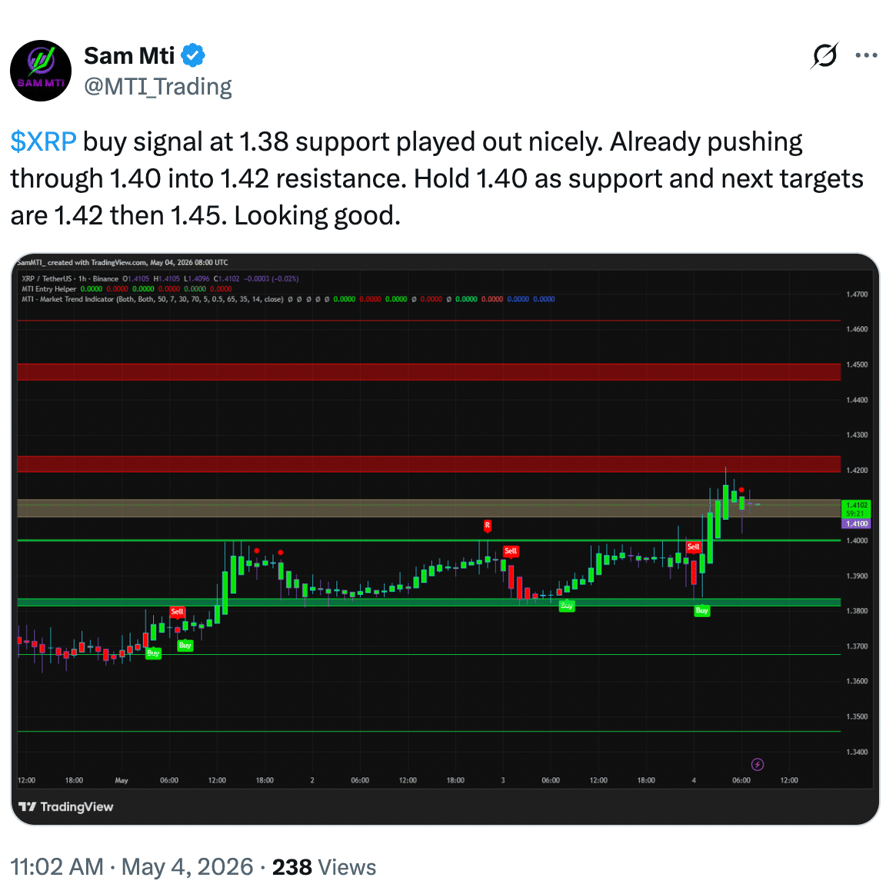
XRP finally gave way at $1.40, and the way it broke matters more than the move itself. This wasn’t a slow drift lower. It was a high-volume push that cleared a level buyers had defended for weeks. Once that kind of support goes, it usually doesn’t snap back quickly. It tends to flip, and that’s exactly the test now.

News Background

• Bitcoin dominance pushed toward 60%, reinforcing a rotation out of altcoins and limiting follow-through demand for XRP.

• The multi-month triangle structure that had been compressing price finally resolved, with the move breaking lower instead of triggering the expected upside expansion.

Price Action Summary

• XRP dropped from $1.44 to $1.39, breaking cleanly through the $1.40 support zone.
• The move was driven by a sharp spike in participation, not thin liquidity.
• Price is now stabilizing just below the breakdown level, trading in a tight $1.39–$1.40 range.

Technical Analysis

• The key shift is structural. $1.40 was support, now it’s resistance unless reclaimed quickly.
• Volume expanding into the breakdown confirms real selling pressure, not just positioning noise.
• The triangle pattern that held price for weeks has resolved lower, removing the compression support.
• Short-term bounces are showing up, but they’re reactive, not strong enough to reverse the move yet.

What traders should watch

• $1.40 is now the pivot. Reclaim it with volume, and the breakdown starts to look like a fakeout.
• $1.37 is the next downside level. Losing that opens the path toward deeper support near $1.31.
• If price keeps holding below $1.40, sellers stay in control and rallies are likely to get sold.

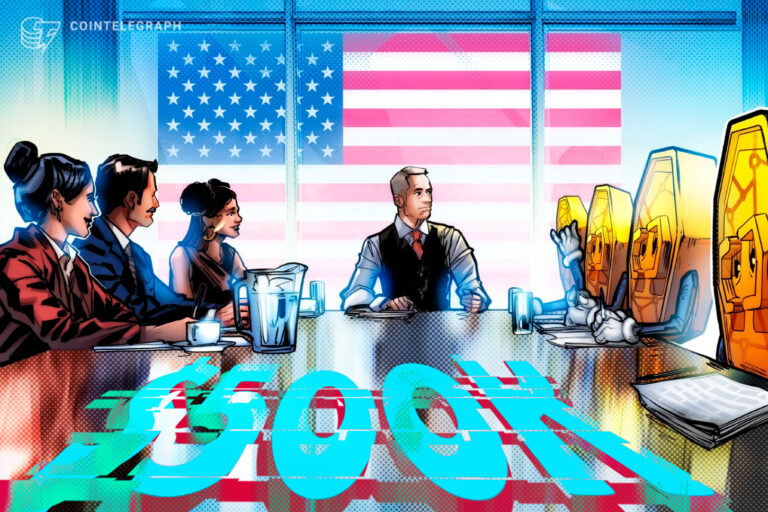
SEC, CFTC Chiefs Signal ‘New Day’ For Onshore Crypto

0

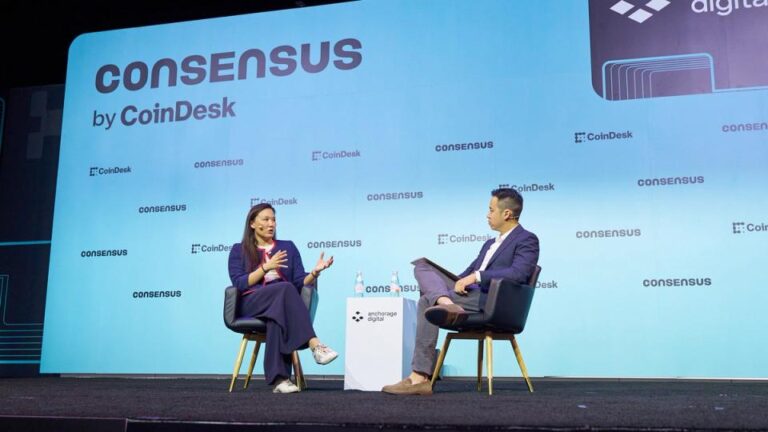
SEC Chair Paul Atkins and CFTC Chair Mike Selig used back‑to‑back fireside chats on the Nakamoto Stage at The Bitcoin 2026 Conference to signal a reset in Washington’s approach to digital assets, tokenization, and market structure. 

Atkins described it as “a new day at the SEC,” while Selig said regulators are “turning over a new page” and need to harmonize their efforts.

Atkins said the SEC is taking a new approach to digital assets and wants that activity onshore rather than pushed to foreign jurisdictions. He said the SEC and CFTC are now working together on digital assets and aim to set a new benchmark for inter‑agency collaboration.

That cooperation underpins the joint token taxonomy guidance, which draws lines between digital commodities, collectibles, and tokenized securities and offers a framework market participants can use as they classify assets.

Atkins revisited the long‑running debate over how the Howey test and existing securities laws apply to crypto. Atkins said the SEC is trying to apply that framework to digital assets, tokens, and related instruments while grappling with the boundary between securities and commodities. 

Atkins: “Innovation exemption” is coming

He indicated that an “innovation exemption” is coming, designed to give crypto projects room to build within a defined regulatory lane instead of staying in a gray area or moving offshore.

Atkins tied that effort to Congress and said legislators need to speak clearly on digital assets so there are durable rules and so entrepreneurs can pursue their goals in the United States.

He argued that it is important to have a statute that is future proof for this space and said nothing future proofs of a market like clear statutory law drafted with emerging technology in mind. He pointed to token taxonomy guidance as a step in that direction but stressed that a statute from Congress would anchor policy across administrations.

On the recent guidance, Atkins said the agencies wanted to provide principles and definitions without publishing a prescriptive list of tokens or implying recommendations about what investors should buy. He cited President Donald Trump’s GENIUS Act on stablecoins as an example of a principles‑based regulatory model that leaves room for innovation while drawing firm boundaries around risk. 

He said the SEC is focused on tokenized securities through a principles‑based approach rather than detailed product‑by‑product prescriptions.

Atkins also addressed the Clarity Act and broader crypto market structure legislation. He said there could be movement on that package in May, with the possibility of passage in June, but he cautioned that nothing is guaranteed. 

If crypto structure reform does not pass, he said, industry participants should remember that elections have consequences, pointing to pivots at both the SEC and CFTC as evidence of how quickly supervisory priorities can shift.

Looking ahead, Atkins framed crypto and blockchain technology as the most exciting aspect of the current transition. He highlighted the prospect of instantaneous settlement and said faster settlement can reduce risk in the financial system.

Instant or near‑instant settlement, he argued, can shrink counterparty and settlement risk and free up capital that is now tied up in back‑office processes. He said regulators are trying to foster that outcome rather than stand in its way.

Atkins said “this is a new day at the SEC” and previewed the agency’s next step: an initiative that will allow firms to experiment on‑chain with tokenized and securitized instruments over the next few weeks. 

Under that effort, companies will be able to test tokenization in a supervised environment while staying within federal securities law. He framed this as part of the coming innovation exemption, intended to open a sandbox for tokenized securities under clear parameters rather than through informal no‑action relief.

Selig: CFTC is turning a new page on crypto

In his own session, Selig echoed the theme of regulatory reset. He said the CFTC is “turning over a new page” in its approach to digital assets and emphasized the need to harmonize the agency’s work with the SEC. For markets that trade products with both commodity‑like and security‑like features, he said, the two agencies need a coordinated framework instead of overlapping or conflicting rules.

Selig also grounded his remarks in a broader principle, saying “our country was founded on the idea of private property.” In the context of crypto, that line underscored his view that token holders and innovators should have clear, enforceable rights in law. 

He suggested that a coherent crypto market structure for digital assets should respect property rights and give market participants predictable rules, rather than drive activity into less regulated jurisdictions.