Tokenisation infrastructure provider Ctrl Alt has officially launched its first tokenised structured product on the Solana network. The milestone transaction sets a new benchmark for integrating traditional finance with on-chain capital, having already placed over $400million in tokenized assets on-chain.
The transaction involved Ctrl Alt arranging, structuring, and executing the tokenization of a structured product backed by yield-bearing assets. These underlying assets were sourced directly from a regulated UK financial services firm.
Bridging traditional finance and digital capital
To support the complex legal structuring of the transaction, Ctrl Alt partnered with Carey Olsen, a leading law firm and offshore specialist. The structure was established and tokenized using a specialized vehicle domiciled in Guernsey. This jurisdiction was specifically selected for its innovation-friendly regulatory environment, deep financial expertise, and speed of execution.
The approach highlights the next evolutionary stage of tokenization, proving how innovative structures can effectively bridge on-chain capital with traditional finance opportunities. By combining blockchain technology with established legal frameworks, the approach offers several distinct advantages:
Financial firms can raise, deploy, and manage funds efficiently while maintaining familiar governance and regulatory standards.
The structure provides profound operational efficiency across the entire structured product lifecycle.
It actively supports digital issuance, transfer, and settlement while preserving traditional management and oversight.
Industry perspectives
Matt Ong, CEO and founder of Ctrl Alt
Matt Ong, founder and CEO at Ctrl Alt, emphasized the growing institutional appetite for blockchain-based funding.
“Tokenization is increasingly becoming part of the conversation for financial institutions seeking new ways to access capital,” Ong stated. “By combining innovative structured finance with on-chain funding, we’re able to create solutions that integrate with existing frameworks while providing greater efficiency and flexibility. We’re proud to deliver the first structured product on Solana.”
Ben Brophy, head of institutional growth, Europe at the Solana Foundation
Ben Brophy, head of institutional growth, Europe at the Solana Foundation, noted the importance of this integration for the wider blockchain ecosystem.
“Bringing together traditional experience and technical understanding to design and deliver access to Real World Assets (RWA) is key to greater institutional utilisation of Solana,” Brophy commented. “Internet capital markets on Solana brings together allocators, issuers, and market infrastructure, enabling more efficient access to products and services. Ctrl Alt has demonstrated that they are leading the market in bringing alternative financial instruments on-chain, and driving material capital allocations into these assets.”
Matt Brehaut, partner at Carey Olsen, praised the choice of jurisdiction for the landmark deal.
“Guernsey’s sophisticated regulatory framework, flexibility and financial expertise make it the natural choice for establishing innovative structures of this kind, and Solana and Ctrl Alt’s decision to domicile their first tokenized structured product in Guernsey further reinforces the island’s position as a leading centre for cutting-edge on-chain finance,” Brehaut explained.
Founded in 2022, Ctrl Alt supports the end-to-end asset lifecycle from origination and structuring through to issuance and distribution. As of April 2026, the firm has successfully tokenized over $1.4billion in assets, spanning real estate, private credit, funds, and commodities.
Bitcoin (BTC) buyers resumed their activity during the early Asian trading hours on Wednesday, pushing the price to a new multi-month high of $82,240.
Onchain indicators, including the short-term holder (STH) cost basis, suggest that the BTC price can go higher, with the next big target at $92,000.
Key takeaways:
Bitcoin holders are back in profit, increasing the chances of reaching $92,000.
BTC bulls must overcome resistance at $84,000 to continue the uptrend.
Bitcoin price eyes $92,000 next
Data from TradingView shows that BTC/USD had risen 37% to trade above $82,000 from its multi-month low of $60,000 reached on Feb. 6.
This rally has seen Bitcoin rise above the cost basis of its short-term holders, currently at $79,000, according to data from Glassnode.
STH cost basis refers to the average purchase price of investors who have held Bitcoin for less than 155 days.
Historically, reclaiming this level has coincided with extended recovery phases, as investors returning to profit are often less inclined to sell and more willing to add exposure. The shift can also attract fresh buyers and trigger short squeezes as bearish positioning unwinds.
Related: Bitcoin in ‘disbelief rally’ as traders spot $84K BTC price target
The chart below shows that when the price reclaimed its realized price in April 2025, it rallied 30% toward the upper band of this metric at $112,000 four weeks later.
Similar occurrences in October 2024, October 2023 and January 2023 also saw the BTC price rally toward the same onchain level, as shown in the chart below.
If BTC breaks above the line, there is a good chance of seeing $92,423 in the short term, about 13% above the current price.
Bitcoin STH cost basis. Source: Glassnode
“Bitcoin has crossed the coveted ‘short-term holder breakout,’” analyst Mitchell Askew said in a Wednesday post on X, adding:
“This typically signals the end of bear markets and consolidation periods.”
Bitcoin analyst Plan C said if the price “can find sustained support above this level,” it would confirm that the 50% drawdown from the $126,000 all-time high was just a “mid-cycle correction.”
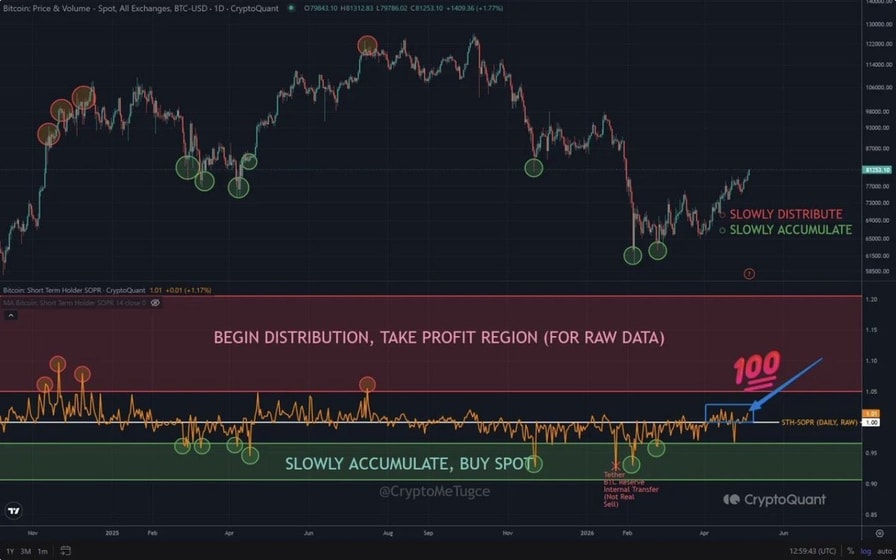
Meanwhile, Bitcoin’s STH spent output profit ratio (SOPR) has flipped positive, showing early signs of a shift in market behavior.
The metric is “back above 1, which usually means recent buyers are back in profit and selling pressure is easing,” analyst BitBull said in a Wednesday post on X, adding:
“This is where markets often move from accumulation into early bullish phases.”
Bitcoin STH SOPR. Source: BitBull
As Cointelegraph reported, several technical indicators suggest that Bitcoin’s bottom is in, with analysts setting targets as high as $250,000 within a year.
Bitcoin’s price needs to flip $84,000 into support
Bitcoin’s bullish weekly close above the 20-week exponential moving average and true market mean at $78,300 has convinced traders it can move higher from current levels.
Analysts say the continuation of Bitcoin’s rally now hinges on breaking above the $82,000-$84,000 supply zone.
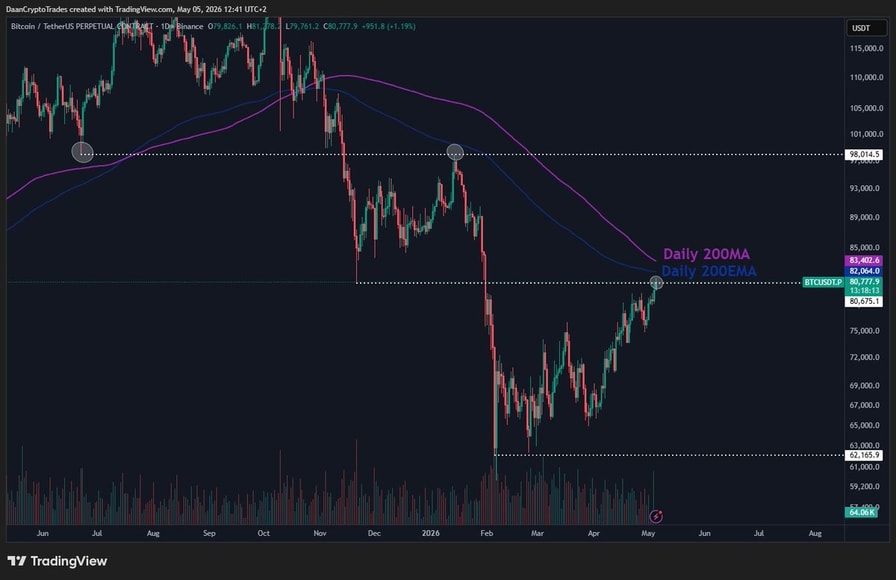
Bitcoin is retesting the low $80,000s region, which “corresponds with the November lows and the Daily 200MA/EMA coming in a bit higher,” trader and analyst Daan Crypto Trades said in his latest Bitcoin analysis on X.
Note that the 200-day EMA and the 200-day simple moving average are at $82,600 and $83,402, respectively.
This is a “big level” for Bitcoin bulls, the analyst said, adding:
“Acceptance higher can lead to a further bounce back into the $90Ks, but a rejection will likely keep this rangebound with $80K as the ceiling for a while.”
BTC/USD daily chart. Source: X/Daan Crypto Trades
MN Capital founder Michael van de Poppe shared a chart showing $84,000-$86,000 as the “next resistance zone,” which, if broken, could potentially see Bitcoin “continue to the 50-Week MA around $90K.”
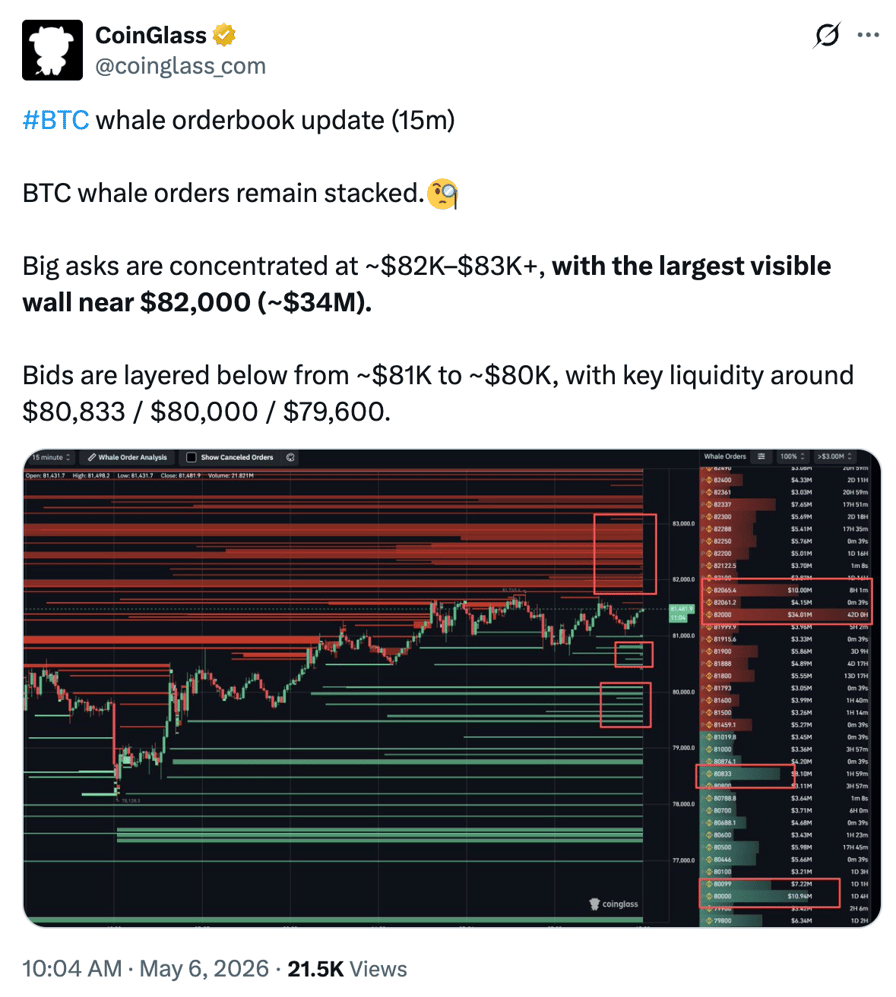
Meanwhile, Bitcoin’s whale order book showed “big ask orders concentrated” between $82,000-$84,000, making it a crucial level for the bulls to overcome.
Bitcoin whale order book. Source: CoinGlass
As Cointelegraph reported, the BTC/USD pair may rise as high as $92,000 if resistance at $84,000 is broken.
This article is produced in accordance with Cointelegraph’s Editorial Policy and is intended for informational purposes only. It does not constitute investment advice or recommendations. All investments and trades carry risk; readers are encouraged to conduct independent research.
The odds on a seven-leg parlay and the odds on a fresh memecoin trade are roughly the same, BONK core contributor Nom told audience at the ongoing Consensus Miami on Tuesday.
Most memecoin teams lack the staying power to push their projects through real regulatory steps, Nom said, citing exchange listings, ETF filings and public-company structures as the markers that separate tokens that last from those that rinse retail.
Crypto has built systems “really, really good at incentivizing inorganic traffic,” he added, pointing to points programs and airdrop farms that pull in mercenary capital and then watch network activity collapse the following week.
BONK has worked through several of those rails. Nasdaq-listed Bonk Holdings (BNKK), which rebranded from beverage company Safety Shot in October 2025, holds roughly 2.7% of BONK’s circulating supply and is targeting $115 million in token holdings by the end of 2026.
Tuttle Capital has filed a 2x leveraged BONK ETF with the SEC, and TenX Protocols, listed on the TSX Venture Exchange, made a public treasury allocation in January.
The token launched Christmas Day 2022, days after the FTX collapse, with Solana trading below $10 and most builders questioning whether the chain would survive. BONK went out as an airdrop to NFT holders, developers and active wallets with no presale, no venture funding and no whitepaper.
The pitch was distribution rather than a token, Nom said, built to give Solana developers something to rally around in a dead market.
The surrounding stack now includes LetsBonk.fun, the Solana memecoin launchpad that flipped rival Pump.fun on monthly volume earlier this year, plus BonkBot, a Telegram trading interface, and around a million wallets, per figures cited on the panel.
Pressed on where the next breakout community comes from, Nom said it would form around something most people currently dismiss, naming the TON network and Telegram-built projects as candidates worth watching.
Whether BNKK hits its $115 million treasury target by year-end and whether Tuttle’s leveraged ETF clears the SEC are the two cleanest signals for whether Nom’s TradFi-bridge thesis actually plays out.
The fireside was moderated by Lionel Williams, vice president of business development at Light Node Ventures.
The following is the fintech, digital and wider economic development overview of the Central American nation of Costa Rica in 2026
Often regarded as one of Central America’s most stable and prosperous nations, Costa Rica offers a wealth of biodiversity and an economy that is growing. In terms of fintech, what is the country’s fintech landscape like?
Costa Rica has long stood apart in Central America. Known for political stability, environmental stewardship, and a service-oriented economy, it has also increasingly emerged as a quiet contender in Latin America’s digital transformation story. The country of around 5.3 million people historically has been more developed than many regional peers, supported by a strong banking sector and growing digital adoption. By 2026, that trajectory has continued, marked by consolidation, regulatory evolution, and a more defined role within the broader Latin American fintech landscape.
Financial services and fintech overview
Beautiful aerial view of San Jose Downtown City, and the Sabana metropolitan Park In Costa Rica IMAGE SOURCE GETTY
The economic backdrop helps explain why. Costa Rica’s economy is valued at approximately $90billion, with its gross domestic product (GDP) per capita reaching around $17,000 in 2026). Its strengths lie in a diversified mix of services, advanced manufacturing (particularly medical devices), tourism, and a growing digital services sector. San José remains the country’s financial hub, home to major institutions such as Banco Nacional de Costa Rica, one of the country’s most influential banks and a key player in digital banking.
That broader economic stability has helped shape a fintech sector that is relatively mature by Central American standards. In 2026, Costa Rica’s ecosystem is estimated to include up to 120 fintech firms operating across payments, lending, wealthtech, and insurtech. That still leaves it smaller than Latin American giants such as Mexico and Brazil, but it places Costa Rica firmly among the more developed fintech markets in Central America.
Key players include fintechs focused on blockchain like Decentral Games, quick loans such as Rayo Credit, and payment integrations such as Olanzo.
What is particularly notable is that Costa Rica’s fintech evolution is no longer simply about access or early adoption. It is increasingly about optimisation. Digital payments, online banking, and e-commerce integration are now mainstream, while fintechs are focusing more on improving user experience, expanding financial products, and deepening interoperability. The result is an ecosystem shaped not just by startups, but by a collaborative relationship between new entrants and incumbent banks.
The Banco Central de Costa Rica (BCCR – English: Central Bank of Costa Rica) has been instrumental in that transition. BCCR the past few years has continued to modernise the national payments system, most notably through the expansion of SINPE Móvil, the instant payment platform that enables real-time transfers using mobile numbers. Regulatory discussions have also advanced around open banking, data-sharing protocols, and fintech licensing, pointing to a more innovation-friendly environment even if formal frameworks are still evolving.
Financial inclusion
Financial inclusion, meanwhile, remains one of Costa Rica’s strongest comparative advantages. Around 85 per cent of adults are estimated to have access to formal financial accounts as of last year. That figure is high by emerging market standards, underpinned by solid banking penetration and digital infrastructure. Still, some gaps persist, particularly among rural communities and informal workers, which is where fintech providers are increasingly directing mobile-first solutions.
This progress does not exist in isolation. Costa Rica’s digital financial development is closely tied to wider national strategies centred on innovation, sustainability, and digital governance. Government efforts to expand broadband access and implement digital transformation strategies have helped create fertile ground for digital services growth. Combined with a skilled workforce and strong education system, these factors have also strengthened Costa Rica’s appeal to multinational technology firms and digital entrepreneurs alike.
Payments remain one of the clearest indicators of this transformation. SINPE Móvil has become a cornerstone of the country’s financial ecosystem, supporting low-cost, real-time transactions for consumers and businesses. In doing so, it has not only supported inclusion, but also accelerated digital commerce and helped formalise parts of the informal economy.
Costa Rica also benefits from a more developed support ecosystem than many of its neighbours. Organisations such as the Fintech Costa Rica (Costa Rican Fintech Association) and the Asociación Blockchain Costa Rica (English: Blockchain Association of Costa Rica) along with innovation hubs and industry networks, play a meaningful role in advocacy, collaboration, and ecosystem building. They help bridge the interests of regulators, banks, startups, and investors. This is an increasingly important function as the sector grows more sophisticated.
That said, the country still faces challenges. Regulatory clarity on areas such as cryptoassets and digital assets remains incomplete, and while the fintech ecosystem is expanding, access to venture capital and scale-up financing is still more limited than in larger Latin American markets. Costa Rica may be stable and promising, but it is not yet a heavyweight in terms of investment depth.
Even so, Costa Rica offers a compelling example of how a smaller economy can use strong institutions and digital infrastructure to build a resilient fintech ecosystem. Rather than chasing disruption for its own sake, the country has focused on steady and sustainable growth. By 2026, Costa Rica’s fintech ecosystem is defined less by novelty than by integration. Digital financial services are no longer peripheral; they are becoming embedded in the everyday workings of the economy.
Bullish (BLSH) shares surged more than 11% following the company’s $4.2 billion agreement to acquire transfer agent Equiniti, with the stock climbing another 1.5% in pre-market trading Wednesday as analysts framed the deal as a transformational move beyond crypto trading.
The acquisition gives Bullish, the crypto platform led by former NYSE president Tom Farley (also CoinDesk’s parent company), direct access to one of the financial industry’s core pieces of infrastructure: shareholder records.
Equiniti services nearly 3,000 public companies, including more than 30% of the S&P 500 and over half of the FTSE 100. Analysts at Clear Street said the deal marks “a material step in repositioning Bullish from a crypto exchange to a tokenization infrastructure company.”
The logic behind the acquisition centers on tokenization, the process of turning traditional assets like stocks into blockchain-based digital tokens that can trade continuously and settle instantly.
While Bullish already operates trading infrastructure, custody systems and token issuance tools, analysts said the company lacked direct relationships with the corporate issuers whose shares would ultimately need to be tokenized.
“Equiniti fills the most important gap in Bullish’s tokenization thesis: issuer access and transfer-agent authority,” Clear Street wrote.
Transfer agents act as the official record keepers for public companies, tracking who owns shares, processing dividends and handling shareholder communications. Bullish therefore gains the regulated framework and client network needed to potentially bring tokenized equities into mainstream finance.
The deal also reflects intensifying competition around tokenized securities. Analysts pointed to recent moves by DTCC, Computershare and Securitize as signs that Wall Street infrastructure firms are racing to modernize market plumbing using blockchain rails.
Clear Street maintained a Buy rating with a $50 price target, arguing the acquisition could sharply improve Bullish’s earnings quality by adding recurring, fee-based revenue less tied to crypto trading volumes.
Compass Point took a more cautious stance, reiterating a Neutral rating and $36 target. The firm said Bullish’s current valuation already prices in much of the expected growth, though it acknowledged potential upside if Bullish succeeds in cross-selling tokenization services to Equiniti’s issuer base.
Both firms agreed the acquisition represents a long-term bet that tokenized securities move from experimentation to core financial infrastructure over the next several years.
Strategy Inc. (formerly MicroStrategy, Nasdaq: MSTR), the world’s largest corporate Bitcoin holder and first Bitcoin Treasury Company, held its Q1 2026 earnings call on May 5. The results were dominated by massive non-cash GAAP losses from Bitcoin’s fair-value accounting amid a volatile quarter. Yet the real story, and the market’s focal point, was a clear strategic pivot: the company signaled it is now willing to sell portions of its Bitcoin holdings tactically. This marks a departure from the long-standing “never sell” narrative and positions BTC as an actively managed capital allocation asset rather than untouchable inventory.
The Numbers: GAAP Pain, Operational Resilience, Bitcoin Growth
Strategy reported an operating loss of $14.47 billion and a net loss of $12.54 billion ($38.25 per diluted common share), compared to smaller losses in Q1 2025. The primary driver was a $14.46 billion unrealized fair-value loss on its digital assets as Bitcoin prices declined during the quarter (roughly from ~$87,000 to ~$68,000 by late March). These are non-cash charges under current accounting rules.
The core software business showed modest growth, with total revenues of $124.3 million (up ~12% year-over-year) and gross profit of $83.4 million (67.1% margin). Cash and equivalents stood at $2.21 billion. More importantly for the Bitcoin Treasury thesis:
Holdings: 818,334 BTC as of early May (3.9% of total supply), up 22% year-to-date in 2026.
Acquisitions: 89,599 BTC purchased in Q1 alone (~$7.3 billion at ~$80,900 average) plus another 56,235 BTC in Q2-to-date.
Key Metrics: 9.4% BTC Yield and ~63,410 BTC gain year-to-date (equating to ~$5 billion in dollar gains). Bitcoin per share rose 18% year-over-year to 213,371 sats.
Capital Raised: ~$11.7 billion year-to-date (roughly half common equity, half preferred—primarily the flagship STRC “Stretch” digital credit product, which has scaled to $8.5 billion outstanding with strong liquidity and a 11.5% dividend yield). fool.com
The balance sheet remains fortress-like: modest net leverage (~9%), ample cash reserves, and a sophisticated digital credit engine via STRC that has attracted institutional and DeFi interest (including tokenized versions). Executives highlighted a proposed shareholder vote to shift STRC dividends from monthly to semi-monthly for better liquidity, with return-of-capital (ROC) tax treatment expected for the foreseeable future.
The Headline Shift: Tactical Bitcoin Sales as Financial Engineering
The call’s biggest takeaway, echoed in real-time X (Twitter) commentary, was the explicit openness to selling Bitcoin under the right conditions. Executive Chairman Michael Saylor stated the company “will probably sell some Bitcoin to fund a dividend just to inoculate the market, just to send the message that we did it.” President and CEO Phong Le added: “We will sell Bitcoin when it’s advantageous to the company… We’re not gonna sit back and just say, ‘We’ll never sell the Bitcoin.’ We wanna be net aggregators of Bitcoin, increasing our total Bitcoin, but more importantly, increasing our Bitcoin per share.” This isn’t a fire sale or abandonment of accumulation. Instead, as detailed in the earnings presentation slides and elaborated by executives, it’s optimized capital allocation:
Tax Harvesting Opportunity: Strategy’s BTC stack has clear cost-basis tiers (from early low-basis holdings to recent higher-cost purchases). Slides illustrated that selling higher-cost-basis BTC (e.g., ~$80k–$100k+ tiers) at current levels could realize substantial capital losses—potentially turning ~$7.6 billion in unrealized losses into immediate tax benefits (estimated $2.2 billion in tax assets at a 29% rate). These losses can offset gains elsewhere, reduce CAMT (corporate alternative minimum tax) exposure, and create valuable tax shields. Because Bitcoin is treated as property by the IRS, wash-sale rules don’t apply, allowing strategic repurchases if desired. thestreet.com
Redeployment for Accretion: Proceeds would fund high-BPS-accretive actions—buying back undervalued MSTR shares (especially below ~1.22x mNAV), retiring convertible debt, or supporting dividends—while maintaining or growing Bitcoin per share. A presentation slide modeled a $1 billion “sell BTC to buy MSTR” trade, showing strong positive delta to BTC yield and gains at sub-1.22x mNAV levels (e.g., +636 bps yield at 0.5x mNAV). This could crush shorts, reduce float/dilution risk, and boost mNAV. thestreet.com
Dividend and Liability Management: Small, targeted sales could perpetually fund STRC preferred dividends (with STRC issuance potentially outpacing the BTC “breakeven” cost). This inoculates against FUD about forced sales or dilution while keeping the company a net BTC buyer overall.
In short, BTC transitions from a static “digital gold” reserve to a dynamic tool for optimizing taxes, liquidity, capital structure, and shareholder value, without increasing leverage. As one sharp X analysis put it: “BTC is no longer treated as untouchable inventory. It’s becoming an actively managed capital allocation asset optimized around Bitcoin per share, float control, taxes, and capital structure.”
Follow BFC on X.
Market Reaction
The earnings call for @strategy explicitly stated a shift in Strategy and it could be awesome. TL;DR -> Sell High Cost Bitcoin, Book Taxable Loss, Use $4B to buy back $MSTR and Converts, boost share price and mNAV, crush shorts.
Disclaimer: This content was prepared on behalf of Bitcoin For Corporations for informational purposes only. It reflects the author’s own analysis and opinion and should not be relied upon as investment advice. Nothing in this article constitutes an offer, invitation, or solicitation to purchase, sell, or subscribe for any security or financial product.
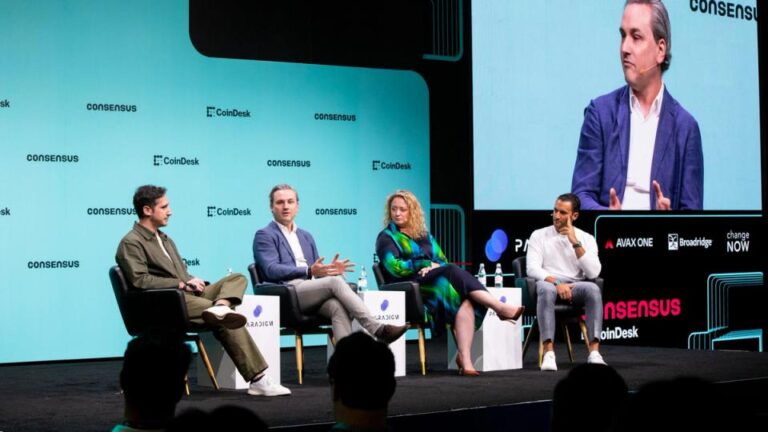
Wall Street’s long-awaited migration into crypto is no longer theoretical, according to executives from Ondo Finance, Robinhood-owned Bitstamp and Babylon Labs. However, institutional adoption remains slower and more fragmented than many in the industry once expected.
The executives described a financial industry increasingly embracing blockchain rails, tokenized securities and crypto-native yield products on the “Is the Wall Street Herd STILL Coming?” panel at Consensus Miami 2026.
“I think it’s very clear that Wall Street is coming to crypto,” said Ondo President Ian De Bode, pointing to recent partnerships with Broadridge and the Depository Trust & Clearing Corporation (DTCC) aimed at tokenizing securities and enabling blockchain-based shareholder voting.
Robinhood’s Nicola White said that the conversation with banks has shifted dramatically over the past two years. “We’re not having conversations anymore about what blockchain is,” she said. “Now it’s about, how do we help them build?”
The panelists emphasized that crypto infrastructure already improves on traditional finance in terms of settlement speed and market accessibility. De Bode noted Ondo’s tokenized treasury products allow investors to mint and redeem positions over weekends while earning a daily yield, capabilities still largely unavailable in traditional money markets.
“That in and of itself as a value prop is mind-blowing to many in TradFi,” he said.
Still, the speakers acknowledged institutional adoption remains constrained by legacy financial infrastructure and regulation. White said banks continue to build crypto products cautiously while waiting for clearer regulatory guidance.
“There’s not a traditional finance Wall Street company we’ve talked to that has said this isn’t something they’re thinking about,” she said.
Babylon Labs’ Boris Alergant argued institutions are increasingly focused on capital efficiency rather than simply bitcoin price appreciation. He said Babylon’s bitcoin-backed lending products are designed to let investors borrow against native bitcoin holdings without relinquishing custody through wrapped assets or centralized intermediaries.
The panel also highlighted a growing divide between regulated U.S. markets and offshore crypto ecosystems. De Bode said permissionless innovation in decentralized finance will likely continue to flourish outside the United States, even as banks adopt more controlled blockchain-based systems domestically.
“I don’t see a world in which everything that happens offshore finds a home in the U.S.,” he said.
Despite the bifurcation, panelists broadly agreed that the two systems will eventually converge as institutional capital and crypto-native liquidity deepen.
Anti Money Laundry AML refers to the laws, regulations, and procedures designed to prevent criminals from disguising illegally obtained funds as legitimate income. Yesterday, FinScan®, provider of advanced anti-money laundering (AML) and sanctions screening solutions from Innovative Systems, announced that its FinScan Payments solution now supports screening for stablecoin transactions and digital wallets across global sanctions lists, alongside traditional payment rails, enabling a single, scalable approach for payments compliance.
Stablecoin payments are projected to reach $56 trillion globally by 2030, and regulators increasingly expect them to be treated like any other payment rail, including screening at origination. Most fintechs and financial institutions already use point solutions to screen traditional payment rails, but few have a solution for stablecoins.
FinScan Payments closes that gap without having to add vendors or integrations to a firm’s compliance framework or tech stack. It screens every payment against sanctions, politically exposed persons (PEP), and dual-use goods lists simultaneously across all rails including stablecoins.
The solution also screens digital wallet addresses and payment parties against customer-selectable global sanctions lists including OFAC, Israel’s NBCTF, Japan’s Ministry of Finance, the UK Sanctions List, and the United Nations’ Security Council sanctions lists.
This is a good news for payments since AML is a critical pillar of financial system integrity. In addition to that, Money laundering remains massive (trillions annually) and creates problems to institutions including: Growing costs, Increasing regulatory pressure, and Technology-driven transformation.
Recently, the Euroepan Union has established a central regulator (AMLA) starting in 2026. Here for more details on EU Regulation.