At the Retail Technology Show, the focus on the evolving merchant-customer relationship centered on three core pillars: integration, reliability, and real-time recognition. Kevin Carson, Senior Vice President and Global Partnerships at FreedomPay, joined the discussion to explain how the company is simplifying the checkout experience by delivering a best-in-class integration library. This extensive library allows customers the free choice to work with preferred vendors such as Oracle Retail, Aptos, or GKE Software, ensuring that technology remains a facilitator rather than a barrier to business.
To ensure this experience remains seamless on a global scale, the FreedomPay platform is built with a primary focus on stability and resiliency. Carson emphasized that the ability to run transactions with high speeds and total accuracy is essential for maintaining consumer trust. However, speed is only one part of the equation; for the modern consumer, the checkout is also an opportunity for engagement. The platform enables merchants to recognize customers in real time based on their specific purchase history, allowing for the immediate delivery of relevant rewards and incentives during the transaction.
Looking at the broader industry, Carson highlighted the rapid rise of intelligent retail solutions, ranging from RFID technology to new Android-based contactless payment methods. The biggest shift currently underway is the move toward tools that allow retailers to truly know and understand their customers in a deeper way. FreedomPay is preparing its clients for this shift by providing an underlying platform designed to consume and integrate these emerging services. By staying ahead of these trends, the company ensures that retailers can continue to offer cutting-edge experiences while maintaining a robust and accurate payment foundation.
Key Highlights from Kevin Carson:
Extensive Integration Libraries: Carson discusses how FreedomPay provides the freedom of choice by supporting a wide array of vendor integrations for its partners.
Global Stability and Speed: The importance of building a resilient platform that can handle high-velocity transactions with total accuracy across the globe.
Real-Time Consumer Recognition: How the platform allows merchants to identify shoppers and provide personalized rewards and incentives at the point of sale.
Underpinning Intelligent Retail: A look at how FreedomPay supports emerging trends like RFID and Android contactless solutions to help retailers understand their customers better.
Bitcoin (BTC) is approaching its “most critical” resistance hurdle of the bear market, new BTC price analysis says.
Key points:
Bitcoin has arguably its most important resistance battle at $84,000.
A failure to reclaim a 200-day trend line opens up the road down to $50,000 lows, warns analysis.
The bull market support band needs to hold in the event of a corrective phase.
Bitcoin faces battle to avoid “bear cycle continuation”
In an X post on Wednesday, crypto investment company TradingShot revealed the next key decision point for Bitcoin bulls.
BTC price action continues to test $82,000, according to data from TradingView, but it is the area around $84,000 that will be essential to reclaim as support next.
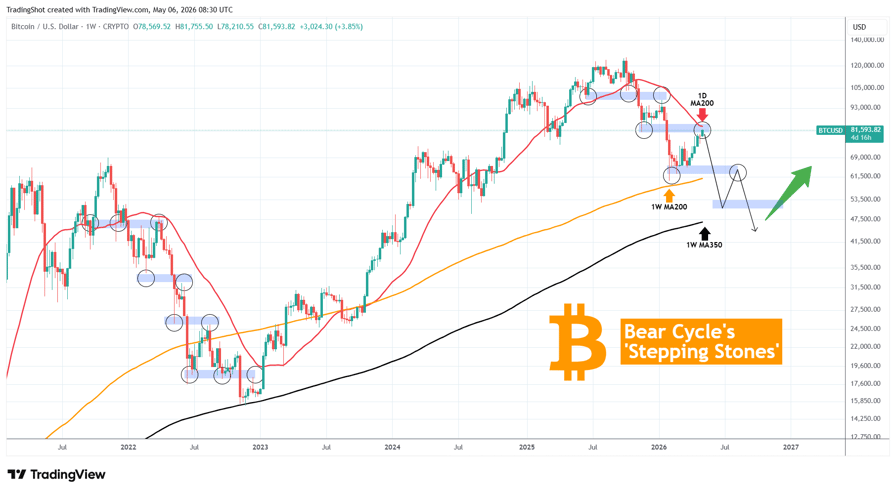
“Bitcoin is about to test its 1D MA200, the most critical Bear Cycle Resistance but has also already entered the Pivot Zone formed from the previous Low,” TradingShot wrote.
An accompanying chart compares current price performance with the 2022 bear market, with the 200-day simple moving average (SMA) at the center.
At the time, BTC/USD retested the 200-day SMA from below after initially losing it, but the reclaim failed — and the result was a trip to new macro lows.
“This is a familiar pattern that $BTC forms during downtrends, it was also emphatically present during the 2022 Bear Cycle where those Pivot Zones got formed from a previous Low that was later tested as Resistance,” the analysis continues.
BTC/USD one-week chart. Source: TradingShot/X
Should history repeat, TradingShot is eyeing a dramatic correction, with a bottom target at $50,000.
“A rejection now on this ‘Stepping Stones’ pattern will confirm the Bear Cycle continuation for BTC to $50000, while a break-out will invalidate it,” it concludes.
As Cointelegraph reported, the $50,000 zone has long been a favorite among traders who see the bear market continuing.
BTC price support band as “main focus”
If the 200-day SMA is the resistance level to beat, two trend lines immediately below price are essential to retain as support, commentators argue.
Related: Bitcoin price nears $82K as ‘big level’ sparks warning of fresh macro rejection
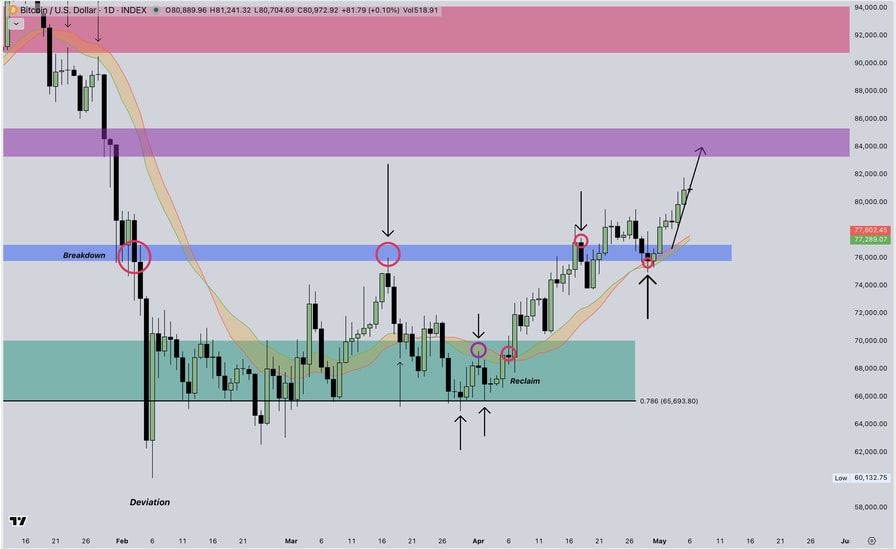
The so-called bull market support band, formed of the 20-week SMA and the 21-week exponential moving average (EMA), sits near $78,000.
In some of its latest X analysis, trading account Cryptic Trades said that the support band should stay the “main focus.”
“I believe that as long as price keeps holding above this range, as well as the April 2025 bottoming formation around $76K, the broader market structure remains intact,” it wrote on Wednesday alongside an explanatory chart.
“The other key level to track is the lost high-timeframe support range marked in purple around $84K, where I believe we could see a short-term rejection.”
BTC/USD one-day chart. Source: Cryptic Trades/X
This article is produced in accordance with Cointelegraph’s Editorial Policy and is intended for informational purposes only. It does not constitute investment advice or recommendations. All investments and trades carry risk; readers are encouraged to conduct independent research.
Federal prosecutors are recommending a light sentence for Roni Cohen-Pavon, the former chief revenue officer of defunct cryptocurrency lending platform Celsius.
In a Monday letter filed in the US District Court for the Southern District of New York (SDNY), US Attorney Jay Clayton cited Cohen-Pavon’s “substantial assistance” to the government by being prepared to testify against former Celsius CEO Alex Mashinsky.
Prosecutors did not request a specific amount of time for the former executive to spend in prison, instead asking the judge to consider the sentencing guidelines for an “appropriate sentencing reduction for a defendant who has rendered substantial assistance.”
“As soon as he pled guilty, Cohen-Pavon’s cooperation was public and known to Mashinsky,” said Clayton. “Cohen-Pavon’s cooperation was likely a significant factor in Mashinsky’s decision to plead guilty a few months prior to his January 2025 trial date.”
Excerpt from US Attorney’s letter in Cohen-Pavon sentencing. Source: PACER
Cohen-Pavon pleaded guilty to fraud and conspiracy to commit price manipulation related to Celsius’s CEL token in September 2023 as part of his role in the crypto lending platform’s activities that led to the loss of billions of dollars when the company collapsed in 2022. He had been scheduled to be sentenced before Judge John Koeltl on May 7, but on Monday the judge moved the sentencing hearing to May 13.
Related: Celsius founder Alex Mashinsky settles FTC case with $10M payment
Mashinsky, the public face of Celsius and one of the most prominent figures in the cryptocurrency industry at the time, was sentenced to 12 years in prison in May 2025 after pleading guilty to commodities and securities fraud. Many experts saw the fall of Celsius as intertwined with the 2022 crypto market downturn that resulted in the collapse of several exchanges, including FTX and Voyager Digital.
Cohen-Pavon’s lawyers asked for time served ahead of his sentencing hearing, saying that the former Celsius executive took “full responsibility for his conduct and the harms caused by his participation in the CEL token manipulation scheme.”
No new trial for former FTX CEO
The sentencing hearing, expected to wrap up the criminal cases associated with Celsius, will come after another SDNY federal judge denied former FTX CEO Sam Bankman-Fried’s request for a new trial. Bankman-Fried, also known as SBF, asked for a new trial by claiming that the judge overseeing his 2023 trial, Lewis Kaplan, showed “manifest prejudice” during the proceedings. He still awaits a decision on his appeal to overturn the conviction.
Magazine: How to fix suspected insider trading on Polymarket and Kalshi
Cointelegraph is committed to independent, transparent journalism. This news article is produced in accordance with Cointelegraph’s Editorial Policy and aims to provide accurate and timely information. Readers are encouraged to verify information independently.
CME Group plans to launch Bitcoin Volatility futures on June 1, pending regulatory review, giving investors a compliant way to trade expected Bitcoin volatility rather than price direction, according to a company release published Tuesday.
The Chicago-based derivatives marketplace said the contracts will settle to the CME CF Bitcoin Volatility Index, a 30-day measure of expected Bitcoin volatility derived from CME options markets.
CME describes the new contracts as Commodity Futures Trading Commission (CFTC)-regulated futures aimed specifically at Bitcoin volatility, extending the existing US regulatory framework that already covers CME’s Bitcoin and Ether derivatives.
Giovanni Vicioso, CME Group’s global head of cryptocurrency products, said in the release that market participants are seeking regulated products that offer exposure to market moves, and that the new futures would let traders invest in or hedge against future Bitcoin volatility.
The launch would give institutions a regulated way to trade Bitcoin volatility in the US directly through CME’s clearing framework, rather than building similar exposure through combinations of Bitcoin options and futures or using offshore venues.
Related:CME CEO Duffy says exchange is exploring issuing its own token
In the same release, Morgan Stanley managing director and head of derivatives sales David Schlageter said the contracts should help market participants manage portfolio risk by trading volatility itself.
CME Group to Launch Bitcoin Volatility Futures Contracts. Source: PR Newswire.
CME described the contracts as the “first-of-their-kind regulated futures contracts,” distinguishing them from existing crypto-native volatility products offered outside the US-regulated futures framework.
Cointelegraph reached out to CME for additional comment, but had not received a response by publication.
Similar products exist elsewhere. Deribit launched BTC DVOL futures in March 2023, tied to its implied-volatility index, while BitMEX introduced its BVOL 30-day historical volatility futures back in January 2015.
CME first introduced cash-settled Bitcoin futures in December 2017 and has since expanded its regulated crypto lineup to include Bitcoin options, Micro Bitcoin futures and options, Ether futures and options and other cryptocurrency contracts.
The group is preparing to move its cryptocurrency futures and options to 24/7 trading from May 29, subject to regulatory review, further aligning its market structure with the always-on nature of digital assets.
That push comes as crypto derivatives continue to dominate trading activity more broadly, with a CoinGlass report estimating 2025 crypto derivatives volume at about $85.7 trillion, and Swiss bank Amina Group finding that derivatives account for roughly three-quarters of all crypto trading.
Magazine: Bitcoin will not hit $1M by 2030, says veteran trader Peter Brandt
Cointelegraph is committed to independent, transparent journalism. This news article is produced in accordance with Cointelegraph’s Editorial Policy and aims to provide accurate and timely information. Readers are encouraged to verify information independently.
TrustedVolumes, an independent market maker and resolver used by 1inch Fusion, confirmed it was exploited and said about $6.7 million in stolen funds are being held across three Ethereum addresses.
In a Thursday X post, the market maker said the stolen funds were split across three wallets, with two addresses each holding about $3 million and a third holding about $700,000. TrustedVolumes said it was open to “constructive communication” over a bug bounty and a “mutually acceptable resolution.”
The confirmation came after Web3 security company Blockaid said its exploit detection system had identified an ongoing Ethereum exploit targeting TrustedVolumes. Blockaid said the attack involved a TrustedVolumes-controlled custom swap infrastructure. Blockaid initially estimated that about $5.87 million had been extracted, including Wrapped Ether, USDT, Wrapped Bitcoin and USDC.
Blockchain security company CertiK said the attacker registered as an allowed order signer through a public function, then used that authorization to execute orders that transferred funds from the targets.
The incident highlights the risks around third-party infrastructure used in decentralized exchange execution, where resolvers and market makers can operate their own contracts even when the core protocol and ordinary users are not directly affected. TrustedVolumes operates independently as a liquidity provider for multiple protocols, including 1inch, which said its own systems, infrastructure and user funds were not affected.
Cointelegraph reached out to TrustedVolumes for additional comment but had not received a response by publication.
Source: TrustedVolumes
1inch says none of its protocols were breached
In an X post, 1inch said reports linking it directly to the TrustedVolumes exploit were “misleading,” adding that “neither 1inch nor any of the 1inch protocols are involved.” The platform said there was “no impact on 1inch systems, infrastructure or user funds.”
1inch co-founder Sergej Kunz also said TrustedVolumes operates independently and is not exclusive to 1inch. “While it is true that 1inch uses TrustedVolumes as a resolver, we are one of many,” Kunz said.
Kunz said the framing of the exploit as a 1inch-related incident was “confusing and harmful,” adding that 1inch is monitoring the situation with security partners and will assist where appropriate.
Related: Andre Cronje says DeFi is ‘no longer DeFi’ as builders debate circuit breakers
Security researcher Vladimir Sobolev, known as Officer’s Notes on X, also told Cointelegraph there was “no risk for 1inch users,” adding that the exploit was related only to TrustedVolumes.
Sobolev said the exploit points to broader weaknesses in crypto security practices, where vulnerabilities can quickly produce immediate losses.
“We lack security in general. Blockchains just tend to have an immediate payoff,” Sobolev told Cointelegraph. “We need to pay more attention to kill switches, monitoring, circuit breakers, etc.”
Both Blockaid and Sobolev noted that the attack was carried out by the same operator responsible for the March 2025 1inch Fusion V1 resolver exploit. However, Blockaid said the latest attack involved a different vulnerability.
In March 2025, 1inch said a vulnerability affected resolvers using an outdated Fusion v1 implementation in their own contracts, while end-user funds remained safe. SlowMist later traced about $5 million in stolen assets, including USDC and Wrapped Ether.
1inch and the affected resolver negotiated with the attacker, who returned most of the stolen funds under a bug bounty agreement, according to 1inch and Decurity’s postmortem.
Magazine: North Korea denies crypto hacks, Upbit’s bank tests Ripple: Asia Express
Cointelegraph is committed to independent, transparent journalism. This news article is produced in accordance with Cointelegraph’s Editorial Policy and aims to provide accurate and timely information. Readers are encouraged to verify information independently.
Study of nearly 2,000 senior hiring leaders finds 53% now prioritize AI fluency over domain expertise, but a critical gap between definitions and measurement is producing confident wrong hires on both sides of the Atlantic
TestGorilla, the leading skills-based hiring platform, today released The State of Hiring for AI Fluency, revealing a fundamental shift in talent evaluation: AI fluency has overtaken domain expertise as the top hiring priority. 53% of hiring managers now prefer candidates with strong AI fluency over deep subject matter experts.
Although 72% of UK and 71% of US organizations have formally defined AI fluency, and nearly all list it as a hiring requirement, 59% across both markets still made a bad AI hire in the past year.Share
But ambition is outpacing reality. Although 72% of UK and 71% of US organizations have formally defined AI fluency, and nearly all list it as a hiring requirement, 59% across both markets still made a bad AI hire in the past year — a candidate who spoke the language fluently in the interview but couldn’t apply it on the job.
“Organizations are no longer just looking for subject matter experts; they are looking for AI-augmented performers who can use emerging technology to 10x their output,” says Wouter Durville, CEO of TestGorilla. “But a candidate can learn the vocabulary, ‘agentic workflows,’ ‘RAG,’ ‘prompt chaining’ in a single weekend. They can describe a workflow convincingly without ever having built one.”
The Infrastructure Paradox
TestGorilla’s research identifies an “Infrastructure Paradox”: companies are investing in AI hiring frameworks built on the same broken proxies that have failed recruiters for decades. The report flags three critical issues:
The Awareness Trap: 37% of organizations set their minimum bar at tool awareness — simply knowing a tool exists.
The Subjectivity Trap: 19% leave AI assessment entirely to individual hiring manager discretion. Without a shared rubric, fluency becomes a vibe-check that rewards the best storyteller, not the best hire.
Confidence vs. Competence: Interviews are designed to observe communication, not execution. Candidates can speak fluently about AI workflows without ever auditing an output or redesigning one.
A bad AI hire can cost more to fix than a vacancy: in lost output, failed projects, and rehiring costs.
A Transatlantic Divide
The data exposes a sharp split. 33% of US organizations report frequent AI-driven errors, compared to just 13% in the UK. UK employers are also less likely to set the bar at mere tool awareness (29% vs. 45% in the US), showing stronger internal alignment on what AI fluency requires.
The conclusion is the same on both sides: subjective evaluation is no longer fit for purpose. Objective, skills-based assessment is the only reliable path to verifying AI competence.
Trusted Editorial content, reviewed by leading industry experts and seasoned editors. Ad Disclosure
Wall Street behemoth Morgan Stanley has launched its long-awaited crypto trading pilot on its E*Trade platform, aiming to challenge major established players with competitive pricing.
Morgan Stanley Debuts Crypto Trading Pilot
Baking giant Morgan Stanley has rolled out a pilot to offer direct crypto trading on its E*Trade platform, with cheaper pricing than its competition, Bloomberg reported on Wednesday.
According to the report, the bank is charging E*Trade users a 50-basis-point fee on the transaction value, placing its prices below those of other major players. For instance, Robinhood’s fees start at 95 basis points, while Coinbase and Charles Schwab’s fees start at 60 and 75 basis points, respectively.
Morgan Stanley is currently offering its crypto trading pilot to a limited number of users, but expects to give access to all of E*Trade’s 8.6 million clients later this year. Jed Finn, Morgan Stanley’s head of wealth management, said in an interview that the launch is “much bigger than trading crypto at a cheaper rate,” adding that “the strategy is disintermediating the disintermediators.”
The banking giant bought E*Trade in 2020 for $13 billion. In May 2025, it introduced plans to allow crypto trading on the platform, following the Trump administration’s efforts to make the US “the crypto capital of the world.”
People familiar with the matter told Bloomberg that executives are preparing an offering to directly convert cryptocurrencies into shares of exchange-traded products (ETPs) without selling the assets. In addition, the bank reportedly plans to add the ability to trade tokenized equities in the second half of 2026.
Morgan Stanley’s Strategic Digital Assets Push
The launch is part of Morgan Stanley’s broader push to expand in the digital assets space, an industry that until recently was off-limits to banks. Over the past few years, the Wall Street giant has been betting on the convergence of traditional finance (TradFi) and decentralized finance (DeFi).
In 2024, Morgan Stanley, which has built one of the most significant Bitcoin Exchange-Traded Fund (ETF) holdings in the US, allowed its managers to offer the funds as an investment option for its wealthy customers.
Last year, it expanded access to crypto fund investments for all clients, moving away from the previous restrictions that limited access to individuals with at least $1.5 million in assets and an aggressive risk tolerance. The shift allowed its financial advisors to present the funds to any client, including those with retirement accounts.
Notably, Morgan Stanley became the first Wall Street bank to debut a spot Bitcoin ETF in April, and made it the cheapest fund in the category. The bank also filed for spot Ethereum and Solana ETFs earlier this year, which are expected to debut this year.
In February, it joined the list of companies applying for a national trust bank charter with the Office of the Comptroller of the Currency (OCC). In its application, the bank said that the charter would be used to conduct crypto trading and staking for its investment clients, reinforcing its strategic push for the broader digital asset industry.
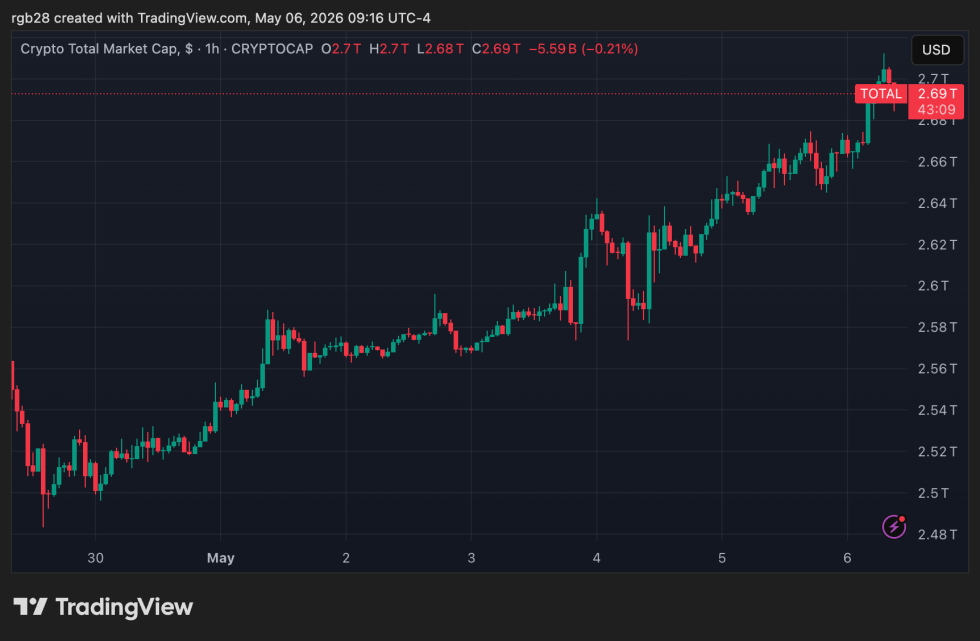
The total crypto market capitalization is at $2.69 trillion in the one-week chart. Source: TOTAL on TradingView
Featured Image from Unsplash.com, Chart from TradingView.com
Editorial Process for bitcoinist is centered on delivering thoroughly researched, accurate, and unbiased content. We uphold strict sourcing standards, and each page undergoes diligent review by our team of top technology experts and seasoned editors. This process ensures the integrity, relevance, and value of our content for our readers.
The Abu Dhabi Securities Exchange (ADX) Group has further strengthened its position as the Middle East’s most liquid ETF hub. The exchange recently hosted the region’s first initial offering period (IOP) for a U.S.-based ETF, which culminated in the successful cross-listing of the KraneShares Wahed Alternative Income Index ETF (KWIN).
This milestone firmly underscores ADX’s continued push to expand access to global investment products and enhance market accessibility for regional investors.
Global demand and ETF mechanics
The IOP for the new ETF ran from 15 to 21 April. Highlighting strong and diverse international demand, the offering attracted investors from more than 46 different nationalities who subscribed directly through the ADX website.
Developed collaboratively by KraneShares and Wahed Invest, KWIN marks a key regional milestone. Key details of the newly listed ETF include:
It is the first Shari’ah-compliant ETF to be cross-listed from the U.S..
It represents the fourth ETF overall from the New York Stock Exchange to join the ADX.
The fund utilizes an options-based strategy designed to generate income.
It tracks the Wahed Shariah Alternative Income Index, which, as of March 2026, contained 306 holdings, including major companies such as Amazon and Lululemon.
Furthermore, KWIN represents the second ETF listing on the ADX since the onset of recent regional geopolitical developments, closely following the KraneShares Artificial Intelligence & Technology ETF (AGIX). According to ADX, this highlights the exchange’s ability to sustain strong momentum and retain investor trust.
A surging ETF ecosystem
The launch of KWIN officially increases the total number of ETFs listed on the ADX to 23. This latest addition brings the total ETF market capitalization on the Abu Dhabi exchange to nearly AED 27 dirhams.
The ADX’s ETF segment continues to experience rapid expansion. In the first quarter of 2026, ETF trading value reached 155 million dirhams, representing a massive 228 per cent year-on-year increase.
This immense growth aligns with broader market performance across the exchange. Over the same period, total trading value across the ADX approached 90 billion dirhams, an increase of 7.5 per cent.
Institutional and foreign engagement
The exchange’s first-quarter metrics also underscore strong international engagement and deep institutional trust:
Institutional participation rose to account for 78 per cent of the total trading value.
Foreign investors accounted for 47.5 per cent of trading.
Transactions from foreign investors exceeded 85 billion dirhams, marking a 22 per cent year-on-year increase.
Bitcoin BTC$81,437.09, the world’s largest digital asset by market value, has risen from roughly $63,000 to over $80,000 in the past three months, according to CoinDesk market data. And key signals that professionals watch closely are now all pointing in the same direction: $85,000.
The rally is not just about price, but about the ripples beneath the surface.
On-chain dynamics
Further gains look likely because bitcoin has topped two levels that on-chain analysts consider among the most important in the market: The True Market Mean at $78,200 and the Short-Term Holder Cost Basis at $79,100.
BTC has topped its True Market Mean and Short-Term Holder Cost Basis. (Glassnode)
Here is why those numbers matter. The True Market Mean is the average price active bitcoin investors paid for the coins they currently hold. The metric doesn’t count every bitcoin ever mined, including those sitting dormant for years or lost, but focuses on coins that are actually changing hands between investors.
That makes it a cleaner estimate of the level that matters most to people that are active in the market. When bitcoin trades above it, most active investors are in profit, and when it falls below it, many are underwater. That’s why analysts use it to gauge sentiment, spot periods of market stress or euphoria, and identify potential mean-reversion zones.
Speaking of the short-term holder cost basis, it represents the average acquisition cost for people who acquired coins less than six months ago. Again, this tells us the price that matters to traders, not long-term dormant holders.
Hence, when the spot price breaks above both these levels, it is said to reflect a bullish outlook.
“Should price sustain above these two levels in the coming week, the deep value regime that persisted from early February 2026 through now would rank among the shortest episodes of its kind in Bitcoin market history,” analysts at research firm Glassnode said in a report.
“Attention now shifts to the next major resistance at the Active Realized Price near $85.2k, which tracks the cost basis of all non-dormant supply and represents the next structural threshold the market must reckon with,” they added.
As of writing, bitcoin traded near $80,800, well above the true market mean and the short-term holder cost levels.
Futures market flows
A subtle shift is underway in the futures market that could help push bitcoin higher.
The signal comes from funding rates, the small recurring payments traders make to keep leveraged futures bets open. For most of the past three months, funding rates were negative, indicating unusually heavy demand to bet against bitcoin in futures markets.
Much of that activity likely came from hedge funds and institutional traders running a popular arbitrage strategy: buying bitcoin or spot bitcoin ETFs while simultaneously shorting futures contracts. That trade created steady selling pressure in the futures market even as bitcoin rallied.
Now, funding rates have flipped back to neutral or slightly positive. That suggests many of those short positions have already been closed, removing a key source of downward pressure on the market.
It also raises the possibility of a short squeeze. If bitcoin continues rising, traders still betting against it may be forced (squeezed) to buy back futures contracts to exit their positions, which can accelerate gains.
“The flip toward neutral doesn’t invalidate the carry trade; it indicates that shorts paying for the privilege are no longer present at scale. Either funding migrates back negative as new ETF capital recreates the trade or the squeeze has further to run,” analysts at OG exchange Bitfinex said, explaining potential for more gains ahead.
Options dynamics
The third signal comes from the options market, where traders use contracts to position for or protect against price moves. Calls are bullish bets that give upside exposure if bitcoin rises, while puts are used as insurance against downside risk.
Options positioning is now set up in a way that could amplify the current move higher.
Market makers, the firms that provide market liquidity, have what’s known as “short gamma” exposure around the $82,000 level, with roughly $2 billion sitting near current prices, according to Glassnode.
Short gamma matters because it forces these dealers to hedge in the direction of the prevailing trend, which is bullish, to stay balanced.
In practice, that means as bitcoin pushes higher, dealer hedging itself can add incremental buying pressure, potentially accelerating the rally toward $85,000. Market makers make money by providing liquidity, meaning they try to stay neutral on price direction rather than betting on it.
But this cuts both ways. If the market turns lower, these same dealers would likely have to hedge in the opposite direction, selling into the decline, which can add to downside pressure.
“Short gamma means dealers are positioned in a way that forces them to hedge in the direction of the move, buying as price rises and selling as it falls. This creates a feedback loop that can accelerate price action, which helps explain the recent push toward $83K,” Glassnode explained.
Caveat
None of the things discussed above happens in a vacuum. Bitcoin still trades closely with U.S. tech stocks, so if equities suddenly turn risk-off, it can quickly slow the momentum or even pause the trend altogether.
Cryptocurrency exchange Coinbase was sued in California federal court over frozen crypto allegedly tied to a $55 million DAI phishing theft from August 2024.
The complaint, filed Monday in a San Francisco federal court, alleges that after laundering the proceeds through crypto mixer Tornado Cash, the attacker deposited part of the “traceable stolen funds” into a Coinbase retail user account, where the funds remain frozen.
The Puerto Rico-based plaintiff is asking the court to declare him the rightful owner of the frozen assets and order Coinbase to return them. The lawsuit also names an unknown John Doe defendant accused of carrying out the theft.
The lawsuit questions the responsibility of cryptocurrency exchanges in handling stolen funds that were traceably sent to these platforms after an exploit. The complaint claims that Coinbase has “acknowledged” that it holds these traced funds and has “indicated that a court order adjudicating ownership is required before it will release the frozen assets.”
The case highlights a problem in crypto theft recovery where exchanges may freeze suspected stolen funds after receiving alerts, but often require a court order before releasing assets to a claimant.
The lawsuit comes nearly two years after an exploiter stole $55 million in Dai stablecoins through a sophisticated phishing attack that deceived the victim into clicking a malicious link to a fraudulent DeFi Saver login, authorizing the attacker to gain access to his account and wallets.
Cointelegraph has reached out to Coinbase for more details surrounding the stolen funds and the path towards user recovery.
Coinbase sued for funds linked to the $55 million DeFi Saver hack. Source: CourtListener
Crypto wallet drainer was used to facilitate $55 million exploit
The $55 million exploit was carried out using the malicious Inferno Drainer platform, which offers a scam-as-a-service malware for malicious actors seeking to facilitate digital asset theft without the need to exploit code-level protocol vulnerabilities.
In addition to notifying law enforcement, the victim contracted crypto analytics platforms Zero Shadow and Five Stones intelligence to trace the stolen crypto. The companies found evidence linking the laundering of the funds to Ukrainian citizen Okelsiy Oleksandrovych Gorelikhin.
On Nov. 30, 2024, Zero Shadow notified Coinbase that stolen funds linked to the theft had been deposited into a Coinbase address, asking the exchange to conduct due diligence and freeze the assets.
On Dec. 2, 2024, Coinbase confirmed that the address belongs to a Coinbase retail user and that it implemented “friction measures” preventing dissipation of those funds pending investigation.
The court filing argued that the stolen cryptocurrency held in the Coinbase account was “identifiable property traceable to Plaintiff’s stolen assets” and added that the defendant had previously demanded the return of the assets.
Related: Arbitrum voters consider $71M ETH release for Kelp recovery
The year 2024 was a breakout year for scam-as-a-service tools, with usage of Inferno Drainer tripling in the first half of the year, rising from roughly 800 malicious decentralized applications created at the start of the year to over 2,400 by the end of it, according to blockchain security firm Blockaid.
Magazine: AI-driven hacks could kill DeFi — unless projects act now
Cointelegraph is committed to independent, transparent journalism. This news article is produced in accordance with Cointelegraph’s Editorial Policy and aims to provide accurate and timely information. Readers are encouraged to verify information independently.