Trusted Editorial content, reviewed by leading industry experts and seasoned editors. Ad Disclosure
Paraguay now controls 4.3% of the global Bitcoin network — a figure that caught the attention of Colombia’s president and may be shaping the country’s next big energy bet.
An Indigenous Community At The Center
Colombian President Gustavo Petro went public this week with a proposal to turn the country’s Caribbean coast into a Bitcoin mining hub, citing Paraguay’s rise as proof the model works for developing nations.
In a post on X, Petro named three cities — Barranquilla, Santa Marta, and Riohacha — as potential sites for mining operations.
He also put forward an unusual condition: that the Wayúu people, Colombia’s largest Indigenous community and long-time residents of the Caribbean coast, be made co-owners of any such project.
“It’s an immense boost to the development of the Caribbean,” Petro wrote.
Si las monedas virtuales se basan en energía fósil estalla el calentamiento mundial y el colapso climático
Hoy los países con abundantes energías limpias encerradas como Venezuela y Paraguay, logran atraer las inversiones en minería del bitcoin. La.minería del bitcoin es el… https://t.co/KroCrG9qkD
The proposal draws on Colombia’s existing energy profile. According to World Bank data published in April 2024, the country generates about 75% of its electricity from renewable sources — more than twice the global average.
Petro argued that tapping those clean energy supplies for Bitcoin mining would sidestep the environmental concerns he has raised about fossil fuel-powered mining operations.
Paraguay’s Rise Sets The Template
The Paraguay comparison is central to Petro’s pitch. The landlocked South American country tapped hydroelectric power from the Itaipu dam and, based on reports, now ranks fourth globally in Bitcoin mining hashrate — behind only the US, Russia, and China.
BTCUSD currently trading at $81,503. Chart: TradingView
Analysts at Hashlabs have said the mining industry can deliver meaningful economic impact to emerging countries by converting surplus electricity into a cash-generating export.
That opening is growing. US commercial miners are increasingly shifting focus toward artificial intelligence and high-performance computing, where profit margins are higher.
Reports indicate that shift is leaving room for countries with low electricity costs to capture a bigger slice of the global Bitcoin network.
A Short Window To Act
There is one major constraint hanging over Petro’s plan. His presidential term ends in August, giving him roughly three months to move the proposal forward. He is barred by Colombia’s constitution from seeking re-election. Colombia holds its next presidential election on May 31.
Featured image from Unsplash, chart from TradingView
Editorial Process for bitcoinist is centered on delivering thoroughly researched, accurate, and unbiased content. We uphold strict sourcing standards, and each page undergoes diligent review by our team of top technology experts and seasoned editors. This process ensures the integrity, relevance, and value of our content for our readers.
The Trump brothers’ bitcoin mining venture cut its cost per coin by nearly a quarter in three months, going against industry trends.
American Bitcoin (ABTC) said in a Wednesday filing that its cost to mine one bitcoin fell to roughly $36,200 in the first quarter, a 23% drop from $46,900 in Q4 2025.
That puts it materially below the publicly listed miner average of around $80,000 per bitcoin in late 2025, as CoinDesk reported, and inside the band where mining at current bitcoin prices remains genuinely profitable rather than a managed loss.
The improvement came from spreading higher production volume across a stable fixed-cost base, plus what management called “continued energy pricing discipline.”
The Drumheller site in Alberta, which was switched on and began running miners in late March, added roughly 3.05 exahash of computing power, a measure of how many guesses per second the mining hardware can make to find new bitcoin. Total fleet capacity hit 28.1 exahash by quarter-end, with around 89,000 mining machines running.
As such, American Bitcoin posted an $81.8 million net loss for the quarter, with most of that driven by mark-to-market accounting on its bitcoin holdings as the price dropped roughly 22% over the period.
Revenue came in at $62.1 million versus $78.3 million in Q4 2025, reflecting a lower average revenue per coin mined of $76,000 versus $100,000.
Strip out the non-cash bitcoin revaluation, however, and the underlying mining business was profitable. The company added 1,620 bitcoin to its strategic reserve in the quarter, taking its holdings to roughly 7,021 BTC, a 30% increase in three months.
Of that, 817 came from mining and 803 from open-market treasury purchases. American Bitcoin is now the 16th largest publicly traded bitcoin holder globally.
What makes the quarter notable structurally is the contrast with the rest of the cohort. Public miners have collectively pivoted toward AI and high-performance computing, signing more than $70 billion in cumulative contracts and reducing their bitcoin treasuries by over 15,000 BTC since late 2024 to fund the transition.
ABTC shares were down about 1% in after-hours trading and remain nearly 90% below their September 2025 listing peak of around $1.25.
OpenTrade, an institutional-grade platform for onchain and real-world asset (RWA)-backed lending and stablecoin yield products, has raised fresh capital to expand its yield infrastructure.
The platform secured $17 million in its latest strategic funding round led by Mercury Fund and Notion Capital, OpenTrade said in a Wednesday announcement seen by Cointelegraph.
The new funding will support the continued expansion of OpenTrade’s permissioned and permissionless yield infrastructure, as well as the growth of its vault-focused service Curation+, CEO David Sutter told Cointelegraph.
“The company also plans to expand its asset management and trading team, increase engineering capacity, and build a dedicated customer success function to support its growing client base,” Sutter said.
CEO positive on regulation amid CLARITY Act debate over stablecoin rules
The raise comes as US lawmakers debate how stablecoin rewards should be regulated under the CLARITY Act, a broader digital asset market structure bill that has been delayed partly by disputes over whether crypto firms should be allowed to offer interest-like incentives on stablecoin balances. Sutter expressed optimism over recent progress around the stalled legislation.
CLARITY is nearing a Senate Banking Committee vote after a compromise between crypto and banking stakeholders. The deal would allow usage-based rewards like cashback or discounts on stablecoin activity but prohibit yield on idle balances.
OpenTrade surpassed $200 million in total value locked (TVL) in April. Source: OpenTrade
“Our structure is derived from securities lending in traditional finance, but adapted to the lending of stablecoins instead of securities,” Sutter said, adding that there may be market-specific nuances affecting availability to institutional or qualified investors.
Sutter told Cointelegraph that the legal architecture underpinning the platform has been purpose-built to offer its products to clients globally while maintaining compliance with existing traditional finance and digital asset regulatory standards.
“There are strong regulatory tailwinds for the industry at large, which will be conducive to continued growth for stablecoins,” Sutter added.
Related: Ripple CEO says market structure bill not ‘done deal,’ despite compromise
Circle Ventures was an early investor in OpenTrade
Founded in 2023, OpenTrade seeks to provide scalable and compliant yield products for fintechs and institutional investors.
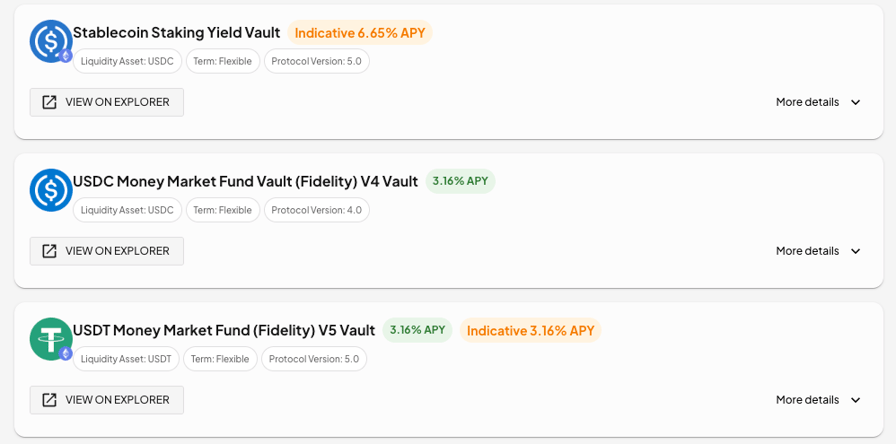
OpenTrade’s infrastructure routes user deposits into tokenized vaults that allocate capital across a mix of yield sources, primarily RWAs such as fixed-income instruments, alongside selected decentralized finance (DeFi) strategies. Each vault follows a defined allocation strategy and operates through smart contract-based mechanisms that manage deposits, track positions and distribute returns.
OpenTrade vaults (an excerpt). Source: OpenTrade
The latest funding round brings OpenTrade’s total funding to $30 million and included backing from prominent industry investor a16z Crypto. The London-based company previously raised $7 million in a strategic round led by Mercury Fund and Notion Capital in June 2025, following a $4 million seed round in November 2024.
OpenTrade also secured funding from investors such as Circle Ventures and Polygon Ventures in May 2023, while announcing plans to launch a platform for USDC-denominated investments and tokenized financial assets.
OpenTrade co-founders Dave Sutter and Jeff Handler previously worked at Centre, a now-dissolved consortium of Circle and Coinbase providing standards governance for the USDC stablecoin.
Magazine: Will the CLARITY Act be good — or bad — for DeFi?
Cointelegraph is committed to independent, transparent journalism. This news article is produced in accordance with Cointelegraph’s Editorial Policy and aims to provide accurate and timely information. Readers are encouraged to verify information independently.
Trusted Editorial content, reviewed by leading industry experts and seasoned editors. Ad Disclosure
The Fear & Greed Index suggests digital asset traders are fearful even after the latest price recovery above $82,000 that Bitcoin has observed.
Crypto Fear & Greed Index Is Still Pointing At A Fearful Market
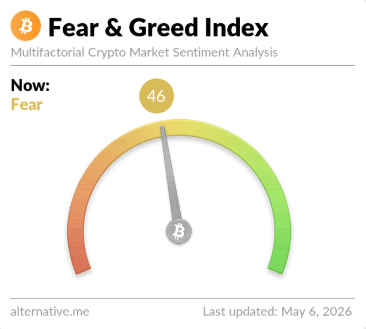
The “Fear & Greed Index” is an indicator created by Alternative that tells us about the average sentiment present among traders in the Bitcoin and wider cryptocurrency markets. It represents the investor mentality as a score lying between 0 and 100. All values above 53 on the scale correspond to a sentiment of greed, while those below 47 suggest fear among the investors. Naturally, the metric being between these two cutoffs implies a net neutral market mentality.
Here is how the latest value of the Fear & Greed Index looks:
The metric has a value of 46 at the moment | Source: Alternative
As displayed above, the indicator has a value of 46, which means that Bitcoin traders are holding a sentiment that leans fearful. The degree of fear is only slight, however, as the metric is sitting right on the edge of the zone.
On Tuesday, the Fear & Greed Index had surged to a value of 50, implying that sentiment was exactly in the balance. Despite bullish momentum in the market continuing over the past day, however, sentiment has actually deteriorated. This could be a potential indication that investors are still not convinced by the recovery surge.
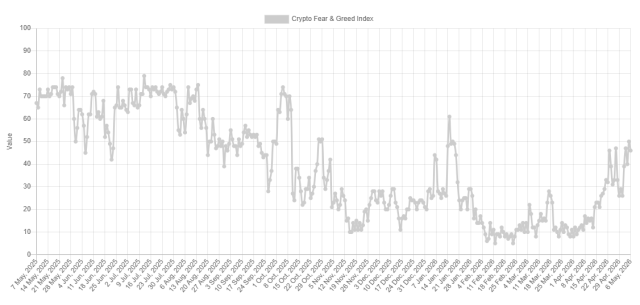
Though the latest pullback in the metric doesn’t mean that the recovery hasn’t caused any uplift in sentiment. As the chart below shows, the Fear & Greed Index was in the depths of fear during the first half of April.
How the Fear & Greed Index has fluctuated over the past twelve months | Source: Alternative
The indicator was so low back then that it was inside a zone called the extreme fear. This region, which corresponds to values of 25 and lower, indicates the presence of the worst FUD in the market. The index saw a long stay inside this region before the recent Bitcoin recovery rally finally triggered a sustained break.
While the sentiment is currently still inside the fear territory, it’s possible that the investor mood could improve further in the coming days if the current bullish momentum continues. It only remains to be seen, however, how things will play out in the market.
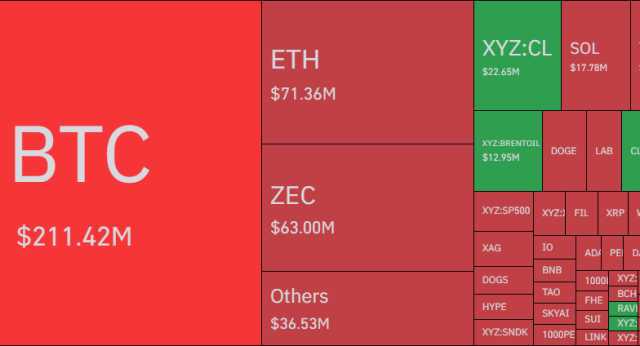
In some other news, the price uplift during the past day has meant that a large number of liquidations have occurred over in the derivatives sector. These liquidations have heavily leaned in the short direction, as the heatmap below from CoinGlass shows.
The majority of the assets have seen a short-heavy flush | Source: CoinGlass
Out of the $211 million in liquidations that Bitcoin-related contracts have witnessed, over $200 million have involved the bearish bets. Overall, short liquidations have amounted to $441 million in the digital asset sector.
Bitcoin Price
Bitcoin has surged to the $82,500 mark following the latest continuation to its rally.
The trend in the price of the coin over the last five days | Source: BTCUSDT on TradingView
Featured image from Dall-E, chart from TradingView.com
Editorial Process for bitcoinist is centered on delivering thoroughly researched, accurate, and unbiased content. We uphold strict sourcing standards, and each page undergoes diligent review by our team of top technology experts and seasoned editors. This process ensures the integrity, relevance, and value of our content for our readers.
The crypto VC’s co-founder said the firm has been buying ZEC since February, and has “built a significant position.”
Zcash (ZEC) rallied over 30% to become today’s top gainer after crypto-focused venture capital firm Multicoin revealed that it’s been accumulating the privacy coin for the past three months.
The VC firm’s co-founder and managing partner Tushar Jain wrote in an X post on May 5 that the firm has acquired “a significant position in ZEC since February.”
ZEC is currently trading around $575, up over 32% in the past 24 hours to reach its highest level since November. The rally pushed ZEC to the top 24-hour gainer spot among the top-100 cryptocurrencies on CoinGecko.
ZEC 1-year price chart. Source: CoinGecko
In yesterday’s X post, Jain wrote that the firm’s thesis for investing in Zcash lies in the asset’s focus on privacy and representation of “the cypherpunk ideals crypto was founded on.”
“We believe that truly private, censorship and seizure resistant assets have clear product-market fit and demand is accelerating. We believe $ZEC is the cleanest way to express this thesis in public markets,” Jain wrote.
ZEC saw a massive and extended rally that lifted other privacy-focused assets in the second half of last year. The rally began in late September, shortly before the Winklevoss brothers revealed their dedicated ZEC digital asset treasury company, Cypherpunk (Nasdaq: CYPH), which had already accumulated over 200,000 ZEC by its public launch.
The DAT made another purchase in late 2025, and a smaller one in March, bringing its total holdings to over 294,700 ZEC, worth just under $170 million at press time. CYPH rallied over 7% today, per Yahoo Finance.
Zcash had a turbulent start to the year when a governance dispute resulted in the core development team and leadership exiting Electric Coin Capital, the firm previously responsibly for Zcash’s development.
The coin tumbled as low as $200 in February and March, but began its recovery after its new development company, Zcash Open Development Lab — formed by the same team from ECC — announced in March that it had raised $25 million in a seed round with participation from major VC firms and angel investors, including Winklevoss Capital and Cypherpunk Technologies, but, notably, not Multicoin.
As it continues to aggressively push into the enterprise market and build agentic AI tools, Anthropic is now targeting a major industry: finance.
The AI lab introduced ten ready-to-run agent templates earlier this week, targeting what it said is the most time-consuming work in financial services, such as building pitchbooks, screening due diligence files and closing the books at the end of the month. The templates ship as a plugin in Claude Cowork and Claude Code. Each template is a reference architecture that includes skills (instructions and domain knowledge), connectors (access to data) and subagents (powered by other Claude versions), Anthropic said. The AI lab said that financial firms can adapt any of the agents to their own modeling conventions, risk policies and approval flows.
Also this week, Anthropic entered into a $1.6 billion joint venture with Fidelity National Information Services for financial crime software and another $1.5 billion joint venture with other Wall Street companies to sell its AI tools to businesses.
Related:Enter Bob, IBM’s Friendly AI Coding Assistant
The financial services agents and other financial ventures are further signs that Anthropic has begun to evolve from a model provider into an AI platform provider serving specific industries. Earlier this year, the Claude stunned the legal industry when it introduced its Claude Cowork plugins, which some saw as a threat to entry-level legal jobs and legal information providers. In April, the cybersecurity industry also became worried about Claude Mythos’ ability to identify and exploit security weaknesses.
Now, the AI model maker is at it again, this time creating agents to support research, client coverage, and finance and operations.
A Focus on Enterprise
On the one hand, Anthropic appears to be on track to profitability after losing money since its 2021 founding, as it approaches an expected IPO this year.
“Anthropic has done a really strong job of going after enterprise business,” said Tom Coshow, an analyst at Gartner. “Most people would agree that it’s been impressive.”
In targeting the enterprise market, the vendor has also pursued the mindshare and opportunities that software service providers saw in AI technology, as well as with older financial services firms with dated IT systems. With these new agents, Anthropic competes against traditional data systems like Bloomberg and FactSet, which junior analysts use to pull together comparative analyses, as well as legacy consulting services such as Infosys and Accenture.
The Industry
With the financial service agents, Anthropic is going after one of the most lucrative industries in the country, said Michael Bennett, associate vice chancellor for data science and AI strategy at University of Illinois Chicago.
Related:Enterprises Contain AI Agents to Balance Risk, Reward
The finance industry holds sensitive data and manages special client relationships. Enterprises will have to decide whether to grant agents access to that sensitive information, Bennett said. However, ROI is also important in finance.
“This is a major tool for increasing ROI on those [finance] relationships,” Bennett said. “If only for the increase in speed, in preparation, in advising and actually even finding new clients, there’s going to have to be a lot of soul searching in the industry.”
Hard Choices
Moreover, with Anthropic’s domain-specific agents now threatening smaller finance companies with expertise in these areas, those firms will likely need to make challenging decisions.
“Would enterprises be better off partnering with a company that builds AI agents for finance, or do Anthropic agents really know how to handle all the edge cases out of the book?” Coshow said. “If they do, that’s a very big threat to a lot of people.” It’s also unclear if the Anthropic agents require tweaks and significant work to connect to data, he added.
Related:SoundHound Launches Self-Learning AI Agent Platform
“Everything involving AI agents is about whether or not they can contextualize the data that they’re using to make a decision about what to do and how reliable they are,” Coshow added. “How much of their AI are they going to own, and do they feel like they own it if Anthropic is doing everything for them?” he continued. “This is the intelligence that is going to drive enterprises in five years.”
The Career Threat
In addition to the dangers to smaller vendors and the potential existential crisis facing older financial firms and newer fintech vendors, the new agents could erode the roles of junior finance associates and entry-level analysts, Bennett said.
“The work that they do now is going to be covered in many instances by a subscription,” he said. “We should expect a significant impact in the industry, if only for that reason.”
He added that educators will also face pressure to figure out how to train entry-level finance workers to advance in an environment in which AI agents are proliferating.
Zcash (ZEC) has outperformed the broader crypto market over the past month, rising by over 125% compared to an average 15% gain for most coins.
ZEC/USD versus TOTAL crypto market cap 30-day performance chart. Source: TradingView
The privacy-focused cryptocurrency may rally further in the coming weeks as a mix of bullish technical and fundamental catalysts converges.
Key takeaways:
US crypto hedge fund Multicoin Capital revealed it has been buying ZEC since February.
Robinhood will list ZEC as Zcash’s network activity has been booming in the past weeks.
ZEC technicals are painting a 40% rally setup.
Multicoin disclosure boosts ZEC momentum
On Tuesday, Multicoin Capital, a US-based crypto hedge fund managing $2.687 billion in assets, revealed a “significant position” in ZEC, fueling speculation that institutional investors are warming up to privacy-focused digital assets again.
Its co-founder, Tushar Jain, revealed that the firm had been accumulating ZEC since February.
Jain described Zcash as “the most direct public market vehicle” for exposure to private, censorship-resistant and seizure-resistant money, framing the investment as a bet on rising demand for financial sovereignty and cypherpunk-style privacy tools.
Source: X
ZEC has rallied by over 43% in the past 24 hours, showing that traders have interpreted the Multicoin announcement as institutional validation of the privacy coin narrative.
ZEC’s flag breakout hints at further gains
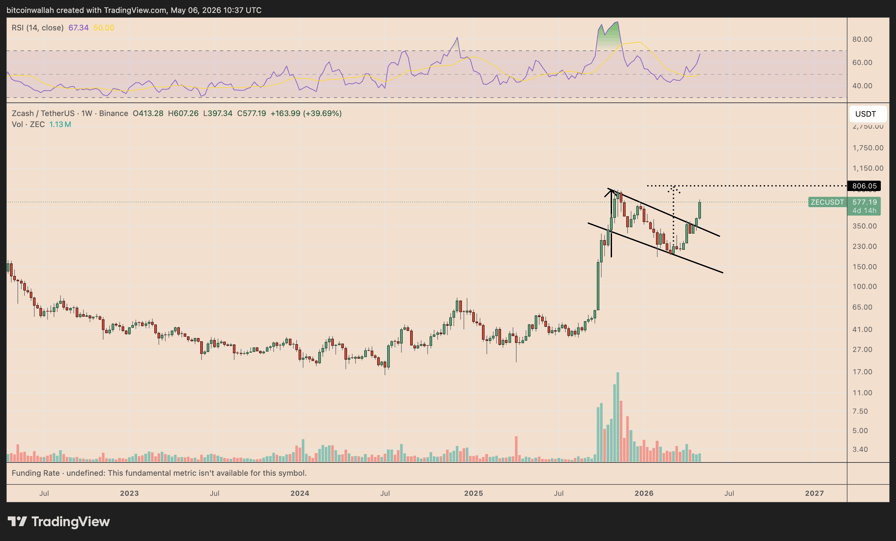
From a technical perspective, Zcash has entered the breakout phase of a prevailing bull flag pattern on the weekly chart.
A bull flag forms when the price consolidates lower within a descending parallel channel after a strong uptrend. It resolves when the price breaks above the channel’s upper trendline and rises by as much as the previous uptrend’s height.
ZEC/USDT weekly chart. Source: TradingView
Applying that rule to ZEC’s chart puts its breakout target near $800. As of Wednesday, Zcash traded as high as $607, leaving the token on track to test the bull flag’s measured upside target located roughly 40% above.
Zcash’s weekly relative strength index (RSI), a momentum indicator that measures whether an asset is overbought or oversold, also suggests the rally may continue.
The RSI currently remains just below 70, a level traders typically associate with overheated market conditions, indicating ZEC may still have room to climb before buyers show signs of exhaustion.
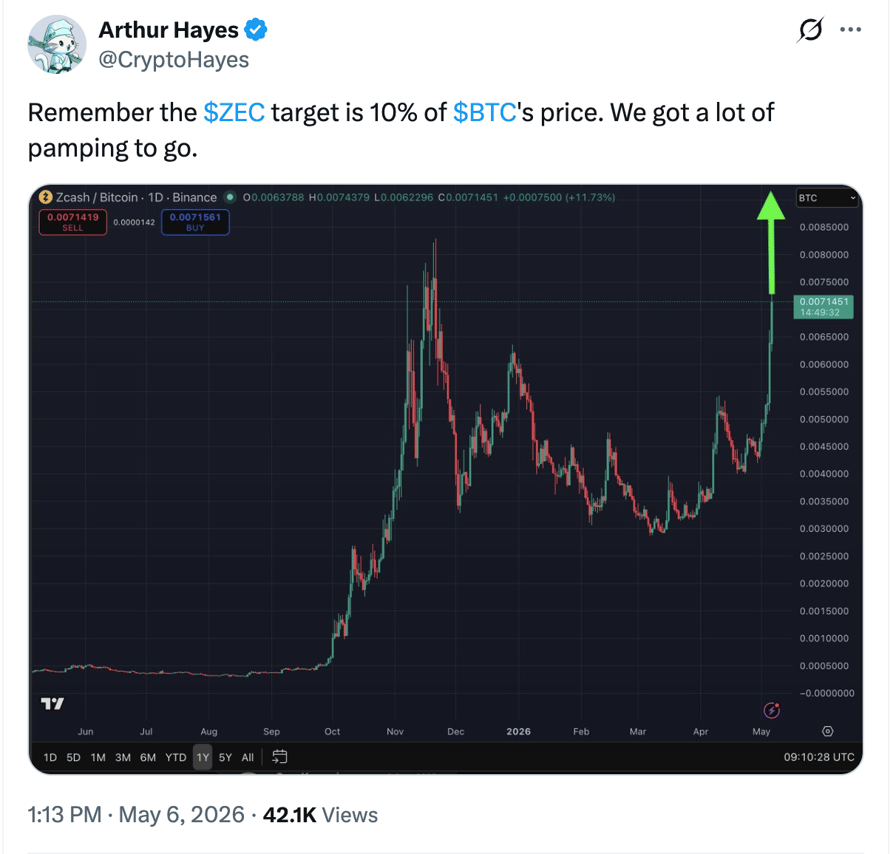
BitMEX Co-Founder Arthur Hayes said ZEC’s target is 10% of Bitcoin’s market capitalization, a scenario that would imply a multi-trillion-dollar valuation for ZEC and prices potentially ranging between $8,000 and $10,000 per coin based on current supply levels.
ZEC has rallied alongside the broader crypto market as US–Iran peace-deal hopes improve risk appetite, mirroring patterns in early April.
Its Robinhood listing on April 23 added another tailwind by opening spot access to 25.9 million funded users, including those in stricter jurisdictions like New York.
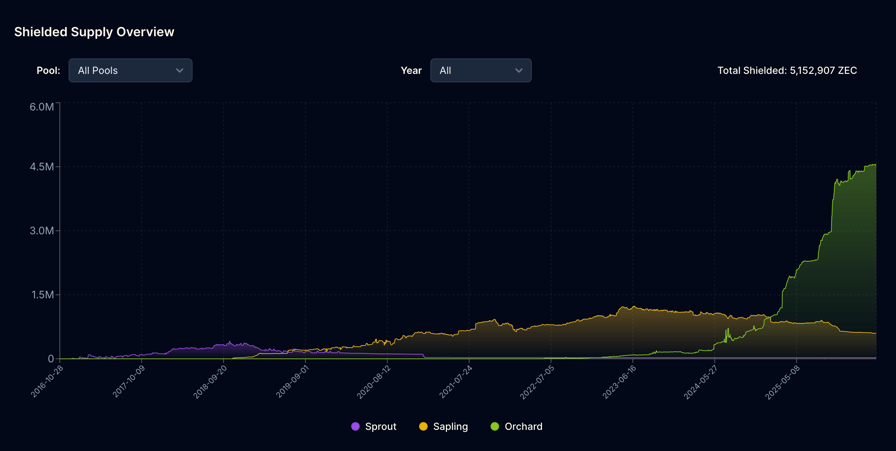
Meanwhile, more than 30% of circulating ZEC now sits in shielded addresses, according to data resource ZecHub.WIKI. This tightening supply shows a big jump in demand for private on-chain transactions over the past year.
This article is produced in accordance with Cointelegraph’s Editorial Policy and is intended for informational purposes only. It does not constitute investment advice or recommendations. All investments and trades carry risk; readers are encouraged to conduct independent research.
Bitcoin lenders may need to become more like traditional finance firms, not less, if they want institutional capital to keep flowing into the sector.
At Consensus 2026 in Miami, Alexander Blume, founder and CEO of institutional bitcoin lender Two Prime, argued that the next stage of crypto credit growth will depend less on decentralized finance experimentation and more on standardization, transparency, and risk management.
“The moment you start trying to explain how any of this stuff works, they’re just like, No… We’ll pay more. Don’t lose my money,” Blume said, referring to institutional borrowers evaluating crypto lending products that become difficult to defend during periods of market stress.
The comments reflected a broader post-2022 shift in crypto lending following the collapses of Celsius, Voyager, and BlockFi, when opaque leverage, aggressive rehypothecation, and weak risk controls triggered a wider credit crisis across the industry. In the years since, many institutional borrowers have moved away from complex DeFi structures in favor of products centered on transparent custody, standardized contracts, and clearly identifiable counterparties.
Across the panel, speakers repeatedly suggested that institutional finance and crypto-native finance remain fundamentally misaligned in their approaches to risk. While DeFi evolved around permissionless access, composability, and capital efficiency, institutions continue to prioritize predictability, legal accountability, and operational simplicity.
That tension was especially visible in the discussion around rehypothecation, the practice of reusing customer collateral to generate additional yield, which became one of the defining risks exposed during the 2022 lending collapse.
“The most important thing to ask… is where is your Bitcoin stored,” said Adam Reeds, co-founder and CEO of Ledn.
Jay Patel, co-founder and CEO of Lygos Finance, said borrowers increasingly need to “underwrite the lender” themselves before taking loans against their bitcoin holdings.
“The biggest point in my mind is definitely the rehypothecation piece,” Patel said.
Blume said institutional borrowers often reject crypto-native lending structures not because they oppose bitcoin, but because the operational complexity surrounding many DeFi systems remains difficult to justify to boards, shareholders, and risk committees.
At one point, Blume distilled the divide between crypto-native finance and institutional finance into a single observation.
“Our whole financial system is set up to have someone else to blame,” he said, arguing that institutional borrowers still prefer identifiable intermediaries, standardized processes, and legal accountability over fully autonomous financial systems.
For many lenders on stage, the future of crypto credit no longer appears tied to making finance more decentralized. Instead, it may depend on convincing institutional borrowers that bitcoin-backed lending can behave predictably enough to resemble the traditional system they already trust.
As the UK considers options to attract and develop the crypto industry at home, the Bank of England (BOE) has put forward several proposals for how it might regulate stablecoins to mitigate perceived financial risks.
These have included a ban on custodial wallets for stablecoin holdings. The UK crypto industry, from stablecoin issuers to Bitcoin hardliners, has predictably taken issue with the ban.
“This would be a serious misstep for the UK, risking long-term damage that is hard to unwind,” said Benoit Marzouk, CEO of stablecoin issuer tGBP told Cointelegraph.
Ban could hamper operability and competitiveness
At the heart of the BOE’s approach to stablecoins, which it recently discussed in a series of inquiries before the House of Lords, is protecting the UK banking system.
The bank argues that unhindered access to stablecoins, which can offer higher yields than traditional banking products, could lead to a run on deposits, and therefore on credit availability from UK banks.
In March, Bank of England Deputy Governor Sarah Breeden told the House of Lords Financial Services Regulation Committee that BOE is “open to other ways of achieving the objective” of credit availability.
Breeden speaks before Parliament. Source: Parliament
“But I think you would expect us as the financial stability authority to ensure that there isn’t a precipitous drop in credit to the businesses and households in the UK,” she said.
One way it believes it can affect this is through banning unhosted wallets. “There is this concept of an unhosted wallet, where you haven’t got a wallet provider who is a regulated entity ensuring that AML [Anti-Money Laundering], KYC [Know Your Customer] criteria are complied with. Unhosted wallets will not be permissible in the UK. They are permissible in the US regime,” Breeden told the committee.
For the crypto industry, it would be two steps backward. According to Marzouk, it would “wipe out hard-earned network effects.”
“If transfers are limited to registered VASPs or custodial wallets, existing GBP stablecoins […] would become in breach of regulations with holding on self-hosted or issuers would be forced into whitelisting models and re-issuing new tokens.”
Related: UK central bank is warming up to stablecoins, but says industry input is lacking
Joey Garcia, chief strategy, policy, and regulatory affairs officer at Xapo Bank, told Cointelegraph that, instead of being an update to the financial system, “this ban essentially restricts any attempt to understand and mitigate the perceived risks.”
“This would be interpreted as a signal of a hostile regulatory environment, discouraging developers and investment in the UK’s fintech sector.”
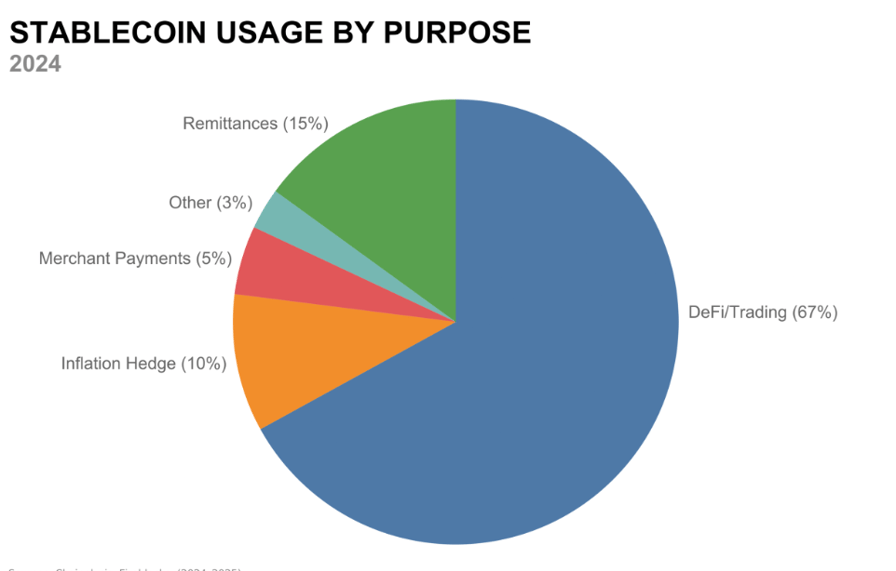
Marzouk said that it also undermines an important use case for stablecoins, namely remittances. Under the BOE’s regime, “recipients couldn’t access funds unless fully onboarded with a regulated exchange.”
Source: ORF America
“A plane without wings is no longer a plane. Likewise, a stablecoin or blockchain asset that can only be transferred to a predefined list of wallets is not truly blockchain, it is effectively e-money within a closed ecosystem and then you don’t need a separate regulation.”
Garcia also said that the utility of stablecoins would be diminished as they “derive much of their value from the ability to be held and transferred on a peer-to-peer basis on open networks.”
“This is particularly relevant for the unbanked and underbanked around the globe, for whom self-custodial wallets and regulated on-ramps can be a primary gateway into digital financial services, and access to digital dollars or digital pounds.”
Curbing such a major use case for stablecoins “kills a major strategic opportunity: Positioning the Pound Sterling, one of the strongest and most trusted currencies, as a credible alternative to USD stablecoins,” said Marzouk.
Crypto industry questions feasibility of wallet ban
Beyond the issue of competitiveness is the feasibility of implementing an unhosted wallet ban.
Susie Violet Ward, the director and co-founder of Bitcoin Policy UK, said that these rules would do little to address real illicit flows, but would rather “expand data collection, erode privacy, impose costs, and add friction and limit access through banks and intermediaries.”
Freddie New, chief policy officer at the Bitcoin Policy UK, said that the proposed policy from BOE was of “such monumental, such overweening, stupidity, that it is hard to formulate a sensible response.”
New said, “let everyone in the UK simply continue to use their ‘self-hosted wallets’ (ie ‘wallets’) without paying them a second’s more attention.”
It may not be as simple as that. The central bank does have some levers it can pull that would be particularly relevant for stablecoins. But even then, “this is extremely challenging to monitor, let alone enforce,” said Garcia.
The BOE could focus on Virtual Asset Service Providers (VASPs). Marzouk said that the bank could limit the issuance of new stablecoins into registered VASPs like crypto exchanges. In turn, these would only allow transfers to other VASPs or custodians “through the validation of existing tools that have been created for the Travel Rule regulation.”
But even this, per Marzouk, stretches the intended purpose of the Travel Rule. “The Travel Rule is designed to enable VASPs to exchange information if there’s some complaints from clients of identity theft, for example: It was not intended to restrict or prohibit self-custody.”
For Garcia, it’s neither “necessary nor feasible.” The underlying technology behind crypto wallets means that anyone can create one. “As long as the internet and public blockchains exist, a direct ban on wallet creation and use is not practically enforceable.”
It’s distinctly possible that the ban will not make it into the final version of the Bank of England’s regulations. The bank’s latest Consultation Paper on stablecoins, published in November, does not propose one explicitly.
Any changes would have to go through the standard process, led by the Treasury under the Financial Conduct Authority’s framework as defined by the 2023 Financial Services and Markets Act. “This involves formal consultation, industry input, and iterative rulemaking before any measures can be finalised,” said Garcia.
The best the industry can do to circumvent a ban is to continue engaging with policymakers, per Garcia.
“As participants within the sector, we must demonstrate the benefits of this technology clearly to address the concerns and risks that have been identified, to strengthen the case for proportionate regulation.”
Magazine: AI-driven hacks could kill DeFi — unless projects act now
A key piece of financial infrastructure stitching tokenized assets to traditional banking got a real cross-border test this week.
Ondo Finance said Wednesday it had completed the first near-real-time cross-border redemption of a tokenized U.S. Treasury fund alongside JPMorgan’s blockchain platform Kinexys, payments giant Mastercard, and Ripple.
The transaction settled in under five seconds on the XRP Ledger and involved OUSG, Ondo’s tokenized U.S. Treasury fund built for accredited investors and qualified purchasers.
The pipeline started with Ondo processing the redemption on the XRP Ledger, after which Mastercard’s Multi-Token Network routed the instructions to Kinexys, and JPMorgan delivered the U.S. dollars to Ripple’s Singapore bank account.
The whole sequence happened outside traditional banking windows, the kind of cross-border settlement that typically takes one to three business days through correspondent banks.
“By connecting public blockchain infrastructure with interbank settlement rails, Ondo, Kinexys by JPMorgan, Mastercard, and Ripple are laying the groundwork for 24/7 global markets that never close,” said Ondo President Ian De Bode in a statement.
Markus Infanger, senior VP at RippleX, said the transaction shows institutions can run cross-border tokenized asset moves as a single integrated flow rather than stitching them together through legacy systems.
The pilot lands as the Depository Trust & Clearing Corporation (DTCC) said earlier this week it would launch its own tokenization service later this year. JPMorgan’s Kinexys platform has now processed over $3 trillion in cumulative transactions, with tokenized deposit volumes across major banks moving to billions of dollars over the past year.
XRP and ONDO were down as much as 2% in the past 24 hours alongside a broader pullback across the crypto market.