RSI measures trend strength and contains three key levels for observers: the 30 oversold boundary, the 50 midpoint and the 70 overbought threshold.
When the price crosses these levels, depending on the direction, traders can infer about the future of the current trend. After rallies, BTC usually corrects once the RSI enters the overbought territory.
Related: Bitcoin bulls target $115K by December: Does data back the expectation?
Analyst Crypto Tice said this is a “rare” signal that has occurred only four times over the last year, with every occurrence leading to a “short-term pullback,” adding:
“Overbought conditions on the daily don’t resolve sideways. They resolve with a flush.”
Fellow analyst Rekt Fencer pointed out that the “last 2 times this happened, it dumped” 35%-38%, as shown in the chart above.
Meanwhile, Bitcoin’s market value to realized value (MVRV) ratio, which measures whether the asset is overvalued, recently entered the “overheated” zone.
“Bitcoin breaks above the overheated level on the short-term holder Bollinger Bands for the first time since November 2024,” analyst FrankAFetter said in a recent post on X.
The last time it was at similar levels was in November 2024 before a 15% BTC price drop.
Bitcoin support at $78,000 becomes key for BTC price
Bitcoin traders agree that $78,000 has now become an important area of support for BTC/USD.
The 200-day exponential moving average at $83,000 is acting as resistance, while the “first main area of interest sits at $78,000,” analyst Jelle said in an X post on Friday, adding:
“Turn that into support and we can have another go at the MAs.”
BTC/USD daily chart. Source: X/Jelle
Fellow analyst Tradermayne said holding the support at $78,000-$80,000 on low time frames would give “bulls a very easy bias level.”
BTC/USD weekly chart. Source: Trader Mayne
Orders are sitting on both sides of the spot price, with analyst Master of Crypto seeing the likelihood of these liquidity clusters being taken out.
“$BTC is holding around the $78.5K–$79.1K support zone,” the analyst said in a Friday post on X, adding:
“If buyers defend this area, the next move could be toward $82K–$83K where a lot of liquidity is sitting. But if this support breaks, Bitcoin could quickly drop to $75K–$76K.”
Bitcoin liquidation heatmap. Source: CoinGlass
The Bitcoin liquidity map shows that a correction below $78,000 would trigger over $3.1 billion worth of leveraged long liquidations across all exchanges.
Kalshi’s co-founder said the new capital will be used to accelerate that institutional adoption.
Prediction market platform Kalshi has officially confirmed it raised $1 billion at a $22 billion valuation, with co-founder and CEO Tarek Mansour announcing the news on X today, May 7. The round was led by Coatue, with participation from Morgan Stanley, Sequoia, and a16z, among others.
The announcement comes nearly two months after the Wall Street Journal first reported on details of the raise. As The Defiant reported at the time, Kalshi’s updated valuation at $22 billion is double that of its previous raise in November.
Mansour framed the milestone as an inflection point for prediction market sector, emphasizing a rapid shift from retail-driven activity toward institutional participation. Hedge funds, asset managers, prop firms, and insurers are now actively trading, providing liquidity, and hedging real-world risk on the platform, according to the founder’s X post.
“Prediction markets are moving from early adoption to core financial infrastructure,” Mansour wrote, adding that the new capital will be used to accelerate that institutional adoption and unlock trillions in capital for active trading and risk management.
The confirmation also puts Kalshi’s valuation well ahead of rival Polymarket’s most recently reported one. Reuters reported last month that the on-chain prediction market platform was in talks to raise at a $15 billion valuation.
Since last fall, Kalshi has consistently posted higher monthly volumes than Polymarket, totaling $73.5 billion in the past year, compared to Polymarket’s $54.5 billion, according to Token Terminal data.
Monthly notional trading volume on Kalshi vs. Polymarket. Source: Token Terminal
The Defiant has tracked the sector’s rapid evolution closely — from Kalshi and Polymarket both moving into perpetual futures trading and Google Finance integrating live prediction market data, to the CFTC launching a sweeping regulatory review of the space earlier this year.
This article was written with the assistance of AI workflows. All our stories are curated, edited and fact-checked by a human.
Bitget, the world’s largest Universal Exchange (UEX), has introduced its Scan to Pay feature on Bitget Pay, enabling users to spend USDT directly at offline merchants by scanning QR codes through the Bitget App.
The feature is now live across selected markets across Southeast Asia and Latin America at launch, where QR-based payments are widely adopted but access to traditional banking infrastructure remains uneven. By integrating with existing local payment networks, Scan to Pay allows users to complete transactions without changing merchant systems or relying on bank intermediaries.
The launch comes as crypto adoption continues to expand beyond trading into real-world use cases. Emerging markets across Southeast Asia and Latin America have seen some of the fastest growth in digital asset usage over the past year, driven in part by demand for stable, accessible financial tools. At the same time, billions of adults globally remain underbanked despite widespread access to mobile payment systems, creating a gap between financial access and financial usability that new payment models are beginning to address.
Scan to Pay is designed around this intersection. Users can set a payment PIN, scan a merchant QR code, and complete transactions instantly, with USDT converted and settled in the background. The experience mirrors familiar local payment flows, while removing the need for manual off-ramping, bank transfers, or currency conversion steps.
“QR code payments have a strong real life usage with over 2.2 billion people using it globally. There’s no reason why crypto shouldn’t be a part of it. It naturally fits into how people live, and spend.” said Gracy Chen, CEO of Bitget.
For users in supported markets, the feature enables stablecoins to function as practical spending tools rather than passive holdings. For travelers and cross-border users, it offers a consistent payment experience across regions without reliance on local banking systems. For merchants, integration requires no change in infrastructure, while transactions are settled without exposure to crypto volatility.
The rollout reflects a broader shift in how digital assets are being positioned within financial systems. As stablecoins gain traction as a medium of exchange, their role is expanding from trading pairs to payment rails that can operate alongside existing networks.
Within Bitget’s UEX model, where trading, assets, and financial services are brought into a single environment, Scan to Pay extends crypto from portfolio management into daily life. As financial services converge, the distinction between holding assets and using them continues to narrow, moving digital assets closer to everyday money.
Stablecoins have moved from crypto niche to an institutional priority, but the next phase of adoption will depend on infrastructure, privacy and real-world usability, executives from MoonPay, Ripple and Paxos said at Consensus Miami 2026.
Richard Harrison, MoonPay’s vice president of banking and payment partnerships, said traditional finance firms are entering stablecoins faster because regulation has made the market easier to navigate.
“What GENIUS brought us was clarity,” Harrison said. “It was like a permission slip for companies to enter into stablecoins.”
Harrison said stablecoins are also a natural evolution of payments, where speed and convenience have long been limited by legacy rails. Cross-border transfers can still take days and remittances can carry steep fees, he said, while stablecoins allow near-instant, one-to-one value transfer.
Still, Harrison said stablecoins represent only a small share of global remittances today and may reach roughly 10% within five years. Business-to-business payments are already a clear use case, he said, but consumer adoption remains harder.
Jack McDonald, Ripple’s senior vice president of stablecoins, said institutional customers require regulated products, strong counterparties and trusted custody arrangements before moving meaningful volume on chain.
“For institutions to really unlock the full demand … you have to be regulated at the highest level,” McDonald said.
He said Ripple is focused less on stablecoin market capitalization than on utility, including payments, corporate treasury movement and collateral use in capital markets. McDonald said Ripple’s stablecoin complements XRP rather than competing with it, because transactions on the XRP Ledger still use XRP as the native token.
Brent Perrault, senior staff software engineer at Paxos, said newer regulated stablecoins can compete by emphasizing trust, distribution and user incentives. He cited PayPal USD’s growth and large institutions such as Charles Schwab using Paxos infrastructure as signs of demand from sophisticated financial firms.
But Perrault said privacy remains unresolved. Public blockchains expose transaction amounts and flows, and partial privacy is insufficient if users eventually move between private and public environments.
Harrison compared stablecoins to electric cars: the core product works, but adoption depends on supporting infrastructure.
“How do you use stablecoin to pay your rent?” he said. “How do you use it to buy a cup of coffee?”
Political action committees (PACs) affiliated with the cryptocurrency company-backed Fairshake reported spending millions of dollars to support candidates in five races, with less than six months until US voters decide on their representatives in Congress.
According to filings with the Federal Election Commission this week, the Protect Progress PAC reported about a combined $1.6 million in expenditures for Jasmine Clark and Christian Menefee, Democrats running to represent Georgia’s 13th Congressional district and Texas’ 18th district, respectively.
The reported media buys came before Clark will face a May 19 Democratic primary and Menefee a May 26 runoff against Representative Al Green, who is running for a 12th term in office. Protect Progress claimed that Green was “actively hostile towards a growing Texas crypto community,” pledging to spend $1.5 million to oppose his reelection to Congress.
Protect Progress, a Fairshake affiliate, typically focuses on Democratic candidates, while another affiliate, Defend American Jobs, supports Republicans. The Defend American Jobs PAC similarly reported spending $5.6 million on candidates in Georgia’s 1st and 14th districts, Nebraska’s 3rd district and US Senate races in Alabama and Kentucky. All four US states are scheduled to hold May primaries.
Related: Americans distrust crypto, AI as industry super PACs flood midterms, poll finds
Among Defend American Jobs’ expenditures, Andy Barr, running for the US Senate in Kentucky and currently a US House representative for the state’s 6th district, received the most support, with more than $3.5 million in media. Barr has made many public statements favoring pro-crypto policies while in Congress, and voted in favor of legislation, including the GENIUS Act and CLARITY Act.
Source: Andy Barr
Fairshake, which reported holding $193 million as of January, has already spent millions of dollars in an attempt to influence voters through the media in the 2026 primaries. The Defend American Jobs PAC spent about $514,000 on advertising supporting Republican James Baird’s reelection in Indiana, and poured millions into media for Texas and Illinois races this year.
Crypto market structure bill could impact candidates’ midterm chances
For many crypto-supporting lawmakers and industry leaders, the progress of a digital asset market structure bill, called the CLARITY Act, could prove to be a litmus test for the 2026 midterm elections. Fairshake and its affiliates spent more than $130 million on media to support or oppose candidates in 2024, potentially influencing voters and changing the makeup of the current Congress, which will decide crypto-related laws.
“I do think it is critically important that every single member of Congress have a position on crypto, it’s part of their election campaign and their platform, and voters are going to be paying attention to this,” Cody Carbone, CEO of crypto advocacy organization The Digital Chamber, told Cointelegraph.
Last week, lawmakers in the US Senate announced a compromise on stablecoin yield that could allow the CLARITY Act to move forward for markup in the Senate Banking Committee, whose approval is necessary before a full floor vote. As of Thursday, the committee had not scheduled a markup on the bill.
Magazine: Guide to the top and emerging global crypto hubs: Mid-2026
XRP keeps grinding toward the top of its recent range, and the move is starting to matter more because liquidity has thinned out while price keeps compressing underneath resistance. That combination tends to make breakouts sharper once the market finally picks a direction.
News Background
• Analysts continue pointing to longer-term bull flag and falling wedge patterns that resemble setups seen before previous XRP rallies.
• XRP ETF inflows and thinning Binance liquidity have added to speculation that the market is entering a higher-volatility phase after weeks of sideways trading.
Price Action Summary
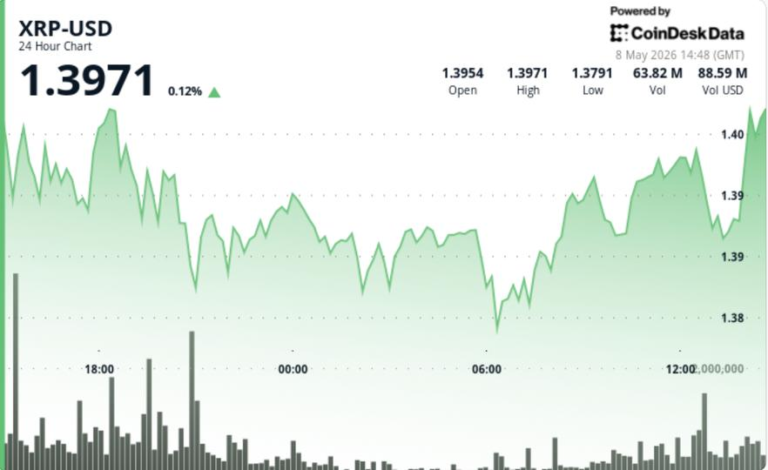
• XRP traded in a tight 1.4% range between $1.3787 and $1.3948 over the 24-hour session. • A late-session push lifted price from $1.3879 to $1.3930 on a 1.45M volume spike, breaking above the immediate consolidation ceiling. • Support repeatedly held between $1.3825-$1.3870, while sellers continued defending the $1.3930-$1.3950 zone.
Technical Analysis
• The market has spent weeks compressing between support near $1.38 and resistance just below $1.40, with volatility continuing to tighten. • Volume expanding into the latest move higher matters because thin liquidity conditions tend to exaggerate price reactions once resistance finally gives way. • XRP is still stuck below larger breakout levels near $1.47 and $1.50, but repeated tests of resistance usually weaken seller control over time. • Analysts tracking bull flag and wedge formations continue targeting the $1.60-$1.73 range if the broader structure confirms.
What traders should watch
• $1.3930-$1.3950 is the immediate resistance zone. A sustained move above it shifts focus toward $1.42 and $1.47. • $1.3825 remains the key support floor holding the current consolidation structure together. • Liquidity conditions remain unusually thin, increasing the odds of a fast move once the range finally breaks.
The following is the fintech, digital and wider economic development overview of the Caribbean nation of Cuba in 2026.
Cuba, an island nation shaped by revolution, state control, and decades of geopolitical tension, occupies a singular place in the global digital economy. Its troubled modern history, from post-revolution centralisation to the long shadow of the US embargo, has profoundly influenced the way its financial system has evolved. Historically, Cuba’s fintech ecosystem is not constrained by lack of need, but by structural isolation. By 2026, that reality still holds, though signs of cautious progress are increasingly visible.
History, pressure and economic constraint
Cuba’s current digital and financial trajectory cannot be separated from its past. For decades, the country’s economy has operated under a combination of central planning, limited market liberalisation, and external restrictions through the communist regime under Fidel Castro. The US embargo, first imposed in the early 1960s, has remained one of the defining features of Cuba’s economic reality.
More recently, policies under President Donald Trump reinforced restrictions on remittances, financial flows, and international banking access. Although later administrations adjusted some measures, the broader blockade remains in place, continuing to limit Cuba’s access to global finance and digital commerce.
Against this backdrop, Cuba’s economy is estimated at approximately $120 billion, though official figures remain difficult to verify. The gross domestic product (GDP) per capita is in the range of $9,000-$10,000, according to the World Bank. The economic base still leans heavily on tourism, remittances, healthcare exports, and state-led services, according to the Organisation for Economic Co-operation and Development (OECD). Havana remains the country’s financial and administrative centre, with the financial system dominated by state institutions such as Banco Metropolitano.
A digital financial system built differently
skyline of Havana, or Habana, the capital and largest city of Cuba IMAGE SOURCE GETTY
Unlike many emerging markets where fintech growth has been startup-led, Cuba’s ecosystem has developed within a state-managed framework. There are fewer than 10 identifiable fintech-like initiatives, most of them linked directly to state banking or payments infrastructure rather than independent private ventures.
At the core of Cuba’s government is communism, which historically doesn’t allow for private ownership nor private enterprises. Despite reforms and a black market, limitations still apply. This further enforces the lack of any noticeable fintechs and wider technologies apart from state-owned enterprises.
That makes Cuba unusual. Innovation exists, but it exists within firm political and regulatory boundaries. Rather than disruption, the pattern has been one of controlled adaptation. Digital wallets, electronic payments, and online banking have expanded gradually, though always under close institutional oversight.
The clearest area of movement has been in payments. The past few years have seen platforms such as Transfermóvil and EnZona continuing to expand their reach. These services allow users to pay bills, transfer funds, and complete basic transactions through mobile devices, helping shift parts of the economy away from cash dependency.
This adoption has not been driven purely by innovation policy. It has also been accelerated by necessity. Cash shortages, inflationary pressure, and the broader effects of currency reform have encouraged both businesses and households to use digital channels where possible. Even so, internet access limitations and smartphone penetration remain structural constraints on wider adoption.
Regulation remains centralised and inclusion influenced by its centralised-controlled government
The Banco Central de Cuba (English: Central Bank of Cuba) continues to operate within a tightly controlled financial environment, where innovation is permitted only insofar as it aligns with state priorities. The last two years have seen policy efforts focused on expanding electronic payments, improving efficiency, and reducing dependence on physical cash.
There is little sign of the sort of liberalising agenda seen elsewhere. Open banking, fintech licensing reform, and broader market competition remain limited. While digital currency and blockchain have occasionally been discussed, practical progress remains modest. The state’s priority continues to be control and stability, not rapid experimentation.
Cuba presents an unusual financial inclusion profile. On paper, a large share of adults hold bank accounts due to the state-run nature of the financial system. By last year, more than 70 per cent of adults may have access to an account, according to the World Bank Findex. Yet account ownership does not necessarily mean full financial participation. Many services remain limited, especially access to credit, digital transactions, and international payments.
This gap is particularly visible in remittances. For years, remittances have acted as a vital financial lifeline for Cuban households. But US restrictions on remittance channels have disrupted formal flows and pushed activity into alternative and often informal networks. That dynamic complicates the development of a transparent and scalable formal fintech ecosystem.
A wider digital transition, but within limits
Cuba’s broader digital transformation is advancing, though unevenly. Mobile connectivity and internet access have improved over the past decade, with mobile penetration now above 65 per cent, according to the World Bank. Government efforts in digitising public services have also helped modernise certain aspects of daily administration.
Still, digital progress remains bounded by infrastructure shortfalls, limited foreign investment, and the country’s continued geopolitical isolation. The digital economy is growing, but only within clearly defined parameters.
Cuba does not yet have a conventional fintech association or startup ecosystem comparable to those in other emerging markets. Innovation is instead shaped by state entities, academic institutions, and a narrow set of public-private arrangements. International ecosystem support is also constrained, both by politics and by Cuba’s limited integration with global capital and innovation networks.
Cuba’s fintech development is not cyclical or simply underfunded; it is structurally shaped by the country’s political economy. Restricted global financial access, centralised regulation, infrastructure limitations, and the enduring impact of the blockade all define the pace and direction of change. Currency volatility and earlier monetary reforms have added further complexity to the financial environment, according to the International Monetary Fund (IMF).
The Cuban fintech ecosystem in 2026 is still limited in scale. Cuba’s fintech future remains bound to its wider geopolitical and economic reality. Progress is visible, but constrained by history, regulation, and the enduring impact of the blockade.
Trusted Editorial content, reviewed by leading industry experts and seasoned editors. Ad Disclosure
Michael Saylor’s Strategy could buy roughly $30 billion worth of bitcoin this year if its current acquisition pace holds, according to JPMorgan analysts, marking a potential acceleration beyond the company’s already aggressive treasury playbook.
The estimate comes after Strategy added 145,834 BTC so far this year, worth around $11 billion, with JPMorgan noting that much of the buying occurred while BTC traded below the company’s estimated average cost of roughly $75,000. At the current annualized pace, the bank said Strategy’s 2026 purchases would exceed the approximately $22 billion it bought in each of 2024 and 2025.
JPMorgan Sees Bitcoin Buying Spree Reacceleration
The latest call centers on the speed of Strategy’s buying, not merely the size of its balance sheet. JPMorgan analysts led by Nikolaos Panigirtzoglou said the company “appears to have accelerated its Bitcoin purchases again in April,” extending what they described as an opportunity-driven pattern this year.
“Strategy appears to have accelerated its Bitcoin purchases again in April,” the analysts said, according to summaries of the note. “The company is pursuing an opportunity-driven buying strategy throughout 2026, sensitive to market conditions and funding opportunities.”
That framing is important. Strategy is not simply buying on a fixed schedule. JPMorgan’s read is that the company has been using price weakness and available financing windows to expand its bitcoin stack, while its stock-market premium gives it a capital-raising mechanism that most corporate bitcoin holders do not have.
Strategy’s premium to net asset value has expanded to around 26% over the past two months, according to reports citing JPMorgan. A larger premium can make equity or debt issuance more attractive, because the company can raise capital above the implied value of the bitcoin it already holds and recycle proceeds into additional BTC purchases.
Strategy’s Balance Sheet Keeps Growing
Strategy said on May 5 that it held 818,334 BTC as of May 3, representing 22% year-to-date growth. The company also reported $11.68 billion raised year to date, while STRC alone had raised $5.58 billion and cumulative dividends declared and paid on preferred stock had reached $692.5 million.
The company’s own commentary emphasizes the funding side of the model. CEO Phong Le said, “Adoption of Bitcoin continues to grow in 2026. Digital Credit, highlighted by STRC, has been a big success. STRC has shown strong demand, high liquidity, and low volatility.” He added that Strategy raised $5.6 billion in year-to-date STRC gross proceeds and cited growing bitcoin activity from major banks including Morgan Stanley, Goldman Sachs and Citi.
CFO Andrew Kang framed the preferred-equity platform as a core part of the company’s capital structure. “Strategy is the dominant issuer of Digital Credit in the world, with over $13.5 billion of preferred equity outstanding, supported by a fortress Bitcoin balance sheet,” he said. “We continue to extend our track record of servicing our dividends, having now met our payment obligations on time and in full across 23 consecutive distributions, totaling over $693 million since the launch of our preferred equity products in early 2025.”
The Trade-Off: Bigger Purchases, Bigger Obligations
The same structure that enables larger bitcoin purchases also increases Strategy’s ongoing obligations. The company reported a first-quarter net loss of $12.54 billion, or $38.25 per share, driven by a $14.46 billion unrealized loss on digital assets. Strategy’s filings also state that perpetual preferred stock dividends must be paid in perpetuity, and that future obligations could require the company to sell common stock or bitcoin.
That tension has become harder to ignore after Saylor signaled that Strategy could sell some bitcoin to pay preferred dividends, even as he later summarized the firm’s stance in a six-word post: “Buy more bitcoin than you sell.”
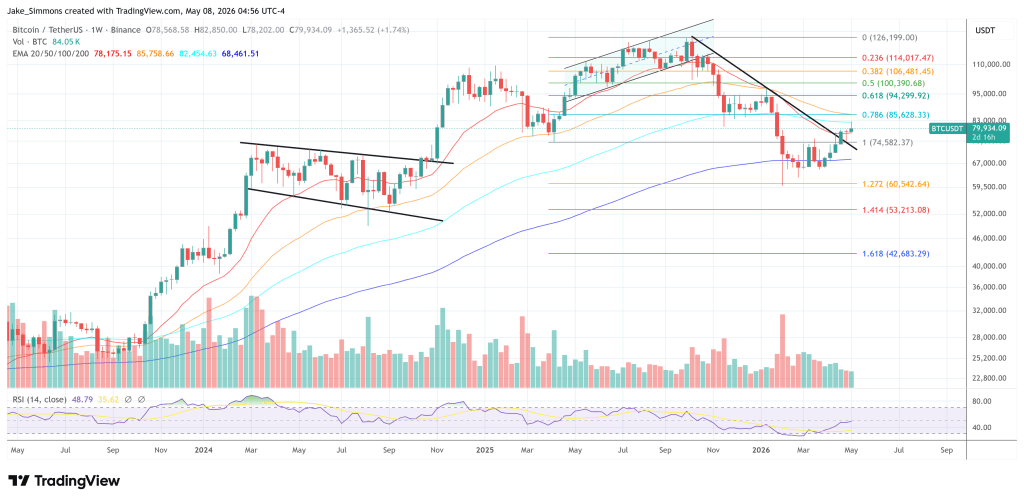
At press time, BTC traded at $79,934.
BTC bulls eye the 0.786 Fib, 1-week chart | Source: BTCUSDT on TradingView.com
featured image created with DALL.E, chart from TradingView.com
Editorial Process for bitcoinist is centered on delivering thoroughly researched, accurate, and unbiased content. We uphold strict sourcing standards, and each page undergoes diligent review by our team of top technology experts and seasoned editors. This process ensures the integrity, relevance, and value of our content for our readers.
Mantle tokenholders backed a proposal authorizing a credit facility of up to 30,000 Ether (ETH), worth about $68 million, for Aave DAO, advancing remediation tied to bad debt from the April rsETH exploit.
The proposal, MIP-34, passed in a seven-day Snapshot vote that ended Friday, according to DAO governance platform Snapshot. The measure authorizes the Mantle Foundation to negotiate and execute definitive agreements with Aave DAO for a loan from the Mantle Treasury, though the facility remains subject to Aave implementing its recovery plan and the parties finalizing terms.
The credit facility is intended to help address the impact of the rsETH incident on Aave V3. The proposal said the attacker deposited 89,567 unbacked rsETH on Aave and borrowed about $190 million in WETH, wstETH and stablecoins, creating potential bad debt estimated at between $123.7 million and $230.1 million.
The vote comes as the fallout from the rsETH exploit has moved beyond the initial liquidity shock into a broader remediation phase, with Mantle positioning its treasury as a backstop while Aave works to address bad debt and restore confidence in its lending markets.
Source: Aave
Aave WETH market cools after post-exploit squeeze
The Mantle credit facility would address the shortfall that also created liquidity stress across Aave’s lending markets.
Galaxy Research said in a Thursday report that the rsETH exploit pushed Aave’s Wrapped Ether (WETH) market into a prolonged squeeze, with WETH utilization staying above 99% for 12.7 days after the incident.
“Across the full analysis horizon, WETH utilization stayed structurally elevated and close to the 100% ceiling, with an average around 99.6% and only easing to about 98.47% by the end of the snapshot period,” Galaxy said.
Related: Aave asks Arbitrum to send 30K ETH from Kelp exploiter to ‘DeFi United’
High utilization means most of the supplied asset has already been borrowed, leaving little idle liquidity available for immediate withdrawals. In Aave’s case, Galaxy said the WETH market remained strained because supply contracted faster than borrows declined, keeping utilization near full capacity even after the initial shock.
The market has since cooled from the near-100% levels described in Galaxy’s analysis. Aavescan data showed Aave’s Ethereum V3 WETH market at about 91.6% utilization on Friday, with roughly 2.02 million WETH supplied and 1.85 million WETH borrowed.
Magazine: North Korea denies crypto hacks, Upbit’s bank tests Ripple: Asia Express
Cointelegraph is committed to independent, transparent journalism. This news article is produced in accordance with Cointelegraph’s Editorial Policy and aims to provide accurate and timely information. Readers are encouraged to verify information independently.