Home Blog Page 344

XRP Network Sees Steep Pullback In New User Activity From Its 2024 High

0

Trusted Editorial content, reviewed by leading industry experts and seasoned editors. Ad Disclosure

XRP’s waning price performance seems to have finally influenced the network’s activity, which has seen a notable cooldown in the month of May. Just a few days into May, the network is struggling to attract new wallet addresses. After over a year, new addresses have fallen to one of their lowest levels.

New XRP Addresses Drop Dramatically

The XRP network’s activity and its price are starting to move toward the same negative direction. While the recent momentum in price is slowly fading away, user growth across the network appears to have sharply cooled down.

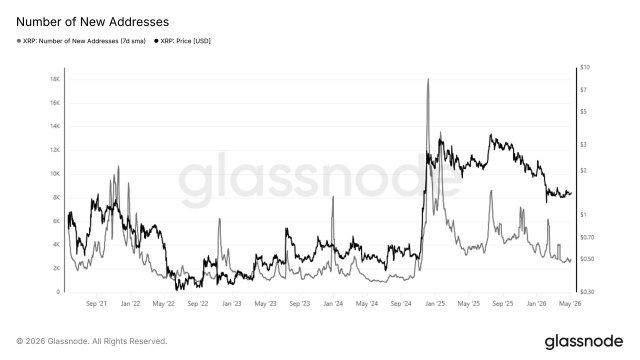
The slowdown is a result of a significant drop in the number of new wallet addresses created on the network. According to the chart from Glassnode, a popular research and on-chain data analytics platform, the metric has fallen from its peak in late 2024. Currently, the tide of new user onboarding and involvement that formerly drove network growth has slowed in recent months.

Glassnode announced that new wallet addresses on the XRP network have collapsed from 18,000 XRP in a single day in December to about 2,700 XRP per day as of yesterday. This drop from the 2024 high to today’s levels represents a more than 85% decrease after over a year.

In the ever-evolving crypto market, new addresses are often linked to retail investors. Therefore, the declining new addresses’ activity points to a sign of weakening retail involvement, particularly during times of increased speculation and market excitement.
XRP
Source: Chart from Glassnode on X

Amid this fading, new wallet addresses created on the XRP network, its monthly active supply is telling a different story. As reported by Glassnode, the monthly active supply is exhibiting bearish activity, dropping from 7.4 billion XRP per day to around 2 billion per day over the same period.

Looking at the setup, the platform has highlighted that the speculative wave that pushed that altcoin’s surge in late 2024 has largely unwound at the network level. In the meantime, this development could either mark a temporary pause or a large change in the adoption trends of the altcoin.

A Continued Decline In Waning Downside Pressure

Market sentiment has heavily shifted, causing a wave of pullback across major crypto assets. XRP was impacted by this drawdown, which has now fallen further despite the absence of significant downside pressure. Such a trend is developing a disconnect in the market where buyers are stepping back, rather than sellers forcefully taking control.

During the period, CW, a verified author at the CryptoQuant platform, has revealed that a trader is net buying a massive volume of futures positions at the current price level. While strong upside pressure is starting to emerge, the price is not rising significantly. This may be linked to the persistent purchase of long positions by a trader, which is currently blocking the rise.

XRP
XRP trading at $1.38 on the 1D chart | Source: XRPUSDT on Tradingview.com

Featured image from Freepik, chart from Tradingview.com

Editorial Process for bitcoinist is centered on delivering thoroughly researched, accurate, and unbiased content. We uphold strict sourcing standards, and each page undergoes diligent review by our team of top technology experts and seasoned editors. This process ensures the integrity, relevance, and value of our content for our readers.

Arbitrum approves $71 Million ETH release despite U.S. seizure fight

0

Arbitrum delegates approved the release of $71 million in ether frozen after last month’s Lazarus-linked rsETH exploit, setting up a direct clash between decentralized governance and an active U.S. court fight over who owns the funds.

The on-chain vote, which closed Friday afternoon Hong Kong time with more than 90% support, authorizes the release of 30,765 ETH frozen by Arbitrum’s Security Council after the April 18 exploit, when attackers used unbacked rsETH tokens as collateral on Aave to borrow roughly $230 million in ETH from the protocol.

The funds are earmarked for a coordinated industry recovery effort led by Aave, KelpDAO, LayerZero, EtherFi and Compound, aimed at making affected users whole.

But the frozen ether is also at the center of an escalating legal dispute in Manhattan federal court.

Last week, attorney Charles Gerstein, representing families holding roughly $877 million in unpaid terrorism judgments against North Korea, served a restraining notice on Arbitrum DAO claiming the frozen ETH constitutes North Korean property because the exploit has been widely attributed to Pyongyang’s Lazarus Group.

That triggered an emergency legal fight.

Aave moved earlier this week to vacate the restraining notice, arguing the assets belong to innocent users, not North Korea, and warning that continued delays risk “cascading liquidations” and broader instability across decentralized finance markets.

Gerstein fired back Tuesday, arguing the exploit was not theft but fraud, meaning the attackers obtained legal title to the ETH by deceiving Aave’s lending markets with worthless collateral.

Friday’s governance vote does not mean the funds move immediately.

Because the measure was structured as a Constitutional AIP under Arbitrum’s governance framework, the transfer cannot be executed for at least eight days, giving the Manhattan court time to intervene before any ETH moves.

Arbitrum delegates were also not voting blindly to the legal risk. The proposal included indemnification protections for the Arbitrum Foundation, Offchain Labs, Security Council members, and governance delegates against certain claims arising from either freezing or releasing the ETH, underscoring how unusual the stakes around the vote had already become.

Speaking at Consensus Miami this week, Aave Labs Chief Legal and Policy Officer Linda Jeng said the exploit had already forced the protocol to rethink its risk framework, expanding collateral standards beyond financial metrics to include cybersecurity, interoperability, and technical architecture reviews.

Jeng, who worked as a regulator during the 2008 financial crisis, drew a contrast with traditional finance’s taxpayer-backed rescues.

“In the financial crisis, we had to bail out the banks,” she said. “Here, we came together as an ecosystem to bail ourselves out.”

Coinbase (COIN) bulls point to crypto legislation and stablecoins after earnings miss

0

Coinbase’s (COIN) weak first-quarter earnings report sparked another divide on Wall Street over whether the crypto platform is building a more durable business or remains tied to crypto’s boom-and-bust cycles.

Several analysts lowered forecasts after the company missed expectations on revenue and adjusted EBITDA as trading activity slowed across the crypto market. Still, a number of firms argued Coinbase’s expanding stablecoin and derivatives businesses — along with the possible passage of crypto legislation in Washington — could improve the company’s outlook later this year.

JPMorgan said the quarter reflected “a challenging environment” but added that Coinbase had “positioned the company well to operate in an increasingly digital world.”

The bank said pending U.S. crypto legislation “does set up for a better outlook into 2H26 and into 2027” and maintained an overweight rating on the stock.

The legislation in focus is the CLARITY Act, a proposed market structure bill that would establish rules for how crypto assets are regulated in the U.S. The bill aims to define which digital assets fall under the Securities and Exchange Commission (SEC) and which would be overseen by the Commodity Futures Trading Commission (CFTC). Coinbase and other crypto firms have argued clearer rules could encourage banks, asset managers and large companies to expand crypto activity.

Coinbase executives told analysts they expect a Senate Banking Committee markup this month, followed by a broader vote later in the summer.

Clear Street also pointed to regulation as a major catalyst.

“We see multiple catalysts ahead and remain constructive on the shares going into 2H26,” the firm wrote, even as it lowered its price target to $107 from $140 following weaker trading volume.

The firm highlighted growth in newer products including prediction markets, which generated more than $100 million in annualized revenue by March, and retail derivatives, which surpassed a $200 million annualized pace.

Oppenheimer said Coinbase’s push beyond spot crypto trading is beginning to show traction.

“Prediction Markets has emerged as one of the fastest growing new products,” the firm wrote, adding that the company’s “Everything Exchange strategy” could support long-term growth. The strategy includes stablecoins, derivatives, payments and tokenized assets alongside traditional crypto trading.

William Blair argued the first quarter may represent the low point of the current cycle.

“If Bitcoin has bottomed, as we suspect it has, April could be the trough spot volume month of the cycle,” the firm wrote.

The firm also pointed to growth in USDC stablecoin activity and Coinbase’s Base blockchain network as signs the company is becoming more embedded in crypto infrastructure beyond trading fees.

Not all analysts were convinced.

Barclays maintained an Underweight rating and warned that “profitability [is] under pressure” as trading activity continues to weaken. The bank said second-quarter transaction revenue trends remain well below Wall Street expectations.

Compass Point also kept a Sell rating, arguing Coinbase “remains entirely beholden to crypto cycles five years after going public.”

The firm said weaker monthly user activity raised questions about whether newer products are attracting new customers or simply replacing older trading businesses.

Shares of Coinbase are down 3.6% in pre-market trading.

OwlTing Launches Self-Custody Wallet to Bring Regulated Stablecoin Payments to AI Agents

0

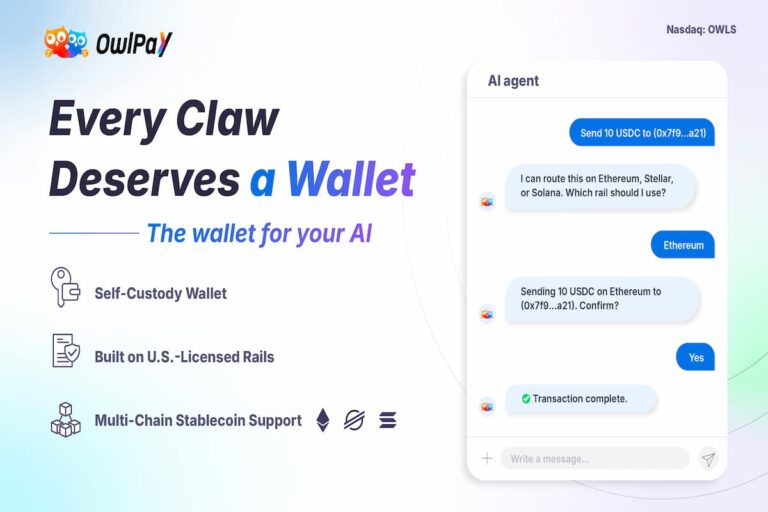
Blockchain technology company OwlTing Group has officially launched the OwlPay Agent Wallet, a new digital platform designed specifically for artificial intelligence agents.

The innovative service allows AI assistants to autonomously send, receive, and manage stablecoins directly on behalf of their users. For instance, a user can simply instruct their AI agent to pay for an online purchase or send funds internationally, and the agent will independently execute the transaction within the user’s authorized limits.

Bridging the gap in agentic commerce

According to projections by McKinsey & Company, the global agentic commerce market could reach between $3trillion and $5trillion by 2030. However, traditional banking and payment infrastructures were not originally designed to accommodate autonomous software agents. OwlTing is addressing this critical gap by providing a regulated, wallet-based infrastructure that directly connects AI workflows to established stablecoin settlement rails.

The new self-custody wallet gives users full control over their private keys and funds, with credentials securely generated and stored locally on the user’s device. At launch, the wallet supports operations across the Ethereum ecosystem, as well as the Stellar and Solana blockchains. Furthermore, the installation process requires no technical configuration; the wallet features a built-in agent skill that allows major AI assistants to automatically learn how to operate it through natural conversation.

Built on regulated infrastructure
Darren Wang, founder and CEO of OwlTing Group

To ensure these autonomous transactions operate within a compliant framework, OwlTing has applied the same regulated infrastructure that underpins its broader consumer services. This includes leveraging its Money Transmitter Licenses across 40 U.S. states and utilizing its Visa Direct integration, which enables eligible U.S. debit cardholders to fund stablecoin transactions.

Darren Wang, founder and CEO of OwlTing Group, emphasized the importance of this compliant foundation as AI capabilities continue to rapidly expand. He noted that while the technology industry has focused heavily on giving AI the ability to think, OwlTing’s focus is firmly on giving AI the ability to transact under regulated rules. Wang added that every AI agent acting on behalf of a user will eventually require a compliant wallet layer backed by genuine licensing infrastructure, user-controlled custody, and payment rails expressly designed for real-world transactions.

Expanding the financial ecosystem

The introduction of the OwlPay Agent Wallet completes OwlTing’s three-layer financial infrastructure for the emerging agentic economy. This comprehensive ecosystem now includes the OwlPay Stablecoin Checkout for merchants, Visa Direct integration for mainstream consumers, and a dedicated, self-custody wallet tailored for AI agents.

Looking ahead, the NASDAQ-listed company plans to progressively introduce additional capabilities into the new wallet over the coming months. The development roadmap includes support for purchasing and cashing out stablecoins with eligible U.S. debit cards, the integration of further fiat channels, a cross-chain bridge, and expanded blockchain support.

SEC chair Paul Atkins signals rule changes for onchain markets and AI-driven finance

0

SEC Chair Paul Atkins said Friday the agency is considering changes to how securities regulations apply to blockchain-based financial markets and AI-powered financial applications, as digital asset firms increasingly move trading and settlement activity onchain.

Speaking at the AI+ Expo in Washington, Atkins said the SEC is considering formal rulemaking around onchain trading systems, blockchain settlement infrastructure, automated financial applications and crypto vaults that increasingly blur the lines between traditional players.

Existing securities rules were designed around traditional market intermediaries such as brokers, exchanges and clearinghouses, he argued, while newer blockchain systems often combine those functions into a single software protocol. Atkins’ predecessor, Gary Gensler, had held a similar view, though he focused more on centralized exchanges that the SEC argued provided those different functions under one roof at the time, mostly through lawsuits.

“A single protocol can execute a trade, manage collateral, route liquidity, execute trading strategies through vault structures and settle the transaction,” Atkins said.

“We should remember that onchain market structures today are often hybrid in nature, combining elements of what are often referred to as ‘traditional’ and ‘decentralized’ finance,” he said. “We should clarify how the Commission views the spectrum of models that may implicate our statutes through notice and comment rulemaking, using our exemptive authorities where necessary and prudent.”

Atkins’ remarks highlighted the latest step in the regulatory agency’s pivot away from the enforcement-heavy approach under former Chair Gary Gensler. Under President Donald Trump’s administartion, the SEC has issued crypto-related staff guidance, no-action reliefs and public statements aimed at reducing legal uncertainty for digital asset firms.

The chair framed the potential changes as part of a broader shift toward an AI-driven and automated financial infrastructure. He argued that artificial intelligence agents will increasingly participate in markets and financial decision-making at machine speed, while blockchain rails allow those systems to move value instantly.

The SEC, he said, should avoid locking emerging technologies into outdated rules.

“Our job is to set the rules of play and referee the game, not to pick the winning team,” Atkins said.

He also reiterated support for congressional efforts to pass crypto market structure legislation, including the CLARITY Act, which would establish a regulatory framework for digital assets shared between the SEC and Commodity Futures Trading Commission (CFTC).

ECB Needs Tokenised Money, Not Crypto Stablecoins

0

Trusted Editorial content, reviewed by leading industry experts and seasoned editors. Ad Disclosure

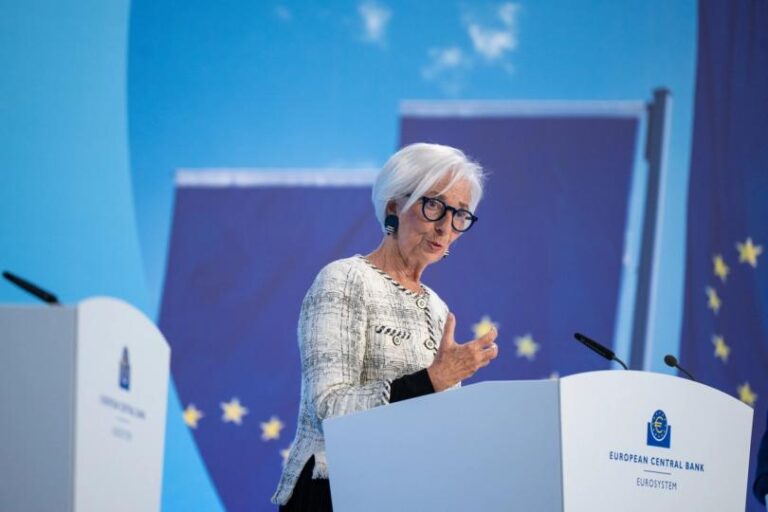
ECB President Christine Lagarde has pushed back against the idea that Europe should answer dollar crypto stablecoin dominance by promoting euro-denominated stablecoins of its own, arguing instead that the region should build tokenised financial infrastructure anchored in central bank money.

In a speech at the Banco de España LatAm Economic Forum in Roda de Bará, Spain, Lagarde framed stablecoins as one of the fastest-moving policy questions in global finance. The market, she said, has grown from less than $10 billion six years ago to more than $300 billion today, with close to 98% of stablecoins denominated in US dollars and nearly 90% controlled by Tether and Circle.

Lagarde: ECB Must Not Copy US Crypto Stablecoin Model

That concentration has turned crypto stablecoins into more than a crypto-market instrument. In Lagarde’s view, they now sit at the intersection of monetary power, financial stability and tokenised-market infrastructure.

“The growing argument is that to remain relevant, Europe must respond by promoting euro-denominated stablecoins of its own,” Lagarde said. “Otherwise, it faces a future of digital dollaritation and a loss of monetary sovereignty.”

But she argued that this framing misses the central issue. Stablecoins, according to Lagarde, perform two separate functions that are often conflated: a monetary function, by extending the reach of a currency, and a technological function, by acting as the cash leg for settlement on distributed ledger infrastructure.

“The argument I want to develop today is that once we disentangle those two functions, the case for promoting euro-denominated stablecoins is far weaker than it appears,” she said. “And a more fundamental question comes into view: do we actually need stablecoins to obtain the benefits they are said to provide? Or are we mistaking the instrument for the outcome?”

Lagarde acknowledged that stablecoins have become central to crypto settlement and increasingly relevant for cross-border payments, particularly in regions where access to stable currencies is limited. She also noted that dollar-backed stablecoins can reinforce demand for US Treasuries, especially if they become yield-bearing instruments.

That dynamic is now openly part of US policy. Lagarde pointed to the GENIUS Act, which the US administration has described not only as a consumer protection and financial stability measure, but also as a tool to support “the continued global dominance of the U.S. dollar” and strengthen demand for Treasuries.

For Europe, however, Lagarde said the monetary case for euro stablecoins is weak once risks are included. Under MiCAR, euro-denominated stablecoins could create additional demand for euro-area safe assets and marginally extend the euro’s international reach. Yet she argued that the trade-offs would be material.

The first is financial stability. Lagarde cited Circle’s USDC depeg during the Silicon Valley Bank collapse in March 2023, when Circle disclosed that $3.3 billion of USDC reserves were held at the failed bank and the token briefly fell to $0.877.
“The promise of par redemption depends on the very market confidence that can vanish when financial stability deteriorates,” she said. “And a mass redemption can accelerate that deterioration.”

The second risk is monetary policy transmission. If retail deposits migrate into non-bank stablecoins and return to banks as wholesale funding, the ECB’s rate decisions may transmit less effectively through the banking system. Lagarde said this matters particularly in the euro area, where banks remain the dominant source of credit to the real economy.

Her conclusion was blunt: stablecoins are not an efficient way to strengthen the euro’s international role. The better route, she said, is deeper capital-market integration through Europe’s savings and investments union, alongside a safe asset base that matches the euro’s global ambitions.

Where Lagarde was more constructive was on tokenisation itself. She described DLT-based market infrastructure as genuinely transformative, especially for Europe’s fragmented financial system. In 2023, the EU had 295 trading venues, 14 central clearing counterparties and 32 central securities depositories, compared with two clearing houses and one central securities depository in the US.

Stablecoins currently fill the settlement gap in tokenized markets because they provide an on-chain unit of value for atomic settlement. But Lagarde argued that private stablecoins are fragile and fragmented foundations for that role.

The ECB’s answer is public infrastructure. From September, the Eurosystem plans to offer wholesale settlement through the Pontes project, linking DLT platforms to TARGET so transactions can settle in central bank money. Lagarde also pointed to the Appia roadmap, published in March, which aims to support a fully interoperable European tokenised financial ecosystem by 2028.

“Europe knows which port it is sailing to,” Lagarde concluded. “Our task is not to replicate instruments developed elsewhere, but to build the foundations and the infrastructure that serve our own objectives, so that we can harness the benefits of innovation without importing the fragilities.”

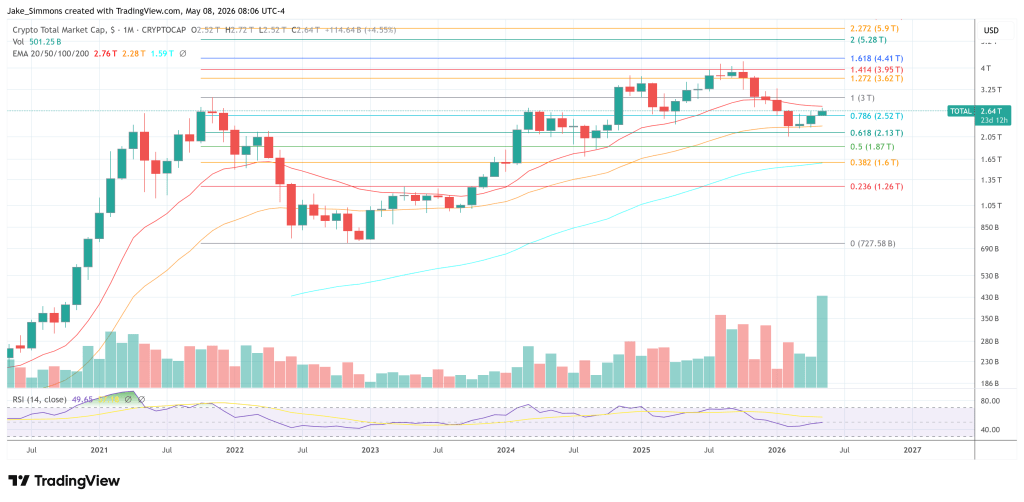
At press time, the total crypto market cap stood at $2.64 trillion.

Total crypto market cap
Total crypto market cap faces the 20-month EMA, 1-week chart | Source: TOTAL on TradingView.com

Featured image created with DALL.E, chart from TradingView.com

Editorial Process for bitcoinist is centered on delivering thoroughly researched, accurate, and unbiased content. We uphold strict sourcing standards, and each page undergoes diligent review by our team of top technology experts and seasoned editors. This process ensures the integrity, relevance, and value of our content for our readers.
Kraken parent goes for the OCC charter in bid to become a federal crypto bank

0

Payward, the parent company of crypto exchange Kraken, has applied for a national trust company charter with the U.S. Office of the Comptroller of the Currency (OCC), according to a Friday announcement shared with CoinDesk, as the company looks to expand its regulated digital-asset custody business.

If approved, the charter would establish Payward National Trust Company (PNTC), a federally regulated entity focused on fiduciary custody and related services for digital assets. Kraken said the trust would primarily serve institutions and customers seeking bank-level custody protections under OCC oversight.

The filing marks Payward’s latest effort to expand its U.S. regulatory footprint as crypto firms increasingly pursue traditional financial charters to attract institutional clients and navigate a shifting regulatory environment.

“A national trust company provides the certainty institutions require and establishes the infrastructure to build the next generation of custody,” Payward and Kraken Co-CEO Arjun Sethi said in the statement.

The move comes as crypto firms increasingly seek federal charters, licenses and banking approvals under the Trump administration’s more industry-friendly approach to digital-asset regulation.

Kraken’s broader expansion strategy has included a string of acquisitions aimed at building regulated trading and payments infrastructure ahead of a potential IPO.

In addition to its $1.5 billion acquisition of retail futures platform NinjaTrader in 2025, Payward agreed in April to acquire crypto derivatives exchange Bitnomial for up to $550 million, adding a full suite of Commodity Futures Trading Commission (CFTC) licenses covering brokerage, clearing and exchange operations.

This week, the company also struck a $600 million deal to buy Hong Kong-based payments firm Reap Technologies, expanding Kraken’s push into stablecoin-powered cross-border payments and card infrastructure in Asia

The proposed trust company would complement Kraken Financial, the Wyoming special purpose depository institution (SPDI) chartered in 2020. Kraken Financial became the first digital-asset bank to secure a Federal Reserve master account, giving it direct access to the U.S. payments system.

Payward framed the OCC application as part of a broader “multi-charter” strategy aimed at offering different types of regulated financial services under both state and federal oversight.

Under the proposal, PNTC would rely on Payward’s existing compliance, risk management and custody infrastructure while expanding access to clients that require a federally regulated qualified custodian.

Crypto firms have increasingly explored bank and trust charters as regulators clarify rules around custody and institutional participation in digital assets. National trust charters, overseen by the OCC, have previously been pursued by crypto-native firms seeking broader legitimacy and nationwide operations without relying solely on state-by-state licensing.

Sethi said the company’s Wyoming SPDI and prospective OCC trust charter would serve “complementary pillars” of Payward’s banking strategy as the U.S. regulatory framework for digital assets continues to evolve.

Read more: Kraken parent Payward closes $550 million Bitnomial deal, securing full CFTC derivatives stack

AI Agents Are Becoming Operational Infrastructure

0

Editor’s Note: Welcome to Prompt, your weekly briefing on the shifting AI landscape. We provide an analytical look at the week’s biggest developments, paired with a curated roundup of the stories that actually matter. 

The next phase of AI isn’t just about models. It’s about agents becoming operational.

AI agents are moving from experimentation into enterprise infrastructure and operations, and organizations are now trying to figure out how to govern, secure and operationalize them.

Agents are moving into real working roles, becoming embedded in workflows rather than remaining limited to demos. This week alone, we’ve seen several examples of that:

Related:AWS Launches Agentic AI Payment Capabilities

This shift is causing enterprises to become more cautious as they try tobalance risk and reward, with many organizations eager to use AI butunprepared for the security and governance challenges it entails.

The infrastructure layer is changing because of agents. Agents are adding infrastructure complexity because they’re persistent, orchestrated and increasingly autonomous. Those changes have companies redesigning work around AI systems.

Meanwhile, Anthropic’s compute deal with SpaceX this week enables the generative AI lab to expand compute capacity, immediately expanding usage limits for Claude Code and the Claude API.

Taken together, these developments point to a broader shift in how AI is being used inside the enterprise.

The next phase of AI isn’t about systems that simply respond to prompts. It’s about systems that can take action, operate across workflows and increasingly function as part of the business itself.

That changes the conversation from capability to control. As agents become more embedded in operations, the challenge is no longer just building more powerful models. It’s now a matter of figuring out how to govern, secure and manage systems that are increasingly acting with greater autonomy.

Related:Anthropic Finance Agents Pose Threat to Established Service Providers

That’s where the next phase of enterprise AI will be defined.

Also in AI This Week:

Beyond agents, coverage highlighted how AI is beginning to reshape retail, workforce strategy, enterprise infrastructure and real-world autonomous systems.

Nvidia Taps Robotics Ecosystem to Scale Physical AI: Nvidia is leaning on its broader robotics ecosystem to help scale physical AI, highlighting growing interest in real-world autonomous systems.

Cisco, Schneider Electric Call for Enabling Regulations to Help AI Flourish: While artificial intelligence has the potential to reshape industries such as manufacturing, speakers at the SelectUSA Investment Summit said stronger policies will be needed to support responsible adoption and build trust in the technology.

Amazon’s Latest AI Feature Allows Shoppers to Interact With Product Summaries: Amazon’s new AI shopping feature reflects how conversational AI is becoming more embedded in the retail experience.

Tech Sector Job Losses Show AI Replacement in Action: New rounds of tech-sector job cuts are fueling debate over how quickly AI is starting to alter workforce needs across the industry.

Related:Enter Bob, IBM’s Friendly AI Coding Assistant

IBM Pursues Enterprise AI With Agents for Hybrid Cloud, Mainframes: IBM is expanding its enterprise AI strategy for agents, hybrid cloud and mainframes as it pushes for more orchestrated AI deployment across business environments.

Kelp DAO Fallout Pushes Solv, DeFi Protocols Toward Chainlink

0

Decentralized finance protocols are reevaluating their blockchain oracle providers’ security after the fallout from the $293 million Kelp DAO exploit last month. Several protocols have announced migrations to Chainlink infrastructure in recent days, citing security concerns around third-party oracle and bridge providers.

On Thursday, Bitcoin DeFi platform Solv Protocol announced it would migrate to Chainlink’s Cross-Chain Interoperability Protocol (CCIP) and replace LayerZero bridges, citing an “extensive security review” concluding that CCIP provided the “strongest security assurances.” 

A day earlier, liquidity protocol Tydro also said it was moving to Chainlink after its previous oracle provider, Chaos Labs, suffered an incident that prompted Tydro to pause markets over concerns about inaccurate price feeds.

The migrations come after an April 18 exploit in which attackers drained 116,500 Kelp DAO restaked ETH (rsETH) tokens worth between $290 million and $293 million. Following the exploit, Kelp DAO also migrated its rsETH token to Chainlink, moving away from its previous LayerZero-powered bridge after attributing the incident to weaknesses in its cross-chain setup.

Source: Solv Protocol

LayerZero, however, said on April 20 that the exploit resulted from a single point of failure in Kelp DAO’s implementation, which relied on a single LayerZero DVN as the only verified path despite prior warnings against that configuration.

DeFi protocols review oracle security after Kelp exploit

The Kelp DAO exploit triggered a “wake-up call” for DeFi providers, according to Zach Rynes, strategic initiatives lead at Chainlink Labs.

Related: Aave liquidates Kelp DAO hacker’s rsETH positions on Ethereum, Arbitrum

Rynes told Cointelegraph that DeFi teams conducting security reviews are increasingly deciding to replace older oracle and bridge systems with Chainlink infrastructure to strengthen baseline security protections, and multiple other DeFi protocols are discussing potential migrations to Chainlink following the exploit.

Oracle providers with long operating histories and strong reliability are becoming increasingly important as hacks continue across the sector, Marcin Kazmierczak, co-founder of RedStone, the fourth-largest blockchain oracle provider, told Cointelegraph, adding that RedStone has also kept a “fully reliable track record.”

Redstone was also contacted by Tydro as an emergency measure after the Chaos Labs oracle attack and provided support to help restore oracle feeds for the protocol.

Source: Redstone

Oracle consolidation raises new questions for DeFi

Following the Kelp DAO exploit, only a smaller group of specialized providers may be able to meet the “demand and reliability requirements” created by growing institutional participation in DeFi, Kazmierczak said.

“A smaller set of trusted oracles is forming in the market,” he said, adding that as capital concentrates around providers with proven track records, the risk of oracle-related exploits could decline.

When asked about the risks of multiple DeFi protocols depending on fewer providers, Rynes said Chainlink’s infrastructure was designed to withstand extreme market conditions.

He pointed to periods including the 2020 Covid market crash, the 2022 FTX collapse and major volatility events in 2025, saying Chainlink continued operating throughout those disruptions.

Related: Arbitrum vote to release $71M in frozen Kelp exploit ETH set to pass

Nik Kunkel, founder of Chronicle, the second-largest oracle provider, said that an overreliance on a single infrastructure provider will always present additional risks.

“There are risks anytime a large portion of an ecosystem depends on a single piece of infrastructure,” Kunkel told Cointelegraph, adding that reducing those risks also requires data infrastructure to remain independently transparent and verifiable.

Top Oracle providers by market share. Source: DefiLlama.com

Chainlink remains the largest oracle provider with a 58% market share and more than $32 billion in value secured, according to DefiLlama. Chronicle ranks second with $7.6 billion in total value secured, while RedStone holds fourth place with $3.7 billion, representing a 6.7% market share.

Magazine: 53 DeFi projects infiltrated, 50M NEO tokens could be ‘given back’: Asia Express

Why Europe shouldn’t just copy the U.S. stablecoin model

0

European Central Bank (ECB) President Christine Lagarde argued against the need for privately-issued euro-pegged stablecoins, even in the face of a market which is 98% dominated by dollar-pegged tokens.

Despite the rapid global adoption of USD stablecoins, Largarde argued Europe should focus on building tokenized settlement infrastructure anchored in central bank money rather than simply replicating the U.S. stablecoin model in a speech Bank of Spain’s LatAm Economic Forum in Madrid on Friday

“The case for promoting euro-denominated stablecoins is far weaker than it appears,” Lagarde said, arguing that the technological case for stablecoins can be replicated by central bank infrastructure, while their monetary function introduces unacceptable risks to financial stability.

Those comments come as Qivalis, a consortium of 12 of Europe’s largest banks, including ING, BBVA, BNP Paribas, Danske Bank, and UniCredit, announced plans to launch a privately-issued digital euro, not a CBDC, later this year under the same premise that Europe faces dollarization risks.

“If we don’t have a euro onchain with depth of liquidity, then the only alternative is the U.S. dollar,” Qivalis CEO Jan-Oliver Sell told CoinDesk. “That’s a real risk to Europe’s financial and digital sovereignty.”

Lagarde reiterated warnings that stablecoins could create financial stability risks during periods of market stress. She referenced the March 2023 collapse of Silicon Valley Bank, when Circle disclosed that $3.3 billion of its USDC reserves were at the bank, causing a brief de-peg of its stablecoin.

“At scale, such dynamics can transmit stress to the underlying asset markets. The promise of par redemption depends on the very market confidence that can vanish when financial stability deteriorates – and a mass redemption can accelerate that deterioration,” she said on Friday.

“As stablecoin use grows, so too does the potential for feedback loops between redemptions and asset markets,] particularly where issuers are non-banks.”

The growing global dominance of U.S. dollar-pegged stablecoins issued by Tether and Circle represents risks to Europe’s financial system, Lagarde said on Friday.

Lagarde noted circulation in six years has increased from $10 billion to $310 billion. However, she expressed concern that nearly 90% of the market is controlled by two issuers – Tether and Circle USDC).

She said that in Europe there’s increasing debate over the bloc’s urgent need to remain relevant.

“Europe must respond by promoting euro-denominated stablecoins of its own,” she said. “Otherwise, it faces a future of digital dollarisation and a loss of monetary sovereignty.”Lagarde is calling on the EU countries to support the development of a CBDCs. “We must build the public infrastructure that will enable alternative instruments, such as stablecoins and other forms of tokenised money, to operate within a framework anchored by central bank money,” she said.

Late last year, Lagarde announced the ECB’s plans for a “digital euro by 2029, assuming the European co-legislators adopt the necessary regulation by 2026,” adding that the preparatory steps, including pilot exercises and initial transactions, could begin as early as mid-2027.