Payward says the OCC national trust charter would complement Kraken’s banking arm, Kraken Financial.
Payward, the parent company of crypto exchange Kraken, has filed an application with the U.S. Office of the Comptroller of the Currency (OCC) for a national trust company charter, according to a press release from the firm today, May 8.
If approved, the entity — Payward National Trust Company (PNTC) — would offer federally regulated custody and other services, mainly for digital assets.
“PNTC expects to serve institutional clients and individual customers seeking regulated, bank-level custody and trust services for digital assets,” the release notes.
Payward says the move would complement its existing banking arm, Kraken Financial, which is a Wyoming Special Purpose Depository Institution and recently received a limited purpose Federal Reserve master account.
Co-CEO Arjun Sethi said the “addition of a national trust company expands what we can offer our clients under an evolving U.S. regulatory framework.”
Just yesterday, the company announced that it has agreed to acquire Hong Kong-based stablecoin payments firm Reap Technologies for up to $600 million in cash and stock, adding card issuance, cross-border payments, and stablecoin treasury services to its B2B platform.
This article was written with the assistance of AI workflows. All our stories are curated, edited and fact-checked by a human.
Earlier in 2026, as a digital asset market structure bill was under consideration in the US Senate, cryptocurrency exchanges Coinbase, Kraken and Gemini reportedly pressed to remove language in the legislation that could have affected their token listings.
According to a Friday Politico report, the three exchanges asked US lawmakers to scrap a provision in the market structure bill that would have required platforms to only offer trading on digital assets “not readily susceptible to manipulation.” The companies reportedly pressed senators to remove the language as it could have made it difficult for exchanges to list smaller tokens.
The edit, which the news outlet reported occurred after the US Senate Agriculture Committee voted to advance its version of the bill in January, signaled the influence crypto companies in communication with the Trump administration and lawmakers could have in legislation affecting the industry. The US Senate Banking Committee postponed its markup on the bill hours after Coinbase CEO Brian Armstrong said that the exchange could not support the legislation “as written,” citing concerns with tokenized equities.
Under the market structure bill, called the CLARITY Act when it passed the US House of Representatives in July 2025, the Commodity Futures Trading Commission (CFTC) would be given more authority in overseeing and regulating digital assets. Both US financial regulators, the CFTC and Securities and Exchange Commission (SEC), announced their intention to coordinate oversight of the crypto industry in March, even in the absence of action from Congress.
Related: US Senator questions Mark Zuckerberg on Meta’s stablecoin plans
Coinbase chief policy officer Faryar Shirzad responded to the report on social media, calling it “old news” and an issue that was included in the markup by the Senate Agriculture Committee.
Source: Faryar Shirzad
Industry leaders, lawmakers speculate on timeline for market structure bill
Last week, two US senators announced a compromise deal on stablecoin yield between representatives of the crypto and banking industries that could allow the CLARITY Act to advance in the banking committee. Although some lawmakers said they intended to push for ethics language on potential conflicts of interest to be included in the bill, many are speculating that passage could be in a matter of weeks.
Coinbase‘s US policy vice president, Kara Calvert, said on Thursday that the exchange expected a markup in the banking committee by next week. Other lawmakers predicted that the bill would become law before the Senate broke for August recess, while White House crypto adviser Patrick Witt said that the administration was aiming for a July 4 deadline for the bill to pass the House after a June Senate vote.
Cointelegraph is committed to independent, transparent journalism. This news article is produced in accordance with Cointelegraph’s Editorial Policy and aims to provide accurate and timely information. Readers are encouraged to verify information independently.
A four-firm pilot settling the first cross-border, cross-bank redemption of tokenized U.S. Treasuries on the XRP Ledger extended a rally sparked by Ondo’s seat at the DTCC’s tokenization table.
After months of trading sideways while its underlying business scaled, the native token of real-world asset (RWA) tokenization platform Ondo Finance is finally catching up.
ONDO is trading at $0.45, up 29% over the past 24 hours and around 68% on the week, according to CoinGecko. The token’s market capitalization has climbed to $2.2 billion, with 24-hour trading volume jumping to $490 million as the breakout accelerated overnight.
ONDO Chart
The rally kicked off on May 4, when the Depository Trust & Clearing Corporation revealed timelines for its tokenization service and named Ondo Finance among more than 50 firms in its industry working group.
The group includes BlackRock, Goldman Sachs, JPMorgan, Franklin Templeton, Morgan Stanley, NYSE Group and Citadel Securities, alongside crypto-native firms Circle, Fireblocks and Robinhood.
“We believe tokenization will significantly change how markets work and operate, bringing new levels of liquidity, transparency and efficiency to investors,” said Frank La Salla, DTCC President and CEO.
DTCC plans to facilitate initial production trades in July 2026 and launch the service commercially in October 2026. The service will initially cover Russell 1000 constituents, ETFs tracking major indices, and U.S. Treasury bills, bonds, and notes, all assets in which Ondo is already active.
For a project whose business has scaled aggressively while its token price largely stagnated, the working group selection brought a stamp of institutional credibility. Ondo’s TVL doubled past $2 billion in January and stands at $3.68 billion today, per DefiLlama, making it the largest tokenized RWA platform.
Two days later, Ondo, Kinexys by J.P. Morgan, Mastercard and Ripple announced that they had completed the first near real-time cross-border, cross-bank redemption of a tokenized U.S. Treasury fund.
In the pilot, Ripple redeemed a portion of its Ondo Short-Term U.S. Government Treasuries (OUSG) holdings on the XRP Ledger, where OUSG has been live since June 2025. Mastercard’s Multi-Token Network routed the fiat settlement instruction to Kinexys, which debited Ondo’s blockchain deposit account and wired U.S. dollars to Ripple’s bank account in Singapore. The blockchain leg cleared in under five seconds, and the entire flow ran outside conventional banking hours.
“This milestone represents the first time tokenized U.S. Treasuries have settled across borders and banks in near-real time and outside traditional banking windows,” said Ian De Bode, President of Ondo Finance.
Ondo has spent the past year branching out beyond Treasuries. Its tokenized stocks and ETFs platform, Ondo Global Markets, launched on Ethereum in September 2025 and has since rolled out across BNB Chain, Solana, and Hyperliquid via Felix.
Tokenized U.S. Treasuries crossed $10 billion in February and now stand at roughly $15 billion, per RWAxyz, with Ondo, BlackRock’s BUIDL and Circle’s USYC the largest issuers.
This article was written with the assistance of AI workflows. All our stories are curated, edited and fact-checked by a human.
Bitcoin (BTC) is attempting its first Bollinger Bands breakout in months, while creator John Bollinger is more bullish than some traders.
Key points:
Bitcoin faces stiff resistance as it attempts daily candle closes above the upper Bollinger Band.
Volatility comes on cue after the Bands’ tightest-ever conditions last month.
Creator John Bollinger takes advantage of positive trading signals as part of his investment program.
Responses mixed as Bitcoin tests Bollinger Bands ceiling
Data from TradingView confirms that on Wednesday, BTC/USD saw its second daily close above the upper Bollinger Band on the daily chart, something it has not achieved since mid-January.
BTC/USD one-day chart with Bollinger Bands data. Source: Source: Cointelegraph/TradingView
The Bollinger Bands indicator, used to assess both volatility and momentum, recently saw the narrowest gap between its constituent trend lines ever recorded for Bitcoin.
This led to predictions of a breakout move, with the direction open to debate, as well as heightened volatility to come.
Commenting on the visit to the upper band, however, trader SuperBro noted that the price was now in an area full of potential points of rejection.
“Closed above the upper Bollinger Band, above the trendline on closing prices, but just below the log trendline on wicks,” they wrote in a post on X.
SuperBro added that most potential liquidations now belonged to long positions below the price, with shorts already taken out.
“There are relatively few short liquidations remaining up to 85K compared to long liquidations down to 74K,” they continued.
“However, bulls still have the momentum advantage and I don’t yet see a good reversal setup. Despite the liquidation imbalance, I’m holding tight to see if we can blast through.”
BTC/USD one-day chart with order-book liquidity data. Source: SuperBro/X
Bollinger, the indicator’s creator, revealed that one of his investment fund’s proprietary trading models had flipped positive on Bitcoin, and had taken a position accordingly.
Source: John Bollinger/X
“Overheated” Bollinger signal returns after 18 months
Wednesday also saw another Bollinger Band milestone, this time concerning the market value to realized value (MVRV) ratio for speculative investors.
Related: Bitcoin can crash to $50K if ‘most critical’ bear market test fails: Analysis
The metric, recently covered by Cointelegraph, compares Bitcoin’s market cap to the price at which the supply last moved, also known as its “realized cap.”
A Bollinger Bands derivative entered “overheated” territory for the first time since late 2024, the X analytics account Frank Fetter noted.
At the time, BTC/USD was building its first visit to $100,000 in history.
Bitcoin short-term holder MVRV ratio with Bollinger Bands oscillator. Source: Frank Fetter/X
Asked whether “overheated” conditions implied a price reversal, the account said this was “not necessarily” a given outcome.
The US CLARITY Act, which aims to provide the US crypto industry with greater regulatory clarity, is set to be voted on by the Senate Banking Committee on Thursday.
On Friday, Senate Banking Committee chair Tim Scott confirmed the legislation will go to a vote on Thursday, triggering a strong reaction across the crypto industry, which has been waiting months for a new markup date.
The bill, introduced in July 2025, was expected to progress earlier this year, but stalled in January after Coinbase withdrew its support for the legislation, citing several concerns, including a lack of legal protections for open source software developers, a prohibition on stablecoin yield, and decentralized finance (DeFi) regulations.
CLARITY Act is “on like Donkey Kong”: Coinbase exec
“It’s on like Donkey Kong,” Coinbase chief legal officer Paul Grewel said in an X post on Friday, following the announcement. Meanwhile, Coinbase chief policy officer Faryar Shirzad said in an X post that it was a “big step forward” and the legislation is essential “for protecting consumers, supporting innovation, and ensuring this technology develops in the United States rather than offshore.”
Source: Faryar Shirzad
Uncertainty around crypto regulation during the Joe Biden administration, with crypto skeptic Gary Gensler leading the US Securities and Exchange Commission (SEC), was linked to reports of crypto firms relocating offshore to more crypto-friendly jurisdictions. Industry participants argued it was harming innovation in the US.
US Senator and pro-crypto advocate Cynthia Lummis said in an X post, “Let’s pass the Clarity Act out of the Banking Committee on Thursday!”
Industry execs had predicted the markup would take place
It comes just days after Kara Calvert, the vice president of US policy at crypto exchange Coinbase, told attendees at the Consensus 2026 conference that she expected “a markup next week.”
Related: ‘Visible flaws’ in Bitcoiners’ mid-bear market forecast: Analyst
Calvert said that the bill needs at least 60 votes to pass in the Senate and that the CLARITY bill needs bipartisan support to become law.
Trusted Editorial content, reviewed by leading industry experts and seasoned editors. Ad Disclosure
Bitcoin has been pushing above key resistance levels while Ethereum struggles to match that momentum — and a CryptoQuant report by analyst MorenoDV has identified a structural reason for that divergence that goes deeper than price action or sentiment. The gap between the two assets is not random. It is being built by the most significant category of market participant in the current cycle.
The report examines Fund Holdings — the total amount of Bitcoin and Ethereum held by institutional investment vehicles, including ETFs, trusts, and dedicated funds. The metric functions as a direct proxy for institutional demand: when fund holdings rise, institutions are adding exposure. When they fall, institutions are reducing it.
Since early February, the data has been telling two very different stories for the two largest crypto assets. Bitcoin fund holdings increased from approximately 1.278 million BTC to 1.370 million BTC — a net accumulation of more than 92,000 BTC, representing 7.2% growth in institutional exposure during a period when the market was recovering from its lows. Over the same period, Ethereum fund holdings moved in the opposite direction — declining from 5.93 million ETH to 5.80 million ETH, a reduction of approximately 127,000 ETH.
Bitcoin Fund Holdings | Source: CryptoQuant
The two assets, the same time period, the same category of participant, and opposite decisions. Understanding why that divergence exists and what it means for both assets going forward is where the report’s most significant analytical contribution lies.
Institutions Are Back. They Are Just Not Back for Everything
The MorenoDV report identifies the relationship between fund positioning and price behavior as more than coincidental. In both Bitcoin and Ethereum, price recovery has closely tracked the direction of fund holdings — as institutional positions stabilized and began expanding, prices gradually recovered from their post-crash lows. The sequencing suggests that institutional positioning is not simply reacting to price movements after the fact. It appears to be actively participating in shaping the market structure that determines where prices go.
Ethereum Fund Holdings | Source: CryptoQuant
That observation makes the divergence between Bitcoin and Ethereum considerably more significant. Bitcoin regained institutional confidence relatively quickly — fund holdings expanded by 92,000 BTC while the price rebuilt from its lows. Ethereum has not seen the same dynamic. Fund holdings declined even as the broader market recovered, reflecting a hesitation that the price action has mirrored.
The report’s explanation for that hesitation is structural rather than speculative. Bitcoin has consolidated its identity as the macro reserve asset of the crypto ecosystem — the deepest liquidity, the most developed ETF infrastructure, and the cleanest institutional framework for allocation. Ethereum occupies a different position in the institutional risk hierarchy. During periods of uncertainty, funds have shown a consistent tendency to reduce ETH exposure first while maintaining or rebuilding Bitcoin positions as the comparatively safer allocation.
The recovery that has followed the October crash is therefore not a uniform return of institutional confidence across crypto. It is a selective one, with capital returning to the asset that institutions perceive as the lower-risk entry point first, and the higher-risk allocation waiting for clarity that has not yet fully arrived.
ETH/BTC Remains Under Pressure As Weak Structure Persists
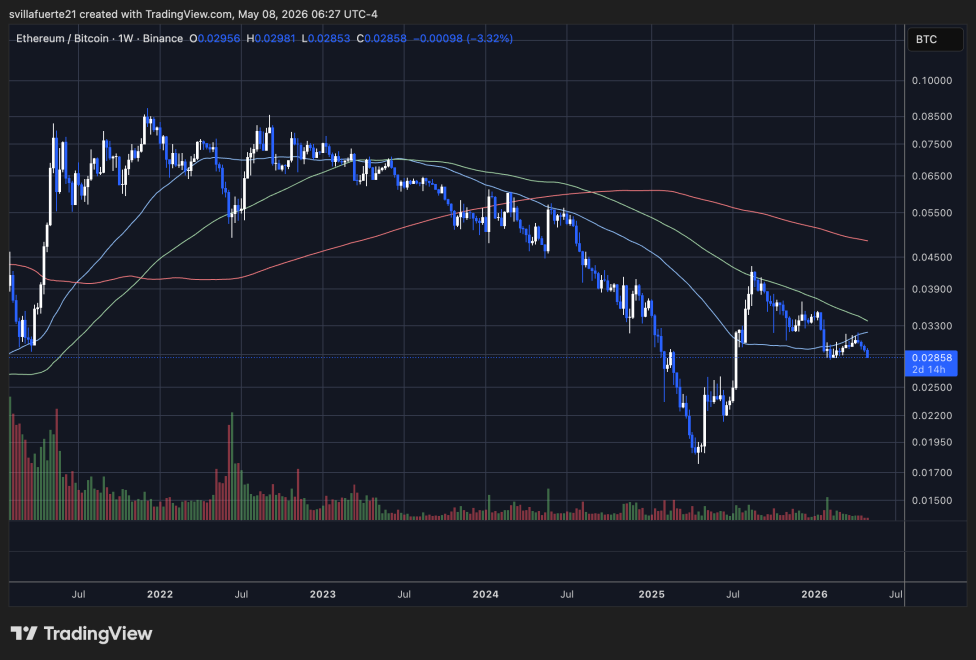
The ETH/BTC pair is trading near 0.0285, continuing to reflect Ethereum’s structural underperformance relative to Bitcoin. The weekly chart shows a clear downtrend that has been in place since mid-2022, defined by consistent lower highs and lower lows. The recent bounce from the 0.019–0.020 region marked a temporary relief rally, but it failed to break the broader bearish structure.
Ethereum loses ground against Bitcoin | Source: ETHUSDT chart on TradingView
Price is now consolidating below the 50-week and 100-week moving averages, both of which continue to slope downward and act as dynamic resistance. This positioning reinforces the idea that the recovery lacks strength. The 200-week moving average remains significantly higher, near the 0.045–0.050 zone, highlighting how far the pair is from reclaiming a neutral or bullish structure.
The rejection near the 0.035–0.038 region earlier this year is particularly important. That zone now defines the upper boundary of any medium-term recovery attempt. Since then, price has drifted lower, forming a compression pattern just above local support.
If the 0.027–0.028 level fails, the chart opens the path toward a retest of the cycle lows near 0.020. For Ethereum to reverse this trend, it would need to reclaim the 0.035 level with conviction — something the current structure does not yet support.
Featured image from ChatGPT, chart from TradingView.com
Editorial Process for bitcoinist is centered on delivering thoroughly researched, accurate, and unbiased content. We uphold strict sourcing standards, and each page undergoes diligent review by our team of top technology experts and seasoned editors. This process ensures the integrity, relevance, and value of our content for our readers.
A Manhattan federal judge has cleared the way for Aave’s recovery effort to move forward after last month’s North Korea-linked rsETH exploit, allowing $71 million in frozen ether to be transferred out of Arbitrum while preserving North Korean terrorism victims’ legal claim on the funds.
In a two-page order published late Friday U.S. time, Judge Margaret Garnett modified a restraining notice previously served on Arbitrum DAO to allow an onchain governance vote transferring the immobilized ETH to a wallet controlled by Aave LLC.
The order also shields participants from liability under the notice, stating that anyone who initiates, votes on or participates in the transfer would not violate the freeze.
Judge Garnett’s ruling follows an earlier off-chain Snapshot temperature check in which Arbitrum delegates overwhelmingly signaled support for returning the frozen ETH as part of Aave’s broader recovery plan. Any actual transfer, however, still requires a separate binding onchain governance vote.
The ruling resolves an immediate standoff that had threatened to derail a coordinated DeFi recovery effort after attorney Charles Gerstein, representing families holding roughly $877 million in unpaid terrorism judgments against North Korea, argued the frozen ETH could be seized because the exploit has been widely attributed to Lazarus Group, which is supported by Pyongyang.
Beyond the Arbitrum dispute
Gerstein’s move against Arbitrum fits into a broader legal strategy to pursue North Korean-linked assets as they surface on decentralized finance (DeFi) infrastructure.
In a separate January lawsuit, many of the same terrorism judgment creditors that went after Arbitrum sued Railgun DAO, alleging the privacy protocol allowed North Korean actors to move funds that should have been frozen and made available to creditors.
At the time, the plaintiffs claimed North Korean hackers used Railgun to launder funds from prior cyberattacks, including the $1.5 billion Bybit exploit, and argued the protocol should have frozen those assets rather than allowing them to move onward.
Once DPRK-controlled wallets were moving funds through the protocol, those assets became potential targets for collection, they argued.
In March, they asked a Washington federal court clerk to enter default against Railgun DAO after alleging the protocol failed to respond to the complaint despite being served. Their complaint also names Digital Currency Group, alleging the crypto investment firm’s $10 million purchase of Railgun governance tokens in 2022 made it a participant in the DAO’s governance and economics.
And in February, the plaintiffs moved to secure USDT that the U.S. government had sought to seize through a forfeiture motion.
Zest Equity, a digital transactional infrastructure company powering private-market transactions, has appointed Zeid Barghouti as the Senior Executive Officer of its FSRA-regulated entity, ZE Transaction Solutions Limited (“Zest ADGM”).
Zeid Bargouti, SEO at Zest Equity
Barghouti, who has served as the Senior Executive Officer of the ADGM-based entity since its inception, also acts as the Head of Business Development and Partnerships at Zest Equity. In this capacity, he is responsible for driving commercial growth across the firm’s SPV platform, managing strategic partnerships, overseeing client relationships, and spearheading market expansion across the MENA region.
In his formalized role as Senior Executive Officer, Barghouti will oversee Zest ADGM and support the ongoing development of its escrow and transaction facilitation solutions tailored for private markets.
Scaling regulated products
Zest Equity is actively building its presence as a foundational digital transactional infrastructure company. Built in the UAE and anchored within the ADGM’s regulatory framework, the company develops its core technology within the Dubai International Financial Centre (DIFC).
Since its founding, the Zest Equity group has digitized more than $230million in transactions across over 200 deals. Furthermore, the firm has received authorization from the FSRA for Zest ADGM to offer both its Zest Arrange and Zest Escrow products. Zest ADGM is fully regulated to deliver the firm’s payment services and arranging deals in investment services to clients across the MENA region and beyond.
Zuhair Shamma, co-founder and CEO of Zest Equity, noted that the appointment actively reflects the company’s commitment to building institutional-grade leadership.
“Zeid has been instrumental to the commercial development of Zest Equity, and the regulatory remit he now assumes is the natural next step as we scale the digital infrastructure underpinning private-market transactions,” Shamma stated. “His combination of regulatory experience and commercial acumen is exactly what this stage of the business demands. His leadership will be central as we scale the institutional infrastructure private markets require.”
A record in regulated financial services
Barghouti brings an established record in regulated financial services across the Gulf region. Prior to joining Zest Equity, he served as the Senior Executive Officer at Capital Investments DIFC Ltd and held senior treasury and financial institution roles within the Capital Bank Group. He also holds an MBA from the University of Manchester and a BSc in Business Management from the University of Surrey.
Commenting on his appointment, Barghouti emphasized the firm’s unique market position.
“Zest Equity occupies a distinctive position in the regional private markets landscape and Zest is a genuine foundation for institutional growth in the region’s private markets,” said Barghouti. “I look forward to contributing further to its development and to the firm’s broader commercial expansion across the region’s private-market ecosystem.”
A campaign to require the Swiss National Bank to hold Bitcoin is set to lapse after failing to gather enough signatures to trigger a national referendum, Reuters reported.
The initiative sought to amend Switzerland’s constitution to require the central bank to hold Bitcoin (BTC) alongside gold and foreign currency assets, but organizers said they collected only about half of the 100,000 signatures required under Swiss law.
The Swiss National Bank (SNB) has repeatedly opposed adding cryptocurrencies to its holdings, saying digital assets do not meet its reserve management standards due to concerns about volatility and liquidity, Reuters reported.
Campaign founder Yves Bennaim told Reuters the effort was always considered unlikely to succeed, but said the initiative helped advance debate around Bitcoin’s role in global finance.
Supporters of the campaign said Bitcoin could help diversify Switzerland’s reserves away from dollar- and euro-denominated assets, which Reuters said account for roughly three-quarters of the SNB’s foreign currency holdings.
Related: Bitcoin profit-taking may ‘accelerate’ as price hits 3-month high: Analyst
Countries experiment cautiously with sovereign Bitcoin reserves
While 2025 saw a wave of publicly traded companies adopt Bitcoin treasury strategies, sovereign adoption of Bitcoin as a reserve asset has remained limited.
El Salvador was the first country to formally adopt Bitcoin as part of a sovereign reserve strategy after President Nayib Bukele began government BTC purchases in 2021 alongside the country’s move to make Bitcoin legal tender. The country currently holds 7,645 BTC, according to data from BitcoinTreasuries.com.
Source: Nayib Bukele
Source: Nayib Bukele
Bhutan, also one of the world’s largest sovereign holders of Bitcoin, built much of its treasury through state-backed mining operations powered by surplus hydroelectric energy as part of a broader strategy to turn renewable energy into a digital export and expand the country’s role in crypto finance.
However, data from Arkham Intelligence shows Bhutan-linked wallets have sharply reduced their holdings in recent months, with reserves falling from around 13,000 BTC at the end of 2024 to roughly 3,654 BTC by April 2026 following a series of large transfers and apparent sales.
Unlike El Salvador and Bhutan, which actively accumulated Bitcoin through purchases or mining, the three largest sovereign Bitcoin holders — United States, China and the United Kingdom — primarily acquired their holdings through criminal seizures and forfeiture proceedings.
Top 5 countries holding Bitcoin. Source: Bitcointreasuries.net
Top 5 countries holding Bitcoin. Source: BitcoinTreasuries.net
On March 6, 2025, US President Donald Trump signed an executive order establishing a Strategic Bitcoin Reserve capitalized with government-held Bitcoin, stating that BTC held by the reserve “shall not be sold” and would be maintained as reserve assets of the United States.
While the executive order allows Treasury and Commerce officials to explore budget-neutral strategies for acquiring additional Bitcoin, the reserve is initially backed by BTC already held by the government through forfeiture proceedings.
Magazine: Adam Back says current demand is ‘almost’ enough to send Bitcoin to $1M
The partnership between FMSI and Bulldog Federal Credit Union (BFCU), announced on May 7, 2026, represents a critical shift for community-chartered financial institutions moving toward “lobby optimization.” For Bulldog Federal—which has grown from a specialized lender for Mack Truck employees to a $300 million asset institution—the implementation of RelationshipOS is designed to eliminate a legacy friction point: manual visit management. By integrating appointment scheduling and lobby management directly into a major website upgrade, BFCU is moving away from the “reactive” service model that many small credit unions have struggled with since the pandemic.
This deal is part of a broader “rebranding” of the 58-year-old institution. By adopting FMSI’s platform, BFCU is effectively “professionalizing” the branch experience to match the expectations of a modern, digitally-native membership. In a 2026 landscape where branch footprints are being scrutinized for their ROI, lobby management systems are no longer just administrative tools; they are data-rich platforms that provide visibility into member intent before they even walk through the door. For FMSI, which relaunched in late 2025 and already serves over 140 institutions, this partnership underscores the demand for “intentional” branch experiences that bridge the gap between digital discovery and in-person service.
FMSI, a provider of branch workforce management and lobby optimization solutions for financial institutions, today announced a new partnership withBulldog Federal Credit Union, a community-chartered credit union serving Washington County, Maryland since 1968.
Bulldog Federal, with approximately $300 million in assets, selected FMSI’s RelationshipOS for both appointment scheduling and lobby management as part of a broader website upgrade and member experience initiative. The credit union, which grew from its roots serving Mack Truck employees to a full community institution with 50 staff members, identified appointment scheduling as a long-standing gap — one that became especially apparent when COVID-era branch closures forced staff to manage visits manually with no scheduling infrastructure in place.
“We recognized that scheduling an appointment was an area that needed improvement,” said Stacy Wright, CEO of Bulldog Federal Credit Union. “With our website upgrade underway, the timing was right to fix that. Based on what we’ve seen from FMSI so far, I’m confident we’ll be happy with both the service and the product. I’d encourage any credit union CEO to reach out and see what FMSI can do for them.”
Gary Plummer, Chief Design Director at Bulldog Federal, said the decision came down to more than features. “We spoke with multiple vendors. FMSI came in better prepared and more professional, and the connection was real. When we invest in a partnership, we need that total buy-in from the other side and we felt it. This is part of a bigger story we’re telling about what Bulldog Federal Credit Union is in 2026 and beyond. We’ve been here since 1968, and we’re reintroducing ourselves to the community in a way that reflects who we are today.”
Bulldog Federal plans to go live with the new website and integrated scheduling in October. The credit union is currently in a testing phase, using the live site as a working platform to identify improvements before the full launch.
“Bulldog Federal has been serving their community for nearly 60 years, and they know their members well,” said Jacob Reeves, General Manager of FMSI. “What stood out to us was how intentional they are about this next chapter. They’re not just adding a scheduling tool. They’re rethinking how members experience the branch from the moment they decide to visit. That’s the right way to approach it.”
FF NEWS TAKE
FMSI is successfully positioning itself as the “member experience layer” for credit unions that are modernizing their physical and digital touchpoints simultaneously. The decision by BFCU to launch in October—using the live site as a working test platform—shows a sophisticated, agile approach to implementation that is rare for community credit unions of this size. Gary Plummer’s focus on the “professionalism and connection” of the FMSI team suggests that for mid-market institutions, the vendor relationship is just as important as the feature set.
However, the real test for Bulldog Federal will be in how they use the data generated by RelationshipOS. While a scheduling tool solves the immediate problem of manual tracking, the long-term value lies in workforce optimization—ensuring the right staff are available for high-value appointments like mortgages or commercial loans. If BFCU can leverage FMSI’s analytics to drive revenue and improve member retention, it will serve as a powerful case study for other $300M–$500M credit unions looking to “reintroduce themselves” to their communities in the late 2020s.