Bitcoin profit-taking could accelerate as BTC prices climb to three-month highs and investors begin locking in gains, according to Julio Moreno, head of research at onchain analytics platform CryptoQuant.
Holders realized 14,600 BTC in profits on Monday, or $1.1 billion, following Bitcoin’s April rally, Moreno said, adding that this is the “highest” single day of profit-taking since Dec. 10, when BTC was trading above $90,000.
Bitcoin holders’ realized profits spike after the April rally. Source: CryptoQuant
The Short-Term Holder Spent Output Profit Ratio (STH-SOPR), an onchain metric that gauges profit-taking by wallets that have held BTC for less than 155 days, also rose above 1, a level that indicates “clear profit-taking territory,” he added. He said:
“Bitcoin holders are realizing more than 20,000 BTC in net profits on a 30-day rolling basis, the first positive reading since December 22, 2025, following a period of heavy net losses in February and March that reached as deep as 398,000 BTC.”
Spikes in realized profit levels during crypto bear markets typically signal local price tops or sideways price action, Moreno said, adding that despite the rise in realized profits, demand has not caught up, and BTC remains in a bear market.
The Bitcoin Short-Term Holder Spent Output Profit Ratio signals that short-term holders are realizing profits. Source: CryptoQuant
Related: Bitcoin ‘supercycle’ or bear-market rally? BTC breaking $81K has traders at odds
Bitcoin ETF inflows remain strong, while analysts are divided on market health
Inflows into Bitcoin exchange-traded funds (ETFs) remain strong, with four days of positive inflows this week, according to Farside data.
ETF inflows for the week surged past $1 billion, before an outflow of $268.5 million on Friday, Farside’s data shows.
Analysts remain divided about whether BTC has bottomed out or whether the ongoing bear market will deepen.
Michael Terpin, an early Bitcoin investor, told Cointelegraph that BTC could bottom out at $57,000 in October 2026. The forecast is based on “historic” price patterns in which BTC hits its cycle low about one year after the cycle top, Terpin said.
There is a “chance” that Bitcoin might reclaim the $100,000 price level in 2026, but the odds are “unlikely,” Terpin told Cointelegraph.
Magazine: Bitcoin will not hit $1M by 2030, says veteran trader Peter Brandt
Estonia’s Financial Supervision and Resolution Authority (FSA), the country’s financial regulator, issued an investor warning for BB Trade Estonia OÜ, the company that operates the Zondacrypto digital asset exchange.
The FSA said the company did not have a white paper listed on its website for the “TeamPL” crypto token listed on the crypto exchange, a violation of the European Union’s Markets in Crypto-Assets (MiCA) regulatory framework. According to the FSA:
“This action violates Article 9, Section 1 of [MiCA], according to which crypto-asset white papers shall remain available on the website of the offerors or persons seeking admission trading for as long as the crypto-assets are held by the public.”
The investor warning for Zondacrypto and its parent company. Source: Estonia FSA
Cointelegraph reached out to Zondacrypto but did not receive a response by the time of publication.
The investor warning follows news of withdrawal issues at the Zondacrypto exchange and an investigation into the company by Polish law enforcement officials.
Related: Europe’s MiCA regime puts smaller crypto firms under pressure
Zondacrypto faces investigation following withdrawal and access issues
In April, Zonda CEO Przemysław Kral said the exchange did not have access to a cold wallet containing about 4,500 Bitcoin (BTC), valued at about $360 million at the time of writing.
Kral claimed that the wallet’s private keys were never handed over by Sylwester Suszek, the founder and former CEO of Zondacrypto, who has been missing since 2022. He also denied rumors that the exchange is insolvent, adding that it would meet all customer obligations.
Kral’s last post on the X social media platform was published on April 16, 2026. Source: Przemysław Kral
Polish investigators initiated a probe into the company in April, following reports from users of withdrawal issues and the inability to access funds.
Since that time, Kral has gone silent on social media, with no new posts since April 16. Local media outlets reported that he flew to Israel, where he is a citizen, amid the probe by Polish law enforcement.
In February, he told Cointelegraph that the company is based outside of Poland because the country has not brought its crypto regulations in line with the EU’s MiCA framework.
“Although we are a company with Polish roots and the largest player in the crypto industry on the Polish market, we have been operating outside Poland for years,” he said.
Magazine: Guide to the top and emerging global crypto hubs: Mid-2026
Bitcoin payments application Strike CEO Jack Mallers said that Wall Street’s growing involvement in Bitcoin poses no threat or conflict to the asset itself.
“My one-word answer to that is no,” Mallers told Danny Knowles on the What Bitcoin Did podcast published to YouTube on Thursday, in response to whether institutional involvement threatens Bitcoin’s core principles. “If Wall Street getting into Bitcoin kills it, it was never going to be successful in the first place,” Mallers said.
Jack Mallers spoke to Danny Knowles on the What Bitcoin Did podcast. Source: What Bitcoin Did
“Bitcoin is predicated on this idea that it is money for all. And the all part should be explored. That means your enemies, too,” he said. “That means the ex-wife that cheated on you, that means your neighbor that’s a fan of the opposing football club, that’s everybody,” he added.
Bitcoin is competing for global capital, says Mallers
Some Bitcoiners argue that Wall Street’s presence threatens Bitcoin’s original ethos by concentrating ownership, influence and custody of the asset in the hands of large financial institutions. Since spot Bitcoin ETFs launched in the US in January 2024, the 11 funds have collectively recorded $59.38 billion in net inflows as of Friday, according to Farside data.
However, Mallers said the “obvious implication” is that Wall Street and other major traditional investors would get involved in Bitcoin as the asset competes for global capital.
“Where wealth exists today, those things will be demonetized like real estate will be demonetized, fine art will be demonetized, government debt will be demonetized, and Bitcoin will be monetized,” he said.
Some Bitcoiners have argued that growing institutional involvement could eventually give large firms too much influence over Bitcoin itself. Bitcoiner and venture capitalist Nic Carter said that major Bitcoin-holding institutions may eventually lose patience with Bitcoin developers for not addressing quantum computing concerns quickly enough. “I think the big institutions that now exist in Bitcoin, they will get fed up, and they will fire the devs and put in new devs,” Carter said in February.
Wall Street moves in on crypto platforms’ customers
There have been several developments in Wall Street’s adoption of Bitcoin and, more broadly, crypto over the past couple of years.
Related: CLARITY Act support carries electoral boost, HarrisX poll finds
Most recently, on Tuesday, it was reported that Morgan Stanley rolled out a cryptocurrency trading pilot on its E*Trade platform, charging lower basic retail fees than some of the largest US crypto and brokerage platforms.
The Wall Street bank is charging clients 50 basis points on the dollar value of each crypto transaction, undercutting Coinbase, Robinhood and Charles Schwab on standard retail pricing.
Magazine: Guide to the top and emerging global crypto hubs: Mid-2026
Tron, Cardano and Solana led weekly gains among the Top 10, while Bitcoin and Ether lagged as US spot ETF demand cooled on Thursday.
Crypto markets were mostly unchanged on Friday as Bitcoin hovered around the $80,000 level and spot ETF flows turned negative for the first time this month.
BTC is trading at $79,938, down 0.3% on the day but still up 2.1% over the past week, according to CoinGecko. Ether slipped 0.8% to $2,281, extending a weekly decline of 1.1% and continuing to lag behind Bitcoin.
BTC Chart
Tron led the Top 10 over the past week with a 7.2% gain. Cardano added 6.6%, while Solana climbed 5.7% to $89. Hyperliquid’s HYPE rose 4% to $42.61, and BNB added 3%.
ETF Flows
US spot Bitcoin ETFs recorded $277.5 million in net outflows on Thursday, ending a five-day run that pulled in roughly $1.69 billion in fresh capital, according to SoSoValue.
Spot Ethereum ETFs followed the same script, registering $103.52 million in outflows after a four-day inflow streak that brought in $271.6 million. The funds now hold $13.6 billion in total net assets.
Crypto Languishes as Stocks Post Records
The crypto pullback is unfolding against another bullish session in US equities. The S&P 500 climbed 0.8% to 7,395, while the Nasdaq Composite gained 1.4% and traded above 26,000 for the first time, putting both indexes on track for a sixth straight weekly gain, the longest winning streak since October 2024.
The rally has been powered by a combination of strong corporate earnings and resilient labour data. The US added 115,000 jobs in April, well above the 65,000 expected, while unemployment held steady at 4.3%. Of the 440 S&P 500 companies that have reported first-quarter results, 83% have topped analyst estimates, with Nvidia and Apple each climbing more than 2% on the day.
The geopolitical backdrop remains volatile. The United States and Iran exchanged fire in the Strait of Hormuz on Thursday, raising fears that the fragile April 8 ceasefire could collapse, with US Central Command reporting strikes on Iranian military facilities at Bandar Abbas and Qeshm Island.
Inflation and Iran Response in Focus
Traders are now turning their attention to April’s Consumer Price Index, scheduled for release on Tuesday, May 12, after March’s print of +3.3% year-on-year marked the highest annual reading since May 2024, driven by rising energy prices tied to the Middle East conflict.
Iran’s response to the latest US peace proposal could land at any moment, with Washington signalling it expects an answer today. A constructive outcome would likely cement the recent oil pullback and extend the rally, while a breakdown risks reversing the macro tailwind that has supported risk assets this week.
The appointment of Batsheva Moshe as General Manager of Israel and EMEA Tech signals a pivotal moment for Kaltura as it transitions from a “video platform” to an “Agentic Digital Experience” powerhouse. This shift, announced on May 7, 2026, marks Kaltura’s aggressive pivot toward AI-driven, autonomous interactions. By recruiting Moshe—a heavy hitter from Wix Enterprise and Poalim Tech—Kaltura is signaling its intent to dominate the “human-to-machine” interaction layer across the EMEA region. This is not just a leadership change; it is the operationalization of a strategy built on recent multi-million dollar acquisitions.
Kaltura’s recent $27 million purchase of eSelf.ai and the $22 million acquisition of PathFactory provide the technical bedrock for this new era. These deals integrated multimodal conversational AI and digital journey orchestration directly into Kaltura’s infrastructure. In a 2026 market where “one-size-fits-all” digital experiences are being replaced by personalized, agentic ones, Moshe’s mandate is to take these high-fidelity AI avatars and “Genie” agents to market. Her deep connections in the Israeli tech ecosystem and her track record of scaling enterprise sales are critical for converting these advanced AI capabilities into sustainable revenue growth across marketing, sales, and employee training sectors.
Batsheva Moshe has been appointed to GM Israel market and EMEA Tech at Kaltura, the Agentic Digital Experience company. In her new role, Batsheva will lead Kaltura’s Go-To-Market operations in Israel, overseeing sales strategy, field sales, and strategic partnerships. Additionally, she will spearhead the company’s growth and expansion within the technology sector across the EMEA region.
This appointment comes at a unique time at Kaltura which is expanding from powering video experiences for large enterprises, to powering end-to-end agentic digital experiences across organizational journeys, for customers, employees, learners, and audiences. This transformation is fueled in part by Kaltura’s recent acquisitions of eSelf.ai, which provides multimodal conversational technology for agentic interactions with live avatars, and PathFactory, a leader in AI-driven content intelligence, digital journey orchestration, and conversation automation for enterprises. Kaltura’s expanded product portfolio increases its applicability to ISVs across Israel and EMEA.
Batsheva is an Israeli influential and respected leader across the business and social sectors. Over the past four years, she served as the General Manager for Israel, Middle East, Eastern Europe and the Nordics, at Wix Enterprise. In this role, she led the enterprise regional growth strategy while managing business development, strategic partnerships, enterprise sales, and delivery teams. Alongside her executive leadership roles, Batsheva serves as a Board Member at Alony Hetz, a major publicly traded real estate investment group.
Prior to joining Wix, Batsheva headed Poalim Tech, the dedicated tech-banking arm of Hapoalim Bank, and before that as the Chief of Staff to the Bank’s Chairman. She began her professional leadership journey as the CEO of Unistream, an award-winning NGO dedicated to bridging Israel’s geographical and social periphery by empowering youth and young adults through entrepreneurship and tech literacy.
Complementing her extensive business career, Batsheva is deeply committed to driving socio-economic impact. She serves as the Chairperson of “Yozmot Atid”, an organization that has empowered thousands of women to achieve financial independence by establishing and scaling small businesses. Furthermore, she serves on the boards of leading educational, employment, and technology institutions, including Ofanim (promoting STEM education), Madatech (Israel’s National Museum of Science), Sapir College, Or Movement, and the ICA Philanthropic Fund, which invests in employment, agriculture and education in the periphery.
“Batsheva brings a rare combination of strategic vision, operational excellence, and multi disciplinary experience across diverse markets, alongside a profound commitment to impact. Her leadership and proven ability to drive organizational growth, coupled with her track record in building high-performing teams, make her uniquely suited to establish and lead Kaltura’s new Go-To-Market operations in Israel and expand our footprint within the EMEA tech sector,” said Ron Yekutiel, Co-founder, President, Chairman and CEO of Kaltura. “As we continue to scale our agentic digital experience platform, her expertise at the intersection of technology, business, and impact will be instrumental in driving our next phase of growth.”
Kaltura’s mission is to power rich, agentic digital experiences across organizational journeys for customers, employees, learners, and audiences. Its platform combines intelligent content creation, enterprise-grade content management and intelligence, and multimodal conversational engagement capabilities. Kaltura serves leading enterprises, financial institutions, educational institutions, media and telecom providers, and other organizations worldwide.
FF NEWS TAKE
Kaltura is effectively rebranding itself as the “Operating System for AI Agents.” While competitors are still focused on basic generative text, Kaltura is betting on multimodal avatars that can “see” screens, understand context, and drive outcomes. The hire of Batsheva Moshe is a “credibility play” designed to reassure large enterprises that this high-tech transition is backed by a leader who understands the conservative requirements of the banking and real estate sectors. Moshe’s background as CEO of Unistream and Chairperson of Yozmot Atid also aligns with a broader corporate trend: the merging of high-scale tech growth with measurable socio-economic impact.
However, the challenge for Kaltura lies in the complexity of its new “Agentic” portfolio. Moving from selling video hosting to selling autonomous digital journeys requires a massive shift in sales DNA. To succeed, Moshe must build teams that can sell “outcomes” rather than “features,” proving that Kaltura’s avatars can genuinely reduce ticket resolution times and boost lead conversion as promised. With Kaltura’s shares recently soaring 30% following the eSelf.ai acquisition, the pressure is on Moshe to turn this market momentum into a dominant, long-term foothold in the EMEA technology landscape.
Despite current challenges in the region, what has been the ecosystem of fintech been like in 2026 for the Middle East nation of Lebanon?
Lebanon has occupied a complicated place in the Middle East’s economic imagination. It has long combined entrepreneurial energy, banking sophistication and diaspora capital with political fragility, periodic conflict and, in recent years, one of the world’s most severe financial collapses. Through previous analysis and coverage, the country’s fintech ecosystem was developing not in spite of crisis, but partly because of it.
In 2026 that remains true. Lebanon’s fintech and wider digital ecosystem is still constrained, uneven and trust-deficient, yet it is also more active, more payments-focused and more institutionally relevant than it was a few years ago.
The macroeconomic backdrop remains difficult. The World Bank’s Lebanon data page shows gross domestic product (GDP) at over $20billion and GDP per capita at roughly $3,478. Saying that, the World Bank’s 2026 macro note points to nominal GDP of over $30billion and GDP per capita over $5,200 for last year. This is a reflection of inflation, exchange-rate effects and the unusual structure of Lebanon’s crisis-era economy rather than a straightforward return to prosperity.
Services still dominate the economy, with trade, tourism, real estate, finance, and remittance-linked consumption playing central roles. Beirut remains the country’s financial hub, and despite the banking sector’s collapse in public trust, institutions such as BLOM Bank and Bank Audi remain among the best-known names in the market.
Fintech ecosystem during times of crisis
Beirut – the capital and largest city of Lebanon IMAGE SOURCE GETTY
That wider backdrop helps explain why Lebanon’s fintech ecosystem this year is best understood as a pragmatic, crisis-shaped market rather than a conventional startup success story. The World Bank noted in its 2024 Lebanon Systematic Country Diagnostic that electronic wallet services were authorised in 2021 and that several licensed non-bank payment providers now operate in the market.
Since then, digital wallets, payment processors and merchant-enablement platforms have become more visible, even as deeper fintech verticals such as wealthtech or open banking remain underdeveloped. In practical terms, Lebanon now has a small but meaningful fintech layer built around wallets, merchant payments, processing, remittances and financial access tools. It has seen even digital currencies such as cryptocurrencies play a large role in daily life, driving mainly in the instability of the financial system in recent memory.
If there is a defining story here, it is payments. Banque du Liban (the country’s central bank) has continued to regulate and formalise the sector, including through its January 2026 Basic Circular No. 1 on electronic payment service providers, which set out licensing categories, annual fees and operational requirements for payment institutions. This matters because, in Lebanon, digital finance is not yet primarily about full-spectrum neobanking. It is about rebuilding transactional capability in a country where the traditional banking system lost credibility after 2019. The Banque du Liban is therefore trying to create a more structured payment-services environment, even while wider banking-sector restructuring remains unresolved.
The market is also producing some identifiable fintech and fintech-adjacent players. For example, MyMonty has positioned itself as a multi-currency digital wallet in Lebanon offering transfers, payments and access to credit products. In July last year, Mastercard and MyMonty announced a collaboration to accelerate digital payment adoption and financial inclusion in Lebanon.
Besides MyMonty, there is also PinPay, which is listed by Lebanon’s Ministry of Economy as a licensed mobile payment service owned and operated by Bank Audi and BankMed. There is also, Areeba, which continues to play an important infrastructure role by enabling banks, fintechs, governments and businesses to enter the digital payments space.
Financial and digital inclusion
Financial inclusion, however, remains one of Lebanon’s weakest metrics. Based on the World Bank’s Global Findex 2025, in 2024 only 23 per cent of adults in Lebanon had an account with a bank, financial institution or mobile money. This was up only 2 percentage points (21 per cent) in 2021. That is extraordinarily low for a country once known for banking sophistication. The problem is not simply infrastructure; it is trust. Years of frozen deposits, currency collapse and institutional failure have deeply damaged confidence in formal finance. Fintech in Lebanon is therefore operating in a paradox: it is needed precisely because the traditional system failed, but it must also grow in a market where faith in formal financial intermediation has been badly eroded.
Beyond private-sector fintech, Lebanon’s wider digital transformation agenda has moved forward this year. This past January, the World Bank approved a $150million Lebanon Digital Acceleration Project as part of a broader $350million financing package, with the project designed to improve access to government services, expand economic opportunities, and strengthen digital platforms and data capabilities. That matters because fintech growth in Lebanon will depend not just on wallets and merchants, but on broader digital infrastructure, public-sector platforms and a more secure enabling environment. The project also aligns with the country’s longer-term digital transformation agenda, which has increasingly framed digital public services as part of economic recovery rather than a separate reform track.
Still, Lebanon’s 2026 story cannot be separated from politics and security. The renewed war between Israel and Hezbollah was pushing Lebanon’s fragile state and society towards breaking point, deepening sectarian and political fractures. Much of the Middle East, and the global economy for that matter, has felt the effects of the wider conflict with Iran. However, Lebanon has also faced much of the brunt.
That is what makes Lebanon’s fintech story so unusual. It is not a tale of clean growth curves or orderly reform. It is a story of adaptation under pressure. This sees the likes of digital wallets, payment processors and digital public infrastructure trying to fill some of the gaps left by a broken financial system and a fragile state.
Lebanon’s relevance lies not in market scale, but in the intensity of the problems its innovators are trying to solve. The country’s fintech ecosystem remains constrained, but it is no longer peripheral. It has become part of the country’s survival logic. In summary, Lebanon’s next phase will depend less on hype and more on whether digital finance can help rebuild everyday trust, access and institutional credibility.
The President of the European Central Bank spoke against EUR-pegged stablecoins at the inaugural Banco de España LatAm Economic Forum today.
European Central Bank President Christine Lagarde spoke out against the development of EUR-pegged stablecoins in a speech earlier today, May 8, at the inaugural Banco de España LatAm Forum in Spain.
Lagarde argues that stablecoins perform two distinct functions: a monetary one, extending a currency’s global reach, and a technological one, enabling settlement in tokenized financial markets. In her speech, the ECB President said that conflating functions would lead Europe toward the wrong solution.
On the monetary side, Lagarde argued that EUR stablecoins aren’t an efficient way to increase euro dominance:
“If we want to strengthen the international appeal of the euro, stablecoins are not an efficient way of doing so.”
She argued that the risks to financial stability and monetary policy transmission outweigh any short-term gains, pointing to USDC’s brief depeg during the 2023 Silicon Valley Bank collapse as an example of risk to financial stability.
On the technology side, Lagarde expressed skepticism toward making stablecoins, which she also referred to as “private liabilities,” the foundation for transaction settlement. What’s needed, she argued, is public infrastructure:
“Instead, we must build the public infrastructure that will enable alternative instruments, such as stablecoins and other forms of tokenised money, to operate within a framework anchored by central bank money.”
Lagarde acknowledged the efficiencies of using blockchain, referred to in the speech as DLT (distributed ledger technology), especially for tokenization, arguing that the technology is “reshaping monetary demand and transforming settlement infrastructure.”
Instead of stablecoins, the ECB President refers to a future in which “central bank money is available natively on-chain,.” While the speech doesn’t explicity refer to a central bank digital currency (CBDC), the wording appears to be referring to something similar, a wholesale central bank settlement layer available natively on distributed ledgers, via the ECB’s Pontes and Appia projects. In that setup, private instruments like stablecoins and tokenized deposits operate on top of a central bank anchor rather than replacing it.
The speech lands as dollar-denominated stablecoins continue to overwhelm their euro rivals. As The Defiant reported, euro-pegged stablecoins ended 2025 at just 0.18% of total stablecoin supply, even as the broader market crossed $310 billion.
MiCA, which brought a broad crypto regulatory framework to the EU, including for stablecoins, reshaped the European market but didn’t close the gap with dollar tokens.
Friday’s remarks from the ECB President extend a running ECB concern: the bank has previously warned about stablecoins threatening financial stability, arguing that a loss of confidence in stablecoin redemptions could trigger a fire sale of reserve assets and destabilize the U.S. Treasury market.
This article was written with the assistance of AI workflows. All our stories are curated, edited and fact-checked by a human.
CFI Financial Group, a global provider of online trading services, has officially received regulatory authorization from the Banco Central do Brasil.The approval allows the firm to operate as a fully licensed securities brokerage firm, known locally as a Corretora de Títulos e Valores Mobiliários.
The newly acquired license enables CFI to provide Brazilian investors with access to a diverse suite of financial instruments, which includes equities and fixed-income securities.
According to the company, this milestone marks its strategic entry into one of Latin America’s most prominent financial markets. It also reinforces CFI’s broader strategy of scaling its global footprint through regulated, locally established operations.
Capitalising on a maturing market
Ziad Melhem, CEO of CFI Financial Group
Brazil currently stands as the largest economy in Latin America and hosts one of the region’s most sophisticated capital markets. The country’s main stock exchange, B3, boasts over 5 million active traders and investors. Over the past five years, retail participation in the country has grown steadily, representing structural, long-term engagement with daily trading volumes reaching billions of reais.
To cater to this evolving market demand, CFI’s local integration strategy includes:
Delivering institutional-grade execution and access for traders and investors.
Building a dedicated local operating structure featuring Brazilian leadership and specialized client service.
Establishing strategic partnerships with local fintechs and content platforms.
Providing highly localized educational content, including Portuguese-language research, market insights, and financial literacy initiatives.
Ziad Melhem, CEO of CFI Financial Group, highlighted the strategic importance of the region.
“Brazil represents an important pillar in our global expansion, and this step reflects our focus on building a strong, licensed, and locally grounded presence,” Melhem said. “The market has reached a level of maturity where clients are looking for more than access; they are looking for depth, transparency and a platform that can support more sophisticated trading needs.”
Melhem added that the firm is grateful to the Banco Central do Brasil for its support and its dedication to fostering a robust financial ecosystem.
A growing global footprint
With this latest authorization, CFI Financial Group now holds 15 regulatory licenses worldwide. Its operations span multiple stringent regulatory frameworks globally, including the Financial Conduct Authority (FCA) in the UK, the Capital Market Authority (CMA) in the UAE, and CySEC in Cyprus.
Established in 1998, the online trading broker currently operates from key international locations including London, Dubai, Abu Dhabi, and Bogotá.
US spot Bitcoin exchange-traded funds (ETFs) have recorded a sixth consecutive week of net inflows, marking the longest such streak since August 2025.
The current six-week run stretches from the week of April 2 through Friday, pulling in a combined $3.4 billion, according to data from SoSoValue. The strongest week came in mid-April, when inflows hit $996.38 million for the week of April 17, while the streak’s weakest showing was the week of April 2 with just $22.34 million. The most recent week logged $622.75 million.
The run marks the longest streak of consecutive net weekly inflows in more than nine months, when a 7-week ran from June 13 to July 18, 2025, drew in roughly $7.57 billion, including $2.72 billion for the week of July 11 and $2.39 billion the following week.
Bitcoin ETFs weekly inflows. Source: SoSoValue
Notably, last week ended on a sour note, with outflows of $277.50 million on Thursday and $145.65 million on Friday. Monday and Tuesday had led the week strongly, pulling in $532.21 million and $467.35 million respectively, before Wednesday’s inflows slowed sharply to $46.33 million ahead of the late-week reversal.
Related: Bitcoin ETFs Extend Rally as Two-Day Inflows Near $1 Billion
Markets on edge as jobs data looms: Analyst
Markets entered Friday cautiously as investors braced for the US April Non-Farm Payrolls report, with consensus estimates pointing to payroll growth of just 62,000, well below the previous reading of 178,000, reinforcing expectations of a cooling labor market, Bitunix analysts wrote in a note shared with Cointelegraph.
The analysts noted that a stronger-than-expected ADP report of 109,000 jobs earlier in the week complicated the picture, leaving traders uncertain about the true state of employment heading into the release.
“On the geopolitical front, although the US and Iran have once again exchanged fire around the Strait of Hormuz, both sides continue to leave room for negotiations,” Bitunix wrote, adding that reports suggest the US and Iran may have reached a partial understanding on certain maritime issues.
In crypto, Bitcoin slipped below $80,000 on Thursday, with liquidation heatmaps showing heavy liquidity clustering around $78,000. A breakdown below that level could trigger cascading liquidations, while dense short positioning between $82,000 and $83,000 keeps the market stuck in a tug-of-war, the analysts wrote.
Related: Bitcoin Slips Below $80K As Spot ETF Inflows Top $1B
Ether ETFs post $70 million in weekly inflows
Meanwhile, Ether ETFs returned to positive territory for the week ending May 8, posting $70.49 million in net inflows after the previous week logged $82.47 million in outflows. The rebound follows a strong three-week run from April 10 to April 24, which drew in a combined $617.91 million, peaking at $275.83 million the week of April 17.
On a daily basis, Thursday saw $103.52 million in outflows, nearly wiping out gains built earlier in the week. Monday and Tuesday attracted $61.29 million and $97.57 million in inflows, respectively, before Wednesday slowed to $11.57 million. Friday’s $3.57 million recovery left the week positive.
Magazine: Guide to the top and emerging global crypto hubs — Mid-2026
Trusted Editorial content, reviewed by leading industry experts and seasoned editors. Ad Disclosure
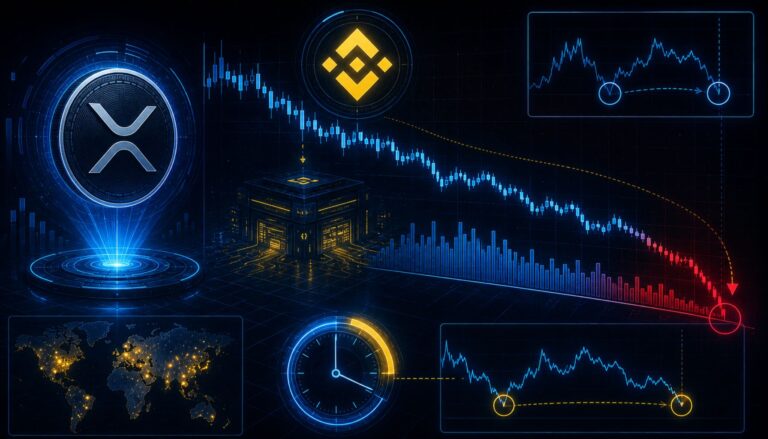
XRP is struggling to hold above $1.37 as the market cools following a period of cautious recovery that has now run into the same resistance that has capped multiple previous attempts at higher levels. The price is under pressure, and a CryptoQuant analysis tracking Binance derivatives activity has identified a condition in the speculative market that adds a specific structural context to the current weakness.
XRP perpetual trading volume on Binance reached approximately $372 million on May 7. That figure requires a historical reference to feel significant: on October 25, 2024, the equivalent reading was approximately $242 million — a period that the analysis identifies as one of the quieter low-volume zones in XRP’s recent derivatives history. The current reading is higher than that October level, but not by the kind of margin that would suggest a meaningful recovery in speculative participation. It remains within the same historically muted range.
That proximity to a 19-month low in derivatives activity is the structural finding that contextualizes the current price weakness. When perpetual volume is this subdued, it reflects a derivatives market where short-term trader interest has not recovered — where the speculative conviction required to drive sustained directional moves in either direction is largely absent.
XRP at $1.37 is not simply facing selling pressure. It is facing selling pressure in a market thin enough that moderate flows in either direction carry disproportionate influence over what happens next.
No Crowding. No Excess. Just Quiet — and What Quiet Has Meant Before
The CryptoQuant analysis frames the low volume reading as a gauge of market psychology rather than simply a trading statistic. Binance perpetual volume is one of the most direct measures of short-term trader intent available. When it expands sharply, it reflects a market where participants are willing to take leveraged directional bets — where conviction is high enough to justify the cost of derivatives exposure. When it stays near historical lows, it describes the opposite: hesitation, reduced risk appetite, and a market that has not yet decided which direction is worth betting on.
The October 2024 comparison is the detail that prevents the current low volume from being read as simply negative. That period was not a structural breakdown in XRP’s derivatives market — it was a quiet zone that preceded a much stronger expansion in trading activity. The low volume did not persist. It was eventually replaced by the kind of aggressive speculative participation that produces the high-volatility phases XRP is known for.
The current structure — $372 million in perpetual volume, close to but above the October 2024 lows — describes a market that is not overheated. There is no crowded positioning to unwind, no excess leverage to flush, and no speculative frenzy inflating the current price level. What exists instead is a low-activity environment where the next expansion in derivatives participation has not yet begun.
Whether that expansion arrives with buyers or sellers is the question the current volume level cannot answer. What it does confirm is that the market has room to move in either direction without the friction of unwinding an overcrowded trade first.
XRP Consolidates Below Resistance As Momentum Stalls
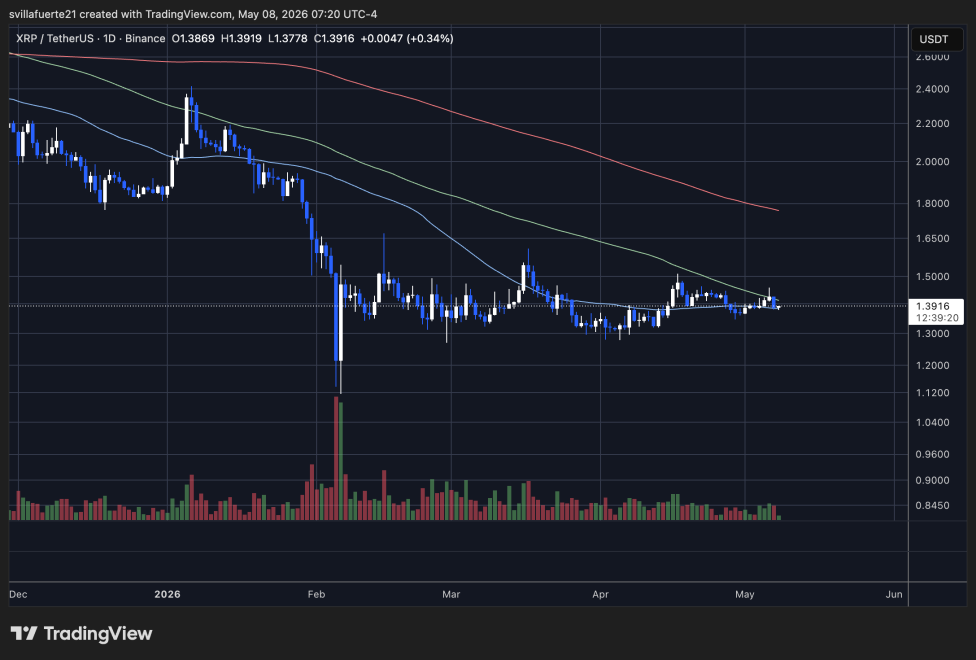
XRP continues to trade in a compressed range around $1.39, reflecting a market that has stabilized after the sharp February breakdown but has yet to establish a clear recovery trend. Price action shows repeated rejection near the descending short-term moving average, which is now acting as dynamic resistance and capping upside attempts.
The broader structure remains weak. XRP is still trading below the 100-day and 200-day moving averages, both of which slope downward, confirming that the dominant trend has not shifted despite the recent stabilization. Each rally into the $1.45–$1.50 region has been sold into, reinforcing the presence of persistent supply overhead.
At the same time, downside pressure appears to be moderating. The $1.30–$1.35 zone has consistently absorbed selling, forming a short-term base where buyers step in with increasing frequency. This compression between resistance and support is tightening volatility and typically precedes a directional move.
Volume trends support this interpretation. Activity has declined notably compared to the capitulation phase in February, suggesting that neither buyers nor sellers currently have strong conviction. This lack of participation leaves XRP sensitive to relatively small inflows or outflows.
Until price reclaims the descending moving averages with volume confirmation, the structure remains neutral-to-bearish despite the ongoing consolidation.
Featured image from ChatGPT, chart from TradingView.com
Editorial Process for bitcoinist is centered on delivering thoroughly researched, accurate, and unbiased content. We uphold strict sourcing standards, and each page undergoes diligent review by our team of top technology experts and seasoned editors. This process ensures the integrity, relevance, and value of our content for our readers.