US nonfarm payrolls revealed that the economy added far more jobs than expected in April, despite ongoing inflation pressure thanks to the Iran war.
The Bureau of Labor Statistics reported 115,000 jobs — far beyond the expected 65,000.
“The change in total nonfarm payroll employment for February was revised down by 23,000, from -133,000 to -156,000, and the change for March was revised up by 7,000, from +178,000 to +185,000,” an accompanying news release stated.
“With these revisions, employment in February and March combined is 16,000 lower than previously reported.”
US civilian unemployment rate. Source: BLS
The unemployment rate remained unchanged at 4.3%.
Bitcoin initially fell on the numbers, as outperformance implied less need for the Federal Reserve to relax financial policy.
As Cointelegraph reported, the Fed made it clear at its latest meeting on interest rates that conditions were conducive to tightening, and that rate cuts were unlikely.
The latest data from CME Group’s FedWatch Tool reflected market expectations of a potential rate hike at the Fed’s next meeting on June 17.
Fed target rate probabilities for June 17 FOMC meeting (screenshot). Source: CME Group
BTC price sees “healthy bullish backtest”
Among traders, the mood was one of cautious optimism with acceptance that recent gains may not hold for long.
Related: Bitcoin Bollinger Bands push key breakout as creator acts on positive signal
“Retesting the highs from the previous consolidation,” Daan Crypto Trades summarized in his latest X analysis.
“Good bounce so far but this is a key level for the bulls to hold.”
Trusted Editorial content, reviewed by leading industry experts and seasoned editors. Ad Disclosure
With less than six months until US voters pick their next Congress, political action committees backed by crypto are making clear they intend to shape who gets elected — and who doesn’t.
A War Chest With Deep Pockets
Fairshake, a PAC funded by crypto companies, and two of its affiliates reported $7.2 million in media spending this week alone, targeting congressional races in Georgia, Alabama, Nebraska, Kentucky, and Texas.
The money came through two separate arms: Protect Progress, which backs Democratic candidates, and Defend American Jobs, which supports Republicans. Together, they reflect a deliberate effort to build influence on both sides of the aisle.
The numbers behind Fairshake are hard to ignore. According to federal filings, the group held more than $190 million as of January. In the 2024 election cycle, its affiliates burned through more than $130 million on political advertising.
That spending is widely credited with shifting the composition of the current Congress — the same body now weighing crypto legislation.
This is another promise kept by President Trump, ensuring America remains the global home of crypto and digital assets for generations to come.
— Congressman Andy Barr (@RepAndyBarr) July 17, 2025
Kentucky Republican Andy Barr pulled in the largest single chunk of this week’s spending. Defend American Jobs directed more than $3.5 million in media support toward his US Senate campaign.
Barr has been a consistent advocate for crypto-friendly policy in Congress, voting in favor of both the GENIUS Act and the CLARITY Act.
Targeting An Incumbent
Not all the money is going toward friendly faces. Protect Progress has set its sights on Representative Al Green of Texas, a Democrat seeking a 12th term in office.
The PAC pledged $1.5 million to block his return to Congress, calling him hostile to Texas’s crypto community. Green faces a May 26 runoff against Christian Menefee, who has received about $1.6 million in combined PAC support alongside Georgia Democrat Jasmine Clark.
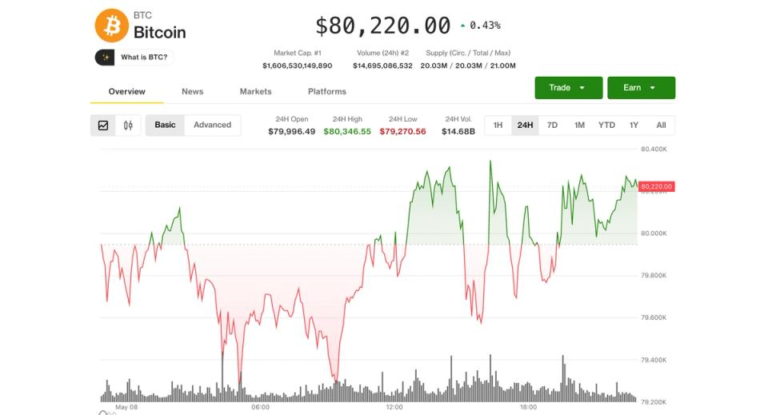
BTCUSD currently trading at $80,223. Chart: TradingView
Clark faces her own primary on May 19 in Georgia’s 13th Congressional district. Both candidates were backed through Protect Progress filings submitted to the Federal Election Commission this week.
Reports indicate Defend American Jobs also spent around $514,000 earlier this cycle supporting Republican James Baird’s reelection bid in Indiana — a race Baird went on to win.
Legislation As The Measuring Stick
The CLARITY Act — a digital asset market structure bill — is shaping up to be a key issue heading into November.
The bill recently cleared a Senate hurdle after lawmakers reached a compromise on stablecoin yield rules, though the Senate Banking Committee had not yet scheduled a markup vote as of Thursday.
Cody Carbone, CEO of The Digital Chamber, a crypto advocacy group, told reporters the stakes are high.
“I do think it is critically important that every single member of Congress have a position on crypto,” he said. “It’s part of their election campaign and their platform, and voters are going to be paying attention to this.”
Featured image from Getty Images, chart from TradingView
Editorial Process for bitcoinist is centered on delivering thoroughly researched, accurate, and unbiased content. We uphold strict sourcing standards, and each page undergoes diligent review by our team of top technology experts and seasoned editors. This process ensures the integrity, relevance, and value of our content for our readers.
Trusted Editorial content, reviewed by leading industry experts and seasoned editors. Ad Disclosure
Bitcoin has seen a pullback to levels below $80,000 as netflow data related to the US spot ETFs shows the exit of a notable amount of capital.
Bitcoin Spot ETF Netflow Has Broken Its 5-Day Green Streak
According to data from SoSoValue, the Bitcoin spot exchange-traded funds (ETFs) have just registered a red day. The spot ETFs refer to investment vehicles that allow investors to gain indirect exposure to the cryptocurrency. Whenever a trader invests into one of these products, the fund buys and custodies the digital asset on their behalf. This makes it so that the holder still gains exposure to the cryptocurrency’s price movements without having to interact with any blockchain element at all.
In the United States, the Securities and Exchange Commission (SEC) approved the spot ETFs back in January 2024. Since the spot ETFs allow for indirect investment, they have gained popularity among the more traditional traders like institutional entities, who can be cautious about digital asset infrastructure like wallets and exchanges. This traction has made the spot ETFs one of the cornerstones of the sector despite being active for only 2+ years.
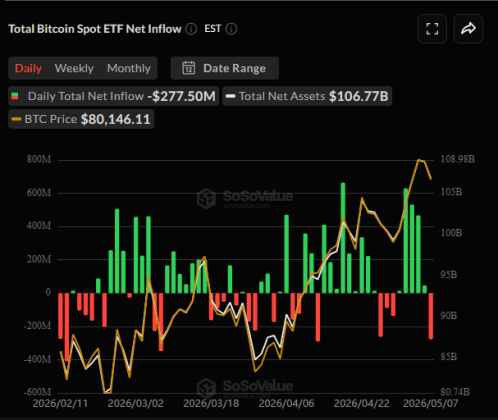
Below is a chart that shows how the netflow of the US Bitcoin spot ETFs has changed over the last few months.
The value of the metric seems to have just turned negative | Source: SoSoValue
As displayed in the graph, the Bitcoin spot ETFs have mostly seen net inflows recently, a behavior convergent with the wider trend of recovery in the digital asset sector. April only witnessed net outflows on seven days, with the scale of withdrawals involved being notably lower than the average inflows for the month.
The month ended with a three-day net outflow spree, but the start of May came with a return of bullish momentum as these funds went on a 5-day green streak. Alongside this spike in interest from institutional traders, BTC observed a rally toward the $83,000 level.
In the past day, however, market winds have changed once more. From the chart, it’s visible that spot ETFs have broken their positive netflow run with a notable red spike. In total, $277 million exited across the funds with these outflows. The Bitcoin price has retraced back below $80,000 alongside the development.
While the outflows aren’t negligible in size, they have still not been enough to overturn the net inflows that the spot ETFs have enjoyed recently; this week’s netflow still stands at a positive $768 million.
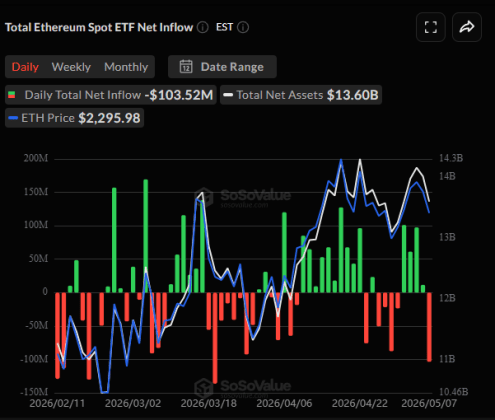
The US Ethereum spot ETFs also saw a red spike on Thursday, with over $103 million in capital exiting the funds.
How the daily netflow has looked for the ETH funds | Source: SoSoValue
Unlike for Bitcoin, though, the outflows have been strong enough to neutralize the recent inflows for Ethereum as the weekly netflow has dropped to a value of just $66 million.
BTC Price
At the time of writing, Bitcoin is trading around $79,800, up 3.5% over the past week.
The trend in the price of the coin over the last five days | Source: BTCUSDT on TradingView
Featured image from Dall-E, chart from TradingView.com
Editorial Process for bitcoinist is centered on delivering thoroughly researched, accurate, and unbiased content. We uphold strict sourcing standards, and each page undergoes diligent review by our team of top technology experts and seasoned editors. This process ensures the integrity, relevance, and value of our content for our readers.
LayerZero Labs acknowledged a Lazarus Group attack on internal RPCs and a multisig signer’s unauthorized personal trade, impacting 0.36% of assets on the protocol.
LayerZero on Thursday issued a public apology for its handling of the April 18 exploit that drained roughly $292 million from Kelp DAO’s rsETH bridge, conceding it should not have allowed its own validator to operate as the sole verifier securing high-value transactions.
In a blog post which begins by stating “first things first: an overdue apology,” the interoperability protocol said its internal RPC nodes — used by the LayerZero Labs Decentralized Verifier Network (DVN) — were compromised by North Korea’s Lazarus Group, which “poisoned” their source of truth, while its external RPC provider was simultaneously hit by a DDoS attack. LayerZero said the underlying protocol itself was not affected.
“We believe developers should choose their own security configurations, but we made a mistake by allowing our DVN to act as a 1/1 DVN for high-value transactions,” the company wrote. “We didn’t police what our DVN was securing, which created a risk we simply didn’t see. We own that.”
The incident impacted a single application — about 0.14% of applications built on LayerZero — and roughly 0.36% of the value of assets across the network, according to the post. LayerZero said more than $9 billion has moved across the protocol since April 19, the day after the exploit.
Previous Finger-Pointing
The apology is a shift from LayerZero’s earlier postmortem, which said the protocol “functioned exactly as intended” and pointed to Kelp’s manual configuration as the root cause. Kelp DAO publicly disputed that account, alleging LayerZero had approved the 1-of-1 DVN setup, and announced it would migrate its bridge infrastructure to Chainlink’s CCIP. Solv Protocol followed days later with plans to move more than $700 million in tokenized bitcoin tech off LayerZero.
LayerZero outlined a series of changes since April 19. The LayerZero Labs DVN no longer services 1/1 DVN configurations. Default settings on all pathways are being migrated to 5/5 where possible, with a minimum of 3/3 on chains where only three DVNs are available — a notable shift given that a recent Dune analysis found 47% of active LayerZero OApps still ran a 1-of-1 setup. The team is also building a second DVN client in Rust for client diversity and has reconfigured RPC quorums to mix internal, dedicated-external, and shared-external nodes.
Unreported Incident
The post also disclosed a separate, previously unreported incident from three and a half years ago, in which a multisig signer used the company’s multisig hardware wallet to execute a personal trade rather than a personal device. LayerZero said the signer was removed, wallets were rotated, and that the company has since added anomaly-detection software to signing devices.
LayerZero said it has built a custom multisig called OneSig and plans to raise its own multisig threshold from 3-of-5 to 7-of-10 across all supported chains. OneSig hashes transactions locally on the signer’s machine to prevent backend tampering, and each signer runs a private anomaly checker. The company said it is also rolling out Console, a platform for asset issuers to configure and monitor deployments, with built-in detection for unknown DVNs, ownership changes and unsafe configurations.
LayerZero said an official post-mortem will be published once its external security partners conclude their work. The hack also left Aave with an estimated $124 million to $230 million in bad debt, and a coalition of DeFi protocols has outlined a technical path to restore rsETH’s backing.
The Senate Banking Committee plans to hold its long-awaited markup hearing for the Digital Asset Market Clarity Act of 2025 (otherwise known as the Clarity Act) on Thursday, May 14 at 10:30 a.m.
The Clarity Act was largely in limbo after Coinbase CEO Brian Armstrong announced the exchange was pulling its support over stablecoin yield and other provisions in January. Last week, Senators Thom Tillis and Angela Alsobrooks released a compromise text addressing yield, which would prohibit crypto companies from offering yield on static stablecoin reserve holdings but allowing rewards for stablecoins involved in activities, seemingly resolving one of the key issues blocking the bill from advancing.
The committee did not release the full text of the updated bill publicly as of press time.
The banking industry groups said they had issues with this compromise text and would provide feedback. A letter published by multiple banking trade associations, including the American Bankers Association, Bank Policy Institute, Independent Community Bankers of America, National Bankers Association and Consumer Bankers Association on Friday said “additional work is needed to arrive at text that embraces the innovation represented by digital assets while also protecting consumers.”
The letter includes recommendations with specific edits to the text of the provision released last week.
The scheduling of a markup hearing suggests lawmakers are ready to move ahead with the current version of the text regardless of these concerns.
There are still other outstanding issues — Senator Kirsten Gillibrand, a longtime champion of the crypto industry, told the audience at Consensus Miami this past week that the Clarity Act needs an ethics provision barring senior government officials from profiting off of the crypto industry while regulating it. Her office reiterated that position in a press release on Thursday, which cited CoinDesk-commissioned polling data which found that 73% of registered U.S. voters believe senior government officials should not have business ties to the industry.
However, this issue may not be addressed in the Senate Banking version of the bill; after the Banking markup, the Senate will need to merge this version of the bill with the Senate Agriculture Committee’s version before the overall Senate can vote to advance the bill.
ParaScript, an AI-powered document processing company, today announced an alliance with ABBYY, combining ABBYY’s OCR and intelligent document processing (IDP) platform with ParaScript’s handwriting recognition and fraud detection capabilities to deliver a unified document intelligence solution that improves accuracy, reduces manual review and strengthens fraud prevention.
ABBYY is a global provider of IDP and AI-powered OCR technology, widely used by enterprises to extract and process data from documents at scale. Together, the companies deliver a comprehensive approach to document automation, addressing the full spectrum of document types from printed text and structured forms to handwritten content, signatures and payment instruments. Customers benefit from a unified workflow that accelerates processing, reduces operational complexity and improves decision accuracy without replacing existing systems.
The alliance is designed to support organizations across financial services, banking, healthcare, insurance and government sectors, where high-volume document processing and accuracy are critical. Use cases include check and remittance processing, loan documentation, identity verification and complex records management requiring consistent, high-quality data extraction.
“Document workflows are becoming more complex, and organizations need solutions that can adapt without increasing operational burden,” said Bruce Orcutt, Chief Marketing Officer at ABBYY. “Our collaboration with ParaScript reflects a shared focus on helping enterprises move beyond fragmented approaches and build more intelligent, scalable automation strategies for the future.”
“ParaScript and ABBYY each bring more than 30 years of experience in recognition and extraction technologies, reflecting reliability, flexibility and proven performance,” said David Gerber, SVP of Sales at ParaScript. “This alliance enables organizations to improve accuracy, reduce manual review and better manage complex document workflows, all while continuing to leverage the ABBYY infrastructure they already trust.”
ParaScript’s SDK solutions are already integrated with ABBYY FlexiCapture, ABBYY’s IDP platform, and will soon be available within ABBYY Vantage, its cloud-based IDP platform, enabling faster deployment through pre-built connectors and streamlined implementation.
A weakening US dollar and higher government debt favor scarce assets, even as spot Bitcoin ETF outflows and low retail demand spark some concern.
Traders expect Kevin Warsh to become Fed Chair, which could benefit Bitcoin.
Bitcoin (BTC) stagnated near $80,000 on Friday following a rejection at $82,500. Traders grew anxious after US-listed spot Bitcoin exchange-traded funds (ETFs) posted $268 million in net outflows on Thursday.
Meanwhile, $270 million in leveraged bullish Bitcoin futures positions were liquidated within 24 hours, forcing investors to evaluate whether a sustained bear market is finally taking hold.
Bitcoin US-listed spot ETFs daily net flows, USD. Source: SoSoValue
The reversal in Bitcoin spot ETF flows on Thursday broke a four-day positive streak. This shift is particularly notable because the S&P 500 Index surged to an all-time high on Friday. There is no evidence of a broad derisking trend across traditional markets, as the US small-cap Russell 2000 Index remains within 2% of its own record peak.
Are Bitcoin retail traders jumping ship?
Underwhelming earnings reports from Coinbase and Robinhood indicated a sharp drop in retail engagement, sparking concerns about Bitcoin’s bull run sustainability. Coinbase recorded a 31% revenue decline compared to the first quarter of 2025, while crypto-related revenue on Robinhood plummeted by 47% over the same period.
Exchanges’ top traders Bitcoin long-to-short ratio. Source: CoinGlass
Top traders at Binance have slashed their Bitcoin longs to the lowest levels in over four weeks. In contrast, whales and market makers at OKX added bullish exposure as the Bitcoin price broke above $80,000 on Tuesday, but they subsequently reduced those positions on Friday.
Overall, the 0.27 long-to-short ratio among top traders at OKX remains a far cry from the 1.20 mark seen just ten days prior.
Weaker US dollar and odds of Strategic Bitcoin Reserves
While Bitcoin derivatives show moderate bearishness, two distinct factors support a sustained bull run. The US dollar has weakened against other major fiat currencies over the past two months. Whether intended by the US administration or not, this move reduces incentives to hold US Treasuries, especially given the current high oil prices.
Brent crude oil, USD (left) vs. US dollar strength index (right). Source: TradingView
The growing US government debt creates an environment favoring scarce assets. Even if the stock market and gold remain the primary options for most investors, Bitcoin tends to benefit from a weaker US dollar.
Regardless of the macroeconomic environment, expectations are rising that the US Strategic Bitcoin Reserve could start adding BTC, and Kevin Warsh is expected to replace Fed Chair Jerome Powell in the near term. Warsh recently reported significant holdings in cryptocurrency assets and companies and has previously expressed pro-Bitcoin views.
Related: Bitcoin bulls target $115K by December–Does data back the expectation?
Odds of the US adding any amount of Bitcoin to its reserves by 2027. Source: Polymarket
While still considered a long shot, the path to budget-neutral strategies for acquiring Bitcoin has been cited by US Treasury Secretary Scott Bessent in the past. Consequently, potential outflows from fixed-income investments due to a weaker US dollar and higher inflation increase the odds of sustained bullish momentum in Bitcoin.
The recent outflows from spot Bitcoin ETFs do not necessarily indicate that a bear market is underway, even if top traders’ current positioning signals a lack of confidence in a short-term rally.
Addepar, a global data and AI platform for investment professionals, today announced the launch of Addepar Data Exchange (ADX), a managed data environment within the Addepar platform that enables firms to unify, govern and activate their data to power investment workflows, analytics and AI at scale.
ADX enables firms to securely ingest and synchronize investment data across complex, multi-system environments, bringing information from across the ecosystem into a consistent, permissioned layer. This capability allows firms to operate from a shared source of truth while integrating seamlessly with existing applications and infrastructure.
ADX builds on Addepar’s multi-year investment in re-architecting its data infrastructure to support scale, performance and AI-driven workflows across more than $9 trillion in assets on its platform. Using Databricks, this foundation powers Addepar internally and is now being extended to clients through ADX, accelerating time to value without the need to build and maintain complex data infrastructure independently.
With ADX, firms can move beyond fragmented workflows and activate data holistically across the organization. Previously siloed information is structured as a connected, dynamic asset that supports more advanced applications—such as proposal generation, reconciliation, asset allocation modeling and market data integrations. Most importantly, it provides the high-quality foundation required for AI to operate effectively across the business.
“Our clients’ success depends on their ability to transform data into a clear strategic advantage across their business,” said Bob Pisani, CTO of Addepar. “ADX is a cornerstone of that vision, extending the foundation we’ve built at Addepar so AI can be deeply embedded across the organization and drive operational leverage.”
As part of the Addepar platform, ADX expands what’s possible with Addison, Addepar’s native AI experience. With access to a broader, unified dataset, Addison can provide more context-rich, traceable outputs grounded in a complete view of the business. It also enables firms to extend Addison with their own analytical models and logic, supporting tailored, agentic workflows.
With ADX, Addepar delivers a purpose-built, vertically integrated data and AI environment designed for the complexity of financial workflows, extending how data is unified, governed and activated across the enterprise. As firms look to operationalize AI, the ability to bring data together in a consistent, connected foundation will increasingly define how they operate and compete.
With bitcoin holding above $80,000 and stocks pushing to fresh record highs, risk appetite spilled deeper into crypto markets Friday, lifting altcoins and blockchain infrastructure plays.
Solana (SOL), Chainlink LINK$10.38, SUI$1.0255 and DOT$1.3813 rose around 5%, while Near Protocol (NEAR) and Uniswap (UNI) gained roughly 7%. Internet Computer Protocol’s ICP jumped nearly 12%, leading majors higher.
CoinDesk 20 Index members (CoinDesk)
The move came alongside another strong session for equities. The tech-heavy Nasdaq climbed 2.2% to fresh record highs, while the S&P 500 added 0.85%, also closing at an all-time high.
Friday’s U.S. labor market data added to the constructive backdrop. The economy added 115,000 jobs in April, comfortably above expectations for 62,000, while the unemployment rate held steady at 4.3%.
Crypto-linked equities also rebounded, led by Coinbase (COIN). Shares of the crypto exchange recovered 10% from session lows after Thursday’s earnings report showed a $398 million quarterly loss with softer trading activity. The firm’s trading platform also suffered early Friday a several hours long outage due to an AWS failure that was fully resolved later.
Despite the weak quarter, several Wall Street analysts focused on longer-term tailwinds tied to stablecoins and crypto regulation.
That narrative gained momentum after SEC Chair Paul Atkins said Friday that the agency is weighing new rulemaking around onchain trading systems, crypto custody infrastructure and blockchain-based settlement rails as finance increasingly converges with AI and distributed ledger technology.
Atkins also reiterated support for congressional efforts to advance crypto market structure legislation, comments investors viewed as supportive for tokenization and blockchain-based financial infrastructure.
The theme drove gains in related equities. Bullish (BLSH), CoinDesk’s parent company, that this week announced a deeper push into tokenization, rose 6%. Digital asset infrastructure firm BitGo (BTGO) surged 10%, while Cantor Equity Partners II (CEPT), which plans to merge with BlackRock-backed tokenization firm Securitize, gained 4.3%.
On April 21st and 22nd 2026, during a Senate Armed Services Committee, Admiral Samuel Paparo of U.S. Indo-Pacific Command made comments on Bitcoin’s utility in cybersecurity for the country’s military, calling it a “valuable computer science tool as power projection,” and disclosing that INCOPACOM is running a Bitcoin node in their experiments with the protocol.
The comments by the INCOPACOM Commander came just days after the Islamic Republic of Iran demanded payment in Bitcoin for safe passage across the Strait of Hormuz. The mention of “power projection” echoed the work of a famous and controversial Bitcoiner, Jason Lowery, author of Softwar: A Novel Theory on Power Projection, MIT Fellow and Special Assistant to the Commander of INDOPACOM.
In his work — which involved an MIT thesis and book expanding on his work — Lowery discussed the cybersecurity value of Bitcoin and its unique ability to deliver “power projection” in cyberspace, a landscape of national security and military operations that otherwise lacks traditional deterrence options.
The book gained significant popularity and earned Lowery both fans and critics across the Bitcoin industry, but was later taken down from distribution by Lowery at the request of his superiors. An event that suggested to some that the book might have something important enough that the U.S. military wants to keep it quiet.
But what is this unique value that Bitcoin brings to military matters, and what does “Power Projection” in this context actually mean?
According to Department of Defense’s 2002 Dictionary of Military and Associated Terms, power projection is; “The ability of a nation to apply all or some of its elements of national power – political, economic, informational, or military – to rapidly and effectively deploy and sustain forces in and from multiple dispersed locations to respond to crises, to contribute to deterrence, and to enhance regional stability.” In other words, the ability of a nation to influence the behavior of other nations or political entities of interest, at a range beyond its national borders. Examples can range from diplomatic to economic influence, as well as military capabilities such as long-range missiles, drones or a powerful navy.
The word deterrence is also doing a lot of work here. The DoD defines it as: “The prevention from action by fear of the consequences. Deterrence is a state of mind brought about by the existence of a credible threat of unacceptable counteraction.”
Lowery brings Bitcoin into the world of deterrence in the physical world by presenting a particularly interesting insight. That just as microchips are essentially wires moving electric power in “encoded logic” inside a computer’s motherboard, so can the globe’s electric grid be seen as a kind of “macrochip”, with giant wires moving large amounts of electricity from power sources across nations and throughout the world. These macrochips now also have logic gates in the form of Bitcoin mines — Lowery argues — they consume large quantities of energy, converting it into the scarce digital asset, which can be programmed via Bitcoin script.
The Bitcoin macrochip could, in theory, bind cybersecurity matters to the physical world, since energy output is one of the most important and expensive resources a nation can muster. While governments can print paper money at will, summoning massive amounts of electricity to influence something like Bitcoin’s proof of work competition is orders of magnitude more difficult and is the basis of Bitcoin’s resilience.
Bitcoin’s Multisignature Deterrence
The most obvious and powerful demonstration of Bitcoin’s “embedded logic” security is the invention of multisignature Bitcoin wallets, which safeguard much of the Bitcoin wealth today.
Multisignature wallets require multiple predefined private keys to sign valid transactions before Bitcoin can be transferred, making it possible to geographically decentralize the storage of Bitcoin private keys across space and jurisdictions.
Multisig challenges hackers not just to hack one key pair, but multiple, across multiple locations under time constraints, since users have the advantage of legitimate access to those keys and can potentially move the bitcoin quickly in response to a threat. Hackers must gain access to enough keys while also fooling alarms and safeguards, avoiding getting caught. Multisig imposes high costs on attackers and, as such, might very well fit the definition of ‘deterrence’. It may even fit the definition of ‘power projection’ as Bitcoin funds can be kept secure and available to be sent when needed anywhere in the world, thanks to Bitcoin’s other networking-based censorship resistance qualities.
This differs from traditional finance and its centralized databases since Banks can freeze and confiscate assets from their rightful owners when pressured politically, as seen in cases like that of Cyprus and their 40% bail in, or the United States’ confiscation of Russia’s foreign treasury reserves held in European custody.
But INDOPACOM did not explicitly talk about Bitcoin, the asset, in their comments; they seemed to think Bitcoin’s proof of work protocol could secure data and networks external to the Bitcoin asset. But the Bitcoin script, the logic internal to the Bitcoin blockchain, only governs BTC, its internal asset.
For external networks to benefit from Bitcoin’s powerful proof of work macrochip, they would have to be anchored to Bitcoin somehow, and that’s where much of Lowery’s thesis starts to stall out. He does, however, develop this idea further by proposing the “Electro-Cyber Dome”.
Cyber Security Threats and the Electro-Cyber Dome
In Software 2.5, Lowery argues that “software system security vulnerabilities are derived from insufficient constraints on control signals” sent to networked machines. An example of this might be fake login attempts that cost a website more computer resources to authenticate than they cost attackers to send. Lowery adds that such vulnerabilities “can be exploited in such a way that it puts software into insecure or hazardous states.” Examples of such network security exploits include, but are not limited to:
Email spam and comment spam — superfluous emails and comments that flood inboxes or forums.
Sybil attacks — creation of large numbers of fake identities to manipulate systems.
Bots and troll farms — automated or coordinated accounts used to amplify malicious activity.
Weaponized misinformation/disinformation campaigns — flooding networks with false or manipulated information.
Distributed Denial-of-Service (DDoS) attacks — flooding networks with superfluous control signals (service requests) to overwhelm bandwidth.
Forged or replayed control signals — impersonating legitimate commands, orders, or data that put software into insecure/hazardous states.
Systemic exploitation of administrative permissions/insider abuse — exploitation of trust-based hierarchies where high-privilege accounts can be compromised or misused.
Lowery suggests that other networks could defend themselves against all of these threats to some significant degree using proof of work (POW) protocols like Bitcoin’s.
In the Bitcoin white paper, Satoshi Nakamoto defined Bitcoin’s POW quite elegantly: “The proof-of-work involves scanning for a value that when hashed, such as with SHA-256, the hash begins with a number of zero bits. The average work required is exponential in the number of zero bits required and can be verified by executing a single hash.”
Nakamoto specifically references Adam Back’s “Hash Cash, A Denial of Service Counter-Measure”, which was designed to make email spam costly by requiring computers sending an email to produce a POW stamp of a difficulty defined by the recipient of the email. Recipient servers would need to keep a list of stamps already used, in order to prevent reuse of the same work by attackers, aka to prevent “double-spending” attacks. These stamps, however, were not transferable, a quality which some cypherpunks wanted in their pursuit of digital money. Hal Finney was one such engineer who furthered the field by inventing RPOW, or reusable proof of work.
RPOW essentially tokenized POW stamps via a centralized server that kept track and facilitated transfers. One of Nakamoto’s key innovations was decentralizing this server and its list of spent stamps, in the form of the blockchain, while also defining a global difficulty algorithm that all Bitcoin miners must satisfy, rather than relative difficulty targets chosen by each website at will.
Lowery, in his concept of the Electro-Cyber Dome, is essentially talking about Hash Cash. He specifically says that servers can choose the difficulty target they see fit, and never proposes that the Dome would or should use Bitcoin’s SHA-256 protocol, though it is implied in his idea of the macrochip. What he does do is use Bitcoin as the principal example of such a cybersecurity network actually working at scale; “We know for sure that electro-cyber domes can function successfully as a security protocol because this is what Bitcoin uses to secure itself and its own bits of information against systemic exploitation.”
Lowery goes further than defense, pointing out that as such systems gain adoption, a concept of aggression becomes possible by large miners, he writes; “it should be noted that this wouldn’t be a strictly “defensive” power projection capability…People with access to proof-of-power can theoretically “smash” through these electro-cyber dome defenses if desired. Thus, proof-of-power protocols are not strictly “defense only” protocols as some have argued. A top threat to people using physical cost function protocols like Bitcoin is other people using the same protocol (hence why Nakamoto mentions the word “attack” 25 times in an 8-page whitepaper, each time referring to people running the same protocol).”
Criticisms of Lowery’s Softwar Thesis
Lowery’s Softwar thesis can be fairly described as controversial within the Bitcoin community. It’s optimistic take that large portions of military conflict could instead be settled via hash rate wars in some future has been described by Shinobi at Bicoin Magazine as “delusional”.
Broadly speaking, critics reject the idea that data or networks external to Bitcoin can be secured in any way with Bitcoin’s technology stack, be it its POW, its blockchain or its native asset. Jameson Lopp did a multi-part review of Lowery’s thesis and book, praising many aspects of the thesis but ultimately dismissing its conclusions, saying that: “Softwar falls short on acting as a blueprint for how we should build the future.”
The most obvious question to me is whether using SHA-256 proof of work to gatekeep access to networks outside of Bitcoin makes sense in the first place, or if it could even be considered using Bitcoin. If the Electro-Cyber Dome is not demanding a high enough POW difficulty to mine any Bitcoin, if it does not use Bitcoin’s target difficulty, its asset or its blockchain, then is it using Bitcoin?
Furthermore, given that China has the bulk of the ASIC manufacturing industry for Bitcoin mining, would INDOPACOM — the U.S. military branch in charge of keeping the Indo Pacific in check — really want to secure its cyber networks with algorithms that China mass produces chips to brute force? That seems like an awkward decision to make at best, and is more likely to lead them to consider alternative POW algorithms. But at that point, they certainly would not be using Bitcoin and would lose the macrochip argument. It would instead be using classic Hash Cash, and maybe that’s the lesson in this story. Lowery’s affinity with Bitcoin might be more of a marketing strategy and a shout-out to an industry that inspired him, rather than the actual tool that INDOPACOM might end up using.
The Happy Middle Ground
In the gap between theory, implementation, and criticisms of Software style ideas, there exist some projects that serve as young but curious examples of how Bitcoin can secure more than money.
SimpleProof, an Open Time Stamps-based Bitcoin notary of sorts, has been using the blockchain to record hashes of data, demonstrating that a certain version existed at a certain time. This very narrow use of Bitcoin as a time-stamping server helped defend one side of the Guatemala elections a few years ago from accusations of fraud by the opposition, resulting in real political consequences for the country.
Michael Saylor, on the other hand, led the creation of what some have called the Orange Checkmark protocol on top of Bitcoin. This tech stack, which can be found on Github, is a privacy preserving Bitcoin native decentralized digital identity system. It gained some interest from the Bitcoin community when it was announced a couple of years ago, but it does not appear to have gained any adoption.
Finally and ironically enough, Jameson Lopp, perhaps Lowery’s most verbose critic with three dedicated articles on the topic, actually implemented a proof-of-work-based spam protection mechanism on his website for a submission form, which, according to Lopp, works well. So if even he can see the use of these old ideas, even if just based on Hash Cash, then perhaps we will one day see Bitcoin-like technologies used to secure the networks and data of the world.