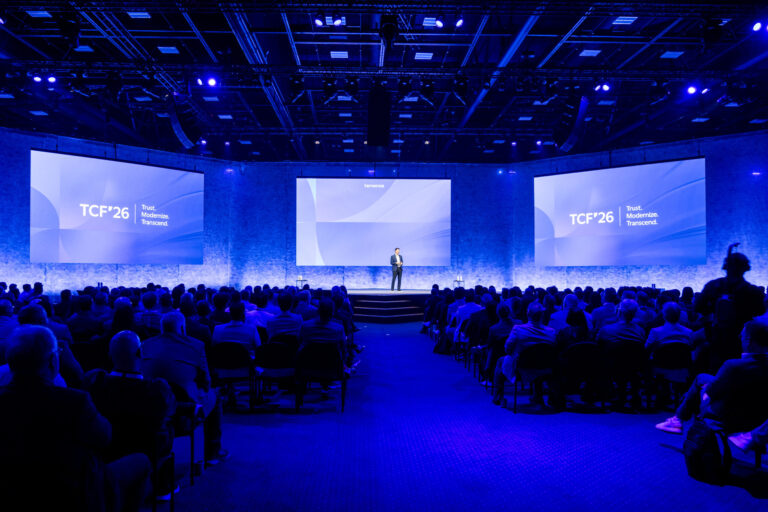
At Temenos Community Forum 2026, the conversation moved quickly from core modernisation to deterministic AI, conversational banking and whether banks can make serious use of agents without losing control.
Held at the Bella Center in Copenhagen from 5 to 7 May, this year’s TCF brought together more than 1,300 people from across Temenos’ customer base, technology partners and wider banking community.
The theme was ‘Trust. Modernise. Transcend.’, which did sound, at first, like conference language doing conference language things. But across the two days, the order of those words became the point.
Temenos wanted to talk about the bank of tomorrow. Banks still needed to know how they get there without disturbing the bank of today.
Takis Spiliopoulos, opening his first TCF as chief executive of Temenos, put that tension neatly. “Modern banking demands two things to coexist,” he said. “First, absolute stability. Second, constant evolution.”
That line sat behind much of the event. AI may have been the headline technology, but the conversations kept coming back to more familiar banking concerns: resilience, regulatory comfort, implementation risk, data quality and the cost of keeping old systems alive.
From listening to showing
Barb Morgan, chief product and technology officer at Temenos, picked up the message from last year directly. In Madrid, she had told attendees that Temenos would build less, but build it better. In Copenhagen, the company wanted to show the receipts.
Morgan told attendees they would see 22 products across the two days. “Build less” and “22 products” do not look like natural best friends, but she tackled that point in a press briefing, saying the discipline still applies, particularly around AI.
“There are a lot of tools out there,” she said. “We will go as fast as we can responsibly go. Those that were here last year may remember I said we’re going to build less, but we’re going to build it better. Same concept applies.”
On stage, Morgan made a similar point about hype and product reality.
“We aren’t going to talk about hype,” Morgan told attendees. “We will only talk about products that are real.”
By ‘real’, she meant products that are live, in private preview, or being actively co-developed with customers with a target to reach general availability within six months. It was a useful bit of stage housekeeping, because TCF 2026 had a lot to get through.
So, what launched?
Temenos announced an expansion of its SaaS offering on Amazon Web Services, adding digital banking and payments to its existing core banking SaaS on AWS. It also announced new composable retail deposits and retail lending capabilities, designed to let banks modernise specific areas of the core without taking on a full replacement programme.
There were customer announcements too. First Abu Dhabi Bank extended its collaboration with Temenos in Saudi Arabia, Reliance Bank selected Temenos SaaS for its digital transformation, and Pakistan’s HBL went live on Temenos Core Banking in the first phase of a programme that is expected to cover more than 40 million accounts once fully rolled out.
Then came the AI announcements: Conversational Studio for Digital, Temenos Copilot for Workbench, Temenos Copilot for Core for branch manager and branch officer personas, and the Temenos FCM AI Agent for Instant Payments. In plain English, Temenos is trying to put AI into the systems banks already use, rather than ask them to bolt another clever layer onto already complicated architecture.
AI grows up, slightly
AI was everywhere at TCF 2026, obviously. By this point, a banking technology conference without agents, copilots or a knowledge graph would feel almost rebellious.
But the tone was different from last year. Sai Rangachari, chief product officer at Temenos, said banks are now having more specific AI conversations than they were 12 months ago.
“People are way more educated on AI now than last year,” he said. “Last year it was just there. We had to talk about it. Everyone talked about it, but not everyone really understood what they were talking about.”
This year, he said, more banks have experimented and have a clearer idea of where AI might help.
“There are real conversations happening around: what are you doing about this problem?”
That was probably the more useful AI thread at TCF. Not AI as a glossy replacement for banking work, but AI pointed at dull, expensive, recurring problems: sanctions alerts, reconciliation, upgrades, product configuration, software delivery and customer service.
Will Moroney, chief revenue officer at Temenos, made a similar point in a press briefing. AI, he suggested, is now forcing conversations with banks that once seemed unlikely to move.
“There are certain banks you just would write off as a vendor like ours,” he said. “We’d say, well, they’re never going to change their core.”
That assumption is harder to hold now, he argued, because AI needs modern data structures, cleaner architecture and systems that can support explainable, auditable decisions. Or, as he put it more directly: “The large banks have now realised that they can’t get on the AI train unless they really do modernise.”
Data, governance and the unglamorous bits
A technology partner panel on day two made the same point from a different angle. Moderated by Rangachari, the session brought together Sebastian Weir, AI transformation leader at IBM Consulting EMEA; Dr Jochen Papenbrock, EMEA head of financial technology at Nvidia; and Shireesh Thota, corporate vice president, Azure Databases at Microsoft.
It could easily have become another ‘AI will change everything’ panel. Instead, some of the strongest comments were about the less glamorous work needed to make AI usable in banking.
Weir warned against chasing whatever frontier model happens to be fashionable that week. “It’s very easy to get distracted with the latest development, the latest frontier technology,” he said, “but that’s not where change sits.”
Thota was even blunter on data. “There’s no AI without data,” he said, adding that banks need real-time operational context, clear knowledge structures and trust in the way data is used.
Without that, he warned, “your AI is going to hallucinate, and you’re going to get lots of wrong answers – very confident but absolutely nonsensical answers.”
It was one of the better lines of the event, partly because it cut through the polished AI language. Banking does not have much room for confident nonsense.
Modernisation, but not the big-bang kind
The other major theme was progressive modernisation. That phrase appeared often enough across the event to deserve its own bingo card, but the basic idea is not complicated: banks want to change without detonating the systems they still depend on.
Morgan said Temenos is seeing more appetite for composability because large, all-in-one modernisation projects carry too much speed and complexity risk. Moroney made the same point from the commercial side, saying banks are increasingly looking at sidecars, call-outs or product-by-product migration.
“It used to be acceptable that 60 or 70 per cent of your budget went to keeping the lights on,” he said. “That’s not acceptable anymore.”
That line gets to much of the urgency. Banks want AI, better customer journeys and faster product launches, but many still spend too much money maintaining old systems. The modernisation story at TCF 2026 was not about a clean jump from old to new. It was about coexistence, sequencing and trying to avoid the kind of project that everyone fears before it has even begun.

Around the conference floor
Away from the main stage, the event moved into The Hive, where attendees could get closer to the demos, partner stands and product teams. It was also home to the Temenos Community Kilometre Challenge, where delegates could ride stationary bikes to raise money for Hack Your Future.
The staging had a softer touch than the usual wall-of-screens tech setup too, with a fine, almost web-like backdrop made from what I was told was Choucroute. Event materials are not my specialist subject, but it felt more considered than the usual plastic-and-LED glare.
A very Copenhagen ending
TCF also had its more theatrical moments. There was also a gala dinner at Øksnehallen, a former market hall in Copenhagen’s Vesterbro district and part of the city’s Brown Meat District.
In keeping with the Danish setting, the evening leaned into full storybook staging: magical woods, canapés hanging from trees, aerial performers on silks and an amazing ballet dancer in red shoes. Let’s hope that, unlike the girl in Hans Christian Andersen’s dark fairy tale, she was not forced to dance endlessly too.
There is probably a banking transformation metaphor in there somewhere, although not one any vendor would choose too eagerly.

For Temenos, TCF 2026 was a clear attempt to move on from last year’s listening message and show more evidence of delivery. The event was bigger, busier and more product-heavy. It also showed how much work sits behind the easier slogans around AI and modernisation.
The bank of tomorrow may well involve agents, copilots and conversational interfaces. But in Copenhagen, the more grounded message was that banks still need trust, control and a way to modernise without asking everyone involved to perform acrobatics.
Next stop for TCF…. Prague in 2027.