Cointelegraph is committed to providing independent, high-quality journalism across the crypto, blockchain, AI, and fintech industries.
All news, reviews, and analyses are produced with full journalistic independence and integrity. For more details on our standards and processes, please read our Editorial Policy.
Europe’s crackdown on Tether’s USDT is entering a new phase.
When Revolut told European users it would delist USDT after Aug. 31, it became another in a long line of European platforms restricting access to the world’s largest stablecoin as firms adapt to the requirements of the EU’s Markets in Crypto-Assets (MiCA) regulation.
MiCA’s stablecoin rules have been phasing in since 2024, and the EU-wide transition period ended on July 1, putting further pressure on platforms to drop tokens that don’t meet the rules.
Yet according to Artemis Analytics, Tether being squeezed out of a major market has shown little sign of triggering a major shift in USDT activity. Alex Weseley, research and data, tells Magazine:
“The data does not indicate any noticeable change in USDT supply or demand attributable directly to MiCA coming into effect in Europe… MiCA didn’t trigger a major venue or chain migration.”
So why is demand for Tether holding up so well?
Stablecoins become financial infrastructure
One reason USDT demand is proving resilient is that dollar stablecoins are being used for more than trading or saving in other regions of the world.
In Argentina, for example, a country long obsessed with stuffing dollars into mattresses and storing wealth outside the traditional financial system, stablecoin activity has continued to grow even though restrictions on accessing actual US dollars have eased.
USDT supply share by chain at MiCA milestones. Source: Artemis.
Lemon, an Argentine crypto and financial services platform, processed $9.3 billion in total volume in 2025, up 60% from the previous year. Transactional users grew 70% to nearly 1.8 million and stablecoin volume grew 45% year-on-year.
Related: Why Argentina is blocking Polymarket despite its global growth
That suggests stablecoins are doing more than simply filling a gap created by restrictions on access to dollars; they’re becoming part of the way people move and spend money.
Ignacio Gimenez, Lemon’s business and planning manager, tells Magazine:
“The role of USDT and other dollar stablecoins is evolving. What we’re seeing is a shift from stablecoins as a store of value to stablecoins as financial infrastructure.”
He says stablecoin activity is “increasingly driven by payments, cross-border transfers and global financial services rather than only by savings,” adding that Argentine users can pay in Brazil through PIX using pesos, receive dollars or euros from overseas and have them credited as USDC, or move between bank dollars and digital dollar balances.
That makes stablecoin demand harder to measure by simply looking at which tokens are available on regulated exchanges.
MiCA is changing the European gateway
Lemon’s experience highlights a shift in user behavior in one of Latin America’s biggest economies, and there are signs that emerging markets are beginning to follow the trend.
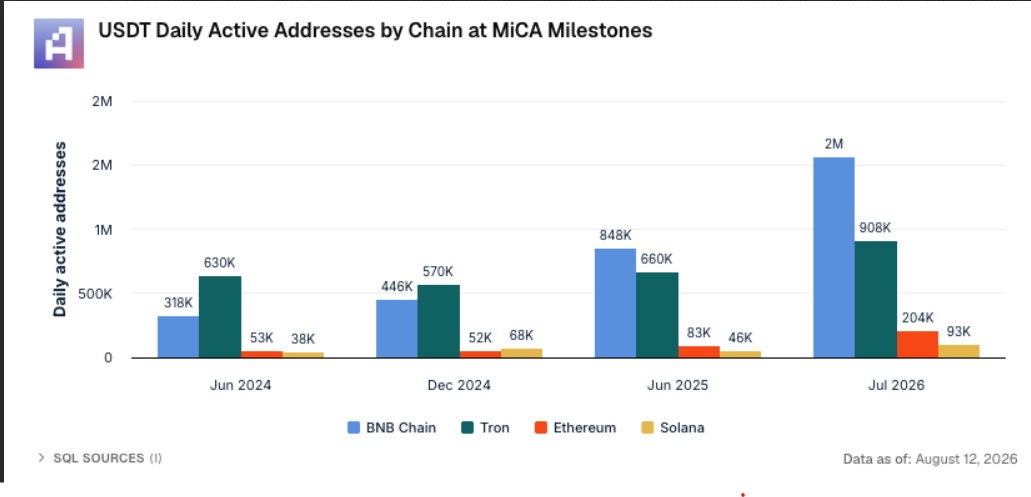
Artemis data shows the number of daily users on Binance Smart Chain rose from about 318,000 in June 2024 to 1.56 million by July 2026, while daily users on Tron increased 44% to around 908,000. These chains are favored by day to day stablecoin users for their low fees. Weseley says:
“That looks like expanding global and emerging market usage rather than a Europe-specific migration, and there’s no clear MiCA-timed break in the chain data.”
That doesn’t mean MiCA is irrelevant: it is certainly changing which stablecoins regulated European platforms can offer, and reshaping the stablecoin market inside the bloc.
USDT daily active addresses by chain at MiCA milestones. Source: Artemis.
Maksym Sakharov, chief executive and co-founder of WeFi, a crypto financial infrastructure company, says that regulation is primarily changing how users access dollar stablecoins, rather than removing the underlying demand, whether it’s for trading, payments, or cross-border transfers. He tells Magazine:
“Users do not choose a stablecoin only because it is available on one regulated platform. They choose it because counterparties use it, liquidity is deep, and it works across many markets.”
For some platforms, the shift began well before the MiCA deadline. Chief executive of OKX Europe, Erald Ghoos, says OKX has not offered USDT to European users for around two years, so the latest MiCA deadline did not make much material difference.
Europe’s alternatives have a dollar problem
Perhaps the bigger question in Europe is what European users will embrace instead. Dollar-denominated stablecoins have a powerful advantage since the crypto market has always treated the greenback as its primary benchmark.
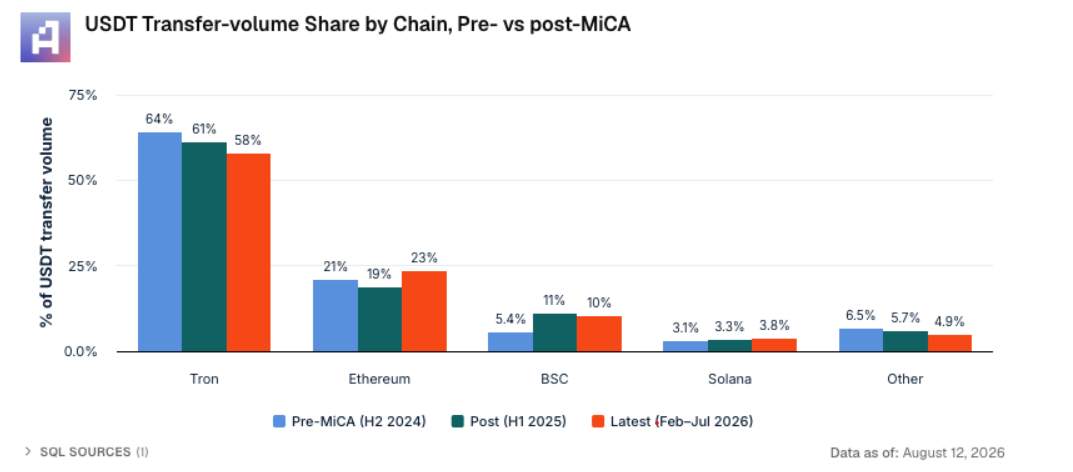
USDT transfer volume share by chain pre vs. post MiCA. Source: Artemis.
While Ghoos doesn’t expect that to change globally any time soon, he says that institutional interest in euro-denominated stablecoins is picking up. He says:
“What we are seeing from institutional players is interest in creating more EUR-denominated stablecoins, which is worth watching as it develops.”
For retail users, euro-denominated stablecoins could also make practical sense by removing additional friction, like currency conversion, from transactions. But while MiCA may determine which products are available through regulated European gateways, it cannot change the dollar’s role in global crypto markets.
Magazine: El Salvador’s Bitcoin experiment turns 5: ‘It was for us, not them’
Cointelegraph publishes long-form journalism, analysis and narrative reporting produced by Cointelegraph’s in-house editorial team with subject-matter expertise. All articles are edited and reviewed by Cointelegraph editors in line with our editorial standards. Some articles contain affiliate links, from which Cointelegraph may earn a commission. These relationships do not influence which products we review or our editorial conclusions. Content published in here does not constitute financial, legal or investment advice. Readers should conduct their own research and consult qualified professionals where appropriate. Cointelegraph maintains full editorial independence.
better.codes, an open autoresearch challenge built by the Ethereum Foundation Formal Verification team in collaboration with Yukon and zkSecurity, is now live.
better.codes takes a self-contained problem from the Proximity Prize research, formalized in Lean, and puts its soundness bound on a public leaderboard that anyone can push forward.
Solvers point their own AI agents at raising the machine-checked soundness bound of koalaIRS12, a Reed–Solomon proximity problem to advance modern succinct non-interactive proof systems (SNARKs).
The Lean kernel checks every submission and each promoted proof raises the bound toward the fixed 128-bit target. Each promoted proof’s new lemmas, proof techniques, and impossibility results are then upstreamed to advance progress for all solvers and agents.
Why provable bits
Nearly all production hash-based SNARKs, from the proof systems securing zkrollups and zkVMs to those central to Ethereum’s post-quantum roadmap, rely on proximity gaps and correlated agreement for Reed–Solomon codes.
What can be proven about these results today stops short of what researchers believe the benchmarks may be. Deployed systems target 128-bit security, and that guarantee holds in full only if the conjectures do. The better.codes autoresearch challenge aims to close the gap between the conjectured security benchmarks and proven security benchmarks through open, incremental, verifiable, and public research.
Earlier this year the Ethereum Foundation launched the Proximity Prize initiative to prove, or disprove, the Reed–Solomon proximity gaps conjectures, with grand challenges laid out in Open Problems in List Decoding and Correlated Agreement by Gal Arnon, Dan Boneh, and Giacomo Fenzi.
The better.codes challenge problem, koalaIRS12, comes from the paper, bridges directly to the grand challenges, and is formalized end to end in ArkLib (the Lean 4 library for formally verified arguments of knowledge).
Always-on autoresearch
better.codes is an autoresearch challenge, a new model for open collaboration where participants run their own AI models, harnesses, and tools in parallel against a common verified benchmark and every promoted submission raises the floor for progress.
No single agentic setup is optimal across an open problem, so many independent setups working the same benchmark move the frontier faster than any one team can. Open challenges built this way, including ecdsa.fail, zk.golf, and snark.fast, have already moved research frontiers in quantum circuit design, verified ZK circuits, and post-quantum proving speed.
How it works
Sign in with GitHub at better.codes and clone the challenge repository. The theorem statement, parameter point, and verification harness are pinned; solvers work inside a designated submission surface and prove a larger soundness lower bound, scored in bits.
A comparator checks that each submission’s exported theorem exactly matches the pinned statement and the Lean kernel checks the proof. Accepted results are promoted to the public repository, credited to the solver and the AI model used.
Submissions are transparent and git-backed. New lemmas, proof techniques, and impossibility results are upstreamed so that anyone can read past diffs and submission notes, build on prior work, and skip dead ends, incrementally advancing progress for all solvers and agents.
What comes next
Today’s launch covers the soundness challenge to raise the proven lower bound for koalaIRS12 to 128 bits. We hope to add further challenges over time. Eligibility, evaluation, awards, and payments are governed by the program terms and may be adjusted as the challenge progresses.
Cointelegraph is committed to providing independent, high-quality journalism across the crypto, blockchain, AI, and fintech industries.
All news, reviews, and analyses are produced with full journalistic independence and integrity. For more details on our standards and processes, please read our Editorial Policy.
GnosisDAO approved Gnosis Chain’s transition from a standalone layer-1 network to a ZK-proven Ethereum Economic Zone (EEZ) rollup.
GIP-153 received 123,158 GNO in support, 115 against and 151 abstaining across 54 voters, Gnosis Chain said in an X post. Turnout reached 123,425 GNO, exceeding the 75,000 quorum.
Under the proposal, Gnosis Chain’s validator set would be retired and the network would settle transactions on Ethereum, making Gnosis Chain a layer-2 (L2) that relies on Ethereum’s validators for settlement.
An initial launch is targeted for late 2026 or early 2027, subject to the required EEZ technology being ready.
The update would enable Gnosis Chain-native smart contracts to call Ethereum and use the result in the same transaction, giving it access to Ethereum mainnet assets and liquidity in an environment “optimized” for consumers, a capability the proposal says is not currently available on existing L2s.
Gnosis Chain to become first production EEZ instance
The EEZ is a framework for building Ethereum-aligned rollups, developed by Gnosis and ZisK, with funding from the Ethereum Foundation.
The initiative aims to unify Ethereum’s fragmented L2 ecosystem by enabling smart contracts across different rollups to execute synchronously without relying on bridges. It targets one of Ethereum’s main scaling trade-offs: improved throughput from dozens of L2 networks, which separate liquidity, infrastructure, and user activity across separate blockchains.
Gnosis Chain would become its first deployed instance while retaining its existing applications, balances and xDAI gas token.
Ethereum co-founder Vitalik Buterin previously raised concerns about the centralized sequencers and trusted bridging mechanisms as potential weak points in the design of some L2 networks. “The original vision of L2s and their role in Ethereum no longer makes sense, and we need a new path,” Buterin wrote in a Feb. 3 X post.
According to data from L2Beat, 22 Ethereum rollups currently secure $27.82 billion. Including validiums, optimiums and other scaling networks, the platform tracks $34.88 billion in total value secured.
Related: Ripple raises $275M for US prime brokerage to meet institutional demand
EEZ could reduce reliance on vulnerable infrastructure: Standard Chartered
EEZ could reduce reliance on blockchain bridges and increase activity within the Ethereum ecosystem, according to Geoffrey Kendrick, global head of digital assets research at Standard Chartered.
“The EEZ will have the benefit of reducing the need for bridges (where hacks tend to occur) and increasing the usability of assets in EVM chains,” he wrote in a May 28 report shared with Cointelegraph.
“Both of these are likely to lead to greater activity in the Ethereum ecosystem.”
Kendrick said the EEZ could create greater composability between assets, allowing smart contracts on different participating networks to interact within the same transaction.
Magazine: Ethereum’s EEZ could pull other blockchains into its orbit
Democratic Senator Ruben Gallego warned that rushing the CLARITY Act to a Senate vote before lawmakers resolve disputes over ethics and stablecoin yield could set US crypto market structure legislation back.
Speaking at the SALT Wyoming Blockchain Symposium on Wednesday, Gallego said the crypto industry should encourage Senate Democrats and Republicans to continue negotiating instead of pushing for an immediate vote. He said lawmakers still had to address the bill’s Agriculture Committee portion, assemble the broader package and determine how to send it to the House.
The CLARITY Act would establish a federal framework for digital assets and divide oversight between the Securities and Exchange Commission and Commodity Futures Trading Commission. On Aug. 7, Senate Majority Leader John Thune confirmed to Cointelegraph that the chamber was “punting” the vote and said CLARITY would be queued up “first thing” after lawmakers returned from recess in September.
“Don’t go for a fast vote,” Gallego said. “A fast vote gets you a fast result, but I’m not sure it’s the result you want.” He added that Congress still had a lot of steps to complete and that “any premature movement is going to set it back further.”
Gallego says White House has not answered ethics proposal
Gallego said he and Republican Senator Thom Tillis submitted compromise ethics language to the White House before the congressional recess but had not received a point-by-point response. He said that sufficiently strong ethics restrictions were necessary to attract Democratic support and advance the bill.
“We’ve been sending offers over and over again to the White House, and they’ve been coming back either blank, or they’ve come back even slightly further back, or we’ve heard nothing,” Gallego said.
Cointelegraph reached out to the White House for comment but did not receive a response before publication.
Related: CLARITY Act delay gives Asian financial hubs an opening: First Digital CEO
The remarks follow renewed pressure from the administration. On Wednesday, Trump urged Congress to pass a “fair version” of the CLARITY Act during a White House appearance with crypto executives.
White House crypto adviser Patrick Witt previously said the administration would negotiate with Democrats until the September vote but “can’t afford to wait forever.”
Magazine: ‘Fabricated rumors’ about BitMart founder, Binance bStocks dominate: Asia Express
Cointelegraph is committed to independent, transparent journalism. This news article is produced in accordance with Cointelegraph’s Editorial Policy and aims to provide accurate and timely information. Readers are encouraged to verify information independently.