The context: Building AI data centers remains a multi-year effort with labor emerging as a key execution challenge.
Prager said the Kentucky facility is expected to come online beginning in 2028 and that TeraWulf has hired Fluor to help construct the project.
He said securing skilled labor and contractors is a bigger challenge than equipment procurement as hyperscale AI facilities become increasingly specialized.
Prager said proximity to reliable power remains the most important requirement for AI customers.
Reading between the lines: TeraWulf says Bitcoin mining is no longer part of its long-term strategy.
Prager said the company originally entered Bitcoin mining because it already owned power assets and mining provided a flexible electricity customer.
He said Bitcoin’s commodity-driven revenue model did not provide the predictable, long-term cash flows the company prefers.
“We’re not involved in Bitcoin,” Prager said, describing AI infrastructure as a more natural fit for TeraWulf’s business.
Worth watching: Prager argued the AI infrastructure boom is constrained by power quality rather than available land.
He said the U.S. faces a shortage of electricity and warned investors that “not all megawatts are created equally.”
Prager said successful AI campuses require reliable generation, redundant transmission, favorable regulation and strong community relationships.
He added that TeraWulf focuses on redeveloping former industrial sites and, where needed, adding new power generation to support both AI facilities and the broader electric grid.
Latest developments: In an interview with Jennifer Sanasie on CoinDesk’s Public Keys Ginns said the convergence between traditional finance and crypto continues to gain momentum despite a prolonged market slump
Franklin Crypto aims to build a leading fundamental crypto investment platform following Franklin Templeton’s acquisition of 250 Digital, the firm that emerged from CoinFund’s liquid investment business, Ginns said.
While venture capital remains a natural fit for institutional allocators, Ginns said current market conditions also make liquid crypto investments increasingly attractive.
“There’s a big disconnect between where prices are and real fundamentals,” Ginns said, pointing to growing institutional engagement across the sector.
What this means: Ginns identified several developments that could bring more institutional capital into crypto markets.
He pointed to Robinhood’s blockchain initiative as an example of traditional financial distribution moving onto crypto rails, creating new opportunities for developers and users.
Ginns also cited growing interest in tokenized money market funds, which could allow investors to earn yield while maintaining on-chain portability.
Tokenized equities, stablecoin adoption and broader financial infrastructure are all contributing to the convergence of traditional finance and blockchain technology, he said.
Latest developments: CEO Stephen Gregory said Binance.US is focused on growth after what he described as a two-year “hibernation” tied to regulatory issues surrounding the broader Binance brand.
Gregory said Binance.US is a separate U.S.-only entity with its own governance structure, though it shares a common beneficial owner and brand name with Binance.com.
He said the exchange previously held roughly 20% of the U.S. crypto exchange market and is targeting a return to that level.
Gregory said Binance.US is now licensed exclusively to serve U.S. customers.
What this means: Binance.US is trying to compete with exchanges such as Coinbase and Kraken by emphasizing lower trading costs and a broader product lineup.
Gregory said the exchange has reduced fees to “essentially almost a no-fee exchange,” with 0% maker fees and 2-basis-point taker fees.
He said the company has kept costs low by operating with a lean team and expects to generate revenue from services like custody alongside trading.
Gregory said the exchange is rebuilding liquidity through incentives and direct outreach to retail customers, including personally contacting some of its top users for feedback.
Bitcoin closed the second quarter of 2026 mired in its deepest and longest downturn since the last bear market, according to Bitwise Asset Management’s newly released Q3 2026 Crypto Market Review.
Yet the $9 billion crypto asset manager frames the pain as a setup rather than a collapse, arguing the industry has never been sturdier beneath the surface.
Bitcoin fell 13.4% in Q2 and is down 32.9% for the year, dropping below $60,000 in June for the first time since 2024 and landing roughly 52% under its October peak of $126,080. That extends what Bitwise calls “crypto winter” to nine months and marks the third straight quarter of negative returns for the broader Bitwise 10 Large Cap Crypto Index, its longest losing streak since 2022.
Chief Investment Officer Matt Hougan does not sugarcoat it, writing that “the vibes in crypto are among the worst I’ve seen in my eight years in this industry.”
Even so, bitcoin held up far better than most of its peers. Its 32.9% year-to-date decline was the shallowest drawdown among major large-cap tokens, easily beating Ethereum’s 46.9% slide, Solana’s 40.6% and Cardano’s 56.5%.
Bitcoin now commands a 64.2% share of the roughly $1.88 trillion total crypto market and carries a 77.4% weight inside the Bitwise 10 index, cementing its status as the sector’s relative safe haven even in a broad selloff.
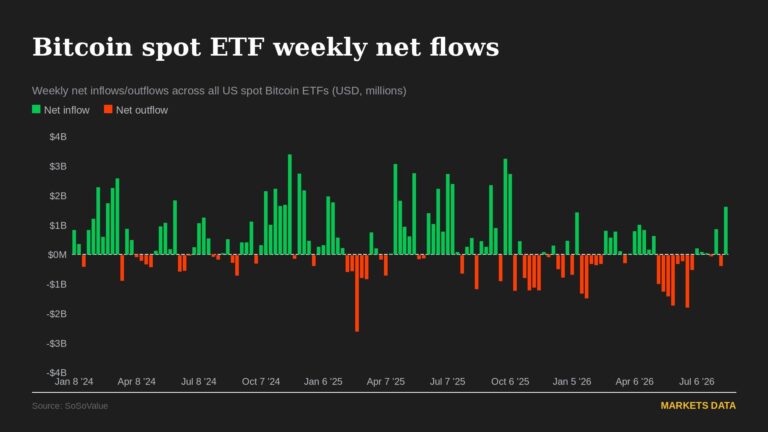
Bitcoin ETF outflows hit a record
The quarter’s most jarring statistic came from the exchange-traded product complex that has anchored bitcoin’s institutional era. U.S. spot bitcoin ETPs bled $4.9 billion in Q2, their worst quarter since launching in January 2024, according to Bitwise.
Assets under management still stand at $72.4 billion, with $53.4 billion in cumulative net flows since inception, but the reversal underscored how quickly professional sentiment can sour.
Filings show investment advisors hold about 43% of professionally owned ETP shares and hedge fund managers another 28%, with Jane Street ($1.8 billion) and Millennium ($1.0 billion) the largest reported holders.
Structural demand nonetheless continued to outstrip new issuance. Bitwise noted in their report that spot ETPs and public companies have together bought roughly 3.6 times the bitcoin mined since the ETFs debuted — about 1.55 million BTC of demand against just 455,416 BTC of new supply.
Treasury companies keep buying, but Strategy blinks
Public-company bitcoin treasuries grew to 1.28 million BTC, up 11.3% quarter over quarter and equal to 6.11% of the 21 million cap, even as the number of firms holding bitcoin slipped by three to 184. Companies added 130,467 BTC in Q2. Strategy remains the runaway leader at 846,842 BTC, trailed by XXI (43,514), Metaplanet (40,177), MARA Holdings (35,303) and Bitcoin Standard Treasury Company (30,021).
The most symbolically loaded move belonged to Strategy, which sold bitcoin for the first time since 2022 — offloading $218 million late in the quarter to fund dividend obligations while keeping holdings valued at $52.3 billion and a $2.55 billion cash reserve. Falling prices punished the equity harshly: Strategy’s stock (MSTR) dropped 30.3% in Q2 and 42.8% year to date, making it one of the worst performers among crypto equities.
The report also touched on several developments that are reshaping bitcoin’s market plumbing. The CFTC approved the first bitcoin perpetual futures at a U.S.-regulated exchange, Kalshi, pulling crypto’s dominant derivative onshore.
Charles Schwab launched retail spot BTC trading, and E*Trade extended access to its 8.6 million users. On the regulatory front, the market-structure CLARITY Act stalled in the Senate over ethics provisions, with prediction markets pricing its 2026 passage odds at just around 20%, down from 75% in May.
Bitwise argues that if CLARITY passes it would likely mark the bottom, and if it fails the industry keeps building under friendly regulators.
Hougan’s core argument is one of cycle-over-cycle progress. Bitcoin’s seasonality data offers modest near-term hope, with July historically averaging a 10.7% gain.
And the firm’s portfolio work still shows a 5% bitcoin allocation adding to a traditional 60/40 mix in 100% of three-year rolling windows since 2014.
“The market is quoting bear-market prices on an industry that is twice the size it was at the last cycle’s bottom,” Hougan writes — a foundation, he says, that “determines what grows in the spring.”
On Monday, several Senate Democrats announced that they’d hold a press conference this week to state their opposition to Clarity and what they said is its “failure to rein in President Donald Trump’s corrupt crypto schemes.” Senator Murphy will join senators Chris Van Hollen and Jeff Merkley at that event on Capitol Hill, which will also highlight their claims that the crypto sector’s Washington influence is causing “growing political corruption.”
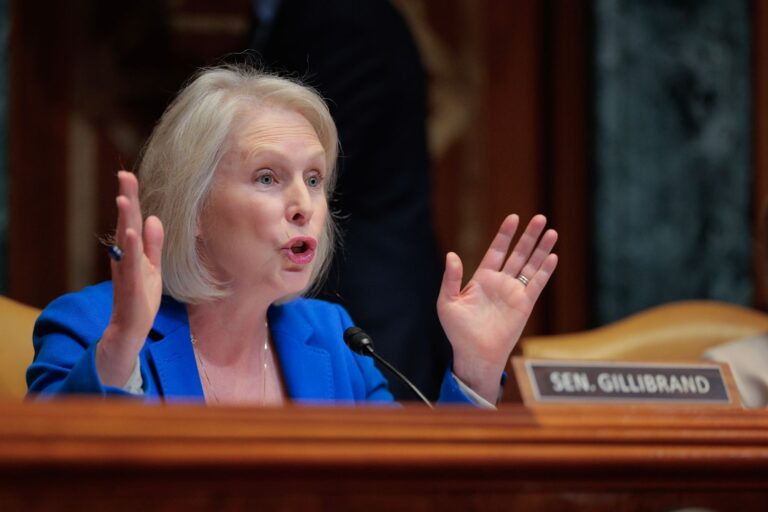
One of the lawmakers involved in the ethics discussions, Senator Kirsten Gillibrand, a New York Democrat, recently noted that Trump’s largest single 2025 income stream, $636 million, came from issuing the memecoin that bore his name. She said that she and fellow Democrats have been pushing to make it illegal for presidents to issue or sponsor any digital assets.
“We cannot let self-dealing destroy an opportunity to strengthen consumer protections, crack down on illicit finance and expand economic opportunity for the millions of Americans our financial system has left behind,” Gillibrand said in a statement. “The time to act is now — and that must include ethics reforms that prohibit members of Congress, the president and their spouses from cashing in on their office.”
Though Clarity would need many Democrats to join with Republicans if advocates want to hit the necessary 60-vote threshold for Senate passage, Gillibrand and other Democrats have said that the bill can’t pass until this is addressed.
The Senate returns to Washington on July 13, with the clock running down on the most consequential piece of crypto legislation in years. Lawmakers now have roughly four weeks to schedule, debate, and pass the CLARITY Act before the August recess.
President Trump weighed in directly on Monday, posting on Truth Social that “in honor of Senator Lindsey Graham, a big supporter, the U.S. Senate should pass the Clarity Act” and warning that China and other countries “would like to take complete and total control of this major financial ‘happening,’” as well as A.I.
White House crypto adviser Patrick Witt amplified the urgency, noting the critical week coincides with the one-year anniversary of the GENIUS Act and cautioning, “We cannot afford to delay any longer.”
This is a window many policy watchers see as the last realistic chance to enact comprehensive digital-asset market structure legislation this Congress.
The CLARITY Act would draw a firm regulatory line between the SEC and the CFTC, granting the commodities regulator exclusive jurisdiction over spot markets for “digital commodities” while leaving the SEC to oversee investment-contract assets.
It cleared the House in July 2025 by a bipartisan 294–134 vote and advanced out of the Senate Banking Committee in May by a 15-9 margin, with two Democrats joining all Republicans.
Those committee votes, however, came with warnings that floor support was not guaranteed.
This week’s milestone is the release of updated text merging the Senate Banking and Agriculture Committee versions, the clearest signal yet of what survived negotiations and what remains unsettled.
Clarity Act issues remain
The bill missed the July 4 signing ceremony that White House crypto adviser Patrick Witt had targeted, and while meetings ran through the recess, the thorniest issues remain unresolved, according to Crypto in America. Getting to 60 votes may prove harder than getting this far, and with the Republican conference shrinking, Democratic buy-in matters more than ever.
Chief among them is the Blockchain Regulatory Certainty Act, folded into the CLARITY Act as Section 604, which would shield non-custodial software developers from being treated as money transmitters.
Law enforcement groups argue the language, as written, would hamper investigations into on-chain crime, and Democratic support may hinge on revisions.
An ethics standoff
The more explosive fight is over ethics. Negotiators have yet to reach a CLARITY Act deal with the White House on guardrails around conflicts of interest tied to President Trump’s crypto ventures, after disclosures showed he earned more than $1 billion from crypto-related businesses last year.
House members have pressed the Senate to act while addressing those concerns, and a coalition of more than 200 companies has urged leadership to bring the bill to the floor. The coalition argued that the bill would establish a clear federal framework for digital assets and help keep innovation in the U.S.
Complicating the math, the death of Senator Lindsey Graham (R-SC) and the continued absence of Mitch McConnell (R-KY) leave Republicans with almost no room for error in reaching 60 votes.
Sentiment is split. Solana Policy Institute President Kristin Smith says momentum is building and a floor vote before recess remains achievable, echoing CFTC leadership calling the bill “so close.”
Others are wary: Galaxy Digital cut its passage odds to 50-50, citing the shrinking calendar and competing priorities like the NDAA. The firm said the legislation still faces procedural hurdles, unresolved ethics and developer-protection disputes, and a crowded Senate agenda that could delay consideration until September. Galaxy said the odds would improve if Senate leaders commit to a July vote. Odds were as high as 70% earlier this year.
The next four weeks may be CLARITY’s last chance in the 119th Congress.
Coinbase Ventures, the corporate venture capital (VC) arm of cryptocurrency exchange Coinbase, led the ranks of crypto-focused VC’s with 30 deals in the first half of 2026.
Runner-up Animoca Brands completed 19 investments, while Silicon Valley VC a16z logged 18 deals and stablecoin giant Tether completed 15, according to data aggregator CryptoRank.
In the past 12 months Coinbase Ventures completed a peer-best 75 deals, followed by Animoca Brands with 40, YZi Labs (previously Binance Labs) with 39, GSR with 31 and a16z with 30.
Those VC deals defy a bear market that saw the total amount raised by cryptocurrency companies fall to $1.4 billion in June, down 63% from $3.8 billion in April.
Deal counts also fell in June, to 61 fundraising rounds, down from 89 rounds in May. Still, last month showed a slight recovery compared to April, when crypto VC funding hit a two-year low of $698 million across 71 total fundraising rounds.
So far in July, crypto firms raised $456 million across 12 funding rounds.
Top active investors and top categories by funding deals. Source: CryptoRank
Looking at the deals of the past six months, Coinbase Ventures participated in seven investment rounds tied to payment protocols, four rounds for DeFi projects and three rounds for infrastructure and real-world asset tokenization projects, respectively.
However, the number of unique investors shrunk to 242 in June, from 452 unique investors in October 2025.
Related: Bitcoin whale moves $188M for first time in 7 years
DeFi, payments, AI remain leading VC categories
Decentralized finance (DeFi), payments and AI attracted the lion’s share of crypto VC funding during the past year.
DeFi protocols saw 216 fundraising rounds in the period, while payments startups logged 131 rounds and AI-crypto companies raised 128 rounds, according to CryptoRank.
Crypto VC capital, invested by category, one-year chart. Source: CryptoRank
Infrastructure providers raised 110 funding rounds, while all other sectors saw fewer than 100 investment rounds over the past year.
In terms of geographical distribution, US-based VCs accounted for $5.8 billion and Australia-based VCs contributed $3.6 billion of funds over the past six months. More than $11.6 billion was invested from undisclosed locations.
Magazine: Strategy sells $216M Bitcoin, Bollinger bullish on BTC: Hodler’s Digest, June 29-July 6, 2026
With the death of Senator Lindsey Graham and another senator hospitalized, Republicans’ current majority in the chamber has been reduced to 51-47, likely requiring more Democratic support to pass crypto market structure.
US President Donald Trump is urging members of the Senate to pass the Digital Asset Market Clarity (CLARITY) Act “in honor of” Senator Lindsey Graham, who died over the weekend.
In a Monday Truth Social post, Trump said that Graham had been “a big supporter” of the CLARITY Act, calling on the Senate to pass the legislation. The chamber has four weeks in session before a month-long state work period in August, giving lawmakers a small window of opportunity to pass the crypto market structure bill. Graham died at age 71 on Saturday.
Source: Donald Trump
Graham, a South Carolina lawmaker who served in the Senate since 2003, did not serve on the banking committee or agriculture committee in the current session of Congress, and did not cast any vote advancing the CLARITY Act. He voted in favor of the Guiding and Establishing National Innovation for US Stablecoins (GENIUS) Act in 2025, but did not appear to have made any public statements directly supporting CLARITY.
The crypto market structure bill is expected to shift much of the authority for enforcing digital asset regulation and oversight from the US Securities and Exchange Commission (SEC) to the Commodity Futures Trading Commission (CFTC). However, many Senate Democrats have signaled that they will not support the legislation without provisions to address potential conflicts of interest between lawmakers and the crypto industry, some citing Trump’s ties to projects like his memecoin and his family’s World Liberty Financial company.
Related: US CBDC ban to go into effect without Trump signoff on housing bill
With the death of Graham and Senator Mitch McConnell hospitalized, Republicans’ current majority in the Senate has been reduced to 51-47, likely requiring additional support from Democrats to meet the 60-vote threshold to pass the crypto bill. Cointelegraph sought comment from the offices of Senators Tim Scott, Kirsten Gillibrand and Angela Alsobrooks for a reaction to Trump’s comments but did not receive an immediate response.
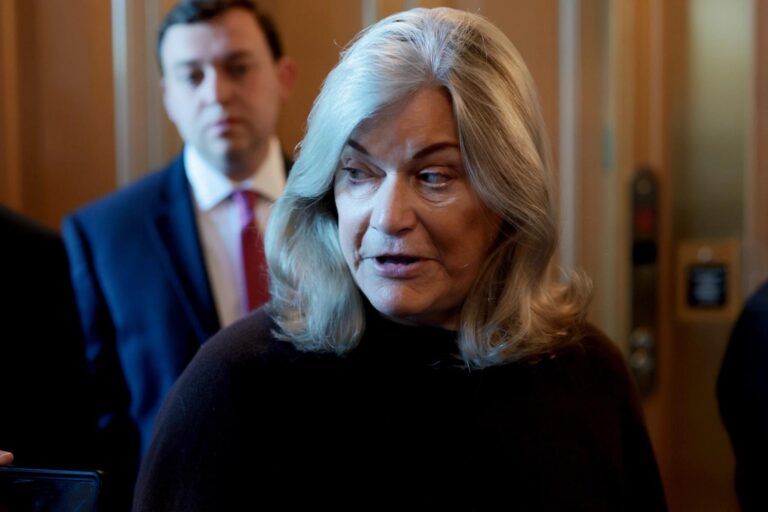
In a Monday X post, Senator Cynthia Lummis said she supported Trump’s comment, adding Graham “was passionate about ensuring that American leadership stayed at the forefront of everything – including digital assets.” Cointelegraph also contacted Lummis’ office for clarification on Graham’s position on digital assets but did not receive an immediate response.
Magazine: Crypto’s CLARITY Act faces partisan fight over ethics on Senate floor
This is a developing story and will be updated as more information is available.
Cointelegraph is committed to independent, transparent journalism. This news article is produced in accordance with Cointelegraph’s Editorial Policy and aims to provide accurate and timely information. Readers are encouraged to verify information independently.
Circle Internet Group’s (CRCL) final approval from the Office of the Comptroller of the Currency to establish First National Digital Currency Bank is a positive milestone, but investors may be overestimating its significance, according to Japanese investment bank Mizuho.
“While a positive development, we believe the market reaction is likely overly optimistic, as this does not resolve fundamental issues that have been hurting the stock of recent,” analysts led by Dan Dolev said in the Friday report.
Shares of the stablecoin issuer closed 5% higher on Friday following the news. The stock on Monday has given back most of those gains, trading 4.7% lower at $63.03 at publication time.
Mizuho reiterated its neutral rating, arguing that the regulatory approval does not resolve the fundamental issues weighing on the stock.
Those challenges include a decline in USDC’s market capitalization since March 2026, which the bank said raises questions about the stablecoin’s growth trajectory.
US stocks were broadly in the red at the open, with the Nasdaq Composite Index down 1% at the time of writing.
Speaking to Fox on the day, US President Donald Trump said that the US would be taking over the Strait of Hormuz, a key international oil route, which Iran closed at the weekend.
“We’re going to keep the strait, and we’ll probably run it. We’ll become the guardian of the strait. Maybe we’ll call it the ‘guardian angel’ of the strait. And we should be reimbursed for that,” he said.
Oil prices stayed higher, with WTI crude circling $75 per barrel.
CFDs on US WTI crude oil one-hour chart. Source: Cointelegraph/TradingView
Bitcoin saw pressure, with sellers firmly in control after an initial drop following the weekly close.
“Massive shorting into this pre NY-open drop. Price is now sitting directly at mVWAP, a key level bulls need to defend!” analytics account JDK Analysis wrote in a post on X.
The post referred to the volume-weighted average price across exchanges, warning that $60,000 could reappear.
“With spot also selling, this still looks very weak. But if New York brings real spot demand and mVWAP holds, a bounce could trap a large number of sellers,” JDK added.
BTC/USD chart with order-book data. Source: JDK Analysis/X
Others also noticed the downward trend, with commentator Exitpump earlier reporting a “crazy amount of aggressive shorting” while open interest continued to rise.
Bitcoin upside targets still see $70,000 returning
Those making the case for a rebound on the day included trader Roman, who retained his new bullish bias.
Related: BTC price bull market to begin in September? Five things to know in Bitcoin this week
In an X post, Roman highlighted several price metrics, including the relative strength index (RSI) and volume, showing downside exhaustion.
“I believe a move higher is coming it all just comes down to formation and how we get there,” he wrote.
“Lots of HTF & LTF indications for 70-75k area + exchange data is showing that more spot is being bought than sold. It’s a matter of when not if.”
BTC/USD one-day chart. Source: Roman/X
Earlier, Cointelegraph reported on various expectations of continued BTC price upside this month before bearish continuation, ultimately ending in a Q3 macro bottom.