

The crypto asset manager argued the market is mispricing Hyperliquid as a niche derivatives exchange instead of a fast-growing “super-app” for global trading markets.
Trump orders government, Fed to review crypto firms' access to payment rails
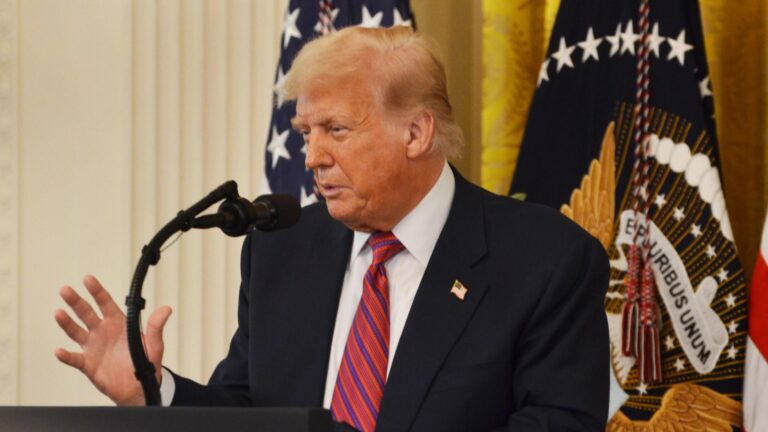
Donald Trump’s executive order asks the Fed to review how depository institutions may be granted access to payment services, an area the crypto industry is deeply involved with.
TD Cowen Raises Strategy (MSTR) Price Target To $400 On Bitcoin Accumulation And Balance Sheet Shift

TD Cowen has raised its price target on Strategy (MSTR) to $400, pointing to strong bitcoin accumulation and a shift in financing strategy as key drivers of potential upside. With shares trading near $166, the new target implies a gain of more than 140%.
The brokerage maintained its buy rating, citing faster-than-expected bitcoin purchases and a change in capital structure that supports growth in bitcoin per share. Strategy, led by executive chairman Michael Saylor, now holds 843,738 BTC, valued near $64 billion. That position represents more than 4% of the total bitcoin supply cap.
Analysts noted that the company has exceeded prior forecasts for bitcoin purchases during the current quarter. Between May 11 and May 17, Strategy acquired 24,869 BTC for about $2.01 billion. TD Cowen now expects the firm to purchase close to 100,000 BTC in the second quarter of this year alone.
A central metric for the firm’s thesis is bitcoin per 1,000 fully diluted shares, which has risen to 2.21 from 1.95 at the end of 2025. This increase suggests that bitcoin accumulation has outpaced dilution from share issuance, a key concern among investors tracking Strategy’s aggressive capital strategy.
Strategy’s preferred equity
The firm’s recent use of preferred equity has played a major role in that dynamic. In the second quarter, Strategy raised about $1.95 billion through preferred share issuance, with most proceeds directed toward bitcoin purchases. TD Cowen views this approach as less dilutive than common stock issuance and more favorable for existing shareholders.
At the same time, Strategy has taken steps to improve its credit profile. The company repurchased about $1.5 billion in convertible notes at a discount, a move that reduces future refinancing risk and limits potential share dilution. Analysts described the transaction as a positive signal for both equity holders and creditors.
TD Cowen’s valuation framework applies a multiple to projected bitcoin gains and incorporates expected holdings, debt, and preferred equity obligations. The firm projects bitcoin-related gains of more than $15 billion in 2026, supporting the higher price target.
Despite the bullish outlook, Strategy’s stock remains volatile and tied to bitcoin price movements. Shares have fallen about 60% over the past year and sit well below their 52-week high above $450. Recent declines in bitcoin have also weighed on the stock, reinforcing its role as a leveraged proxy for the digital asset.
Bitcoin Traders Target $68K As Key Support Zone: Here’s Why

Bitcoin (BTC) traders have shifted their focus lower after futures and order book data point to strong buyer interest in the $68,000-$70,000 zone.
Sell pressure has increased in the derivatives markets and the daily bid-ask ratio fell to -0.03, showing sellers are currently more aggressive than buyers as traders position around liquidation levels.
Bitcoin buyers cluster near $68,000
The visible range volume profile (VRVP) indicator shows the $68,000-$70,000 region as the most densely traded zone on the chart since November 2025. High trading activity in that price range suggests most positions were opened near those levels over the past few months.
The order book data also shows a bid-ask ratio of -0.03, with the metric remaining in negative territory for most of the past month as sell-side activity continued to outweigh aggressive buying pressure.
BTC/USDT price, bid-ask ratio and VPVR profile. Source: Hyblock
Liquidation data adds another pressure point. The heatmap shows more than $3.4 billion in cumulative long positions exposed near $74,700. The figure rises toward $11 billion if Bitcoin falls to $70,000 across the 90-day liquidation range.
Taken together, the positioning data suggests traders are prioritizing deeper liquidity pools rather than chasing higher prices above $80,000.
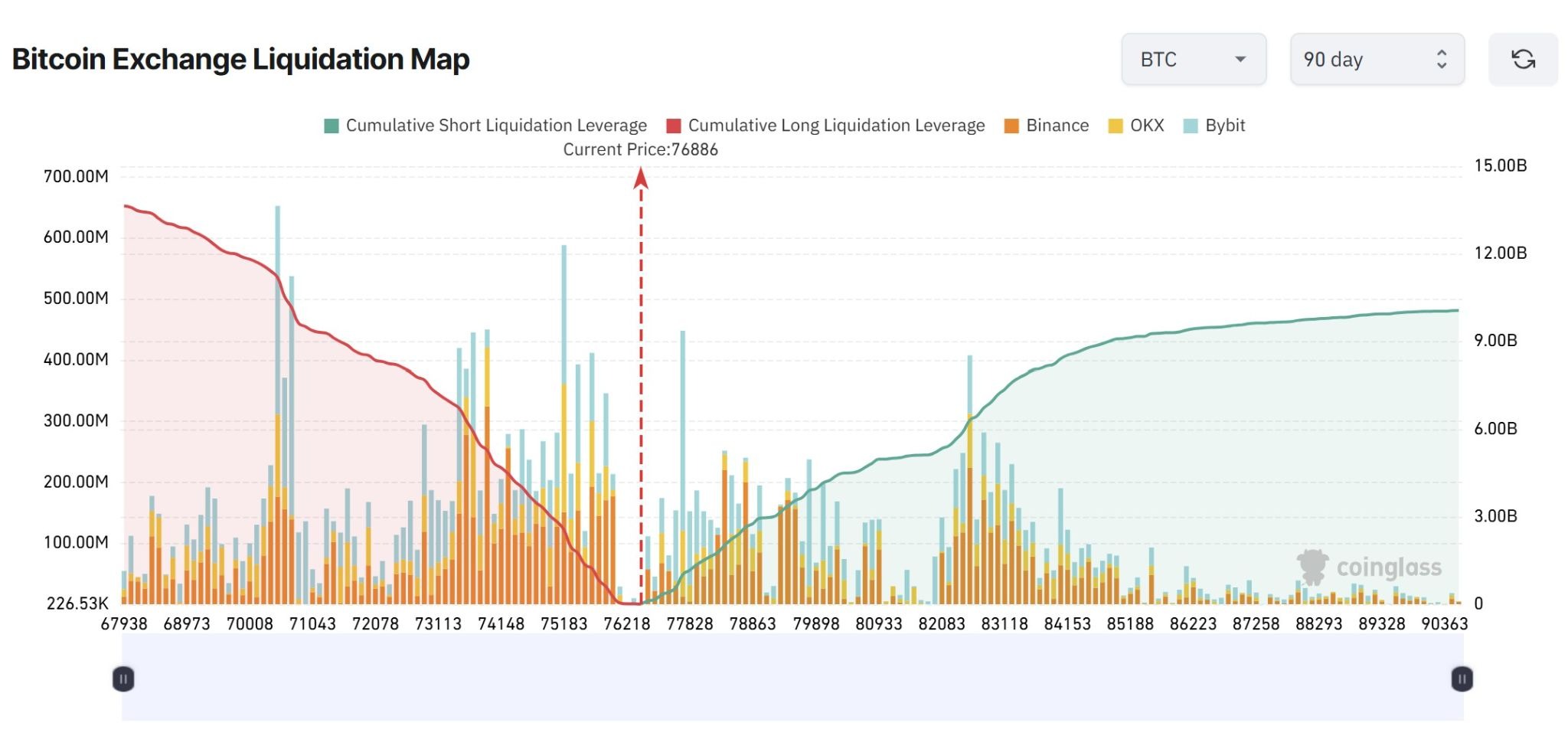
Bitcoin exchange liquidation map. Source: CoinGlass
Related: Bitcoin price stays under $77K as US bond yields near 20-year highs
BTC retail longs are crowded
Crypto analytics platform Hyblock noted Bitcoin retail traders are again leaning heavily bullish as its “True Retail Accounts” long percentage metric climbed above 60%. The indicator tracks the share of retail futures accounts holding long positions.
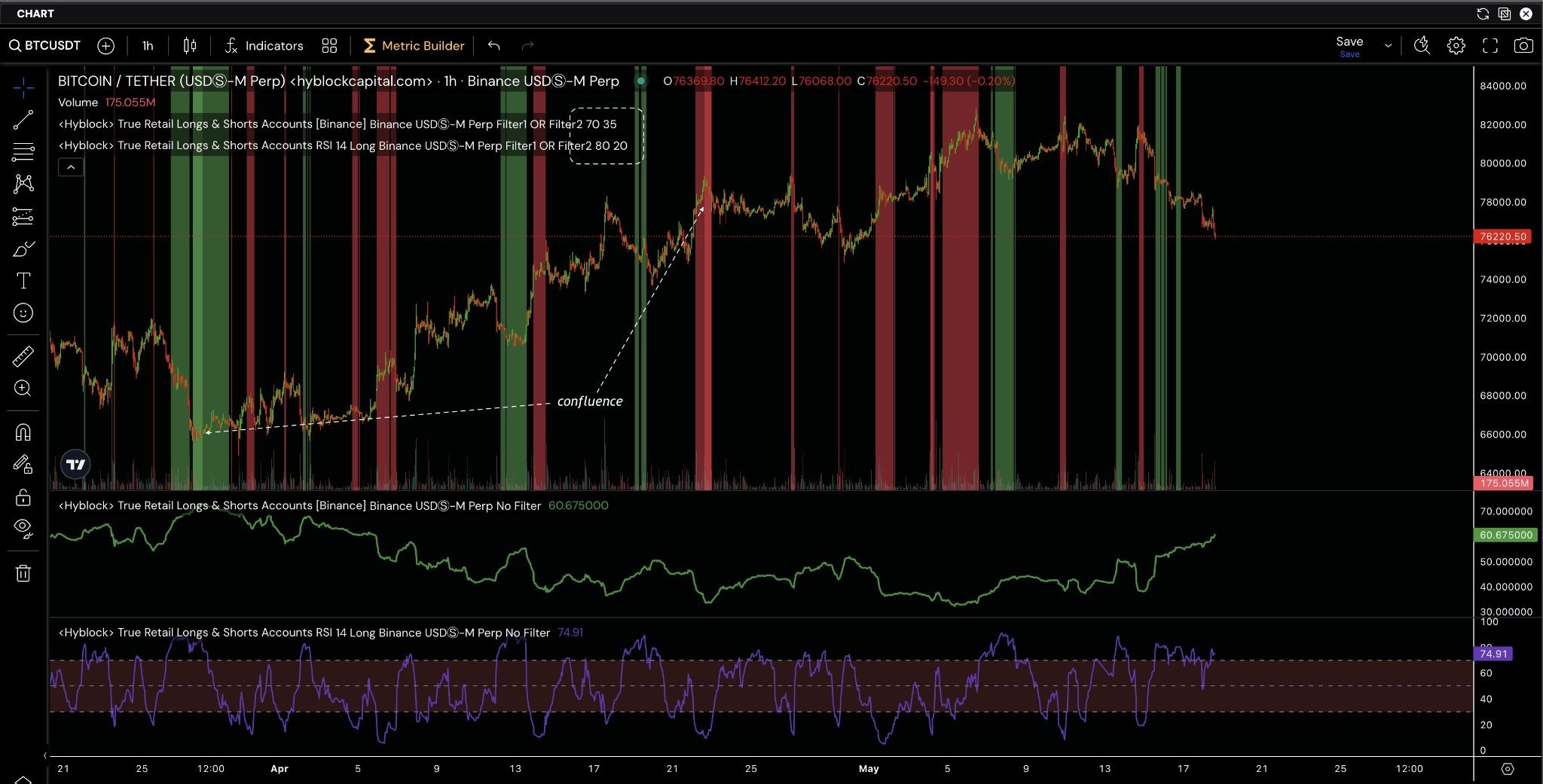
BTC/USDT, one-day chart. Source: Hyblock/X
Previous spikes into the platform’s “extreme long” zone aligned with short-term local tops during rallies toward the $78,000-$82,000 range in early May. The price momentum later cooled after retail positioning became too crowded.
Hyblock explained that the strongest recovery points appeared when retail traders turned aggressively bearish. Several periods when fewer than 35% of retail accounts held long positions emerged near Bitcoin’s lows in March and April, before BTC rebounded from the mid-$60,000 range.
Hyblock combines the retail positioning metric with a 14-period relative strength index (RSI) reading to identify sentiment extremes for BTC.
The latest reading shows the TRA Long (%) near 60.7%, while the RSI stayed elevated at 74.9, suggesting retail traders are still positioned for prices near $76,000. This could lead to deeper correction if BTC follows its previous market behavior.
Related: Bitcoin miner Canaan posts $88.7M net loss in Q1 amid BTC decline
Meme Coins Are Cultural Assets First, Financial Assets Second

This is a contributor content by Nischal Shetty, CoFounder of Shardeum, and Sikka.fun, a mobile-first platform that enables users to create coins in minutes at zero cost.
Most financial commentators still make the same mistake when they talk about meme coins: they lead with the price chart and never get to the point. They’ll tell you Dogecoin is irrational, that Pepe the Frog has no fundamental value, that the whole thing is a casino dressed up in funny dog pictures. And they’re technically right about the fundamentals. But they’re completely missing what meme coins actually are.
Meme coins are, before anything else, cultural objects. They are how the internet votes on what matters right now. Think about what happens the moment something goes viral. A political moment, a celebrity blunder, a tweet that breaks the internet. Within hours, sometimes minutes, a coin gets launched and attached to it an almost immediate financial reflection of whatever is consuming the collective attention of the internet. This isn’t reckless speculation. This is a new kind of cultural record-keeping real-time, decentralized, and brutally honest about what people actually care about.
Dogecoin didn’t survive over a decade because people kept doing DCF analysis on it. It survived because the coin embedded itself into the fabric of internet culture so deeply that dismissing the coin started to feel like dismissing the culture itself. Dogecoin, Shiba Inu, and Pepe are prime examples of a shift from complex cryptocurrencies to lighthearted tokens that have become cultural artefacts and serious players in the crypto space.
That word artifact is doing a lot of work, and it deserves more credit than it gets. Every generation produces cultural artefacts. The 20th century had concert posters, baseball cards, and limited-edition sneakers. These things had no inherent utility either. Their value came entirely from community belief, shared memory, and cultural resonance. Meme coins are the same thing, just native to the internet and tradeable on a blockchain.
What makes a meme coin “work” has almost nothing to do with its whitepaper; most don’t even have one and everything to do with the community that forms around it. Memecoins aren’t just about making quick money anymore. They’re about belonging. About being part of something bigger than yourself.
This is not a trivial point. Humans have always assigned enormous value to signals of group membership. Sports jerseys, band T-shirts, political bumper stickers — these are all ways of saying “I’m part of this.” Holding a meme coin is the digital equivalent, except it also happens to be liquid and globally tradeable at 3 AM. The cultural impact of meme coins is evident in their integration with internet culture, as they often derive inspiration from popular memes and social media trends, a symbiotic relationship that has led to the creation of loyal communities that actively promote and support their chosen tokens.
A Mirror to the Moment
Perhaps the most underappreciated function of meme coins is what they reveal about us culturally. Political meme coins serve as cultural symbols, reinforcing political identities in an era of deepening polarization; these tokens function as digital badges of allegiance, allowing supporters to signal their convictions while participating in speculative markets. When $TRUMP surged after its launch and $BODEN crashed after a poor debate performance, those weren’t just price movements. They were sentiment data. Real-time emotional polling from people who had actual skin in the game.
Crypto pioneer Olaf Carlson-Wee has observed that memecoins are beginning to act as an information discovery system, a way of surfacing what’s cutting-edge in the information markets, suggesting that in the future, every social media post could essentially be a coin. That’s a strange idea until you realize it’s already half true.
The Financial Part Comes Later
None of this means meme coins are good investments. Most aren’t. Their value is determined by how much momentum they can generate and whether they can maintain their audience’s level of interest which is an incredibly fragile foundation for wealth-building. The financial risk is real, and the volatility is not for everyone.
But framing meme coins primarily as financial instruments misses why they exist and why they keep growing. The success of meme coins forces economists and investors to reconsider what actually gives money value if a token can be traded, saved, and spent as real money, it raises the deeper question of what else can do that. The answer meme coins keep giving us is uncomfortable but honest: collective belief is enough. It always has been.
The financial layer matters. But it’s the culture underneath that gives the whole thing life. Strip away the charts, and you still have a community, a joke, a moment in time that a group of strangers decided was worth preserving. That’s not nothing. That’s actually kind of everything.
The above article “Meme Coins Are Cultural Assets First, Financial Assets Second” was first published on AlexaBlockchain. Read the complete article here: https://alexablockchain.com/meme-coins-are-cultural-assets-first-financial-assets-second
Read Also: Why India’s Digital Future Must Move On Chain
Disclaimer: This is a contributor article, a free service allowing blockchain and crypto industry leaders to share their experiences or opinions with AlexaBlockchain’s audience. The content above has not been created or reviewed by the AlexaBlockchain team, and AlexaBlockchain expressly disclaims all warranties, whether express or implied, regarding the accuracy, quality, or reliability of the content. AlexaBlockchain does not guarantee, endorse, or accept responsibility for the content in any manner. This article is not intended to serve as investment advice. Readers are advised to independently verify the accuracy and relevance of any information provided before making any decisions based on the content. To submit an article, please contact us via email.
Bitcoin Price Slides Below $77,000, ETF Sales Top $1 Billion

Bitcoin price’s recovery narrative is under pressure. The world’s largest cryptocurrency has shed nearly $5,000 from its recent high of $82,000, dropping to around $76,900 as of this morning — a four-day losing streak driven by a powerful convergence of macro headwinds, accelerating institutional outflows, and on-chain metrics that reveal a recovery without the capital conviction of prior bull cycles.
Bitcoin price opened Monday at roughly $77,500 before slipping further throughout the session. The total crypto market cap has shed over $100 billion in valuation since last Friday, falling to approximately $2.65 trillion.
Liquidations have been severe. Total crypto liquidations reached near $657 million in a single 24-hour window on Monday, with $584 million — roughly 89% — coming from long positions, according to Glassnode data and Bitcoin Magazine Pro data.
On top of this, U.S. spot Bitcoin ETFs logged $648.6 million in net outflows on Monday alone — their largest single-day net negative since January 29. BlackRock’s IBIT led the exodus with $448.3 million in outflows, followed by Ark & 21Shares’ ARKB at $109.6 million and Fidelity’s FBTC at $63.4 million.
Combined with last week’s total net outflows of $1 billion — which snapped a six-week positive streak — cumulative outflows since May 16 now sit just under $1 billion.
Last Thursday, the bitcoin price was fighting near $82,000, since then it’s dropped over 5% to current levels.
Bitcoin price analysis
Overall, Bitcoin price’s recent rebound has been met with caution from analysts who say the rally still lacks the kind of capital support seen in stronger phases of the last bull cycle.
As market sentiment transitions from acute fear toward persistent uncertainty, the validity of the current recovery hinges on objective measures of net capital inflows. The Realised Cap 30-Day Net Position Change, which quantifies the monthly fluctuation in on-chain capital, serves as the primary barometer for this structural support.
In the wake of the recent ascent to $82,000, this metric reached a positive $2.8 billion per month, providing a basis for recent constructive momentum.
“The current $2.8 billion reading remains significantly shy of this historical benchmark, representing a substantial shortfall in aggressive capital commitment. This data-driven discrepancy suggests the recovery lacks the institutional velocity required to withstand a “higher-for-longer” macroeconomic regime, leaving the market vulnerable to exogenous shocks and interest rate volatility.” Bitfinex analysts wrote to Bitcoin Magazine.
From a macro perspective, tensions between Iran and the United States remain high, with Tehran warning it will respond decisively to any attack while Donald Trump says planned military action has been delayed amid ongoing negotiations encouraged by Gulf states.
Meanwhile, the conflict is still fueling regional instability — from Israeli strikes and Hezbollah attacks in Lebanon to a worsening humanitarian crisis in Gaza — and raising global concerns about a potential food crisis if Iran disrupts shipping through the Strait of Hormuz.
This bitcoin bear market is different with 'uniquely pessimistic' traders limiting downside, K33 says

The research firm said bitcoin traders remain unusually defensive, reducing the risk of the kind of leverage-driven collapse seen in prior downturns.
Even a mountain of T-bills won't save Tether and Circle from a sudden liquidity crisis, expert says
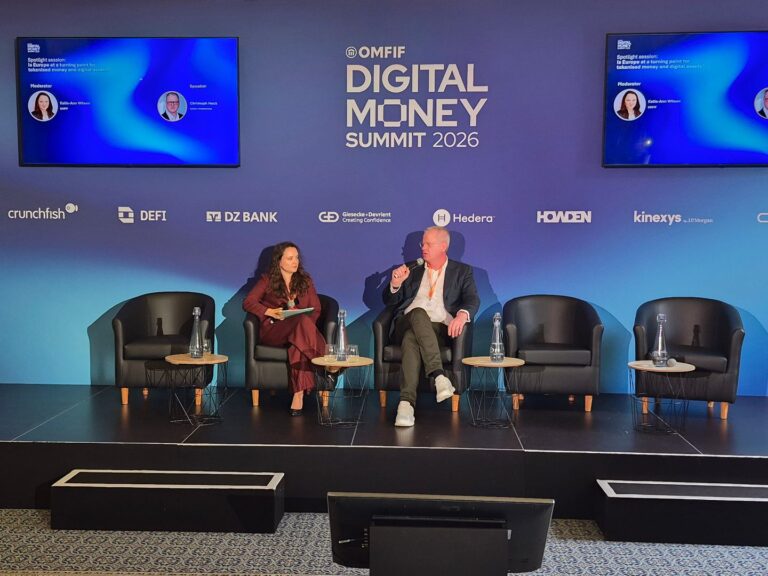
The head of digital assets and tokenization at one of Germany’s largest asset managers said that USDT and USDC are not stablecoins, from his perspective.
Donald Trump Abandons Meme Coins In Favor Of These Indirect Bitcoin Exposure Vehicles

Trusted Editorial content, reviewed by leading industry experts and seasoned editors. Ad Disclosure
US President Donald Trump appears to have quietly shifted his crypto focus from meme coins to Bitcoin (BTC). While his self-titled meme coin, Official Trump (TRUMP), continues to trade in the market after a more than 80% crash, new federal disclosures reveal that the President and his family have been investing in firms with direct ties to BTC. The trades, made in the first quarter of 2026, targeted major global companies built around bitcoin mining, holding, and trading. The move reveals Trump’s deeper push into the crypto market ahead of a clearer regulatory landscape.
Trump Expands Exposure From Meme Coins To Bitcoin Firms
New government records show that Trump and members of his family made a series of investments in crypto-linked stocks during the first three months of this year. The disclosures, which immediately caught the attention of investors and analysts, were submitted to the US Office of Government Ethics (OGE) and made public this week.
The document, known as an OGE Form 278-T, revealed thousands of stock trades carried out under the names of Trump and his family between January and March 2026. Among the crypto stocks, the family bought shares in MARA Holdings (MARA), the world’s largest publicly traded Bitcoin miner, Coinbase (COIN), the largest crypto exchange, and Strategy (MSTR), the world’s first and largest Bitcoin treasury.
Filing records also show nine trading entries linked to Coinbase, with the biggest single transaction executed on February 10 and valued somewhere between $100,001 and $250,000. Two smaller purchases of MARA Holdings were also recorded, with each trade below $50,000.
Interestingly, Strategy shares saw the most activity, with eight transactions that included both buying and selling. The largest stock purchase came on February 12, valued between $50,001 and $100,000. Meanwhile, the largest sale was recorded on January 12, with an estimated amount between $15,001 and $50,000.
Thousands More Trades Round Out Trump’s Busy Quarter
Bitcoin-related stock purchases were only a small part of what Trump and his family traded in Q1. In total, more than 2,000 transactions took place during that quarter, with the overall value of trades estimated between $220 million and $750 million.
Beyond Bitcoin, the filing reported that Trump bought shares in some crypto and fintech stocks, including Robinhood (HOOD), Block Inc. (XYZ), PayPal (PYPL), and SoFi Technologies (SOFI). Other major transactions included purchases of major tech companies such as Nvidia (NVDA), Microsoft (MSFT), Oracle (ORCL), and Boeing (BA), with some of those trades falling in the $1 million to $5 million range.
Notably, Trump’s assets are held in a family trust managed by his children, and some of the trades appear to have been handled through third-party firms rather than directly by the US President. The filing does not give exact amounts of these trades, only ranges. It also does not show whether any trades resulted in a profit or a loss.
Featured image from Pngtree, chart from Tradingview.com

Editorial Process for bitcoinist is centered on delivering thoroughly researched, accurate, and unbiased content. We uphold strict sourcing standards, and each page undergoes diligent review by our team of top technology experts and seasoned editors. This process ensures the integrity, relevance, and value of our content for our readers.
Polymarket Launches Prediction Markets on Private Company Valuations With Nasdaq Data

Polymarket partnered with Nasdaq Private Market to enable trading on private company valuations, IPO timing, and secondary share prices, with early markets on OpenAI, Anthropic, Stripe, and other unicorns.
Polymarket has launched prediction markets on private company valuations in partnership with Nasdaq Private Market (NPM), enabling users to trade outcomes tied to company valuations, IPO timings, and secondary share prices. The integration grants Polymarket access to NPM’s authoritative transaction and pricing data to resolve contracts accurately. Early offerings focus on AI, fintech, and crypto unicorns including OpenAI, Anthropic, Stripe, Databricks, Anduril, Neuralink, and SpaceX.
Initial market pricing reflects trader expectations across the AI sector. Polymarket users have assigned approximately 76% odds to OpenAI reaching a $900 billion valuation by December 31, 2026, while Anthropic futures are priced at roughly 90% probability of hitting a $1.0 trillion valuation by the same date.
Polymarket is positioning the markets as a real-time price-discovery mechanism for institutional investors alongside retail traders. The exclusive data partnership with NPM provides the blockchain-based prediction market with settlement accuracy required for financial derivatives on private equity outcomes.
Sources: BusinessWire | Polymarket (Twitter/X) | The Block
This article was produced with the help of AI flows.