Polymarket partnered with Nasdaq Private Market to enable trading on private company valuations, IPO timing, and secondary share prices, with early markets on OpenAI, Anthropic, Stripe, and other unicorns.
Polymarket has launched prediction markets on private company valuations in partnership with Nasdaq Private Market (NPM), enabling users to trade outcomes tied to company valuations, IPO timings, and secondary share prices. The integration grants Polymarket access to NPM’s authoritative transaction and pricing data to resolve contracts accurately. Early offerings focus on AI, fintech, and crypto unicorns including OpenAI, Anthropic, Stripe, Databricks, Anduril, Neuralink, and SpaceX.
Initial market pricing reflects trader expectations across the AI sector. Polymarket users have assigned approximately 76% odds to OpenAI reaching a $900 billion valuation by December 31, 2026, while Anthropic futures are priced at roughly 90% probability of hitting a $1.0 trillion valuation by the same date.
Polymarket is positioning the markets as a real-time price-discovery mechanism for institutional investors alongside retail traders. The exclusive data partnership with NPM provides the blockchain-based prediction market with settlement accuracy required for financial derivatives on private equity outcomes.
Sources: BusinessWire | Polymarket (Twitter/X) | The Block
This article was produced with the help of AI flows.
XRP (XRP) has fallen 12% over the last five days, and the confirmation of a bearish pattern now points to the risk of more losses ahead.
Key takeaways:
XRP/USD’s bear pennant pattern on the three-day chart points to a possible 52.5% drop toward $0.65.
Persistent institutional demand through exchange-traded products supports the case for a recovery in XRP price.
XRP’s descending triangle breakdown is underway
Since early February, the XRP/USD pair has been consolidating inside a bear pennant on the three-day chart.
In technical analysis, bear pennants are typically viewed as bearish continuation patterns. The pattern was confirmed when the price produced broke below the pennant’s lower trend line at $1.40, as shown in the chart below.
Related: JPMorgan lifts Bitcoin ETF exposure in Q1, led by BlackRock’s IBIT
The downside target is derived by taking the height of the initial drop (the pennant’s post) and placing it lower from the point where the price breaks below the pattern’s lower trend line.
XRP’s measured downside target comes in near $0.65, about 52.5% below current levels.
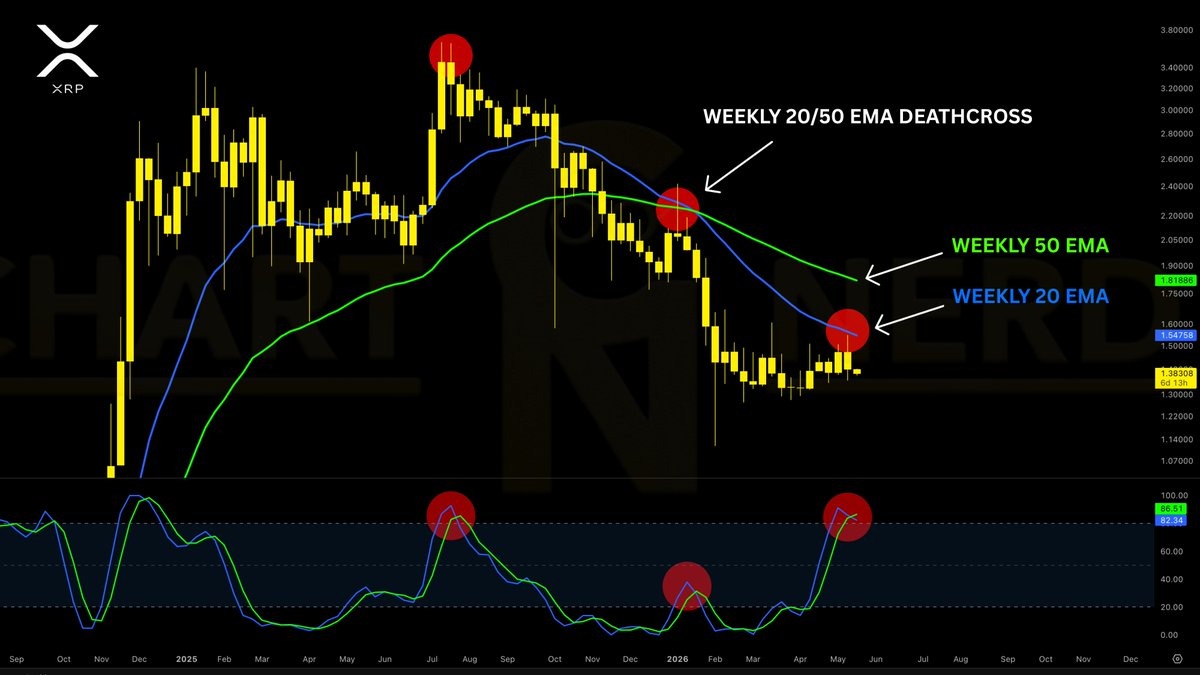
XRP’s Stoch RSI on the weekly chart “has confirmed a deathcross, marking the third time this signal has flashed since the July‑2025 ATH,” technical analyst ChartNerd said in a recent post on X.
The previous two crosses produced deeper corrections of about 50%, and the one in January came after a “relief rally into a weekly 20/50 EMA death cross,” the analyst said, adding:
“A failure at the weekly 20 (just retested) or the weekly 50 ($1.80) will likely open the next leg down later in the year.”
XRP/USD weekly chart. Source: X/ChartNerd
The daily RSI has dropped to 42 from 63 over the last seven days, suggesting increasing bearish momentum.
As Cointelegraph reported, buyers are expected to aggressively defend the $1.27 as a close below it may sink the XRP/USDT pair to $1.11 and later to the psychological level at $1.
XRP price shuns ETF demand
The five-day price correction comes even as institutional sentiment remains relatively positive, as reflected in steady inflows into US-based XRP spot ETFs.
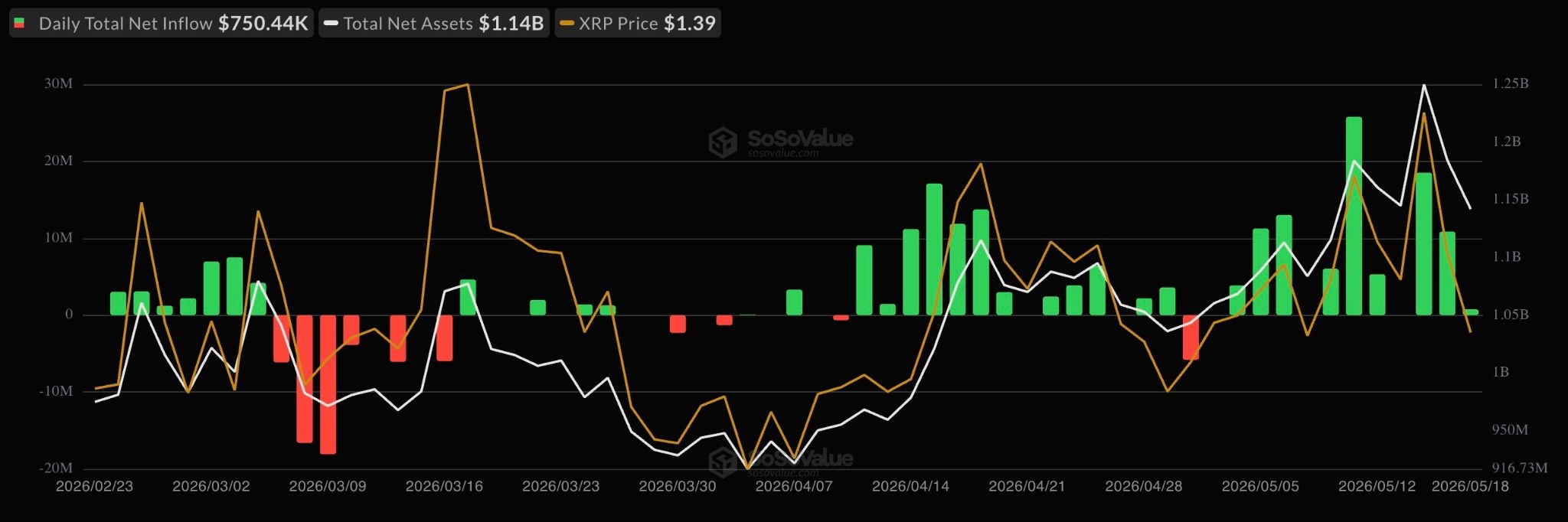
According to data from SoSoValue, XRP ETFs added $750,000 on Monday. This marked nine consecutive days of net inflows, totaling $95.5 million. This streak has pushed cumulative inflows to nearly $1.4 billion and assets under management (AUM) to $1.14 billion.
Spot XRP ETF flows chart. Source: SoSoValue
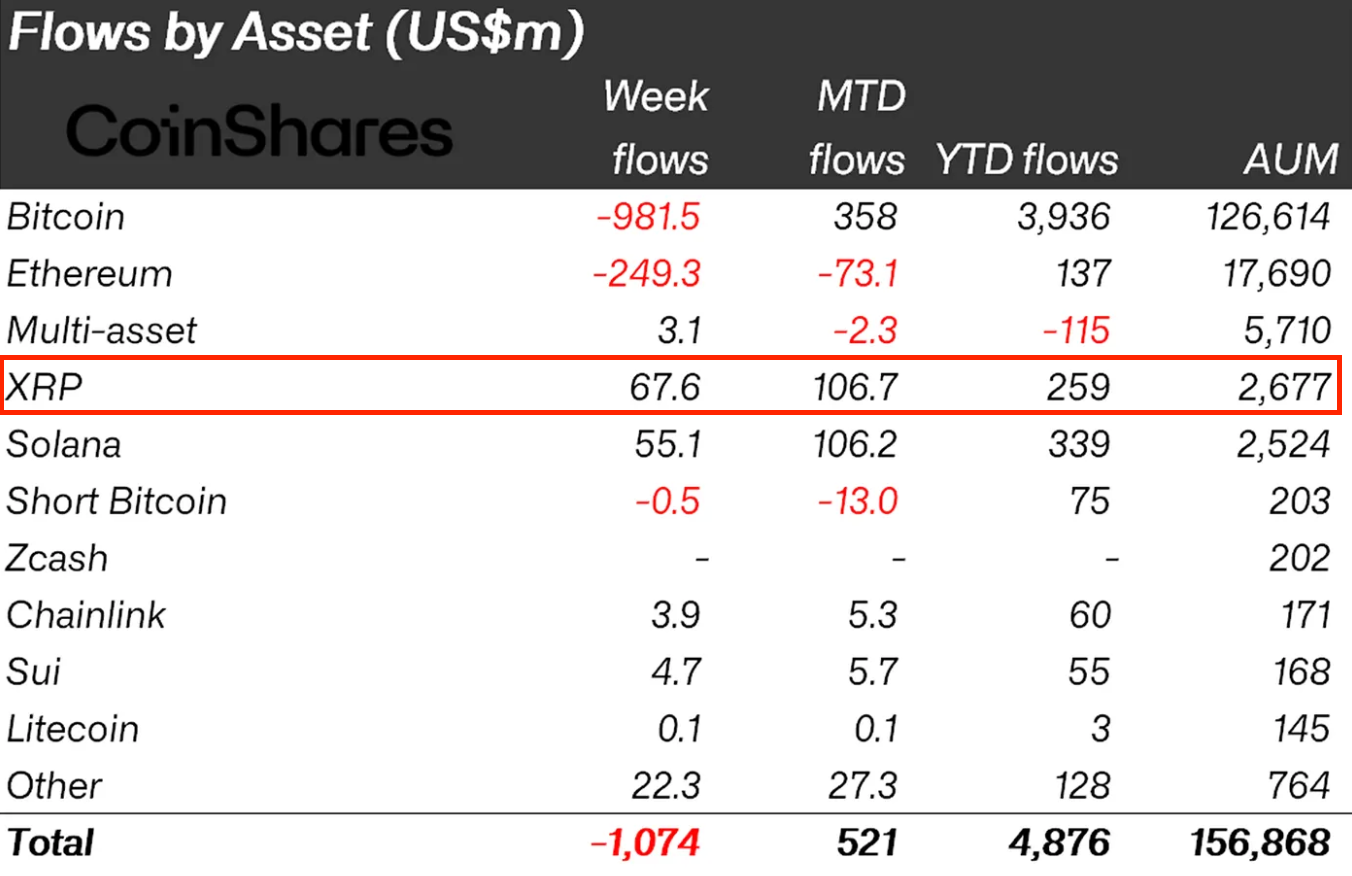
Global XRP investment products also registered weekly inflows of approximately $67.6 million during the week ending May 15, outperforming Bitcoin (BTC) and Ether (ETH), which saw $981.5 million and $250 million in outflows, respectively.
Global crypto ETP flows table. Source: CoinShares
This indicates institutional appetite for XRP products is “heating up, signalling growing confidence in regulated crypto exposure,” TronWeekly said in a post on Tuesday.
As Cointelegraph reported, stronger technical validation, passage of the CLARITY Act in the US and recovering network activity could also contribute to XRP’s recovery.
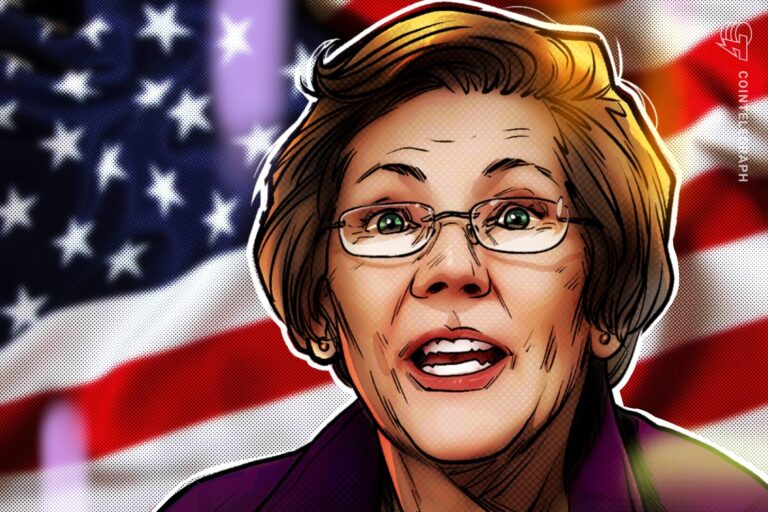
Massachusetts Senator Elizabeth Warren accused Office of the Comptroller of the Currency’s (OCC’s) Jonathan Gould of violating banking laws by approving national trust charters for cryptocurrency companies.
In a Monday letter to Gould, Warren said the OCC head had “approved at least nine national trust charters for crypto companies that intend to engage in activities that appear to go far beyond the narrow set of activities permitted by law,” an apparent violation of the National Bank Act.
Source: US Senate Banking Committee
She called on Gould to provide the full applications of crypto companies the OCC had approved or conditionally approved since December 2025, including Coinbase, Crypto.com’s parent company, Ripple, Stripe, BitGo, Circle, Fidelity Digital Assets, Protego Holdings and Paxos, as well as communications between the office and US President Donald Trump, members of his family and White House officials.
“These companies are effectively crypto banks that want to evade the fundamental safeguards and obligations that come with being a bank,” said Warren. “Your decision to facilitate this regulatory arbitrage not only conflicts with federal law, it also poses serious risks to consumers, the safety and soundness of the banking system, and the separation of banking and commerce.”
Related: Warren urges Fed, Treasury not to ‘bail out’ crypto amid Trump-linked firm concerns
Warren, ranking member of the US Senate Banking Committee, has repeatedly criticized lawmakers and regulators for supporting policies with potential conflicts of interest related to Trump’s ties to the crypto industry. She pushed for provisions in the crypto market structure bill, the CLARITY Act, in a committee markup last week and called on Gould to delay consideration of the Trump family-backed crypto business World Liberty Financial, which filed for a charter in January.
Cointelegraph requested comment from the OCC but did not receive an immediate response.
Kraken parent’s application under review
On May 8, Payward, the parent company of cryptocurrency exchange Kraken, filed an application with the OCC for a national trust charter. The company said, if approved, the charter would allow it to “provide fiduciary custody and other services primarily for digital assets” under the Payward National Trust Company.
A national trust bank charter mainly allows holders to provide fiduciary and custodial services without engaging in deposit-taking or commercial lending, which means they are not subject to the same regulatory requirements as traditional banks.
Magazine: Crypto scammers face death, Aussie CGT makes Asian hubs attractive: Asia Express
The Ethereum Foundation saw the resignations of two top researchers on Monday, bringing the total number of high-profile departures at the organization to at least eight in recent months.
Julian Ma and Carl Beek, both researchers at the Ethereum Foundation, ended their respective four and seven-year tenures at the organization.
Ma contributed to Ethereum’s censorship-resistant properties and cross-layer bridge algorithms and strategy, while Beek contributed to the early design of the Beacon Chain, which introduced proof-of-stake to the blockchain.
Ma and Beek add to a wave of high-profile departures from the Ethereum Foundation this year, bringing the total to five senior developers and researchers who have left in May alone.
Ma said in a post to X that he left the Ethereum Foundation to focus on work in product and growth, adding the organization “is an amazing place but not right for my next steps.”
Source: Julian Ma
Beek said in an X post that he was leaving on May 29 and, for now, would spend time with his wife and 1-month-old child.
Last year, Ethereum co-founder Vitalik Buterin announced major leadership changes and a new direction for the Foundation, which were in response to criticism from Ethereum’s users over the blockchain’s handling of its long-term roadmap, with Buterin aiming to bring new talent to the organization to redevelop the protocol for higher and faster throughput.
Cointelegraph reached out to the Ethereum Foundation for comment.
Related: Ethereum Foundation unstakes $50M in ETH amid treasury shift
Recent Ethereum Foundation member resignations
Earlier this month, the Ethereum Foundation said Barnabé Monnot and Tim Beiko, leaders of its Protocol Cluster team, would be moving on, while the team’s other lead, Alex Stokes, would be going on sabbatical.
In April, Josh Stark, a key researcher and project manager, said he was leaving the organization, which happened a day after Ethereum Foundation contributor Trent Van Epps announced his resignation.
In February, Tomasz Stanczak announced he was stepping down as the organization’s co-executive director.
Magazine: ETH stalls at $2.4K five times, SOL to rally to $120: Market Moves
Btrust, the non-profit organization dedicated to decentralizing Bitcoin open-source development, has announced the appointment of a new Board of Directors, marking the completion of a landmark governance transition and the launch of the organization’s next strategic chapter.
Following a global, open call and a rigorous, multi-stage selection process, Janet Maingi, Bruno Garcia, and Laurence Aderemi have assumed full governance responsibilities, the organization told Bitcoin Magazine.
The selection was guided by Btrust’s Genesis Principles, which prioritize transparency, fairness, and mission alignment — values that have anchored the organization since its founding.
The transition fulfills the original mandate set in 2021, when Btrust was established with a 500 BTC endowment from Twitter co-founder Jack Dorsey and rapper Jay-Z — a donation valued at approximately $24.5 million at the time of announcement. The gift was intended to fund Bitcoin development across Africa and India, with Dorsey and Jay-Z deliberately stepping back from governance to allow an independent board full decision-making authority.
The inaugural board — composed of Obi Nwosu, Ojoma Ochai, Carla Kirk-Cohen, and Abubakar Nur Khalil — was tasked with building the organization’s operational and financial foundation before enabling a structured handover to a successor board.
Btrust’s long-term mission of bitcoin development
Over a multi-week transition period that concluded April 30, 2026, the incoming and outgoing boards collaborated closely to ensure continuity across governance, financial oversight, and operations. The handover included budget reviews, documentation consolidation, and the initiation of an independent audit designed to reinforce accountability.
“Today marks an important milestone for Btrust,” said CEO Abubakar Nur Khalil, who was formally named to the top executive role in late 2025 after serving in an interim capacity. “We are confident the new board will strengthen our impact and safeguard our long-term mission.”
The new board brings deep and complementary expertise spanning Bitcoin infrastructure, energy systems, and open-source software development. Their appointment comes at a pivotal moment for the organization, which has steadily expanded its footprint across the Global South.
In 2023, Btrust acquired Qala, a Bitcoin and Lightning Network developer training firm, rebranding it as the Btrust Builders Programme to accelerate the pipeline of open-source contributors from Africa. More recently, Btrust has signaled expansion into Latin America as part of its broader global strategy.
With the governance transition now complete, Btrust moves forward with renewed institutional clarity. The organization’s core mission — ensuring the Bitcoin ecosystem remains open, inclusive, and resilient by diversifying who builds it — remains unchanged. The new board is expected to guide grantmaking strategy, strengthen oversight of the Builders Programme, and deepen Btrust’s presence in underrepresented developer communities worldwide.
Bitcoin (BTC) price dropped to $76,500 on Monday, erasing nearly all of this month’s gains as fresh US-Iran war tensions soured the crypto market sentiment. This has led investors and traders to reevaluate their risks and stay cautious, with many recent buyers selling their BTC at a loss.
Key takeaways:
Bitcoin short-term holders sold over 10,000 BTC worth approximately $770 million at a loss on Monday.
Analysts agree that pushing Bitcoin’s price below $76,000 could trigger a fresh downtrend toward $65,000-$70,000.
Bitcoin’s “weak hands” realizing losses
Bitcoin has retraced 7% from its local high of $82,800 set on May 6. The rejection from the 200-day moving averages at $82,000, the daily close below the true market mean, and the short-term holder cost basis around $78,000 have cemented a more risk-off stance among Bitcoin investors.
Related: Bitcoin’s trend-defining battle starts at $74K support: Analyst
Onchain data from CryptoQuant showed that more than 10,000 BTC were transferred by short-term holders — investors who have held the asset for less than 155 days — to Binance at a loss on Monday.
These moves occurred with Bitcoin at roughly $76,900, about 2% below their average purchase price of $78,440, suggesting that recent buyers sent approximately $769 million in BTC to Binance at a loss.
This “reflects short-term holder stress, forced selling, or capitulation from weaker hands during a correction,” CryptoQuant analyst Amr Tah said in a QuickTake post on Tuesday.
Bitcoin: Transfer volume by STH in loss to Binance. Source: CryptoQuant
This activity underscores a familiar pattern of short-term speculators panic-selling during market dips, frequently realizing losses.
A similar occurrence in mid-November 2025 preceded a 15% BTC price decline to $78,400 from $96,000 in less than five days.
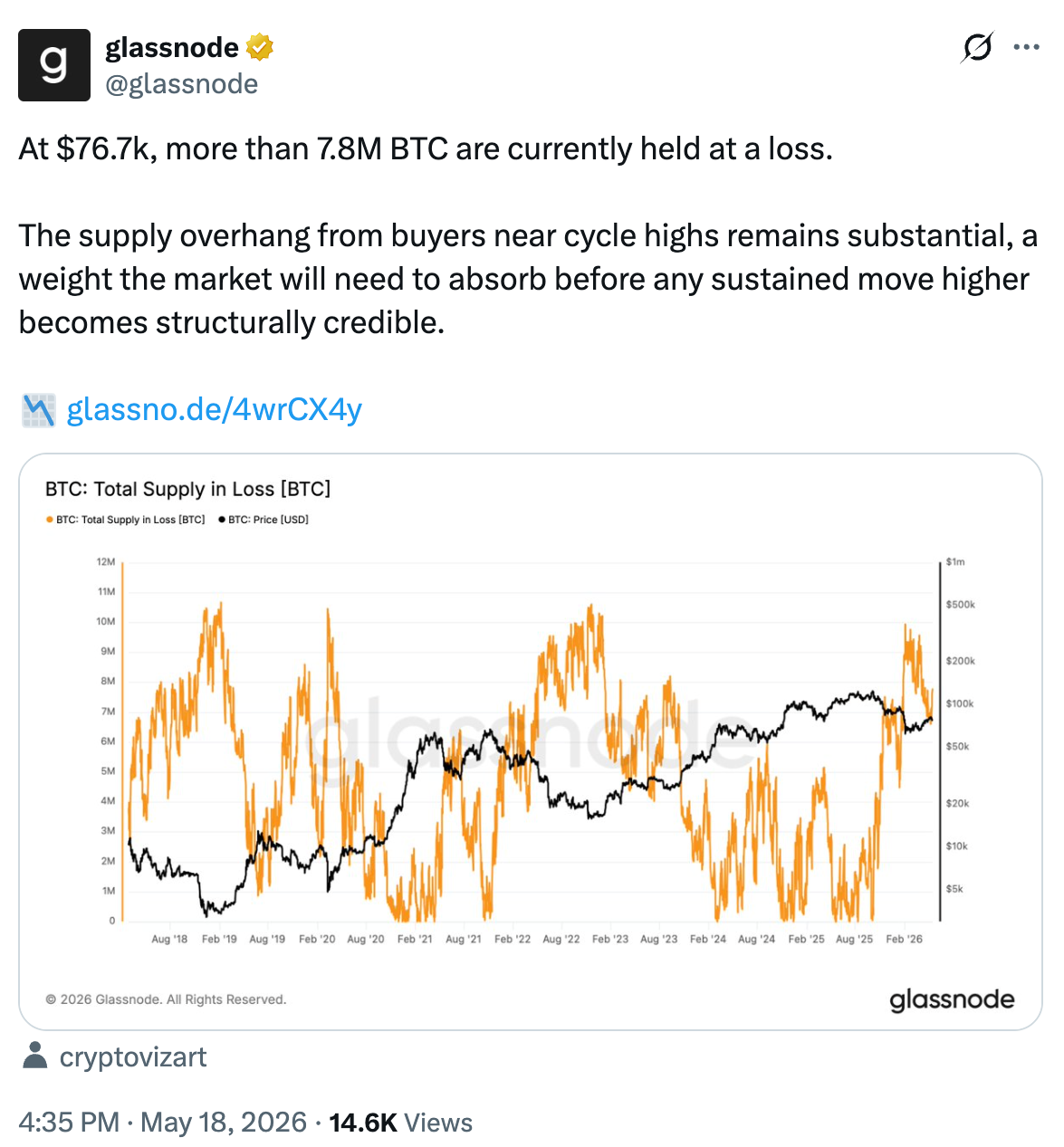
Additional data from Glassnode shows that more than “7.8M BTC are currently held at a loss,” a supply overhang that the market would need to “absorb before any sustained move higher becomes structurally credible.”
BTC total supply in loss. Source: Glassnode
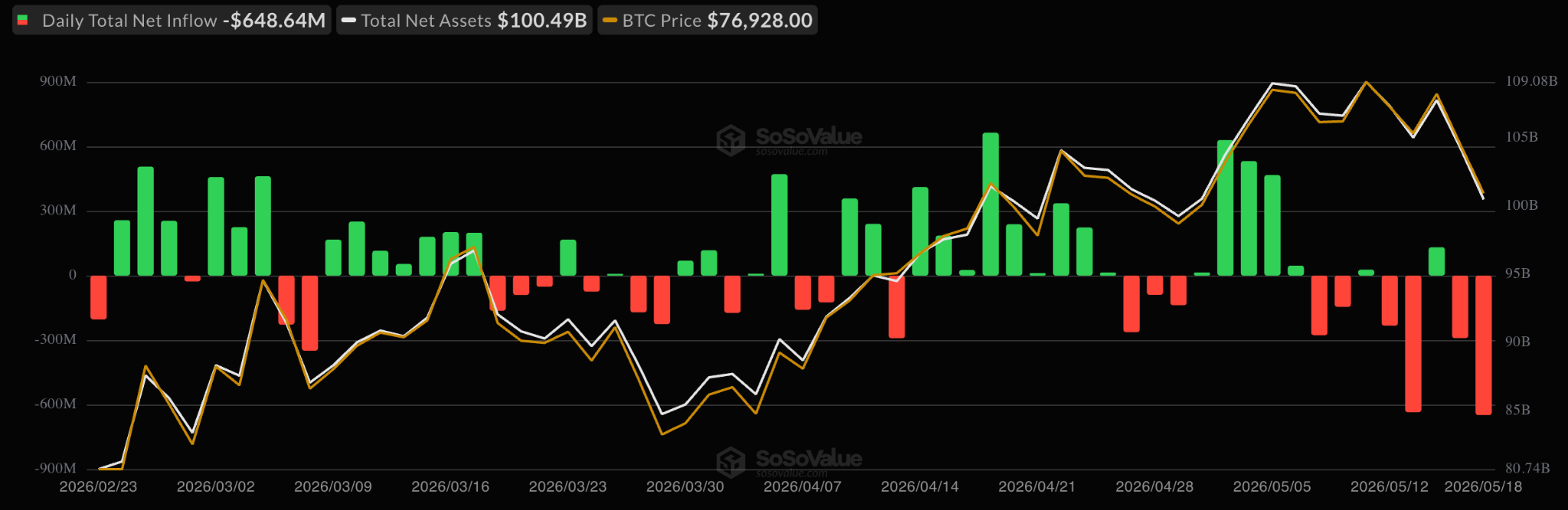
Also accompanying Bitcoin’s slump are heavy outflows from US-based spot Bitcoin exchange-traded funds (ETFs), which have recorded negative flows for six out of the last eight days.
These investment products saw $648.6 million in net outflows on Monday, the largest withdrawal since Jan. 29.
Global Bitcoin investment products also recorded $981.5 million in net outflows during the week ending May 15, suggesting declining institutional appetite for BTC.
“Markets are getting absolutely hammered,” analyst Alek_Carter said in an X post on Tuesday, referring to the large outflows from Bitcoin investment products, adding:
“Money is rotating out fast, panic is creeping in, and traders are clearly hitting the risk-off button hard.”
As Cointelegraph reported, record-low retail investor activity, aggressive selling in the futures markets and weakening spot demand are pulling down Bitcoin’s price to new May lows.
How low can Bitcoin price go?
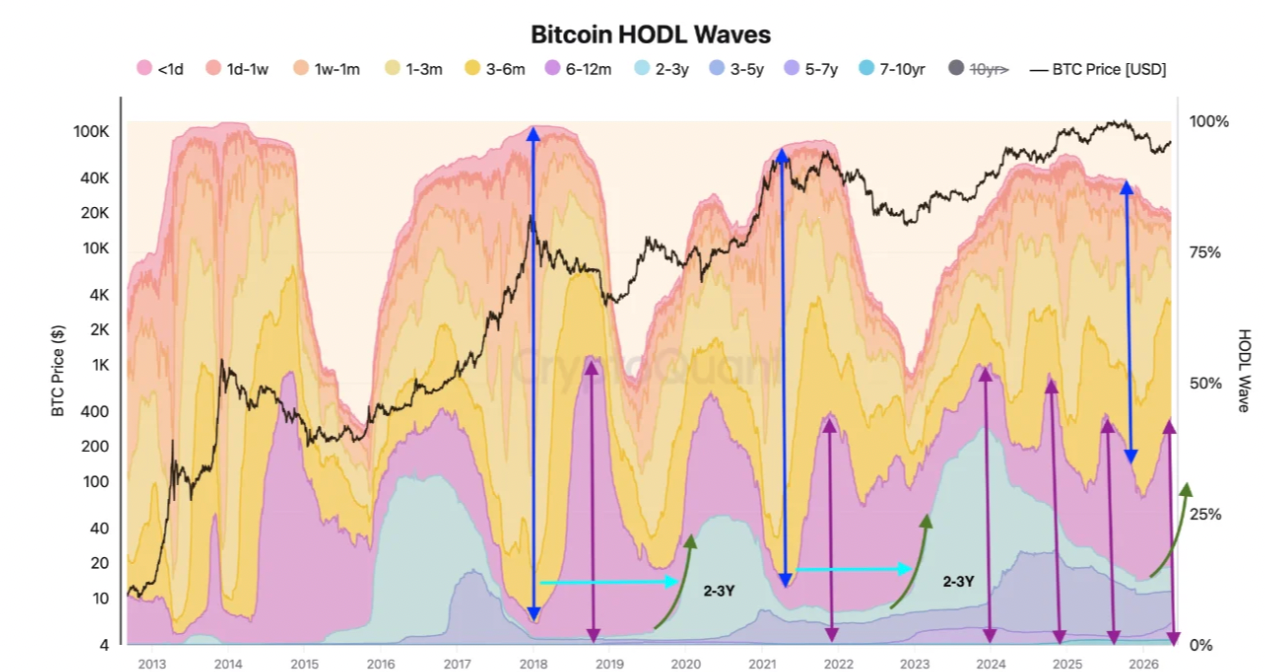
The Bitcoin HODL Waves indicator, which tracks the age distribution of BTC holdings, suggests Bitcoin could bottom at $65,500-$70,500 if current market weakness continues.
Historically, spikes in long-term holder activity and declining short-term speculation have coincided with major market bottoms before recoveries.
The chart below shows a stronger long-term holder base (the blue/purple bands are noticeably thicker), “reflecting growing institutional adoption,” CryptoQuant analyst Sunny Mom said in a Quicktake analysis on Tuesday.
This suggests that the supply structure is structurally stronger in the current cycle than before, “which changes how BTC forms its bottom,” the analyst said, adding:
“Our predicted price range for this cycle’s bottom is $65.9K–$70.5K. If $70.5K holds, we’ll slowly grind out a bottom in the upper range.”
Bitcoin HODL wave indicator. Source: CryptoQuant
From a technical perspective, Bitcoin is printing the fifth consecutive daily red candle, suggesting that the “momentum is starting to shift back to the bears,” analyst Alex Marzell said on Monday in a post on X, adding:
“Bitcoin may come back to retest the breakout zone around $70K support.”
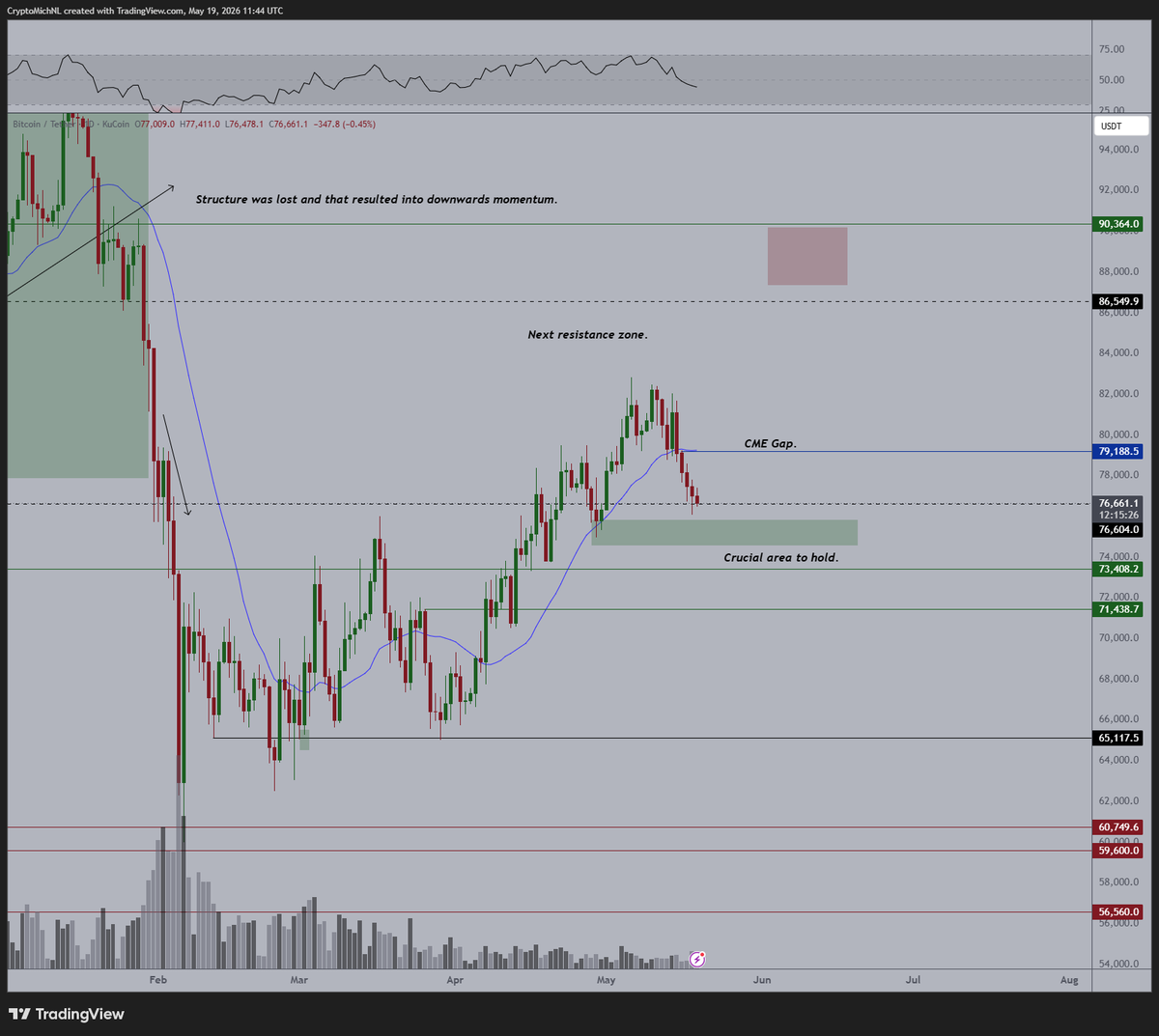
Echoing this sentiment, MN Capital founder Michael van de Poppe said this “doesn’t look great” for Bitcoin, adding that the price needs to hold support at $74,500-$76,000 “in order to get back some momentum in the markets.”
“If this area doesn’t hold, then we’re most likely cascading through the lows of the recent rally and test <$65,000 for support.”
BTC/USD daily chart. Source: X/Michael van de Poppe
As Cointelegraph reported, a break below the 50-day SMA at $76,000 would increase the risk of the BTC/USDT pair dropping to $65,000. in the short term.
Aave V4 introduces a new market architecture featuring collateral isolation across Hubs and Spokes, with Prime, Core, and Plus Hubs launching initially.
Aave V4 is gaining momentum during its capped launch phase with a redesigned market structure, according to an announcement from Stani Kulechov. The protocol introduces a two-layer isolation model that segments collateral across separate Hubs, which are further divided into Spokes, with liquidity sharing selectively capped within each Hub across its Spokes.
The initial market structure is organized around three Hubs: Prime, Core, and Plus, with additional Hubs expected to launch in subsequent phases. This architecture represents a shift from Aave’s previous market design, implementing greater granularity in how collateral isolation and liquidity provisioning are managed across the protocol.
The capped launch phase allows Aave to roll out V4 incrementally while monitoring performance and risk parameters across the new market structure before full deployment.
Sources: Stani Kulechov on X
This article was produced with the help of AI flows.
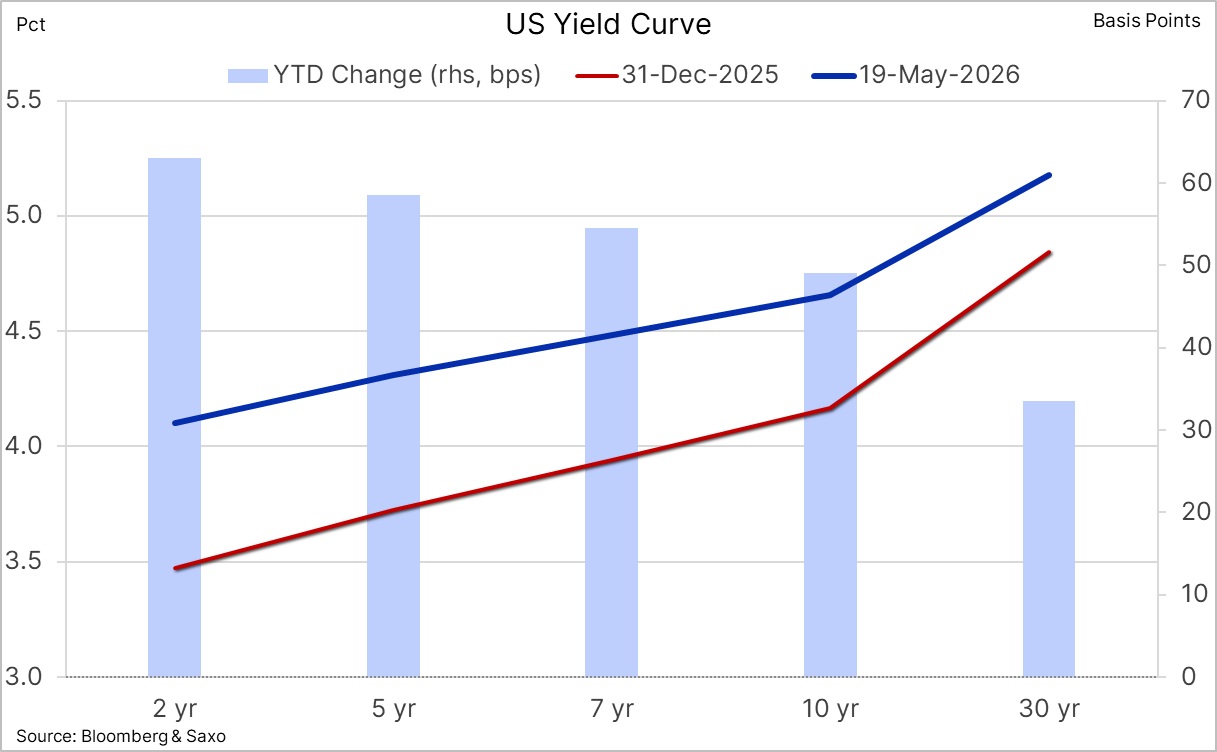
Commenting, Ole S. Hansen, head of commodity strategy at Saxobank, said that bonds reflected demand for “greater compensation for holding longer-dated debt amid war-driven energy inflation and mounting concerns over widening budget deficits.”
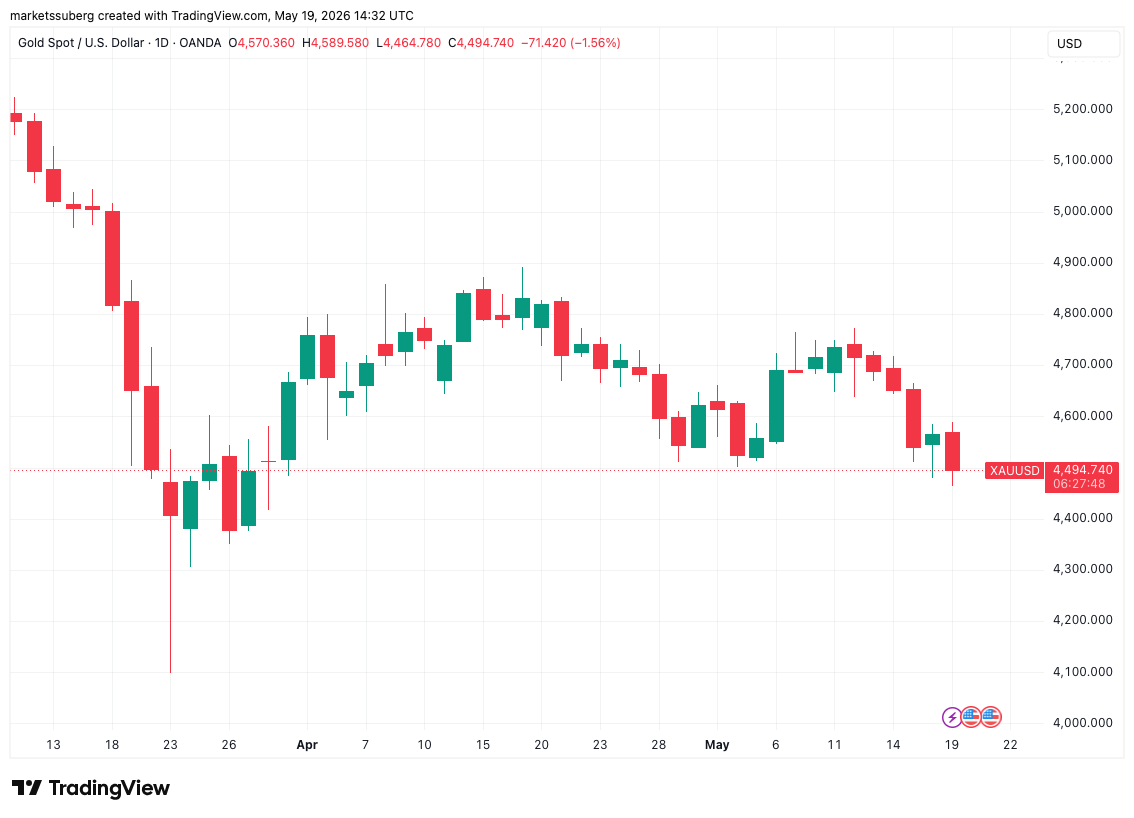
“This development has sent gold below USD 4,500 support, highlighting the current market reaction function driven by oil, inflation expectations, bond yields, and central bank rate expectations,” he wrote in a reaction on X.
US yield curve data. Source: Ole S. Hansen/X
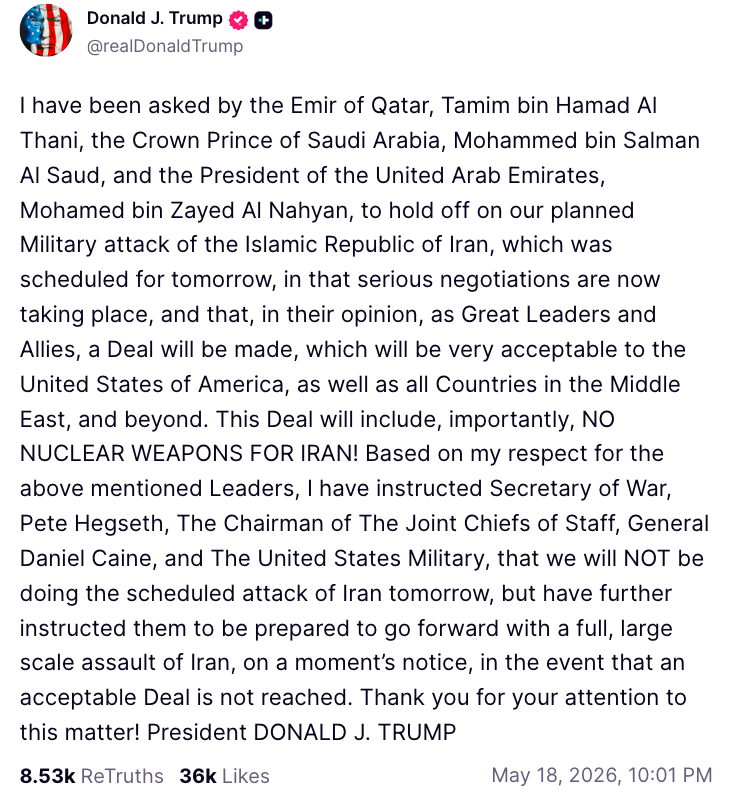
News that US president Donald Trump had canceled strikes on Iran offered markets little relief.
In a post on Truth Social, Trump added that gulf countries should be “prepared to go forward with a full, large scale assault of Iran, on a moment’s notice, in the event that an acceptable Deal is not reached” on the conflict.
Source: Truth Social
Bitcoin analysis sees “crucial” support holding
In crypto circles, the outlook became gloomier. Trader and analyst Michaël van de Poppe warned of a double BTC price headwind of high bond yields and high oil prices.
Related: BTC price ‘bull trap’ at $76.5K? Five things to know in Bitcoin this week
“Neither of these are progressive for risk-on assets (including Bitcoin), which means that we clearly need to see those reverse in order to see strength pouring back into the ecosystem,” he told X followers.
Van de Poppe said that Bitcoin itself did not “look great.”
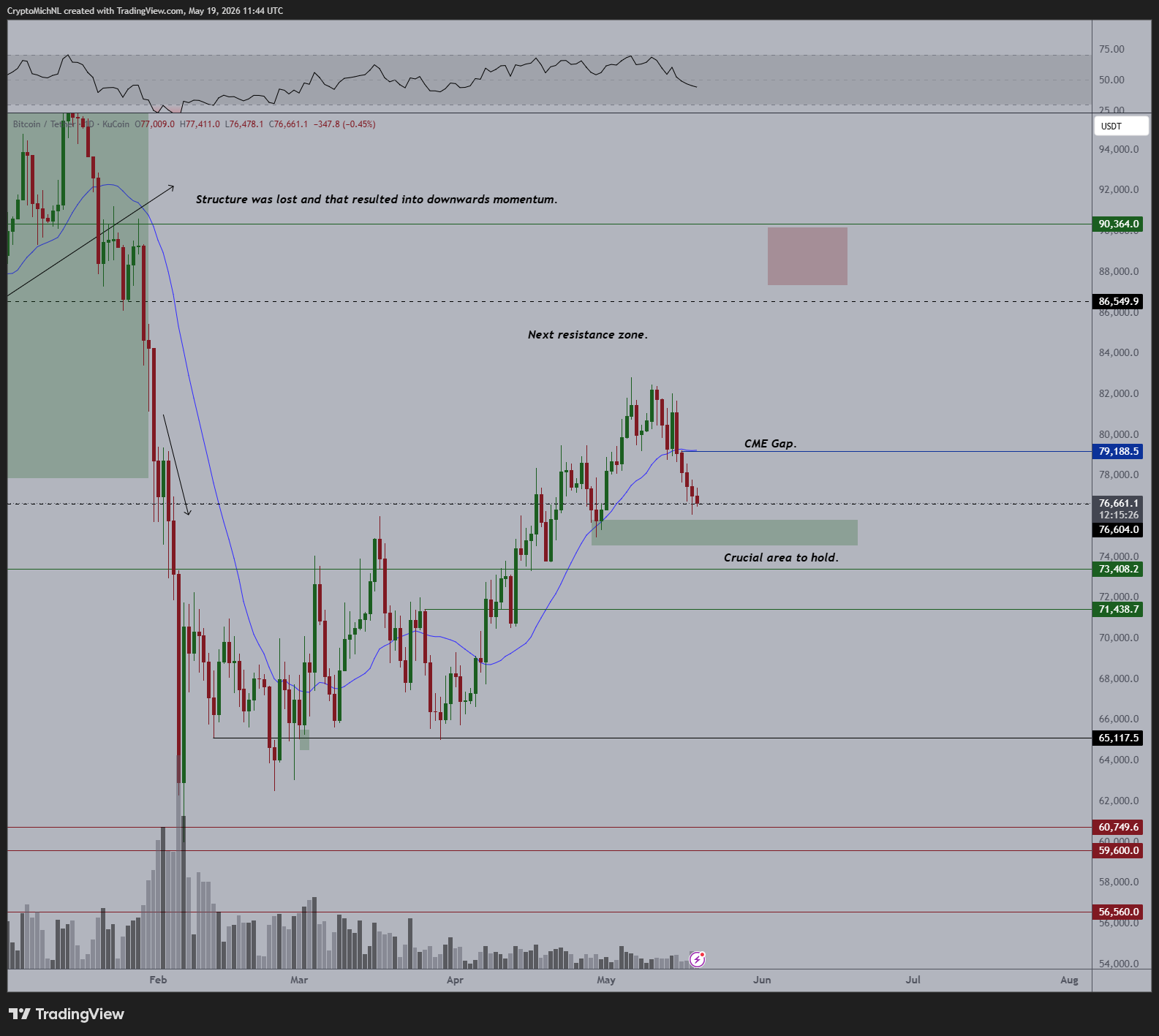
“Bitcoin is at a crucial level of support and it seems to be that it’s going to be holding,” a previous X post stated.
“Anything lower of $75,000-76,000 might signal that the accumulation needs to take longer.”
BTC/USDT one-day chart. Source: Michaël van de Poppe/X
Anatoly Yakovenko argues Solana needs its own atomically composable perpetuals DEX as Hyperliquid pursues regulatory clarity in Washington.
Solana co-founder Anatoly Yakovenko has publicly backed development of a new perpetuals DEX native to the Solana Virtual Machine, directly challenging Hyperliquid’s lead in onchain derivatives trading. The endorsement marks an escalating competitive push within the Solana ecosystem to capture perpetuals volume that has largely migrated to Hyperliquid in recent months.
Yakovenko’s support signals Solana’s strategic intent to build atomically composable perpetuals infrastructure within the SVM, suggesting the ecosystem views perpetuals as critical to retaining user activity and trading volume on-chain. His backing carries weight given Solana’s technical architecture and developer ecosystem, though no specific project details or launch timeline were disclosed.
The competition intensifies as Hyperliquid co-founder Jeffrey Yan has been in Washington engaging with policymakers on the regulatory path forward, including discussions around the CLARITY Act—proposed legislation addressing crypto derivatives regulation. Hyperliquid’s move to establish regulatory clarity at the federal level could provide it a structural advantage against emerging competitors if legislation passes.
Hyperliquid has emerged as the dominant onchain perpetuals protocol, consolidating significant trading volume away from centralized exchanges. A Solana-native alternative would leverage the blockchain’s speed and cost structure to compete directly, though Hyperliquid’s existing network effects and liquidity present a formidable barrier to entry.
Sources: X (Anatoly Yakovenko) | NewsBTC
This article was produced with the help of AI flows.