

Polymarket’s new private-company prediction markets let retail traders bet on startup milestones once reserved for Wall Street insiders.
Bitcoin Becomes Lifeline For Activists As HRF Unveils ‘Bitcoin For Nonprofits’ Guide
The Human Rights Foundation’s Freedom Tech program released a new playbook for movements that are learning to rely on Bitcoin when hostile governments weaponize banks and payment networks against them.
Titled “Bitcoin for Nonprofits: A Guide To Help Your Movement Achieve Financial Freedom,” the publication targets civil society organizations, grassroots groups, and activist networks that face frozen accounts, blocked wires, and weaponized compliance as part of everyday operations. It lays out a practical model for treating Bitcoin not as a speculative asset, but as parallel financial infrastructure when traditional rails fall under state control.
The guide, shared with Bitcoin Magazine, opens with the now‑familiar pattern of financial repression. Bank accounts for opposition groups are shut without warning. Foreign donations are rejected or stalled in opaque “review.”
HRF guide details
Currency crises in places like Venezuela, Turkey, and Nigeria erase savings and turn local treasuries into fast‑melting ice cubes. In this environment, the guide argues, many nonprofits discover that their main constraint is no longer donor interest or operational capacity, but the way money moves through centralized, surveilled systems.
The bulk of the document is an operations manual for that new reality. It walks readers through Bitcoin basics — how the network is secured by miners rather than banks, why its fixed 21 million supply matters in high‑inflation economies, and what makes it different from company‑run cryptocurrencies or bank‑dependent stablecoins.
The guide presents those distinctions through a political lens: in a crunch, assets that sit on top of bank accounts and regulated issuers can be frozen or reprogrammed; bitcoin held in self‑custody, by design, cannot.
From there, the focus shifts to how nonprofits can actually use this in the field. Detailed sections describe how to set up wallets, safeguard recovery phrases, and combine “hot” mobile wallets with “cold” hardware devices so that small operational balances stay accessible while larger treasuries remain offline.
The authors push strongly toward self‑custody and away from custodial exchanges, stressing that an organization does not gain much by moving to Bitcoin if it still leaves its keys with an intermediary inside the same jurisdiction it fears.
Multisignature setups are another central theme. Rather than putting full control of the treasury in one person’s hands, the guide recommends 2‑of‑3 or 3‑of‑5 multisig arrangements that require several keyholders to sign before funds can move.
That structure is presented as protection against arrest, coercion, and simple loss: if one hardware wallet is confiscated or a staffer disappears, the rest of the team can still recover funds and keep operating.
The guide also digs into on‑ and off‑ramp design, a pain point for many movements. It outlines how nonprofits can blend centralized exchanges, peer‑to‑peer marketplaces, Bitcoin ATMs, voucher systems, and local brokers to move between bitcoin and local currencies while managing surveillance and counterparty risk.
Case studies show how that patchwork already works in practice, from evacuation support in war zones to women’s education initiatives where participants are barred from holding bank accounts.
On top of the base layer, the text profiles an emerging ecosystem of tools that target hostile or fragile environments. Lightning wallets enable instant, low‑fee micro‑donations, useful for global crowdfunding during protests or crackdowns.
Sidechains such as Liquid offer cheaper, more private transfers with federation tradeoffs that some groups accept for specific flows. Chaumian ecash projects, including Fedi and Cashu, introduce near‑cash privacy and simple UX for small balances, giving donors and recipients another option when linking identities to financial activity carries real risk.
The publication does not gloss over Bitcoin’s downsides. It flags volatility, legal gray zones, self‑custody failures, internal governance breakdowns, and reputational attacks as material risks that nonprofits must plan for rather than ignore. To address them, it recommends conservative treasury allocations, slow rollout, strict key‑management discipline, and clear roles inside organizations, along with selective use of stablecoins or fiat rails where short‑term price stability and regulatory clarity matter more than censorship resistance.
You can read the full guide here.
21Shares says Hyperliquid ETF demand shows appetite for 24/7 trading

21Shares says strong early flows into its new Hyperliquid ETF reflect growing investor demand for around-the-clock access to crypto and traditional assets.
Senator Elizabeth Warren accuses U.S. regulator of approving unqualified crypto banks
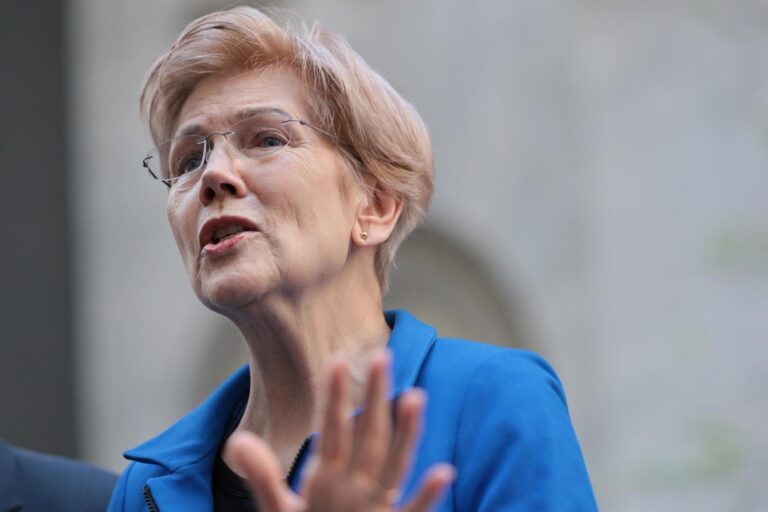
The Senate Banking Committee’s top Democrat sent a letter to the Office of the Comptroller of the Currency questioning the charters of nine crypto firms.
BoE Says Tokenization Could Lower Costs as UK Advances Stablecoin Rules

The Bank of England is stepping up its focus on digital money, with Deputy Governor Sarah Breeden highlighting tokenization as a potential way to reduce costs, speed settlement and increase competition.
Speaking at London’s City Week on Tuesday, Breeden said tokenization — the representation of assets and money on digital ledgers — could improve the efficiency and functionality of payments and financial markets, provided that trust and interoperability are preserved.
Breeden stressed that central bank money will remain the foundation, or “anchor,” of the monetary system, even as private-sector innovations such as tokenized deposits and regulated stablecoins gain traction.
She said the central bank is working with industry, government and regulators to build a framework that supports innovation without undermining financial stability.
“Alongside traditional bank deposits, people should be able to pay with tokenized bank deposits, regulated stablecoins and, potentially, a retail central bank digital currency (CBDC),” she said, according to a transcript of the speech. “More competition, from a wider range of technologies and business models, should lower costs and improve functionality for users.”
The BoE’s CBDC Academic Advisory Group said in January that “retail CBDC is not strictly required to preserve uniformity, but may play a valuable supporting role, particularly as transactional use of cash declines.”
Related: Crypto awareness tops 80% among young people in UK: Coinbase survey
BoE moves to modernize settlement infrastructure
The UK is taking additional steps to prepare its financial system for tokenized assets. On Monday, the BoE proposed extending the operating hours of its core settlement infrastructure to near 24/7 availability.
In the proposal, the central bank said longer operating hours would help support cross-border payments and securities settlement as tokenization and other digital asset technologies continue to evolve.
An excerpt of the BoE’s proposal to extend settlement hours. Source: Bank of England
The proposal follows Breeden’s comments earlier this month that the Bank was reconsidering its approach to pound-sterling-denominated stablecoins, including whether to ease limits on how much consumers can hold. The review is intended to reduce friction for early adopters as policymakers seek to strengthen the UK’s position as a competitive hub for digital assets.
The Bank of England has softened is stance on stablecoins in recent months as officials engage more closely with industry groups and revisit earlier proposals that would have imposed stricter reserve and backing requirements.
Related: Stablecoin industry opposes Bank of England’s unhosted wallet ban
Canaan Posts $88.7M Net Loss in Q1 2026 as Bitcoin Prices Weigh on Mining Revenue

Bitcoin miner Canaan reported a net loss of $88.7 million for the first quarter of 2026, as falling Bitcoin (BTC) prices squeezed margins and triggered a significant inventory write-down.
The company posted total revenue of $62.7 million for the quarter ending March 31, a sharp decline from the $196.3 million it recorded in the previous quarter, according to a Tuesday press release.
Industrial mining equipment remained the company’s primary revenue driver at $39.6 million, though sales tumbled 75% from the prior quarter. Self-mining contributed $19.1 million, while the home mining segment brought in $2.7 million, a category that more than doubled year-on-year.
Source: Canaan
“Although average Bitcoin prices and hashprice declined significantly quarter-over-quarter, our bitcoin production experienced a comparatively smaller decrease, reflecting the resilience of our mining operations and continued hashrate deployment,” Jin (James) Cheng, chief financial officer of Canaan, said.
A $25 million inventory write-down weighed on the quarter’s gross loss of $23 million, while loss from operations reached $54.3 million.
Related: Bitcoin turns risk on as stocks hit new highs and miner profits rise: Is $85K BTC next?
Canaan’s self-mining hashrate surges 66%
Canaan expanded its self-mining footprint to 11 exahashes per second of installed computing power, a 66% jump from a year earlier. The company held 1,808 Bitcoin on its balance sheet as of March 31, valued at approximately $121 million.
In the quarter, Canaan also completed the acquisition of Cipher Mining’s 49% stake in three West Texas joint venture projects totaling roughly 4.4 EH/s in hashrate capacity and 120 megawatts of power. The deal, closed through a share issuance rather than cash, gives Canaan access to power rates below three cents per kilowatt-hour on the ERCOT grid.
Looking ahead, Canaan guided Q2 revenues between $35 million and $45 million, a further sequential decline.
Canaan shares closed down 3.54% at $0.4827 on Monday, shedding a further 7.71% in pre-market trading to $0.4455, according to Yahoo Finance.
Related: Hut 8 refinances Bitcoin-backed loan with $200M FalconX deal
Major miners report losses in Q1
Across the sector, major miners including Riot Platforms, Core Scientific, CleanSpark and TeraWulf all reported widening losses in Q1. MARA topped the group with a $1.3 billion net loss, roughly $1 billion of it tied to non-cash mark-to-market adjustments on its Bitcoin holdings.
As mining margins compress, a growing number of miners are pivoting toward AI and high-performance computing as an alternative revenue stream. On Monday, HIVE Digital Technologies announced plans to build a 320-megawatt AI data center campus near Toronto, capable of supporting more than 100,000 GPUs at full build-out.
Magazine: Guide to the top and emerging global crypto hubs — Mid-2026
The U.S. can’t lose the bitcoin race to China

The next global power competition is not being fought over missiles alone. It’s being fought over money, and right now, China is moving aggressively to shape the future of it, argues Gooden.
SOL Negative Funding Rate Highlights Falling SOL Demand

Key takeaways:
- Solana perpetual futures funding rates flipped negative, signaling excess demand for bearish positions.
- Rival networks like Base and Hyperliquid pose direct threats to Solana by aggressively capturing DEX market volume.
Solana’s native token SOL (SOL) faced a 15% correction following a rejection at $98 on May 11. A retest of the $83 level on Tuesday was followed by negative futures funding rates, indicating increased demand for short SOL positions.
While declining network activity contributed to the price drop, competition among rival blockchain networks has picked up.
SOL perpetual futures annualized funding rate. Source: Laevitas
The SOL perpetual futures funding rate stood at -3% on Tuesday, down considerably from the +8% on Saturday. During neutral market conditions, this indicator hovers near +9% to account for the cost of capital and exchange risk. Demand for bullish leverage has been largely absent since Saturday, when SOL price slipped below $90.
Solana DEX activity has declined by 56% since January
Declining activity on Solana’s decentralized exchanges (DEXs) has reduced ecosystem revenue and demand for SOL. This reduced appetite for decentralized applications (DApps) was not exclusive to Solana, but growing competition poses a major threat, as investors fear that demand for memecoins has faded for good.
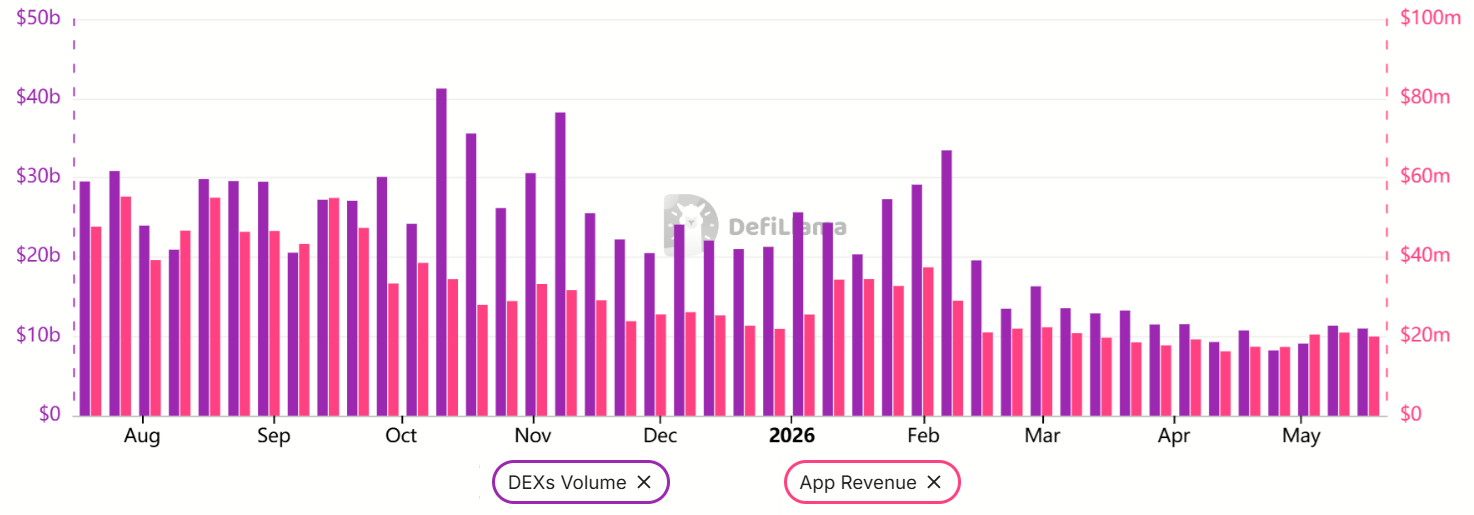
Solana weekly DEX volumes, DApps revenue, USD. Source: DefiLlama
Solana DApp revenue stabilized near $20 million per week, down from an average of $35 million in January. This movement closely mirrors the network’s DEX activity trend, which currently stands at $11 billion per week, compared to January’s average of $25 billion. The 30-day DApp revenue leaders on Solana are Pump, Axiom Pro, Phantom, and Jupiter, which command a combined 65% market share.
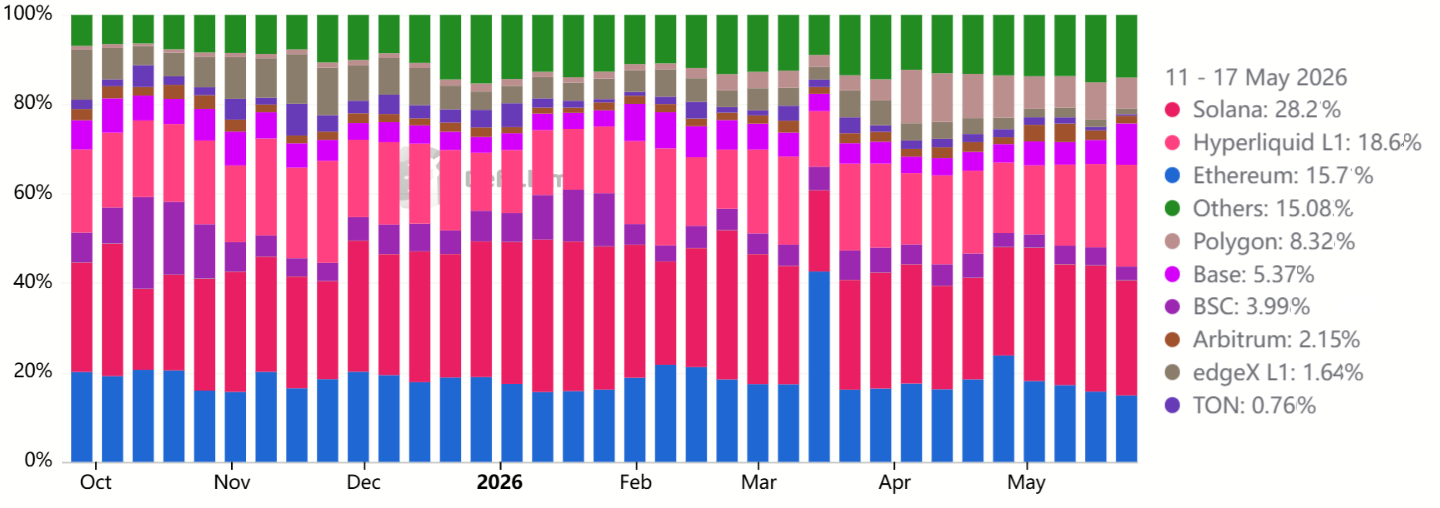
Blockchain ranked by weekly DApps revenue market share. Source: DefiLlama
Solana remained the top blockchain for DApp revenue despite intensifying competition. Hyperliquid created a direct threat due to its dominance in perpetual contracts, offering a high-throughput solution with core trading features built directly into the consensus layer. Meanwhile, the Ethereum layer-2 network Base offered seamless integration into the Coinbase ecosystem.
In terms of total value locked (TVL), Solana secured second place with $5.9 billion, followed by BNB Chain at $5.5 billion and Base at $4.5 billion. DEX platforms and staking DApps like Jupiter, Kamino, Sanctum, and Raydium lead Solana’s TVL. Still, no blockchain threatens Ethereum’s $43.2 billion TVL, which relies heavily on collateralized lending and liquid staking.
Potential spoofing activity on Solana network DApps
Solana’s footprint in the DApp industry cannot be understated, but the network’s low fees offer a perfect opportunity for maximal extractable value (MEV) botting and inflated activity.
Related: Goldman Sachs exits XRP, Solana ETF exposure in Q1 2026
Source: X/lukecannon727
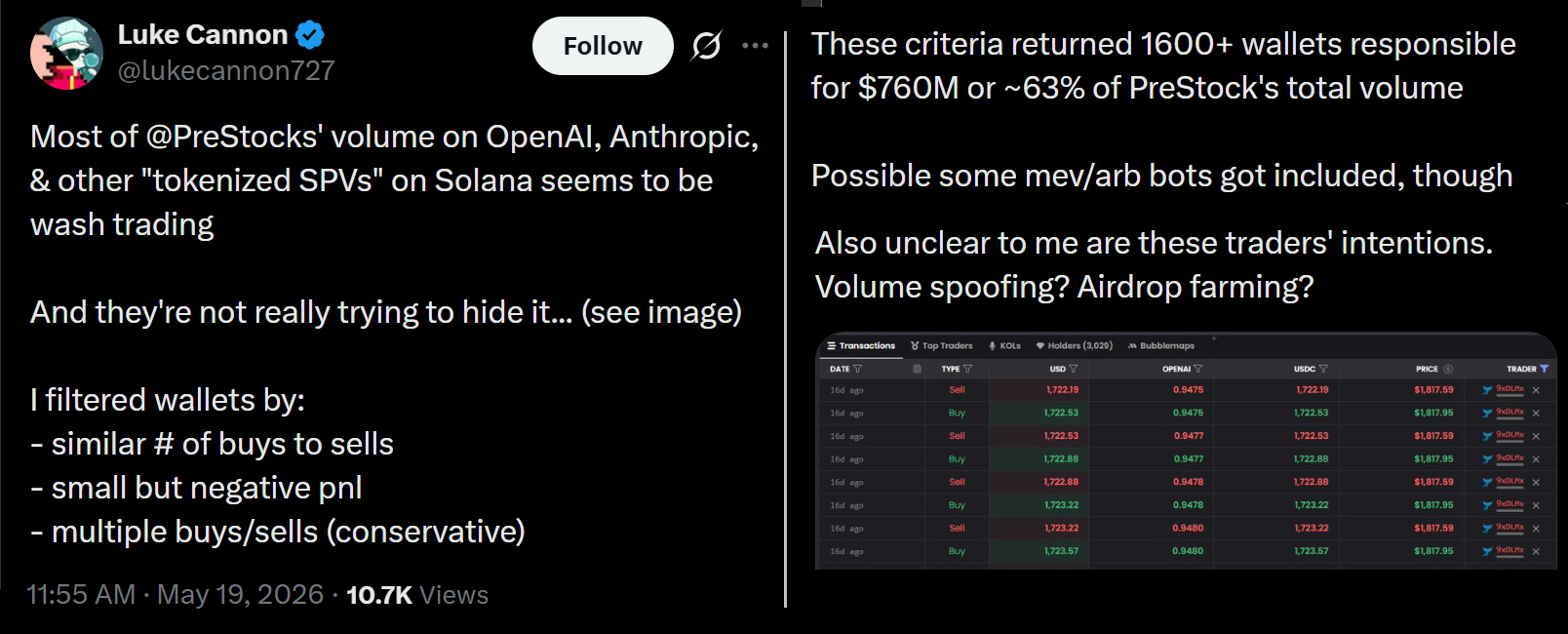
X user lukecannon727 noted that 1,600 addresses were reportedly responsible for nearly 63% of volumes on PreStocks, a synthetic asset trading platform that runs on the Solana network. According to the analysis, those entities presented balanced trading activity, high execution frequency, and small net losses. These findings are highly consistent with arbitrage activity, but they could also indicate volume spoofing.
Recent weakness in SOL prices can be partially attributed to the broader decline in DApp demand and increased competition, especially from Hyperliquid and Base. An eventual bull run seems highly dependent on a pickup in DEX activity, particularly in memecoin trading. But, at the same time, there is no indication that SOL should retest the $78 level last seen in early April.
The SEC wants to let newly public companies raise cash instantly in its biggest rule change in decades
The agency is proposing its largest overhaul of public listing rules in over 20 years, cutting compliance costs and giving crypto firms a much easier path to raise cash on Wall Street.
SEC Looking To Open The Door For Tokenized Stocks: Report

The U.S. Securities and Exchange Commission is putting the finishing touches on a framework that would allow digital, blockchain-based versions of publicly traded stocks to trade on crypto platforms — a move that signals how far Washington has traveled in its relationship with an industry it once treated with suspicion.
According to a Bloomberg report published Monday, the SEC plans to release an “innovation exemption” for tokenized securities as early as next week. The proposal, under development by an agency now led by Chair Paul Atkins, would create a lighter regulatory pathway for platforms offering digital representations of equities without requiring full registration compliance. The SEC did not respond to requests for comment.
What makes the framework notable is what the tokens would and would not be. Under the reported structure, third parties could issue tokens that track the price of a public company’s shares without that company’s backing or consent.
The tokens would trade around the clock on decentralized crypto platforms. They would not carry traditional shareholder rights: no votes at annual meetings, no dividend checks, no seat at the table when a company makes decisions that affect its shareholders.
Tokenized stocks settle faster, operate across borders without the friction of legacy infrastructure, and could open equity markets to investors who have historically been locked out by geography or cost. The vision is ambitious: proponents want to put the plumbing of the $126 trillion global equity market on blockchain rails.
The absence of consent from underlying companies and the removal of shareholder protections raise uncomfortable questions about what investors are actually buying — and who is responsible when something goes wrong.
Wall Street, SEC’s embrace of tokenized products
The SEC’s reported shift arrives at a moment when Wall Street has moved from watching tokenization at arm’s length to racing toward it. The Depository Trust & Clearing Corporation, which sits at the center of U.S. securities settlement, announced plans to begin limited production trades of tokenized assets in July, with a broader launch set for October. The DTCC’s involvement matters: it processes and safeguards the vast majority of U.S. market transactions, and its entry into tokenization lends institutional credibility to what has until recently been an experimental frontier.
Nasdaq and the New York Stock Exchange have not stayed on the sideline either. The SEC approved Nasdaq’s rule change in March to support tokenized share trading — one that preserves traditional ownership rights.
The NYSE, whose parent company Intercontinental Exchange also struck a partnership with crypto exchange OKX, received its own SEC approval in April and is building a platform for 24/7 onchain settlement.
The market for tokenized equities is already growing at a pace that exceeds most forecasts. Data from RWA.xyz shows the sector now holds $1.4 billion in distributed value across more than 2,200 assets — a figure that climbed roughly 30% in just the past 30 days. Monthly transfer volume has hit $3.24 billion. The holder base has grown 25% in a month to around 265,000 people.
Atkins has framed the SEC’s direction as a matter of regulatory clarity. Existing securities rules, he has argued, were designed for a world of human intermediaries and fixed trading hours — not for blockchain protocols that collapse the functions of exchange, clearing, and settlement into a single layer. The agency, he has said, should write rules rather than pursue enforcement actions to shape how these markets develop.
That argument carries weight in the current political climate. The Republican-led Senate Banking Committee advanced crypto legislation earlier this month, part of a broader effort under the current Trump administration to build a more defined regulatory framework for crypto products and digital assets.