Bitwise’s chief investment officer said that Hyperliquid is targeting not the $3 trillion crypto economy, but the $600 trillion global asset market.
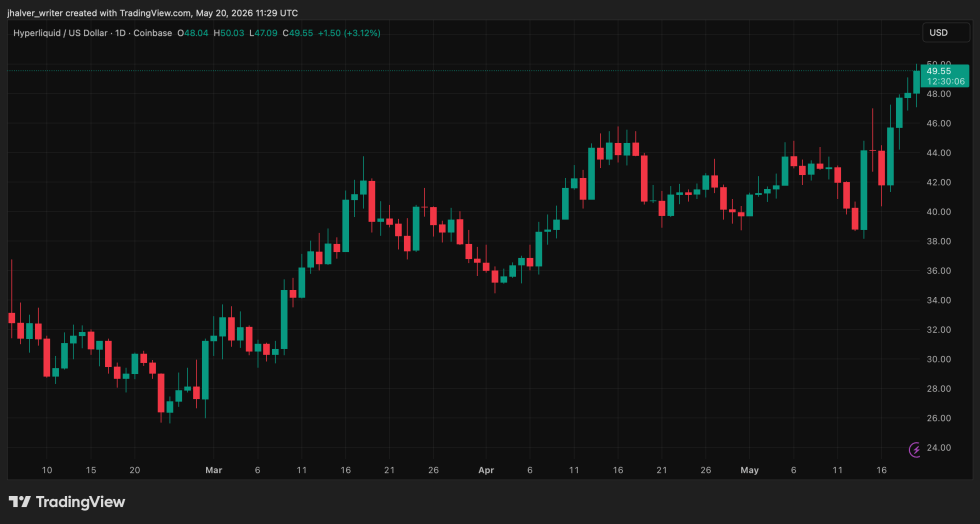
Hyperliquid’s HYPE token crossed $50 on Wednesday for the first time since September 2025, in part fueled by a high-profile call from Bitwise’s chief investment officer.
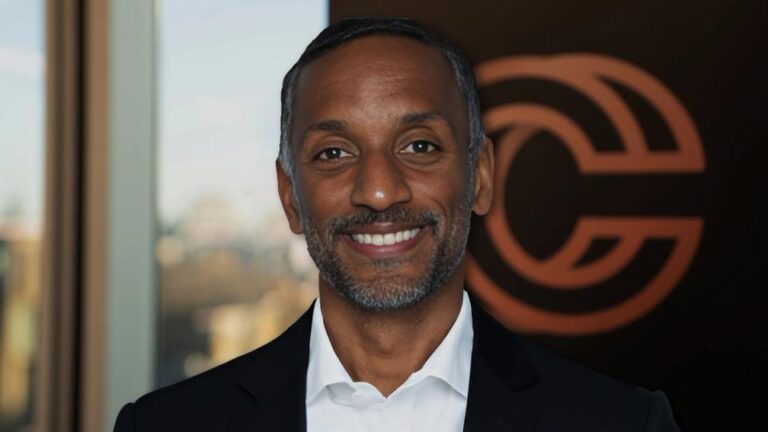
Bitwise CIO Matt Hougan on Tuesday argued in a weekly memo that the market is undervaluing Hyperliquid. Hougan framed Hyperliquid as a fast-growing trading venue moving beyond crypto perps into commodities, S&P 500 futures, pre-IPO stocks, prediction markets, and other non-crypto assets. He said Hyperliquid is targeting not the $3 trillion crypto economy, but the $600 trillion global asset market. He expects non-crypto assets to grow from nearly half to 70% of total platform volume over time.
Hougan estimated Hyperliquid is generating between $800 million and $1 billion in annualized revenue, trading at roughly 10–14 times its buyback stream, a multiple he argued compares favorably with traditional exchanges like Robinhood and CME Group, which trade at higher multiples with slower growth.
“Hyperliquid’s move above $50 looks like a combination of momentum and improving fundamentals, but unlike many narrative driven rallies in crypto, Hyperliquid actually has meaningful on chain activity underneath the price action,” said Jason Rindahl, CEO of Nebula DeFi, in an emailed comment Wednesday.
Hyperliquid has been on a tear, gaining 32% in the past seven days, making it the best-performing large-cap crypto asset of 2026, according to CoinGecko.
SpaceX Pre-IPO Trading
The rally is also fueled by Trade.xyz, a decentralized perpetuals platform built on Hyperliquid’s HIP-3 framework, which on Monday launched a synthetic pre-IPO perpetuals contract tracking SpaceX’s implied valuation.
The SPCX-USDC contract opened at a $150 reference price implying a $1.78 trillion SpaceX valuation, spiked to $216 within hours, and settled around $202.89. The market recorded $33 million in 24-hour volume and $21.8 million in open interest on its first day. The Defiant reported on the SpaceX launch when it triggered HYPE’s 7% move on Monday.
SpaceX filed its S-1 confidentially with the SEC on April 1 and is reportedly targeting June 11 for IPO pricing on Nasdaq.
The SpaceX launch sits within a broader expansion of Hyperliquid’s permissionless perpetuals marketplace. The HIP-3 framework, which allows third-party teams to create their own perpetual futures markets, has processed more than $120 billion in total volume since launch, according to Dune Analytics. On April 8, HIP-3 deployers generated 48.1% of Hyperliquid’s total platform volume, approaching parity with its native markets.
HYPE ETF
Institutional infrastructure has also converged around the token in recent weeks. On May 12, 21Shares launched the first US-listed spot HYPE ETF on Nasdaq. Bitwise followed on May 15 with its BHYP fund on the NYSE.
The 21Shares fund has since recorded around $10.5 million in cumulative net inflows, according to SoSoValue.
On Monday, Bitwise said it will allocate 10% of BHYP management fees to purchasing and holding HYPE on its balance sheet, with acquired tokens subject to a minimum 12-month holding period. Bitwise cited Hyperliquid’s model, under which approximately 99% of the network’s revenue goes toward buying back and burning HYPE, as the rationale for its approach.
Tighter
The ETF moves followed Coinbase announcing on May 14 that it had become Hyperliquid’s official USDC treasury deployer under the platform’s Aligned Quote Asset framework. As part of the deal, Circle said it will expand USDC’s role on Hyperliquid while staking 500,000 HYPE tokens as it moves toward validator status, and approximately 90% of the interest income from the platform’s USDC deposits will be rebated to Hyperliquid.
Regulatory Pressure
Not all signals are uniformly bullish. Intercontinental Exchange and CME Group have reportedly urged the CFTC to address potential market integrity risks associated with Hyperliquid’s pseudonymous trading environment, while the Hyperliquid Policy Center has pushed back, arguing the platform’s transparency is “hostile” to insider trading.
Hougan also acknowledged that Hyperliquid is not currently available to US users and still requires integration into the domestic regulatory framework, leaving regulatory execution as a key test for the business. The platform also faces ongoing token unlock pressure: 237 million HYPE tokens allocated to core contributors began unlocking in November 2025 and continue to vest through late 2027.
Political action committees (PACs) aligned with and funded by the cryptocurrency industry notched a series of wins in three US state primaries on Tuesday, potentially setting a precedent for the 2026 midterm elections.
The Fairshake PAC and its affiliates poured a combined $20 million into supportive media for the races. The committee, largely funded by crypto companies Ripple Labs and Coinbase, is behind the Defend American Jobs PAC in supporting Republican candidates and Protect Progress PAC for Democrats considered to be “pro-crypto.”
Four Republican candidates and one Democrat won their respective primaries for US Senate and House of Representatives seats in Georgia and Kentucky, while one Alabama Republican will go to a runoff election.
“Fairshake’s 6-0 sweep tonight was a clear victory for pro-crypto leaders across the country,” Fairshake spokesperson Geoff Vetter told Cointelegraph. He said:
“This powerful bipartisan mandate is being heard across America from Georgia to Alabama to Kentucky.”
According to Federal Election Commission filings, Protect Progress spent more than $4.2 million to support Jasmine Clark, a Georgia representative running in the state’s 13th Congressional district. Defend American Jobs reported similar expenditures for media to support Republican candidates: $455,000 for Clay Fuller in Georgia’s 14th district, $709,000 for Houston Gaines in Georgia’s 10th district, $431,000 for Jim Kingston in Georgia’s 1st district and $7.2 million for Andy Barr for Kentucky’s US Senate seat.
Barry Moore, who was supported with $7.4 million from Defend American Jobs in his run for Alabama’s US Senate seat, will head to a runoff against state Attorney General Steve Marshall and Republican candidate Jared Hudson, after none of the three secured a majority of the vote in the primary.
Source: Jasmine Clark
Fairshake and its affiliates, backed by the crypto industry, are expected to spend millions of dollars in 2026 to “oppose anti-crypto politicians and support pro-crypto leaders,” according to a spokesperson in January. The company reported holding a $193 million war chest, far surpassing its 2024 expenditures of $130 million on media and ads to support congressional candidates.
Related: Crypto PACs spend $7.2M to support candidates in 5 US states ahead of elections
Despite the multimillion-dollar expenditures, the crypto-backed PAC hasn’t always been successful in swaying enough voters before a key election or primary. Fairshake reportedly spent $8 million opposing Illinois Lieutenant Governor Juliana Stratton in her US Senate primary, but she beat other candidates with more than 40% of the vote.
Coming Texas run-off seen again testing crypto PAC support
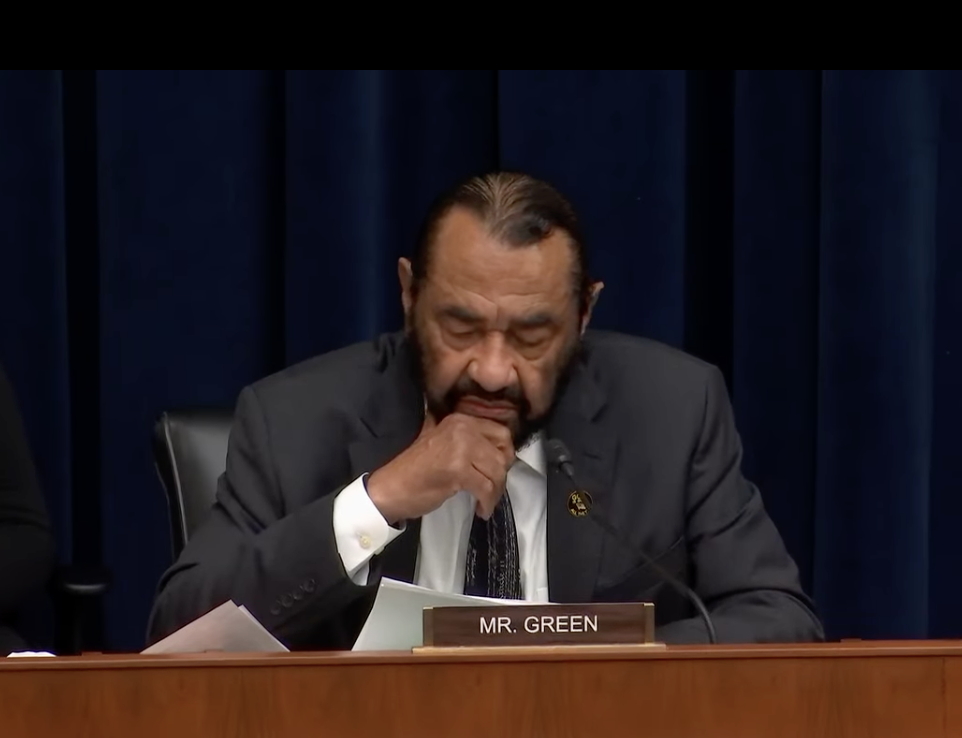
Protect Progress has ramped up spending on supportive media for Democratic candidate Christian Menefee, running to unseat incumbent Al Green in Texas’ 18th Congressional District.
Representative Al Green addressing the House Financial Services Committee in March. Source: Al Green
According to FEC filings as of Tuesday, the PAC spent more than $4.1 million to support Menefee. It also reported spending more than $2.8 million on media to oppose Green, who has expressed anti-crypto views and voting records against the payment stablecoin bill GENIUS Act and digital asset market structure bill, the CLARITY Act.
Protect Progress reportedly spent more than $1.5 million opposing Green ahead of a March primary against Menefee, but neither candidate secured a majority of the vote, triggering next Tuesday’s runoff.
Magazine: 5 tech predictions the mainstream media got horribly wrong
Hunter Biden, the son of former President Joe Biden, is now accepting Bitcoin as payment for his artwork on his official website.
The homepage of Hunter Biden’s official website, hunterbiden.com, features his signature bright, large-scale floral paintings, while the footer now includes a simple but striking notice: “BITCOIN ACCEPTED,” listed alongside links to the site’s privacy policy, terms of use and “Verisart Authentication.”
Verisart provides blockchain‑based certificates of authenticity designed to permanently record provenance and ownership of artworks, both physical and digital.
Biden’s art career has been politically fraught from the start, with initial shows in New York and Los Angeles pricing works between roughly 75,000 and 500,000 dollars despite being a novice painter.
Subsequent reporting revealed that one prominent buyer, Democratic donor and Los Angeles real‑estate investor Elizabeth Hirsh Naftali, later received a presidential appointment from Joe Biden, prompting oversight hearings and accusations of influence‑peddling surrounding the art sales.
Court filings in March 2025 paint a starkly different picture of his current fortunes: Biden told a federal judge that he now has “significant debt in the millions of dollars” and had managed to sell only one painting for 36,000 dollars since late 2023, after selling 27 works in earlier years at an average of nearly 55,000 dollars.
He cited crashing art sales as a reason he could no longer afford to pursue some of his lawsuits over the publication of materials from his infamous laptop.
Hunter Biden: Addiction, tragedy and a life of scandals
Hunter Biden’s controversies are rooted in a life marked by early trauma and long‑running addiction struggles. He survived the 1972 car crash that killed his mother and baby sister, an event that left both him and his brother Beau grievously injured and shaped the family’s narrative for decades.
As an adult, Hunter Biden has spoken openly about his battles with alcohol and crack cocaine, which intensified after Beau’s death from brain cancer in 2015 and led to multiple stints in rehab.
These struggles spilled into public view through his divorce from Kathleen Buhle, who described repeated relapses and drug use, and later through his controversial relationship with Beau’s widow, Hallie Biden, which drew intense media scrutiny.
In 2018, Hunter Biden fathered a child with Lunden Roberts, an Arkansas woman he initially claimed not to know; a DNA test confirmed paternity and sparked a long‑running child‑support fight frequently cited by Republican critics.
His overseas business dealings generated even greater backlash. Hunter Biden joined the board of Ukrainian gas company Burisma in 2014, reportedly earning up to 1.2 million dollars a year while his father handled Ukraine policy, and also pursued ventures with Chinese investors. Republicans alleged these arrangements monetized access to Joe Biden.
The furor intensified after files from a laptop Biden allegedly abandoned at a Delaware repair shop surfaced, appearing to show drug use and negotiations over foreign deals.
Federal prosecutors separately charged him with failing to pay more than 1.4 million dollars in taxes and lying about drug use on a 2018 gun form; he was convicted on three gun felonies in 2024 before receiving a sweeping presidential pardon from his father.
A bipartisan group of lawmakers introduced a revised crypto tax bill Wednesday that aims to update the tax code to better address crypto use cases and would, if signed into law, direct the IRS to analyze the effect de minimis exemptions might have.
Congressmen Steven Horsford (D-N.V.), Max Miller (R-Ohio), Suzan DelBene (D-Wash.) and Mike Carey (R-Ohio) reintroduced the Digital Asset Protection, Accountability, Regulation, Innovation, Taxation and Yields Act, otherwise known as the Parity Act, that Horsford and Miller had previously pushed a few times. The new language comes a week after lawmakers reportedly met to discuss crypto tax reform.
The new version of the bill calls for “regulated payment stablecoins” to incur no gain or loss unless the cost basis is less than 99% of the redemption value of the stablecoin, and it also creates a safe harbor for trading through brokers or in taxpayer accounts, defines how so-called “wash sale” rules might apply to digital assets and addresses how digital assets earned by acting as a validator.
The bill also directs the IRS to review what sort of tax burden crypto holders face when it comes to “small digital asset transactions” and how many transactions worth less than $200 are captured under existing law. This review should include the IRS’ needs if there was a de minimis exemption — meaning a carveout for activity that the law should consider too small to be concerned with — for crypto transactions, as well as whether and how such an exemption might be abused.
The crypto industry has long argued that freeing taxpayers of the burden of having to file and report taxes on small transactions would make it easier to use crypto as a payments tool for small items like a cup of coffee.
The bill is meant to just be a first step toward broader crypto tax reform, Horsford said at CoinDesk’s Consensus Miami conference earlier this month.
“I actually think tax is the foundation. Why? Because it’s tax policy that will determine number one, how these digital assets can be used in our finance system. And at a time when our federal tax code is outdated, it does not take into account the modernization of digital assets,” he said.
“For example, none of the current regulatory policy framework tells a consumer, an institution, or a builder what happens to their taxes when they sell a digital asset, earned staking reward, lend crypto on the U.S. platform or make a charitable contribution in bitcoin,” the lawmaker said “Those are tax questions. And they remain entirely unresolved.”
Copying its moves from the week’s first two trading days, Bitcoin faced tailwinds as US market sentiment stayed bearish on the macroeconomic outlook.
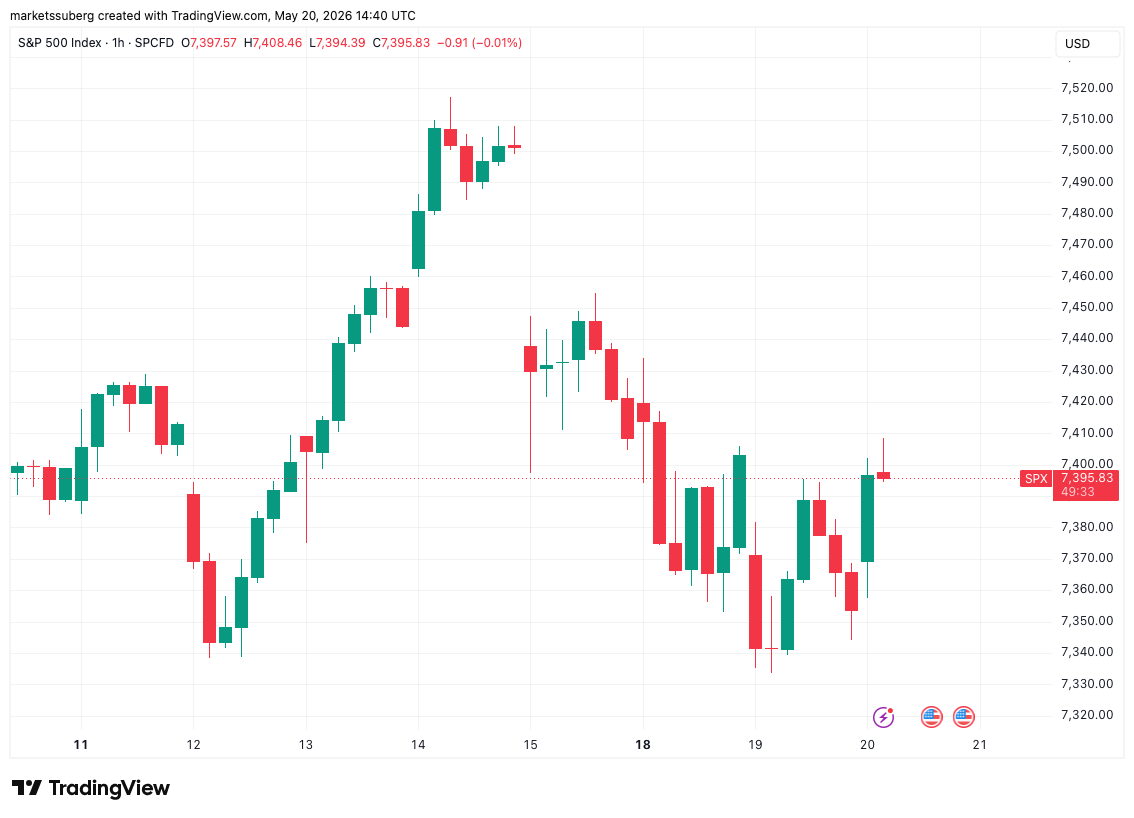
The S&P 500 fell 1.3% before rebounding, with traders waiting for the week’s key potential volatility catalyst: Q1 earnings from tech company Nvidia.
On Monday, trading resource The Kobeissi Letter described the numbers as the “biggest earnings event of the quarter.”
Continuing, it noted the role of tech stocks in driving S&P 500 strength — even as the US-Iran war and associated inflation risk spooked other markets.
“A handful of tech stocks are driving the entire market,” it summarized in a post on X.
In crypto circles, attention focused on the Coinbase Premium Index, which highlighted the ongoing lack of bullish sentiment during US trading sessions.
Related: BTC price ‘bull trap’ at $76.5K? Five things to know in Bitcoin this week
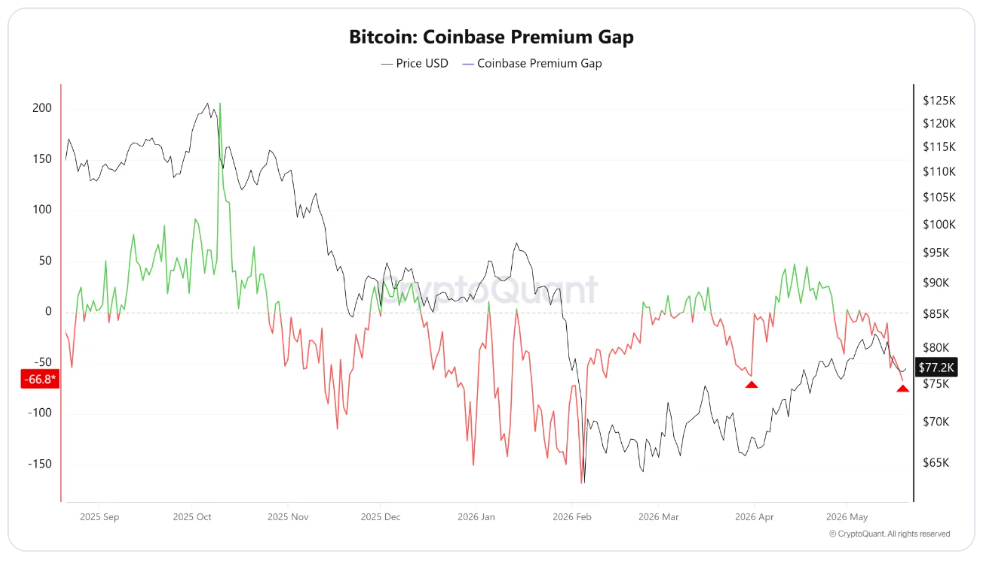
The Index, which measures the difference in price between Coinbase’s BTC/USD and Binance’s BTC/USDT pairs, fell to its lowest levels since February on the day.
Commenting in one of its QuickTake blog posts, onchain analytics platform CryptoQuant said that spot Bitcoin demand “remains soft.”
“The latest Coinbase Premium Gap reading stands near -$66.8, meaning Bitcoin is trading at a lower price on Coinbase Pro’s USD pair compared with Binance’s USDT pair. This is deeper than the late-March reading of around -$62.6, when Bitcoin was trading near $68,000,” contributor Amr Taha wrote.
“The comparison is important because Bitcoin is now trading much higher, around $77,200, yet the Coinbase discount versus Binance is wider than it was when BTC was nearly $9,000 lower.”
Bitcoin Coinbase Premium gap (screenshot). Source: CryptoQuant
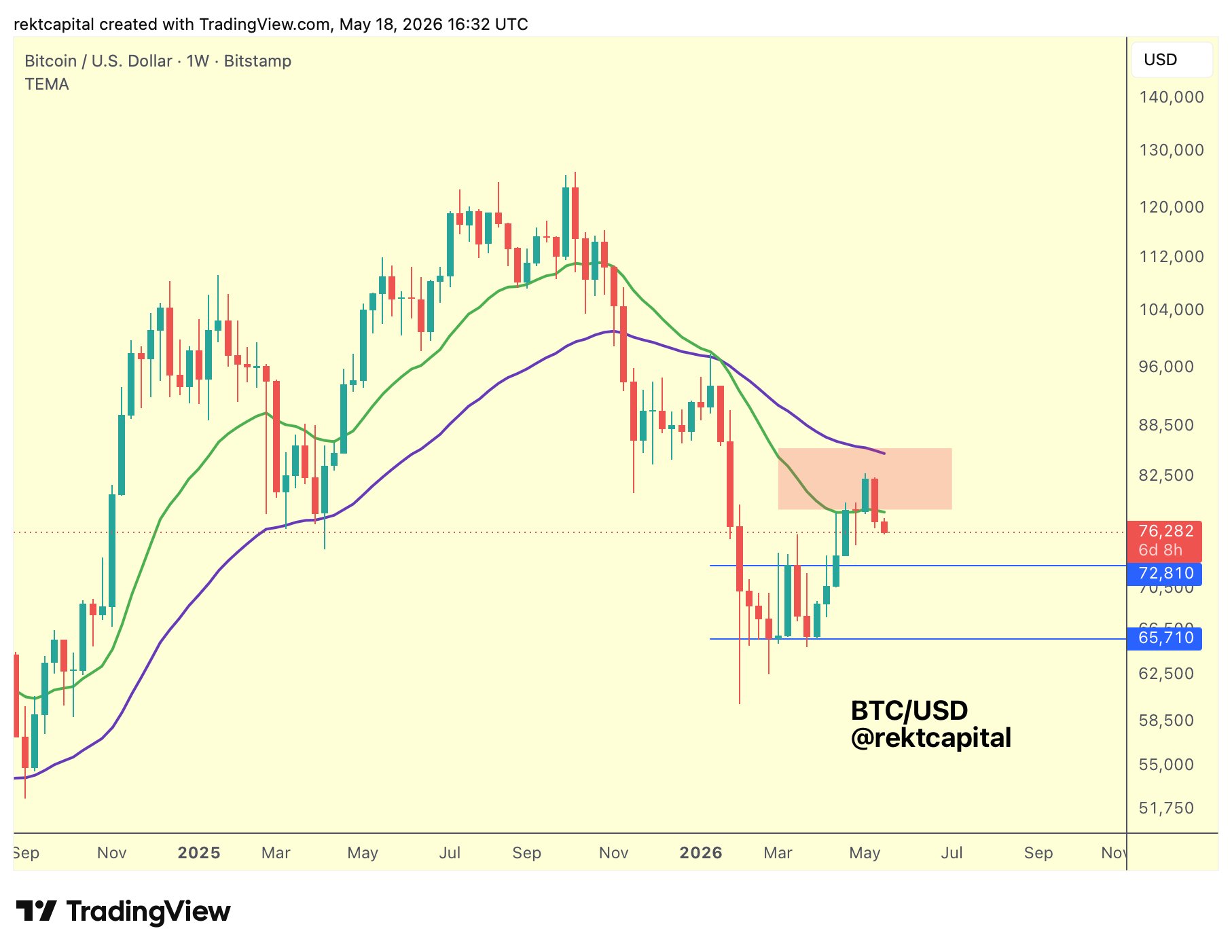
Others monitored familiar trend lines, including the 21-week exponential moving average (EMA).
As Cointelegraph reported, BTC/USD reclaimed that level on weekly time frames in late April, only to lose it again this week.
“Bitcoin has Weekly Closed below the 21-week EMA (green) which technically positions price to potentially turn it into new resistance on any upcoming rebound,” trader and analyst Rekt Capital told X followers on Tuesday while analyzing the weekly chart.
“Turning the 21-week EMA into new resistance would fully confirm the breakdown from it.”
What happened? India’s long-running debate over crypto regulation moved back into Parliament this week, as the Standing Committee on Finance held discussions with Binance, WazirX and ZebPay on the future of virtual digital assets.
The May 20 sitting, listed by the Lok Sabha Secretariat under the subject “A Study on Virtual Digital Assets (VDAs) and Way Forward,” brought together crypto exchanges, the International Financial Services Centres Authority, the Ministry of Finance and the Ministry of Corporate Affairs.
Standing Committee on Finance Invites ZebPay, Binance, and WazirX the subject “A Study on Virtual Digital Assets (VDAs) and Way Forward”. Image Credit: Lok Sabha Secretariat
The hearing signals that India is still searching for a regulatory model for crypto, four years after introducing a tax framework for digital assets.
It also comes as lawmakers weigh three competing priorities: tax collection, investor protection and the risk of capital moving offshore.
According to The Economic Times, committee chairman Bhartruhari Mahtab said the panel found it “alarming” that thousands of crores of rupees were being invested in VDAs, with money flowing outside India. He said the committee was studying different global approaches, including regulation in the US, UK and EU, bans such as China’s, and containment-led models in countries such as Japan and Brazil.
India currently taxes crypto but has not enacted a dedicated law governing the asset class.
That contradiction was reportedly raised inside the committee with some members questioning how the government can impose a 30% tax when there is still no comprehensive crypto policy.
The result is a policy middle ground.
Crypto is not banned in India. But it is also not regulated like securities, commodities, payments instruments or banking products.
Instead, India has built a framework around taxation, anti-money laundering compliance and enforcement against non-compliant offshore platforms.
That approach has given the state visibility over transactions, while leaving investors without a clear statutory protection regime.
The Finance Committee’s meeting suggests lawmakers may now be trying to decide whether that patchwork is enough.
Taxation remains the centre of India’s crypto policy
India’s current crypto framework began with the 2022-23 Union Budget.
The government imposed a 30% tax on income from the transfer of virtual digital assets, along with cess and surcharge. It also introduced a 1% tax deducted at source on crypto transactions above prescribed thresholds.
The tax regime was designed to create a reporting trail.
But it also became one of the industry’s biggest points of contention.
Crypto exchanges and industry groups have repeatedly argued that the 1% TDS pushed trading activity toward offshore platforms and peer-to-peer channels. That made it harder for Indian authorities to monitor transactions, even as the tax was meant to improve visibility.
The Finance Committee’s latest discussion appears to reflect the same tension.
Mahtab said it was necessary that income generated from VDA investments should be taxed within India, especially when platforms or entities may be based outside the country.
That perspective is worth noting. The issue is no longer only whether crypto should be allowed. It is also about where trading occurs, who captures the data, and whether India can tax the activity without driving it into less visible markets.
AML rules have become the main regulatory anchor
India’s strongest crypto oversight mechanism today is the Financial Intelligence Unit.
The Ministry of Finance said in October 2025 that VDA service providers were brought under the anti-money laundering and counter-terror financing framework in March 2023. It said VDA platforms operating in India, whether offshore or onshore, must register with FIU-IND and comply with obligations under the Prevention of Money Laundering Act.
The government also made clear that the obligations are activity-based.
That means a platform does not need a physical presence in India to fall under Indian AML rules if it serves Indian users.
As of October 2025, 50 VDA service providers had registered with FIU-IND, according to the same Ministry of Finance release. The FIU had also issued notices to 25 offshore VDA service providers for non-compliance and sought takedown action for platforms found operating illegally without complying with PMLA provisions.
This has become India’s de facto crypto regulatory perimeter.
It focuses on KYC, record-keeping, suspicious transaction reporting and compliance by intermediaries.
But it does not answer broader questions about market conduct, custody standards, segregation of client assets, conflict of interest, token listings, exchange insolvency or user compensation after hacks.
That gap is one reason the Finance Committee’s study could be significant.
Investor protection is no longer theoretical
The presence of WazirX in the committee discussion is notable because India’s crypto debate is no longer abstract.
In July 2024, WazirX suffered one of the largest crypto exchange breaches linked to Indian users. The incident froze access for many customers and triggered a prolonged restructuring process.
The episode exposed a core weakness in India’s crypto policy architecture.
Users were trading on a large domestic-facing platform, but when the platform faced a custody and solvency crisis, the recovery process depended heavily on cross-border restructuring proceedings rather than a dedicated Indian crypto investor protection regime.
That matters for lawmakers.
A tax-and-AML-only framework can help the state monitor activity. It does not necessarily protect users when an exchange fails, is hacked, mismanages custody, or operates through complex offshore corporate structures.
The Ministry of Finance has itself warned that crypto products and NFTs are unregulated and can be highly risky, with no regulatory recourse for losses from such transactions.
That warning now sits uneasily beside India’s large retail participation.
Chainalysis ranked India first in its 2025 Global Crypto Adoption Index, followed by the US, Pakistan, Vietnam and Brazil. The firm said its index measures grassroots crypto adoption using on-chain and off-chain data across 151 countries.
India, in other words, is not regulating a fringe market.
It is dealing with a mass retail and increasingly institutional asset class that has already moved faster than the law.
RBI’s caution still shapes the debate
A major obstacle to a full crypto framework remains the Reserve Bank of India’s long-standing concern about private digital assets.
According to The Economic Times, Mahtab said after the meeting that the RBI is opposed to allowing regulation or permission for virtual digital assets to operate in India.
That position has historically shaped India’s cautious approach.
The central bank has raised concerns around monetary sovereignty, financial stability, consumer protection and the possibility of crypto becoming a channel for illicit flows or speculative excess.
The government, however, has avoided an outright ban.
Instead, it has chosen taxation, AML oversight and selective enforcement against offshore firms.
The Finance Committee’s study may therefore become a forum for reconciling two different views inside the state.
One view treats crypto primarily as a systemic risk to be contained.
The other accepts that usage is already widespread and argues that regulated domestic platforms may be safer than pushing activity offshore.
Industry sees engagement as progress
Avinash Shekhar, co-founder and CEO of Pi42, said the formal engagement with major global and domestic platforms is an important step for the sector.
“India bringing major global and domestic crypto platforms into formal policy discussions is a significant step for the industry’s long-term evolution,” Shekhar said in a statement shared with AlexaBlockchain.
“It signals that the conversation is gradually moving from uncertainty toward structured engagement between policymakers and the ecosystem,” he added.
He said India already represents one of the world’s largest digital asset user bases, making regulatory clarity important for investor protection, market transparency and responsible innovation.
“These discussions can help policymakers better understand how areas such as compliance, custody, taxation, cybersecurity, and cross-border transactions function in practice,” Shekhar said.
He added that a balanced framework could strengthen confidence among users, institutions and businesses, while encouraging more innovation and liquidity to remain within regulated Indian platforms rather than moving offshore.
That is the industry’s central argument.
If India wants tax revenue and risk oversight, it may need to make compliant domestic trading viable.
No public exchange statements found after meeting
There was no official post-meeting statements from Binance, WazirX or ZebPay executives at the time of writing. Binance, WazirX or ZebPay did not immediately respond to a requests for comment about the discussion with the committee.
The Lok Sabha Secretariat’s public X account said the Standing Committee on Finance, chaired by Bhartruhari Mahtab, held discussions with representatives of ZebPay, Binance and WazirX.
The absence of detailed public comments from the exchanges leaves open several questions.
It is not yet clear what specific recommendations the platforms made on taxation, TDS, custody, cybersecurity, offshore flows or investor protection.
It is also not clear whether the committee will seek written submissions from the exchanges before making recommendations.
How crucial is this meeting? And, what does this indicate?
The meeting is highly crucial because it shows India’s crypto policy is entering a more structured phase.
For years, the country’s position has been defined by three ideas: high taxes, AML compliance and regulatory caution.
That approach has reduced the likelihood of a sudden policy embrace.
But it has not resolved the core problem.
Millions of Indians continue to use crypto. Domestic exchanges want clearer rules. Offshore platforms remain attractive to users seeking liquidity and product access. Regulators remain worried about capital flight, tax evasion, fraud and systemic risk.
The Finance Committee now appears to be examining whether India should continue with containment or move toward a clearer licensing and conduct framework.
Such a framework could include stronger custody norms, capital requirements, mandatory proof of reserves, cyber-risk standards, exchange governance rules, token due diligence, user asset segregation and clearer enforcement powers.
It could also revisit the tax design.
A lower TDS rate, better reporting architecture and stricter FIU compliance could potentially keep more trading activity on regulated platforms while preserving transaction visibility for the tax department.
But the political threshold remains high.
Any reform must satisfy the RBI’s concerns, the finance ministry’s revenue objectives, law enforcement’s AML priorities and the industry’s demand for workable rules.
That is a difficult balance.
Yet the latest parliamentary hearing shows the debate has moved beyond whether crypto exists in India.
The question now is whether India wants crypto activity to remain taxable but legally uncertain, or whether it wants to bring the market into a fuller regulatory perimeter.
The above article “Is India Moving From Crypto Uncertainty Toward a Clearer Policy Framework?” was first published on AlexaBlockchain. Read the complete article here: https://alexablockchain.com/is-india-moving-from-crypto-uncertainty-toward-a-clearer-policy-framework/
Read Also: MoneyGram, Pairpoint and eToro Back Midnight’s Privacy Blockchain Before Mainnet
Disclaimer: The information provided on AlexaBlockchain is for informational purposes only and does not constitute financial advice. Read complete disclaimer here.
Image Credits: Lok Sabha Secretariat, Shutterstock, Canva, Wiki Commons
Trusted Editorial content, reviewed by leading industry experts and seasoned editors. Ad Disclosure
Arthur Hayes, co-founder of BitMEX and Chief Investment Officer of Maelstrom, called for the CLARITY Act to be vetoed in a recent interview with Scott Melker, host of The Wolf of All Streets — comments that have resurfaced at a moment of peak legislative momentum, just days after the bill cleared the Senate Banking Committee with a bipartisan 15-9 vote.
Speaking with Melker, Hayes delivered his position without qualification. “The CLARITY Act should be vetoed. We don’t need no regulation.” The remark, amplified by Wu Blockchain (@WuBlockchain) on X, puts him in direct and public opposition to virtually every major centralized exchange, lobby group, and corporate executive in the space — all of whom have spent months treating the bill as the most consequential piece of crypto legislation in US history.
Why Hayes Says The Industry Is Wrong
The argument Hayes is making is not that regulation is inconvenient. It is that regulation is structurally incompatible with what Bitcoin and decentralized systems actually are.
His framing is pointed: the companies lobbying hardest for the CLARITY Act — exchanges, custodians, and institutional platforms — are entities that need regulatory frameworks to operate and attract traditional capital.
The bill clears their path. It does not, in Hayes’ view, do anything meaningful for Bitcoin or genuinely decentralized systems, which derive their value precisely from operating outside any regulatory architecture. “Regulation is for people who own centralized companies — obviously they want this, that makes complete sense,” he said, per reporting of his remarks at Consensus Miami 2026 where he expanded on the same thesis.
The macro argument runs beneath the regulatory one. Hayes has consistently maintained that Bitcoin’s price is driven by global liquidity conditions and fiat money supply expansion — not legislative milestones. “So what is CLARITY going to bring? Nothing — unless there’s more money printing,” he said. “Otherwise, there’s no value here, because it’s just another asset on a bank balance sheet,” per Yahoo Finance’s reporting of his Consensus remarks. AI-related job disruption and rising geopolitical tensions, he argued, may ultimately force central banks toward fresh liquidity injections — and that, not the CLARITY Act, is what actually moves Bitcoin.
The Bill That Just Got Harder To Stop
Hayes’ comments land at an uncomfortable moment for anyone who shares his skepticism. The CLARITY Act cleared the Senate Banking Committee with a 15-9 vote — two Democrats, Ruben Gallego and Andy Kim, crossed the aisle to support it — a margin that surprised even supporters who had anticipated a strict party-line outcome, per Scott Melker’s reporting on Yahoo Finance. The bill now moves toward reconciliation with the Senate Agriculture Committee’s version, a floor vote requiring seven Democratic senators, and ultimately a presidential signature.
Ripple CEO Brad Garlinghouse, speaking at Consensus Miami, warned that if passage doesn’t happen before the summer recess, the probability drops sharply — potentially pushing any action to 2030 or beyond, per dMarket Forces. Senator Bernie Moreno has described the current window as Congress’s last real opportunity before the 2026 midterm calendar complicates everything.
The Portfolio Behind The Conviction
Hayes’ own positions reflect the worldview driving his CLARITY Act argument. Outside Bitcoin, his two largest holdings are HYPE — Hyperliquid’s token, which he targets at $150 by August 2026 — and ZCash, a privacy-focused cryptocurrency he has set a $10,000 long-term price target for, per Stocktwits’ reporting of his Consensus remarks.
HYPE's price trends to the upside as seen on the daily chart. Source: HYPEUSD on Tradingview
Both are assets whose value proposition is rooted in decentralization and censorship resistance rather than regulatory accommodation. Neither benefits meaningfully from the CLARITY Act. The portfolio is an argument made in capital.
This development marks a critical and genuinely uncomfortable moment for the nascent sector. The industry is closer than it has ever been to a durable US regulatory framework — the Senate Banking Committee just proved it — and one of Bitcoin’s most prominent voices is on record saying that getting there may be exactly the wrong outcome.
Cover image from ChatGPT, HYPEUSD chart from Tradingview
Editorial Process for bitcoinist is centered on delivering thoroughly researched, accurate, and unbiased content. We uphold strict sourcing standards, and each page undergoes diligent review by our team of top technology experts and seasoned editors. This process ensures the integrity, relevance, and value of our content for our readers.
Cryptocurrency custody firm Copper has been out shopping itself, seeking a buyer willing to pay about $500 million for the platform, according to two people familiar with the matter.
Wall Street investment bank Cantor Fitzgerald has been appointed to help sell Copper, the people said.
Copper and Cantor didn’t respond to requests for comment.
The jewel in Copper’s crown is the ClearLoop settlement system, which enables network participants to do delivery versus payment (DvP) from within custody without bringing assets onchain, thereby eliminating settlement risk.
Copper closed its enterprise custody business in 2023 to focus on ClearLoop, launched in 2020 and caters to dozens of institutional firms. The firm boasts more than 1,000 active counterparties and over $50 billion in monthly notional trading volume, according to its website.
Copper was said to be weighing an IPO earlier this year, potentially following in the footsteps of crypto custodian Bitgo, with whom Copper forged a partnership on the ClearLoop application. However, with bitcoin trading below $80,000, and artificial intelligence soaking up most of the capital, the crypto IPO market has been on a holding pattern this year.
Meanwhile, the deal-making in the crypto market has been active this year, as crypto-native, traditional and fintech firms are looking to expand their digital asset capabilities through acquisitions.
Earlier this year, Mastercard agreed to buy U.K.-based stablecoin infrastructure firm BVNK for as much as $1.8 billion. Kraken’s parent company, Payward, agreed to acquire the derivatives platform Bitnomial, while Bullish, owner of CoinDesk, announced a $4.2 billion deal to buy Equiniti, aimed at combining transfer agency services with tokenization infrastructure.
And just this week, London-based bank Standard Chartered said it will buy the remaining shares of Zodia Custody, its cryptocurrency custodian subsidiary, that it doesn’t already own. The deal came just weeks after the bank’s venture capital division reportedly took a stake in crypto trading firm GSR at a valuation of more than $1 billion.
Prediction markets platforms such as those run by Kalshi and Crypto.com drew two hours of critical questioning in a U.S. Senate Commerce Committee hearing, including scrutiny on the platforms’ advertising practices, regulatory disputes and the cheating they may encourage.
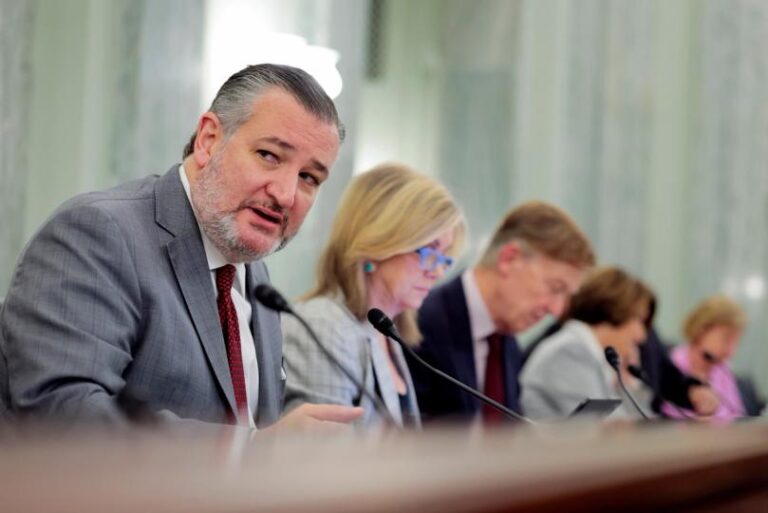
“We want athletes competing on merit, but the opportunity to make money can tempt gamblers — and sometimes even athletes themselves — to guarantee a sure bet,” Senator Ted Cruz, a Texas Republican who chairs the committee, said during the Wednesday hearing. He said high-profile incidents of player cheating “sow doubt in the minds of fans.”
Cruz flagged some recent cases, saying: “NBA players and coaches are accused of manipulating performance and providing insider information to win bets. Two major league baseball pitchers allegedly rigged their own pitches in exchange for money. [Major League Soccer] banned two players for intentionally getting yellow cards to win bets, and the UFC has canceled matches and terminated contracts because of suspected match fixing.”
“It is not uncommon for fans scrolling Twitter on a Sunday afternoon in the fall to see posts speculating that a controversial call by an official was related to gambling,” Cruz said.
Other lawmakers focused on marketing that fosters problem gambling or that has reached youths that are otherwise meant to be blocked from betting. Senator John Hickenlooper, a Colorado Democrat, accused the prediction markets businesses of unleashing the “hounds of hell” in social media and marketing to “prey on our young people.”
Patrick McHenry, who was a prominent member of the House of Representatives until his recent retirement, is now an adviser at the Coalition for Prediction Markets that represents Kalshi, Crypto.com, Robinhood, Coinbase and others. He said trades aren’t allowed for anybody under 18 and that the average age of users is 33.
Problem gamblers
Harry Levant, director of gambling policy at the Public Health Advocacy Institute, testified on Wednesday, telling the lawmakers he was a recovering gambling addict and lamenting the “avalanche of unregulated advertising” from prediction market firms.
“It’s a known addictive product, just like heroin,” he said.
Earlier this week, Kalshi co-founder and CEO Tarek Mansour posted on social media site X to highlight his company’s $2 million commitment with the National Council on Problem Gambling to support an initiative on “trader health and safety.””As retail participation in markets increase, we have a responsibility to balance free markets and individual responsibility with customer education and safety guardrails,” he wrote.
And still other lawmakers on Wednesday dove into the rapidly growing industry’s avoidance of state regulators and competition with regulated gaming on U.S. tribal lands, where revenue is a core support of tribal reservations’ financial health.
CFTC
Even as the senators put the event-contract space under the microscope, the Commodity Futures Trading Commission that regulates derivatives trading platforms is pursuing a lawsuit filed on Tuesday to stop a new law in Minnesota that was set to hold prediction market activity as illegal there. The regulator adds this to a growing list of lawsuits the federal agency has filed against states that have sought to limit prediction markets or declare them in violation of state gambling laws.
“This Minnesota law turns lawful operators and participants in prediction markets into felons overnight,” said CFTC Chairman Mike Selig in a statement, who added this suit alongside similar agency fights against Arizona, Connecticut, Illinois and New York.
Selig has led an agency legal campaign to defend his agency’s authority to supervise and regulate prediction markets, which are managed on registered platforms under CFTC rules. Meanwhile, his agency — at which he’s the sole member of what’s meant to be a five-member commission — is also pursuing a formal rule to establish tailored standards for the sector.
McHenry defended the CFTC role on Wednesday.
“The CFTC, as a cop on the beat, has the capacity to oversee this market, just as they’ve done with the broader commodities marketplace that’s been around and well versed for decades,” McHenry said.
Senator Hickenlooper responded, “You’re the first person who’s told me you think that they think the CFTC is up to the standards.”
One of the witnesses, Bill Miller, the president and CEO of the American Gaming Association, contended the federal regulators “are absolutely not competent to handle this, and two, they are absolutely hurting tribes and states financially.” He added that, “it was never Congress’s intent to create a federal department of gambling through the CFTC.”
McHenry argued that these event contracts are derivatives that belong to “fundamentally different business models” from bets placed with gambling businesses. He equated them to long-regulated grain futures contracts, and he added that “our member companies have enhanced surveillance greater than any casino and greater than any sportsbook in the country.”
In the end, Chairman Cruz said, “The Supreme Court may have to decide the issue.”
Tether International has acquired SoftBank’s entire stake in Twenty One Capital, the Bitcoin treasury company co-founded by Jack Mallers, consolidating control over one of the most prominent public Bitcoin vehicles to emerge in the past year.
The transaction, announced May 20, removes the last major outside ownership bloc from Twenty One’s founding three-party structure. SoftBank’s representatives on the company’s board stepped down at closing, per the terms of XXI’s shareholder agreement. No financial details of the deal were disclosed.
Twenty One Capital launched in April 2025 through a business combination with Cantor Equity Partners, with the three founding sponsors — Tether, SoftBank, and Bitfinex — contributing Bitcoin in exchange for shares priced at $10 each.
At inception, Tether was expected to contribute roughly 24,000 BTC, SoftBank 10,500 BTC, and Bitfinex around 7,000 BTC. The company was built to debut with more than 42,000 BTC — enough to rank as the third-largest corporate Bitcoin treasury in the world at the time, with an implied enterprise value of $3.6 billion based on an 84-day average Bitcoin reference price.
Before its listing, Tether added a further 4,812 BTC worth approximately $458.7 million to Twenty One’s treasury, bringing its holdings to 36,312 BTC at that stage.
With SoftBank’s exit, Twenty One moves from a coalition-backed vehicle to what is, in practical terms, Tether’s public Bitcoin operating arm.
The shift is structural: a company once held up by three institutional pillars now rests almost entirely on Tether’s balance sheet and strategic direction.
Paolo Ardoino, Tether’s CEO, acknowledged SoftBank’s role in shaping the company’s early formation but framed the buyout as the beginning of a new phase. “They leave behind a company with a stronger foundation, a clearer mandate, and an ambitious path ahead,” he said in a statement.
More than a bitcoin treasury
That path appears to extend well beyond Bitcoin treasury accumulation. In April, Tether proposed merging Twenty One with Strike — Jack Mallers’ Bitcoin payments company — and Elektron Energy, a Bitcoin mining operation.
The combination would place a Bitcoin treasury, a payments and financial services layer, and mining infrastructure under one corporate umbrella, transforming Twenty One from a balance-sheet trade into an integrated Bitcoin holding company.
Twenty One has positioned itself as a direct counterpoint to Michael Saylor’s Strategy, adopting performance metrics like Bitcoin Per Share and Bitcoin Return Rate rather than conventional earnings benchmarks.