Home Blog Page 277

Bitcoin Funding Flips Positive, Is $85K Next?

0

Key takeaways:

  • Bitcoin derivatives show limited conviction among pro traders, but ETF flows and Strategy could play a role in the next higher rally. 
  • Reduced odds of a peace plan between the US and Iran, and high oil prices, could impede Bitcoin’s price discovery.

Bitcoin (BTC) flirted with the $82,000 level on Monday, sparking a brief surge in demand for bullish leverage. Bitcoin has held near $80,000 for over a week, prompting many traders to bet on further upside. However, derivative metrics show that professional players remain skeptical, leaving many to wonder whether $85,000 is actually within reach.

Bitcoin perpetual futures annualized funding rate. Source: Laevitas

The annualized funding rate for Bitcoin perpetual futures briefly jumped to 6% on Monday, touching neutral-to-bullish territory for the first time in over a month. Still, the indicator has mostly stayed negative, signaling more demand for bearish leverage. This lack of confidence among bulls doesn’t necessarily block further gains, but it does highlight a cautious mood among traders.

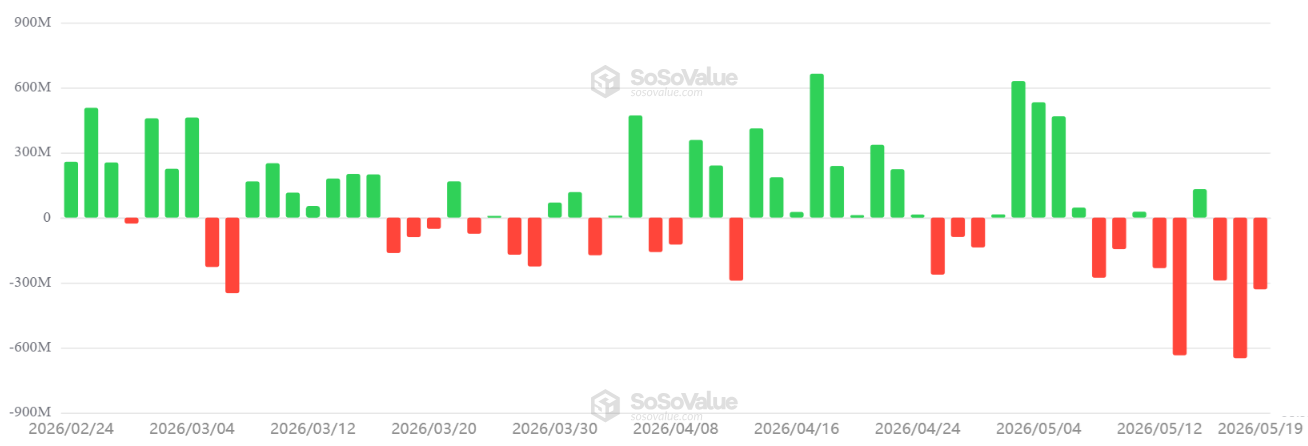
US-listed Bitcoin spot ETFs daily net flows, USD. Source: SoSoValue

Outflows from US-listed spot Bitcoin ETFs on Thursday and Friday likely fueled this bearish sentiment. Since ETF flows are a go-to proxy for institutional interest, seeing a reversal right as Bitcoin failed to break $82,000 on several attempts is triggering real concern across the market.

Bitcoin miners pivot to AI, BTC price remains stable 

The artificial intelligence sector continues to capture investors’ attention, especially after several Bitcoin mining firms pivoted to high-performance computing. Iren (IREN US) announced a massive $34 billion deal with Nvidia on Friday. Additionally, Core Scientific (CORZ US) recently announced plans to expand its campus in Muskogee, Oklahoma.

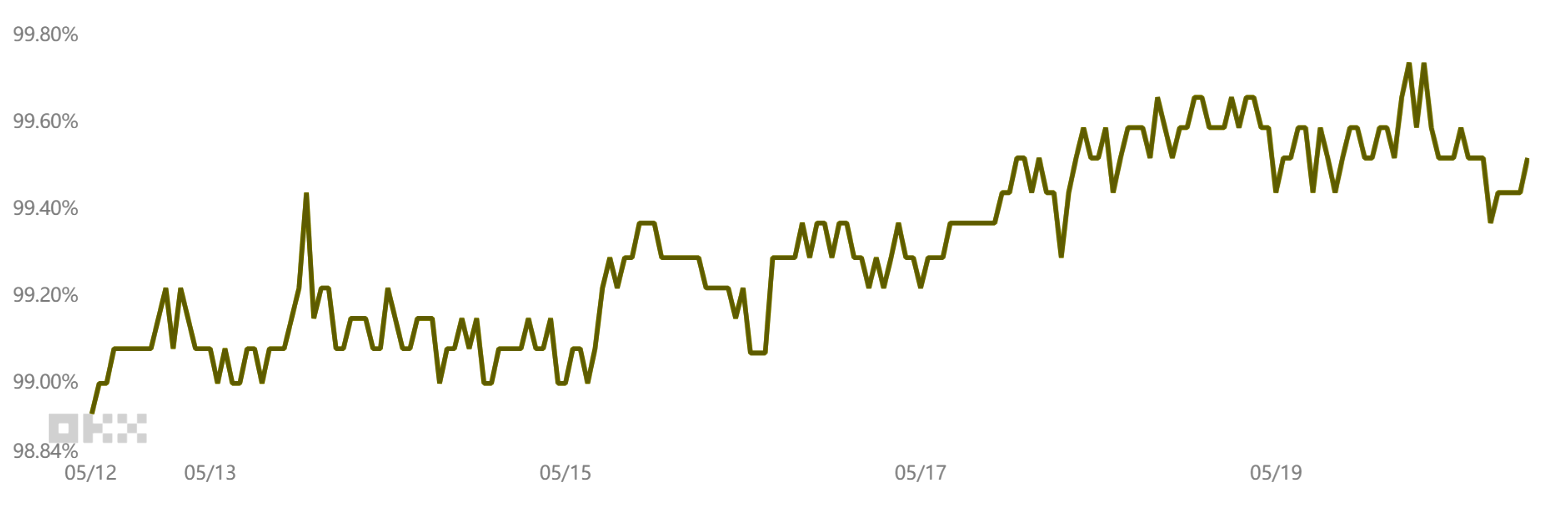
Bitcoin’s hashrate dropped to its lowest point in eight weeks on April 26, but the indicator showed plenty of resilience throughout May.

Bitcoin 7-day average hashrate, exahashes per second. Source: Blockchain.com

The estimated processing power supporting the Bitcoin network climbed 5% in just two weeks, reaching 970 exahashes per second. While this is still far from the peak of 1,150 exahashes per second, the fear that miners would abandon the network for AI proved irrational. 

Even so, bullish momentum hasn’t quite returned for traders, as Bitcoin remains 35% below its all-time high.

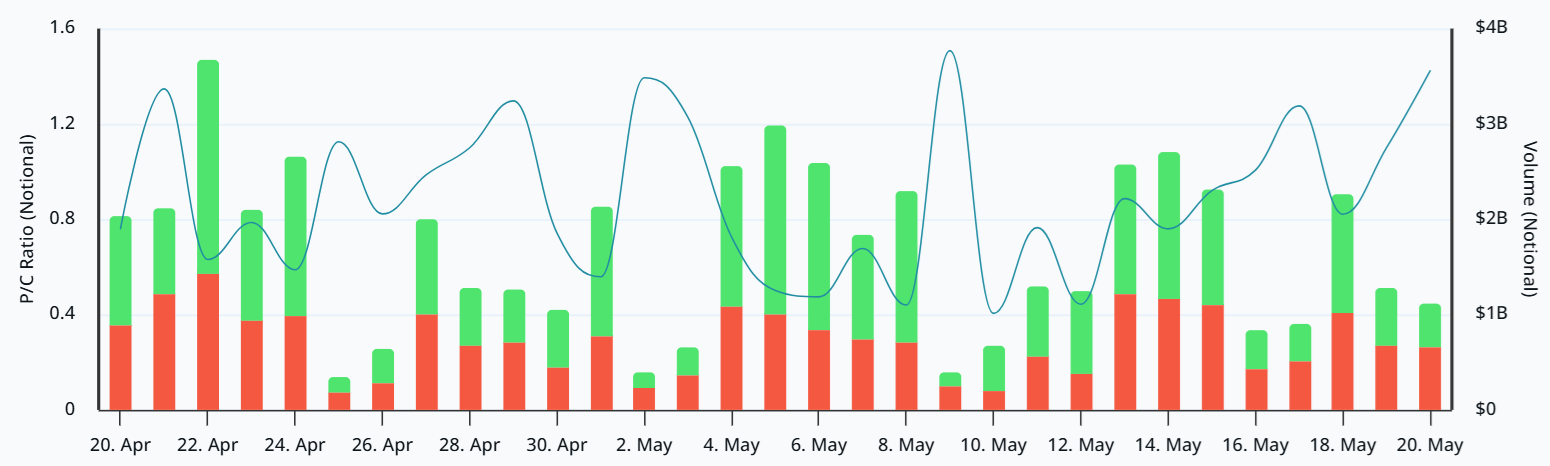
Bitcoin 30-day options delta skew (put-call) at Deribit. Source: Laevitas

The Bitcoin options delta skew (put-call) sat at 10% on Monday, unchanged from the previous week. Put (sell) options are trading at a premium, hinting that whales and market makers aren’t comfortable holding downside risk right now. Whether the main issue is the economy or geopolitics, professional traders clearly fear a correction.

Related: Bitcoin stalls as BTC ETF outflows hit $268M–Will new Fed chair restore the rally?

Outside of crypto, Brent crude oil prices jumped above $105 on Monday as the Strait of Hormuz remains partially closed due to the war in Iran. US President Donald Trump called Iran’s latest demands “totally unacceptable,” while Israeli Prime Minister Benjamin Netanyahu argued the conflict won’t end until Iran’s enriched uranium stockpiles are “taken out.”

On the corporate BTC treasury side, Strategy (MSTR US) announced it acquired $43 million in Bitcoin after a one-week break. The buy was funded by selling company shares. So, while the derivatives market still feels a bit bearish, the path to $85,000 is still wide open. Any fresh inflows into Bitcoin spot ETFs this week could easily be the catalyst the market needs.

Ethics Remains Sticking Point as Crypto Market Structure Bill Goes to Senate Markup

With lawmakers on the US Senate Banking Committee set to consider a markup on a cryptocurrency market structure bill this week, some Democrats are holding the line — and potentially their votes — on ethics provisions.

The Digital Asset Market Clarity Act (CLARITY), passed by the US House of Representatives in July 2025, is scheduled for a markup in the Banking Committee on Thursday after months of delays due to concerns about language on stablecoin yield, tokenized equities, ethics and more issues related to the crypto industry.

Although the Senate Agriculture Committee passed its version of the bill in a January markup, the legislation must pass through both panels to address different aspects of securities and commodities laws.

“Negotiations continue to be positive, and I remain confident we can get a bipartisan bill over the finish line this Congress,” Senator Kirsten Gillibrand told Cointelegraph. “Americans deserve a well-regulated market with strong consumer protections and real ethics reforms so politicians can’t cash in on their insider status for personal gain.”

Earlier this month, Senators Thom Tillis and Angela Alsobrooks, both of whom sit on the banking committee, announced a compromise deal on stablecoin yield that could allow the CLARITY Act to move forward after months of delays. However, New York’s Gillibrand said that even if the bill were to pass the banking committee, her fellow Democrats would not vote in favor of CLARITY without an ethics provision to deal with potential conflicts of interest by members of Congress, elected officials and the US President and Vice President.

Prediction market sentiment on CLARITY Act passage. Source: Polymarket

Related: 7 Democrats seen as ‘key’ to advancing CLARITY Act: Galaxy

Even before taking office in January 2025, US President Donald Trump had close ties to the industry, through the launch of his memecoin Official Trump (TRUMP) and his family’s crypto business, World Liberty Financial. Forbes reported that the president’s personal fortune had increased by about $1.2 billion as of July 2025 due to his crypto ventures. 

Full steam ahead for some Republican lawmakers

Senator Tim Scott, the Republican who chairs the banking committee, said that concerns about the president’s crypto ties were outside the body’s purview for markup and needed to be addressed by the ethics committee before any potential floor vote in the chamber. Tillis, also a Republican, said in April that he would not support any bill without “a bipartisan agreement when it comes to the ethics provision.”

Cynthia Lummis, Wyoming’s junior senator who has led the charge on the bill in the Senate and will be retiring in 2027, has urged lawmakers to vote for CLARITY on Thursday.

Source: Cynthia Lummis

“I’m hopeful, given that there seems to be so much momentum from the Democrats, from the Republicans saying ‘hey, we’re ready to get a deal to get this done’ that they can resolve ethics and that it won’t hold this up,” Cody Carbone, CEO of crypto advocacy organization The Digital Chamber, told Cointelegraph. “Ethics has to be tackled on the floor, it’s not within the jurisdiction of the Senate Banking Committee, so I don’t expect it to hold up the markup.”

Even if the bill were to advance in the banking committee and get the 60 votes needed to pass in the Senate, CLARITY would likely need to return to the House for both chambers to pass a reconciled version before it could go to Trump’s desk to potentially be signed into law.

Magazine: Strategy reveals why they would sell BTC, Trump Media posts loss: Hodler’s Digest, May 3 – 9

Circle (CRCL) beats earnings estimates but misses on revenue amid $222 million Arc raise

0

Circle, issuer of the world’s second-largest stablecoin, USDC, posted estimate-beating first-quarter earnings as revenue rose 20% and it raised $222 million for its Arc blockchain network in a presale of the ARC token.

Earnings per share (EPS) of 21 cents beat analyst estimates of 17 cents, while revenue rose 20% to a less-than-forecast $694 million. Adjusted earnings before interest, taxes, depreciation and amortization (Ebitda) grew 24% from a year earlier to $151 million, the New York-based company reported.

USDC onchain transaction volume jumped over 260% from the year-earlier quarter to $21.5 trillion, and USDC in circulation increased 28% to $77 billion.

The ARC token presale values the project at $3 billion. The fundraising round included investment from a mix of Wall Street heavyweights and crypto-native firms, including BlackRock, Apollo Funds, a16z crypto, ARK Invest, CoinDesk’s parent company Bullish, Haun Ventures, Intercontinental Exchange and Standard Chartered Ventures.

The fundraising marks Circle’s most ambitious expansion beyond USDC and payments infrastructure, pushing the stablecoin issuer deeper into the race to build blockchain infrastructure for institutional finance.

Circle also published the Arc whitepaper on Monday, outlining ARC as a “native coordination asset” designed to support governance, validator security and network operations across the chain.

Arc, which began testing in October, is being positioned as a blockchain optimized for stablecoin-based capital markets and regulated financial activity, which includes tokenized assets, cross-border settlement and onchain finance.

Unlike USDC, which functions as a dollar-pegged payment token, ARC appears intended to play a role closer to ether (ETH) on Ethereum or SOL on Solana — helping coordinate the network’s economic and security model.

CRCL shares were nearly 1.2% higher at $115 in pre-market trading at around 7:30 a.m. ET.

UPDATE (May 11, 11:20 UTC): Adds Circle’s first-quarter earnings report information and restructures article to lead with earnings.

Trump Mobile buyers stuck without phones as TRUMP token sits 97% below peak

0

Two Trump-branded ventures aimed at retail buyers are both in difficult positions months after their debuts, though for different reasons.

Roughly 600,000 buyers have paid $100 deposits for the gold-colored Trump Mobile T1 phone since its initial announcement, putting around $60 million into a venture that has not delivered a single confirmed device as of May 2026, per Moneywise.

Deposits were paid to Trump Mobile’s registered company T1 Mobile LLC, which uses a limited liability agreement from DTTM Operations, LLC – the company that manages intellectual property, trademarks, and likeness on merchandise associated to U.S. president Donald Trump.

Promised delivery dates have slipped from late summer 2025 to November, then to December, and finally to first-quarter 2026, before being removed from the website entirely.

According to IBTimes reporting, the company updated its terms of service in April to clarify that deposits represent a “conditional opportunity” to buy the device if the company chooses to sell it, removing any binding contract. (CoinDesk has not independently reviewed the previous version of the terms.)

Trump Mobile did not respond to a request for comment send by email as of publication time.

The TRUMP memecoin, a separately structured venture, has had its own difficult run. The token launched in January 2025 at $1.21, zoomed to $73 within 48 hours as retail speculators piled in around the inauguration, and has spent the 16 months since grinding lower.

TRUMP traded at $2.45 on Monday, down roughly 97% from its peak and 82% on the year, CoinGecko data show. Chainalysis estimated retail investors in TRUMP have collectively lost roughly $2 billion since its introduction.

TRUMP launched with 80% of supply held by Trump-affiliated entities CIC Digital and Fight Fight Fight, with those tokens scheduled to unlock at approximately $500,000 worth per day (at current prices) through mid-2028. The schedule was disclosed as part of the token’s launch terms, but has produced sustained sell-side supply during a period of declining buyer interest.

TRUMP’s daily DEX trading volume has dropped from a January 20, 2025 peak of nearly $7 billion across roughly 400,000 traders to about $16 million across just 4,200 traders on May 5, 2026, per Dune Analytics data tracked by user @seoul.

That is a 99% drop in both daily turnover and unique daily participants. Average trade size has fallen from around $2,700 to $260 over the same period, suggesting the remaining buyers are smaller retail accounts rather than the larger speculators who drove the original launch.

The share of TRUMP holders with more than $1,000 in the token has collapsed from roughly 19% at launch to about 2% today, meaning almost every remaining wallet now holds less than $1,000 worth of TRUMP. The token has effectively settled into a long tail of small bag-holders with no large position holders left to drive meaningful price action.

For TRUMP holders, the onchain math suggests that a return to launch-era valuations is becoming increasingly unlikely. At current prices, the remaining insider token unlocks represent more than $2.5 billion in potential supply overhang.

Absorbing that supply would require a demand event larger than anything the token has seen since launch, with the token down 13.6% over the past 30 days and roughly 0.1% on the day.

A dinner hosted by Trump for the top 220 token holders at his Virginia golf club in May 2025 produced a rally that faded within weeks. Tron founder Justin Sun pledged $100 million in TRUMP purchases ahead of the July 2025 unlock, with the token continuing to drift lower in the months that followed.

A separate Mar-a-Lago Crypto & Business Conference on April 25, 2026, limited to the top 297 TRUMP token holders with VIP access for the top 29, drew a letter from Senators Warren, Adam Schiff (Democrat, California), and Richard Blumenthal (Democrat, Connecticut) requesting documents about the President’s role in promoting the event.

While Trump tokens and the mobile ventures have different structures and mechanisms, they debuted on the back of front-loaded political enthusiasm, and have struggled in the months since to translate that initial momentum into either delivered product or sustained price support.

Solana ETF Inflows Hit February High: Is $120 Next?

0

The spot Solana (SOL) exchange-traded funds (ETFs) recorded their strongest weekly performance since February, attracting $39.23 million in total net flows. The surge in capital inflows coincided with SOL futures open interest rising by $1.5 billion in May, signaling a sharp increase in trader positioning across the derivatives markets.

The rise in market activity comes alongside Solana’s 15% rally to $97 in the past seven days, with traders targeting the next major resistance level at $120. 

SOL ETF demand rises with futures interest

Bitwise’s BSOL ETF led the latest inflow wave with $36 million in weekly net inflows last week, while Fidelity’s FSOL added over $1.8 million. Since its launch, BSOL has attracted $861 million, accounting for nearly 81% of cumulative inflows across all spot SOL ETFs, which now total about $1.06 billion.

Spot SOL ETF netflows. Source: SoSoValue

Futures activity rose alongside the ETF demand. Solana open interest (OI) climbed to $6.4 billion from $4.94 billion on May 1, marking a 29.5% increase in less than two weeks.

Aggregated spot cumulative volume delta (CVD), which measures the net difference between market buy and sell orders, climbed to nearly $250 million from $163 million in five days, during SOL’s push toward $96.

The futures CVD expanded to about $593.6 million after rising steadily from May 5 onward, as buyers absorbed sell-side liquidity in both the spot and futures markets. 

SOL price, aggregated open interest, spot, and futures CVD and funding rate. Source: velo.chart

The funding rate held near 0.065%, indicating traders continued to pay to maintain long exposure. The buying activity has started to flatten near the $95-$96 range as spot and volume deltas have cooled over the past 24-hours. 

Related: South Korea crypto holdings halve in a year as investors turn to stock market

Solana eyes a breakout: Is $120 next?

Solana is forming an Adam and Eve pattern near the $95 resistance level, with the setup’s neckline directly at the current breakout zone. A confirmed move above that level places the technical target near $120. 

An Adam and Eve pattern on the higher time frame chart could signal a bottom for SOL if price successfully turns the $95 resistance level into support. 

SOL/USDT, one-day chart. Source: Cointelegraph/TradingView

SOL also pushed above its 100-day exponential moving average for the first time since October 2025, adding another technical shift to the mix alongside ETF inflows and rising futures positioning. 

A confirmed daily close and consolidation above $95 could open the path toward the pattern’s projected target near $120, due to a lack of resistance sitting between the two levels after the 42% dip in February.

Crypto analyst BATMAN noted that Solana recently broke above a 231-day downtrend on the SOL/BTC daily chart, signaling improving relative strength against Bitcoin. According to the analyst, the $89-$91 zone now acts as the nearest support cluster and a likely retest region if SOL holds above the breakout area. 

SOL/USDT, one-chart analysis by BATMAN. Source: X

Related: XRP metrics line up bull signals for ‘full-scale rally’ to $2

XRP Holds Range As Buyers Begin To Absorb Supply – The Setup Behind A Potential Breakout

0

Trusted Editorial content, reviewed by leading industry experts and seasoned editors. Ad Disclosure

XRP is struggling to push above the $1.50 level as the market heats up and buyers search for the momentum needed to break through resistance that has capped the recovery at every recent attempt. The price action is frustrating — sideways, unconvincing, and offering little clarity on direction. But a CryptoQuant analyst has identified something in the order flow data that reframes the current weakness as considerably more constructive than the chart alone suggests.

The most important signal the analyst identifies is not what is happening — it is what is not happening. Aggressive selling pressure, which defined XRP’s market structure during the worst of the decline, is no longer present at the same intensity. The Taker Buy Sell Ratio has been moving close to the 1.0 level for an extended period — meaning the balance between aggressive buyers and aggressive sellers has shifted from clear seller dominance toward something approaching equilibrium, with a slight tilt toward buyer advantage.

That equilibrium is more significant than it initially appears. A ratio consistently below 1.0 during this kind of sideways price action would typically produce a much harder decline — sellers controlling order flow without buyer absorption tends to resolve downward. XRP has been holding the $1.35 to $1.45 range instead, which means something is absorbing the selling that would otherwise send the price lower.

The analyst’s finding is that the absorption is real, documented in the order flow, and building toward a specific structural outcome.

The Sellers Have Stepped Back. The Buyers Have Not Yet Stepped Up. That Gap Is the Setup

The CryptoQuant analysis adds the volume dimension that completes the picture. Both taker buy volume and taker sell volume have dropped sharply compared to previous months — a simultaneous reduction on both sides of the order flow that describes a market in a specific and recognizable phase. The massive sell spikes that characterized January and February are no longer appearing. The aggressive, fear-driven selling that defined XRP’s worst period has faded to a level that no longer constitutes meaningful downward pressure.

XRP Ledger: Taker Buy Sell Ratio | Source: CryptoQuant

What has not yet appeared is the equally aggressive buying that would confirm the next directional move. There is no FOMO. No surge of market buy orders chasing the price higher. The conditions are quiet in both directions, which is precisely what accumulation phases look like before they resolve.

The analyst’s probabilistic assessment draws on three converging signals: the ratio recovering toward buyer advantage while price holds stable, the absence of a breakdown despite reduced overall volume, and the structural fading of sell pressure. Together, they increase the probability of an upside resolution rather than another sharp decline.

The honest caveat the analysis preserves is that timing remains uncertain. Strong buying momentum has not entered the market. The current structure is energy building rather than energy releasing — whales stabilizing, sellers exhausted, buyers cautious. The specific trigger the analyst identifies is the ratio holding above 1.0 for several consecutive days while buy volume begins recovering.

If that combination develops, the probability of a move toward the $1.50 to $1.60 region increases significantly. Until then, XRP looks more likely to move sideways to upward than to experience another sharp leg lower, which is the most constructive objective assessment the current data supports.

XRP Stabilizes As Selling Pressure Continues To Fade

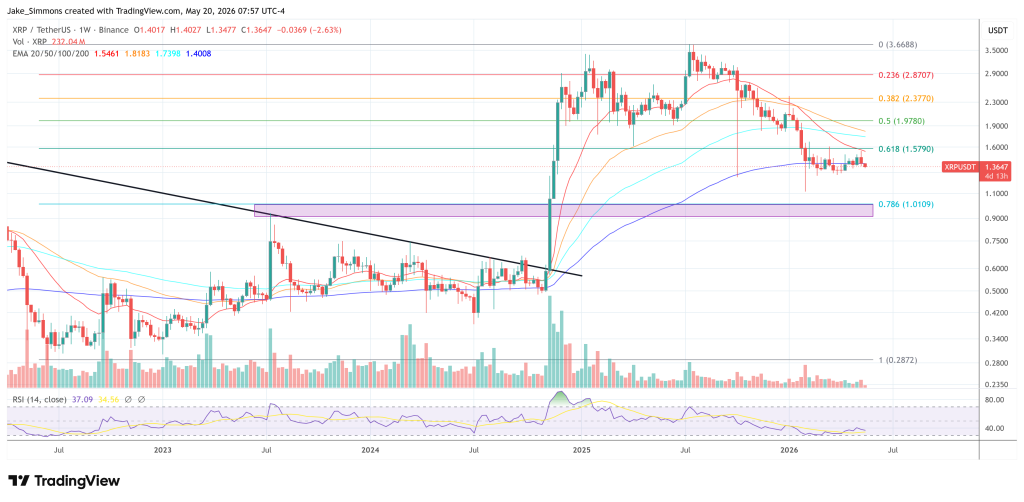
XRP continues consolidating near the $1.45 region after months of persistent weakness that followed the rejection from the 2025 highs above $3.00. The broader structure still reflects a market in recovery mode rather than a confirmed bullish reversal, but the chart shows important signs that downside momentum is gradually weakening.

XRP testing pivotal resistance level | Source: XRPUSDT chart on TradingView

One of the clearest developments is the stabilization around the $1.30–$1.45 range. Despite repeated attempts to push lower during the first quarter of 2026, sellers have failed to generate a sustained breakdown beneath support. That behavior contrasts sharply with the aggressive downside expansion seen during the late-2025 decline, suggesting that sell-side pressure is losing intensity.

At the same time, XRP remains below all major moving averages on the higher timeframe. The declining 50-period and 100-period moving averages continue acting as overhead resistance, reinforcing that the broader trend has not yet shifted bullish. Every recovery attempt toward the $1.60–$1.90 region has faced renewed selling pressure.

Volume trends also remain relatively subdued compared to previous expansion phases. Participation has stabilized, but strong speculative momentum has not yet returned to the market. This combination of weakening sell pressure and muted buying activity typically reflects accumulation rather than trend acceleration.

Featured image from ChatGPT, chart from TradingView.com 

Editorial Process for bitcoinist is centered on delivering thoroughly researched, accurate, and unbiased content. We uphold strict sourcing standards, and each page undergoes diligent review by our team of top technology experts and seasoned editors. This process ensures the integrity, relevance, and value of our content for our readers.

88% of small business owners act against inflation andlabor pressures, embracing AI as a tool for growth, not replacement

0

Retirement planning remains top concern for small businesses

While inflation and labor shortages continue to weigh heavily on U.S. small businesses, owners are pivoting away from crisis mode and actively adopting new strategies, including implementing artificial intelligence (AI), to maintain stability and fuel growth. According to a new April 2026 survey of 500 U.S. small-business owners conducted by Wakefield Research for ShareBuilder 401k, an overwhelming 88% of owners have taken decisive action over the past year to counteract inflation and labor needs. This marks a significant jump from the 78% who took similar actions in 2024.

Half of all small businesses (50%) have increased prices to protect margins, while others have turned to lower-cost vendors (23%) or increased employee wages (22%). Inflation remains the most dominant pressure point, cited by 62% as a top concern.Share

Half of all small businesses (50%) have increased prices to protect margins, while others have turned to lower-cost vendors (23%) or increased employee wages (22%). Inflation remains the most dominant pressure point, cited by 62% as a top concern for the coming year.

The Labor Crunch and the AI Solution

Staffing remains incredibly difficult among those surveyed, with 76% of owners reporting that hiring is tough right now, even when they offer competitive pay and benefits. Consequently, the cost of labor and the ability to hire and retain the right employees are top concerns for a third of businesses (33%).

Instead of replacing workers, small businesses are leaning on artificial intelligence to bridge the talent gap and increase capacity.

  • Nearly three-quarters (72%) view AI as a tool that supports staff and improves efficiency, rather than a way to reduce headcount.
  • Just 9% of owners see AI as a replacement for workers.
  • In fact, 70% anticipate that integrating AI will enable them to hire additional employees in the future.
  • The technology is already delivering real returns: 75% of owners report that AI saves them time weekly, and 63% rely on AI insights to guide their business decisions.

However, adopting this technology adds a new layer of complexity to operations, with 21% of owners citing AI integration as a top concern for the year ahead.

Retirement Planning Outpaces AI as Top Stressor

Even as owners navigate the complexities of machine learning and inflation, personal financial security weighs far more heavily on their minds. A striking 63% of small-business owners find planning for their own retirement more daunting than managing AI in their business.

While 81% of owners are currently saving for retirement, the highest rate since 2017, many remain anxious about the future. More than four in 10 (41%) lack confidence that they are saving enough. Furthermore, owners are delaying their exit strategies, pushing their average planned retirement age to 68, up from 65 in 2024 and 2022.

Despite these anxieties, businesses are increasingly stepping up to support their teams’ futures. Nearly three in 10 (29%) now offer a 401(k) plan, up from 24% in 2024. The decision is largely values-driven, with 76% stating that it is their responsibility as business owners to provide this benefit.

Cautious Optimism for the Year Ahead

The small-business sector remains resilient despite ongoing hurdles. While 63% are still concerned about the impact of market volatility, the intensity of that fear has plummeted, with only 19% “very” or “extremely concerned,” down sharply from 41% in 2020.

Overall, 68% report increased confidence in their business outlook compared to last year, driving planned, growth-facing investments into marketing and sales (58%) and AI solutions (40%).

Ronin gaming sidechain gets ready to transition to Ethereum layer 2

0

Ronin, the gaming-centric blockchain once synonymous with the industry’s infamous $625 million exploit, is officially shedding its sidechain skin on May 12 to become an Ethereum layer 2 to improve security while maintaining throughput.

Ronin, which announced the migration in April, will execute a hard fork at block 55,577,490, a process that will result in about 10 hours of downtime for users, the network said Monday on X. According to onchain data, the migration is expected to begin on Tuesday around 15:16 UTC.

“Four years ago, we launched Ronin because Axie Infinity needed a faster and more efficient network,” Ronin said when announcing the migration. “It worked. Axie Infinity onboarded millions of gamers to crypto, and Pixels proved that it was possible to do it again.” The time has come to plug “back into the mothership.”

While operating as an independent sidechain in mid-May 2022, Ronin suffered what is still today the largest DeFI bridge exploit in history. Layer 2 protocols benefit from tighter links to the underlying blockchain than sidechains, offering benefits that include greater security.

The network’s native token, RON, is currently trading at around 11 cents with a market capitalization of about $89.5 million, according to CoinDesk data. While the token remains significantly below its 2024 peak, the migration sparked a rally, with prices climbing 30% over the last 30 days as investors eye a shift in the network’s supply dynamics.

“During this downtime window, all network transactions [including transfers, swaps, and smart contract interactions] will be paused,” Ronin said, adding that all games using its network will also be affected. “To avoid any inconvenience, please complete all necessary transactions/onchain game actions on the Ronin Network before the downtime begins.”

During the downtime, a “Proof of Distribution” model will be introduced to reward builders based on active network contribution rather than passive staking, Ronin said. The team noted that “this is fundamentally bullish for RON as it dramatically cuts token inflation from over 20% to below 1%.”

The company also said that transitioning to the OP Stack will allow it to inherit Ethereum’s robust security while maintaining high throughput. The move redirects 90 million RON tokens previously earmarked for staking rewards into the Ronin Treasury, while more than doubling marketplace fees to 1.25% from 0.5%.

Ronin said its narrative is dominated by its pivotal return to Ethereum, a strategic move to reset its economics, secure its bridge infrastructure, and secure its future in an upgrade intended to improve scalability and reduce costs through the use of EigenDA for data availability.

Bitmine buys 26K ether (ETH) after Tom Lee said to slow down accumulation

0

Bitmine Immersion Technologies (BMNR) has sharply slowed its ether (ETH) purchase pace as Chairman Tom Lee signaled, following months of aggressive buying that made it the world’s largest Ethereum treasury company.

The firm bought 26,659 ether last week, worth about $63 million based on ether’s current price. That’s roughly a quarter of the average weekly haul it purchased over the past weeks.

The purchase lifted Bitmine’s holdings to over 5.2 million ETH, or around 4.31% of ether’s circulating supply, according to a Monday company update.

The update follows comments Lee made last week at Consensus 2026 in Miami, where he said BitMine may begin moderating its buying pace after one of the fastest accumulation runs in the crypto market.

The slowdown follows comments Tom Lee made last week at Consensus 2026 in Miami, where he said Bitmine was considering easing purchases as it approached its long-term goal of acquiring 5% of Ethereum’s supply.

“We have decided to slow down our pace of weekly accumulation from over 100,000 [ETH] per week,” Lee said in Monday’s statement. “Our previous pace of buys would have us reach 5% by mid-July.”

Bitmine remains one of the few major digital asset treasury firms still consistently buying crypto during the recent market downturn. Since the start of 2026, the company has acquired more than 1 million ETH, according to Lee.

The company’s total crypto and cash holdings stood at $13.4 billion. In addition to ETH, BitMine holds 201 bitcoin, $775 million in cash and equity stakes including investments in Beast Industries and Eightco Holdings.

Lee reiterated his view that “crypto spring” has begun, pointing to ether’s recent recovery and improving sentiment in software and growth stocks.

“If ETH closes above $2,100 at the end of May, this would be the third consecutive monthly gain — this has never been seen in a crypto bear market,” Lee said.

BitMine has also expanded its staking operations. The firm now has over 4.7 million ETH staked — more than 90% of its holdings — representing about $11.1 billion worth of assets generating staking rewards. Its MAVAN staking platform, launched earlier this year, is aimed at institutional clients as well as Bitmine’s own treasury operations.

CoinDesk 20 performance update: SUI surges 25% over weekend

0

Cronos (CRO), up 9.7% from Friday, joined Sui (SUI) as a top performer.