Home Blog Page 276

Crypto and AI Could Be Dirty Words on 2026 Campaign Trail

The AI and crypto industries have made headlines over the past year thanks to the impressive war chests amassed by corporate political action committees (PACs).

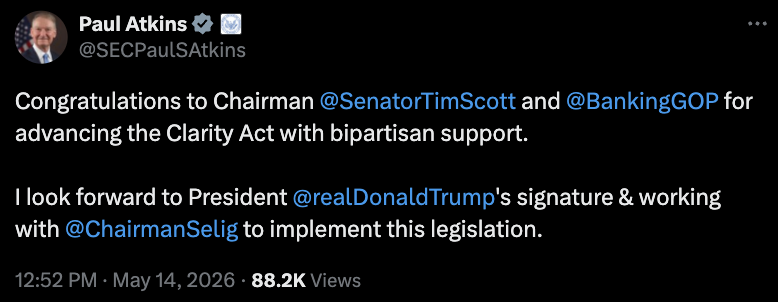
Profligate spending during the last federal elections in the US has led to unprecedented policy changes favoring the crypto industry, with indications that a full legislative framework in the form of the CLARITY Act is on its way to becoming law. 

But this hasn’t endeared the crypto industry to voters. Recent polls from Politico show distrust of the crypto industry, and the electorate isn’t sold on the benefits of AI.

“Voters across the ideological spectrum are raising concerns,” Michael Beckel, director of money in politics reform at Issue One, told Cointelegraph. “Some candidates on both sides of the aisle are trying to harness that frustration and outrage.”

Voters don’t trust crypto and don’t believe AI benefits them

According to the recent poll by Public First for Politico, most Americans don’t trust crypto and don’t believe in the benefits of AI. 

Source: Politico

While Republican voters are somewhat more likely to trust crypto, 47% of Americans overall trust a traditional bank over a crypto platform, while 17% trust a crypto platform as much as a traditional bank. 

The numbers for AI aren’t great either. Some 43% of Americans overall believe that the risks outweigh the benefits, while 33% believe the inverse. 

Source: Politico

Related: Crypto PACs secure massive war chests ahead of US midterms

Currently, most people haven’t heard about the major crypto and AI lobbies. According to Politico, only nine percent have heard of AI Super PAC Leading the Future. Only three percent have heard of pro-crypto PAC Fairshake.

That’s not much compared to public awareness of large lobbies like the National Rifle Association or the Planned Parenthood Action Fund, which are practically household names.

Still, association with crypto could be a problem. Ohio Republican Representative Jim Renacci told Politico, “I do think if they see somebody is backed by crypto, that’s always going to be a problem, because, let’s face it, the people that I talk to in Ohio, they don’t understand crypto, and most say they’re not comfortable with [it].”

Improving awareness around crypto lobbies may not help them much. Rick Claypool, research director at Public Citizen, told Cointelegraph:

“Generally speaking, voters are against corporate money influencing politics.”

“Even after Citizens United, the norm had been for big, brand-name corporations not to engage directly. Or when they did engage, they would often contribute through dark money groups that obscure their funding source.”

In this regard, the crypto industry’s spending spree in 2024 was somewhat unusual. Major contributors like Coinbase or a16z weren’t shy about the millions of dollars they put into campaigns.

But even then, “the voter-facing message from Fairshake was never about crypto, which voters never really cared about.” Mailers and ad buys reflected the supported candidates’ positions more broadly, or sometimes attacked those of the perceived anti-crypto candidate. 

Overall, “candidates who are seen as not beholden to corporate interests have an electoral edge,” said Claypool. This was true for populist candidates like US Senator Bernie Sanders and even US President Donald Trump, who claimed during his 2016 campaign that “he was so rich he could not be bought, which is laughable in hindsight.” 

If awareness about crypto — and crypto’s concerted efforts to influence policy — increases among the electorate, it may not shake out well. 

Issue One’s Beckel said, “If voters view an industry as toxic, that can have serious implications for candidates who don’t want to be perceived as too close to a controversial company or industry.”

Grassroots organize against AI, crypto gets its day in Washington

Voter dissatisfaction with a certain industry has translated into real action. 

Beckel noted a recent example when voter attitudes about the oil and fossil fuel lobby were enough to get some Democratic candidates to swear off any contributions. Beckel said that some organizations are already urging lawmakers to forswear any contributions from AI lobbies.

Indeed, there has been a grassroots movement growing against the AI industry more directly, namely the construction of the highly expensive and resource-intensive data centers. Local movements in seven states have blocked or delayed over $64 billion in data center investment. One state, Maine, is poised to introduce a state-wide ban.

Municipalities in California, Oregon, Arizona, Texas, Missouri, Indiana and Virginia have banned or delayed projects. Source: Data Center Watch

According to Claypool, this could prove a great opportunity for Congressional candidates “to seize the grassroots momentum against data centers and Big Tech for Democrats in particular, but not exclusively, since the tech sector has so fully enmeshed itself with the Trump administration.”

This increasing partisan alignment could also affect how voters perceive these industries. 

Jason Thielman, former executive director of the National Republican Senatorial Committee, said that the crypto industry has attempted to “maintain a degree of bipartisanship and identify people whom they think will be champions on these issues.”

But even as the lobby claims to be bipartisan — Coinbase CEO Brian Armstrong called crypto “the most bipartisan issue” in DC — its priorities like deregulation and withdrawn enforcement lean mostly, but not exclusively, Republican, said Claypool.

Claypool said that “crypto billionaires have tried to present themselves as scrappy underdogs against Wall Street.”

“But that’s a less compelling argument now that crypto allies run, in addition to the White House, the DOJ, SEC, CFTC, the Treasury Dept., and the Commerce Dept.”

Furthermore, the sector has become deeply tied to Trump himself after the president’s full embrace of the industry in 2024, as well as pardons for convicted crypto execs and his use of crypto for his own personal enrichment. 

With Trump’s popularity sliding due to geopolitical bungles, an unpredictable economic outlook and controversial policies at home, having ties to him and his party may carry political risk.

In a Democratic Illinois Senate primary, Illinois Lieutenant Governor Juliana Stratton accused her opponent Representative Raja Krishnamoorthi of being backed by big money from “MAGA-backed crypto bros.” She won by seven points. 

It could also influence future policymaking. Said Beckel, “If an industry is viewed as a friend of one party and enemy of another, it may be more likely to be in the crosshairs or under the microscope when the other party is in power.”

For crypto and AI, that moment may come as soon as Nov. 4.

Magazine: XRP ‘probably going to $12,’ Bitcoin ETFs add $1B: Market Moves

Ripple Gets Major Boost For Prime Brokerage Growth: $200M Debt Facility Announced

0

Trusted Editorial content, reviewed by leading industry experts and seasoned editors. Ad Disclosure

On Monday, Ripple announced that it had secured a $200 million debt facility from Neuberger Specialty Finance, an asset-based investment company dedicated to providing high-yield credit. 

The company said the financing is intended to support continued expansion of its multi-asset prime brokerage platform, Ripple Prime, as it sees “rising client demand for institutional-grade prime services and margin financing solutions.”

How Will Ripple Prime Use Its $200M Debt 

Ripple Prime was created after Ripple acquired Hidden Road for around $1.2 billion late last year. It functions as the clearing and intermediation arm for exchange-traded derivatives (ETD) and related financing activities. The firm stated that its platform has been performing strongly, saying Ripple Prime’s revenue has tripled year-over-year.

According to the official release, the new facility allows Ripple Prime to draw down up to $200 million, giving it additional flexibility as client requirements change. The company said the proceeds will be used to extend financing to customers participating across both traditional and digital markets. 

By doing so, the brokerage platform said it expects to increase its lending capacity and strengthen its ability to support both existing institutional clients and new relationships.

Noel Kimmel, President of Ripple Prime, said that access to financing and balance-sheet strength matters for institutional participants in volatile and fast-moving markets. 

He added that the facility is designed to help the company grow “alongside” its clients by expanding margin capacity, improving responsiveness, and supporting better capital efficiency. 

Kimmel also highlighted Neuberger Specialty Finance’s experience in asset-based finance and said the lender’s support reflects the prime services platform Ripple Prime has built, along with the company’s “many growth opportunities.”

Neuberger And Kroll Both Weigh In

Neuberger Specialty Finance’s Peter Sterling, the firm’s Head, said the facility reflects Neuberger’s focus on working with market-leading platforms. 

He described brokerage platform as a business at the intersection of traditional markets and expanding markets, combining what he called fintech-grade technology and agility with bank-level compliance and operational rigor.

The announcement arrives after credit rating activity earlier this year. In April, Kroll assigned Ripple Prime an inaugural investment-grade issuer rating of “BBB.” 

Kroll’s analysis, as previously reported by Bitcoinist, described the company as being in a scaling phase, pointing to the ETD platform launched in 2024 and Ripple Prime’s fixed-income repo activities. Those repo activities reportedly reached meaningful scale in 2025, with concentration in short-duration US Treasuries (T-Bills) and agency securities. 

Ripple
The 1-D chart shows XRP’s attempt to break from its current consolidation range. Source: XRPUSDT on TradingView.com

At the time of writing, the price of Ripple’s associated cryptocurrency, XRP, was $1.47, marking an 8% increase over the past thirty days amid a wider crypto surge driven by Bitcoin’s (BTC) rise above $82,000. 

Featured image created with OpenArt, chart from TradingView.com 

Editorial Process for bitcoinist is centered on delivering thoroughly researched, accurate, and unbiased content. We uphold strict sourcing standards, and each page undergoes diligent review by our team of top technology experts and seasoned editors. This process ensures the integrity, relevance, and value of our content for our readers.

Aave launches binding Arbitrum vote to move $71 million in disputed ETH

0

DeFi lender Aave and other stakeholders impacted by last month’s Kelp DAO hack have launched a binding Arbitrum governance vote to transfer $71 million in disputed ether into an Aave LLC-controlled address

A Constitutional Arbitrum Improvement Proposal, or AIP, is the DAO’s formal on-chain governance mechanism for approving binding protocol actions. This amended proposal implements Judge Margaret Garnett’s recent court order, which authorizes an on-chain Arbitrum DAO vote to transfer the frozen ETH from its current immobilized address to a wallet controlled by Aave LLC, provided that the restraining notice sought by North Korean terrorism judgment creditors is respected.

If approved, the proposal would move 30,765 ETH from the wallet where Arbitrum’s Security Council immobilized the funds to an Aave LLC-controlled address, as required by the court’s order. However, the assets would remain subject to strict legal restrictions and cannot be freely used, transferred, or deployed by Aave LLC unless permitted by the court.

The legal fight over the frozen assets took an unusual turn after blockchain forensics firms widely attributed the exploit to North Korea’s Lazarus Group. That attribution comes from blockchain analytics firms and external forensic research, and has not been established as a legal finding within either the Arbitrum governance process or the ongoing court proceedings.

Still, that attribution has been cited alongside broader legal arguments by lawyers representing families holding roughly $877 million in unpaid U.S. terrorism judgments against North Korea, who argue that if the assets are ultimately deemed linked to North Korea for enforcement purposes, they could potentially be used to satisfy those longstanding court awards.

Aave disputes that premise, arguing that the ether belongs to users harmed in the exploit, not to the attackers who briefly controlled it, turning the case into a fight over whether the funds should go to DeFi victims or to terrorism creditors.

In a separate lawsuit, many of the same terrorism judgment creditors sued privacy protocol Railgun DAO, alleging it allowed North Korean-linked funds to move through its infrastructure rather than freezing them, as part of a broader strategy to pursue allegedly Pyongyang-linked crypto across decentralized finance.

Voting on the AIP is scheduled to begin May 15.

Ray Dalio explains why central banks won’t touch BTC

0

Bitcoin’s transparency was once considered one of its greatest strengths. Now, Ray Dalio says, it may be the very reason central banks won’t adopt it as a reserve asset, even though corporations and institutional investors have embraced it.

The billionaire hedge fund manager, who is also a bitcoin investor, said on X that, “Bitcoin lacks privacy. Transactions can be monitored and potentially controlled, which is why central banks aren’t looking to hold it.”

Ray Dalio has previously said he allocates about 1% of his portfolio to bitcoin.

Bitcoin, the world’s largest blockchain network, operates as a decentralized peer-to-peer system built on a public ledger. Every transaction is permanently recorded on this transparent ledger, allowing anyone to view it in real time.

Anyone can open a Bitcoin block explorer, enter a wallet address into the search bar, and view the entire transaction history associated with it. While wallet addresses are pseudonymous rather than directly tied to identities, blockchain analytics firms and law enforcement agencies can often trace the movement of funds and link activity back to individuals or institutions.

In other words, the flow of BTC, the blockchain’s native token, is highly transparent and traceable, even if it is not always directly tied to real-world identities.

This level of transparency, often praised by Bitcoin supporters, may also be what keeps central banks away. Imagine being a central bank and accumulating an asset whose flows can be tracked in real time on a public ledger.

The lack of privacy is also a concern for large institutional players. At Consensus Hong Kong in February, participants noted that the mass adoption of blockchain technology at the institutional level may ultimately depend on stronger privacy features, particularly for large transactions.

The market seems to align with the growing expert consensus on privacy. For instance, the privacy-focused coin zcash (ZEC) has surged over 800% since early 2025. Bitcoin, meanwhile, is down over 10%.

Correlated to stocks

Dalio’s concerns, however, go beyond central bank adoption. He pointed to structural issues that limit bitcoin’s appeal as a reserve asset compared to traditional alternatives like gold.

One of them is its tendency to take cues from Wall Street, especially the technology stocks, rather than acting as an independent store of value during periods of stress.

As of writing, the 90-day correlation coefficient between bitcoin and the Nasdaq, Wall Street’s tech-heavy index, was 0.89, according to data source TradingView. That translates into an R² of 0.79, meaning roughly 79% of bitcoin’s price movements can be explained by its relationship with the Nasdaq over the 90 days. The data points to BTC’s behavior more as a risk-on asset than an independent store of value.

The other issue Dalio highlighted is the market’s scale and structure. Unlike gold, which is deeply established, widely held, and exists outside any single digital system, bitcoin remains a relatively small and more easily influenced market. In his view, these factors further weaken its case as a global reserve asset, despite growing institutional participation.

“Ultimately, gold is more widely held, deeply established, and still plays a central role in the global system,” he said.

Dalio has repeatedly favored gold over bitcoin, and his views have been countered by crypto industry experts.

Bitcoin Treasury Race Heats Up As Capital B Secures $18 Million

0

Trusted Editorial content, reviewed by leading industry experts and seasoned editors. Ad Disclosure

Europe’s second-largest Bitcoin treasury company just got a significant cash injection. Capital B, listed on the French stock exchange, has raised 15.2 million euros — roughly $17.8 million — through a private share placement, with notable backing from Blockstream CEO Adam Back and Paris-based asset manager TOBAM.

A Bigger Prize On The Horizon

The real number to watch, though, may be much larger. Each share in the deal came attached with four subscription warrants at a fixed price of $0.78. If all of those warrants are exercised, Capital B could pull in an additional $116.5 million through the issuance of about 92 million new shares, according to board director of Bitcoin strategy Alexandre Laizet.

The company said the fresh capital, combined with revenue from its ongoing operations, could allow it to purchase around 182 more Bitcoin. That would push its total holdings to roughly 3,125 BTC.

Source: Capital B

Back In The Picture — Again

Adam Back’s involvement raised eyebrows. This is the second time in a week the cryptographer and Blockstream chief has backed Capital B. Just seven days earlier, Back participated in a separate $1.3 million raise from the same company.

Capital B currently holds 2,943 BTC, valued at approximately $237 million. That makes it the 25th-largest corporate Bitcoin holder in the world and the second-largest in Europe, trailing only Germany’s Bitcoin Group SE, according to data from Bitcointreasuries.

BTCUSD trading at $81,363 on the 24-hour chart: TradingView

The timing of the raise sets Capital B apart from much of the rest of the corporate Bitcoin sector. While other firms have been pulling back — selling holdings, cutting debt, or setting up hedging programs after months of soft market conditions — Capital B is still buying.

Nakamoto, a Nasdaq-listed Bitcoin treasury firm, announced a derivatives program in late April to guard against downside risk. Earlier, Genius Group sold its entire 84 BTC treasury to pay off an $8.5 million debt.

Shares Climb After Announcement

Capital B shares climbed about 4.25% on Monday following the news, trading near 0.67 euros. The stock is still down around 10% for the year.

Strategy, the company led by Michael Saylor, raised $2.5 billion in late April through stock and preferred share sales. A smaller raise by XCE — $794,000, also backed by Adam Back — was announced around the same time.

Capital B’s latest move signals that at least some European companies are still pressing forward with Bitcoin accumulation, even as conditions remain uncertain.

Featured image from FinanceFeeds, chart from TradingView

Editorial Process for bitcoinist is centered on delivering thoroughly researched, accurate, and unbiased content. We uphold strict sourcing standards, and each page undergoes diligent review by our team of top technology experts and seasoned editors. This process ensures the integrity, relevance, and value of our content for our readers.

What next for XRP as related firm Ripple grabs $200 million funding

0

XRP keeps pushing into the same resistance area that has rejected rallies since February, but the way it’s trading is starting to change. Price is no longer getting sold off immediately after touching the range. Instead, XRP is holding near the highs, which usually matters more than the initial breakout itself.

News Background

• Ripple Prime secured a $200 million funding facility from Neuberger Berman to expand margin financing across traditional and digital asset trading markets.

• Ripple said demand for its prime brokerage business has accelerated since the Hidden Road acquisition, with revenue tripling year over year.

• The broader XRP narrative also continues shifting toward institutional infrastructure after Ripple, JPMorgan, Mastercard and Ondo recently completed a tokenized Treasury settlement on XRPL.

Price Action Summary

• XRP climbed from $1.4483 to $1.4565 during the 24-hour session, briefly reaching an intraday high of $1.4877.
• Volume surged during the May 11 15:00 UTC session, when more than 105M XRP traded as price broke above $1.4750.
• The rally later cooled into consolidation near $1.45-$1.46 rather than fully retracing, keeping short-term structure constructive.

Technical Analysis

• XRP is still trading inside a larger multi-month compression structure, but repeated tests near resistance tend to weaken seller control over time.
• The market reclaimed several shorter-term moving averages during the recent move higher, improving momentum conditions beneath the surface.
• Price continues to stall near the same $1.47-$1.50 region that has repeatedly capped upside attempts, making this the most important zone on the chart right now.
• Volume profiles show relatively thin liquidity above current levels, which could accelerate moves quickly if XRP secures a clean break higher.

What traders should watch

• $1.47-$1.50 remains the key resistance area. A sustained move above it shifts focus toward $1.60.
• $1.43-$1.45 is now the near-term support zone bulls need to defend to keep the breakout structure intact.
• XRP is still compressing inside a broader triangle pattern, which raises the odds of a larger directional move once the range finally resolves.

Verifiability and the Integration of Stablecoins in Traditional Finance

0

At the Money20/20 Asia event in Bangkok, the prevailing theme within the financial sector was identified as a massive, region-wide push toward the adoption of stablecoins. Rodrigo Coelho, Chief Executive Officer at Edge & Node, discussed how this shift is impacting all regions of APAC, with banks increasingly working on systems that bring stablecoins directly into their core operations. This trend is being driven by significant regulatory movements across the continent. In Japan, new regulations are taking shape, while in Singapore and Korea, authorities are passing new licensing frameworks to manage the growing intersection of digital assets and traditional financial systems. According to Coelho, this year represents a pivotal moment for the adoption of tokenization and blockchain technology within the traditional financial system.

However, the move into blockchain-native assets introduces a significant technical hurdle: data integrity. In traditional setups, when a financial institution extracts data from a blockchain and moves it into an in-house database or data warehouse, they are essentially creating a copy. This process causes the institution to lose the trust assumptions inherent to the blockchain itself. Without a verifiable connection, firms cannot be certain if their internal data has been tampered with, modified, or if specific blocks of information were lost during the transfer. This is a critical problem when utilizing traditional extraction methods, such as RPC nodes, which can lead to incomplete data sets or incorrect totals.

To address these risks, Edge & Node has developed AMP, a blockchain-native database designed to extract data from various chains and bring it in-house while maintaining a verifiable link. For banks and fintechs adopting this solution over the next 12 months, the primary benefit is 100% verifiability and cryptographic proof that the internal data perfectly matches the source blockchain. This capability is essential for modern compliance and audit requirements. For example, if a firm must produce an audit report or a compliance statement for the Travel Rule, missing even a single block of data could cause totals to be incorrect and transactions to be overlooked. By providing a state-of-the-art method for data extraction, AMP allows enterprises to utilize blockchain data with the level of trust and accuracy required by the traditional financial system.

The rapid evolution of the APAC regulatory landscape means that ensuring stablecoin operations are built on a foundation of verifiable data is paramount. As banks in Japan, Korea, and Singapore begin to operationalize tokenization, the ability to prove data integrity will be the difference between a successful integration and a compliance failure. By bridging the gap between blockchain trust and enterprise data warehouses, Edge & Node is helping financial institutions respond to the stablecoin shift with a solution that prioritizes security, auditability, and regulatory peace of mind.

Key Highlights from Rodrigo Coelho:

  • The Stablecoin Surge: Coelho identifies stablecoins and tokenization as the primary drivers of financial innovation across APAC this year.

  • Regulatory Momentum: A look at how new licensing and regulations in Japan, Singapore, and Korea are forcing banks to integrate digital assets into their operations.

  • Solving the Data Trust Gap: Why traditional methods of copying blockchain data into internal databases often result in a loss of trust and potential data tampering.

  • Cryptographic Verifiability: How the AMP database provides 100% cryptographic proof that internal records match the blockchain, ensuring total accuracy for audits and Travel Rule compliance.

Bitcoin briefly hits $82,000, SOL, DOGE higher as Michael Burry warns of stock crash

0

Crypto majors held their ground on Tuesday even as the macro tape turned sharply against risk assets.

Bitcoin traded just over $81,000 in Asian morning hours Tuesday after briefly touching $82,026 overnight. Solana (SOL) and were the standouts among the majors, up as much as 2% on the day. BNB added 1.7% to $662, XRP held at $1.46, up 0.9% on the day while ether down 0.8%.

Investor Michael Burry, made famous in The Big Short for calling the 2008 housing collapse, warned in a Substack post that the Nasdaq 100 is trading at 43 times earnings, well above the implied level of around 30 times, and likened the current setup to “the scene of the bloody car crash, minutes before it happens.”

Burry flagged the Philadelphia Semiconductor Index’s 70% rally since the end of March as the centerpiece of what he called a parabolic surge in tech valuations, advising readers to take profits and reduce exposure to the AI trade.

“Wall Street may be overstating by more than 50% the earnings at our fastest growing, most highly valued companies,” Burry wrote.

Brent crude zoomed almost 1% to above $105 a barrel after President Donald Trump cast doubt on the ceasefire with Iran in remarks Monday, fueling concern that the closure of the Strait of Hormuz will be prolonged. The Treasury 10-year yield rose to 4.42% and the dollar strengthened against all its Group-of-10 peers on haven demand.

Equity markets across Asia pulled back from records. The Kospi slid as much as 5.1% intraday after a top South Korean policymaker proposed paying citizens a dividend funded by taxes on AI profits, with the comments fueling sharp swings as investors tried to parse the scope of the proposal.

MSCI’s Asia Pacific index swung between gains and losses. European futures pointed to a 0.6% loss at the open. U.S. futures edged lower after the S&P 500 closed at a record high Monday, capping a six-week winning streak that gained more than 16%, the strongest such run since the global financial crisis.

Bitcoin’s price-action will likely be tested later Tuesday as investors watch the U.S. inflation print, which will show how much of the war-driven price pressures has fed through to consumer prices and could shape the outlook for Federal Reserve interest rate decisions.

A hot number on top of fresh Iran tensions and Burry’s bear call would put real pressure on the AI-trade thesis underpinning the equity rally, while a soft print buys risk assets, including crypto, another week of room.

Fintech Marketing Community 2026: The New FinTech Marketing Playbook

0

The Fintech Marketing Community 2026 event provided a vital checkpoint as the past twelve months have seen drops in funding, increasing pressure from regulatory bodies, and rapid advancements in AIThe core message from Fintech Marketing Community was that FinTech firms need to move past the noise of new technologies and distractions, committing instead to proven, fundamental marketing strategies, especially building genuine customer trust.

A key conversation at Fintech Marketing Community 2026 was with Howard Dawber, the Deputy Mayor of London of Business and Growth, who proudly positioned London as the world’s leading FinTech hubDeffity shared that while North America and Europe raised similar total amounts in fintech funding, around $40 billion each, London accounted for $30 billion of the European totalCrucially, in the second half of the previous year, funding into UK FinTech companies, totalling $12 billion, outpacing the investment levels seen in both New York and San Francisco for the first time

When discussing marketing approaches in fintech, Alexander Ford of Flawless observed that US customers often prefer video content from community and roundtable discussions, while UK and European fintech marketing materials on similar topics are typically far more polished and professionally produced. Discussion turned to the inappropriate uses of AI in marketing, highlighting that some regional sales managers are independently creating their own blog posts and customer profile analyses using generative AI tools, such as ClaudeThese managers are proceeding without any input from the central marketing team or customer-facing roles like account managers

During a segment on achieving success in FinTech Awards, Matthew Hyde explained that judges seek proof to substantiate every claimBeyond performance data, award entrants are assessed on the quality of their team, the company’s culture, and its commitment to diversity and inclusionThe path to winning involves being authentic and backing up all written submissions with a compelling, personal presentation during the interview phase.

The morning sessions underscored a broader consensus: businesses should stop trying to reach every consumer touch point, social media channels and AI capabilities. The morning session at Fintech Marketing Community showed narrowing the focus to successfully execute one or two activities for a couple of core customer segmentsThis focus on sincerity is vital, as global consumer trust is eroding due to the prevalence of AI-generated content

Andrew Carrier, a fractional Chief Marketing Officer, articulated this central idea by saying that growth is essentially the steady accumulation of trustThe entire event promoted a theme of returning to fundamental business practices and concentrating on delivering value precisely when customers need it.

From the angle of behavioral science, Marisa Murgatroyd and Shona Sharma of The Experience Group shared the constant emergence of AI-driven competitors makes it essential to perfect the customer experience as a flawed customer journey instantly jeopardises loyalty, engagement, and long-term customer value.

Jeremy Bliss of Silver Agency discussed that major error in current marketing is centering brand’s entire identity around the mere presence of AIBrands that succeed in building confidence today are customer-focused, demonstrate a clear purpose, and communicate plainly

Andrew Carrier additonally noted that although AI can massively accelerate work, companies that don’t think strategically about their content will simply produce generic-sounding messages, which is already a common issue across the FinTech sectorFurthermore, Sarah Sinclair of Co-Labs Global discussed a strong preference was voiced for marketing that is driven by data and focuses on clear communications, defining exactly who the company serves, what they do, and how, rather than just selling.

The later panel discussions at Fintech Marketing Community shifted towards optimising technology stacks, and the session emphasised the need for a modular and intentional approach to MarTechThis strategy prevents an unhealthy dependence on a single provider, which could otherwise lead to unexpected price increases that leave a company feeling exposed.

Bitcoin Funding Flips Positive, Is $85K Next?

0

Key takeaways:

  • Bitcoin derivatives show limited conviction among pro traders, but ETF flows and Strategy could play a role in the next higher rally. 
  • Reduced odds of a peace plan between the US and Iran, and high oil prices, could impede Bitcoin’s price discovery.

Bitcoin (BTC) flirted with the $82,000 level on Monday, sparking a brief surge in demand for bullish leverage. Bitcoin has held near $80,000 for over a week, prompting many traders to bet on further upside. However, derivative metrics show that professional players remain skeptical, leaving many to wonder whether $85,000 is actually within reach.

Bitcoin perpetual futures annualized funding rate. Source: Laevitas

The annualized funding rate for Bitcoin perpetual futures briefly jumped to 6% on Monday, touching neutral-to-bullish territory for the first time in over a month. Still, the indicator has mostly stayed negative, signaling more demand for bearish leverage. This lack of confidence among bulls doesn’t necessarily block further gains, but it does highlight a cautious mood among traders.

US-listed Bitcoin spot ETFs daily net flows, USD. Source: SoSoValue

Outflows from US-listed spot Bitcoin ETFs on Thursday and Friday likely fueled this bearish sentiment. Since ETF flows are a go-to proxy for institutional interest, seeing a reversal right as Bitcoin failed to break $82,000 on several attempts is triggering real concern across the market.

Bitcoin miners pivot to AI, BTC price remains stable 

The artificial intelligence sector continues to capture investors’ attention, especially after several Bitcoin mining firms pivoted to high-performance computing. Iren (IREN US) announced a massive $34 billion deal with Nvidia on Friday. Additionally, Core Scientific (CORZ US) recently announced plans to expand its campus in Muskogee, Oklahoma.

Bitcoin’s hashrate dropped to its lowest point in eight weeks on April 26, but the indicator showed plenty of resilience throughout May.

Bitcoin 7-day average hashrate, exahashes per second. Source: Blockchain.com

The estimated processing power supporting the Bitcoin network climbed 5% in just two weeks, reaching 970 exahashes per second. While this is still far from the peak of 1,150 exahashes per second, the fear that miners would abandon the network for AI proved irrational. 

Even so, bullish momentum hasn’t quite returned for traders, as Bitcoin remains 35% below its all-time high.

Bitcoin 30-day options delta skew (put-call) at Deribit. Source: Laevitas

The Bitcoin options delta skew (put-call) sat at 10% on Monday, unchanged from the previous week. Put (sell) options are trading at a premium, hinting that whales and market makers aren’t comfortable holding downside risk right now. Whether the main issue is the economy or geopolitics, professional traders clearly fear a correction.

Related: Bitcoin stalls as BTC ETF outflows hit $268M–Will new Fed chair restore the rally?

Outside of crypto, Brent crude oil prices jumped above $105 on Monday as the Strait of Hormuz remains partially closed due to the war in Iran. US President Donald Trump called Iran’s latest demands “totally unacceptable,” while Israeli Prime Minister Benjamin Netanyahu argued the conflict won’t end until Iran’s enriched uranium stockpiles are “taken out.”

On the corporate BTC treasury side, Strategy (MSTR US) announced it acquired $43 million in Bitcoin after a one-week break. The buy was funded by selling company shares. So, while the derivatives market still feels a bit bearish, the path to $85,000 is still wide open. Any fresh inflows into Bitcoin spot ETFs this week could easily be the catalyst the market needs.