AI powerhouse Nvidia (NVDA) reported first-quarter earnings on Wednesday, posting revenue of $81.6 billion and adjusted earnings per share of $1.87, beating Wall Street expectations yet again as investors looked for signs that demand for artificial intelligence infrastructure remains strong enough to sustain the chipmaker’s massive rally.
Shares were volatile in after-hours trading following the results. They ended the day up about a percent on Wednesday.
Beyond the headline numbers, investors focused on four key themes: demand for Nvidia’s next-generation Blackwell chips, future products including Rubin, AI spending from hyperscalers and whether AI demand is expanding beyond model training into inference and enterprise applications.
Nvidia CFO Colette Kress said the company’s record data center revenue was “driven by the ramp of our Blackwell 300 products and demand for our InfiniBand, Spectrum-X Ethernet and NVLink solutions,” underscoring how Nvidia’s next-generation AI chips are becoming the company’s main growth engine.
Kress added that Blackwell architecture products now account for the majority of Nvidia’s revenue as the company secures additional inventory and supply commitments “to meet demand beyond the next several quarters.”
Trusted Editorial content, reviewed by leading industry experts and seasoned editors. Ad Disclosure
Evernorth Chief Business Officer Sagar Shah has pushed back on the idea that Ripple’s dollar-backed stablecoin RLUSD could replace XRP, arguing that the two assets are designed for different roles in on-chain finance. In a May 20 blog post, Shah said RLUSD can serve as a high-quality digital dollar, while XRP remains the neutral routing asset for cross-asset settlement, liquidity and collateral on the XRP Ledger.
The argument addresses a recurring question in the XRP community and among market observers: if RLUSD can move dollars on-chain and settle quickly, what function is still left for XRP?
Shah’s answer is that RLUSD and XRP are not competing for the same job. RLUSD, he wrote, represents a dollar leg in transactions. XRP is the asset that can sit between markets when two parties do not naturally want to trade the same asset pair.
Will RLUSD Replace XRP?
To explain the distinction, Shah used a playground trading analogy in which children try to swap snacks at recess. Direct trading becomes inefficient when one child has Goldfish, another has fruit snacks, and the person with fruit snacks wants pretzels instead of Goldfish. As the number of snacks grows, the number of possible trading pairs expands rapidly. With ten different snacks, Shah noted, there are 45 possible pairs. With 100 snacks, there are nearly 5,000.
That, he argued, mirrors the problem faced by real markets as tokenized assets proliferate.
“The chance that two specific kids happen to want each other’s exact snack at the exact same moment gets smaller and smaller,” Shah wrote. “This is the same problem real markets have. The more assets there are, the harder direct trading becomes.”
In the analogy, the solution is “the swap kid,” a participant who holds a little bit of every snack and allows everyone else to trade through him. Shah said this is the role XRP plays on the XRP Ledger. A trader may see a simple swap from a tokenized Treasury bill into a euro stablecoin, but the actual route could be tokenized Treasury bill to XRP to euro stablecoin.
“The XRP step is invisible to the trader,” Shah wrote. “They see ‘Treasury bill in, euro stablecoin out.’ But the XRP in the middle is what makes the trade possible, instantly, without anybody having to find a specific buyer on the other side.”
Shah framed RLUSD as “something entirely different.” It is a stablecoin, designed to be valued at $1 and backed by reserves held by its issuer. That makes it useful when one side of a trade wants a digital dollar. But it does not make RLUSD a universal routing asset across the ledger, he argued.
“RLUSD isn’t trying to be the swap kid,” Shah wrote. “It’s trying to be a juice box — a specific thing, with a known value, useful whenever both sides of a trade want a dollar.”
The distinction matters most in markets where there is no natural dollar leg. Shah cited examples such as tokenized Treasuries being swapped for tokenized euro money market funds, lending markets denominated in different assets, and other cross-asset activity that does not begin or end with dollars. In those cases, he said, the ledger needs a neutral bridge asset in the middle.
Three Reasons Why RLUSD Is Not An XRP Killer
Shah gave three reasons why he believes RLUSD cannot serve that function. The first is issuer risk. RLUSD exists because a company mints it and holds dollars in reserve. That is standard for stablecoins, but Shah argued it becomes a structural weakness if the stablecoin becomes the mandatory routing asset for all trades.
“If any stablecoin issuer ever ran into trouble — a regulatory issue, a banking issue, a court order to freeze accounts, a problem with their license — the stablecoin could have a problem too,” he wrote, adding that this was a general point about issued stablecoins rather than a claim about any specific issuer. “That’s fine if the stablecoin is one asset among many. It’s a serious design flaw if the stablecoin is the asset every trade routes through.”
The second issue is neutrality. Stablecoin issuers must comply with sanctions, court orders, blacklists and geographic restrictions. Shah said those controls are appropriate for a regulated stablecoin, but problematic if the same token is expected to route trades across a global permissionless ledger.
“The router has to work for everybody across jurisdictions and counterparties, without an intermediary who can decide who’s allowed to trade,” Shah wrote. “Under the current protocol design, no party can freeze XRP or prevent it from settling a trade. That neutrality is a structural requirement for the routing role.”
The third point is market structure. Liquidity pools and automated market makers require two different assets. There can be pools between RLUSD and euro stablecoins, or RLUSD and tokenized Treasuries. But Shah argued the broader question is which non-RLUSD asset becomes the common bridge across the ledger. In Evernorth’s view, that asset is XRP.
“In a world with hundreds of tokenized assets, every pair can’t have its own pool,” he wrote. “There isn’t enough capital or enough market-maker attention. A few assets end up doing most of the bridging work.”
Shah said XRP is positioned for that role because it is among the most liquid assets on the XRP Ledger across a wide range of other assets, because the protocol’s pathfinding routes through it by default, and because market makers concentrate capital on XRP pairs where volume exists. He also pointed to XRP’s lack of issuer, resistance to censorship under the current protocol design, and years of uninterrupted operation as relevant attributes for a bridge asset.
The post also extended the argument beyond trading. Shah said XRP can function as collateral in on-chain lending because it is liquid, broadly accepted and not subject to an issuer that can interfere with the asset during the life of a loan. He also highlighted escrow, where XRP can be locked for release at a future time or upon certain conditions, with the ledger enforcing the rules.
For Evernorth, the broader thesis is that on-chain finance will need both a digital dollar and a routing asset as more assets move on-chain. Shah was careful to frame that as a forward-looking view subject to uncertainty, but said the roles remain separate.
“We’re not making the case that RLUSD is unimportant,” he wrote. “The growth of on-chain finance requires a high-quality digital dollar, and RLUSD is designed to be one. We hold a view that the dollar leg and the routing leg are two different functions, and both grow with the size of the system.”
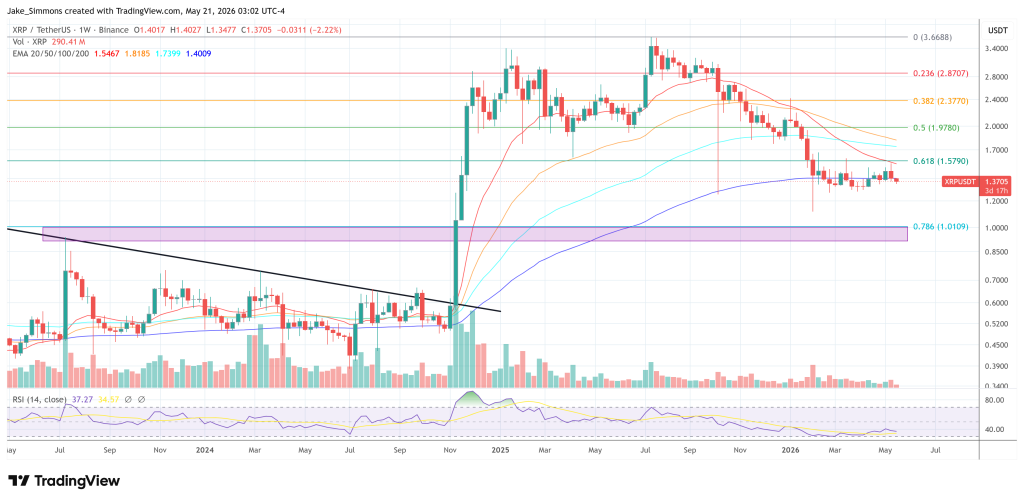
At press time, XRP traded at $1.37.
XRP bulls must break the 0.618 Fib, 1-week chart | Source: XRPUSDT on TradingView.com
Featured image created with DALL.E, chart from TradingView.com
Editorial Process for bitcoinist is centered on delivering thoroughly researched, accurate, and unbiased content. We uphold strict sourcing standards, and each page undergoes diligent review by our team of top technology experts and seasoned editors. This process ensures the integrity, relevance, and value of our content for our readers.
Trading giant IG (IGG), which started offering cryptocurrency trading in the U.K. a year ago, said it plans to expand the service across Europe, without giving a time scale.
The European division of the London-listed investment platform will use crypto exchange Bitpanda’s infrastructure — including liquidity, trading connectivity and market data — to provide digital asset access to European investors, according to an emailed statement on Thursday.
The company reported revenue of 331.2 million pounds ($445 million) for the first quarter of 2026 this week, of which spot crypto contributed 2.4 million pounds ($3.2 million).
IG, which introduced spread betting to the U.K. in the early 1970s,is one of Europe’s best-known retail trading platforms, offering clients access to equities, foreign exchange, commodities and derivatives markets. It has 1.3 million clients globally.
Bitpanda is primarily licensed in Austria, with headquarters in Vienna. The exchange also holds licenses under the European Union’s Markets in Crypto-Assets (MiCA) regulation in Germany and Malta, allowing it to offer crypto services across the bloc.
A massive XRP derivatives play is betting that its price goes nowhere until the end of June, even as macro headwinds and regulatory developments suggest a volatility boom.
The move hit the tape on crypto exchange Deribit as a single-block trade, meaning it was a large transaction executed over-the-counter in a privately negotiated deal to prevent it drastically moving the price.
The trade likely involved a whale or an institution executing what is known as the “short straddle” strategy by shorting (selling) 1.5 million contracts of both the $1.40 call and put options expiring on June. 26.
By selling both the call and put, the trader is effectively providing insurance against sharp price movements away from the $1.40 strike. The trader received an upfront premium of $224,500 for assuming this volatility risk.
The trader will retain that amount as profit if XRP remains near $1.40 through June 26.
Hence, the bet is essentially on volatility to stay low, with prices pinned near $1.40. The payments-focused cryptocurrency has largely traded between $1.30 and $1.50 since February, according to CoinDesk data.
The strategy is not without risk. A sharp move in either direction would turn the position unprofitable, requiring the trader to cover losses owed to option buyers.
As of now, plenty of factors point to potential for volatility. Inflation concerns in the U.S. and other parts of the world are pushing up government bond yields worldwide, disincentivizing investments in stocks, cryptocurrencies and other risky assets.
Meanwhile, the Senate Banking Committee advanced the Clarity Act, a landmark U.S. legislative proposal designed to establish a clear regulatory framework for cryptocurrencies and digital assets. The bill now moves forward to a full Senate vote.
Stuart Alderoty, chief legal officer at Ripple, which uses XRP to facilitate cross-border transactions, reportedly called the banking committee’s decision a “monumental outcome” and cited the protection of 67 million American crypto holders as the bill’s purpose.
XRP is often seen as a U.S. crypto play, as Ripple is based in San Francisco and is among several firms that have received conditional approval from the Office of the Comptroller of the Currency (OCC) to establish the Ripple National Trust Bank (RNTB).
Bitcoin is at a critical juncture, as a close below $76,000 may deepen the pullback toward $70,000.
HYPE and ZEC are in an up move, but most other major altcoins are struggling to find support.
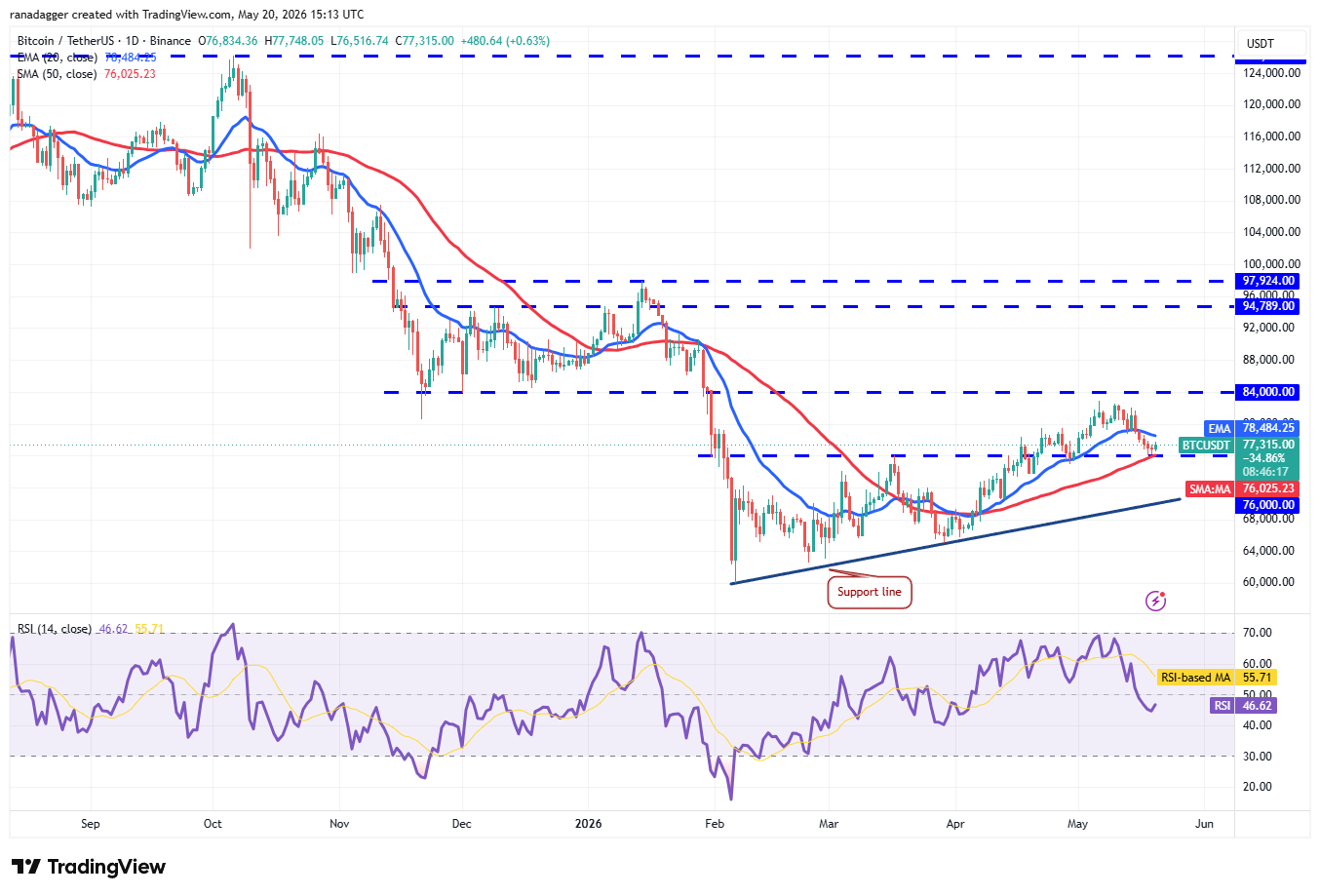
Bitcoin (BTC) has risen above $77,500, but the recovery is expected to face resistance in the $78,500-$82,000 range. The net outflows of $979.7 million from spot BTC exchange-traded funds this week, according to Fireside Investors data, suggest that investors have turned cautious in the near term.
Crypto analyst Ardi said in a post on X that the next retest of the $74,000 to $75,000 zone may be the most important test of this entire bear market. The zone is important because it acted as stiff resistance in 2024 and then flipped into support during the retest in 2025. A break below the support zone may “expose the market to a much deeper rotation back toward the bear market lows.”
Crypto market data daily view. Source: TradingView
Although BTC appears weak in the near term, analysts do not anticipate a sharp decline. CryptoQuant analyst Sunny Mom said in a recent QuickTake analysis that if BTC holds the $70,700 level, it is likely to consolidate in the $70,000 to $82,000 range “to burn time and digest the supply.”
Could BTC and the major altcoins start a strong recovery? Let’s analyze the charts of the top 10 cryptocurrencies to find out.
Bitcoin price prediction
BTC is attempting a bounce off the breakout level at $76,000, indicating that the bulls are striving to turn it into support.
Sellers are unlikely to give up easily and may vigorously defend the 20-day exponential moving average ($78,484). If the BTC price turns down sharply from the 20-day EMA, it increases the risk of a break below $76,000. If that happens, the BTC/USDT pair may plunge to the support line.
Contrarily, a close above the 20-day EMA signals demand at lower levels. The bulls will then endeavor to push the pair to the overhead resistance at $84,000. This is a critical level for the bears to defend, as a close above it clears the path for a rally toward $97,924.
Ether price prediction
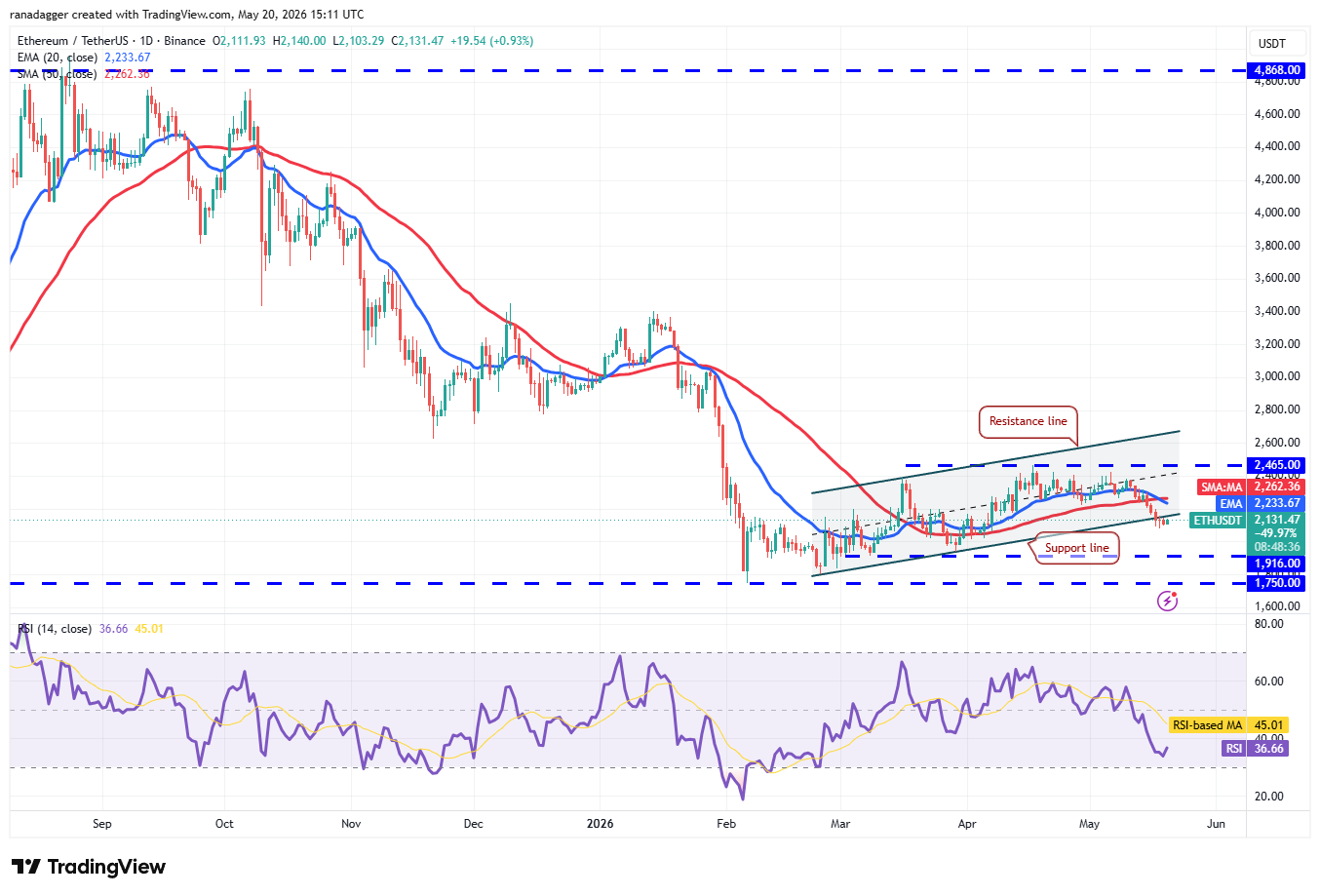
Ether (ETH) fell below the support line of the ascending channel pattern on Sunday, but the bears have not been able to capitalize on the breakdown.
The bulls are striving to push the ETH price back into the channel. If they succeed, the next hurdle is likely to be at the moving averages. If the price turns sharply down relative to the moving averages, the risk of a drop to $1,916 increases.
Alternatively, a close above the moving averages suggests that the market has rejected the break below the support line. The ETH/USDT pair may then rally to $2,465, then to the resistance line.
BNB price prediction
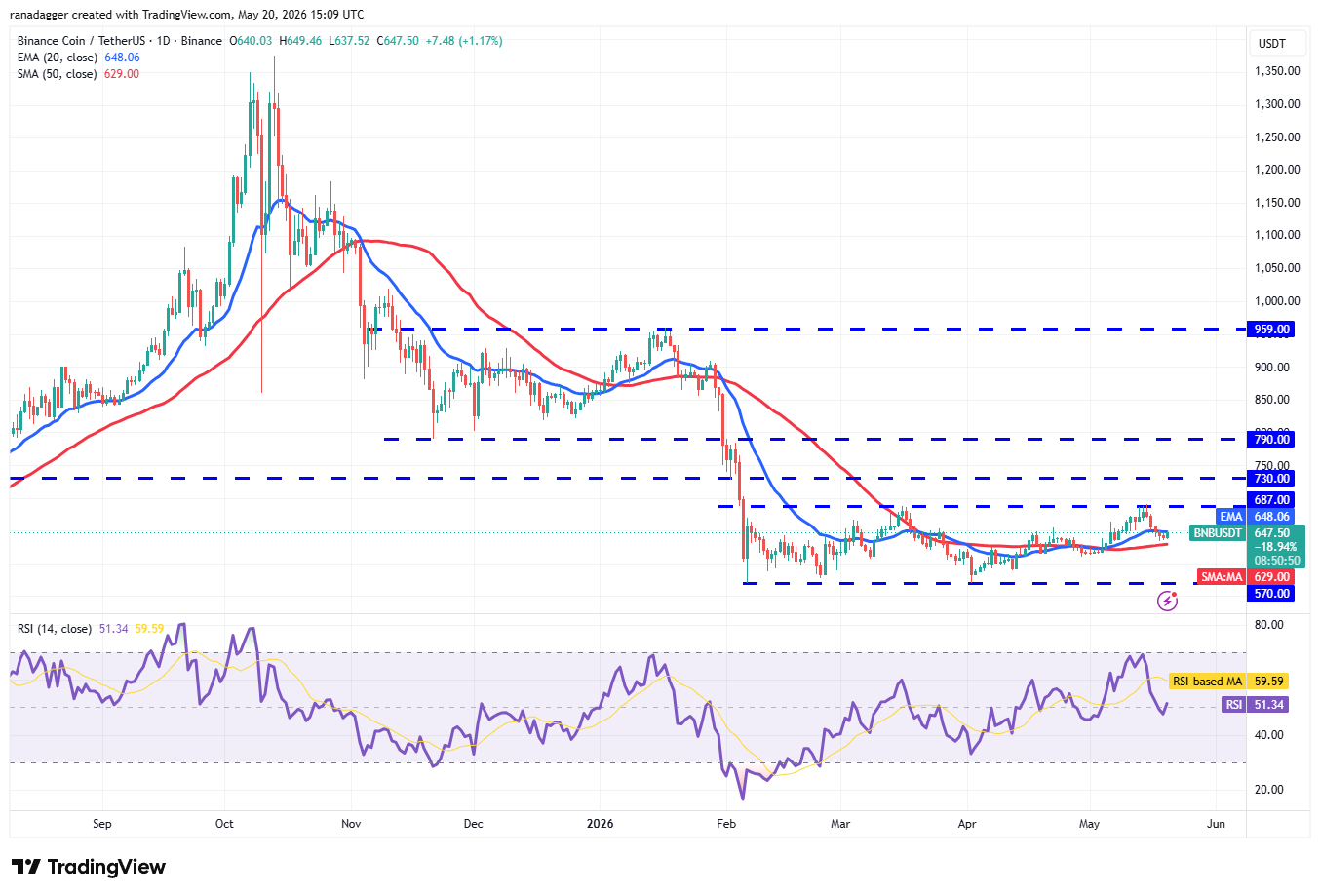
BNB (BNB) is attempting to find support at the 50-day SMA ($629), indicating a lack of aggressive selling at lower levels.
If the price closes above the 20-day EMA ($648), the bulls will again strive to push the BNB/USDT pair to the $687 resistance. Sellers are expected to aggressively defend the level, as a close above it may push the BNB price to $730 and, after that, to $790. That indicates the pair may have bottomed out in the short term.
Instead, if the price turns down and breaks below the 50-day SMA, it suggests the pair may remain within the $570 to $687 range for some time.
XRP price prediction
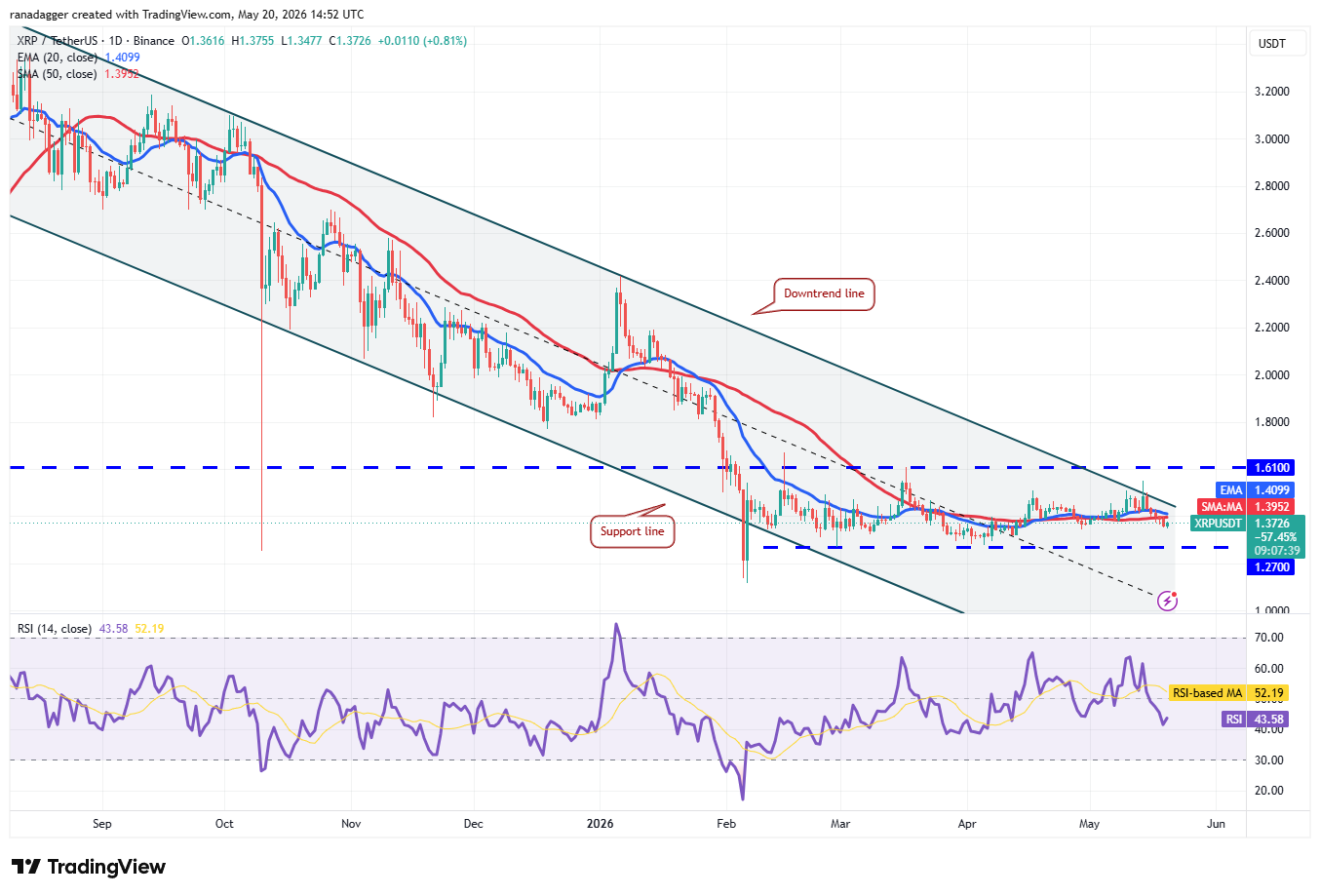
XRP (XRP) closed below the 50-day SMA ($1.39) on Monday, but a minor positive is that the bulls have not let the price dip to $1.27.
Buyers will have to achieve a close above the downtrend line to signal a comeback. The XRP/USDT pair may then move higher toward the $1.61 level, where bears are expected to step in. A close above the $1.61 resistance signals a potential trend change. The XRP price may then rally to $2 and later to $2.40.
On the contrary, if the price continues lower and or turns down from the downtrend line, it suggests that the bears remain in control. That increases the risk of a break below the $1.27 support. If that happens, the pair may plummet to $1.11.
Solana price prediction
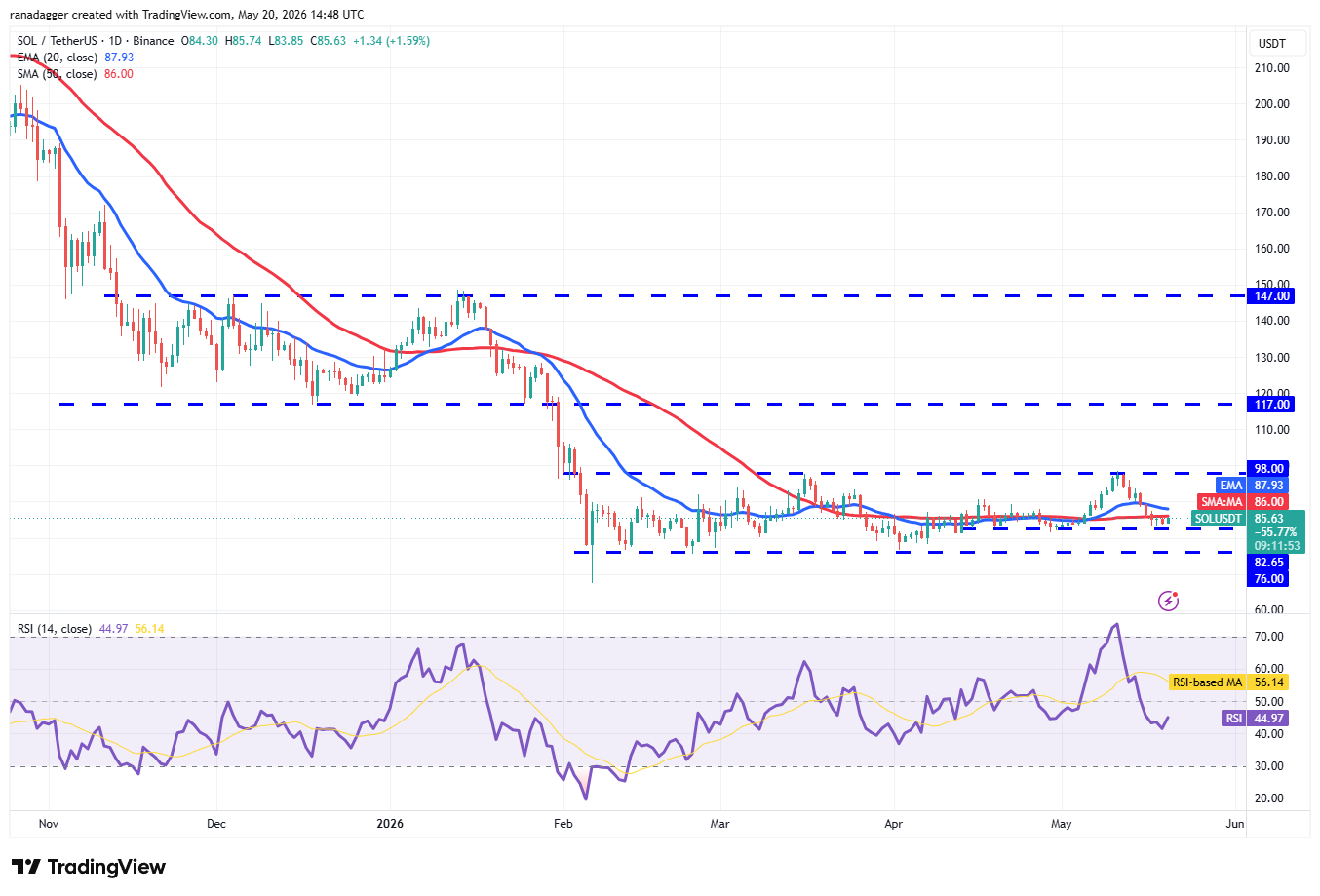
Solana (SOL) has held above the $82.65 support over the past few days, but bulls are struggling to trigger a strong rebound.
The 20-day EMA ($87.93) has begun to turn lower, and the RSI is in negative territory, indicating a slight advantage for bears. If the SOL price turns sharply down from the 20-day EMA, the likelihood of a break below $82.65 increases. The SOL/USDT pair may then descend to the $76 support.
Buyers are likely to have other plans. They will attempt to push the price above the 20-day EMA and the $91 resistance. If they do that, the pair may reach the $98 level.
Dogecoin price prediction
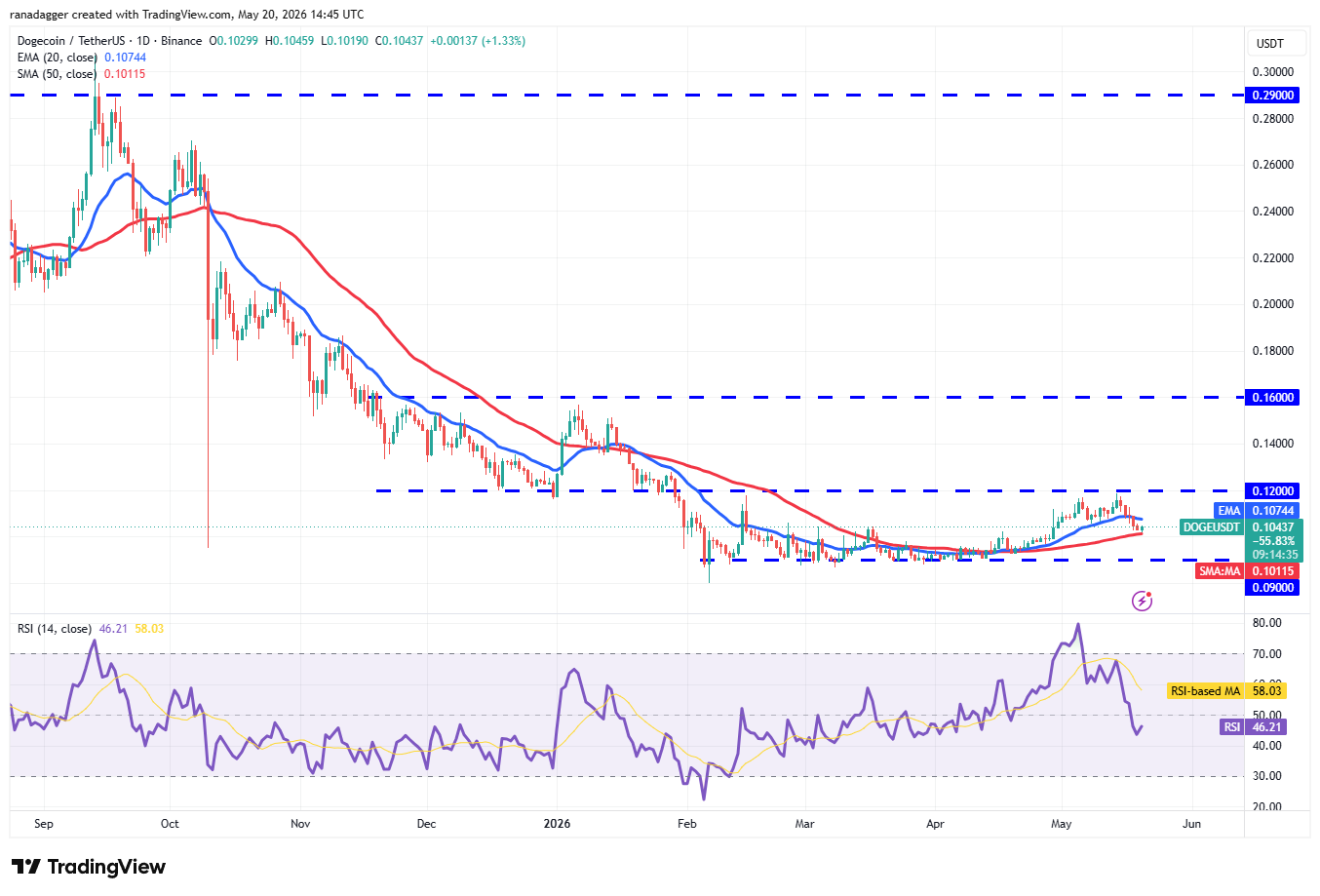
Dogecoin (DOGE) has been stuck in the $0.09-$0.12 range, suggesting buying on dips and selling on rallies.
The bulls are attempting to start a bounce off the 50-day SMA ($0.10), but are expected to hit a hurdle at the 20-day EMA ($0.11). If the DOGE price turns down sharply from the 20-day EMA, the likelihood of a drop to $0.09 increases.
On the other hand, a close above the 20-day EMA suggests that the DOGE/USDT pair may climb to the $0.12 resistance. Buyers will have to push and maintain the price above $0.12 to signal the start of a new uptrend to $0.14, and subsequently to $0.16.
Hyperliquid price prediction
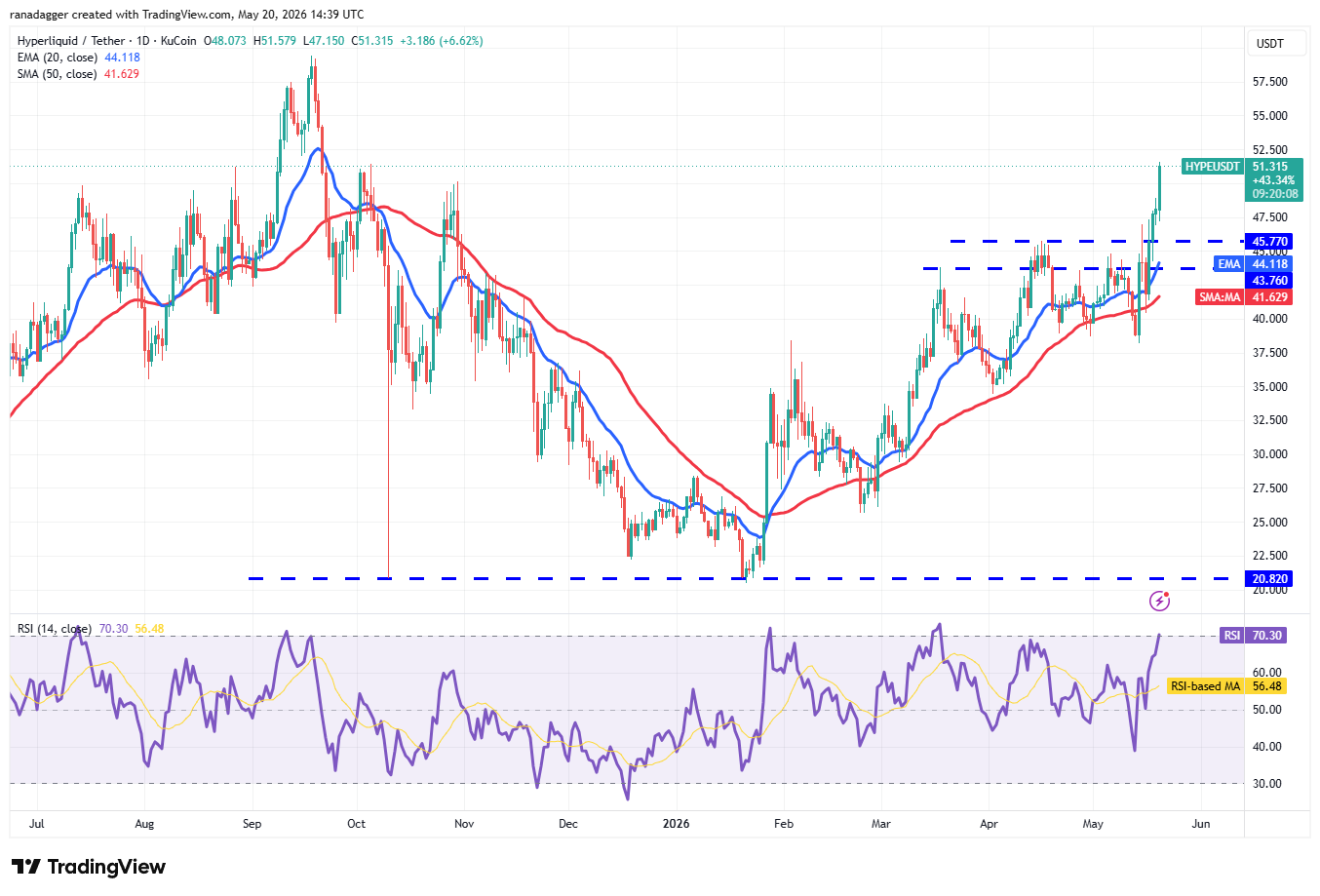
Hyperliquid (HYPE) closed above the $45.77 resistance on Monday, signaling the resumption of the uptrend.
There is resistance at $51.43, but if the bulls pierce the level, the HYPE price may surge toward $59.41. Sellers are expected to fiercely defend the $59.41 level, as a break above it could push the HYPE/USDT pair into uncharted territory.
The first support on the downside is the breakout level of $45.77 and then the 20-day EMA ($44.11). Sellers will have to pull the price below the 20-day EMA to suggest that the bulls are losing their grip. The pair may then tumble to the 50-day SMA ($41.62).
Related: Ethereum traders warn of a ‘nasty’ ETH price drop if $2K support breaks
Cardano price prediction
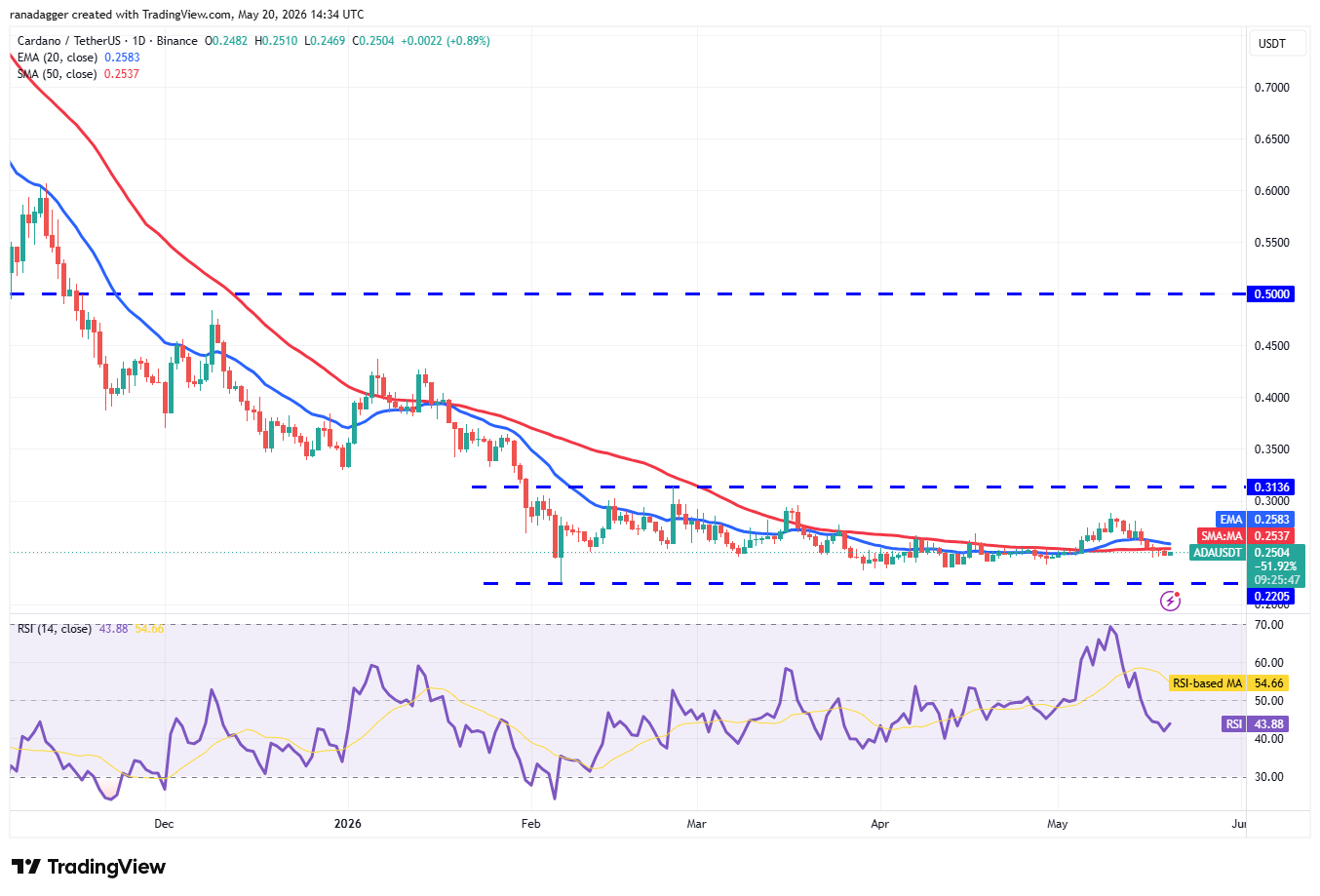
Cardano (ADA) has been clinging to the 50-day SMA ($0.25), indicating that the bulls are attempting to reclaim the level.
Any recovery is expected to face selling at the 20-day EMA ($0.26). If the price turns sharply down from the 20-day EMA, the bears will attempt to drive the ADA/USDT pair toward the solid support at $0.22.
On the upside, a break and close above the 20-day EMA signals strength. The ADA price may rise toward $0.29, then to $0.31, where bears are likely to mount a strong defense.
Zcash price prediction
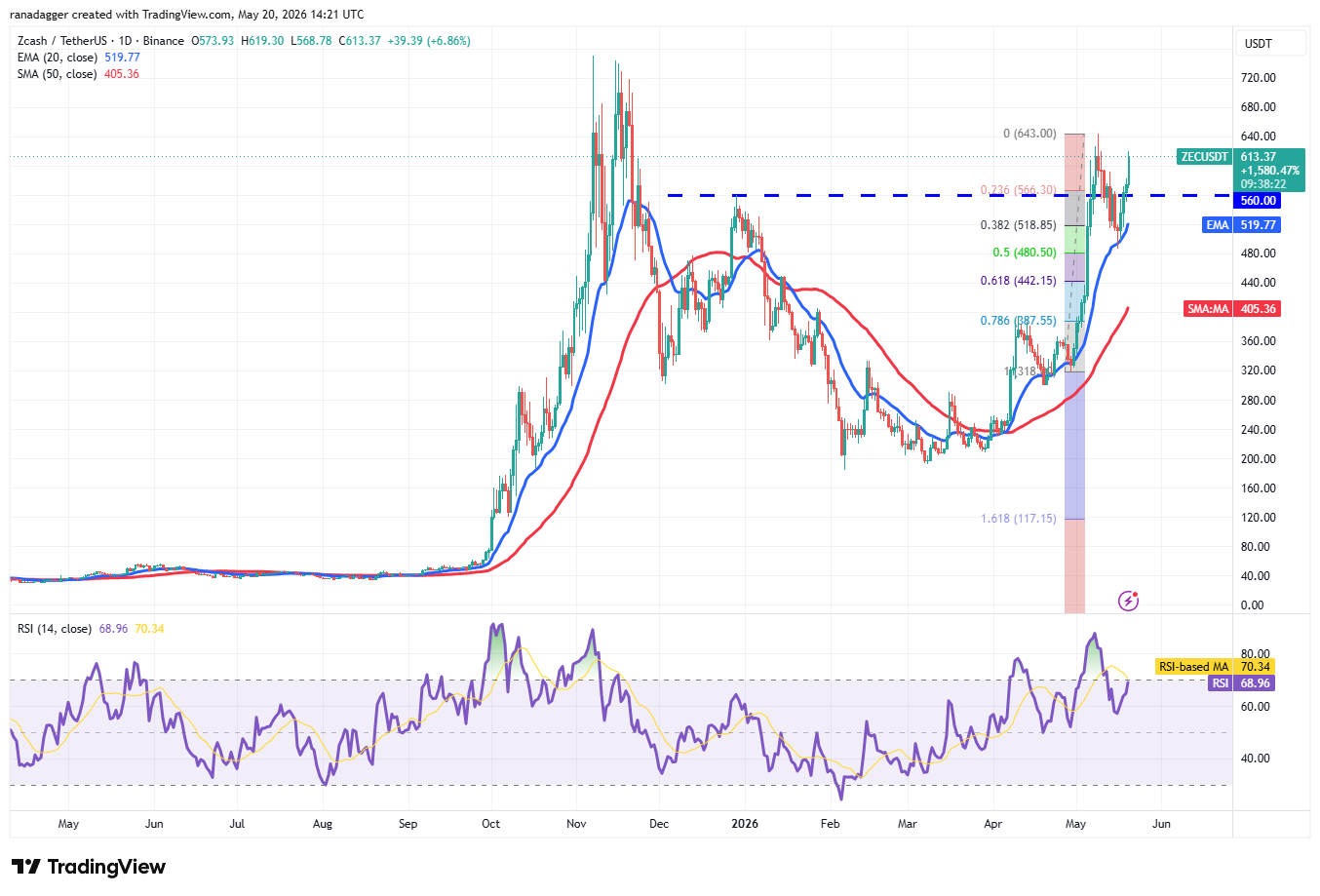
Zcash (ZEC) bounced off the 20-day EMA ($519) on Sunday, indicating that the bulls continue to buy the dips.
Buyers will need to drive the ZEC price above $643 to initiate the next leg of the uptrend. The ZEC/USDT pair may then skyrocket toward $750, where the bears are expected to mount a strong defense.
The first support to watch out for on the downside is the 20-day EMA. A break and close below the 20-day EMA suggests that the traders are booking profits. That may pull the pair to the 61.8% Fibonacci retracement level of $442.
Bitcoin Cash price prediction
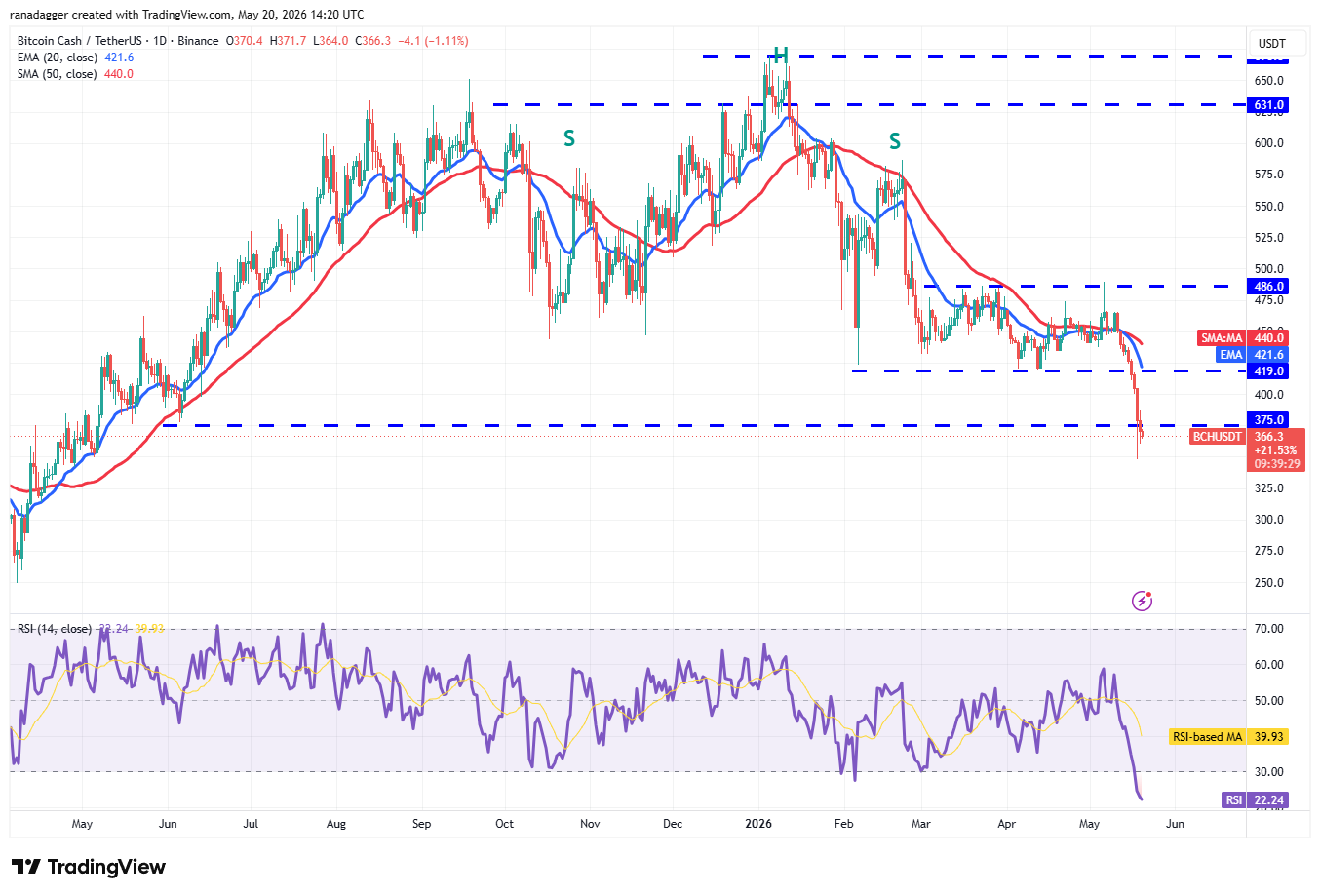
Bitcoin Cash (BCH) closed below the $419 support on Saturday, signaling the resumption of the downtrend.
The selling picked up momentum, and the BCH/USDT pair fell below the $375 support on Monday. Buyers are attempting to push the price back above $375, but the bears have held their ground. If the BCH price turns down from $375 and breaks below $348, the pair may plummet to $300.
Buyers have an uphill task ahead of them. They will have to push the price above the 20-day EMA ($421) and maintain it to signal a comeback.
Syndicate Labs announced it is winding down after five years of developing onchain infrastructure for customizable Ethereum rollups and sequencers, citing a shrinking market for rollups.
The company said on Thursday on X that the decision was necessary because “the rollup market has fundamentally shifted.”
“Unfortunately, the rollup market has shrunk dramatically. For every new rollup spinning up, several more are quietly shutting down,” it said.
Syndicate Labs is a venture capital-backed company that focuses on enabling customizable, programmable Ethereum appchains, or application-specific rollups, with smart sequencers. It raised $20 million in Series A funding led by Andreessen Horowitz in 2021.
The Ethereum scaling ecosystem is dominated primarily by three players — Arbitrum One, Base and OP Mainnet — which command a 75% market share. Smaller players are slowly getting squeezed out as activity and capital concentrate among the top three.
Additionally, the total value secured across the layer-2 rollup ecosystem has declined by about 36% since its peak of just over $50 billion in October, with smaller networks losing much more as capital migrated to the industry leaders, according to L2Beat.
“L2 activity has dropped 61% since June, leaving many smaller networks as ‘zombie chains’ with minimal usage,” reported 21Shares in December.
Three players account for nearly $30 billion in rollup total value secured. Source: L2Beat
Rollup market has shifted
Syndicate said the market has shifted away from its technology, “making it impossible to wait out these market conditions.”
“Instead, custom chains are being built by consulting teams from scratch, with very little reusable tech or network value.”
Related: Legend becomes latest DeFi app to throw in towel
The company said the Syndicate Network Collective is independent of Syndicate Labs, so SYND token governance is not immediately affected. It also said the decision to wind down was not influenced by the recent bridge compromise.
The Syndicate Commons Bridge on Base was exploited in late April because of a security breach and a leaked private key, resulting in the loss of 18.5 million SYND tokens worth about $330,000 at the time.
SYND fell 44% after the hack and declined another 21% over the past three hours, hitting an all-time low of $0.012 after the closure announcement, according to CoinGecko. The token is down 99.5% from its September 2025 peak of $2.61.
A year of DeFi and crypto closures
Syndicate Labs is the latest addition to a growing list of crypto and DeFi closures this year.
DeFi mobile superapp Legend announced it was winding down on May 13, citing growth and scaling problems.
Other recent closures include Solana DeFi aggregator Step Finance, DeFi derivatives protocol Polynomial, Balancer Labs, the team behind the DeFi protocol Balancer, and Seamless Protocol, a DeFi lending protocol on Base.
Magazine: 5 tech predictions the mainstream media got horribly wrong
Welcome to our institutional newsletter, Crypto Long & Short. This week:
Alec Beckman on why BTC-backed lending is not a crypto story, but a capital efficiency story.
Serena Sebastiani on how stablecoins aren’t a crypto product; they’re becoming the settlement infrastructure global finance forgot.
Top headlines institutions should pay attention to by Francisco Rodrigues.
“Ethena’s Solana lending markets cross $1B in 4 days” in Chart of the Week.
Thanks for joining us!
-Alexandra Levis
Expert Insights
Bitcoin-backed loans belong in the cost-of-capital conversation
By Alec Beckman, VP of the Americas, Psalion
The argument is not about whether to buy bitcoin or not. It is for advisors, real estate investors, small business owners and founders who already own it, or work with clients who do. The practical question is simple: if a client carries meaningful debt, why is BTC-backed lending not in the capital stack discussion? Debt-heavy professionals already compare collateral, rate, fees, speed and covenants. Bitcoin-backed loans should be evaluated the same way.
The debt menu is familiar. HELOCs are tied to home equity, often variable, and currently sit above 7% for many borrowers. Hard money and bridge loans can move quickly, but often price around 10% to 14% plus points. Securities-based lending can be efficient, but rates often begin around 6% to 8% and require sizable brokerage assets in one place. Personal loans frequently land in the low-to-mid teens. SBA loans can be useful, but the all-in cost, documentation and time to fund are not trivial.
Bitcoin-backed lending changes the collateral, not the math. The borrower pledges BTC, receives dollars or stablecoins and repays under agreed terms. The asset is liquid, verifiable and easy to monitor. Market rates still vary widely, but more competitive structures are emerging. At Psalion, for example, we facilitate access to Bitcoin-backed loans at a 5.5% fixed rate, up to 60% LTV, with a 0.5% origination fee. That is one data point, but it shows why the category belongs in a serious debt comparison.
Rate matters first. For someone already holding BTC, the relevant question is not “Should I borrow?” It is “Where should I borrow?” Against a house? A business? A securities portfolio? Or BTC? If BTC collateral produces cheaper capital than the borrower’s existing debt, it can reduce the blended cost of capital.
Fees matter next. Hard money can carry points on origination. SBA structures can include guarantee fees, closing costs and advisory costs. Personal loans may embed higher APR through origination. Lower fee bitcoin-backed lending can make the all-in economics materially cleaner.
Friction matters too. Traditional credit often requires income verification, tax returns, appraisals, operating statements, personal guarantees, covenants and time. BTC-backed lending is collateral-first. The collateral can be verified quickly and monitored continuously. Faster access to liquidity is not just convenience. It can change the economics of a refinance, acquisition, tax payment or bridge need.
Advisors should care because BTC is now part of more client balance sheets. Too often, BTC sits idle while the same client pays higher rates elsewhere. If the client can borrow against BTC and replace more expensive debt, the advisor has improved the balance sheet without forcing a sale and potentially creating a taxable gain.
There is a second use case: yield on spread. Some real estate investors, founders and business owners see opportunities where expected returns exceed their cost of capital, such as private credit, commercial real estate lending, inventory or operating expansion.
Borrowing against BTC to pursue those opportunities can make sense when the borrower understands both sides of the trade: the yield opportunity and the collateral risk.
That risk is real. Bitcoin is volatile. If the price falls enough, LTV can breach agreed thresholds and trigger margin calls or liquidation. Liquidation can create a taxable event. This is not for every client. It is for borrowers who understand BTC volatility, maintain liquidity and size loans conservatively below maximum LTV.
For clients who already own bitcoin and already carry debt, BTC-backed lending is not a crypto story. It is a capital efficiency story. Ignoring it may mean leaving cheaper capital, or a valuable spread opportunity, on the table.
Principled Perspectives
Stablecoins are now infrastructures
By Serena Sebastiani, chief strategy officer and head of government and regulatory affairs, Fuze
There’s a kind of financial friction that becomes invisible when you live inside it long enough.
From New York or London, cross-border payments work. From Nairobi, Jakarta or Almaty, they don’t.
An SME in Nairobi pays a supplier in Karachi. The money leaves Monday. It arrives Thursday. Along the way it passes through two correspondent banks, absorbs fees on both ends, gets hit with an FX spread on the USD conversion and triggers multiple compliance checks. Both the buyer and the supplier absorb the friction by pricing it into the deal and extending the credit note.
This is how it actually works to operate across the fastest-growing trade corridors globally: Gulf to South Asia, intra-African trade, CIS to MENA, and Southeast Asia remittances.
Multiply that by the $136 billion SME trade finance gap in Africa alone. Multiply it by the $100 billion in annual remittances flowing into the continent. Multiply it across the Gulf-to-South-Asia corridor, CIS-to-MENA and intra-ASEAN. And also account for the cost of sending money into Sub-Saharan Africa, which remains the most expensive region in the world, at 8.3% on average (almost three times the UN’s 3% target). In live corridors today, stablecoin rails are already operating at under 1%. What we’re looking at is not simply a matter of optimizing the margins, but a structural gap in the fastest-growing regions of the global economy.
SWIFT was built for a specific world: large banks, large tickets and major financial centres. It works perfectly for that world. Yet the supplier payment in Nairobi, the remittance from Riyadh to Manila, or the trade settlement between Almaty and Istanbul has been making do with infrastructure designed for someone else’s economy.
That’s the gap stablecoins are moving into, and they’re not a product but real plumbing.
Chart 1: The Remittance Cost Gap
Sources: World Bank (Q1 2025); UN SDG 10.c; Transak / Operational corridor data
What we observe from the ground
I spent time with regulators and market operators across high-growth corridors and a pattern that emerges is that people closest to the friction are the least ideological about the solution. They are the ones actually trying to integrate stablecoins into the existing financial system.
In Kigali for example, the framing isn’t “crypto adoption.” Rwanda’s National Bank launched a CBDC pilot in February with cross-border interoperability as the explicit design priority. A draft Virtual Assets Law now in parliament applies a clean two-tier structure: Central Bank oversight for payment stablecoins and Capital Markets Authority for investment instruments. A fintech license passporting agreement with Kenya, signed in March, is already being designed as a template for the East African Community. This is regulatory infrastructure being built with precision, for a specific problem, by people who understand their own market.
The insight is not Rwanda-specific, but Africa-wide, where mobile money already functions as the default financial layer. With over a billion registered accounts, 96% financial inclusion in markets like Rwanda, this distribution infrastructure took decades to build. What mobile money never solved for is cross-border interoperability. Stablecoins fit that gap naturally, not replacing fiat currencies, but acting as the settlement layer that makes mobile money efficient.
The same logic, four corridors
Middle East
The Central Bank of UAE’s Payment Token Services Regulation treats stablecoins as settlement infrastructure rather than speculative securities. That regulatory framing is practical and allows banks to issue AED stablecoins that can be used directly as a means of payment, and banks and licensed fintechs can build on stablecoin rails without treating every transaction as a liability. In this way, the Gulf stablecoin settlement is happening inside regulated perimeters.
CIS markets
In Kazakhstan, Uzbekistan and Georgia, the driver is dollar access. Domestic currency volatility creates structural demand for USD, and formal banking doesn’t reliably provide them. Stablecoin adoption here is dollarization leveraging a new distribution channel. The institutional opportunity is providing that access inside a compliance framework, with the custody and reserve standards that make it durable.
Southeast Asia
In Southeast Asia, the driver is cost and speed. In corridors like Gulf-Indonesia or Gulf-Philippines for remittances, stablecoin rails eliminate the need for pre-funding and speed up settlement from days to minutes (often under 20 minutes, 24/7). Cost reductions of 40–80% are already observable in operational flows.
I engaged with regulators, banks and fintechs in these markets. The question here is: how can we facilitate higher volumes on stablecoin rails and give back to the households?
Africa
Remittances are expensive, but the B2B case is urgent as well. Intra-African trade only accounts for 16% of total trade, against 68% for Europe and 59% for Asia. The AfCFTA created the legal architecture for a $3.4 trillion market, but the payment infrastructure hasn’t kept up. Chinese traders sourcing African goods are already settling in USDT because it is superior for their transaction sizes and timelines. To make this properly institutional and largely adopted, the essence is to guarantee that the activity happens compliantly, with proper rails.
Chart 2: Intra-Regional Trade Share — Africa vs Peers
Sources: UNCTAD / AfDB / WTO; World Bank / African Union (AfCFTA projection)
Stablecoins are infrastructure
Global banks and fintechs are still largely approaching stablecoins as a product to distribute to customers. The more significant opportunity is treating them as infrastructure to build on, particularly in remittances and B2B payment flows: treasury management, supplier payments and FX settlement. These are flows where the speed improvement and cost reduction are measurable (minutes vs days, basis points), and where the compliance trails on well-designed digital rails are demonstrable and trackable. These include on-chain transaction monitoring, wallet attribution and automated regulatory reporting that produces a compliance record that informal transfer channels structurally cannot. The data generated by these rails is what gets correspondent banking relationships restored in markets where de-risking has cut them.
Solving the friction
What remains to be solved for the infrastructure to properly work at scale? Regulatory frameworks that define reserve standards and redemption rights, cross-border supervisory coordination and AML/CFT laws interoperability.
All this is being worked through, and more in the market that matters (high-growth) than in established developed countries.
From experience working with regulators and now proactively engaging with them, I learned that the pattern that works is: 1. A phased licensing framework that lets regulators learn alongside the market; 2. Proportionate requirements scaled to institutional size and risk profile; 3. Bilateral passporting agreements that make compliance portable across corridors.
The corridors where this infrastructure is most needed are not waiting for global standards to arrive but are actively building. The question for global institutions is whether they’re part of that architecture or arriving late to fintech-leading infrastructure.
Headlines of the Week
Francisco Rodrigues
This week’s headlines show structural progress on Wall Street’s onchain push, with a market-structure bill clearing its biggest hurdle, JPMorgan extending its tokenization stack, and asset managers tackling the redemption-speed problem. Solana has meanwhile kept quietly cementing its infrastructure for institutional use.
Clarity Act clears U.S. Senate committee, on its way to a final test in Congress: Chairman Tim Scott secured a 15-9 bipartisan vote with Democrats Gallego and Alsobrooks crossing over, though unresolved law enforcement and government-ethics provisions still stand between the bill and a floor vote before the summer recess.
JPMorgan files to launch new tokenized fund as Wall Street tokenization race heats up: The Ethereum-based JLTXX fund, run through JPMorgan’s Kinexys blockchain unit, is structured to satisfy GENIUS Act stablecoin reserve requirements — landing days after BlackRock filed for its own tokenized Treasury vehicle.
BlackRock, Janus Henderson tokenized funds get instant redemptions with new $1 billion facility: Grove’s Basin facility advances stablecoin liquidity against approved redemptions from BlackRock’s $2.2 billion BUIDL and Janus Henderson’s $1.1 billion JTRSY, targeting the multi-day settlement gap that has held back the $15 billion tokenized Treasury market.
Mike Novogratz’s Galaxy receives New York BitLicense for institutional crypto push: NYDFS cleared GalaxyOne Prime NY to serve hedge funds, RIAs and family offices on a $9 billion platform, making Galaxy only the second firm to win a BitLicense in 2026 after Strike.
Solana is shedding its memecoin reputation as big banks move billions into its ecosystem: A Messari report shows Solana’s tokenized RWA market cap jumped 43% QoQ to $2.01 billion, with BlackRock’s BUIDL, Ondo, Franklin Templeton and a Citigroup-PwC trade finance PoC live on the network, alongside payments integrations from Visa, Stripe, PayPal and Western Union.
Chart of the Week
Ethena’s Solana lending markets cross $1B in 4 days
Combined USDe and USDG supply across the Bitwise-curated Jupiter Lend market and the Kamino Ethena market rose from $401M on launch day (May 12) to $1.06B on May 16 – driven almost entirely by looper-led growth on Jupiter Lend, where supply climbed from $201M to $812M while Kamino’s Ethena Prime vault held steady around $250M.
Listen. Read. Watch. Engage.
Looking for more? Receive the latest crypto news from coindesk.com and market updates from coindesk.com/institutions.
Trump Media & Technology Group likely abandoned plans for its bitcoin BTC$77,545.45 exchange-traded fund (ETF) because the economics no longer worked.
ETF analysts say the company behind Truth Social faced a brutal reality: the spot bitcoin ETF market has become crowded, fees have collapsed and investors already have more than a dozen similar products to choose from.
This week, Trump Media withdrew registration statements with the U.S. Securities and Exchange Commission for the “Truth Social Bitcoin ETF” and “Truth Social Bitcoin & Ethereum ETF,” ending plans to launch the funds.
The company described the move as a “structural reset” designed to help it build the right investment products for investors. But analysts following the ETF market say competitive pressure was the more likely reason.
“The first five Truth Social ETFs have received a lukewarm reception, attracting just over $30 million in combined assets since their launch at the end of 2025,” Nate Geraci, president of NovaDius Wealth Management, told CoinDesk.
“That tepid investor response may have dissuaded the firm from entering a highly competitive category, where it would face some of the world’s largest asset managers and well-established crypto-native ETF issuers,” Geraci said. With spot bitcoin ETF fees already as low as 14 basis points, the Truth Social Bitcoin ETF would likely have been “a dead man walking,” he said.
The fee pressure has intensified in recent months as major Wall Street firms expanded into crypto products. Morgan Stanley recently launched a bitcoin ETF charging 14 basis points, one of the cheapest offerings in the market.
That raised the bar for any new entrant trying to gain traction.
Bloomberg Intelligence ETF analyst James Seyffart questioned Trump Media’s explanation for the withdrawal. On X, Seyffart said the company pointed to differences between products registered under the Securities Act of 1933 and funds structured under the Investment Company Act of 1940.
“But it doesn’t make a ton of sense to me,” Seyffart wrote. “Of course a 33 Act ETP is different from a 40 Act ETF and it has less protections. Anyone in this space knows that. Nothing has changed.”
Instead, Seyffart said he suspects “it more has to do with the competitive landscape for spot bitcoin ETFs.”
He added that Trump Media may still pursue crypto-related funds under a ’40 Act structure, which allows issuers to build more flexible strategies using derivatives, income products or actively managed portfolios.
“I mean do we really need a 14th spot bitcoin ETF?” Seyffart wrote. “But something that can be more differentiated makes sense.”
Eric Balchunas, senior ETF analyst at Bloomberg Intelligence, pointed directly to the fee war.
“My guess: Yorkville guy told Truth ppl after MSBT that they either gotta come in below 14bp fee or you might as well forget it,” Balchunas wrote on X. “No one will buy it, and it could be embarrassing.”
Some crypto observers speculated that the withdrawal may have been linked to political scrutiny of the Trump family’s crypto ventures or to negotiations tied to the CLARITY Act. Seyffart told CoinDesk he does not believe those concerns drove the decision.
ETHEREUM COMMUNITY RESPONDS TO EF DEPARTURES: A wave of departures from the Ethereum Foundation (EF) is reigniting a debate inside the crypto industry: What is going on at the main steward behind Ethereum, and why does the community know so little about what is happening behind the scenes? Days after several high-profile figures said they had left the foundation during an internal shakeup, community members on X began openly questioning the organization’s direction, leadership structure and communication practices. “What’s happening at the EF?” crypto commentator Andy, the co-founder of the Rollup podcast, wrote in a post on X. Others echoed similar frustrations, arguing the EF has failed to clearly explain the rationale behind the changes or how responsibilities inside the organization are evolving. “Why can’t the EF just be transparent about things,” wrote Joon Ian Wong, a prominent figure in the crypto community events space. The criticism reflects a longstanding tension surrounding the Ethereum Foundation, the Switzerland-based nonprofit that plays a central role in funding research, coordinating upgrades and stewarding development of the world’s second-largest blockchain by market capitalization. Unlike traditional corporations, the EF has historically operated with a loose and decentralized structure. Some have argued that the model preserves Ethereum’s neutrality and prevents excessive concentration of power. Others say the approach has increasingly clashed with the expectations of an ecosystem now underpinning hundreds of billions of dollars in assets and decentralized financial activity. The latest departures appear to have reopened that debate. — Margaux Nijkerk Read more.
CITI SAYS BITCOIN PARTICULARLY EXPOSED TO QUANTUM THREATS: Quantum computing is emerging as a growing risk for digital assets, with Wall Street bank Citi (C) warning that recent breakthroughs are accelerating the timeline for potential threats to crypto security and internet infrastructure. In a report, the bank said advances in quantum computing are challenging the cryptographic systems underpinning cryptocurrencies, financial networks and online communications. “While large-scale quantum attacks remain a medium-term concern, the pace of progress has shortened the horizon and warrants closer attention from investors,” wrote analyst Alex Saunders. Quantum computing is a long-term threat to crypto because a sufficiently powerful quantum computer could break the cryptographic systems that protect wallets, exchanges and blockchains, especially public-key cryptography like ECDSA used by Bitcoin and Ethereum. In theory, a quantum attacker could derive private keys from exposed public keys, forge transactions, and steal funds. Still, the risk is not immediate. Experts say the hardware needed to do this at scale is still years away, and blockchains will probably migrate to post-quantum cryptography before then. The analyst highlighted Bitcoin as particularly exposed because of its conservative governance model and slower ability to implement protocol upgrades. Saunders pointed to vulnerabilities tied to public keys exposed onchain, dormant wallets and early pay-to-public-key (P2PK) addresses, including wallets believed to belong to Bitcoin creator Satoshi Nakamoto. Latest estimates put around 6.5 million–6.9 million bitcoin at quantum risk due to already-exposed public keys. This is about one-third of circulating supply, or roughly $450 billion worth, depending on the BTC price. — Will Canny Read more.
JUMP CRYPTO’S FIREDANCER CLIENT: Jump Crypto’s long-awaited Firedancer validator client is now producing blocks on Solana mainnet, marking a turning point in the project’s yearslong push to overhaul the blockchain’s performance infrastructure. “Firedancer is live and running in production,” Firedancer founding engineer Ritchie Patel told CoinDesk in an interview. “We have packed tens of millions of transactions over the last few months.” The rollout, however, is intentionally restrained. Patel said the team preferred to roll out progressively across the network rather than through a broad public launch, as the team remains cautious about rapidly increasing adoption. “We don’t want everybody to run it yet,” Patel said. “If half the network upgrades before we’ve done full security audits, that would be a bit much.” Firedancer, developed by Jump Crypto, is a validator client for Solana, or another version of the software that runs the blockchain. The effort emerged partly in response to concerns around Solana’s earlier outages and its reliance on a single dominant client maintained by Solana infrastructure firm Anza. Rather than framing Firedancer as a competitor to Anza, Patel described the relationship as collaborative. — Margaux Nijkerk Read more.
BUTERIN ON AI FORMAL VERIFICATION AND CRYPTO: Vitalik Buterin says artificial intelligence could make cryptocurrency systems and critical internet infrastructure more secure if developers combine AI-generated code with mathematically verified software. The Ethereum co-founder argued that AI-assisted “formal verification” could become one of the most important tools for cybersecurity as increasingly advanced AI systems make it easier to discover software vulnerabilities, in a lengthy blog post shared. Formal verification refers to the use of machine-checkable mathematical proofs to confirm that software behaves exactly as intended. While the technique has existed for decades, Buterin said recent advances in AI are making it more practical by helping developers write both code and the proofs needed to verify it. Buterin framed the technology as a response to growing fears that AI could overwhelm defenders by accelerating bug discovery and cyberattacks. Smart contract exploits remain a persistent issue across crypto, with attackers frequently draining millions of dollars from vulnerable decentralized finance protocols. Mathematically verified software could help reverse that trend, especially in areas where security failures would be catastrophic, Buterin argued. He specifically pointed to Ethereum infrastructure, zero-knowledge proof systems, consensus mechanisms and post-quantum cryptography as technologies that could benefit from formal verification. — Margaux Nijkerk Read More.
In Other News
Qivalis, a group of European banks building a regulated euro stablecoin, said Wednesday that 25 more lenders joined the initiative, more than tripling its membership as banks across the region deepen their push into blockchain finance. The expansion brings the consortium to 37 financial institutions spanning 15 European countries. New members include ABN AMRO, Rabobank, Intesa Sanpaolo, Nordea, Erste Group and National Bank of Greece. The expansion comes as tokenization gains traction among large financial institutions and asset managers, with stablecoins — crypto tokens whose value is pegged to a traditional asset such as a fiat currency — playing a key role in settlement and asset trades on blockchain rails. The effort also reflects a broader push by European banks to expand the use of euro-denominated stablecoins and reduce dominance of U.S. dollar-backed tokens, which currently account for about 99% of the global stablecoin market. The total stablecoin market capitalization is about $318 billion, dominated by Tether’s USDT and Circle Internet’s (CRCL) USDC. Together they account for more than 80% of the total. By building a regulated euro-based alternative, Qivalis aims to strengthen the single currency’s role in digital payments and tokenized finance as blockchain settlement gains traction among institutions. “This infrastructure is essential if Europe is to compete in the global digital economy whilst preserving its strategic autonomy,” said Howard Davies, chairman of Qivalis’ supervisory board. — Kristzian Sandor Read more.
Galaxy Digital said New York regulators granted the company a BitLicense and money transmitter license, allowing the crypto financial services firm to expand institutional digital asset operations in one of the industry’s most tightly regulated markets. The approval from the New York State Department of Financial Services authorizes GalaxyOne Prime NY, the company’s New York entity, to offer regulated crypto trading and custody services across the state. Galaxy said in a press release that the move gives New York-based institutions — including hedge funds, registered investment advisers and family offices — access to its digital asset platform, which the company said manages roughly $9 billion in client assets. “New York is home to the deepest pool of institutional capital in the country, and digital assets are no longer sitting at the edge of those allocations,” said Mike Novogratz, Galaxy’s founder and CEO, in a statement. — Helene Braun Read more.
Regulatory and Policy
U.S. President Donald Trump ordered the federal government to update its regulatory frameworks to integrate “digital assets and innovative technology into traditional financial services and payment systems” in an executive order. According to the document, the U.S. should foster financial technology services into its existing payment and financial services rails. “It is therefore the policy of the United States to streamline regulatory processes, reduce unnecessary barriers to entry, and encourage collaboration between fintech firms, federally regulated financial institutions, and Federal financial regulators,” the order said. The order directed the heads of financial regulators to review their existing rules over the next three months and identify any rules or documents “that unduly impede fintech firms from entering into partnerships with federally regulated institutions.” Within six months, Trump directed regulators to “take steps to encourage innovation as a result of the review.” These steps include asking the Federal Reserve Board of Governors to review how it allows uninsured depository institutions and non-bank financial firms access to payment accounts and services. — Nikhilesh De Read more.
U.S. Senator Elizabeth Warren is demanding the agency that regulates national banks explain its chartering of nine crypto-focused institutions, which, she argued, didn’t meet federal regulations and posed a risk to the financial system. The U.S. Office of the Comptroller of the Currency has granted trust charters to a series of banks as the agency embraced President Donald Trump’s agenda to elevate the crypto sector and establish a friendly regulatory environment. Now Warren, the ranking Democrat on the Senate Banking Committee, sent a letter to OCC chief Jonathan Gould, calling for an explanation of approvals for trusts belonging to companies including Coinbase, Paxos, Ripple, BitGo and Fidelity Digital Asset Services. “These companies are effectively crypto banks that want to evade the fundamental safeguards and obligations that come with being a bank,” Warren, who has criticized Gould’s decision previously in hearings, wrote in the letter. “Your decision to facilitate this regulatory arbitrage not only conflicts with federal law, it also poses serious risks to consumers, the safety and soundness of the banking system, and the separation of banking and commerce.” — Jesse Hamilton Read more.
Calendar
June 2-3, 2026: Proof of Talk, Paris
June 4, 2026: Stable Summit, New York
June 8-10, 2026: ETHConf, New York
Sept. 16-17, 2026: Avalanche Summit, New York
Sept. 29-Oct.1, 2026: Korea Blockchain Week, Seoul
Binance has launched perpetual futures that allow users to trade the anticipated valuations of private companies before they go public. The first contract to go live is tied to SpaceX, a company expected to debut at a valuation of $2 trillion or more.
The “Pre-IPO Perpetual Contracts” are designed to provide retail traders with early exposure to high-profile initial public offerings (IPOs), a market segment historically reserved for institutional investors and venture capital firms. The first listing, SPCXUSDT, will be margined and settled in the dollar-pegged stablecoin tether USDT$0.9992 and is based on the expected market valuation of Elon Musk’s Space Exploration Technologies Corp. (SpaceX).
The move marks the expansion of Binance’s derivatives product suite into traditional finance territory.
“Pre-IPO perpetual futures is another example of how Binance is democratizing access to market opportunities by combining crypto-native infrastructure with major financial events. As interest in public listings continues to grow, we’re giving users a more flexible way to engage with anticipated IPOs earlier,” Shunyet Jan, head of spot and derivatives business at Binance, said in the press release shared with CoinDesk.
“This launch reflects our vision for Binance as a financial super app — one that offers access to an expanding range of financial opportunities that have traditionally been more difficult to reach,” Jan added.
These pre-IPO contracts are built on the same perpetual futures rails used for crypto trading. Before a company’s public debut, the contract price will reflect publicly available signals, such as private funding rounds and announced IPO price ranges. Once the stock begins trading on a secondary exchange, the contract will transition to reflect the shares’ live market performance.
SpaceX filed its S-1 registration statement with the Securities and Exchange Commission (SEC) on Wednesday, disclosing holdings of 18,712 BTC at a cost basis of roughly $35,000 per bitcoin. The filing also revealed $4.69 billion in first-quarter revenue and a $4.28 billion net loss and suggests at a possible Nasdaq debut next month.
Traders on the decentralized betting platform Polymarket are pricing in more than a 70% chance that the IPO will ultimately close above $2 trillion. Reuters reported that SpaceX is targeting a valuation of around $1.75 trillion for its planned listing.
Binance’s recent listing of SpaceX pre-IPO futures follows comparable offerings from OKX, Crypto.com, and Hyperliquid’s Trade.xyz. Trade.xyz’s SpaceX perpetual futures launched on May 18 with a reference price of $150 per share, implying a $1.78 trillion valuation, and generated an impressive $33 million in trading volume on the first day alone.
The growing number of SpaceX pre-IPO markets may be taking capital and, more importantly, attention away from major cryptocurrencies.
It could be more than a coincidence that bitcoin’s price rally ran out of steam at around $80,000 a week ago and prices have since pulled back to under $78,000.
Traditional market analysts are concerned that SpaceX’s upcoming IPO, expected to be the largest stock debut in history, could divert significant capital away from other segments of the U.S. market, including European IPOs.
Deepwater Asset Management’s Gene Munster captured the sentiment on X, noting that SpaceX’s blockbuster IPO filing on Wednesday “sucked the air out of the NVDA quarter,” even as the AI chipmaker delivered blowout quarterly earnings. Nvidia shares still ended the day flat at $220.60.
“Yes, NVDA crushed earnings,” Munster said. “But SpaceX’s positioning as a sovereign AI company offers a more compelling long-term (10-year) growth story.” He added that Nvidia and SpaceX together could reach a combined market capitalization of $7 trillion.