U.S. inflation data came in hotter than expected on Wednesday, reinforcing expectations that the Federal Reserve will keep interest rates steady at 350-375bps not only at its June 17 meeting, but also likely through the end of the year.
The Consumer Price Index (CPI) year-over-year rose 3.8% in April, according to a report from the Bureau of Labor Statistics. Economists’ forecasts had been for a rise of 3.7% following March’s 3.3% increase.
On a month-over-month basis, CPI rose 0.6%, above expectations of 0.3% and up from March’s 0.2%.
Core CPI, which excludes food and energy costs, rose 0.4% in April versus forecasts of 0.2% and March’s 0.3%. Year-over-year core CPI was higher by 2.8% versus forecasts of 2.7% and March’s 2.6%.
Under pressure this morning, bitcoin BTC$80,860.65 traded at $80,700 following the report, down 1.2% over the past 24 hours.
U.S. stock index futures were down across the board, and the 10-year treasury yield came in higher at 4.44%. WTI crude oil is posing a threat to the markets, and is higher by 3% on the day at $101.
Ahead of the CPI data, markets were pricing in a 98% probability that the Federal Reserve would leave interest rates unchanged at its March meeting, according to the CME Fed Watch tool.
Kevin Warsh is set to be confirmed as the next Federal Reserve Chair this week, as he is expected to take over from Jerome Powell on May 15.
At the Money20/20 Asia event in Bangkok, the primary shift identified in the financial landscape was the significant transition from traditional finance rails to decentralized finance (DeFi) rails. Mario Bernardi, Head of Ecosystem at Pyth, noted that institutions traditionally limited to legacy systems—such as those involved in borrowing, lending, and perpetual decentralized exchanges (DEXs)—are now expanding into the Web3 ecosystem. This shift represents a move toward integrating financial rails within the DeFi space, allowing traditional institutions to tap into the unique capabilities of blockchain-based infrastructure.
Pyth is facilitating this transition by addressing the long-standing challenges of high costs and fragmentation in financial data distribution. Historically, institutions have relied on major data distributors, which often require expensive subscriptions and multiple API integrations to cover different asset classes. By offering a decentralized alternative, Pyth allows companies to move away from these restrictive legacy models and toward a more agile, blockchain-native approach to data consumption that is better suited for the modern DeFi landscape.
For banks and fintechs adopting this solution over the next 12 months, the primary results will be substantial cost reduction and a massive increase in data efficiency. Traditional data subscriptions can cost thousands, or even hundreds of thousands of dollars, for a single API. In contrast, Pyth allows users to access all necessary assets through a single subscription and a single API integration. This streamlined approach eliminates the need to plug into multiple vendors, significantly reducing technical overhead while providing comprehensive market coverage, allowing institutions to operate more effectively within both traditional and decentralized financial markets.
Key Highlights from Mario Bernardi:
The Shift to DeFi Rails: Bernardi identifies the movement of traditional borrowing, lending, and DEX institutions toward decentralized Web3 rails as the year’s biggest shift.
Drastic Cost Reduction: How moving away from expensive legacy distributors like Bloomberg or Refinitiv can save institutions tens or hundreds of thousands of dollars.
Unified Data Efficiency: The advantage of using a single API through Pyth to cover all required asset classes instead of managing multiple vendor integrations.
Expanding Financial Infrastructure: A look at how institutions are leveraging decentralized rails to modernize their traditional financial operations.
Trusted Editorial content, reviewed by leading industry experts and seasoned editors. Ad Disclosure
A Bloomberg investigation published May 12 has revealed that members of the Trump family made approximately $1.55 billion from sales of the crypto World Liberty Financial (WLFI), lifting their total fortune by roughly $660 million after accounting for previously undisclosed transactions — while early retail investors remain locked out of 80% of their holdings as the token trades near all-time lows.
The investigation, based on analysis conducted by intelligence platform Tokenomist.ai at Bloomberg’s request, found that World Liberty Financial sold an additional 5.9 billion tokens to accredited private investors after its two public fundraising rounds closed — transactions worth hundreds of millions of dollars that had not been publicly disclosed or explained to the project’s broader investor base. The sales came on top of the more than $550 million already raised through public rounds, according to Bloomberg’s reporting.
Who Received The Crypto Proceeds
Under World Liberty Financial’s own governance disclosures, DT Marks DEFI LLC — a Trump-affiliated entity — is entitled to receive 75% of all WLFI token sale proceeds after agreed reserves and expenses, per the Bloomberg report.
Trump-affiliated parties also hold 22.5 billion WLFI tokens directly. World Liberty confirmed the private sales to Bloomberg, describing them as “white glove” transactions with private purchasers, but declined to identify the buyers or disclose where the proceeds were directed.
The project was co-founded by members of the Trump and Witkoff families, with Zach Witkoff serving as chief executive. Both Donald Trump and Steve Witkoff — who serves as the president’s special envoy to the Middle East — were listed as co-founder emeritus on the project’s website, though the page listing co-founders was subsequently removed. A spokesperson said the company regularly updates its site, per Bloomberg’s account.
Investors Left Holding The Loss
The contrast between insider outcomes and retail investor experience is stark. Early buyers who participated in the public fundraising rounds remain locked out of 80% of their token holdings, with no mechanism to exit into a market that has moved sharply against them. WLFI traded below six cents this week, representing an approximately 85% decline from its all-time high of $0.46, according to BanklessTimes.
Eswar Prasad, a professor at Cornell University, told Bloomberg directly: the Trump family is profiting from a financial venture with glaring conflicts of interest in a way that blocks other investors from sharing in the gains.
The project’s highest-profile external backer has also turned adversarial. Justin Sun, founder of the Tron blockchain and a major WLFI investor, filed suit against the venture in April in San Francisco federal court alleging extortion and an illegal scheme to seize his tokens — claims the project’s co-founders deny, per Bloomberg’s reporting.
World Liberty has also deposited 5 billion of its own WLFI tokens into Dolomite, a decentralized lending protocol whose co-founder holds a role at World Liberty, and borrowed roughly $75 million in stablecoins against them. Critics cited by Bloomberg have argued the structure may allow insiders to convert holdings to cash without waiting for unlock periods that could extend years into the future.
WLFI's price trends to the downside on the daily chart. Source: WLFIUSD chart on Tradingview
The investigation marks a critical and uncomfortable moment for the nascent sector’s relationship with political legitimacy. A crypto project backed by a sitting president, generating billions for founder-affiliated entities while retail investors absorb near-total losses, is precisely the kind of outcome that regulatory critics have long warned the industry invites without meaningful disclosure standards and investor protections.
Cover image from Grok, BTCUSD chart from Tradingview
Editorial Process for bitcoinist is centered on delivering thoroughly researched, accurate, and unbiased content. We uphold strict sourcing standards, and each page undergoes diligent review by our team of top technology experts and seasoned editors. This process ensures the integrity, relevance, and value of our content for our readers.
Exodus Movement (EXOD) cut its bitcoin holdings by 1,076 BTC in the first quarter, while adding 5,068 SOL, as it moved more of its balance sheet into cash as the crypto wallet provider prepared to close its W3C payments deal.
The company held 628 BTC at the end of March, down from 1,704 BTC on Dec. 31, according to its latest quarterly filing. The value of those holdings fell to $42.8 million from $149.2 million.
Revenue fell 36.8% to $22.7 million in Q1 from $36 million a year earlier, according to Exodus’ earnings release. Net loss widened to $32.1 million from $12.9 million, driven in part by a $36.4 million loss on crypto.
Exodus’ solana holdings rose to 17,541 SOL from 12,473 SOL over the same period. Their fair value still fell to $1.5 million from $1.6 million over the crypto sell-off seen over the period.
In total, Exodus said it sold $73.2 million of cryptocurrency held during the quarter, and bought $962,000. The company said the increase in net sales for cash was tied to proceeds that will be used to fund the W3C acquisition.
“During Q1 2026, the Company has continued to sell digital assets to prepare for the next disbursement related to the W3C closing, and has set aside over $70 million in US dollar reserves for these obligations,” the filing reads.
Cash, cash equivalents and stablecoins rose to $74.4 million from $5.2 million at year-end. Total crypto and liquid assets held fell to $122.6 million from $161.6 million.
The filing does not break out sales by token. The balance sheet move was concentrated in bitcoin, with BTC down 63% and SOL up 41%. Bitcoin lost around 23% of its value in Q1, while SOL dropped more than 34% over the period.
Exodus closed its acquisition of Monavate and Baanx on May 1, adding card issuing and payments infrastructure to its self-custody business. The deal followed its $175 million agreement to buy W3C’s payments units and its push into stablecoin payments.
Temenos, the Swiss-based banking technology provider, used this year’s Temenos Community Forum to make a more product-led case for bank modernisation.
At last year’s event in Madrid, the message was that Temenos wanted to ‘build less…. but build it better’. By TCF 2026 in Copenhagen, ‘less’ appeared to come with a fairly full demo schedule.
Cloud, core modernisation, AI, trust and regulation were all still on the agenda, as you would expect. But this year felt more practical. Temenos had come to show what it had been building, rather than simply talk about where banking might go next.
“We wanted this conference to be more product heavy,” Sai Rangachari, chief product officer at Temenos, told The Fintech Times. “We wanted more demos and we wanted to balance out more vision with the demos, so people felt inspired, but also didn’t walk away thinking this is all fluff. There are real product demos behind it.”
Sai Rangachari, chief product officer at Temenos
Rangachari, who joined Temenos as chief product officer in early 2025, says the change came partly from what the company heard from banks after last year’s event.
“Last time, we heard the feedback: this is all great, the innovation is great, but I’m stuck here. How do I go from here to here so I can take advantage of all these innovations?”
That feeling ran through much of the conversation in Copenhagen. Banks may be interested in AI agents, conversational banking and more intelligent systems, but many are still working with old technology, undocumented integrations and transformation programmes that come with real operational risk.
“The whole conversation is beginning to switch from, should I modernise, to how do I modernise?” Rangachari says. “The appetite for modernisation has grown quite a bit, because it’s going to become existential.”
From listening to action
Rangachari says Temenos deliberately put more emphasis on demos and practical use cases at TCF 2026, rather than leaving the event at the level of future vision.
“At some point people get tired of you listening; they want you to act on it,” he says. “So we listened, we heard, and we invested, and we’re showcasing.”
He also says AI is changing how Temenos works internally. It is being built into products for banks, but it is also being used by Temenos’ own teams to improve how quickly products are developed and shipped.
“The pace of change has changed for us,” he says. “We’re able to deliver way more than ever before, because we are beginning to use AI internally as well, and it’s improved our shipping speed and the quality.”
For Rangachari, part of the job now is deciding where Temenos should lead, and where it needs banks in the room from the start. Some bets come from a clear view of where the market is heading; others need closer work with customers.
Conversational banking is one area where Temenos has its own conviction. In more specific operational areas, Rangachari says the company wants design partners closely involved.
“We don’t want to build those things in a silo,” he says.
Making modernisation less daunting
Composable core banking is one example. The term can make the idea sound more complicated than it needs to be, but Rangachari’s explanation is fairly simple: banks do not always have to rip everything out at once. They can change one part, prove it works, and then move on to the next.
Instead of asking a bank to replace the whole core in one large programme, the idea is to let it modernise specific functions independently.
“It’s manageable. It’s also about risk mitigation. And, it’s also about cost and time,” he says. “Instead of trying to do a full big-bang replacement, can I replace this first, and then can we go after this?”
Deposits and lending are natural starting points. They sit close to how banks make money, and Rangachari says they are two of the areas where Temenos is seeing the strongest demand.
“Banks make money primarily on two things, deposits and lending,” he says. “This is where they make their money. Now banks are beginning to make money with payments as well, and that’s why payments are seeing huge growth. But historically, it’s been deposits and lending.”
Many banks are trying to change systems that have accumulated years of fixes, tweaks and patches. Replacing one module may be the easy part. The slower work is finding out what else it touches, which changes teams made along the way, and what only a handful of people inside the bank still understand.
“For us, in a sandbox environment, it takes us two days, three days, one week, whatever,” Rangachari says. “But for a bank, it could take a year, because the complexity is not in the actual module.”
He adds: “If it was simply replacing the components, that’s easy. But you have to go and rewire every connectivity.”
This is where the modernisation conversation gets much more practical. Banks still want innovation, but they need a route that reflects the reality of their systems, rather than the neat version that appears on a slide.
“Banks are beginning to ask the question: do I have to replace the whole thing for me to go chase this growth?” he says. “That’s where our composable or point solutions come into play. We’re really saying, no, there’s no need to go replacing everything. You can update just this piece, take advantage of that innovation, and then the next piece and the next piece.”
Where AI becomes useful
AI was everywhere at TCF 2026, because of course it was. But Rangachari says the conversation has changed since last year.
“People are way more educated on AI now than last year,” he says. “Last year it was just there. We had to talk about it. Everyone talked about it, but not everyone really understood what they were talking about.”
This year, he says, more banks have actually tried it. That makes the conversation less vague. Banks are beginning to know where they want AI to help, and where they are still wary.
“There are real conversations happening around: what are you doing about this problem?” he says.
One example came from a wealth management user group, where a client asked whether AI could listen to a customer conversation and automatically surface the right order form or product information on screen in real time.
For Rangachari, this is where AI starts to become useful: pointed at a specific banking task, rather than presented as a magic layer that somehow improves everything.
Customer-facing AI tends to get the attention, but some of the more immediate gains may sit inside the bank. Employees still spend too much time moving through systems, preparing information, handling exceptions and switching between screens.
“Why should an employee go through 20 screens to create a product when you can just type in and say, create a product?” he says.
Reconciliation, sanctions screening, implementation, installation and upgrades are also areas where he sees AI supporting teams. In those cases, the aim is to reduce manual work and give specialists more time for cases that need judgement.
Trust, proof and control
Banks may like the demo. They still need to know what happens when it is running inside the actual bank.
Rangachari says trust comes in several forms. Banks want to know whether peer institutions are using a product. They want to see a business case. They also need evidence that the technology can be governed properly.
“There are three things that are non-negotiable for us,” he says. “Explainable, auditable, governed. Every decision explainable. Every action taken is auditable. And then it’s governed.”
Temenos starts AI agents in listening or advisory mode. The system can recommend an action, but the human remains responsible for deciding whether to take it. Greater autonomy comes later, if the bank chooses to allow it.
Rangachari says trust has to be built through proof, not just promises.
“Sometimes they look for trust in: do they have other banks using it?” he says. “A lot of the banks are looking for who among their peer group is utilising it. That becomes a good proof point.”
The architecture behind intelligent banking
Behind Temenos’ AI strategy sit four architectural foundations: a banking knowledge graph, conversational interfaces, model context protocol and an agentic framework.
Put more plainly, Temenos is trying to give its AI enough banking context to be useful, enough connectivity to work across systems, and enough governance to be acceptable in a regulated environment.
Temenos wants the knowledge graph to bring together its banking knowledge, including code, product configurations and information on how customers have set up their environments. Conversational interfaces change how users interact with banking software. Model context protocol helps AI models and systems find and use each other’s capabilities. The agentic framework governs and orchestrates the agents themselves.
“All of these things are useless if we cannot orchestrate them well, and we cannot govern them well,” Rangachari says.
Temenos is keen to make the point that this is embedded AI, rather than another clever layer sitting awkwardly on top of the stack. Banks tend to be wary of anything that sounds bolted on, especially when it touches core systems, compliance teams or customer channels. The real test is whether it can sit inside the way a bank already works.
Rangachari expects the next phase of banking to be hybrid. Some customers will continue to use web banking. Others will prefer mobile. Some will move towards conversational banking. Others may eventually rely on their own AI agents to interact with banks on their behalf.
For banks, that means more channels to support, not fewer. Digital banking is unlikely to collapse neatly into one new interface. The channels will stack up, while the systems underneath still need to be modernised.
The pressure to keep up
Banks are being pulled in both directions. They cannot chase every new interface or AI idea without addressing the operating model behind it. But waiting until every legacy issue has been fixed is hardly realistic either.
Rangachari sees that tension as healthy.
“If you don’t have the push and pull, then you only innovate at the pace of the back end, and that might take a long time,” he says.
The largest banks have the budgets to invest heavily in technology. Across the rest of the market, institutions are under the same pressure to improve, but often without the same depth of internal resource.
“The tier ones have billions of dollars to innovate. They will innovate, and they will invest in technology,” Rangachari says. “What about the rest of the world, the long tail? They need players like Temenos innovating, because they can take advantage of the same thing.”
His argument is that many banks need a more manageable route into change: one that lets them move piece by piece, without turning every major upgrade into a leap into the unknown.
This is an excerpt from CoinDesk newsletter ‘Daybook.’Sign up here, if you haven’t already.
Bitcoin’s BTC$80,621.04 rally stalled in the $80,000–$82,000 range, where it has largely traded since last Wednesday. While fund flows continue to point toward an eventual breakout, macro risks, particularly inflation, suggest caution.
The U.S. is scheduled to report its consumer price index (CPI) for April at 8:30 a.m. ET. According to FactSet, the median estimate is 3.7%, up from 3.3% in March. If that proves correct, it would mark the largest increase in the CPI since January 2024 and be well above the trailing 12-month average of 2.7%.
Analysts are worried that such a reading, especially against the backdrop of what President Donald Trump described as an “unbelievably weak” U.S.-Iran ceasefire and still-elevated oil prices, could trigger risk aversion, potentially weighing on asset prices.
“Markets are entering a highly sensitive period where geopolitics, inflation risks and central bank expectations are colliding,” said Lukman Otunuga, head of market research at global trading broker FXTM. “The combination of elevated oil prices, uncertainty around the Iran conflict, and critical U.S. economic data could drive heightened volatility across commodities, currencies and global equities in the days ahead.”
Still, the reaction could also depend on the core CPI print, which excludes the volatile food and energy component. The core reading is forecast to have increased to 2.7% year-on-year from 2.6% in March.
It’s also possible that higher inflation is already priced in, which may be why the rally stalled in the first place.
Beyond inflation, another key development is XRP and Solana’s (SOL) proximity to major supply zones. XRP briefly tested $1.50 today, a price where breakouts have repeatedly proved short-lived since February. The same applies to SOL, which has once again approached resistance near $97.
Institutional demand for these tokens is heating up. On Monday, the U.S.-listed spot XRP ETFs pulled in $25.8 million in investor funds, the most since Jan. 5. Bitcoin and solana ETFs also continued to attract money, while ether ETFs lost $16.9 million.
In traditional markets, WTI crude futures jumped over 3% and Nasdaq futures dropped over 0.7%, both pointing to risk aversion. Stay alert!
Read more: For analysis of today’s activity in altcoins and derivatives, see Crypto Markets Today . For a comprehensive list of events this week, see CoinDesk’s “Crypto Week Ahead.”
What’s trending
Today’s signal
XRP’s daily chart in candlestick format. (TradingView)
The chart shows XRP’s daily price swings in candlestick format since January.
The cryptocurrency tested resistance at $1.50 early today and has since pulled back. Over the past three months, recovery rallies in the token have been cut short by persistent selling pressure above $1.50.
A decisive break above that level could trigger a much stronger rally as more traders start buying in, adding momentum to the move higher.
Peter Thiel-backed payments startup Augustus received conditional approval from the US Office of the Comptroller of the Currency (OCC) to establish a US national bank built around artificial intelligence and stablecoin-based payments.
The approval, announced Monday, would allow Augustus to expand its existing European banking operations into the US, as financial firms increasingly compete to modernize cross-border settlement infrastructure using tokenized dollars and blockchain-based payment systems.
The company describes Augustus National Bank as “the first clearing bank for the AI era,” built on an AI and stablecoin-native core designed to interact directly with machine agents at “the speed of compute,” rather than relying on batch processes and human clerks.
Founded in 2022, Augustus operates under European banking licences and says it already processes billions of dollars for institutional clients, including cryptocurrency exchange Kraken. Its proposed US national bank charter, however, is still at the conditional approval stage and will only become effective once the OCC’s pre-opening requirements are satisfied.
Augustus secures OCC conditional approval. Source: PR Newswire
Related: Stablecoin issuer Circle faces lawsuit over $280M Drift Protocol hack
While companies such as Ripple and Circle have pursued national trust bank charters under the OCC framework, only a limited number of digital asset firms have reached comparable advanced stages in the federal chartering process. The OCC approval places Augustus among a small group of companies that have progressed toward a national bank charter in recent years, according to the release.
Race to build the stablecoin bank
The move comes as competition intensifies to modernize cross-border payments and stablecoin settlement infrastructure in the US.
Under the Guiding and Establishing Innovation for US Stablecoins (GENIUS) Act regime for payment stablecoins, banks and trust companies can issue fully reserved dollar tokens, and a growing group of issuers and payments companies are testing ways to integrate tokenized dollar flows into regulated banking rails.
Circle’s collaboration with core banking provider Finastra in August 2025, for example, lets banks settle cross-border payments in USDC via Finastra’s Global PAYplus hub, and Citi and HSBC introduced live tokenized deposit services for 24/7 cross-border and interbank payments in November 2025.
Augustus, backed by Peter Thiel’s Valar Ventures, Creandum, and the founders of companies including Ramp and Deel, has raised about $40 million, according to the company. At 25, Dabitz would be the youngest chief executive of a federally chartered bank in over 100 years.
Cointelegraph reached out to Augustus for comment, but had not received a response by publication.
Asia Express: North Korea denies crypto hacks, Upbit’s bank tests Ripple
Trusted Editorial content, reviewed by leading industry experts and seasoned editors. Ad Disclosure
A one-year grace period will soften the blow for some investors, but the clock is already ticking. Assets acquired after May 10 will fall under the transition window, while those bought before that date will see their final tax bill calculated proportionally, based on how long they were held under each tax system.
What Is Actually Changing
Australia currently gives investors a 50% capital gains tax discount on assets held for more than 12 months — including crypto.
The Albanese government’s fiscal year 2027 budget, due Tuesday, is expected to scrap that discount entirely. In its place, a new model would tax the full real gain on an asset, adjusted for inflation over the period it was held. The changes would take effect in July 2027.
The Australian Financial Review first reported the plans, citing people with knowledge of the budget. Crypto holders, sharemarket investors, landlords, and business owners would all be affected.
AUSTRALIA COULD SCRAP 50% CRYPTO TAX DISCOUNT IN BIGGEST CAPITAL GAINS OVERHAUL IN YEARS
The Australian government is set to release its 2027 budget on Tuesday. It will reportedly scrap the 50% capital gains tax discount for Australian crypto investors who hold assets longer… pic.twitter.com/p53PrPwJgt
Not everyone is alarmed. Scott Phillips, chief investment officer at The Motley Fool, said investors will likely pay more tax under the new setup — but will still walk away with strong returns.
BTCUSD trading at $80,762 on the 24-hour chart: TradingView
“Not for nothing, but when people say a CGT change would hit founders and growth investors, they’re not wrong. But implicit in that argument is that those groups will be making a motza in the first place. That’s all the incentive they will need,” he said.
Others are less calm. Chris Joye, a portfolio manager at Coolabah Capital Investments, warned that the proposed changes would effectively double the tax rate on assets like shares, commercial property, and rental housing.
The single biggest winner from the budget: the tax-free owner-occupied home, which is where people will put their money. After the budget doubles the capital gains tax on productive businesses/assets from circa 23.5% to 46-47%, investors will understandably pull money from… pic.twitter.com/w7LsiWAOOz
He put the new effective rate at around 46% to 47%, up from roughly 23.5% today. His concern is that investors will respond by pulling money out of productive assets and funneling it into owner-occupied homes, which carry no capital gains tax.
“The single biggest winner from the budget: the tax-free owner-occupied home, which is where people will put their money,” Joye said.
Image: AKIF CPA
What It Means For Crypto Holders
Long-term crypto investors are squarely in the crosshairs. Under the current system, holding Bitcoin or any other digital asset beyond 12 months cuts the taxable gain in half.
Under the proposed model, the full gain — minus an inflation adjustment — gets taxed. For high-income earners sitting on assets that have not grown far beyond inflation, the tax hit could be considerably larger than what they face today.
Featured image from andy/stock.adobe.com, chart from TradingView
Editorial Process for bitcoinist is centered on delivering thoroughly researched, accurate, and unbiased content. We uphold strict sourcing standards, and each page undergoes diligent review by our team of top technology experts and seasoned editors. This process ensures the integrity, relevance, and value of our content for our readers.
Tokenized stock protocol xStocks has crossed $100M market cap on Ethereum with 1,000% YTD growth, while expanding to BNB Chain with $30M in commodities-linked assets.
xStocks has surpassed $100M in total market cap on Ethereum, driven primarily by the growth of STRCx, according to Token Terminal data published May 11. The protocol has achieved approximately 1,000% year-to-date growth on Ethereum. On BNB Chain, xStocks assets have separately crossed $30M in market cap, led by tokenized commodities including copper, silver, platinum, and palladium.
xStocks enables users to trade tokenized representations of real-world stocks and commodities on blockchain infrastructure. The protocol’s expansion across multiple chains reflects growing demand for asset tokenization in DeFi, with Ethereum remaining the primary hub while BNB Chain offers an alternative deployment for users seeking different fee structures and network economics.
Sources: Token Terminal | Token Terminal
This article was generated automatically by The Defiant’s AI news system from publicly available sources.
The broader crypto market ticked lower on Tuesday with bitcoin BTC$80,984.66 falling 1% since midnight UTC to $80,800 and ether (ETH) losing 2% to $2,290.
U.S. equity futures also dropped after U.S. President Donald Trump said the ceasefire with Iran was “on massive life support,” leading to a spike in Brent crude oil to $107 per barrel and a 0.4% rise in the U.S Dollar Index (DXY).
Bitcoin, however, remains above Bitmine (BMNR) Chairman Tom Lee’s line in the sand at $76,000, which he said would confirm the end of a bull market if bitcoin can hold above that level at the end of the month.
The altcoin market is mixed with the majority of tokens underperforming the two largest cryptocurrencies, while a small corner of the market, including CRO$0.08090, curve (CRV) and toncoin (TON), bucked the bearish price action with upside moves between 5% and 10% in the past 24 hours.
Derivatives positioning
Market-wide notional open interest (OI) in crypto futures rose to $125 billion even as volumes fell 6% to $174 million. The moves suggest reduced short-term speculation and gradual trader positioning.
ZEC’s OI crashed over 10% to 1.90 million tokens from the 4.5-month high of 2.48 million tokens last week. At the same time, the token’s price dropped to $550 from $642. The combination suggests unwinding of bullish bets rather than fresh capital flows deployed for shorts or bearish plays.
SUI, CORE, and HBAR were among the other major OI decliners. Open interest in Canton’s CC token, meanwhile, jumped more than 10%, with positive funding rates and a positive 24-hour OI-adjusted cumulative volume delta signaling stronger buyer dominance.
ETH and XMR are other notable OI gainers, though their CVDs are negative, a sign that sellers are leading the price action with market orders rather than passive limit orders.
The relentless decline in bitcoin’s 30-day implied volatility index, BVIV, has stalled this month, stabilizing near 40%. But there are no signs of a renewed upswing, which points to continued market calm, an environment favorable for further bullish price action.
Wall Street’s volatility gauge, the VIX, which measures the 30-day implied volatility of the S&P 500 index, has jumped more than 10% this week to nearly 19 points. Though still below the recent highs above 30, the minor upswing warrants attention.
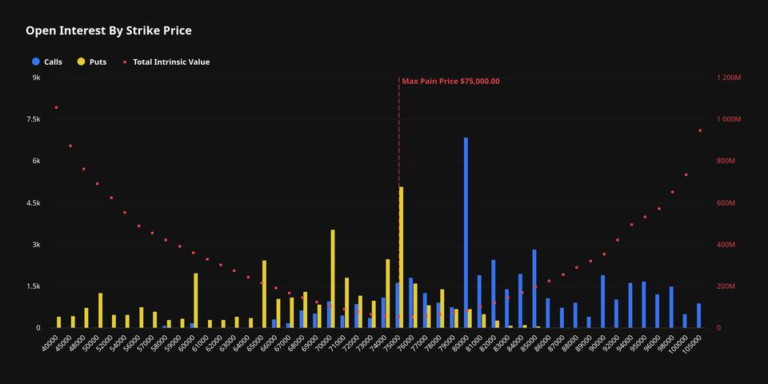
On Deribit, the 24-hour volume ranking featured BTC calls at strikes of $80,000, $82,000, and $84,000. The calls are bets that the price of bitcoin will rally. It also included puts, or bets on a drop, at strikes of $65,000 and $74,000.
Token talk
All CoinDesk benchmarks are in the red since midnight UTC, with the DeFi Select Index (DFX) leading the losses with a 2.7% move, followed by the CoinDesk Computing Select Index (CPUS) down by 2.3%.
JUP, MON and SEI are among the day’s worst-performing altcoins, tumbling by between 5.6% and 6.3% due to a persistent lack of liquidity.
CRO$0.08090 is one of the best-performing altcoins, adding 4.1% to notch a three-day winning streak.
CRO’s rally can be attributed to a governance proposal that, if passed, would change the project’s tokenomics by replacing inflation-driven staking rewards with a system in which yields are fully funded by actual protocol revenue.
CoinMarketCap’s “Altcoin Season” indicator is at 50/100, the highest level since late March as sentiment across the sector shows signs of improvement.