Decentralized platform Hyperliquid is now competing with established betting platforms such as Polymarket, but with a differentiated mechanism for resolving bets.
The leading decentralized exchange has expanded its HIP-4 outcome contracts beyond crypto price milestones into real-world events. This native prediction-market infrastructure allows users to trade macro contracts, such as inflation data and interest-rate decisions, directly alongside their standard crypto perpetuals out of a single account.
Outcome markets mark a notable expansion for the decentralized derivatives venue, which built its business around crypto perpetual futures and initially tested the product using price‑outcome contracts settled against its own market data.
Hyperliquid first tested the product on exchange‑native outcomes, such as whether bitcoin would trade above a specific level by a fixed time using Hyperliquid’s own reference prices. The latest rollout expands that model into real‑world macro events, or offchain outcomes, like U.S. inflation and Federal Reserve decisions, directly competing with prediction market platforms like Polymarket.
Native resolution
What sets it apart is that HIP‑4 brings dispute resolution and settlement in‑house, rather than depending on an external oracle network like Polymarket.
Here’s why it matters. Offchain events introduce a new problem: determining truth.
Polymarket handles this through UMA, an external oracle protocol that uses an optimistic dispute system. A proposed settlement stands unless challenged, at which point UMA tokenholders vote on the final result. That model has faced criticism following controversial resolutions, prompting accusations that large tokenholders could influence outcomes.
Hyperliquid uses a more vertically integrated model. Validators themselves ingest external information through automated newsfeed software, determine whether markets should launch, and vote on settlement outcomes.
Multi-purpose platform
The launch also fits into Hyperliquid’s broader effort to evolve into a multi‑asset trading venue. FalconX said in a recent report that the exchange’s expanding product stack could position it as a challenger not just to crypto‑native rivals but also to traditional exchanges.
“For example, you could pair a HIP‑3 perps position on NVDA with outcome markets that NVDA will miss or beat earnings,” CoinDesk previously reported.
Hyperliquid’s outcome markets are structured as fully collateralized contracts rather than leveraged bets, thereby limiting losses to the amount paid upfront. Traders buy “Yes” or “No” positions tied to a defined event, with contracts settling at either 1 USDC or zero USDC depending on the result. If a trader buys a “Yes” contract at 0.65 USDC, their maximum loss is limited to that upfront amount, unlike perpetual futures, where leverage can trigger liquidations.
That makes the product sit somewhere between a prediction market and a simplified binary options contract.
If Hyperliquid’s outcome markets gain traction, traders could eventually use the same venue to express directional crypto views, hedge macro risks, and speculate on event outcomes without moving collateral between platforms.
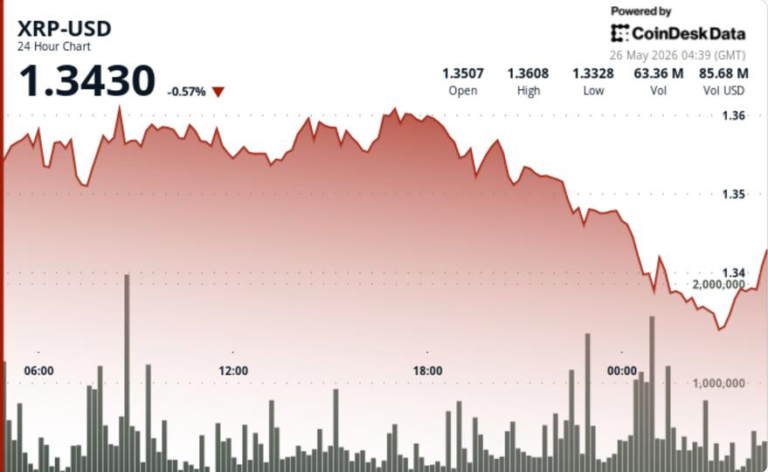
XRP spent weeks tightening into a narrow range, but the market finally started leaning lower after another failed push above resistance near $1.36. The move matters because repeated tests of support tend to weaken buyers over time, and XRP is now drifting back toward the same $1.30 area traders have treated as the line between consolidation and broader breakdown risk.
News Background
• Analysts remain split on XRP’s structure, with some calling the latest move a confirmed triangle breakdown while others still frame it as late-stage compression before a larger breakout.
• CME Group is preparing to launch 24/7 XRP-linked futures trading later this month, adding another layer of institutional exposure to the token.
• Whale activity also cooled sharply during the period, with large transaction counts falling more than 57% over nine days.
Price Action Summary
• XRP fell from $1.3457 to $1.3366 during the 24-hour session while trading inside a relatively tight 1.9% range. • The largest move came after a failed breakout attempt near $1.3620, where elevated volume quickly reversed into selling pressure. • XRP later broke below the $1.35 level and consolidated near session lows around $1.336 into the close.
Technical Analysis
• The breakdown below $1.35 reinforced short-term bearish momentum after weeks of tightening price action. • XRP is now trading beneath several key moving averages, while resistance near $1.36 continues to reject upside attempts. • Some analysts view the recent move as a confirmed symmetrical triangle breakdown with downside risk toward $1.14. • Others still argue the broader structure resembles compression rather than outright collapse, especially while XRP remains above the critical $1.30 support area.
What traders should watch
• $1.30-$1.31 is now the key support zone. Losing it would likely accelerate downside momentum. • $1.35 becomes the immediate resistance area XRP needs to reclaim to stabilize near-term structure. • CME’s upcoming XRP futures launch could increase volatility and improve liquidity once trading begins later this month.
Stablecoin issuer Tether and the government of Georgia plan to launch a stablecoin called “GELT” that would represent the Georgian lari under the country’s digital asset regulatory framework.
On Monday, Tether said the stablecoin is expected to support cross-border commerce and digital payments in Georgia. The company said GELT’s structure, rollout and regulatory implementation will be announced at a later stage.
The plan builds on Georgia’s recent efforts to develop rules for digital assets and stablecoins, including a framework covering reserve management, redemption rights, issuer oversight and Anti-Money Laundering compliance. In March, the National Bank of Georgia said it had developed rules for the initial offering of “stable virtual assets,” including requirements for full reserve backing, offering documents and external auditor verification.
Georgian Prime Minister Irakli Kobakhidze said the partnership with Tether would help lay the foundations for a more connected and transparent financial world. National Bank of Georgia President Natia Turnava said the central bank welcomes the collaboration as part of its strategy to advance digital financial infrastructure.
The announcement did not say who would legally issue GELT, where reserves would be held, or whether holders would have direct redemption rights. The company also did not provide a definite launch timeline.
Tether acknowledged Cointelegraph’s request for comment. Cointelegraph reached out to the National Bank of Georgia for more information, but did not receive a response by publication.
Georgia released stablecoin rules in March
On March 6, the National Bank of Georgia released rules covering stablecoin issuance. The framework said a stablecoin offering in Georgia cannot be provided without prior written consent from the National Bank.
It applies to virtual asset service providers, or VASPs, registered with the central bank, while companies that are not registered as VASPs must obtain registration before conducting a stablecoin offering or providing related services. The central bank said stablecoins in circulation must be fully backed by reserve assets that meet liquidity and credit quality requirements.
Related: Tether buys SoftBank’s stake in Bitcoin company Twenty One Capital
The rules also require issuers to prepare documents related to the initial issuance and submit them for external auditor verification, according to the central bank. The regulator said the framework intends to improve consumer protection, risk management and alignment with international standards.
GELT to join Tether’s non-dollar stablecoin lineup
The GELT stablecoin would join Tether’s smaller lineup of currency-specific stablecoin products beyond its flagship USDT. Tether has previously launched tokens pegged to the Mexican peso and offshore Chinese yuan and has also announced plans for a United Arab Emirates dirham-pegged stablecoin.
Tether’s Mexican peso-pegged MXNT launched in 2022 with initial support on Ethereum, Tron and Polygon. Its offshore Chinese yuan-pegged CNHT was created in 2019 and later expanded to Tron, while the planned UAE dirham token was announced in 2024 with backing from liquid UAE-based reserves.
The company has also developed market-specific stablecoin products. In January 2026, Tether launched USAT as a US-regulated dollar stablecoin aimed at the American market.
Tether has also wound down some of its earlier non-USDT stablecoins. The company stopped minting its euro-pegged EURT and said redemptions ended in November 2025, while its offshore Chinese yuan-pegged CNHT is set to become non-redeemable in February 2027.
Magazine: ETH bears growling, Tom Lee’s buying, XRP to ‘explode’: Market Moves
Ethereum liquid staking protocol Kelp DAO says its restaked Ether token has been restored with a five-week recovery effort after the protocol suffered a $293 million exploit by North Korea’s Lazarus Group on April 18.
Kelp DAO posted to X on Monday that the final tranche of 20,373.7 Kelp DAO restaked ETH (rsETH) tokens was sent to the LayerZero smart contract responsible for locking, minting, burning and releasing rsETH during cross-chain transfers.
“This closes the operational part of the rsETH recovery plan,” Kelp said. Several crypto protocols contributed funds to help restore rsETH’s backing under the DeFi United initiative.
Source: Stani Kulechov
The Kelp DAO hack in April caused a ripple effect throughout the crypto lending market that disrupted billions of dollars in liquidity and resurfaced concerns about the interconnectedness of decentralized finance protocols.
Aave was one of the hardest hit as the Kelp DAO attacker put a large portion of the stolen 116,500 rsETH up as collateral on its lending platform to borrow wrapped Ether, leaving $190 million in bad debt and triggering a wave of withdrawals.
The Kelp DAO hack was one of 25 crypto hacks in April, which saw a combined $630 million worth of losses, the worst month since February 2025, when crypto exchange Bybit was hacked for a record $1.5 billion.
The first tranche of 25,000 rsETH was transferred on May 13, allowing rsETH bridging between the Ethereum mainnet and the blockchain’s layer 2 networks to reopen.
Kelp reopened withdrawals for rsETH the following day and said on Tuesday that rsETH mints, redemptions and rewards operations “have been running normally.”.
Aave’s TVL bleed stops, but has not recovered
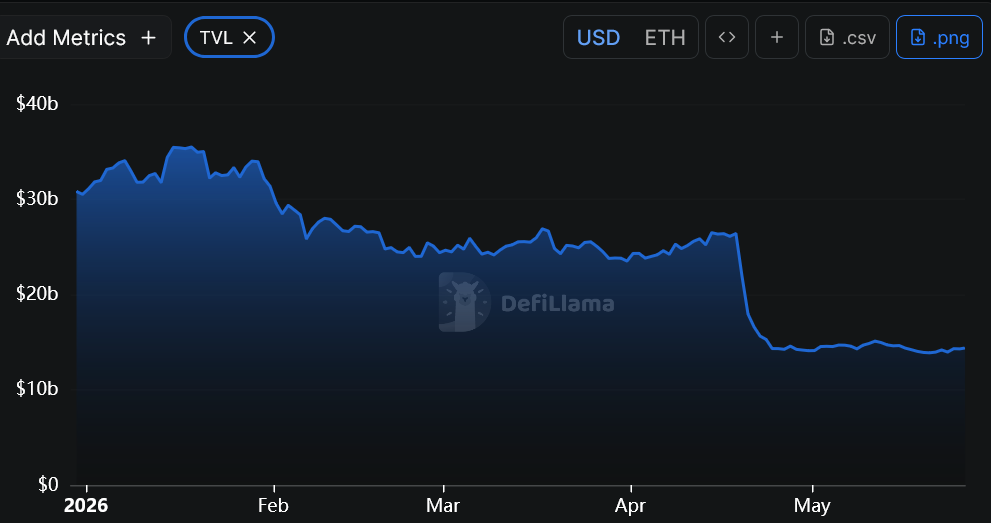
The Kelp DAO exploit contributed to Aave’s total value locked falling from $26.4 billion to below $14 billion, losing its long-held position as the largest DeFi protocol by TVL.
Related: Crypto hackers stole $17B over past 10 years: DefiLlama
DefiLlama data shows that net outflows from Aave’s lending markets have eased over the past month.
However, Aave’s TVL has shown no signs of recovery, hovering between the $13.9 billion and $15.1 billion mark since about a week after the incident took place.
Source: Aave’s change in TVL in 2026. Source: DefiLlama
Magazine: The legal battle over who can claim DeFi’s stolen millions
Cointelegraph is committed to independent, transparent journalism. This news article is produced in accordance with Cointelegraph’s Editorial Policy and aims to provide accurate and timely information. Readers are encouraged to verify information independently.
A New York lawsuit filed by Noah Doe and two Wyoming-based LLCs, ABC Company and XYZ Company, seeks a court order declaring ownership of 39,069 dormant Bitcoin addresses, raising important questions about the legal treatment of inactive Bitcoin under property laws.
Filed on May 1, the suit claims that the coins tied to the listed addresses represent legally abandoned property they found and reported to the New York Police Department and claimed under New York lost-property law.
The plaintiffs claim that the dormant Bitcoin wallets were legally “abandoned” property that they found, including wallets belonging to early Bitcoin miners and addresses attributed to Bitcoin creator Satoshi Nakamoto, among other lost coins and unidentified entities. They claim that these constitute seizable property, akin to traditional bank accounts.
The lawsuit raises important questions about the legal treatment of long-dormant Bitcoin wallets, including Satoshi-era tokens that have been inactive for over a decade. While the legal basis of the lawsuit is questionable, it is unclear how the plaintiff could recover the lost Bitcoin without possessing the private keys to access the wallets.
However, even if the court ruled in favor of the plaintiff, it would only be a symbolic move that is not technically enforceable, as the Bitcoin network has no mechanism to “reassign funds without a private key,” Noveleader, lead research analyst at investment research firm Castle Labs, told Cointelegraph, adding:
“The one narrow exception would be if any of these coins are moved to a regulated custodian or exchange, at which point a court could compel that intermediary to act.”
The research analyst argued that a significant portion of these coins may belong to deceased holders, those who lost their keys or simply to long-term holders who haven’t transacted, meaning that none of these instances constitute legal abandonment.
ABC Company, XYZ Company, Noah Doe, lawsuit against John Does holding 39,069 BTC. Source: ilawconotices.com
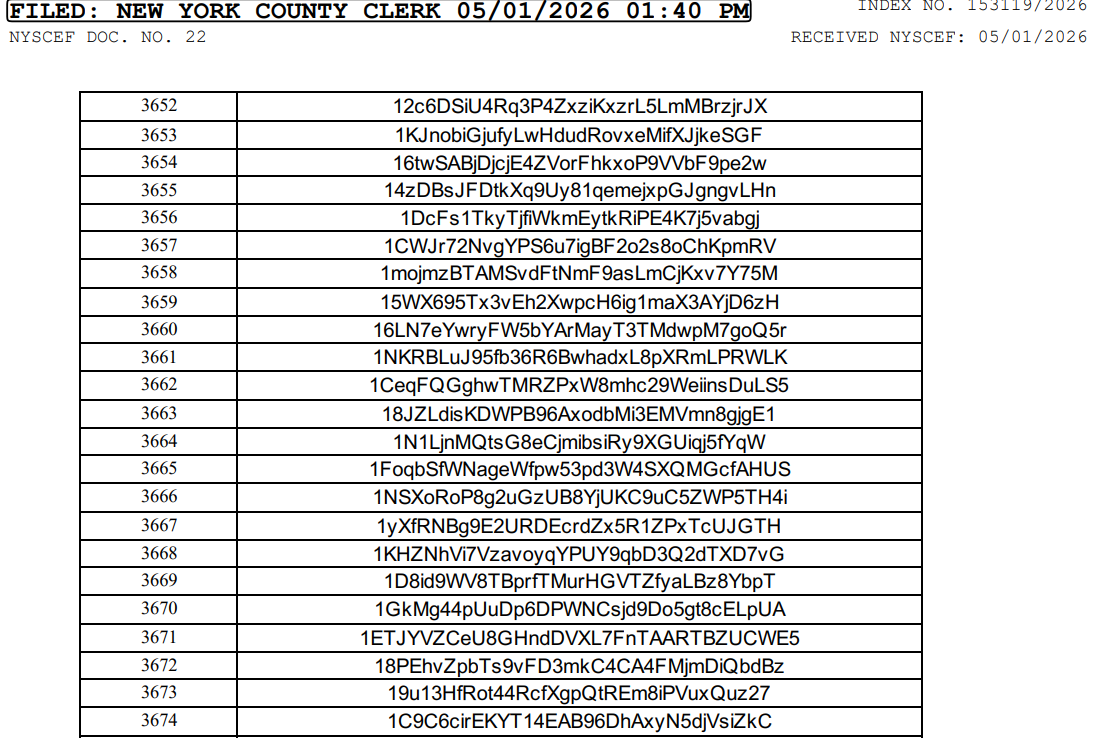
The 901-page lawsuit lists 39,069 total Bitcoin wallet addresses, including wallet address “12c6D” associated with Satoshi Nakamoto and address “1Feex” linked to the Mt. Gox exchange hacker.
ABC Company, XYZ Company, Noah Doe, lawsuit against John Does holding 39,069 BTC, Bitcoin wallets. Source: ilawconotices.com
The listed addresses hold an estimated 3.7 million BTC, valued at about $285 billion, according to Sani, the founder of Bitcoin onchain analytics platform Timechain Index.
The founder also noted that most of the old Satoshi-era tokens are currently sitting in Pay-to-Public-Key (P2PK) output formats, while the plaintiffs only sent legal notices to the corresponding hashed public key under Pay-to-Public-Key-Hash (P2PKH) formats, which often hold no value.
This could undermine the claim that proper notice of abandonment was given to the holder, since plaintiffs sent the legal notices to the empty P2PKH addresses, while the actual BTC balance sits in unnotified P2PK scripts.
Castle Labs’ lead research analyst agreed, adding that the messaging attempt was “structurally defective” because it was sent to the address formats no longer used by the targeted wallets. Sending a small transaction via the OP_RETURN function would be “similarly ineffective” as it only works with active recipients monitoring their wallets.
Related: Bitcoin miner MARA spent $4.3M on CEO security in 2025 as crypto attacks rise
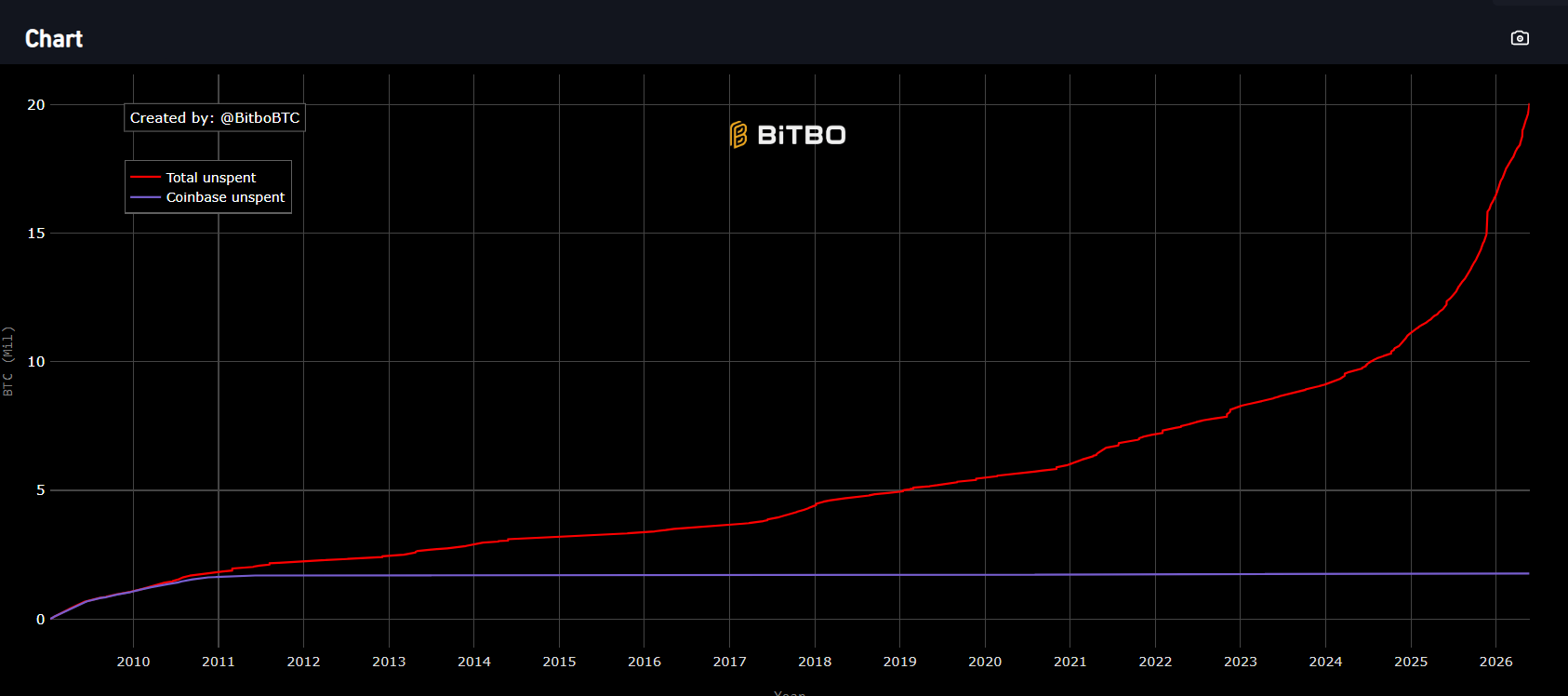
The over 39,000 wallets named in the lawsuit hold Bitcoin that are considered dormant, or lost, meaning that they haven’t been circulating onchain for multiple years.
The supply of Bitcoin dormant for the past five and 10 years. Source: Bitbo
There are currently 3.5 million Bitcoin, worth about $271 billion, that have been dormant for the past 10 years and another 6.6 million coins, worth around $577 billion, that have been dormant for over five years, Bitbo data shows. Magazine: The legal battle over who can claim DeFi’s stolen millions
The Ethereum Foundation’s Kohaku Initiative released an SDK enabling seamless integration of shielded pool protocols like Railgun, Tornado Cash, and Privacy Pools directly into wallet interfaces, with 4337 relaying now operational.
The Ethereum Foundation’s Kohaku Initiative announced the release of its SDK for integrating privacy protocols into Ethereum wallets without intermediaries.
The team achieved a major milestone with v0.0.1-alpha.21 of the kohaku-eth/railgun integration, which now features operational 4337 mempool relaying for private transactions. Tornado Cash and Privacy Pools integrations are in development.
Kohaku aims to make end-to-end privacy the default for Ethereum users by abstracting away the complexity of interacting with existing shielded pool protocols.
Rather than relying on protocol-specific relaying infrastructure, the SDK enables all privacy protocol transactions to route through the 4337 mempool—a shift the team describes as a major contribution toward user-controlled privacy without dependence on centralized relayers.
Wallets in the works
The initiative is actively demonstrating practical applications of the SDK beyond theoretical research. Developers have created a CLI-based wallet that consumes the Kohaku SDK to showcase real-world functionality. Wallet integrations are underway, with production wallets including Ambire preparing implementations. A browser extension experimental wallet developed in collaboration with breadcoop is also in progress.
Kohaku’s scope extends beyond the work currently highlighted. The initiative is also developing infrastructure for post-quantum accounts, multisigs, and hardware wallet support, according to the team.
The SDK documentation is being expanded to improve developer experience, with the team emphasizing that wallet integration timelines require patience as production implementations move forward.
The Kohaku Initiative represents the Ethereum Foundation’s focus on bringing privacy solutions from the research phase to real user adoption. Code is available on GitHub, and vision documentation for the CLI wallet component is publicly accessible. The team plans to showcase progress at Berlin Blockchain Week.
Sources: Ethereum Foundation Kohaku GitHub | Kohaku CLI GitHub Repository | Kohaku Vision Documentation | X Announcement
In the upcoming 2026 midterm elections, Americans will elect 35 of 100 Senate seats and all of the 435 voting seats of the House of Representatives.
The cratering popularity of President Donald Trump’s administration, which polls show is the result of everything from the economy to the War in Iran and his handling of immigration, has put Democrats in an historic lead.
The generic congressional ballot test, i.e., a poll that asks which party the respondent plans to support, recently showed that the Democrats had the largest mid-term lead of any party in the last 20 years.
But the Democrats have to contend not only with gerrymandering and a $1.8 billion slush fund for Trump’s political allies, but also the millions of dollars the crypto lobby is pouring into the elections.
According to Follow the Crypto, an accountability project tracking political donations from the crypto industry, political action committees and crypto execs combined have donated over $500 million to influence the 2026 elections.
Crypto’s partisan divide becomes even clearer
According to Follow the Crypto, crypto-associated Political Action Committees (PAC) spending on the 2026 elections has already exceeded $245 million. Super PACs, which cannot donate to political campaigns directly but can spend an unlimited amount of money, have spent $49 million this cycle.
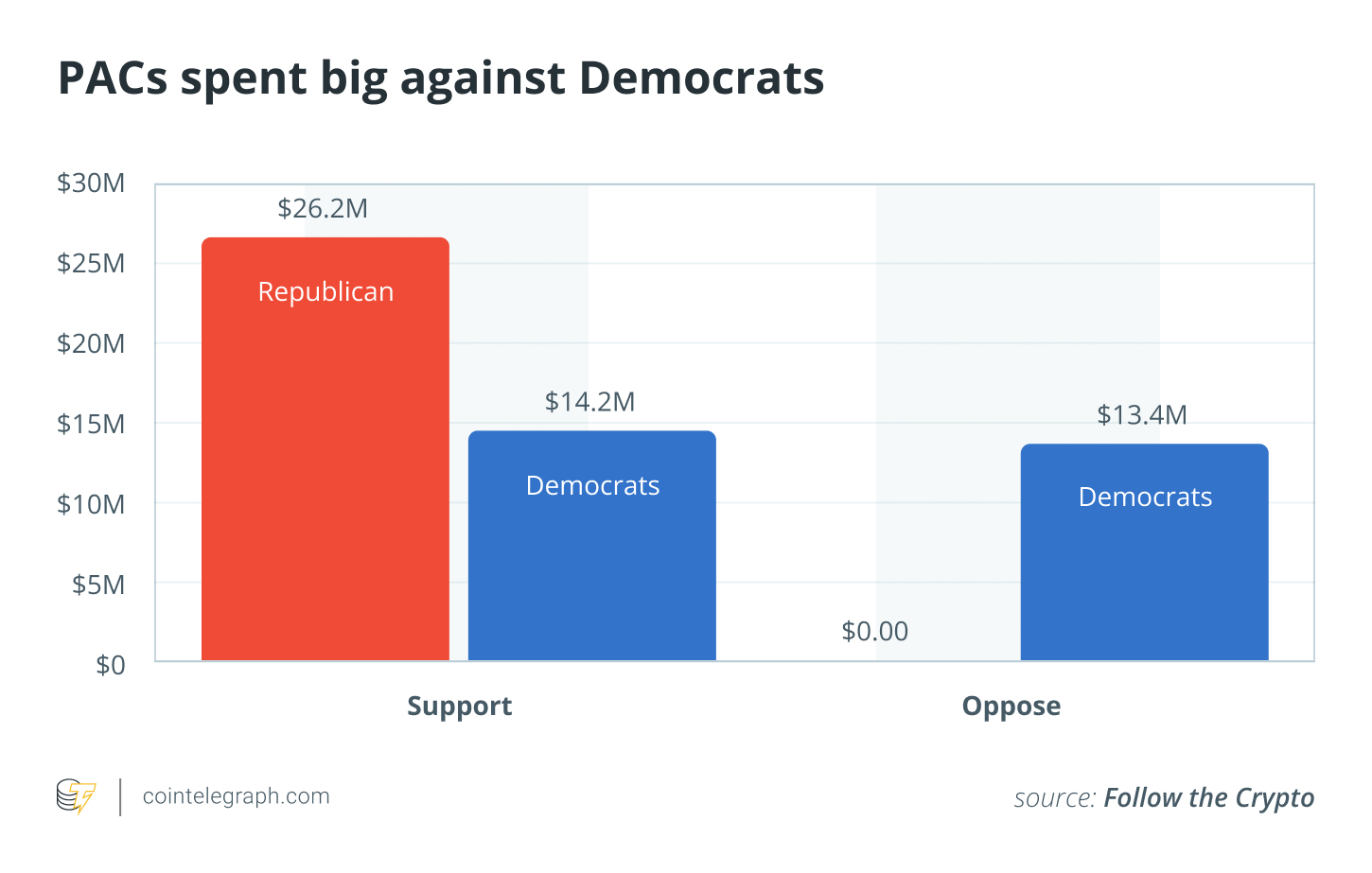
Super PACs are showing an increasingly partisan preference, contributing $23.4 million to support Republicans. It’s more than double the $11.3 million it spent to support Democrats.
The difference is even more stark when considering contributions from companies and associated individuals, e.g., CEOs and other executives. Here, companies and associations have spent more than 11 times on Republicans than on Democrats.
Part of this vast divide in spending could be explained by not necessarily a partisan bias toward Republicans, but the fact that Republican attitudes toward the finance industry tend to value deregulation and relaxed oversight. Democrats are not opposed to crypto on the level of party platform, but tend to be more skeptical.
But PACs have also spent a considerable sum opposing Democrats as well. Indeed, they’ve spent nearly $2 million more opposing Democrats than they have supporting them.
Crypto PACs spent more against Democrats than for them. Source: Follow the Crypto
Furthermore, in three out of the four special elections for the House where crypto PACs backed the winner, the victor was a Republican:
Randy Fine (Florida 6th), $1.67 million
Jimmy Patronis (Florida 1st), $558,000
Clayton Fuller (Georgia 14th), $755,000
Crypto spends big in primaries, with mixed results
So far, most of the expenditures have been in primary elections, where the party decides among themselves which candidate will represent them in the general elections in November. Here, the crypto lobby can ensure that they have at least one crypto-friendly candidate on the ballot.
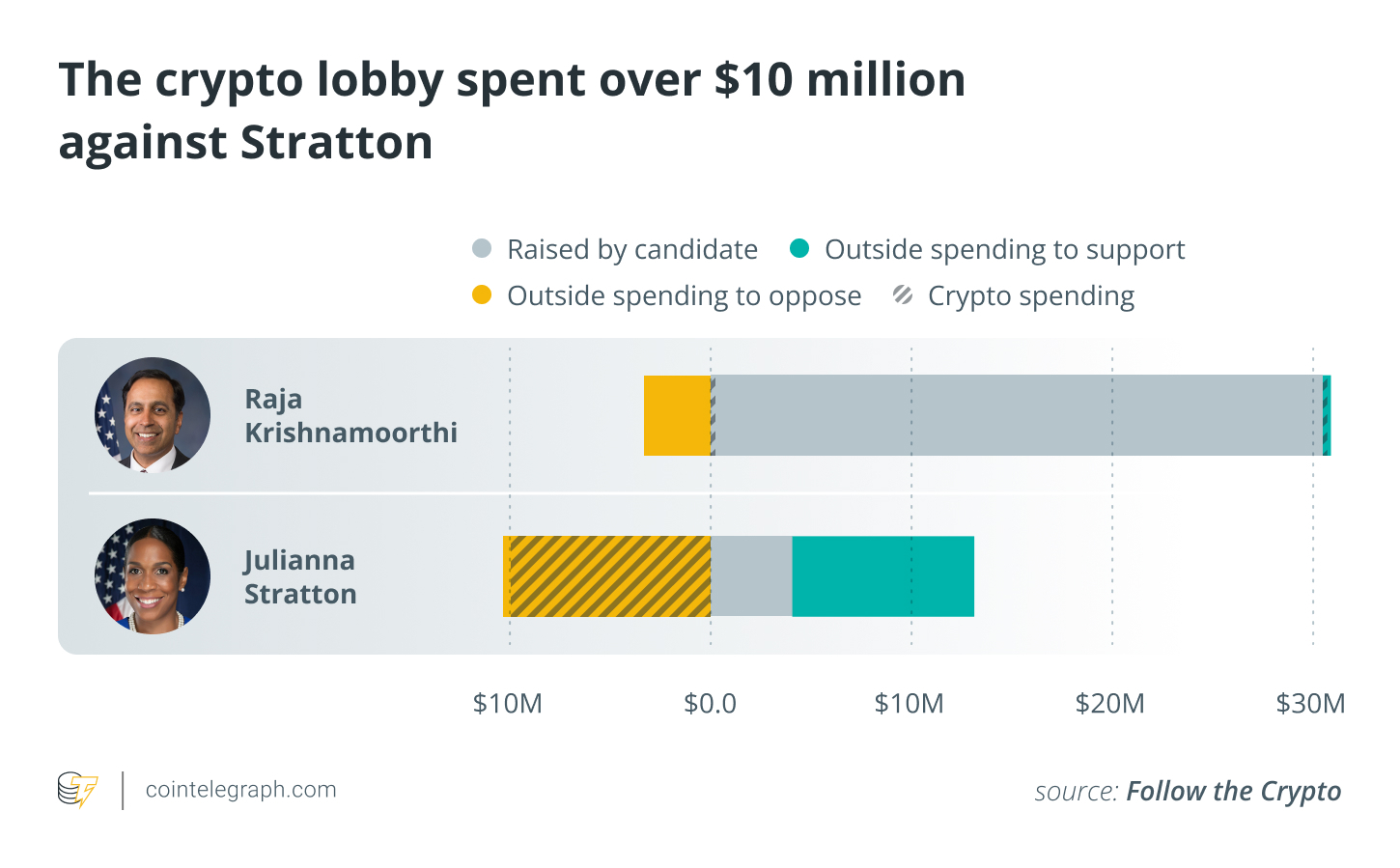
Three recent examples of profligate spending in primaries stand out. First is the Illinois senate primary that took place in March. Illinois Lieutenant Governor Juliana Stratton faced off against Representative Raja Krishnamoorthi.
Related: Crypto industry ties were a liability in Illinois primary
Kirashnamoorthi received only a nominal donation from crypto donors, but crypto PACs spent over $10 million on materials against Stratton. The spending against nearly totalled more than the total financial support for Stratton. In this case, it didn’t work. In fact, Stratton used the crypto money as a point against her opponent, and won by over seven percent of the vote.
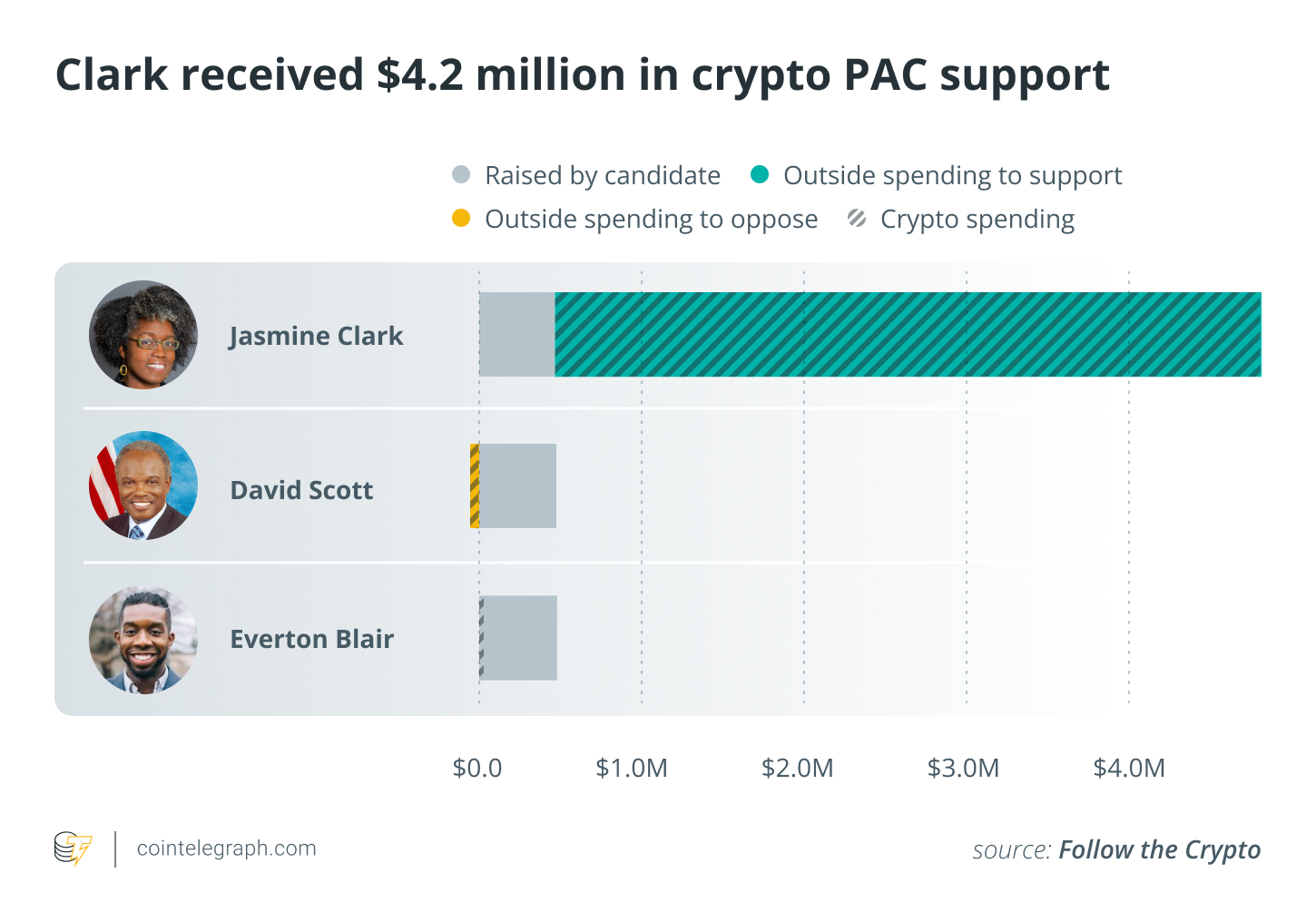
Earlier this week, Georgia State Representative Jasmine Clark won the primary for Georgia’s 13th Federal Congressional District. Clark received 56% of the vote over her opponents Heavenly Kimes and Everton Blair, who received 21.5% and 11.6%, respectively.
Clark received massive support from the crypto lobby. According to Follow the Crypto, outside spending from PACs accounted for $4.2 million in contributions — over nine times the amount of money her campaign raised itself.
Elections analyst Matt Klein said that “one of Clark’s opponents showed me data suggesting that the millions of dollars in crypto [money] for her was a huge turn-off for Dem voters.”
Despite this, Clark still won. According to Klein, this is because the other campaigns lacked the finances to inform the electorate. “The problem: Voters had no way of knowing it was crypto money! To advertise that message, guess what you need…”
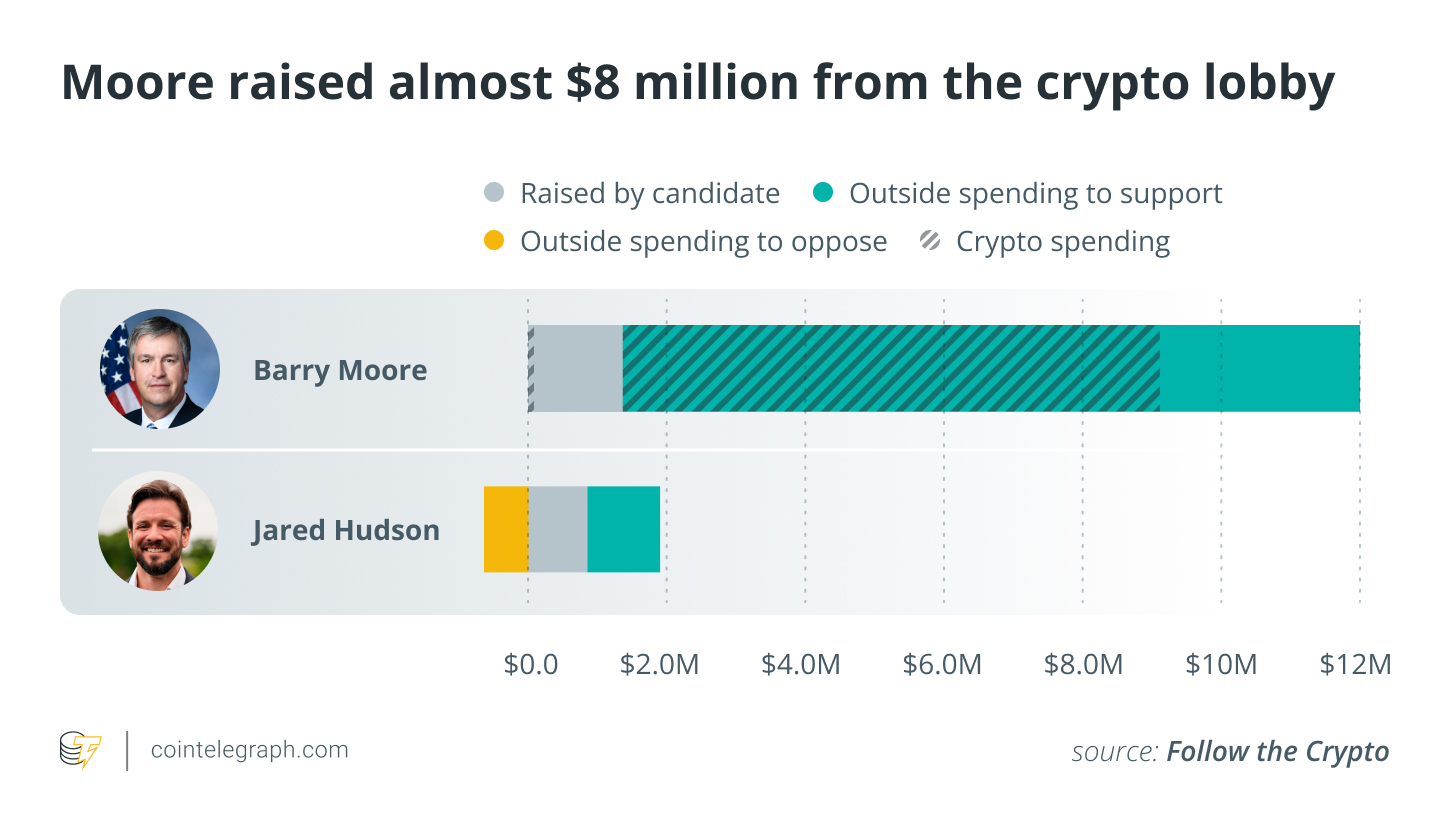
In Alabama, Senator Tommy Tuberville is leaving office, leaving an empty seat. The leading candidates to replace him, Steve Marshall, Jared Hudson and Barry Moore, faced off in a primary earlier this week.
Moore, who is favored by Trump, received $7.8 million in donations from the crypto lobby — almost four times the total raised by his opponent.
While Moore finished first in the primary results on Tuesday, he did not get the majority needed to secure the election. Now, he and Hudson are headed to a runoff.
Crypto sweep or careful messaging?
The crypto industry is already on track to break its previous record for spending in the 2024 presidential elections. But as shown above, it remains to be seen how effective crypto is as an actual organizing issue.
As reported in industry media, Fairshake, the largest crypto PAC, claimed a sweep in six primaries in which it spent money, claiming that a “powerful bipartisan mandate is being heard.”
But all the GOP candidates to which it donated were also endorsed by President Trump, a particularly powerful edge in red, Republican-dominated states like Alabama. Messaging in those campaigns reportedly concentrated on those associations, rather than the candidates’ positions on crypto.
Moore’s site draws particular attention to his association with Trump, which he doubles down on in his issues page. There is no mention of crypto and blockchain in his economic agenda, save for mention in support statements from other legislators.
Clark also received sizable donations, but was previously in a very tight race against her opponent Representative David Scott, before he passed away. As noted above, the fact that she received large donations from the crypto industry was not well known.
Any mention of crypto is notably absent from campaign sites or advertisements. Clark’s site makes no mention of digital assets in her agenda. Nor does she note crypto-associate organizations among her endorsements.
Crypto is increasingly becoming a political issue. Money can certainly make a difference in American elections, but even candidates don’t seem sold on it as a campaign issue.
Magazine: 5 tech predictions the mainstream media got horribly wrong
Ethereum co-founder Vitalik Buterin outlined a leaner, more focused future for the Ethereum Foundation (EF).
While most of Crypto Twitter reacted enthusiastically to Ethereum co-founder Vitalik Buterin outlining a leaner, more focused future for the Ethereum Foundation (EF), the market reaction was more muted.
Ether rose about 1.4% in the 24 hours after Buterin’s post, trading near $2,132 as of Monday. The gain was in line with the broader cryptocurrency market, which also advanced modestly, with total capitalization up 1.1% to roughly $2.67 trillion, according to CoinGecko data.
Spot flows were also in line with the broader market, with ETH attracting $47.8 million in the past 24 hours, compared with Bitcoin’s $159,8 million, per CoinGlass tracking.
Buterin described the EF transitioning to a “smaller ship” that prioritizes longevity over breadth and will sell less ETH. The foundation now holds approximately 0.16% of total ETH supply.
Leadership Turmoil
The announcement arrives amid ongoing leadership turmoil at the EF. At least eight senior contributors have departed in 2026, with five exits in May alone, including high-profile researchers.
These changes have fueled public debate about the organization’s direction and Ethereum’s execution. Ether has significantly underperformed Bitcoin in recent years, falling nearly 60% against BTC over the past five years while broader market sentiment has fluctuated.
CROPS Focus
Buterin, Ethereum co-founder, emphasized that the EF is “one node” in a broader ecosystem rather than its central authority. He highlighted a narrow focus on CROPS principles — censorship/capture resistance, openness, privacy, and security — over chasing high TPS or ultra-low latency.
He noted his own influence within the organization continues to decrease as the board expands, with President Aya Miyaguchi executing much of the transition. Buterin also disclosed that nearly 90% of his net worth remains in ETH.
Community Support
Crypto community reactions leaned supportive on the philosophical reset. Anthony Sassano, independent Ethereum educator, replied directly thanking Buterin and highlighted the framing of ETH as Ethereum’s highest-value product. Author and early Ethereum advisor William Mougayar quote-tweeted the post, calling it “a crystal clear message” and stating “Ethereum is untouchable.”
Many in the community viewed the shift as Ethereum maturing toward a more decentralized, principles-driven model. Supporters praised the emphasis on long-term resilience, formal verification, and intermediary minimization over hype-driven growth metrics.
Skeptical Voices
Some voices expressed skepticism, though, questioning whether the humbler EF role risks a maintenance-mode perception or insufficient ambition amid L2 fragmentation and Ether’s relative underperformance. Critics pointed to past researcher exits and execution challenges as ongoing concerns.
Overall, the post is seen as a clarifying pivot that reinforces Ethereum’s differentiation through credible neutrality and self-sovereignty.
While short-term price action remained subdued, the reduced EF selling overhang and focused mandate provided a stabilizing narrative in a consolidating market. Longer-term implications will depend on how the broader ecosystem fills any perceived gaps left by a smaller EF.
Token Terminal reports that tokenized stocks have become the leading category of tokenized assets on Ethereum, with xStocks and Ondo Finance leading the sector.
Tokenized stocks have emerged as the fastest-growing category of tokenized assets on Ethereum, according to Token Terminal. xStocks and Ondo Finance assets are leading the expansion of this new asset class on the blockchain.
The growth in tokenized stock offerings reflects expanding demand for blockchain-based access to traditional equities. These instruments allow investors to hold fractional ownership of stocks as ERC-20 tokens on Ethereum, enabling 24/7 trading and programmable settlement distinct from traditional market hours and settlement cycles.
The tokenization of traditional assets represents a key use case for blockchain technology, bridging decentralized finance with conventional securities. Token Terminal’s analysis highlights which protocols and platforms are capturing the largest share of this emerging market segment.
Two Texas Congressional candidates supported by millions of dollars in spending from interest groups aligned with the cryptocurrency industry are headed for runoffs this week in races for the US Senate and House of Representatives.
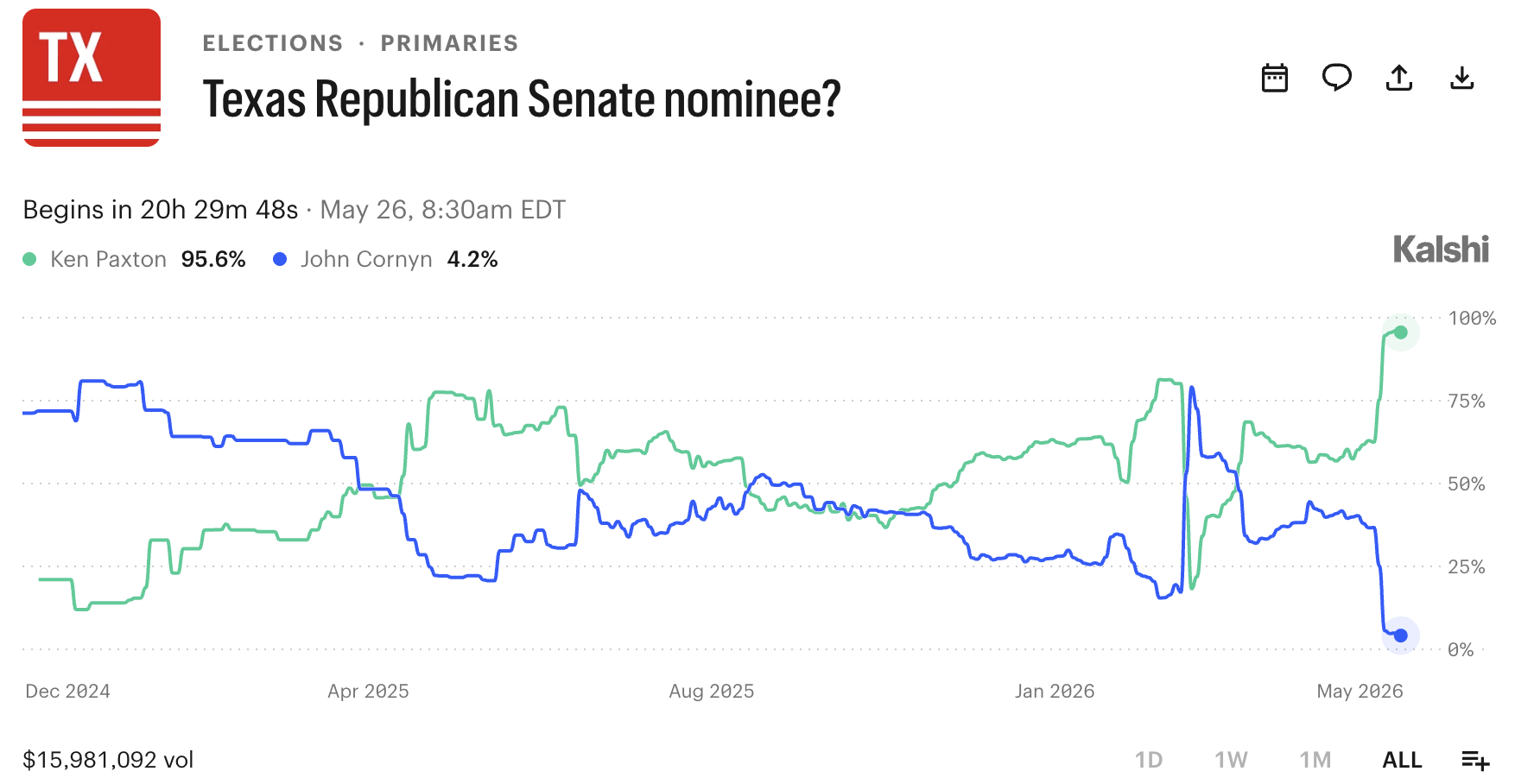
On Tuesday, Democratic voters in Texas’ 18th congressional district will decide between incumbent Al Green and challenger Christian Menefee to run in November’s general election. Statewide, voters will choose between Texas Attorney General Ken Paxton and incumbent John Cornyn for the Republican primary for US Senate.
Both Tuesday races are runoffs after none of the candidates failed to secure a majority in Texas’ March primaries. The crypto industry, through spending on media by political action committees (PACs), has stakes in both races, which could influence policy and the makeup of Congress going into 2027.
As of Sunday, Protect Progress, affiliated with the Ripple- and Coinbase-backed Fairshake PAC, reported spending $5 million to support Menefee over Green. The PAC spent $2.8 million on ads opposing Green. Menefee also has the endorsement of the Blockchain Leadership Fund, a committee backed by Anchorage Digital and Chainlink Labs, though it had not reported any expenditures as of Monday.
Source: US Federal Election Commission
The outcome of the primaries could influence who will ultimately win Texas’ 18th district and one of the state’s two Senate seats in the November general election, potentially affecting which political party controls Congress in 2027. Under a Republican majority, lawmakers have passed key pieces of legislation supported by the crypto industry, including the stablecoin GENIUS Act.
At least one of the ads funded by Protect Progress to support Menefee did not mention crypto or blockchain, but rather Green’s opposition to US President Donald Trump. Bill King, a former opinion writer for the Houston Chronicle, said in a local FOX26 segment that aired on Sunday:
“I saw 12 television commercials yesterday paid for by the Protect Progress PAC […] and that same group of people are the ones that are primarily funding Trump.”
Related: Texas Lt. Gov. calls for study of crypto, prediction markets
The Fellowship PAC, funded by Wall Street firm Cantor Fitzgerald and Anchorage, reported spending $500,000 to support Paxton over Cornyn for the US Senate seat. The expenditure came about 24 hours after Trump endorsed Paxton, saying that Cornyn had been “very late in backing” him as a Republican candidate for president.
Prediction markets heavily favor Paxton and Menefee
The Kalshi prediction market gave its users 91% and 96% chances on event contracts favoring Menefee over Green and Paxton over Cornyn, respectively.
Source: Kalshi
The platform has consistently provided event contracts favoring the Democratic candidate since February, while Paxton’s odds surged above 90% for the first time after Trump’s endorsement on Tuesday, and stood at almost 96%, at last look on Monday. Bets on that race topped more than $16 million in total volume.
Rival predictions market platform Polymarket gave both candidates similar chances in Tuesday’s runoffs.
Magazine: ETH bears growling, Tom Lee’s buying, XRP to ‘explode’: Market Moves