Bitmine Immersion (BMNR), the Ethereum treasury firm helmed by chairman Tom Lee, ramped up purchases again, making its biggest haul since December.
The company said Monday it bought 111,942 ether (ETH) last week, worth around $237 million at current prices. That lifted the firm’s holdings to almost 5.4 million ETH, about 4.47% of Ethereum’s circulating supply.
The purchase marks a renewed acceleration in Bitmine’s buying pace after Lee said earlier in May at Consensus 2026 in Miami that the company planned to slow weekly accumulation. The shift happened as the firm aims to take advantage of ETH sliding from $2,400 in early May and April to near $2,100.
“We continue to steadily acquire ETH,” Lee said in the statement. “We view the recent pullback of ETH to below $2,200 as an attractive opportunity.”
Lee added that the firm is expected to reach its goal to corner 5% of ether’s supply later in 2026.
Bitmine’s total crypto and cash holdings stand at $12.3 billion, according to the report. The company also holds 203 bitcoin, $444 million in cash and equity stakes including investments in Beast Industries and Eightco Holdings.
The firm said it has staked more than 4.7 million ETH — about 87% of its holdings — generating approximately $276 million in annualized staking revenue.
Ether’s (ETH) price printed a “bear pennant” on the daily chart, a technical chart formation associated with strong downward momentum. Could a weakening technical setup and a decline in total value locked signal the continuation of ETH’s correction to $1,800?
Key takeaways:
Ether is forming a bear pennant on the daily chart, with a potential breakdown to $1,800.
ETH price may see further losses if Ethereum’s total value locked continues to shrink.
Ether bears eye ETH price “dump” to $1,800
Ether’s 13% drop from its multi-month highs above $2,400 saw it breach a key trend line that has supported the price since early February.
“ETH is going to dump hard soon?” Chain Mind said in a video posted on X, suggesting where ETH/USD might move next after dropping below the ascending trend line.
“This is the crucial moment for ETH,” Chain Mind said, adding that the price was required to reclaim the support level, otherwise a drop to areas below $1,800 was in the cards.
ETH daily chart. Source: X/Chain Mind
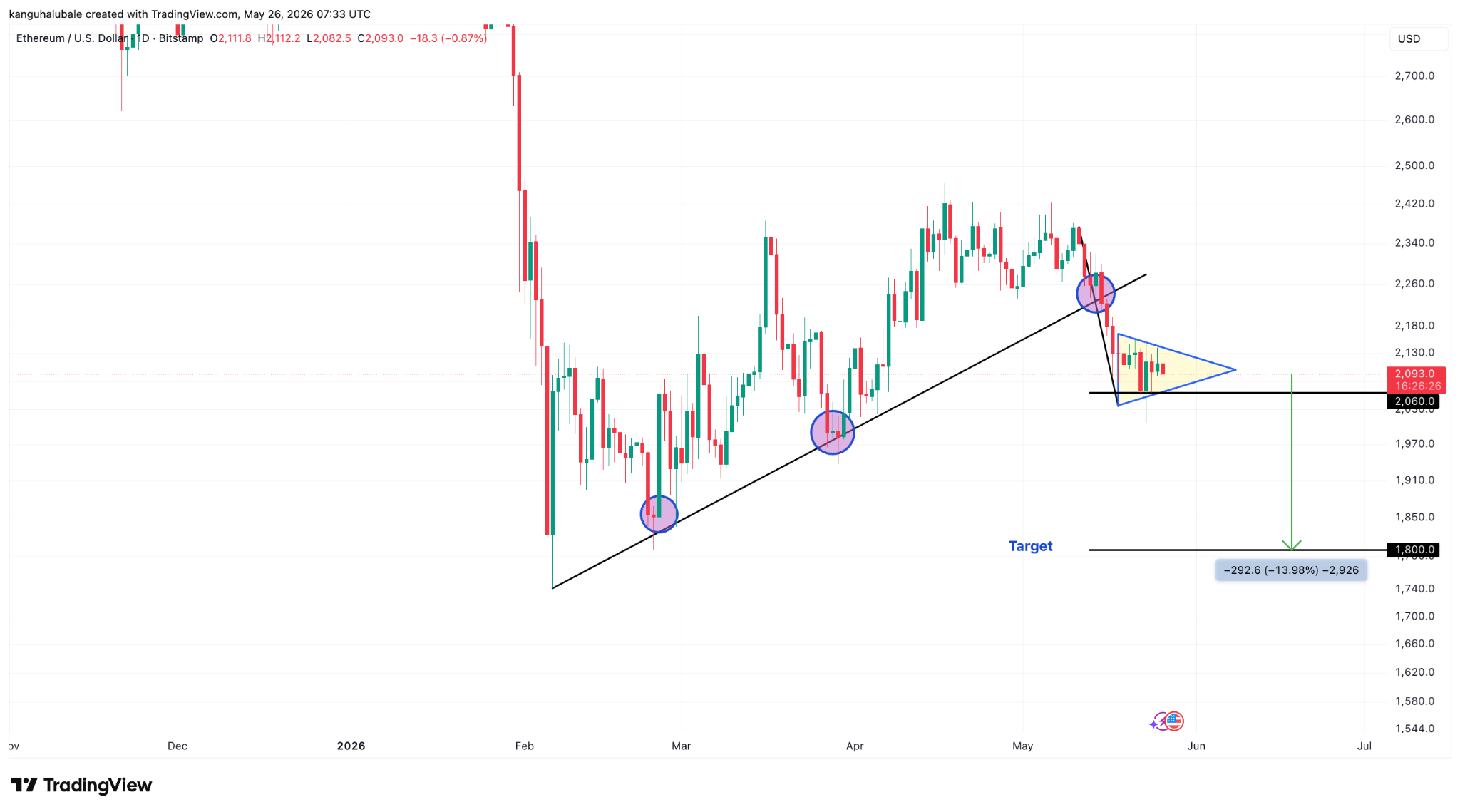
Meanwhile, ETH’s price has formed a bear pennant chart pattern on the daily chart, as shown below.
A bear pennant pattern is a bearish setup that forms after the price consolidates inside two converging lines following a sharp price drop.
The pennant will resolve once the price breaks below the lower trend line at $2,060, opening the way for a drop equal to the previous uptrend’s height. This puts the lower target for ETH/USD at $1,800, down 14% from the current price.
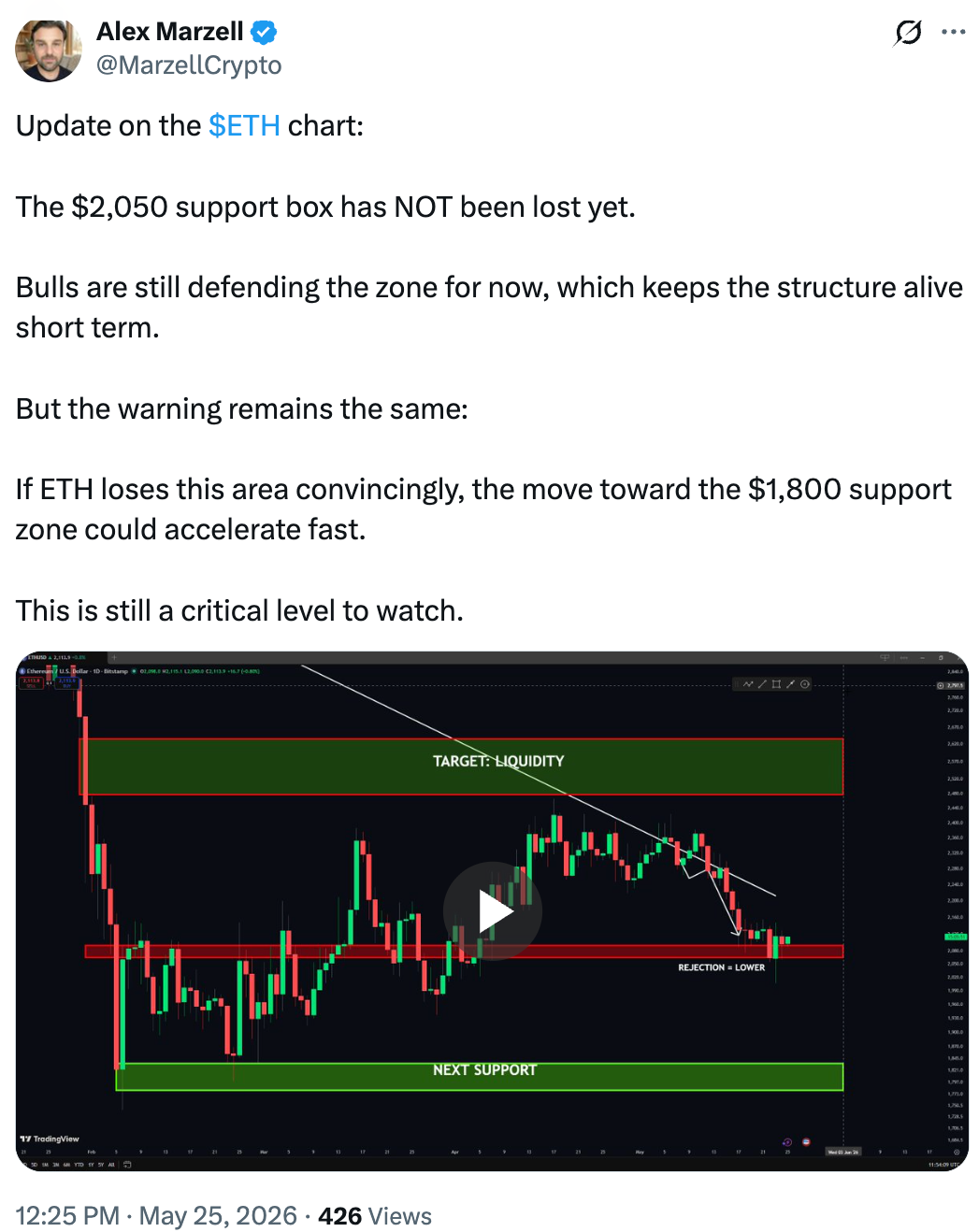
Crypto analyst Alex Marzell said that if Ether’s price dropped below $2,050, it would increase the chances of a move toward the next support zone at $1,800.
Source: Alex Marzell
As Cointelegraph reported, Ether’s downtrend is likely to continue toward $1,750 in the short term if key support levels do not hold.
Ethereum’s total value locked crashes 55%
Ether’s bearish technical outlook overlaps with several other headwinds, such as recent Ethereum Foundation departures, weakening social media sentiment, and declining total value locked (TVL) across its DeFi protocols.
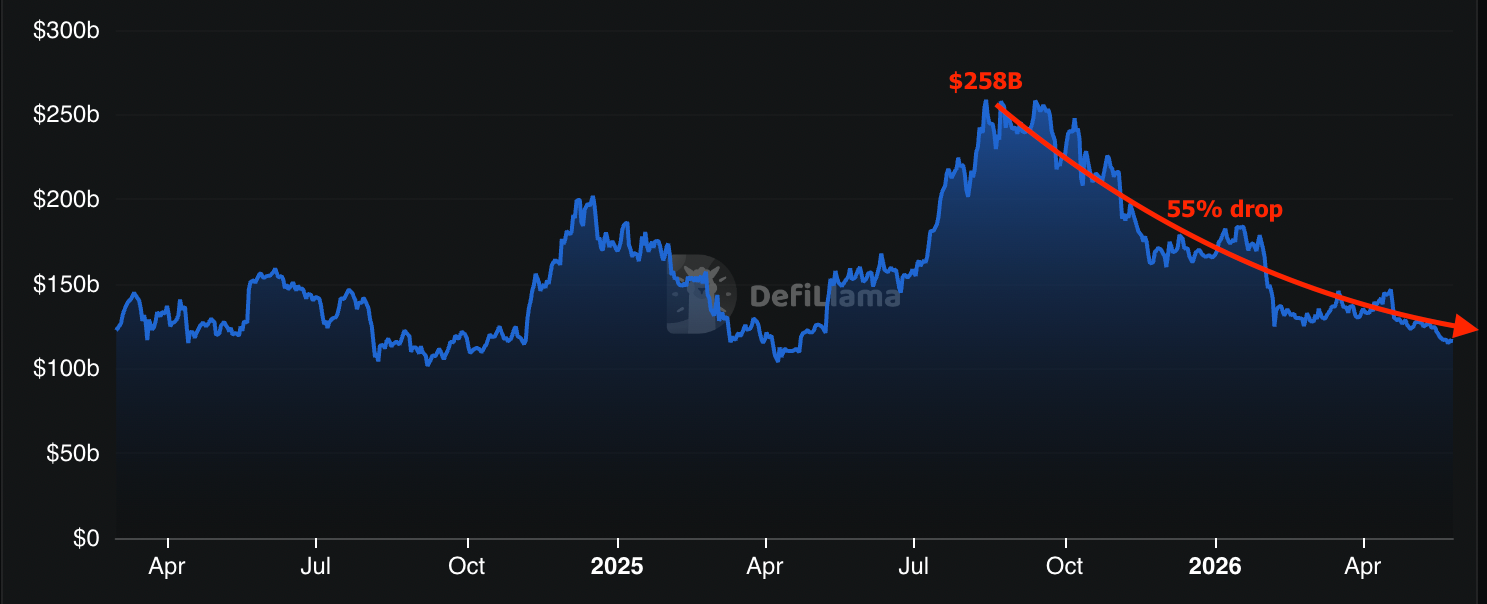
Ethereum’s TVL has now fallen to $116 billion, levels last seen in April 2025. For comparison, the network’s TVL hit an all-time high of $258 billion on Aug. 14, 2025.
The TVL has therefore more than halved, representing a 55% decline.
Ethereum total value locked. Source: DefiLlama
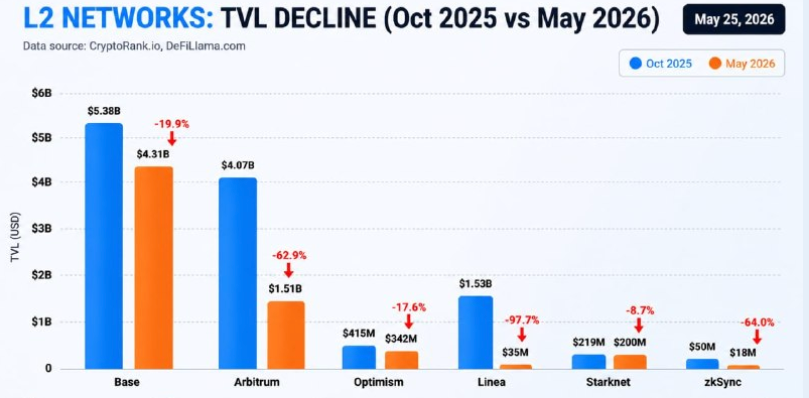
Negative TVL growth is more pronounced in Ethereum’s layer-2 (L2) network, led by Ether.fi whose total value locked is down 32% over the last 30 days.
“There is a sustained TVL decline” across Ethereum’s L2 sector, CryptoRank said in its Telegram note on Monday.
The sharpest corrections are seen in Arbitrum (-63%), zkSync (-64%), and Linea (-98%), “pointing to high liquidity sensitivity to incentive programs and short-term reward mechanics,” the crypto analytics platform said, adding:
“This reinforces the broader picture of capital fragmentation in Ethereum’s rollup ecosystem and undermines the ‘unified liquidity pool’ effect that early L2 development models envisioned.”
Layer-2 networks: TVL decline since October 2025. Source: CryptoRank
Declining TVL signals weakening onchain demand, adding downside pressure on ETH and increasing the risk of further price declines in the near term.
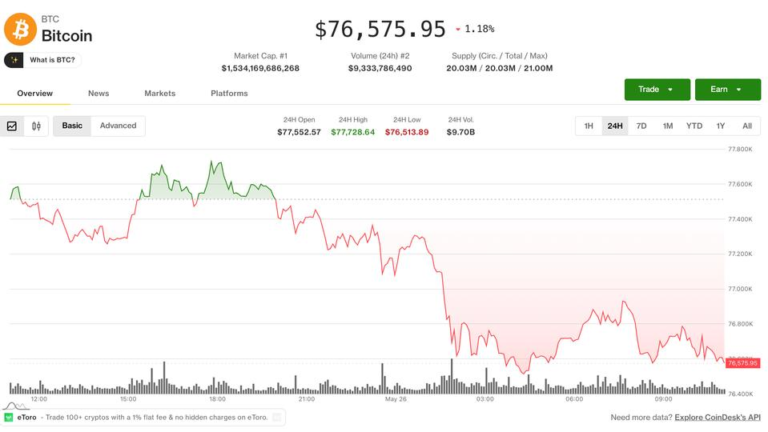
Bitcoin BTC$77,234.04 traded at $76,600 on Tuesday, down 0.8% since midnight UTC, as Monday’s brief bounce to $77,800 fades. The move leaves the largest cryptocurrency potentially forming another lower high in a bearish structure that has been in place since October, and down 7% over the past two weeks.
The weakness is not reflected in broader financial markets. S&P 500 index futures and Nasdaq 100 futures have gained more than 0.5%, pointing to crypto-specific headwinds rather than macroeconomic and geopolitical pressures.
Ether (ETH) is faring worse. Trading at $2,098, ETH has shed more than 10% over the past two weeks and sits firmly in the middle of the range it carved out between February and April, with no signs of reclaiming lost ground.
The altcoin market is mixed, with notable gains across AI tokens and steep losses for tokens that performed well earlier in the year like zcash (ZEC), which has lost around 7% since midnight.
Derivatives positioning
Crypto futures market volume has dropped 10% to $130 billion in 24 hours. Notional open interest (OI) is little changed around $126 billion, and 24-hour liquidations have declined 21% to $126 million. This points to a steady, rather boring market environment following the extended U.S. weekend holiday (though crypto is never closed).
SHIB, LINK, HBAR, NEAR and TRX are major OI gainers of the past 24 hours, while ZEC, XLM and HYPE are losers. The action indicates selective market positioning rather than broad-based capital deployment across the altcoin universe.
NEAR rose 58% in the week ended May 24 and has since gained an additional 14% to $2.82, a level last seen in November. The rally, likely fueled by a series of upgrades involving dynamic scaling, privacy and quantum defenses, is accompanied by an influx of new money into derivatives. Open interest jumped to a record 309 million tokens from 182 million a week ago.
NEAR also has the most positive 24-hour cumulative volume delta (CVD) among major tokens, a sign that buyers are setting the price action by trading at market orders rather than passive limit orders. Funding rates are only marginally positive, a sign the market is far from overheated. Together, these signal potential for continued price gains.
OI for futures in Chainlink’s LINK increased to 42.96 million tokens, the most since Feb. 7. Annualized funding rates of around 8% point to futures trading above the spot price in a bullish sign for the provider of oracle data.
Bitcoin futures have cooled. OI in BTC has pulled back to 711K BTC from 793k BTC early this month. ETH OI hovers just below record highs near 15 million ETH. BTC and ETH’s 30-day implied volatility indexes continue to slide in a sign of persistent volatility selling and no signs of panic demand for options.
Still, on Deribit, BTC puts at strikes from $70K to $76K are among the most traded of the past 24 hours. Puts represent a bearish bet, offering protection against price weakness in the underlying asset.
Token talk
CoinDesk’s Computing Select Index (CPUS) was the top-performing benchmark on Tuesday, rising by 1.9% since midnight UTC and 2.7% over the past 24 hours.
The CPUS is a basket of AI tokens and chainlink. FET added 4.8% on Tuesday, and RENDER climbed 7.2%.
The DeFi Select Index (DFX) also outperformed the crypto majors, rising by 1.3%. The gain suggests investors are opting for more speculative bets while waiting for bitcoin and ether to resolve their current trading ranges.
Privacy tokens weakened across the board as monero (XMR) and dash (DASH) followed zcash (ZEC) lower by around 1.5% apiece.
CoinMarketCap’s “Altcoin Season” indicator is currently at 35/100, up from last week’s low of 31/100 and below the monthly high of 50/100.
Ether treasury company Bitmine Immersion Technologies has been included in a preliminary list for potential inclusion in the Russell 3000 index, a move that chairman Tom Lee hinted could provide tailwinds for the company’s stock.
FTSE Russell, a subsidiary of the London Stock Exchange Group, published a preliminary index inclusion list for the Russell 3000 on Friday, its index tracking the 3,000 largest companies in the US.
Lee said in an X post Saturday that Bitmine could be included in the Russell 1000, an index tracking the largest 1,000 US companies, due to the index’s minimum market capitalization threshold of $5.7 billion. Bitmine’s market cap was $10.15 billion as of market close on Friday.
Lee said that “many active managers only buy equities on the Russell 1000,” adding that it is estimated that up to 25% of the market cap of a stock included in the index is held by passive index funds or exchange-traded funds.
Source: Tom Lee
Bitmine’s inclusion in the Russell 1000 would place it in the same index as major US large-cap equities, including tech giants Nvidia Corporation, Microsoft, and Apple and could trigger automatic buying by passive funds, providing traditional investors with indirect exposure to its Ether holdings.
FTSE Russell will provide further list updates on, June 5, June 12 and June 18, and the newly reconstituted indexes take effect after the US market close on June 26.
Bitmine stock down 30% year to date
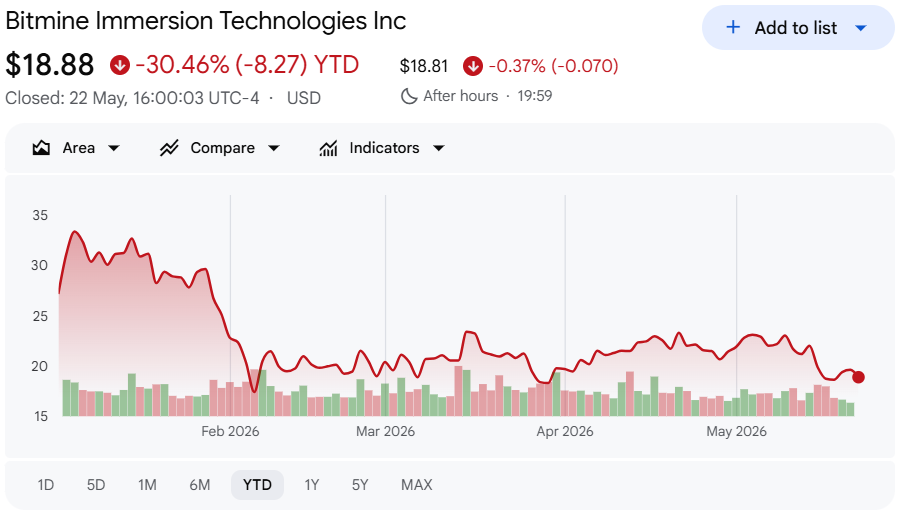
Shares in Bitmine Immersion Technologies (BMNR) are down over 30% year-to-date and closed trading on Friday at $18.88. The company announced plans to build an Ether treasury in July 2025. By July 3, its stock had spiked to more than $135. The company disclosed holdings of 163,142 Ether worth about $500 million on July 14 of the same year.
Bitmine’s stock is down over 30% year-to-date. Source: Google Finance
As of last week, Bitmine held 5.28 million Ether, or about 4.37% of Ethereum’s total supply, with the company’s ultimate goal to hold 5% of the token’s circulating supply of 120.7 million. To hit its target of over 6 million Ether, Bitmine needs around 756,538 more in its stash.
Related: Ether pullback was ‘attractive opportunity’ for 71,672 ETH buy: Bitmine’s Lee
Ether is down over 57% from its all-time high of $4,946, according to CoinGecko. BitMine also has an estimated $7.3 billion in paper losses due to the price drop.
However, Lee previously argued that Ether’s steep drawdown may offer another buying opportunity and said last Monday that the company has staked most of its stash, with annualized staking revenues of $289 million.
Magazine: Polymarket seeks Japan entry, Harvard dumps entire ETH position: Hodler’s Digest, May 17 – 23
Declining oil prices boosted global stock markets, helping lift Bitcoin back to $77,000 amid reduced inflation fears.
$2.66 billion spot Bitcoin ETF outflows have kept professional crypto traders from turning resoundingly bullish.
Bitcoin (BTC) reclaimed the $77,000 level on Monday following a recovery in global stock markets. US President Donald Trump stated on Saturday that talks with Iran to reopen the Strait of Hormuz were progressing, causing crude Brent oil prices to retreat to a five-week low and setting the stage for a potential Bitcoin price run to $82,000.
Crude Brent oil futures (left) vs. Bitcoin/USD (right). Source: TradingView
Global stock markets reacted positively on Monday, with a 2.9% gain in Japan’s Nikkei 225 Index and France’s CAC 40 closing up 1.8%. Reduced inflationary pressure from oil prices caused yields on 5-year Eurozone government bonds to hit 2.64%, their lowest level in five weeks. This prospect of reduced geopolitical risk prompted investors to rotate cash positions back into bonds and equities.
Despite the overall drop in risk perception, professional Bitcoin traders refused to flip bullish.
Bitcoin 3-month futures contracts traded at a 2% annualized premium (basis rate) relative to spot markets, indicating a lack of demand for bullish leveraged positions. Under neutral conditions, this indicator typically ranges between 5% and 10% to compensate for capital costs. Still, one could argue that low leverage remains constructive as long as the $74,000 support holds.
Bitcoin spot ETF outflows and Strategy’s focus on reducing debt
Recent outflows from spot Bitcoin exchange-traded funds (ETFs) likely contributed to the bulls’ lack of confidence.
US-listed Bitcoin spot ETFs daily net flows, USD. Source: SoSoValue
US-listed spot Bitcoin ETFs experienced $2.66 billion in net outflows since May 7. Despite representing less than 3% of total assets under management, the shift signals fading appeal for institutional investors. Strategy’s (MSTR) pause on Bitcoin acquisitions to repurchase some of its convertible bonds has also fueled concerns.
Strategy (MSTR US) debt profile. Source: Strategy
The company held $8.7 billion in convertible debt with an average maturity of less than 4 years. Strategy’s decision to focus on Bitcoin yield per share might temporarily hold back additions to its 843,738 BTC reserves, but it benefits shareholders by reducing financial leverage and lowering potential share issuance.
Related: Why is Bitcoin falling despite pro-crypto Kevin Warsh becoming Fed chair?
It remains unclear what could flip Bitcoin traders’ sentiment in a favorable direction, especially as the stock market—particularly the tech sector—continues to dominate investors’ attention. With earnings on the rise, Nvidia’s board approved an additional $80 billion share repurchase program, strengthening investment appeal despite a record-high market capitalization.
Bitcoin’s odds of reclaiming $82,000 likely depend on greater visibility into global economic growth prospects. A potential deal between the US and Iran is certainly a step in the right direction, but as long as spot Bitcoin ETF flows remain negative, investor sentiment may remain subdued.
Privacy tokens gave back the loudest share of the gains crypto markets had been holding onto.
Zcash (ZEC) dropped 5.2% over 24 hours to $619, the biggest pullback among the top 20 by market cap, though the token is still up 8.2% over the past seven days, per CoinDesk data. Monero (XMR) fell 4% to $378.
Both have been among the strongest performers across crypto over the past several weeks, with ZEC drawing institutional attention after Multicoin Capital’s stake disclosure earlier this month and the broader narrative around privacy tokens.
A 5% drop after that kind of run reads as profit-taking rather than fresh selling, since the structural buyers in privacy tokens have been adding through the rally, not distributing into it.
Hyperliquid’s HYPE token traded above Dogecoin’s market cap during Asian hours before pulling back, with HYPE down 4% to $59 and DOGE$0.1014 off 0.8% to $0.1009. HYPE is still up 23.6% over the past seven days on the back of last week’s SpaceX pre-IPO perpetual launch on Hyperliquid.
Tron (TRX) was the lone gainer among the top 10, up 2.6% to $0.3739 and 4.8% over the past seven days. Bitcoin held near $76,500, ether sat at $2,087, and Solana traded at $83.97, all in tight ranges with no major move in either direction.
The macro backdrop drove the cautious tone. US Central Command confirmed strikes on missile launch sites in Iran and boats attempting to place mines in the Strait of Hormuz, describing the action as defensive.
Brent crude rose almost 2% to $98 a barrel, bouncing back from Monday’s 7% slump when London and New York were closed for holidays. The dollar strengthened against all G-10 peers, gold pulled back 0.6% to $4,545, and S&P 500 futures held a 0.6% gain after Monday’s US market closure.
Ondo Finance founder Nathan Allman has died, the company said in a post on X on Tuesday, without disclosing the cause.
“It is with profound sadness that we announce the unexpected passing of Nathan Allman, Ondo’s founder. Our hearts are with his family and loved ones,” the company said. “Nate’s brilliance, humility, and drive shaped every part of what Ondo is today. His belief in the power of technology to create a more open, accessible financial system lives on in everything we build.”
Ian De Bode, Ondo’s longtime president who has led strategy, product, and day-to-day operations for over two years, will serve as CEO. De Bode has the full confidence of the leadership team, the company said.
Allman, a Brown University graduate, founded Ondo in 2021 after working on Goldman Sachs’ digital assets team. Under his leadership, Ondo became a pioneer in tokenized real-world assets, growing total value locked to $3.5 billion.
Major products launched during his tenure include USDY, a yield-bearing stablecoin, OUSG, a tokenized U.S. Treasury fund, and tokenized equities through Ondo Global Markets.
The company said it would continue building what Allman started as the most meaningful way to honor him.
Bitcoin’s implied volatility plunged to a multi-month low, signaling that traders expect further price consolidation.
Excessive confidence among Bitcoin bears could catalyze a liquidation-driven bull run above $82,000.
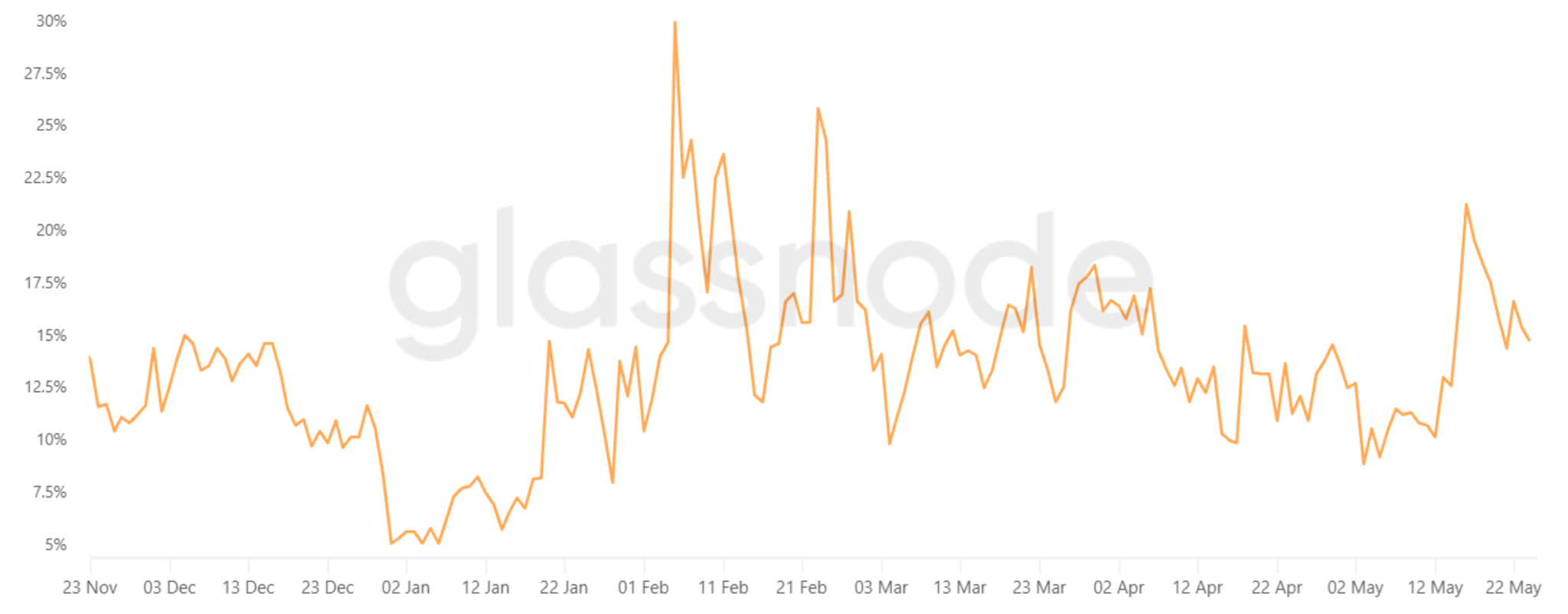
Bitcoin (BTC) implied volatility dropped to 36%, its lowest level in eight months, signaling that professional traders are pricing in lower odds of wide price swings. While declining volatility is not inherently bullish or bearish, Bitcoin derivatives data suggest that overconfidence among bears could catalyze a bullish breakout.
Bitcoin/USD (blue) vs. Deribit Bitcoin volatility index (orange). Source: TradingView
A sharp price decline between January and February caused an initial spike in volatility, especially due to the lack of a clear rationale for the move. Even as Bitcoin traded in a relatively narrow range between $63,000 and $71,000 in March, implied volatility held above 50%.
Traders became increasingly confident in the support level near $60,000, leading to a lower risk perception and a subsequent reduction in volatility. Some analysts claim the Bitcoin price has been tamed due to growing institutional participation and the expansion of derivatives products, including Strategy’s perpetual stocks.
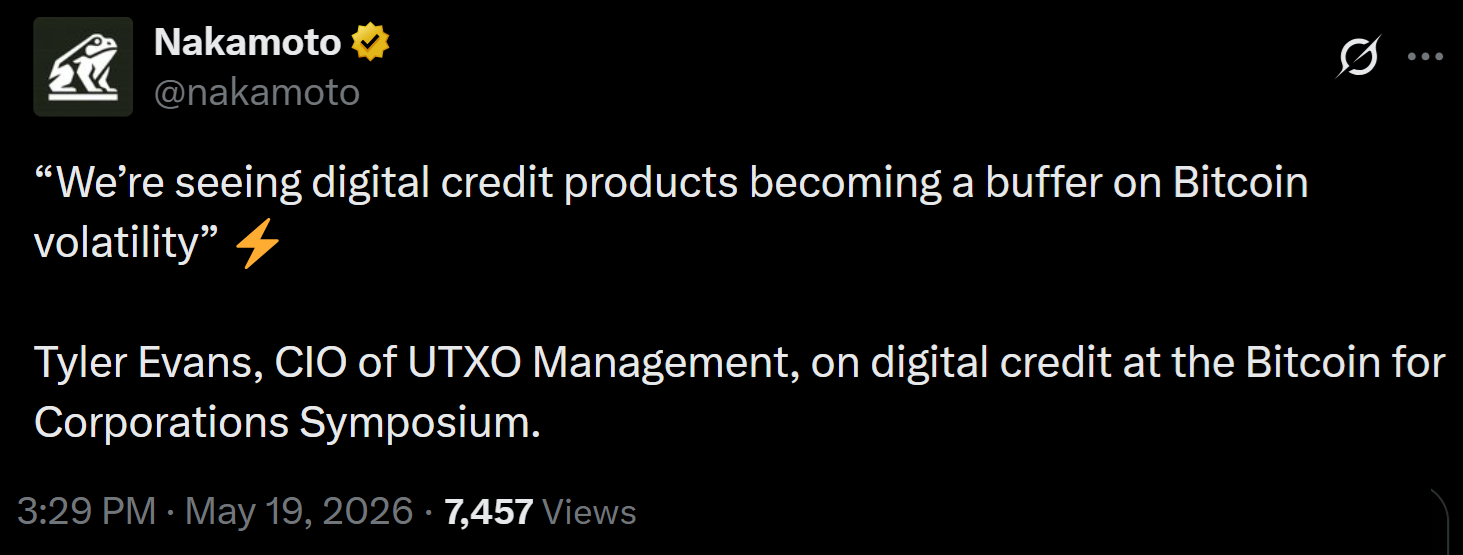
Source: X/Nakamoto
Tyler Evans, chief investment officer of UTXO Management, reportedly said that digital credit products created a buffer against Bitcoin’s volatility. Rather than being forced to sell their holdings, large investors—including miners and companies focused on building Bitcoin reserves—have increasingly resorted to collateralized loans.
Is Bitcoin volatility bound to go up?
Bitcoin’s volatility may return to levels above 42%, as the asset is far from mature in terms of adoption and potential use cases. Bitcoin’s volatility has never held below 35%, but in theory, it could go lower. Historically, major price swings occur after a period of consolidation, which results in lower volatility.
Regardless of whether it is driven by external factors such as trade wars, economic stimulus measures, or excessive stock market valuations, Bitcoin’s price moves are often accelerated by liquidations of leveraged positions.
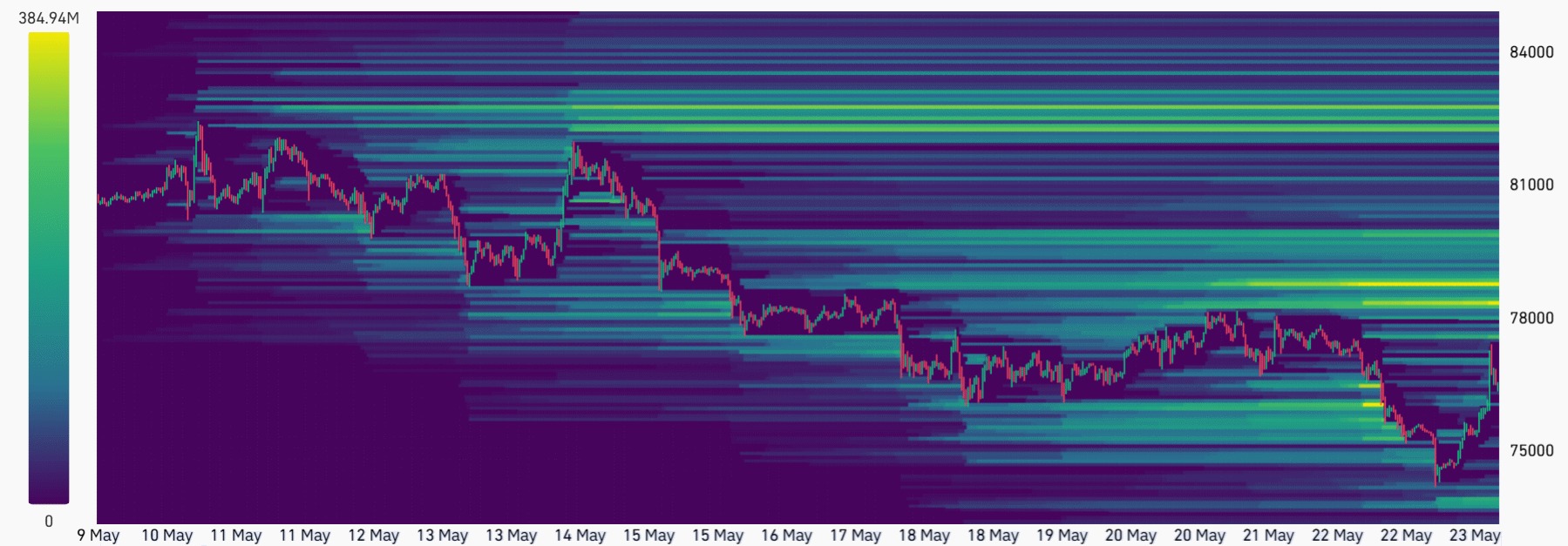
Bitcoin liquidation heatmap estimates show a high concentration of shorts (sell positions) between $78,000 and $83,000. Bears might have become overconfident after nearly four months of the Bitcoin price holding below $90,000. The Bitcoin options skew can be helpful to assess how whales and market makers are positioned.
Professional traders currently fear a Bitcoin price decline as put (sell) options trade at a 14% premium relative to call (buy) instruments. Under neutral market conditions, this indicator should range between -6% and +6%, but this has not been the case over the past four months.
Volatility should not be used to predict market direction. However, given the weak sentiment in Bitcoin options markets, odds are that a bullish breakout above $82,000 would trigger a stronger squeeze in leveraged positions, while a retest of $72,000 seems somewhat priced in.
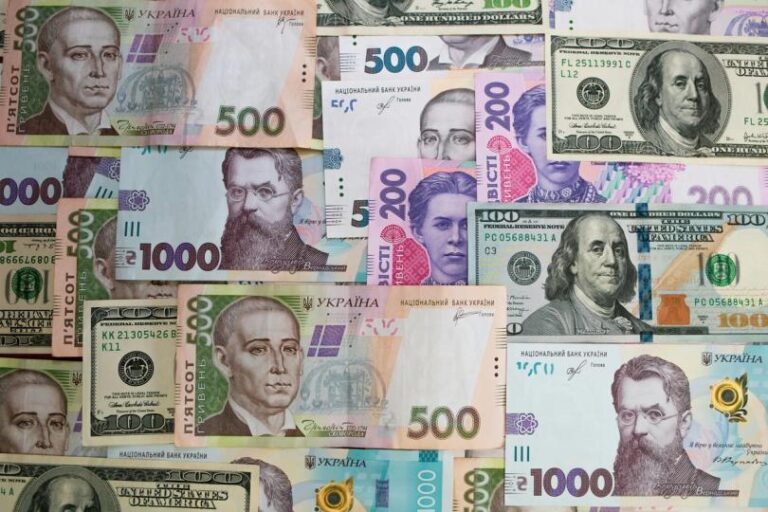
The combined market value of all stablecoins has hit a record high of $322 billion, dwarfing the foreign exchange reserves of 95 countries, including several developed countries.
As of now, their combined market cap is bigger than the FX reserves of Poland, Thailand, Mexico, and developed economies such as the United Kingdom, Canada and even the oil-exporting giant United Arab Emirates.
In essence, the amount of dollars and other fiat currencies held by users outside traditional banking channels now exceeds the official FX reserves, a sovereign protective cover against external economic shocks, of most nations.
Stablecoins are tokenized versions of fiat currencies issued on blockchain. Their values are pegged 1:1 to the U.S. dollar or other currencies such as the euro, yen, Swiss franc and others. Their combined market cap has grown multi-fold in recent years, with most activity concentrated in dollar-pegged coins such as tether USDT$0.9994 and USD Coin (USDC).
The growth is evidence of how fast capital is migrating to blockchain rails.
Foreign exchange (FX) reserves are the dollars, euros, yen, and gold that central banks hold as a buffer to stabilize their currencies, pay foreign debts, and finance energy and other imports. Only 14 nations, led by China, Japan, Russia, India, Taiwan and Germany, hold more FX reserves than the market value of stablecoins.
Top 20 nations by FX reserves and stablecoin market cap. (TradingEconomics, CoinDesk, Claude)
Double-edged sword
Stablecoins are widely used for trading cryptocurrencies. They allow users to exit volatile tokens without converting back to fiat currencies. For DeFi protocols, they serve as the settlement layer, and for cross-border payments, they provide a faster, cheaper way to move money across borders while bypassing legacy banking channels.
“The use of stablecoins in cross-border payments has grown, notably in corridors where legacy correspondent banking is slow or costly,” a recently released Bank of International Settlements report said. “Cross-border stablecoin flows have grown substantially since 2022, with particularly pronounced activity in regions experiencing high inflation and exchange rate volatility.”
But the ease of moving money comes with a risk.
Stablecoin transactions can trigger capital outflows, leaving already vulnerable current account deficit countries exposed to fiat-currency depreciation.
“Increases in stablecoin flows are associated with subsequent domestic currency depreciation, deviations from covered interest parity and widening wedges between stablecoin-implied and official exchange rates in segmented markets (Aldasoro et al (2026)),” the BIS said.
“These patterns are consistent with stablecoins enabling circumvention of capital controls and providing a relatively frictionless mechanism for EMDE residents to shift savings into dollar-denominated instruments,” the bank added.