Home Blog Page 259

ING Appoints Andrea Burnett as UK Head of Network Sector Coverage

0

WHY THIS MATTERS

The appointment of Andrea Burnett as the UK’s first-ever Head of Network Sector Coverage, announced on May 12, 2026, marks a structural shift in ING’s strategy to challenge Tier-1 global banks in the City. While ING is already a powerhouse in European corporate banking, the creation of this role signals a pivot toward capturing the high-velocity “corridor business”—multinational clients moving capital between the UK, EMEA, and beyond. By recruiting a heavyweight with experience from J.P. Morgan, Bank of America, and Santander, ING is betting that its “Network Sector” model can serve as a primary differentiator against domestic UK lenders that lack the same global footprint.

This move comes at a strategic time for ING UK. Under the leadership of Alexandra MacMahon, the bank is aggressively pursuing “capital-light” growth by focusing on advisory and cross-border transaction services. Burnett’s mandate is to operationalize this by ensuring that a client in London can seamlessly access ING’s deep sector expertise and liquidity in markets like the Benelux, Poland, and Turkey. In an era where corporate treasurers are consolidating their banking relationships, Burnett’s task is to position ING not just as a lender, but as the central “orchestrator” for international financial operations.

ING has appointed Andrea Burnett as UK Head of Network Sector Coverage, a newly created role designed to support the bank’s growth ambitions with multinational clients through its global network.

Based in London, Andrea will lead ING’s UK Network Sector Coverage team, and her focus will be deepening cross‑border relationships with existing and prospective corporate clients. 

She will also support complex international transactions and lead execution of ING’s Network Sector Coverage Strategy in the UK, leveraging ING’s global network as a key differentiator for clients. 

Alexandra MacMahon, UK Country Head at ING, said:

“Andrea brings deep experience in advising multinational clients on complex, cross‑border transactions, and a strong track record of delivery.

This new role reflects our ambition to accelerate growth by making even better use of ING’s international network, and Andrea will play a key role in doing exactly that for our clients.” 

Andrea joins ING from Banco Santander, where she was an executive director in Corporate & Investment Banking. 

She previously held senior roles at J.P. Morgan, Lloyds Banking Group and Bank of America. 

Andrea Burnett, UK Head of Network Sector Coverage at ING, added:

“ING’s global network and sector expertise are powerful differentiators for multinational clients.

I’m excited to join at a time of strong momentum, with a clear focus on cross‑border collaboration and international growth.” 

Andrea will join ING on 1 June. She will report hierarchically to the UK Head of Sectors, with a functional reporting line to Victor Abad, Global Head of Network Sector Clients.

FF NEWS TAKE

ING is making a play for the “Middle Market Multinationals.” By creating a dedicated lead for Network Sector Coverage, the bank is signaling that it no longer wants to be just a “support bank” for large UK corporates—it wants to be the Lead Left on their international transactions. Andrea Burnett brings the institutional “DNA” of bulge-bracket firms, which is essential for ING to move up the value chain into more complex, cross-border structured finance and M&A.

However, the “Network Sector” strategy is only as strong as the internal collaboration between regional offices. Burnett’s dual reporting line to Victor Abad (Global Head of Network Sector Clients) and the UK Head of Sectors is designed to break down geographic silos. If she can successfully leverage ING’s Terra approach (sustainability-linked lending) as part of this cross-border push, ING could capture a significant “Green Premium” from multinational clients looking to harmonize their ESG goals across multiple jurisdictions.

Blockaid Launches Real-Time Compliance Suite As Institutions Deepen Crypto Exposure

0

Blockchain security firm Blockaid has introduced Risk Exposure, a real-time compliance infrastructure suite built for institutions that now operate inside crypto and decentralized finance but still answer to regulators.

The launch extends Blockaid’s platform beyond scam and exploit prevention into what the company calls programmable, real-time compliance for institutional onchain finance, a category it argues has no adequate solution today.

The need is real. Banks, asset managers, custodians, and payment processors have moved from occasional crypto experimentation into continuous onchain operations. They hold positions in liquidity pools, run stablecoin settlement across multiple chains, and manage treasury exposure through DeFi protocols around the clock. 

A wallet or pool that screens clean at 9 a.m. can carry tainted exposure by noon — without the institution touching a single transaction — as stolen funds move through bridges, mixers, and smart contracts faster than any compliance team can track.

The numbers behind that risk are substantial. Over the past 18 months, North Korean-linked actors moved more than $1.5 billion through the Bybit hack. Exploits at Cetus, Balancer, and KelpDAO pushed combined losses past $600 million. In most cases, tainted funds spread across wallets, liquidity pools, and counterparties before legacy compliance systems flagged anything. The forensic model — tag addresses after the fact, file a report — was not designed for this environment.

Real-time crypto compliance

Risk Exposure is built around three functions. A Risk Screening API evaluates inflows before funds are accepted, returning structured verdicts with exposure categories, dollar amounts, and severity scores formatted for audits and SAR filings. A Cosigner Policy Engine embeds AML thresholds into multisig workflows, rejecting transactions that breach preset limits even after internal approvals have cleared. DeFi Toxicity Monitors track protocols, liquidity pools, and counterparty positions throughout the day, sending alerts when exposure to sanctioned entities, stolen crypto funds, scam infrastructure, or mixers crosses defined thresholds.

Blockaid also points to a parallel threat: AI-driven “pig butchering” fraud has pushed crypto investment scams into the tens of billions of dollars each year. The FBI’s Operation Level Up found that roughly 8 in 10 victims never file a report, which means compliance tools that rely on law enforcement records to tag addresses miss the bulk of that activity. 

Blockaid’s system uses transaction simulation, behavioral analysis, and AI-driven threat identification to surface exposure earlier — before scam proceeds enter institutional systems undetected.

The firm screens more than 500 million transactions each month for clients including Coinbase, MetaMask, Uniswap, Fireblocks, Polymarket, and OKX, processing hundreds of transactions per second with verdicts returned in under 300 milliseconds at 99.99% accuracy. Founded in 2022, the company has raised $83 million from Ribbit Capital, Sequoia, Greylock, and others.

For Bitcoin specifically, the implications are pointed. As BTC custody, BTC-backed lending, and Bitcoin treasury strategies move deeper into institutional balance sheets, the compliance infrastructure those institutions carry will determine how far that integration can go. 

Risk Exposure is the kind of tooling that lets a regulated bank or asset manager maintain onchain exposure without asking a regulator to accept ambiguity in return.

Coinbase CEO Brian Armstrong Says Clarity Act ‘Closer Than Ever’

Coinbase CEO Brian Armstrong is supporting the latest version of the Digital Asset Market Clarity Act (CLARITY) ahead of the US Senate’s markup of the crypto market structure bill on Thursday. 

“I don’t think it’s ever been in a stronger or more bipartisan position,” he said about the latest iteration of the market structure bill.

Armstrong said that the banking and crypto industry lobbies have reached a “healthy compromise” on stablecoin yield, which was one of the main issues that stalled the market structure bill in January. He added:

“I think there was a healthy compromise there, brokered by Senators Tillis and Alsobrooks. And you know, it was a good compromise because both sides left a little bit unhappy, but at least we got to a place that we can all live with.”

The latest version of the CLARITY bill also improved provisions surrounding decentralized finance (DeFi), tokenized stocks, and the authority of the Commodity Futures Trading Commission (CFTC) to regulate crypto markets, he said.

Source: Brian Armstrong

The comments and the bill’s pending markup follow months of back-and-forth negotiations between the banking sector and the crypto industry over the bill, which stalled in January 2025 after crypto industry players, led by Coinbase, rejected the initial draft.

Related: Latest version of crypto market structure bill raises eyebrows ahead of Senate markup

About 20% of the US population owns crypto, according to industry advocacy groups

About one in five Americans, or 20%, owns cryptocurrency, according to the National Cryptocurrency Association’s 2025 State of Crypto Holders report, which surveyed 54,000 US residents.

The survey found that about 67% of US crypto owners are below the age of 45, while about 15% are over 55 years old.

A demographic breakdown of crypto users in the United States. Source: National Cryptocurrency Association

The top-ranked use case for cryptocurrency was as an investment, with 52% of holders indicating that they use digital assets to “invest in their financial future,” according to the survey.

A HarrisX poll conducted earlier this month also found that 52% of the 2,008 registered US voters surveyed supported passing the CLARITY Act into law, while just 11% opposed the passage of the legislation.

Magazine: Will the CLARITY Act be good — or bad — for DeFi?

Cointelegraph is committed to independent, transparent journalism. This news article is produced in accordance with Cointelegraph’s Editorial Policy and aims to provide accurate and timely information. Readers are encouraged to verify information independently.

Bitmine Slows Ether Buy, Targets 5% ETH Supply by December

0

Ether treasury company Bitmine Immersion Technologies has slowed the pace of its Ether purchases after previously increasing its buying rate and acquiring more than 100,000 tokens over the last three weeks.

Bitmine said on Monday that it purchased 26,659 ETH over the last week, down from the over 100,000 tokens a week it was previously maintaining, but that it was still on track for its goal to buy 5% of the token’s 120.7 million circulating supply by the end of the year. 

“We have decided to slow down our pace of weekly accumulation from >100,000 per week as we originally targeted reaching the ‘alchemy of 5%’ target in late 2026,” Bitmine chairman Tom Lee said. “Our previous pace of >100k weekly buys would have us reach 5% by mid-July.”

Bitmine is the largest Ether treasury company and one of the most frequent buyers of the token, a business model it adopted from Michael Saylor’s Bitcoin treasury firm Strategy.

Bitmine estimates it will reach its goal of holding 5% of the Ether supply by the end of 2026. Source: Bitmine

Bitmine plans staking of entire Ether stash

Bitmine’s total staked Ether stands at over 4.7 million, and the company estimates its annual staking rewards will be roughly $352 million once its entire stash is staked. Blockchain explorer beaconcha.in has tracked over 38 million Ether staked as of Sunday.

Lee said the goal is for Bitmine to eventually stake its entire stash.

“We intend to hold and stake our ETH holdings, which means our ETH holdings are essentially reducing available supply of ETH and removed 4.3% of ETH supply since June 30th, 2025. In other words, ETH supply has been disinflationary since June 2025,” he said.

Bitmine has staked over 4.7 million Ether. Source: Bitmine

Ether hit an all-time high of $4,946 in August 2025, but it dropped in line with the rest of the crypto market toward the end of last year. It’s still down 52% from its peak and has been drifting between $2,274 and $2,411 over the last seven days, according to CoinGecko.

Crypto spring in full swing

Lee also doubled down on his belief that a so-called “crypto spring” has started and pointed to Ether’s price rising in correlation with software stocks as further evidence. 

“Crypto spring has commenced and we wanted to highlight the importance of owning ETH as a source of diversification, and the likely drivers of this coming ‘crypto bull’ cycle,” he added.

“If ETH closes above $2,100 at the end of May 2026, this would be the third consecutive monthly gain – this has never been seen in a crypto bear market. Thus, a close above $2,100 would validate ‘crypto spring’ has arrived.”

Magazine: Guide to the top and emerging global crypto hubs — Mid-2026 

Fraud in America has diverged into two distinct challenges across age groups, new Abrigo survey finds

0

New national survey finds that deepfake scams dominate among younger Americans while impersonation fraud threatens older Americans

Fraud in America is increasingly divided along generational lines, according to a new national survey from Abrigo, a leading provider of compliance, credit risk, lending, and data and analytics solutions for U.S. financial institutions. More than half of Americans under 35 are concerned with deepfake scams, while over 60% of those over 55 are concerned with impersonation scams.

“This data tells financial institutions that fraud strategy can no longer be one-size-fits-all,” said Jay Blandford, CEO at Abrigo.Share

While younger and older Americans see fraud risks differently and have distinct expectations of their banks, most financial institutions continue to approach fraud as a single problem with a one-size-fits-all solution.

The proliferation of fraud nationwide brings urgency to this issue. Nearly 2 in 5 Americans (39%) report being fraud victims. And 1 in 5 experienced bank fraud in the past 12 months. Among those affected, 59% report stress or anxiety as a direct result, and nearly 60% say they would reduce their banking relationship following a fraud event.

“This data tells financial institutions that fraud strategy can no longer be one-size-fits-all,” said Jay Blandford, CEO at Abrigo. “Younger customers need protection that moves as fast as the platforms they use. Older customers need protection that accounts for how authority and trust get exploited. Serving both well requires different tools, different communication, and a much sharper understanding of who is actually at risk.”

Among younger Americans, fraud blends seamlessly into everyday digital life. More than half of those 18 to 24 (53%) and 25 to 34 (55%) are concerned about deepfake scams. Peer-to-peer payment fraud is a concern for 43% to 44% of both groups. These consumers are worried about being tricked in real time.

The picture shifts entirely for Americans over 55. The threat is due to perceived authority. Impersonation scams, where fraudsters pose as banks or government agencies to steal information or payments, have awareness rates of 66% among people ages 55 to 64 and 61% of those 65 and older. That means roughly 1 in 3 older Americans may not recognize these scams when they encounter them.

Phantom hacker scams, in which fraudsters impersonate multiple officials in sequence to convince victims their money is at risk, are a concern for more than 56% for both age groups, with nearly 44% unaware of the threat. These consumers are also being targeted through perceived authority, with scammers posing as banks, government agencies, and tech support.

Generational differences also influence who consumers blame for fraud. Among Americans aged 25 to 34, the majority (51%) believe banks should always reimburse fraud victims. Among those 65 and older, only 17% agree that the financial institution bears responsibility, and nearly half (46%) say fraud is their own responsibility if they authorize payment.

More than half of Americans 65 and older (51%) are extremely concerned about AI-powered fraud. Yet fewer than 1 in 10 (8%) say they are very comfortable using financial apps. The gap matters because direct communication through a verified banking app is one of the most reliable ways to distinguish a legitimate institution from someone impersonating one, which is a distinction older Americans are being asked to make without the tools that would make it easier.

By The Numbers:

  • Credit card fraud is the top concern across all age groups, cited by 1 in 3 Americans (34%), followed by ACH fraud at 13% and peer-to-peer fraud at 9%.
  • Among fraud victims, nearly 1 in 5 (20%) report check fraud, despite declining check usage among younger consumers.
  • Women are more concerned about peer-to-peer scams than men, at 45% versus 40%.
  • Nearly 4 in 5 Americans (79%) support government legislation to address fraud.
  • More than 2 in 5 Americans (42%) say banks are primarily responsible for protection.
  • Among Americans 35 to 44, concern is consistently high across both digital and traditional fraud: data breaches at 59%, peer-to-peer scams at 54%, and deepfakes at 51%.

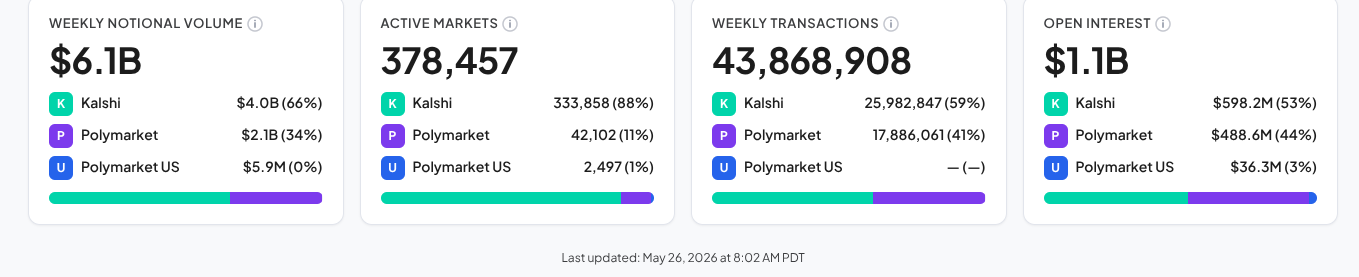
Prediction market conference blamed Nevada pressure for move. Regulators say no.

0

Predict 2026 says it moved to New York from Las Vegas because of “regulatory pressure” from the Nevada Gaming Control Board. A spokesperson for the regulator says otherwise.

“The Nevada Gaming Control Board did not direct, request, or otherwise pressure any licensee or venue to cancel or decline to host any recent or upcoming event or conference, as has been suggested,” a spokesperson told CoinDesk.

Earlier this month, the Prediction Conference, which featured some top traders from Polymarket, took place in Las Vegas – but at a hotel without a casino.

“We had a successful event last month that was attended by several stakeholders and will be hosting a second edition in November again in Las Vegas,” its founder, Ish Milly, told CoinDesk. “Our venue is off the strip and not in a casino.”

A spokesperson for the Nevada gaming regulator also told CoinDesk that “Gaming licensees are expected to adhere to all federal, state, and local statutes and ordinances and prevent any occurrences that may bring discredit to the state or the gaming industry.”

Nevada is one of the states that is locked in a legal battle with the prediction market industry.

In April, a judge in the state ruled that Kalshi’s prediction markets were “indistinguishable” from gambling and ordered an in-state ban on the platform to be extended.

Recently, Michael Selig, chair of the Commodity Futures Trading Commission, told Axios that sports betting and prediction markets are “two separate things.” Selig also said that the CFTC is working with major sports leagues on market surveillance and other market integrity measures.

PayJoy Crosses 20 million Customer Milestone with $3.5billion in Financed Loans

0


PayJoy, an emerging markets credit provider and Public Benefit Corporation, has officially reached 20 million customers globally. Operating heavily across Latin America, Africa, and Asia, the San Francisco-based company announced that it has successfully financed over $3.5billion in loans since its inception in 2015. The milestone reflects a strong, continued demand for accessible and responsible credit solutions explicitly tailored for underserved, underbanked populations.

Overcoming the unsecured credit barrier

In many emerging markets, traditional unsecured lending is frequently deemed too risky for first-time borrowers, effectively locking millions out of the formal financial system. PayJoy addresses this critical structural gap by utilizing the borrower’s smartphone itself as collateral, a proprietary mechanism designed to significantly lower the overall cost of credit and radically expand financial access.

The firm’s secured-credit technology goes beyond hardware locking, utilizing cutting-edge machine learning, robust data science, and advanced anti-fraud artificial intelligence to underwrite loans. By turning an everyday digital device into a collateralized asset, PayJoy provides immediate point-of-sale financing that traditional lenders simply cannot profitably offer.

Building credit and business performance
Doug Ricket, CEO and Co-Founder of PayJoy

This innovative approach to secured lending has proven highly effective in mitigating risk and improving borrower behavior. According to recent research conducted by the Mexican credit bureau Círculo de Crédito, PayJoy customers are approximately three times less likely to be late—defined as 30 days past due—compared to borrowers utilizing competing lenders. As these customers consistently repay their loans, they actively build their formal credit history, ultimately gaining access to broader financial opportunities such as the PayJoy Card.

Doug Ricket, CEO and co-founder of PayJoy, emphasized the dual impact of the company’s lending model. He stated that reaching the 20 million customer mark clearly demonstrates that financial inclusion and strong business performance can successfully go hand in hand. Ricket explained that the company started by making smartphones more affordable, but is today building a broad credit platform that helps tens of millions of people access new opportunities, build financial resilience, and confidently move forward. To support this growing global mission, the firm now employs over 1,000 people worldwide.


EToro (ETOR) reiterates commitment to crypto despite falling activity in first quarter 2026

0

EToro (ETOR) doubled down on its commitment to crypto even as digital asset activity weakened in the first quarter and into April.

Revenue from crypto assets dropped 38% from the year-earlier quarter to $2.15 billion, the company said in its first-quarter earnings report released Tuesday. Net trading income from crypto derivatives fell 57% to $33.4 million while overall net income rose 37% to $82.4 million.

The trading platform said the crypto activity decline extended into April, with the total number of crypto trades falling 32% year-over-year and the invested amount per trade dropping 22%. Despite the downturn, CEO Yoni Assia expressed a bullish outlook.

“We do expect later this year to start seeing crypto rising back to, you know, near all-time-highs and that will drive crypto engagement,” Assia told CNBC, adding that the platform’s data suggests that when the markets fall, “retail investors on eToro actually buy the dip.”

The company said it activated its BitLicense to start trading in New York, three years after it was granted, and it completed the $70 million acquisition of crypto wallet provider Zengo, closed April 30.

“The acquisition of Zengo, a leading self-custodial crypto wallet provider, meaningfully advances our strategy of bridging traditional finance with on-chain infrastructure, prediction markets, perpetuals and the broader crypto ecosystem,” Assia said in the report.

Etoro shares fell 0.61% in pre-market trading on Wednesday.

Crypto Bill Advances in Senate With Strong Support: Brian Armstrong

0

Coinbase CEO Brian Armstrong says crypto legislation is closer to passage, crediting Senate support and 3.7 million Stand With Crypto advocates.

Coinbase CEO Brian Armstrong announced on May 13 that crypto-focused legislation has advanced significantly in the Senate, describing the bill as strong and beneficial for the American financial system. Armstrong credited the Senate, its staff, and 3.7 million Stand With Crypto advocates for pushing the legislation forward. The bill aims to make the U.S. financial system faster, cheaper, and more accessible while positioning the country to lead in building next-generation financial infrastructure.

Armstrong’s post marks a milestone in the crypto industry’s push for regulatory clarity, a key priority for exchanges and digital asset firms operating in the U.S. The Stand With Crypto initiative, launched by Coinbase, has mobilized grassroots support for pro-crypto legislation. The endorsement from a major crypto exchange executive signals momentum for the bill as it moves through the legislative process.

Sources: Brian Armstrong (Twitter/X)

This article was generated automatically by The Defiant’s AI news system from publicly available sources.

Bitcoin (BTC) price holds below $81,000 with Trump-Xi talks on the horizon

0

Bitcoin , a leading indicator of risk sentiment, remains a paragon of stability ahead of President Donald Trump’s arrival in Beijing for talks with his Chinese counterpart, Xi Jinping.

The largest cryptocurrency recently traded 0.5% higher since midnight UTC at $80,900, in line with the gain of the CoinDesk 5 Index (CD5). All five members of the index advanced. The broader CoinDesk 20 Index (CD20) rose 1.3% while the CoinDesk 80 (CD80) was little changed, indicating a particular focus on the largest tokens.

The Trump-Xi talks are likely to cover tariffs, rare earth supply chains, and the Middle East. Any positive outcome, even a symbolic one on paper, could improve overall market sentiment and support risk assets

Ether (ETH) added 1.3% since midnight to $2,300 after the Ethereum Foundation published “Clear Signing,” a new standard designed to stop users from unknowingly approving malicious crypto transactions.

Among altcoins, Injective blockchain’s INJ token surged as much as 24%, the most since Feb. 19, alongside 5% gains in Polkadot’s DOT and the TRUMP memecoin.

Derivatives Positioning

  • BNB futures open interest (OI) rose to 6.15 million tokens, up over 5% in 24 hours and the highest since April 3. The move points to fresh capital inflows.
  • ZEC’s OI growth is the biggest among the major cryptocurrencies. Its 24-hour cumulative volume delta (CVD) is also positive and the highest among majors.
  • That’s also a sign of new money flowing into the market, with traders buying via market orders rather than passive limit orders, signaling strong bullish sentiment.
  • Still, the BNB market doesn’t look overheated. Funding rates remain below an annualized 10%, a sign of healthy bullish conditions without excessive leverage buildup. Its market capitalization has increased to $92.2 billion, the highest since March 18, reflecting renewed investor interest.
  • OI in DOGE has increased 5.75% to 15.38 billion tokens, with its price chart pointing to a bullish crossover of the widely tracked 50- and 100-day simple moving averages. The token traded 4% higher at 11 cents as of writing. The other key metrics display a BNB-like bullish setup, suggesting improving speculative demand.
  • Another standout is ether (ETH), the second-largest token by market value. OI in ether futures topped 15 million ETH, nearing last July’s record 15.30 million.
  • The increasing demand for leverage, coupled with the relentless tightening of Bollinger Bands, suggests scope for a volatility boom.
  • OI in bitcoin has held largely unchanged near 740K BTC in the past 24 hours, indicating relatively stable positioning in bitcoin compared to altcoins.
  • Broadly speaking, most tokens, except BNB, XRP and TRX, have negative 24-hour CVDs, meaning the altcoin market is dominated by sellers shorting via market orders rather than passive limit orders. That signals lingering caution beneath the broader market strength.
  • While macro risks pile up in the form of high inflation and hardening bond yields across the advanced world, the market remains calm. That’s evident from the continued decline in bitcoin’s and ether’s 30-day implied volatility indices. Ether’s EVIV index hit fresh year-to-date lows below 55%, while BVIV remains pinned near 40%, levels last seen in late January.
  • The subdued volatility environment suggests traders are not yet pricing in major near-term turbulence.
  • In the options market on Deribit, higher-strike call options continue to dominate volume rankings. Calls represent a bullish bet on the underlying BTC.
  • As for block flows, put spreads and straddles emerged as preferred strategies over the past 24 hours, indicating traders are positioning for both downside protection and a potential volatility expansion.

Token Talk

  • The DeFi United initiative seems to be restoring confidence in decentralized finance ecosystem, with the tokens of Aave , Arbitrum (ARB) and Lido (LDO) recovering over the past week.
  • AAVE rose 3%, ARB gained 16% and LDO added 11% over seven days. ARB’s move stands out after the Kelp DAO exploit, which hit Arbitrum lending markets and left wrapped ether stranded across chains.
  • The April 18 attack released unbacked rsETH through Kelp’s LayerZero OFT bridge. Aave’s incident report attributed the path to a forged LayerZero packet and a single-DVN configuration, while LayerZero linked the attack to North Korea’s Lazarus Group. It sparked a widespread recovery effort.
  • Phase 1 of that recovery is now complete. The attacker’s rsETH on Arbitrum was burned, removing the unbacked supply, and Aave V3 positions tied to the exploiter were forcibly liquidated.
  • The 117,132 rsETH, worth roughly $278 million, is set to be progressively refilled into the LayerZero bridge adapter over the next two weeks. Withdrawals are expected to resume within 24 hours of the first tranche.
  • A separate legal process is ongoing for 30,765 ETH, roughly $71 million, frozen by Arbitrum’s Security Council. A U.S. federal court cleared an Arbitrum governance vote to move the funds to an Aave-controlled wallet while keeping the recovered ETH under court restrictions.