Home Blog Page 235

Japan’s Ruling Party Pushes Crypto ETFs, Yen-Denominated Stablecoins

A group of lawmakers within Japan’s Liberal Democratic Party (LDP) are seeking reforms to the country’s cryptocurrency taxation system, as well as support for initiatives for the development and adoption of yen-denominated stablecoins.

According to a Monday Nada News report, the LDP’s Parliamentary Association for the Promotion of Blockchain delivered recommendations to Finance Minister Satsuki Katayama, including provisions on stablecoins, exchange-traded funds (ETFs), central bank digital currencies (CBDCs), and applications for blockchain technology.

The document proposes doubling the leverage cap for retail cryptocurrency derivatives trading and establishing a framework for ETFs tied to digital assets.

Katayama reportedly responded to the proposals by saying Japan “must move forward without falling behind global developments,” referencing crypto legislation and frameworks in the United States. 

“We must advance initiatives to expand on-chain finance across Asia — including the development and adoption of yen-denominated stablecoins,” LDP member Junichi Kanda said at a Monday press conference.

Finance Minister Satsuki Katayama (second from left) in a December 2024 meeting on Promotion of a Digital Society. Source: LDP

The recommendation came about two months after the Japanese government approved changes to allow classification of crypto assets as financial instruments rather than solely as a method of payment. The country’s financial watchdog, the Financial Services Agency, also reportedly planned to amend its regulatory framework to allow crypto ETFs.

Related: Japan PM Takaichi disavows ‘Sanae Token’ after memecoin hits $28M peak

Japan’s potential entry into the global $320 billion stablecoin market, now dominated by tokens pegged to the US dollar, comes after US lawmakers enacted legislation for a payment stablecoin framework, the GENIUS Act. According to an April report from the Bank for International Settlements, the market capitalization of Japanese yen-denominated stablecoins was less than 0.01% of US dollar-pegged coins.

Source: Pexels

Polymarket reported eyeing Japanese market

Prediction markets platform Polymarket, already facing regulatory scrutiny in the US amid state-level lawsuits and while supported at the federal level, was reportedly looking at approval to operate in Japan by 2030. Japan’s strict laws covering online and in-person gambling could prove a challenge for the company.

Magazine: 50K investors fight Korean crypto tax, Singapore cancels Bsquared: Asia Express
MoneyGram launches stablecoin on Stellar, joining rush toward digital dollar payments

0

MoneyGram announced Tuesday it had launched its own U.S. dollar-backed stablecoin on the Stellar (XLM) blockchain, joining a growing wave of global payments companies and banks building products around digital dollars.

The stablecoin, dubbed MGUSD, will be embedded into the MoneyGram app, allowing customers to hold a dollar-denominated balance in a self-custodial wallet and transfer funds through the company’s global payments network.

The product debuted Tuesday in the U.S. with plans for a broader international rollout, the firm said.

MoneyGram’s move comes as stablecoins have become one of crypto’s fastest-growing sectors, drawing interest from banks, fintech firms and payment providers looking to revamp cross-border payments using blockchain rails. These tokens, with prices tied to fiat currencies like the U.S. dollar, could offer cheaper, faster and around-the-clock settlements than traditional banking rails, making them increasingly popular for remittances. Their market size could reach $4 trillion by 2030 from the current $300 billion, global bank Citi projected.

SoFi recently unveiled its in-house build stablecoin SoFiUSD, while companies such as PayPal and Western Union partnered with crypto infrastructure providers like Paxos and Anchorage Digital to bring stablecoin services to customers.

MoneyGram, with over 60 million customers and nearly half a million retail
locations, is following the latter path.

The company partnered with Bridge, the stablecoin infrastructure platform acquired by Stripe, which serves as MGUSD’s regulated issuer. Blockchain infrastructure firm M0 developed the smart contracts used to mint and redeem the token, while Fireblocks provides wallet infrastructure.

“Starting with our distribution platform, we’re using stablecoin as a foundation to build future applications on our global network,” said Anthony Soohoo, chairman and CEO of MoneyGram, in a statement. “MGUSD is the stablecoin we built for our customers, for the families sending money home and for the billions of people around the world with limited financial access.”

The company said MGUSD is intended to serve as a core piece of infrastructure across its payments network, which reaches more than 60 million customers and nearly 500,000 retail locations worldwide.

The launch builds on MoneyGram’s relationship with the Stellar Development Foundation, a partnership that has focused on stablecoin-powered remittance services for the past five years.

“Stellar was built for real-world utility at institutional scale,” Stellar Development Foundation CEO Denelle Dixon said in a statement. “MGUSD is the next milestone that demonstrates what purpose-built blockchain can deliver when paired with a trusted payments network.”

Radiant to Wind Down After Failing to Recover From 2024 Hack

0

Crypto lending protocol Radiant Capital says it will start closing down as it failed to establish a “viable path forward” after North Korea exploited it for $50 million in October 2024.

Radiant’s decentralized autonomous organization said in a blog post on Monday that its inability to recover the stolen funds, secure new capital and maintain a runway to continue operating responsibly forced it to wind down.

It added on X that contributors and community members had helped maintain the protocol under “increasingly difficult conditions,” but it was not enough to sustain the protocol “without recovery, capital, or growth.”

Source: Radiant Capital

Radiant launched in 2022 and aimed to be a single platform to bring liquidity to several blockchains. It rapidly expanded in 2023, with its total value locked soaring to a high of $386.8 million in December 2023 even as value locked across the crypto market fell.

North Korea’s Lazarus Group exploited Radiant in October 2024, and its TVL fell to $75 million before collapsing further to $5 million within the month after the hack, which it never recovered from.

Radiant not fully shutting down

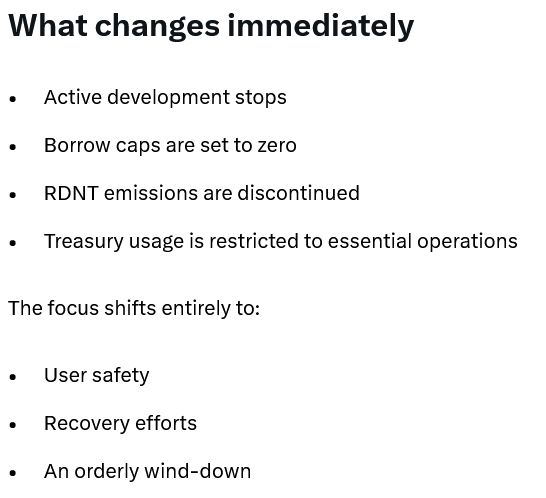
Radiant said that instead of fully shutting down, it will transition into a “maintenance state,” where the protocol’s frontend will stay online, its smart contracts will remain accessible and users will be able to withdraw, repay, and manage their positions. 

However, its decentralized autonomous organization will no longer contribute to development, upgrades or expansions.

Related: DxSale drained for $7.3M in BNB Chain liquidity exploit 

“Users are encouraged to actively manage risk and reduce exposure,” it said.

Source: Radiant Capital

Radiant said it would continue recovery efforts stemming from the hack by keeping its remediation portal open and returning any recovered funds to affected users.

The Radiant Capital (RDNT) token fell 4.2% after sharing that it was winding down. The token hit an all-time high of 58 cents in September 2022, but is now trading for a fraction of a cent.

Magazine: AI-driven hacks could kill DeFi — unless projects act now

Cointelegraph is committed to independent, transparent journalism. This news article is produced in accordance with Cointelegraph’s Editorial Policy and aims to provide accurate and timely information. Readers are encouraged to verify information independently.

Bitcoin’s biggest ETF selloff yet hits $3.4 billion as AI stocks keep climbing

0

U.S. spot bitcoin ETFs have suffered their largest and longest withdrawal streak on record, with investors pulling roughly $3.45 billion across 11 consecutive trading sessions as bitcoin slid toward $70,000, according to data provider SoSoValue.

The 11-session run, which began May 15, marks the longest stretch of net redemptions since the funds debuted in January 2024, surpassing the eight-day record set in February 2025.

However, Wall Street’s appetite for risk remains strong, with Nvidia up 6%, and other stocks linked to semiconductors and AI attracting the interest of investors.

The latest session saw investors withdraw another $484 million from the funds, helping push down BTC’s price by 4% during the Asian trading day.

Meanwhile, Strategy (MSTR), the largest corporate holder of bitcoin, disclosed on Monday that it sold 32 BTC, worth roughly $2.5 million, to fund distributions on one of its preferred stock offerings.

While the sale represented a tiny fraction of the company’s holdings, it marked Strategy’s first bitcoin sale since December 2022 and came after months of Executive Chairman Michael Saylor championing a buy-and-hold approach.

The move also comes as other measures of institutional demand are beginning to weaken.

In its most recent weekly report, CryptoQuant warned that bitcoin is increasingly becoming a market of holders rather than buyers.

CryptoQuant noted that ETF and corporate treasury accumulation has slowed markedly in recent months, making the current record ETF withdrawal streak another sign that one of the primary sources of demand underpinning bitcoin’s rally may be fading.

Anchorage Digital Pushes Federally Chartered Settlement Into Non-Custodial DeFi With Coordinated Multiparty Layer

0

The OCC-chartered crypto bank is positioning its Atlas network as a coordinated multiparty settlement layer for institutional trading on Hyperliquid, Lighter, and Aave — letting funds touch live DeFi without moving assets offshore or prefunding venues.

Anchorage Digital, the only federally chartered crypto bank in the United States, is positioning its Atlas settlement network as a coordinated multiparty settlement layer for institutional trading on non-custodial DeFi venues — beginning with Hyperliquid, Lighter, and Aave — letting buy-side firms transact on live on-chain markets without moving assets offshore or prefunding exchange accounts.

The framing extends a December 7 integration in which Anchorage wired institutional middleware provider BridgePort into Atlas as the coordination layer for “traditional and non-custodial execution venues,” adding pre-order asset allocation and post-trade settlement messaging to a network that previously focused on spot OTC settlement and collateral management.

Anchorage Digital Bank is valued at $4.2 billion after a Tether-led $100 million Series E in February and custodies tens of billions of dollars for clients including BlackRock, 21Shares, and Cantor Fitzgerald.

The structural point for asset managers: assets stay on-chain, segregated, and bankruptcy-remote at Anchorage Digital Bank while institutions route orders to non-custodial venues through Anchorage’s Porto self-custody wallet.

The bank — not the trading venue — holds the collateral, and the coordination layer fires simultaneous settlement instructions only when joint conditions are met. That removes the prefunding and counterparty-bankruptcy exposure that has kept regulated capital out of perpetuals DEXs and on-chain lending.

How Coordinated Multiparty Settlement Works

In a case study Anchorage published on its learning portal, institutional fund Deep Q Digital uses Porto to authorize on-chain operations across all three named venues.

Trades execute on the DEX in question — perpetuals on Hyperliquid’s HyperCore, perpetuals on Lighter’s zero-knowledge order book, lending positions on Aave — while Anchorage Digital Bank holds the underlying collateral and Atlas coordinates settlement. Porto runs on certified hardware security modules with no seed phrases and lets institutions encode signing policies and approval quorums per venue.

Lighter, which closed a $68 million Series at a $1.5 billion valuation in November, names Anchorage and FalconX as its two institutional access partners. Hyperliquid is the dominant perpetuals DEX and the venue 21Shares positioned around by switching custody to Anchorage for its HYPE ETF that launched May 12.

Federally Chartered Bank

Anchorage’s pitch is a feature peer settlement networks legally cannot match: crypto settlement through a federally regulated, qualified custodian. The OCC conditionally approved Anchorage Digital Bank in January 2021 and lifted a 2022 Bank Secrecy Act consent order in August 2025 after the bank spent tens of millions on remediation.

That regulatory posture has made Anchorage the default custody choice for staking-yield ETFs and is now its principal selling point against non-bank settlement networks like Fireblocks Off-Exchange and Copper ClearLoop, neither of which serves non-custodial DeFi venues at this scale.

Membrane Labs holds a February patent on a similar credit-and-netting architecture for non-custodial settlement, without a bank charter. Anchorage’s argument is that pairing the architecture with OCC supervision is what lets regulated U.S. capital actually use it.

Bank-as-Coordinator

The bank-as-coordinator model is the inverse of DeFi’s promise: it reintroduces a single regulated intermediary as the trust anchor for what would otherwise be a permissionless venue. Managers who want non-custodial DeFi for censorship-resistant rails will find that Atlas puts the bank back in the middle. The 2022 consent order, while now lifted, sits on the record.

The economics are also untested at perpetuals throughput. Hyperliquid and Lighter clear millions of trades a day at sub-cent fees; whether Atlas’s coordination is priced to compete with directly funded venue accounts has not been publicly disclosed. Anchorage did not respond to a request for comment on settlement fees or live volumes routed through the non-custodial branch of Atlas by publication time. CEO Nathan McCauley used the Consensus 2026 mainstage to announce a separate “agent bank” product, and the roadmap suggests Atlas will keep adding venues — making routed volumes the metric that will say whether institutional desks pick this rail over funded accounts.

Bitmine Buys $52M ETH, Tom Lee Says Fundamentals Strong

0

Bitmine Immersion Technologies has purchased another $52 million worth of Ether (ETH), with its chair, Tom Lee, saying that the token’s price isn’t yet reflecting the Ethereum blockchain’s strengths.

“Over the past week, we acquired 26,497 ETH,” Lee said in a statement on Monday. “In our view, ETH prices are not reflecting the strengthening of Ethereum fundamentals, but then again, this is not surprising given we are in the early stages of crypto spring.”

Bitmine is the largest Ether treasury company with 5.4 million ETH worth more than $10.5 billion. It had slowed its pace of buying earlier this month after scooping up more than 100,000 Ether a week for three straight weeks.

Source: Bitmine

Ether is down 4.7% over the past week and has traded between $1,963 and $2,126, according to CoinGecko. It has traded mostly flat over the past day at just below $2,000.

Lee told CNBC on Monday that there is disappointment in crypto at the moment because it hasn’t moved while other sectors like software are rallying, but argued that it “always happens at the end of crypto winter.”

Related: Sharplink, Forward Industries among crypto firms considered for Russell indexes

Lee argued that the thesis for Bitcoin and Ethereum that he believes in still stands; that they are likely to be the future of money, despite the short-term price downturn across the market and some long-term holders and whales selling.

“As AI systems evolve, we’re now talking about using commerce and operating websites, you need decentralized identity and verification, and that’s really what crypto does,” he said. 

“We know Wall Street wants to go toward tokenization; it’s a vast improvement in efficiency of how money actually moves, and it’s an innovation. That only happens on Bitcoin, Ethereum and other smart contracts. The future isn’t changed.”  

Bitmine announced plans to build an Ether treasury in July 2025, aiming to hold 5% of the total circulating supply of 120.6 million tokens. Its current stash holds over 5.4 million tokens, roughly 90% to its target. Lee has said he expects the company to hit its goal sometime in 2026.

Magazine: Big Questions: Do we really only need 2–5 cryptocurrencies? 

Cointelegraph is committed to independent, transparent journalism. This news article is produced in accordance with Cointelegraph’s Editorial Policy and aims to provide accurate and timely information. Readers are encouraged to verify information independently.

Strategy (MSTR) sold bitcoin in late May, and told the market in June. Here’s how Polymarket bettors are fighting over when it counts.

0

The Polymarket contract asked a simple question: did Strategy (MSTR) sell any bitcoin by May 31? The company’s filing says it sold 32 BTC between May 26 and 31. The filing came out June 1. That gap has split bettors into a $79 million fight over whether a sale counts when it happens, or when it’s confirmed.

The dispute turns on a single ambiguity: the rules ask whether Strategy sold bitcoin “by 11:59 PM ET” on May 31, but they don’t say whether that means the sale must have occurred by then or been confirmed by then.

Strategy executed the trades between May 26 and 31 and dated the activity “as of May 31, 2026, 4:00 p.m. Eastern Time” — inside the window. But the 8-K disclosing them wasn’t filed until June 1, after the market closed. So the sale date falls before the deadline; the filing date falls after it. Which one governs is the whole fight.

The fight breaks into three camps, and it plays out in the language of UMA’s voting options. One says the market is event-based and should resolve “Yes” (P2), because Strategy’s own filing dates the sale inside the deadline.

Another says it is effectively announcement-based and must resolve “No” (P1), because nothing confirmed the sale before the market closed. A third invokes P4 — the “too early” vote, meant for proposals made before an event has occurred — arguing the rules were too vague to resolve until Strategy’s filing landed.

CoinDesk went through the dispute threads on both Polymarket and UMA’s Discord channels, and with the assistance of AI, summarized the arguments the different camps are making.

The ‘Yes’ case: the sale is what matters

This camp reads the market as event-based, pointing to rules that resolve “Yes” if the firm “sells any of its Bitcoin” by the deadline, with no requirement that the sale be announced by then.

Their evidence is Strategy’s own disclosure, which lists the 32 BTC as sold “during period May 26, 2026 to May 31, 2026” and presents the activity “as of May 31, 2026, 4:00 p.m. Eastern Time” — inside the window. Because the rules name “information from MSTR” as the primary resolution source, they argue, the source itself confirms the sale.

Several add that Strategy reports weekly, usually on Mondays, so a late-month sale could never be confirmed before a month-end deadline — making a “No” reading a bet on filing schedules rather than events.

The ‘No’ case: only what was knowable by the deadline counts

This camp treats the market as announcement-gated, citing past Polymarket markets that resolved using only information available within the timeframe. The 11:59 p.m. ET deadline, they argue, defines a closed window: new information can always arrive later, but it doesn’t reach back to change a settled outcome, and nothing had confirmed a sale when the answer was proposed June 1.

Some note that the “as of May 31” language the other side leans on only surfaced in that day’s filing. Underpinning it is an integrity argument — that if a dispute can hold a market open until favorable evidence appears, anyone could extend any deadline for the price of a bond.

The ‘too early’ case: the rules can’t resolve this yet

A smaller group argues the market was too poorly drafted to resolve cleanly either way, noting the rules require the sale to occur “on the date specified in the title” rather than “by” it, leaving no coherent timeframe.

With Strategy’s filing due imminently and named as the primary source, this camp contends the market should have stayed open until that disclosure published rather than being resolved on a deadline they consider malformed. The “No” camp’s reply: P4 doesn’t apply, because the sale itself predates the deadline — the proposal wasn’t early, the confirmation was just late.

Polymarket’s clarification, and the catch

Polymarket has since added context backing the “No” reading, stating that no information from MSTR, on-chain data, or credible reporting confirmed a sale within the timeframe and that “confirmation achieved outside of the market’s time frame does not qualify.” Traders priced it accordingly, with the May 31 contract collapsing from 81% “Yes” during the dispute to under 1%.

But Polymarket doesn’t cast the final vote — UMA’s token holders do, and the two have split before. In 2024, UMA voted that Barron Trump wasn’t involved in the DJT memecoin; Polymarket overruled the oracle and refunded “Yes” holders anyway. For now, the two appear aligned.

The sale everyone can see is trading at less than a penny.

Debate on CLARITY Act Continues this Week as US Senate Returns

US Senate consideration of the Digital Asset Clarity (CLARITY) Act is likely to resume as members reconvene this week after an extended Memorial Day holiday.

Many US lawmakers and crypto industry leaders are pushing for consideration of the CLARITY Act, a crypto market structure bill introduced by Republicans and passed by the House of Representatives in July 2025.

The bill, expected to give more authority to the federal commodities regulator over digital assets, passed two crucial committees before the one-week break. It has been debated in Congress amid pushback from industry and banking representatives over stablecoins, tokenized equities and other issues.

“This will be actually the biggest financial regulatory bill that Congress has done in quite some time, certainly since Dodd-Frank,” Coinbase chief policy officer Faryar Shirzad said in a Monday Fox Business interview, referring to a 2010 law in response to the 2008 financial crisis.

Coinbase chief policy officer Faryar Shirzad. Source: Fox Business

JPMorgan CEO Jamie Dimon said on Friday that the banking industry would not accept the CLARITY Act as written, arguing that the bill allows crypto companies to pay interest on user deposits and stablecoin balances.

This week, lawmakers in the Senate will have the opportunity to start consolidating the versions of market structure passed by the agriculture committee in January and banking committee in May, creating legislation that some in the chamber expect will be up for a vote by August.

White House crypto adviser Patrick Witt said in May that officials were setting a target for the US’ Independence Day holiday, but it was unclear whether the bill would be ready for a vote amid pushback over ethics.

US Senator Kirsten Gillibrand said in May that “there will be no one voting for this bill if we don’t have an ethics provision.” Lawmakers in the banking committee did not take up consideration of amendments that would have addressed ethics and conflicts of interest, with some Republicans saying that the issue was a matter for the full Senate.

Related: Crypto market structure bill clears committee, but concerns abound before Senate vote

Should a consolidated bill reach the Senate floor in a matter of weeks, the Republican-led chamber would still need some support from Democrats to meet the 60-vote requirement to pass the legislation and return it to the House and potentially the president’s desk. Some lawmakers, including Senator Elizabeth Warren, have called out US President Donald Trump’s ties to the crypto industry in debate on CLARITY, based on his memecoin, his family’s crypto business World Liberty Financial and other conflicts as an elected official.

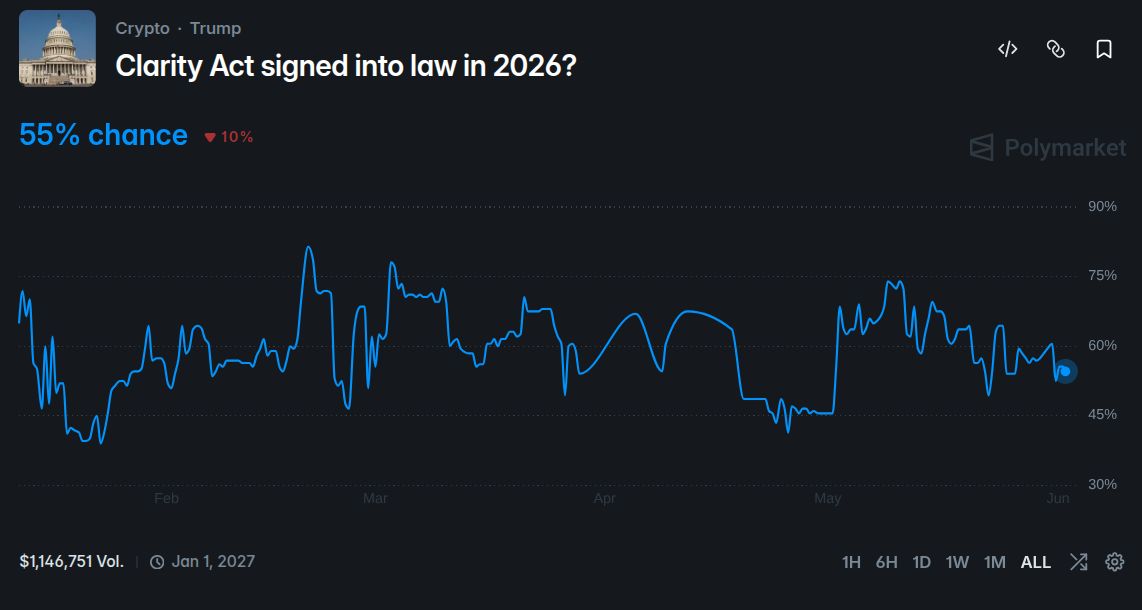
More than $1.1 million has been wagered on Polymarket on the likelihood of the law’s passage this year, with the prediction market showing a 55% chance of that happening, at last look on Monday.

Source: Polymarket

GENIUS Act comment period ending

On Tuesday, the US Treasury Department, Federal Deposit Insurance Corporation (FDIC), Financial Crimes Enforcement Network (FinCEN) and Treasury’s Office of Foreign Assets Control will close for public comments on the GENIUS Act, a stablecoin payments bill signed into law in July 2025.

Although at least one banking group has requested that the government agencies extend the comment period, the Tuesday deadline is expected to mark the next step in GENIUS’ implementation. According to the bill, it will go into effect 18 months after enactment or 120 days after regulators issue final rules.

Magazine: Big Questions: Do we really only need 2–5 cryptocurrencies?

What next for BTC prices as Bitcoin slides to $70,000 on Strategy’s sale

0

Bitcoin extended its slide below $71,000 in early Asian hours Tuesday, down 3.4% in the past 24 hours and 7.5% on the week, as the aftermath of Strategy’s first disclosed bitcoin sale weighed on the market while stocks paused at record highs and oil pushed further on the stalled U.S.-Iran ceasefire negotiations.

BTC traded near $70,830 by Tuesday morning, with the 24-hour range stretching from a low of $70,120 to a high of $73,458, per CoinDesk data. Ether (ETH) hovered just below $2,000 at $1,996, sat flat at $0.10, XRP fell 3% to $1.28 and Solana’s SOL slipped 1.7% to $80.47.

Monday’s 8-K filing from Strategy (MSTR), the largest corporate holder of bitcoin, disclosed the company’s first publicized sale of bitcoin in the five years since it began accumulating, with 32 coins sold for $2.5 million at an average price of $77,135 and proceeds earmarked to fund preferred stock distributions.

CoinDesk covered the sale extensively on Monday, including the broader funding-stack context behind it and the resulting Polymarket resolution around a $14 million market that debates whether the sale occured in May or June.

Stocks eased from all-time highs as investors locked in gains on the AI rally that has dominated markets this year, Bloomberg reported.

MSCI’s Asia-Pacific equity index fell 0.5%, with South Korea’s Kospi sliding 1.8% after its 105% year-to-date run. Nasdaq 100 futures slipped 0.7%, while Chinese tech bucked the trend with Tencent (0700) jumping 7.5%.

Brent crude pared some of Monday’s advance but held around $94.40 a barrel as the U.S.-Iran impasse persisted, with Treasuries holding their losses from the prior session on concerns that higher energy costs would force the Federal Reserve to keep interest rates higher for longer. Iran said it would halt message exchanges with Washington, Tasnim news agency reported.

Hyperliquid’s HYPE remained the outlier in the top 10 by market value, gaining 24.3% over the past seven days to $73.76 even as bitcoin and ether bled.

BTC is now at its lowest level in weeks. With ETF demand still flowing the wrong way and Strategy disclosed as a seller, there is no obvious near-term catalyst for a reversal.

$60M Polymarket Dispute Over Strategy’s May Bitcoin Sale Puts UMA’s Token-Voting Oracle on Trial

0

A multi-million-dollar Polymarket contract on whether Strategy sold any bitcoin by May 31 has been disputed twice and is now in front of UMA tokenholders, reigniting an analyst argument that prediction-market oracles built on token voting are structurally unfit for high-stakes settlement.

A Polymarket contract that drew more than $60 million in trading volume is sitting in UMA’s optimistic-oracle queue after two proposed “No” resolutions on the question “MicroStrategy sells any Bitcoin by May 31, 2026?” were challenged, sending the dispute to a token-weighted vote.

The trigger is a Strategy 8-K filed Monday that disclosed 32 BTC sold between May 26 and May 31 at an average net price of $77,135, the first disposal since 2022. The sale closed before the contract’s 11:59 PM ET cutoff. The 8-K hit the wire on June 1. The contract is now reading 12c Yes / 89c No.

The dispute is being framed across Crypto Twitter not as an edge case but as a structural verdict on Polymarket’s resolution stack. “UMA’s token-voting model is structurally broken,” analyst Eric Conner (@econoar) posted Monday. “Whales weaponize ambiguous rules to resolve Polymarket markets incorrectly and save their own positions. Zero legitimacy remains until deterministic settlement replaces it. This is exactly what Hyperliquid fixes with HIP-4.”

UMA’s Vote

Polymarket outsources contested settlements to UMA’s optimistic oracle, where a proposed resolution can be challenged twice before the question escalates to a token-holder vote. The native token’s voting power, not a court of facts, decides the payout.

A Wall Street Journal investigation in May found that in most disputed Polymarket markets more than half the UMA votes came from the ten largest wallets, at least 60% of active UMA voters could be linked to live Polymarket accounts, and roughly one in five disputes had at least one voter with a financial stake in the contract they were ruling on. Polymarket has logged more than 1,150 disputed markets in 2026, already past its full-year 2025 total.

The Strategy market is the highest-dollar live test since the $237 million Zelenskyy-suit market last year. Polymarket itself can’t override the vote; it posted a bulletin telling voters that “no information from MSTR, on-chain data, or consensus of credible reporting confirmed that MicroStrategy sold Bitcoin within the market’s timeframe. Confirmation achieved outside of the market’s timeframe does not qualify.”

Yes-side traders, including a holder pseudonymous as “Surprised-Legacy” whose $19,610 wager at roughly 11c would pay about $200,000 if Yes resolves, argue the 8-K’s stated sale window, not the filing’s date, is what the rules ask about.

Deterministic-Settlement

Hyperliquid’s HIP-4 outcome markets, live on mainnet since May 2, replace the optimistic-oracle layer entirely. Settlement is determined by the chain’s own validator set running automated newsfeed software; there is no token-vote backstop, no two-round dispute window, and no path for a holder of the settlement-layer token to also be a participant in the market being settled. Each binary contract resolves to 1 or 0 against a pre-specified data source.

Kalshi reaches the same end-state through opposite infrastructure: an exchange-cleared central-counterparty book run through Kalshi Klear LLC, CFTC-registered as a derivatives clearing organization in August 2024. Disputes are handled by the exchange under rules filed with a federal regulator, not by anonymous tokenholders.

Polymarket’s U.S. arm is itself now a CFTC-registered designated contract market, but the international book where the Strategy market sits still settles in USDC on Polygon under UMA.

Where the $60M Sits Now

UMA’s voting window runs roughly two days. The June 30 and December 31 children of the same market have already resolved Yes without dispute, meaning the $60 million in question turns entirely on whether “selling in May” requires public disclosure inside the month or only on-chain execution inside the month.