Home Blog Page 22

Coinbase, Circle Drop 10% After CLARITY Act Vote

0

Crypto-linked stocks fell sharply on Tuesday after the US Senate failed to advance the CLARITY Act, with shares of Circle and Coinbase dropping about 10%.

Bitcoin treasury companies were also hit, with American Bitcoin falling around 8%, while Strategy and Strive each declined about 5%, according to Yahoo Finance data. Bitcoin miners joined the selloff, with Riot Platforms falling about 6%, CleanSpark nearly 5%, Hut 8 more than 4% and IREN almost 4%.

Coinbase (COIN) shares fell 9.9% on Tuesday. Source: Yahoo Finance

The declines followed a Senate vote on a cloture motion to bring the legislation to the Senate floor, short of the 60 votes required. The CLARITY Act would set rules for the US digital asset market and delineate which parts of the industry fall under the Commodity Futures Trading Commission (CFTC) and Securities and Exchange Commission (SEC).

The setback leaves the bill with little time to advance this year, with fewer than 36 legislative days remaining before a new Congress is sworn in following November’s midterm elections.

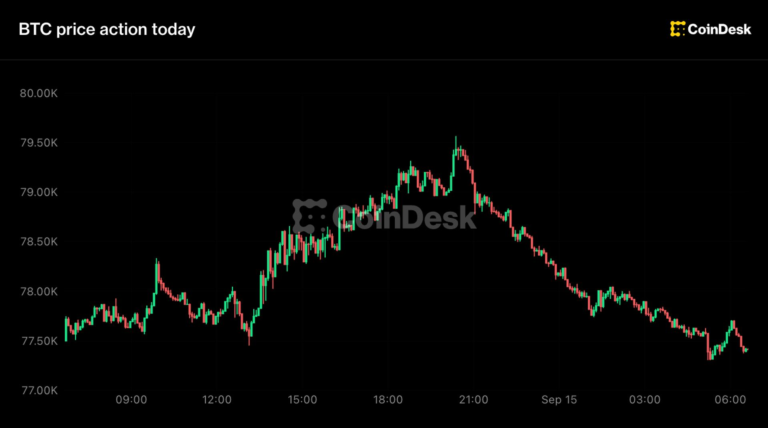
Following the vote, Bitcoin briefly fell below $75,000, but had climbed back to around $76,000 at the time of writing, CoinGecko data showed.

Related: Democrats push back on GOP’s ‘final’ CLARITY offer with counterproposal: Politico

Armstrong pushed for CLARITY ahead of vote

Coinbase CEO Brian Armstrong had been one of the most vocal industry advocates for the CLARITY Act, saying in May that the legislation had never been in a “stronger or more bipartisan position.”

Armstrong was even more explicit about the bill’s prospects in August, predicting either “60+ votes in the Senate on September 15th” or new rules from the CFTC and SEC on Sept. 16 if the bill failed to advance. “Sounds like clarity is coming either way,” he wrote on X.
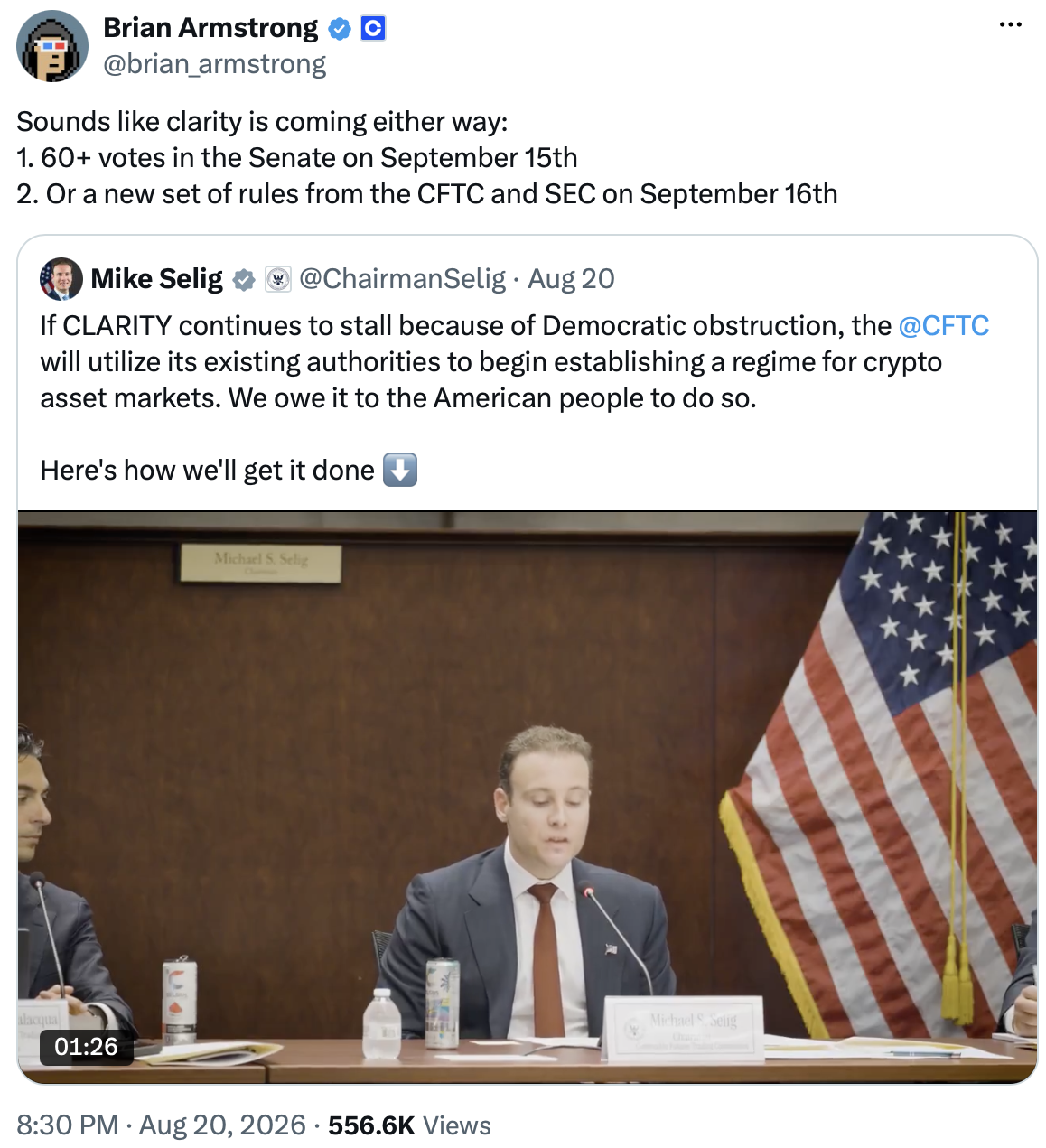
Source: Brian Armstrong

Ahead of Tuesday’s vote, Armstrong again urged senators to support the legislation, framing the choice as one between promoting US crypto innovation and allowing other countries to take the lead. “History — and the crypto voter — won’t forget,” he wrote.

Following the failed vote, Strategy co-founder Michael Saylor offered his own take on regulatory clarity. “The only clarity you need is Bitcoin,” he wrote on X.
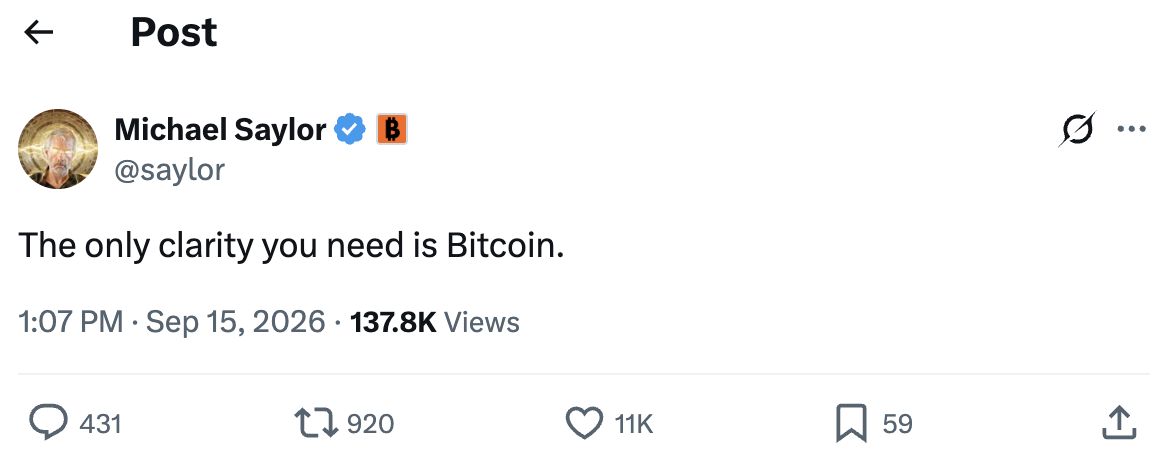
Source: Michael Saylor


DOJ Seeks $61M USDT Forfeiture Tied to Iranian Oil Sales

0

The US Department of Justice (DOJ) is seeking forfeiture of more than $61 million in Tether’s USDT stablecoin, alleging the funds came from black-market sales of sanctioned Iranian oil and were intended to finance Iran’s government and military, including the Islamic Revolutionary Guard Corps (IRGC). 

On Monday, the DOJ alleged that Blessed Trust and Hexa Whale, both incorporated in Hong Kong, used Binance accounts to move proceeds from oil sold to buyers in China. A network of related addresses allegedly received and distributed more than $1.5 billion, including transfers to IRGC-linked money-transfer businesses, cryptocurrency addresses and an Iranian exchange.

A Binance spokesperson told Cointelegraph that Binance did not permit transactions with sanctioned individuals and would continue cooperating with law enforcement, including by investigating, restricting or freezing accounts where appropriate. The spokesperson said the case was not filed against the exchange and did not allege wrongdoing by Binance. 

The filing comes as Washington expands financial pressure on Tehran and the US-Israeli war with Iran disrupts energy infrastructure and oil shipments across the Middle East. Oil prices rose on Tuesday following attacks on Saudi infrastructure and continued reductions in vessel traffic through the Strait of Hormuz.

Tether freezes $61 million in USDT

According to the complaint, Tether froze about 61.19 million USDT across 10 addresses on the Tron network in 2025. It said a seizure warrant authorizes the FBI to take custody of the assets by having Tether destroy the frozen tokens and issue replacements of equal value to be transferred to an FBI-controlled hardware wallet.

Cointelegraph contacted Tether for comment but had not received a response by publication.

The DOJ said the allegations contained in the civil forfeiture complaint had not been proven. The US would obtain permanent ownership of the assets only if a court enters a forfeiture judgment in the government’s favor.

The enforcement action also follows the US Treasury’s August expansion of its Iran sanctions framework to cover the country’s digital asset sector. The measure allows US authorities to target foreign individuals and companies operating in or supporting the sector.

At the time, the Treasury alleged that UAE-based broker Ivan Obukhov had processed more than $100 million in crypto payments since 2023 to facilitate Iranian oil sales for the IRGC’s Quds Force.

Recent: CoinEx to cease operation after 9 years, citing ‘significant’ crypto contraction

Iran conflict pushes oil prices higher 

The war between the US and Israel and Iran, which began in February, continues to disrupt oil shipments through the Middle East.

Reuters reported on Tuesday that Saudi Arabia’s East-West pipeline remained offline after Friday attacks that Riyadh blamed on Iran-backed fighters in Iraq, while Iran-backed Houthi forces launched separate missile and drone attacks on Saudi Arabia on Monday.

At the time of writing, market data showed Brent crude trading at about $107.59 per barrel, up 1.81%, while US West Texas Intermediate traded at roughly $103.35, up 1.93%.

Magazine: Why are AI’s biggest companies suddenly asking to slow down?

US Crypto Tax Bill Leaves Out Mining, Staking Deferral

0

The US House Ways and Means Committee will consider a 114-page crypto tax package on Wednesday that leaves out a provision that would have allowed miners and stakers to defer taxation of rewards until the tokens are sold.

The Digital Asset Tax Certainty Act, H.R. 10357, was published alongside the committee’s markup notice on Monday. The package does not include the reward-timing provision contained in Representative Mike Carey’s Tax Clarity for Mining and Staking Act, introduced in June.

The provision would have allowed taxpayers to choose between recognizing newly created tokens as income when received or treating them similarly to self-created property and paying tax when sold.

Without the provision, mining and staking rewards would remain taxable when received or brought under the recipient’s control, potentially before they are sold for cash.

The package comes just as the Senate is considering whether to advance the CLARITY Act, which would determine how the US Securities and Exchange Commission and Commodity Futures Trading Commission divide oversight of the US crypto market.

House crypto package covers fees, stablecoins, wash sales

To be sure, the bill retains some of its mining and staking provisions. It would classify income from blockchain validator activities as ordinary income, establish whether it is sourced inside or outside of the United States and allow qualifying investment trusts to stake digital assets without losing their trust status.  

The package would also prevent taxpayers from recognizing gains or losses when crypto is used to pay network or transaction fees of up to $10. It proposes special tax treatment for qualifying US dollar stablecoins and would allow qualifying digital asset loans to occur without being treated as taxable sales.

Other provisions would offer simplified accounting for widely traded crypto assets, extend wash-sale and constructive-sale rules to crypto and establish a voluntary disclosure program for taxpayers seeking to correct earlier digital asset tax violations. 

Related: Trade groups seek to block Illinois crypto tax before January effective date

In June, the committee circulated seven crypto tax drafts ahead of a hearing on digital asset taxation. The proposals covered stablecoins, mining, staking and measures aimed at reducing the tax-reporting burden associated with crypto transactions.

In response, the Blockchain Association, Crypto Council for Innovation and Digital Chamber urged Congress to pass Carey’s legislation as introduced. The groups argued that taxing rewards before they can be sold creates liquidity problems for miners and stakers, while opposing an amendment that would have limited the deferral to five years.

Magazine: Why are AI’s biggest companies suddenly asking to slow down?

Ethereum, Base Wallet Standards Collaboration Breaks Down

0

Ethereum and Base are set to implement different account abstraction standards after efforts to agree on a shared account abstraction standard broke down last week.

Interoperability standards became secondary to each chain’s core goals, leading both to go their separate ways and “putting the burden on wallets,” Derek Chiang, founding member and researcher at Ethlabs, as well as a co-author of Ethereum’s EIP-8141 proposal, said in a Monday X post.

The divergence could require wallet developers to support separate transaction formats to provide a consistent experience across networks. Account abstraction allows programmable rules for authorizing transactions and paying fees.

Ethereum is now advancing Frame Transactions under EIP-8141 as a “headliner” item under its Hegotá upgrade, which would introduce native account abstraction and create a path toward post-quantum authentication. Separately, Base is developing native account abstraction via Keystore under EIP-8130, currently live on devnet.

The divergence also highlights different priorities between layer-1 and layer-2 blockchain networks. Chiang said L1s are increasingly focused on censorship, capture-resistance, open-source, privacy and security features, favoring different account standards, while scalability-focused L2s are more aligned with standards such as EIP-8130.

The researcher argued that the separation won’t necessarily result in a bad outcome, as both Ethereum and Base are now “free to innovate on AA to the maximal extent in accordance with their own visions.” 

Ethereum developers could begin implementing Hegotá in late 2026 following Glamsterdam, arguably one of the most consequential upgrades of the year. Glamsterdam is designed to improve scalability, harden the L1, and make the network easier to use, with a mainnet launch expected sometime in the second half of 2026, according to Ethereum’s public roadmap.  

Related: Standard Chartered forecasts SKY rising fivefold to $0.325 by 2028

Cointelegraph is committed to independent, transparent journalism. This news article is produced in accordance with Cointelegraph’s Editorial Policy and aims to provide accurate and timely information. Readers are encouraged to verify information independently.

Live updates: Bitcoin slides from nearly $80,000 as Senate votes on Clarity Act

0

Senators take a procedural vote on the crypto market structure bill later Tuesday. Bitcoin has given back 3% since touching $79,530 overnight, with XRP and zcash the only majors gaining ground.

CLARITY Act Odds Sink Amid Democratic Opposition to GOP Deal

0

Odds of the CLARITY Act becoming law this year on Polymarket fell sharply again on Monday after spiking the day before, as key Senate Democrats reportedly said they had not been swayed by Republicans’ “final” crypto bill proposal.  

Polymarket traders initially saw a newly revised Republican proposal with expanded ethics provisions as a positive sign, sending the odds to 35%. However, their confidence was dashed as reservations about the revised text began mounting, with the odds falling back as low as 16% on Monday. 

US Senator Mark Warner, one of the Democrats involved in negotiations, reportedly said the revised ethics provision was not “near enough,” while Democrats involved in negotiations began preparing a counterproposal on Monday. 

Republicans need 60 votes to advance the bill, and failure on Tuesday could stall legislation that would determine how the US Securities and Exchange Commission and Commodity Futures Trading Commission divide oversight of the US crypto market.

Key Democrats remain unconvinced by ethics offer

Punchbowl News’ Brendan Pedersen reported that Senator Raphael Warnock said Democrats should not advance legislation that fails to address opportunities for corruption that are occurring “in real time.”

Pedersen reported that Senator Ruben Gallego said the latest ethics offer left “much to be desired” and that he planned to work on a counterproposal. Pedersen separately reported that staff for Senator Elizabeth Warren on the Senate Banking Committee circulated talking points arguing that the proposed state AG enforcement mechanism could be overridden by a determination from White House ethics officials.

Democrats have since sent their counterproposal to Republican negotiators, Politico’s Jasper Goodman reported, citing three people with knowledge of the matter.

Not all Democrats oppose advancing the bill toward floor consideration. Senator Kirsten Gillibrand has privately urged colleagues to support the procedural motion, Politico reported. 

Republican Senator Cynthia Lummis said President Donald Trump had accepted two significant ethics provisions and that there was “nothing left to give” Democrats.

The resistance adds to opposition from a coalition of 18 state attorneys general and raises further uncertainty about whether Republicans can assemble the votes needed to advance the bill. 

Banking and tribal groups challenge latest text

The Indian Gaming Association, a national organization representing tribal gaming interests, urged member tribes to press senators to vote against the bill, saying its proposed decentralized finance changes did not address Indian Country’s concerns about prediction markets. 

The association called for explicit language affirming that federal commodities law does not preempt tribal or state gaming laws, including the Indian Gaming Regulatory Act.

Related: Revised CLARITY Act targets ‘non-decentralized’ DeFi operators

Eight banking trade groups also said the revised text failed to close loopholes allowing stablecoin rewards that function like deposit interest. According to the groups, the proposed regulatory “circuit breaker” would activate only after substantial deposit flight from community banks had already occurred.

Crypto industry groups have urged senators to advance the legislation. In a statement on Monday, Blockchain Association CEO Summer Mersinger said the industry had made significant concessions to help build bipartisan support and urged every senator to vote yes. 

She argued that the bill would provide clear rules, protect consumers and deter illicit activity while preventing crypto jobs, developers and innovation from moving overseas. 

Magazine: Why are AI’s biggest companies suddenly asking to slow down?

Solana transactions just got more than 3 times bigger, giving an edge over Ethereum

0

Transaction V1 raises Solana’s limit to 4,096 bytes from 1,232, giving developers more room for multi-step trades, company-wallet approvals and privacy proofs.

SEC's Atkins backs Clarity Act but says agency will keep pushing crypto rules without it

0

The SEC chair said crypto issuance, transfer agent modernization and custody will form the backbone of the agency’s regulatory push.

Democrats push back on GOP’s ‘final’ CLARITY offer with counterproposal: Politico

0

Some Democrats remain dissatisfied with the bill’s crypto ethics provisions and will be sending a counterproposal just hours before a key procedural vote.

Even if Clarity fails, Wall Street’s crypto push is unlikely to stop

0

The Clarity Act could give banks, brokers and asset managers a clearer rulebook, but financial firms have already moved far enough into digital assets that failure may slow adoption rather than stop it.