Home Blog Page 1313

Mitsui to offer retail access to digital securities tied to aircraft and ships

0

Key Takeaways

  • Mitsui will offer Japan’s first digital securities for fractional ownership of aircraft and ships via its Alterna platform.
  • Japan’s digital securities market more than doubled in 2025, driven by expanding use cases and institutional entry.

Share this article

Japanese trading giant Mitsui & Co. plans to offer the country’s first digital securities for aircraft and ships, according to a Nikkei report.

The products will be issued via Mitsui & Co. Digital Asset Management, which already leads Japan in real estate tokenization through its investment platform Alterna.

The move will allow retail investors to gain fractional exposure to capital-intensive assets like planes and cargo vessels, with minimum investments starting around 100,000 yen ($630).

Japan aims to double shipbuilding output by 2035, and aircraft demand is projected to more than double by 2043.

Mitsui’s goal is to quadruple digital securities sales to 100 billion yen by fiscal 2030. Its product roadmap includes future offerings for lower-volatility assets like corporate bonds, alongside more real estate products. The company also plans to deploy AI tools to cut product development time from up to 12 months to just 1–2 months.

Japan’s digital securities market is accelerating, with issuance hitting 152.9 billion yen in 2025, more than double 2024 levels, according to the report.

Major brokerages like Mitsubishi UFJ Morgan Stanley Securities and platforms such as Osaka Digital Exchange already offer digital securities and are broadening access through secondary and peer-to-peer markets.

Dubai Bans Privacy Tokens on Regulated Exchanges

0

DFSA cites money-laundering and sanctions risks as it bans assets like Monero and Zcash from DIFC-based platforms.

Dubai’s financial regulator has banned privacy-focused cryptocurrencies like Monero (XMR) and Zcash (ZEC) from use on regulated exchanges.

The new rules, issued by the Dubai Financial Services Authority (DFSA), took effect earlier today, Jan. 12, and apply across trading, promotion and fund activity in the Dubai International Financial Centre (DIFC).

“A person must not in or from the DIFC carry on a financial service relating to a privacy token or that involves the use of a privacy device,” the document reads. However, residents are still allowed to hold privacy coins in private wallets.

The DFSA said privacy tokens and related tools, such as mixers including Tornado Cash, pose anti-money-laundering (AML) and sanctions compliance risks.

The decision reignites a broader debate across the crypto industry over privacy versus regulation, as some policymakers push for stricter oversight while others argue that privacy tools are imperative to the original promise of decentralized finance (DeFi).

At a December roundtable hosted by the U.S. Securities and Exchange Commission’s Crypto Task Force, Commissioner Hester Peirce said financial surveillance rules need to be rethought as crypto adoption grows. Peirce further argued that privacy should not be treated as a signal of criminal activity.

The scrutiny of privacy tools has also intensified following the 2025 conviction of Roman Storm, a co-founder of Tornado Cash, in a U.S. case that raised concerns about money laundering and sanctions violations. The verdict further fueled debate over whether developers of non-custodial, open-source privacy tools can be held legally responsible for how their software is used.

The DFSA’s new rule came into effect as privacy tokens were among the day’s top gainers, with Monero up about 16% and ZEC rising more than 3% over 24 hours. ZEC was also the top-performing cryptocurrency of 2025, posting a rally of more than 800%, while XMR ranked as the second-best performing large-cap token, up about 127%.

Bitcoin stalls below $92,000 as privacy coins rally; crypto miners surge on Meta AI news

0

Traders rotated to Monero (XMR), Zcash (ZEC) and Railgun (RAIL) as bitcoin, ether remain stuck under key resistance levels.

15,000x ROI Potential? Why Zero Knowledge Proof’s Presale Auction Is Pulling Attention Away From Polkadot

0

Crypto markets are moving fast again. Prices jump, narratives flip, and capital rotates quickly. Bitcoin and Ethereum still anchor confidence, but traders are increasingly selective. The focus has shifted from expansion stories to structure, from promises to systems that can hold under pressure. In this environment, long-term conviction matters more than short-term noise.

Polkadot represents one era of crypto thinking. It pushed scale through many chains, many teams, and many dependencies. That approach shaped an entire cycle, but it also exposed the cost of complexity.

Zero Knowledge Proof (ZKP) enters at a different moment. With its presale auction live, price momentum building, and a clean structure already in place, ZKP is being watched as a potential best long term crypto for investors prioritizing durability. 

Polkadot: A Complex System That Defined a Cycle

Polkadot was built to solve fragmentation. Its parachain model allowed many blockchains to connect under one umbrella. This vision attracted developers, capital, and attention. For a time, it worked well. Polkadot became a symbol of multi-chain ambition.

But that ambition came with weight. Each parachain needed auctions, coordination, incentives, and long-term upkeep. Success depended not on one system working well, but on many systems working together. Over time, this created friction. When some parachains slowed or failed to gain traction, the entire network felt the strain.

Today, Polkadot stands as a reminder of how quickly complexity can become a burden. It is not broken. But it belongs to a phase of crypto where scale was prioritized before stability. For long-term investors, that context matters. 

ZKP: One System, One Auction, No Dependencies

Zero Knowledge Proof (ZKP) is built around a simpler idea. Fewer moving parts mean fewer failure points. Instead of layering chains, ZKP runs on a single public presale auction, one compute layer, and one shared rule set.

The presale auction is live, and price action is already drawing attention. Early participants are entering a system that was fully built before public access. Over $100 million was spent upfront by the founding team to fund infrastructure, compute, hardware, and distribution systems. No venture capital. No private rounds. No early unlocks waiting to dilute supply.

This structure matters now. While many projects still depend on coordination across ecosystems, ZKP only needs its core to function. There are no parachains to align, no external modules to manage, and no competing incentive systems pulling in different directions.

That clarity is why ZKP is increasingly discussed as a best long term crypto candidate. It is not designed to expand outward first. It is designed to hold. 
ZKP: One System, One Auction, No Dependencies

Chart Watch: ZKP vs Polkadot Over Time

If you map both projects on a simple timeline, the contrast is clear.

Polkadot’s chart reflects cycles of buildup and pullback, driven by ecosystem news, auctions, and shifting narratives. Each surge depended on multiple factors aligning at once.

ZKP’s chart tells a different story. From the start of the presale auction, price movement reflects direct participation, fixed supply rules, and transparent mechanics. There are no unlock cliffs, no surprise allocations, and no delayed sell pressure.

For investors looking at 15,000x ROI potential, this matters. Explosive returns historically come from early access to clean systems, not from late entry into complex ones already priced by insiders. 

Why ZKP Is Framed as the Best Long Term Crypto

The comparison between ZKP and Polkadot is no longer about features. It is about timing and design philosophy.

Polkadot showed what multi-chain coordination could look like. ZKP shows what happens when a system is stripped down to essentials. One auction. One layer. One economic model. No outside influence.

ZKP’s presale auction removes speculation about future dilution. Its funding model removes pressure from investors who expect returns before the network matures. Its structure removes dependency risk.

For long-term holders, these are not small details. They define how a network survives stress, regulation shifts, and market cycles. 

Final Take

Polkadot belongs to crypto’s expansion era. ZKP belongs to its consolidation era.

As markets mature, endurance matters more than reach. The best long term crypto is not always the one with the most components, but the one with the fewest ways to break.

With the presale auction live, price momentum building, and early participants positioning for 15,000x ROI potential, ZKP is no longer a concept. It is an active system being priced in real time.

History favors projects that arrive prepared. ZKP is betting that simplicity is not a limitation, but an advantage.

Find Out More about Zero Knowledge Proof: 

Auction: https://auction.zkp.com/

Website: https://zkp.com/

X: https://x.com/ZKPofficial

Telegram: https://t.me/ZKPofficial



Bitcoin Bears Hold $94K Resistance As Price Drops To $90,891 Weekly Close

0

Bitcoin Price Weekly Outlook

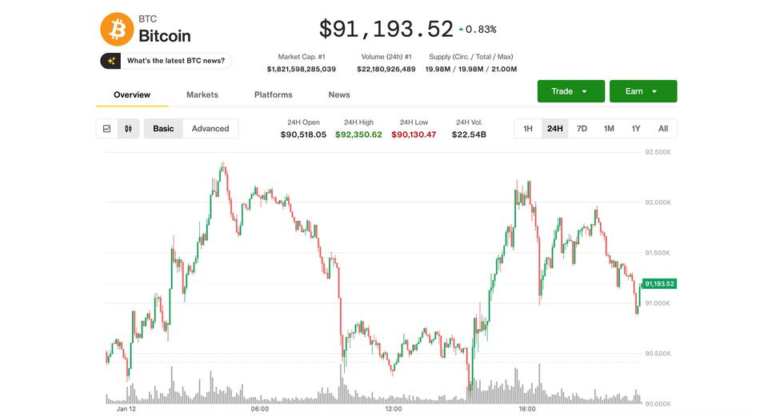
Bitcoin buyers made a nice push to $94,000 resistance again last week, but the price promptly sold off again from this level to close the week out at $90,891. Sunday’s close gave us a doji candle, indicating indecision and a potential reversal back in the bears’ favor. The bulls are once again looking lethargic as they lack the follow-through necessary to overtake resistance. Bears are in the driver’s seat heading into this week. Look for them to try to push the price down through the $87,000 support level to make another attempt at breaking $84,000 support.

Key Support and Resistance Levels Now

The bulls are looking for support at the $87,000 level to hold if bears manage to keep the push lower going here. $84,000 still sits as strong support below here, but will weaken with any further pressure. If the bears can manage to break this support, the price is sure to accelerate down to the low $70,000 area, with a close below $68,000 required to lose this support level. Below this zone, bulls will look to gain some sort of strength off the 0.618 Fibonacci retracement at $58,000.

Bears will look to defend the $91,400 level as resistance over the short term here. The resistance at $94,000 has done its job so far, but it will be under heavy pressure if bulls can muster the strength to get the price back up there. Above $94,000, there is a resistance zone that stretches from $98,000 up to $103,500. Above here, we have another resistance zone from $106,000 up to $109,000 at the 0.618 Fibonacci retracement from the drop from the top down to $80,000.

Outlook For This Week

Wounded bulls need some help to hang on to momentum this week. Look for the bears to push the price down to $87,000 early in the week and possibly below it. Bulls will try to stop the price from closing any days below $87,000. If the bears manage a daily close below here, $84,000 support will be under heavy threat, and the bulls will need buyers to step up to the plate with some big volume to hold this support level once again.

Market mood: Bearish – After a weekly shooting star doji candle close, the bulls’ momentum has faded. The bears have tilted control slightly in their favor to start this week.

The next few weeks
Price action may remain choppy and confined within a range over the next few weeks. Bulls need to see a close above $94,000 to break above this range and look for upward momentum, while bears need to see a close below $84,000 to try to break down below this major support level. Between $94,000 and $84,000 is now a neutral zone, where bulls and bears may battle back and forth. Neither side is poised to take firm control of the price action until either of these boundaries is broken.

Terminology Guide:

Bulls/Bullish: Buyers or investors expecting the price to go higher.

Bears/Bearish: Sellers or investors expecting the price to go lower.

Support or support level: A level at which the price should hold for the asset, at least initially. The more touches on support, the weaker it gets and the more likely it is to fail to hold the price.

Resistance or resistance level: Opposite of support.  The level that is likely to reject the price, at least initially. The more touches at resistance, the weaker it gets and the more likely it is to fail to hold back the price.

Shooting Star Candle: A candlestick that occurs after an uptrend, marked by a long wick upwards above the candle body and a smaller wick (or no wick) to the downside. The long wick up indicates strong selling near the highs. This candle can often indicate the end of an uptrend.

Doji Candle: A candlestick that closes at nearly the same price at which it opened. This candle indicates indecision, and can signal a reversal in price action if it occurs after an uptrend or downtrend.

Fibonacci Retracements and Extensions: Ratios based on what is known as the golden ratio, a universal ratio pertaining to growth and decay cycles in nature. The golden ratio is based on the constants Phi (1.618) and phi (0.618).

Iranian Protestors Use Freedom Tech To Bypass Regime Crackdown

0

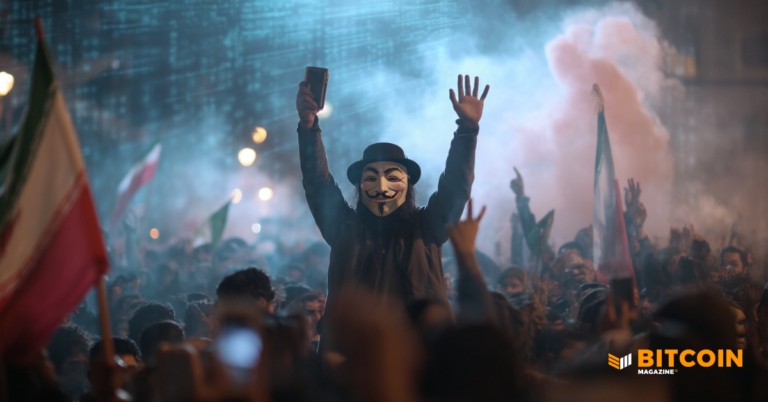
Iran has been experiencing intense protests against the Islamic Republic regime in recent weeks. Authorities have responded with severe measures, including a nationwide telecoms blackout and jamming satellite services like Starlink, aimed at preventing coordination among demonstrators.

Iranians are embracing freedom tech tools; Bitchat, Noghteha, and Delta Chat for offline communication. Two of these apps trace their origins directly to Bitcoin, highlighting how technologies from this community provide practical solutions in high-stakes environments. Bitchat, built by Bitcoin pioneers Jack Dorsey and open-source developer Calle, operates over Bluetooth mesh networks and the Nostr protocol without needing an internet connection. Noghteha on the otherhand, is a closed-source fork of Bitchat, adapted for the Iranian context with full Persian/Farsi support, an enhanced user interface, and features tailored to local needs.

How Did Bitchat and Noghteha Gain Popularity?

Bitchat first gained widespread attention when Jack Dorsey announced it on X on July 6, 2025, describing it as a weekend project to explore Bluetooth mesh networks. The announcement generated immediate interest, reflected in surges on Google Trends for related searches. In September, Frank Corva wrote about Bitchat’s role in supporting Nepalese protestors during social media restrictions and unrest, where nearly 50,000 downloads occurred in a single day.

Noghteha, on the other hand, saw rapid adoption in the first week of January 2026. Before the full internet shutdown, Google Play recorded more than 70,000 downloads of Noghteha in the space of three days, with numbers likely increasing through peer-to-peer sharing, sideloading, and Bluetooth transfers afterward.

Promotion of Noghteha reached a broad audience through Iran International, an opposition satellite TV channel based outside Iran. The station, a major source of information and coordination guidance from figures like opposition leader Reza Pahlavi, broadcast details about the app.

The developer Nariman Gharib, a digital-political activist, released the app independently, without government or private funding, as a response to the regime’s tactics.

But Why Fork Bitchat?

The Iranian regime employs highly sophisticated information warfare tactics. As Ziya Sadr, a prominent Bitcoin researcher and former political prisoner, explains: “The regime sets up phishing attacks, creates fake download links, and uses influencers on social media to misguide people into installing malicious versions of the same app.”

This persistent threat is likely the main reason the Noghteha developer chose not to release the app as fully open-source, and perhaps it also explains the app’s release timing, just before the internet shutdown. By releasing so close to the expected blackout, there was an opportunity to distribute a new, closed-source version into as many hands as possible before the regime could interfere with downloads or seed malicious alternatives.

Noghteha remains compliant with Bitchat’s MIT license, which allows modifications and redistribution with proper attribution. This approach is an attempt to quickly protect protesters from regime sabotage.

Calle, Bitchat’s co-creator, doesn’t quite see it that way. He’s concerned about the closed-source elements, donation requests, and security risks in adversarial settings—points that are valid and hard to dispute. 

Yet the interaction raises a worthy question: Is Bitchat cypherpunk enough to counter the regime’s potential undermining of it, where openness itself could be weaponized? In that sense, does Noghteha achieve something that Bitchat can’t, and should that be the case, can Bitchat be adapted to become more resilient against such tactics?

Ultimately, it’s inspiring to see Bitcoin gaining prominence on the international stage, alongside freedom tech tools rooted in the cypherpunk principles of privacy through cryptography. Cypherpunks and, more recently, Bitcoin developers have pioneered technologies that excel in high-stakes scenarios, empowering individuals to maintain communication and autonomy amid oppression. With many of these tools released under permissive open-source licenses like MIT, they invite cloning and repurposing to fit various needs. While closed-source adaptations introduce new risks, they also can also generate valuable lessons, potentially guiding future enhancements to better withstand information warfare tactics.

The events in Iran demonstrate how innovations from the Bitcoin ecosystem adapt and thrive, offering real support to those navigating censorship, blackouts, and repression through resilient, user-focused tools.

Editor’s Note: A Warning on Security Users should proceed with caution. Noghteha is a closed-source application. Calle, the original developer of Bitchat, has explicitly warned against using the app due to the inability to verify its code or security. However, reports from the ground indicate it is being widely and successfully used by protestors.

Rumored Venezuelan Bitcoin Fate ‘Remains To Be Seen’: SEC

0

U.S. Securities and Exchange Commission Chair Paul Atkins said today that it remains unclear whether the U.S. government will move to seize the widely discussed Bitcoin holdings rumored to be tied to Venezuela, an uncertainty that comes as Washington seeks to bring greater regulatory clarity to digital asset markets.

Atkins told Fox Business the question of pursuing the so‑called Venezuela Bitcoin stash — variously estimated at roughly 600,000 BTC, or about $56 billion to $67 billion at current prices — is “still to be seen” and is being handled by other parts of the administration. 

“I leave that to others to deal with. That’s not my focus,” Atkins said, underscoring that the SEC is not currently prioritizing asset confiscation.

Rumors in crypto and intelligence circles have pointed to a massive “shadow reserve” of Bitcoin allegedly accumulated by the Venezuelan government through gold sales, oil deals settled in stablecoins, and other transactions dating back to 2018.

If verified and under U.S. control, such a reserve would rank among the largest Bitcoin holdings globally. 

But independent blockchain analysts note that there is no verifiable on‑chain evidence yet linking wallets containing such amounts to Venezuela’s government, and publicly traceable addresses connected to state entities reflect only a tiny fraction of the rumored holdings.

Bitcoin and CLARITY Act update 

Atkins pivoted quickly from the Venezuela question to highlight ongoing legislative efforts in Congress aimed at clarifying the regulatory framework for digital assets. 

“This week is an important week because the Senate is taking up a bipartisan bill that will bring clarity and certainty to the crypto world,” he said, referring to a measure designed to delineate oversight responsibilities between the SEC and the Commodity Futures Trading Commission (CFTC).

The bill — backed by members of both parties and anticipated to be marked up this week — represents the next step in positioning the U.S. as a global leader in digital asset markets, Atkins said.

He also cited the Genius Act, passed late last year, as the first statute formally recognizing crypto assets under U.S. law, and credited it with helping to bring regulatory clarity to stablecoin frameworks.

Atkins expressed optimism that with clearer rules, markets will gain much‑needed certainty around products and oversight. 

He noted ongoing collaboration with the new CFTC chairman and reiterated the SEC’s commitment to enforcing future regulations once enacted. 

While ethical questions around public officials and crypto business interests remain under Congressional purview, Atkins said the immediate priority is a regulatory regime that reduces market ambiguity and supports investor confidence.

Crypto market structure bill markup delayed to last week of January, Senator Boozman says

0

Senate Agriculture Committee will finalize crypto market structure legislation by late January after talks advanced over the weekend, Boozman said.

Charles Hoskinson slams Trump’s crypto policy as 'extractive,' warns of industry fallout

0

Cardano founder says Trump’s actions have politicized crypto and alienated half the country.

NVIDIA and Lilly launch $1B AI lab to transform drug discovery and manufacturing

0

Key Takeaways

  • NVIDIA and Lilly will co-invest up to $1B in an AI lab to develop biomedical foundation models and scale AI across pharma operations.
  • The lab will link wet and dry labs in a continuous AI learning loop, accelerating experimentation and molecule discovery.

Share this article

NVIDIA and Eli Lilly have announced a joint AI co-innovation lab to accelerate drug discovery and pharma innovation, committing up to $1 billion over five years.

The lab, based in South San Francisco, brings together Lilly’s pharmaceutical R&D expertise and NVIDIA’s AI and compute infrastructure to build next-generation foundation models using NVIDIA BioNeMo™.

The initiative will co-locate domain scientists and AI engineers to create a continuous learning system linking Lilly’s wet labs and dry labs for 24/7 AI-assisted experimentation. The goal is to use large-scale data and compute to shorten the drug development cycle and improve molecule identification and validation.

NVIDIA founder Jensen Huang called the lab a “blueprint for drug discovery”, enabling scientists to explore vast chemical spaces in silico. Lilly CEO David Ricks said the partnership could “reinvent drug discovery” by combining Lilly’s proprietary data with NVIDIA’s model-building capabilities.

The collaboration expands Lilly’s prior investments in AI, including the launch of its AI factory and supercomputer. The lab will leverage NVIDIA Vera Rubin architecture and use digital twins, robotics, and agentic AI to optimize manufacturing, supply chains, and clinical operations.

Lilly’s TuneLab platform will integrate NVIDIA Clara™ open foundation models for biotech partners, while NVIDIA’s Inception program will support ecosystem startups with access to compute and technical guidance.