Strategy purchased 1,550 bitcoin for $101.3 million between June 1 and 7, one week after its first BTC sale since 2022. Cash reserve reached $1 billion.
Strategy purchased 1,550 bitcoin between June 1 and June 7 for $101.3 million, reversing the narrative from its prior week when it sold 32 BTC for the first time since 2022. The company disclosed the purchase in an 8-K filed with the SEC on Monday, June 8.
The 1,550 coins were acquired at an average price of $65,332 each. Strategy’s total bitcoin holdings now stand at 845,256 BTC, bought at an average of $75,680 per coin. The company’s U.S. dollar reserve, a designated liquidity buffer established in December 2025 to fund preferred-stock dividends and debt interest, reached $1 billion as of June 7, according to the filing.
The purchase closes a week-long narrative detour. On June 1, The Defiant reported that Strategy had sold 32 BTC for roughly $2.5 million, its first bitcoin-native disposal since a December 2022 tax-loss harvest, to cover obligations on its STRC preferred-stock instrument, which carries an 11.5% annual dividend. That sale drew public pushback from portions of the Bitcoin community who viewed it as a departure from Strategy’s longstanding hold posture.
The ATM Connection
The 1,550-coin purchase was funded through Strategy’s at-the-money share-sale program, per the 8-K. Strategy has been an active ATM seller: as of June 5, 2026, the company had raised $181 million from Class A common stock sales under the program during the same filing period, according to the document. A separate $21 billion MSTR Stock ATM offering, announced in March 2026, has not yet been drawn down, pending depletion of the existing facility.
The cash-reserve milestone adds a structural dimension to the buy. Strategy has framed its USD Reserve as a mechanism for insulating its BTC holdings from dividend pressure. The reserve stood near zero for most of the company’s bitcoin accumulation phase. Reaching $1 billion means management has, in principle, set aside enough cash to service near-term preferred-stock obligations without touching BTC.
That framing does not eliminate the risk of future sales if the reserve is drawn down, but it does change the near-term calculus that spooked observers when the 32-BTC sale was announced.
The Sell-Then-Buy Sequence
The pricing sequence is notable. The 32-coin sale on May 26–31 executed at $77,135 per coin. The 1,550-coin purchase a week later came in at $65,332 — roughly $12,000 lower per coin. At face value, Strategy sold high and bought lower in the same two-week window.
Michael Saylor addressed the criticism of the June 1 sale in a June 5 post on X, framing Strategy’s approach as one of accumulation amid ideological noise. He did not confirm the new purchase publicly prior to the filing.
Strategy’s Position in Context
Strategy remains the largest publicly traded bitcoin holder by a significant margin. Among 175 companies tracked by CoinGecko’s public-treasury data, Strategy’s 845,256 BTC, valued at approximately $53.95 billion at Monday’s price of $63,821, accounts for roughly 66% of all bitcoin held on public-company balance sheets.
The second-largest holder, XXI, holds 43,514 BTC. Metaplanet, the Tokyo-listed company that has modeled its bitcoin strategy on Strategy’s approach, holds 40,177 BTC, per CoinGecko.
Bitcoin traded at $63,821 at the time of publication, up 2.9% over the trailing 24 hours, per CoinGecko. That places Strategy’s average cost basis of $75,680 approximately 16% above the current market price, meaning the position carries an unrealized loss on the aggregate entry.
BitMine Immersion Technologies acquired 126,971 ETH for approximately $207 million last week at an average of $1,630 per token, its largest weekly purchase of 2026, lifting its total treasury to 5.54 million ETH, equal to 4.59% of Ethereum’s circulating supply.
BitMine Immersion Technologies (NYSE: BMNR) acquired 126,971 ether last week at an average cost of roughly $1,630 per token, spending approximately $207 million as ETH fell to its lowest levels since earlier this year. The purchase is the company’s single largest weekly ETH acquisition of 2026.
The buys lifted BitMine’s total holdings to 5,543,872 ETH, equal to 4.59% of Ethereum’s circulating supply of 120.7 million tokens, per the company’s 8-K filing with the SEC dated June 8. At $1,630 per ETH, the Coinbase price as of 3:00 p.m. ET on June 7, the treasury is valued at approximately $9.04 billion.
ETH had shed roughly 26% in the two weeks before the purchase window. The token traded near $2,123 on May 25 before sliding to an intraday trough around $1,561 on June 6, a drawdown that can be attributed partly to contagion from the Zcash Orchard circuit vulnerability disclosed on May 29. That flaw, which could have allowed undetected ZEC counterfeiting, was patched via a hard fork on June 3, but the broader altcoin market sold off in the interim. ETH’s 7-day decline of 13.9% was among the steepest in the large-cap layer-1 cohort, per CoinGecko price data.
The Thesis Behind the Buy
BitMine chairman Tom Lee framed the decision as a deliberate counter-trade.
“The broad selloff in crypto, in our view, is a superficial take,” Lee said in the SEC filing. “As AI systems capabilities improve, the demand for de-centralized and hardened solutions will likely increase, particularly to protect users from agentic systems.”
Lee added in the same filing: “We increased our buying as we believe this pullback in ETH prices does not reflect the strengthening of Ethereum fundamentals. This is not surprising given we are in the early stages of crypto spring.”
Staking and the ‘5%’ Target
The latest accumulation brings BitMine to 92% of its “Alchemy of 5%” goal, the company’s target of holding 5% of Ethereum’s total circulating supply. BitMine launched its own staking infrastructure, MAVAN (Made in America Validator Network), in 2026 and has deployed the majority of its holdings there.
As of June 7, 4,718,677 ETH, or 85% of total holdings, is staked. The company projects annualized staking revenue of roughly $230 million at the current 7-day yield of 2.99%. Lee said that when fully staked at scale, the projected annual reward rises to $270 million.
BitMine’s total crypto, cash, and investment holdings stand at $9.6 billion, including $247 million in cash, an $88 million stake in Eightco Holdings (NASDAQ: ORBS), and a $180 million position in Beast Industries, per the filing.
Treasury Context
BitMine remains the largest corporate ETH treasury globally, per CoinGecko’s public-treasury tracker. The next largest holder, SharpLink (NASDAQ: SBET), holds 868,699 ETH, less than one-sixth of BitMine’s position. The Ether Machine (NASDAQ: ETHM) is third at 496,712 ETH. All 32 tracked public companies combined hold roughly 7.55 million ETH, meaning BitMine accounts for about 73% of the corporate ETH treasury universe.
ETH was trading at $1,692 at the time of writing, per CoinGecko, up approximately 8% from the June 6 trough but still down 13.9% over the prior seven days.
Bybit, the world’s second-largest crypto exchange by trading volume, has joined the tokenization race to capture the highly-anticipated public listing of SpaceX later this week with its new Bybit IPO Express service.
The Dubai-based exchange is the second crypto exchange to offer tokenized initial public offerings (IPO) following Kraken. Its parent company Payward said it would soon allow its Kraken customers and xStocks alliance members to participate in U.S.-listed IPOs through tokenized shares.
Binance, Bitget and Gate previously offered pre-IPO markets in the form of derivatives. That means investors are not actually buying the actual shares.price. Instead, they are betting on a prediction market or trading IOUs based on what they believed the company would be worth.
Bybit’sIPO services are powered by Payward Services’ xStocks and are eligible retail investors worldwide who can participate in blockbuster IPO projects by subscribing to tokenized representations of publicly traded equities.
“The launch marks a fundamental step in the convergence of traditional capital markets and crypto-native infrastructure, as exchanges increasingly compete to expand beyond digital asset trading into broader financial services,” Bybit said in its press release.
The aim of such services is democratize access millions of users to participate in IPOs that were previously only available to institutional investors, private banking clients, and select brokerage networks.
Bybit also said that through xStocks’ regulated blockchain, holders of tokenized listed stocks can access extended trading hours, Decentralized Finance (DeFi) composability and flexibility and crypto-native settlement.
“For Bybit customers, it is the first time cryptocurrency exchange users can purchase shares at IPO pricing outside of the competitive secondary market,” the press release added.
Bybit said the registration period for the SpaceX IPO is from June 7 to 11. Allocation follows on June 11 and 12, the day when the token also becomes publicly available for trading on Bybit spot. Elon Musk’s SpaceX plans a $75 billion IPO on June 12 at a $1.75 trillion valuation, ranking it among the largest ever.
After a massive selloff last week, one of bitcoin’s BTC$62,786.88 closely watched onchain metrics is approaching a threshold that has historically marked bear market bottoms.
The metric is called the market value-to-realized value (MVRV) Z-Score. Every major bitcoin cycle bottom has coincided with the Z-Score touching or briefly dipping below zero (into the green zone, in the chart).
Bitcoin’s MVRV Z-score. (TradingView)
And right now, it is knocking on the door of the zone that has coincided with the lowest point of previous bear markets. It happened in 2011-2012 when bitcoin saw its first major crash. It happened again in 2014 and late 2018. Most recently, it fell below zero in the second half of 2022, marking a price bottom that paved the way for a three-year bull run.
What is the MVRV Z-Score
The metric compares the deviation of bitcoin’s market value – what the token is worth right now based on the current market price – from it’s realized price.
The second figure, widely considered close to fair value, is obtained by averaging the prices of every bitcoin since the last time it was transacted onchain.
When the market price is far above fair value, bitcoin is considered expensive relative to its own history. When the market price falls toward or below the fair value, bitcoin is cheap. The Z-Score takes the difference between those two numbers and measures how extreme it is statistically.
The result is a single line that cuts through the noise of day-to-day price action and shows where the price is relative to the broader market cycle. A high Z-Score means the market is running hot, and a low or below-zero score means the opposite.
According to BitBo, the Z-Score is currently at 0.24, just above the upper boundary of the historically significant “green zone,” which begins at approximately 0 and extends slightly below zero.
In other words, it’s very close to the “accumulation” zone. To be clear, this is not a price level, but only a measure of how stretched or compressed bitcoin’s market value is relative to its realized value.
Absolute bottom?
However, the bottom might not be in just yet, as the behavior of wallet holders suggests there might still be a bit more selling needed for it to be truly in.
Onchain data suggests that Long-Term Holder MVRV (LTH-MVRV), which measures the profitability of coins held for at least 155 days, and Short-Term Holder MVRV (STH-MVRV), which focuses on coins held for less than 155 days, haven’t converged yet.
When these two data points close the gap, historically, a major cycle low forms. This was previously seen in 2015, 2019, and 2022.
LTH/STH MVRV (Glassnode)
However, currently, STH-MVRV stands at 0.84, while LTH-MVRV remains elevated at 1.29. Meaning long-term holders are still sitting on relatively large unrealized profits, indicating that further downside in bitcoin may be required before a typical bear market bottom is established.
While it is impossible to time market bottoms, after the brutal selling last week that wiped hundreds of billions off crypto’s market value, conditions that have historically preceded recoveries are beginning to emerge.
Read more: Bitcoin, ether eye worst weekly rout since FTX collapse as cryptos shed $390 billion
Bitcoin (BTC) is showing a rare divergence between its falling prices and rising momentum, a setup that last appeared around the FTX-era market bottom.
Key takeaways:
Bitcoin’s second weekly bullish divergence on record is hinting at a rally toward $90,000.
The cryptocurrency is also holding near its 200-week SMA, a level that has historically acted as a bottom zone during the 2015, 2018 and 2020 bear markets.
Bitcoin’s last bullish divergence preceded a 755% rally
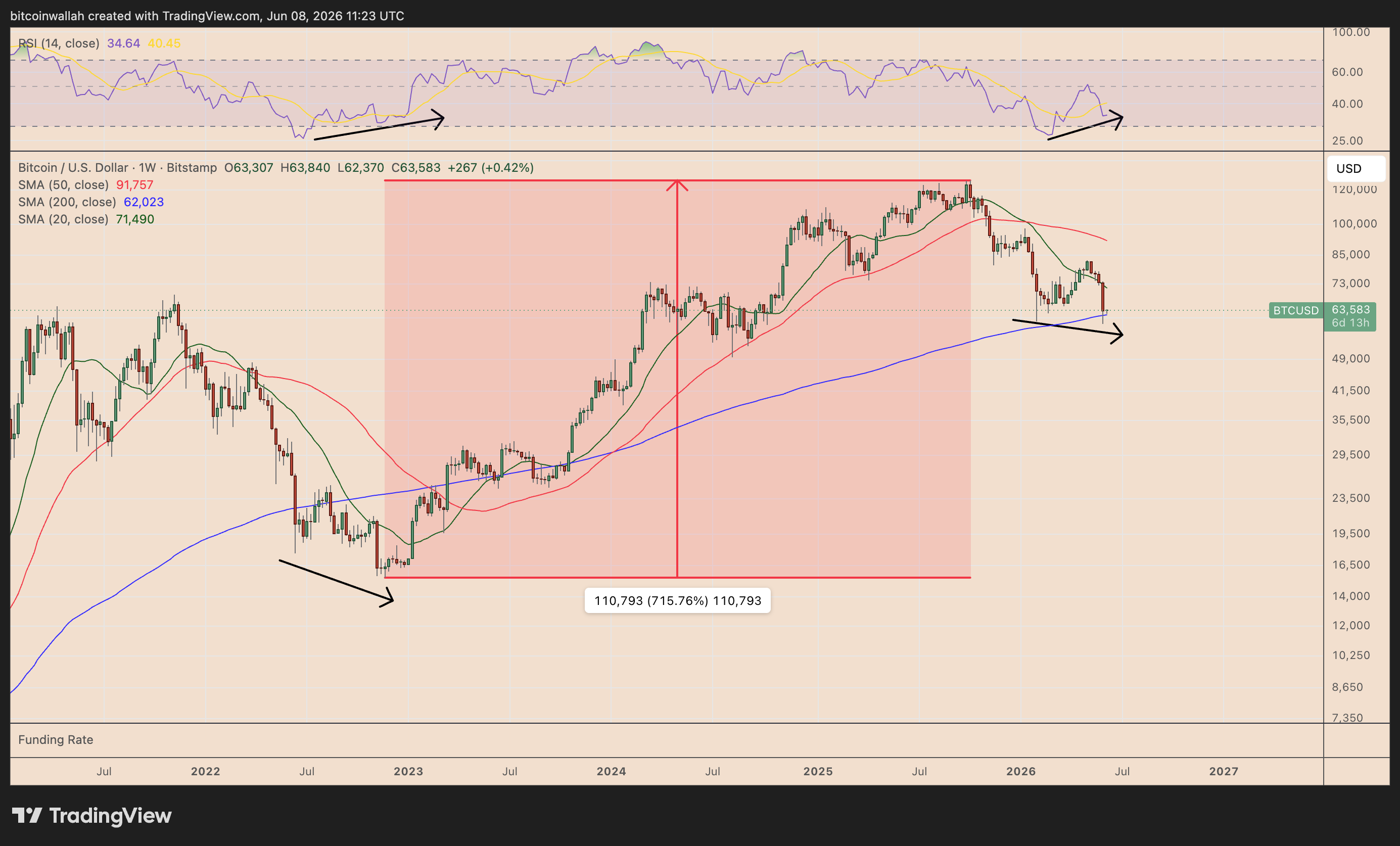
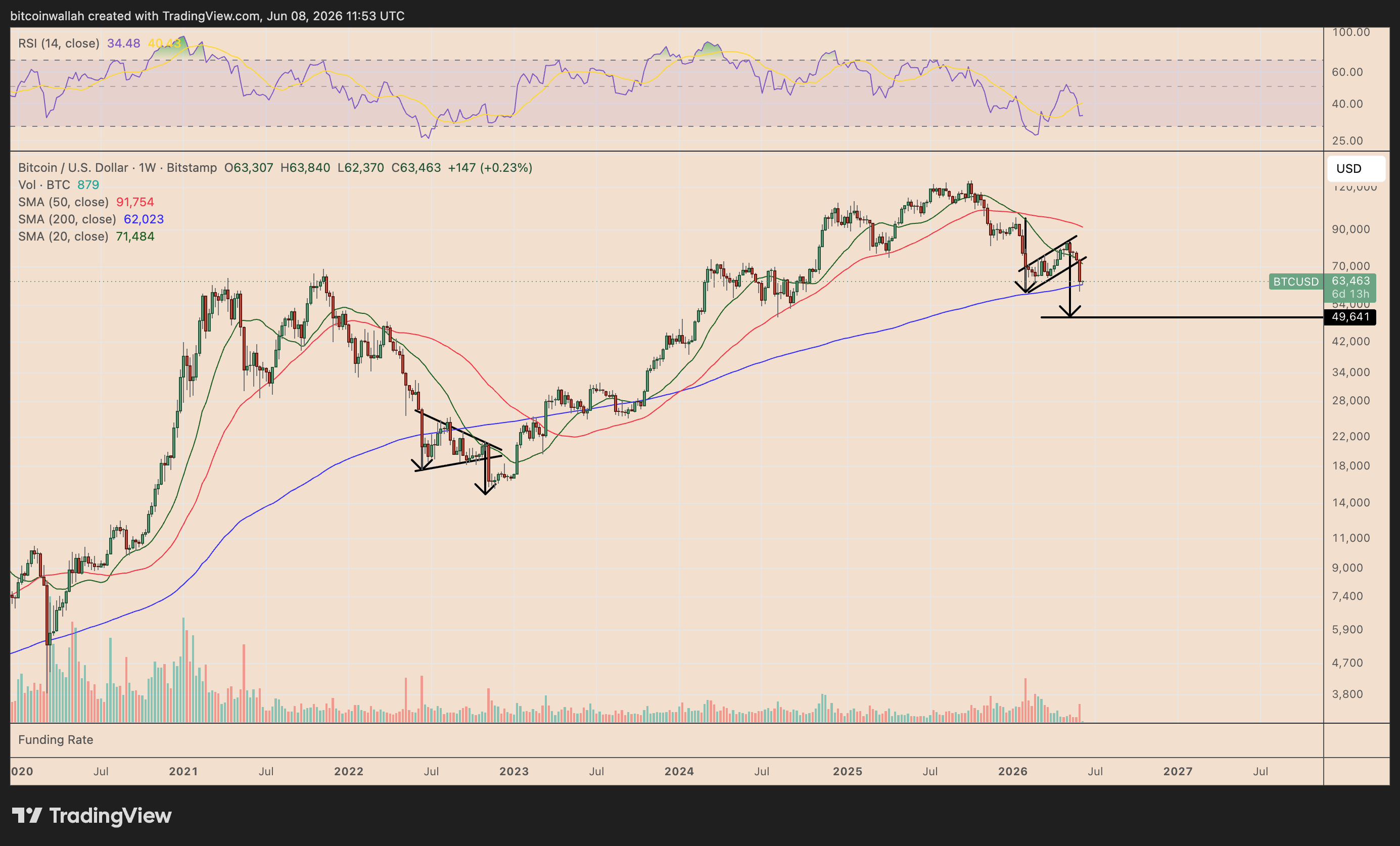
As of Monday, BTC’s weekly relative strength index (RSI) was over 34, almost two weeks after slipping under the oversold threshold of 30. In the same period, the price dropped to around $63,000 from $75,770.
BTC/USD weekly chart. Source: TradingView
Bitcoin is still falling to lower price levels, confirming that sellers remain active. However, its RSI is no longer dropping alongside price. Instead, the momentum indicator has rebounded from oversold territory and is now forming a higher low.
In technical analysis, this is known as a bullish divergence. It occurs when the price continues to weaken, but the underlying momentum starts improving. The setup often suggests that selling pressure is losing strength before price confirms a rebound.
A confirmed divergence this week would mark only the second such signal on Bitcoin’s weekly chart. The first followed the FTX crash in November 2022, preceding a 715% rally from around $15,500 to a record high near $126,200.
BTC/USD weekly chart. Source: TradingView
That historical precedent puts Bitcoin’s nearby upside levels back in focus. The first major target is the 50-week simple moving average (50-week SMA, red line) near $91,755, which often acts as dynamic resistance during recovery attempts.
Bitcoin holds historic bottom zone near $62,000
The bullish case is further supported by where the divergence is forming.
Bitcoin is holding near its 200-week SMA (blue line), currently at around $62,000. This line has acted as a bottom zone at the end of the 2015, 2018, and 2020 bear markets.
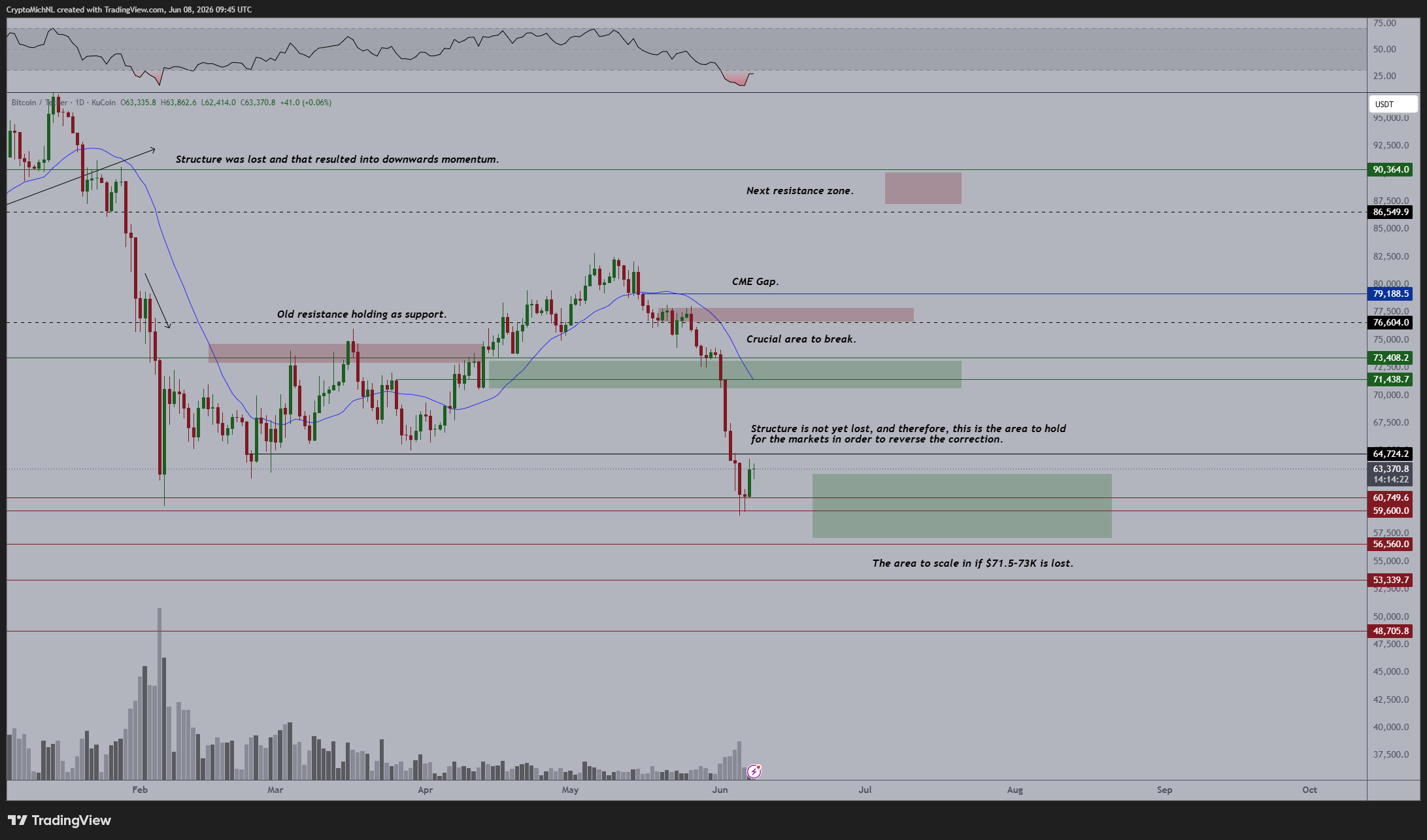
Analyst Michael van de Poppë called the 200-week SMA an “ideal area to accumulate,” albeit adding that bulls must break above the $64,000-65,000 area for further bullish confirmation.
“If that breaks, there’s nothing stopping Bitcoin from running all the way towards $71,500-73,000 and potentially even as high as the CME gap at $79,000,” he said in a Monday post.
BTC/USD daily chart. Source: Michael van de Poppë/TradingView
In the same analysis, Van de Poppe highlighted the area above $90,000 as the “next resistance zone,” aligning with the 50-week SMA target.
Bitcoin bear flag keeps $50,000 price target in focus
Bitcoin’s bullish divergence setup is forming while BTC is already in the breakdown stage of a weekly bear flag, keeping downside risks alive.
Related: BTC price bottom not due until Q4? Five things to know in Bitcoin this week
A bear flag forms when the price rebounds inside a rising parallel channel after a sharp decline, before breaking lower again. Bitcoin has now slipped below that channel, similar to its breakdown from the symmetrical triangle consolidation in 2022.
BTC/USD weekly chart. Source: TradingView
BTC risks falling toward the bear flag’s measured target under $50,000 if the pattern plays out. That level would remain in focus unless Bitcoin reclaims the flag’s lower trend line as support.
Bitcoin’s (BTC) lowest-ever readings on the daily and two-week relative strength index (RSI) are coinciding with steady accumulation across several investor cohorts, strengthening what one analyst called the “best thesis” for buying BTC.
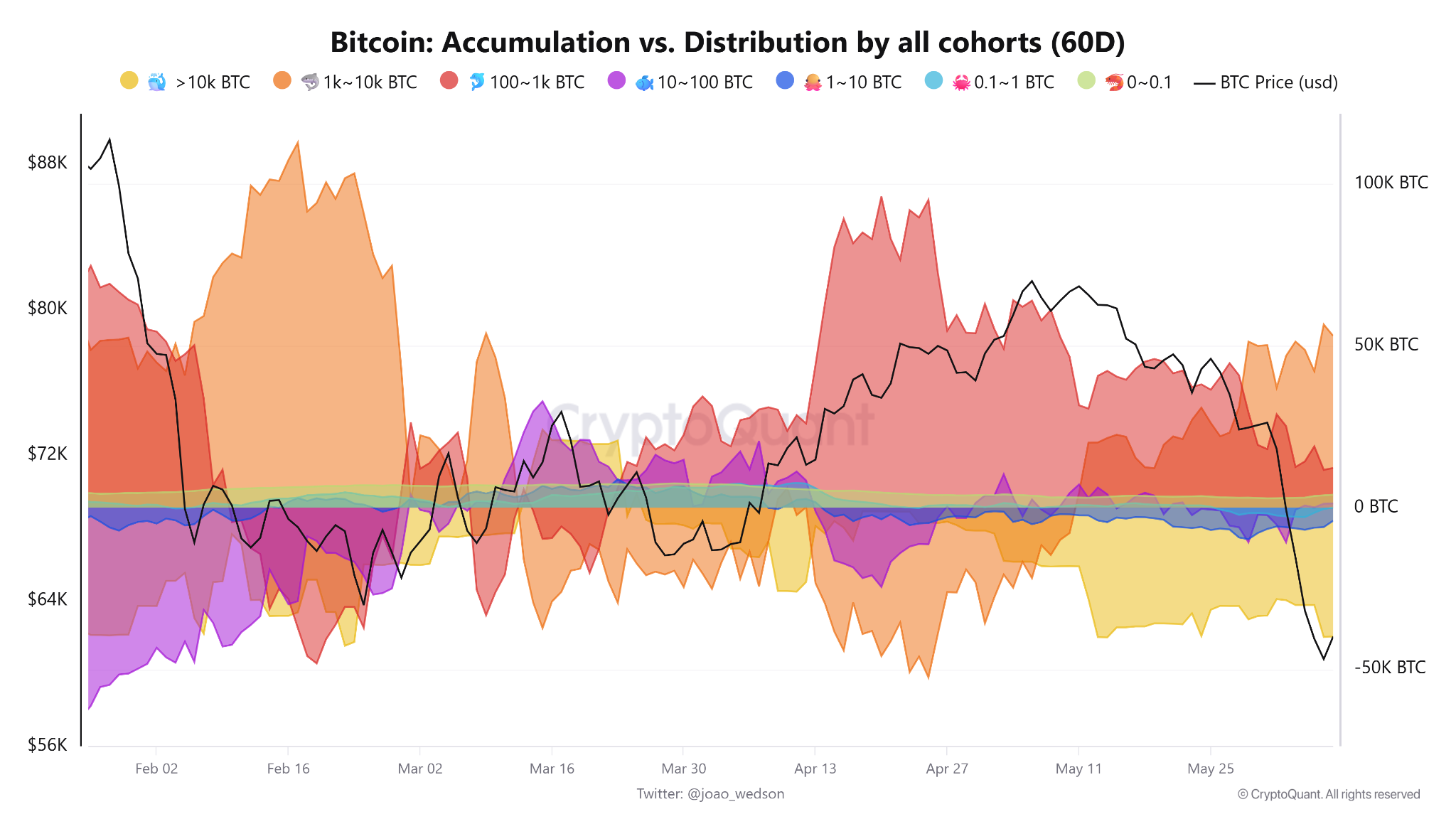
Onchain data shows wallets holding 1,000–10,000 BTC added more than 53,000 BTC over the past 60 days, while smaller retail investors also increased their holdings.
BTC accumulation grows across key cohorts
MN Capital founder Michael van de Poppe highlighted Bitcoin’s historically weak momentum readings as a potential long-term opportunity.
“The lowest Bitcoin read on the 2-Week RSI, and Daily RSI EVER. That’s the best thesis for accumulating and buying your Bitcoin,” van de Poppe said, adding that the panic-driven selling could continue while presenting rare buying opportunities.
Onchain data supports part of that view. Glassnode’s Accumulation Trend Score shows the strongest buying activity among smaller holders and select mid-sized investors. BTC wallets holding less than 0.1 BTC recorded a score of 0.78, the highest among the tracked cohorts. The 10–100 BTC group followed with a score of 0.71, signaling consistent accumulation over recent weeks.
Some larger holders have also been active buyers. Over the past 60 days, wallets holding 1,000–10,000 BTC added 53,042 BTC, the largest increase among all cohorts. Addresses holding 100–1,000 BTC accumulated another 12,233 BTC, while the 10–100 BTC group added 1,283 BTC.
However, a different picture emerged among the largest entities. BTC wallets holding more than 10,000 BTC reduced balances by 39,840 BTC during the same period. Smaller groups holding between 1 and 10 BTC also trimmed exposure. The positioning split points to sustained demand from whales below the largest cohort and from retail investors accumulating into weakness.
Bitcoin accumulation vs distribution (60-day change). Source: CryptoQuant
Related: Bitcoin price eyes $90K as FTX-era BTC bullish divergence flashes again
Analysts map potential bottom zones below $60,000
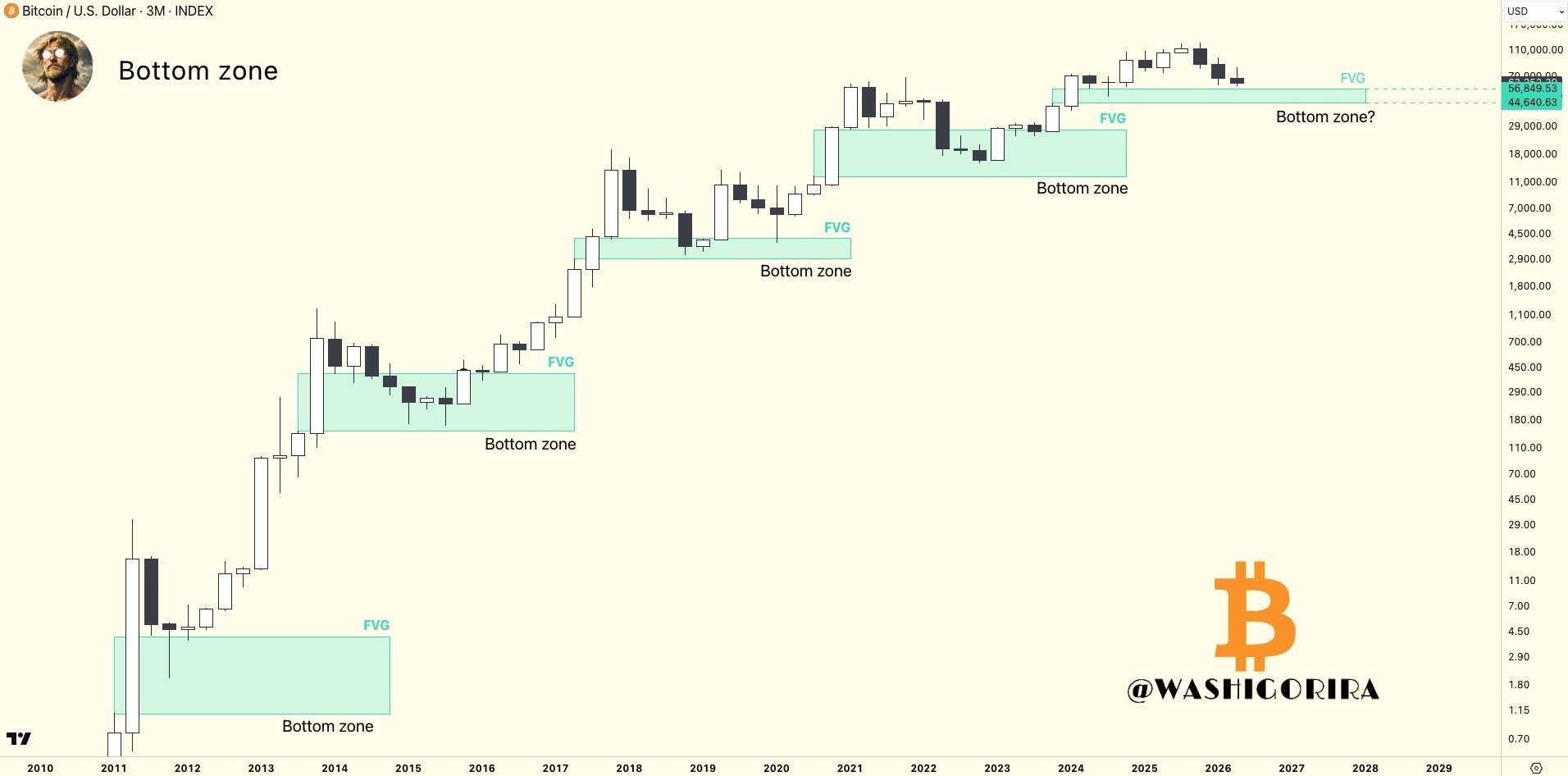
Market analyst Titan of Crypto highlighted a quarterly fair value gap (FVG) between $56,800 and $44,600. An FVG is a price imbalance created when Bitcoin moves sharply in one direction over a short period, leaving a zone with relatively little trading activity.
BTC quarterly price and FVG analysis by Titan of Crypto. Source: X
The quarterly chart shows that Bitcoin revisited similar imbalance zones created in 2011, 2013, 2017, and 2020 before establishing a bottom. The latest gap, formed in 2024, remains unfilled, making the $56,800–$44,600 range an important bracket if the current correction extends further.
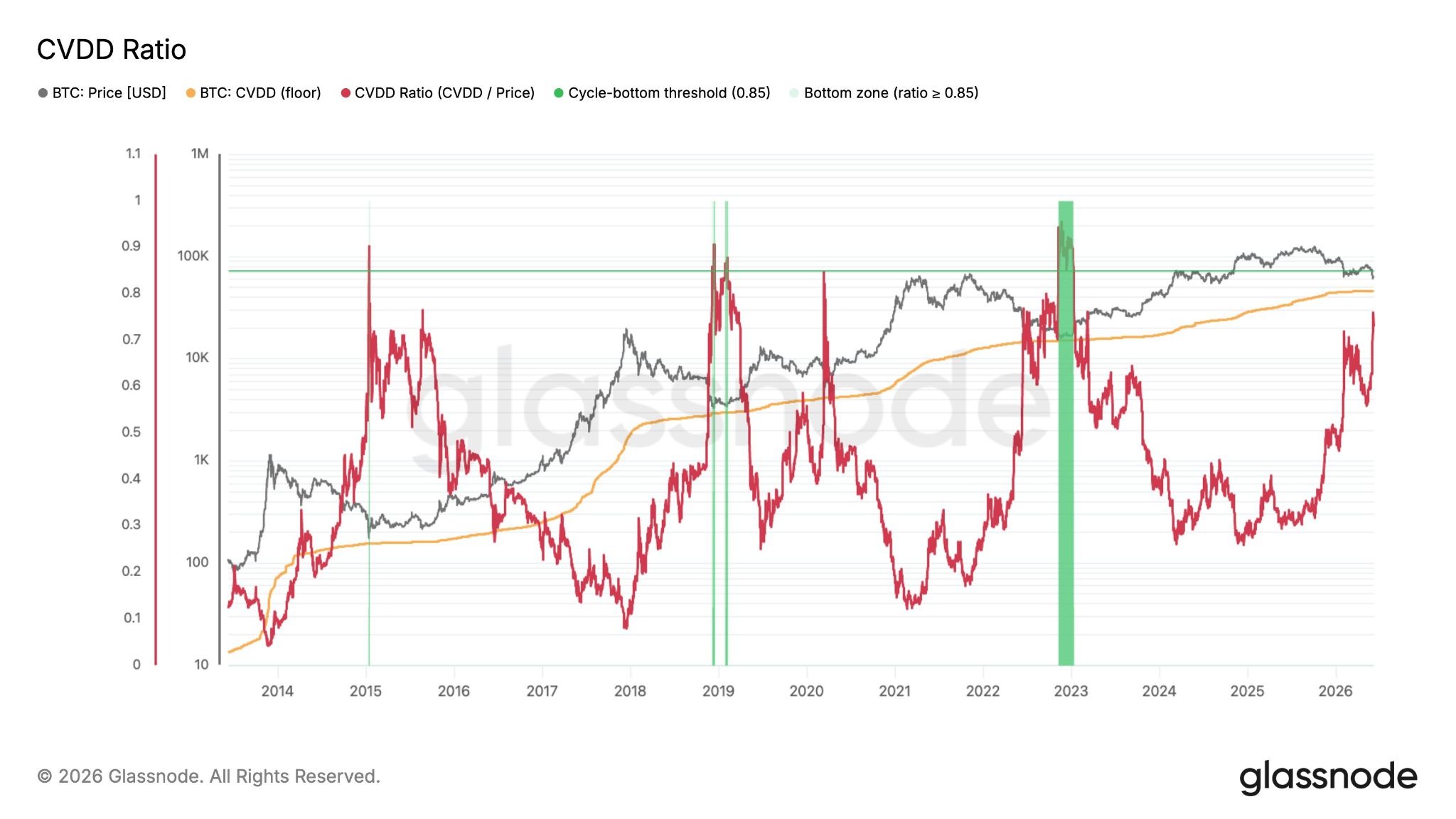
Meanwhile, Glassnode co-founder Rafael pointed to Bitcoin’s cumulative value days destroyed-to-price ratio (CVDD), a long-term valuation metric that compares the market price to a historical cost basis floor derived from coin-holding behavior. The ratio currently sits near 0.73 and has historically approached 1.0 near major cycle bottoms.
With the CVDD floor near $46,000, Rafael said a similar pattern would place a potential bottom in the $52,000–$59,000 range.
Bitcoin CVDD ratio. Source: Rafael/X
Related: Spot Bitcoin ETFs bleed $1.7B as outflow streak hits four weeks
Bitmine Immersion Technologies increased its Ether holdings to 5.54 million ETH after acquiring nearly 127,000 tokens over the past week, bringing its treasury to 4.59% of Ethereum’s total supply.
The company said it has now reached 92% of its stated goal of acquiring 5% of Ethereum’s total supply, a strategy it calls the “Alchemy of 5%.” It added that 4.72 million ETH (ETH), or about 85% of its holdings, are currently staked through validator infrastructure, worth roughly $7.7 billion at current prices.
Bitmine projected $230 million in annualized staking revenue from its current staked ETH position, with rewards potentially rising to $270 million if its holdings are fully staked through MAVAN and other staking partners.
Despite the broader crypto market pullback, Bitmine Chairman Tom Lee said advances in artificial intelligence could increase demand for public blockchains such as Ethereum (ETH), which he described as a “reliable decentralized” blockchain.
The global crypto market cap stands at $2.19 trillion, according to CoinMarketCap data at time of publication. That’s down from $2.69 trillion on May 9.
As of June 7, Bitmine held 5,543,872 ETH and 204 Bitcoin (BTC), along with $247 million in cash and equity stakes in Beast Industries and Eightco Holdings.
According to CoinGecko data, Bitmine ranks as the largest Ether treasury company among 32 public entities tracked by the platform. Its 5.54 million ETH holdings are more than six times larger than those of second-ranked SharpLink, which holds 868,699 ETH.
Top Ethereum treasury companies. Source: CoinGecko
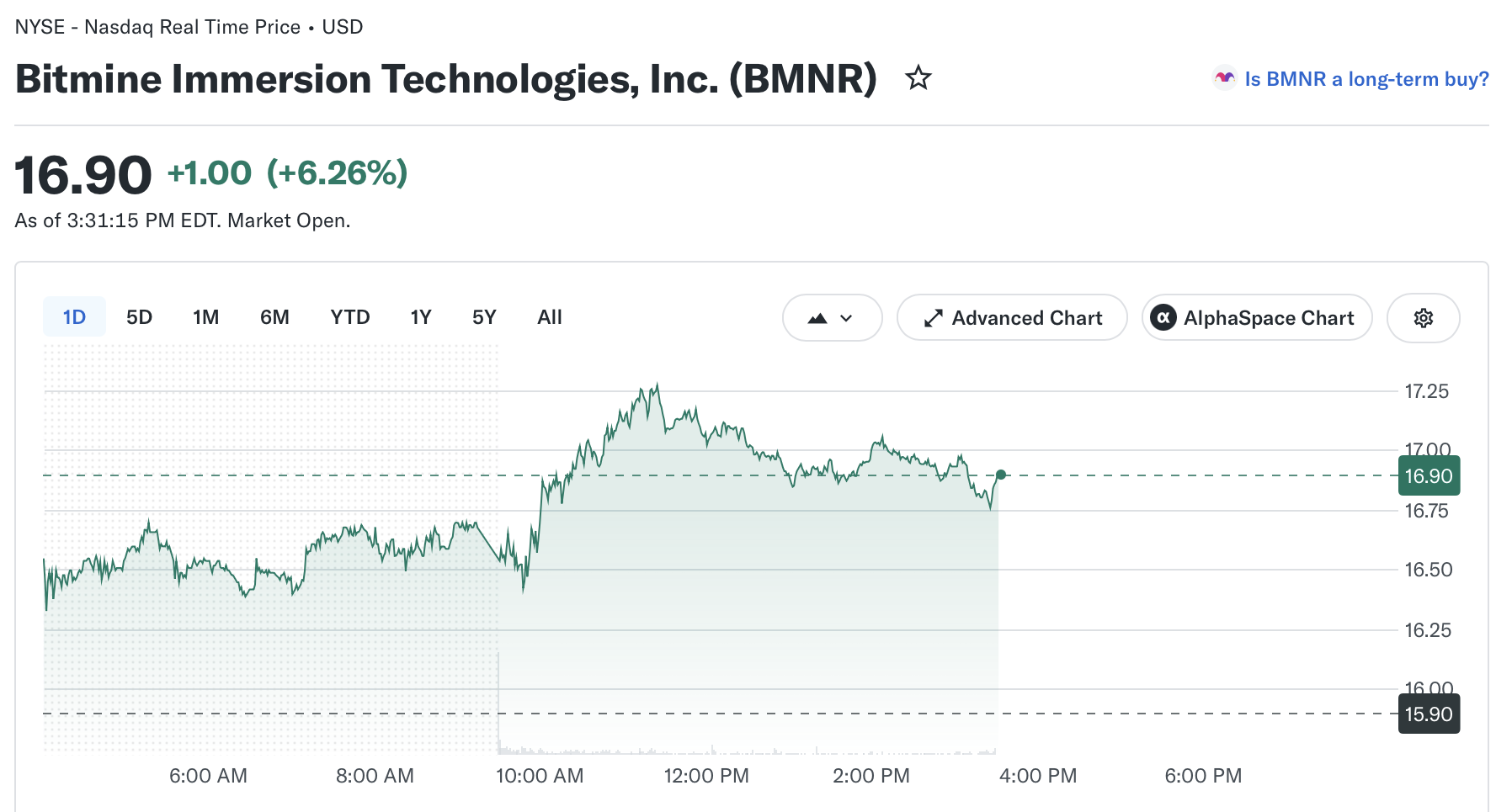
Bitmine shares rose more than 6% on Monday following the announcement, though the stock remains down around 38% year-to-date, according to Yahoo Finance data. The company had a market capitalization of about $9.59 billion.
Source: Yahoo Finance
Related: ETH falls to 13-month low on Zcash bug, Bitcoin below $60K: Is $1.4K next?
Ether faces pressure despite Bitmine’s continued accumulation
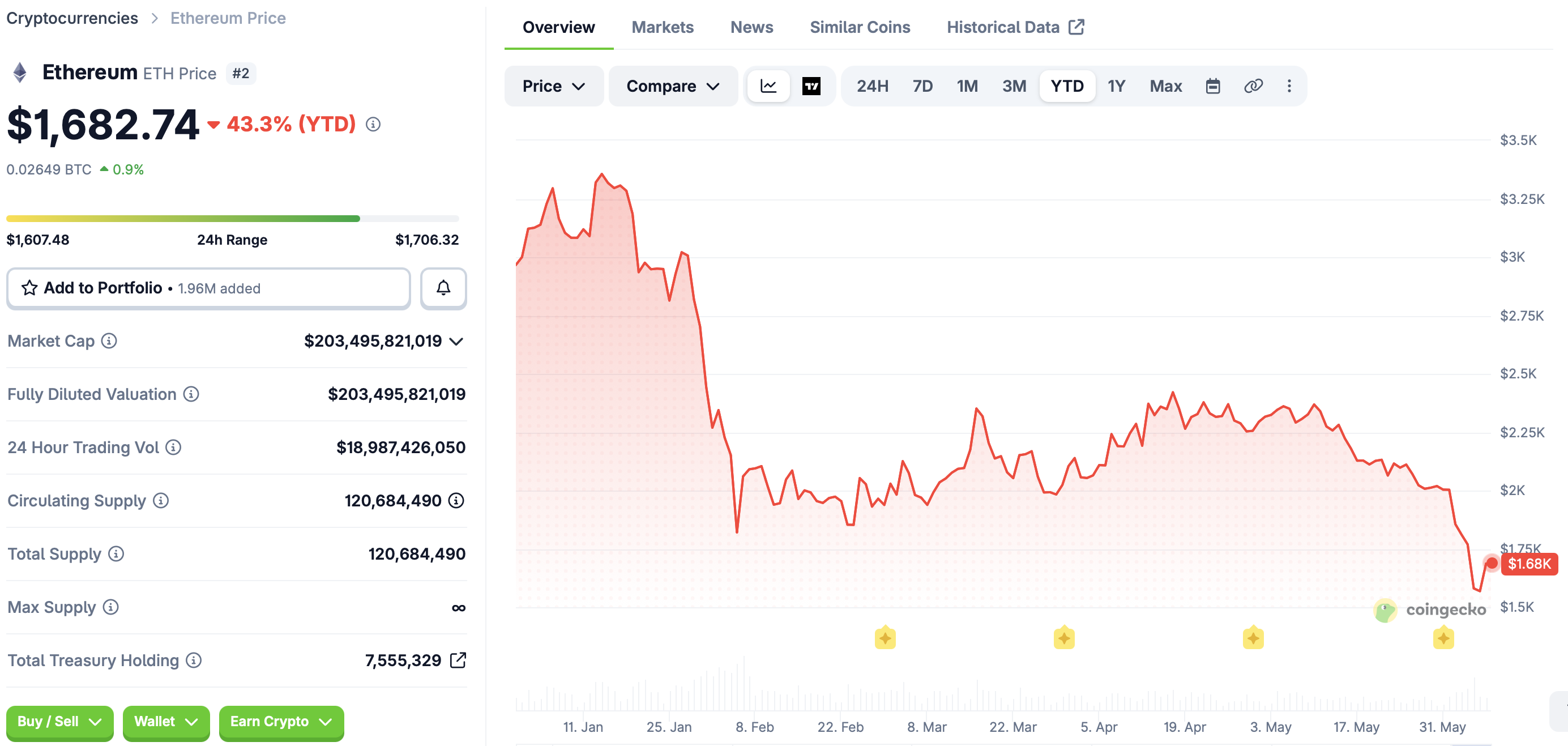
It has been a difficult year for Ether, the second-largest cryptocurrency by market capitalization, even as Bitmine aggressively expands its treasury. CoinGecko data shows ETH is down more than 43% year-to-date, falling from above $3,000 in January to about $1,685 on Monday.
Source: CoinGecko
Some large holders have reduced their exposure during the downturn. In May, the Ethereum Foundation sold 20,000 ETH through two over-the-counter transactions worth about $46.8 million combined. The sales followed an earlier 5,000 ETH deal in March, bringing the foundation’s total ETH sold this year to 25,000 ETH.
The cryptocurrency’s weak price performance has also prompted some long-time Ethereum supporters to reassess their investment outlook. In May, Bankless co-founder David Hoffman said he had sold the remainder of his Ether holdings, arguing that the long-standing “ETH is Money” thesis had largely played out.
Hoffman said he remains bullish on Ethereum as a network but believes much of its future growth may not be reflected in the token itself. He said that layer-2 networks and other ecosystem participants capture a significant share of the economic value generated on the blockchain.
Magazine: Bitcoin copying 2022 ‘almost perfectly,’ Ether to $4K in 2026: Market Moves
Memecoin issuance platform Pump.fun’s new bounty product has produced its first controversy.
A user posting as Arivu on X said he completed a Pump.fun GO bounty last week that asked someone to tattoo the ticker “$boutywork” on their forehead and provide video proof. The task appeared to reference a token called $Bountywork, but the bounty description itself used the misspelled version “$boutywork.”
Arivu said he followed the task exactly.
“Guys I have followed everything exactly what the name mentioned in the line,” he wrote on X, adding that it was not his mistake because he tattooed the exact name mentioned by the bounty creator. “Please i gave my life,” he wrote.
The typo then became the market.
A Solana token using the ticker BOUTYWORK began trading on PumpSwap, rising to an over $600,000 market cap shortly after going live. It grabbed over $3.5 million in volume in 24 hours, 2,630 holders and roughly $43,000 of liquidity.
Arivu later posted that he had received $20,000, but from the trading fee of a token someone had launched. He shared the token address and thanked users, saying they had changed his life.
‘Pay anyone to do anything’
Pump.fun GO, announced last week, that it will let users create and complete bounties for almost any task. The company pitched it as a way to “pay anyone to do anything,” a line that sounds like internet fun (and most of the bounties are light-hearted dares) until the task becomes more exploitive, such as permanent body modifications.
The backlash on the new platform came quickly.
One X user claimed to have spoken with the tattoo shop and alleged that the person who got the tattoo may have been exploited by someone else trying to profit from the token’s price rally. A phone call to the tattoo shop made by CoinDesk went unanswered twice.
Nikita Bier, the widely-followed head of product at X, was more blunt:
“It’s sad that all the rich people left crypto and it’s now the entire industry is just teenagers in America forcing poor people to do shameful things.”
The tattoo was not the only task pushing Pump.fun GO beyond normal memecoin theater.
Other open bounties reviewed by CoinDesk showed how widespread the dares are. Some were silly internet dares, such as one that asked users to beat a watermelon-eating challenge in under 60 seconds for a reward pool of about $93.
Another offered about $663 for people to go to Los Angeles’ Skid Row, a 50-block neighborhood that contains one of the largest homeless populations known for its drug markets and extreme poverty, and interview two homeless people on camera about who they voted for.
But some started to turn dangerous.
One bounty asked people to drink a whole bottle of alcohol while promoting a token, with videos showing multiple submissions of users appearing to chug bottles in about a minute.
Another offered about $266 for someone to shave their head while screaming “Jobcoin.”
That is where the exploitative nature of memecoin frenzy shows up.
Pump.fun GO turns attention into a bounty, the bounty into content, and the content into a token trade. The person doing the stunt may get a small payout. The creator can launch a coin around it and capture far more if the market catches on.
The more attention something gets, the more profit it could potentially generate.
To be clear, Pump.fun has no role in the types of streams users choose to create, and it has an active moderation team that takes down dark or malicious content. Pump has been moderating platform activity since it started.
CoinDesk has reached out to Pump.fun for comments.
However, this isn’t the first time Pump.fun has found itself embroiled in controversial social experiments.
Previously, the platform had live streaming videos ranging from extreme dark humor to dark behavior, all in an effort to pump their tokens to a few million dollars in market capitalization.
At the time when some of these streams went live, several videos that emerged, including suicidal streams, death threats and a man locked up in his toilet continuously, were disturbing, to say the least.
And that makes for the uncomfortable part of this story.
On one side, this is the wild and wacky side of crypto internet: a typo, a bounty, a Solana token, a viral photo and a chart that goes vertical before most people understand what happened.
On the other hand, when crypto is reeling from a bear market and trying to be taken seriously by the masses, such stunts show how quickly memecoin incentives can hold back crypto’s reputation as a serious contender for everyday financial rails.
Bitcoin rebounded on Monday, offering traders a partial reprieve after a sharp liquidation-driven slide that had pushed the world’s largest cryptocurrency into one of its weakest stretches in months.
According to CoinMarketCap Bitcoin data, BTC price rose 3.7% over the past 24 hours to trade at $63,971 at the time of writing. Trading activity also picked up, with Bitcoin’s 24-hour volume rising 14.91% to $35.95 billion.
BTC price rose to $63,971 up 3.7% over the past 24 hours. Image Credit: CoinMarketCap
The broader crypto market advanced 2.76% to $2.19 trillion.
The move looked less like a decisive return of risk appetite and more like an oversold relief rally. After a brutal week of forced selling, traders appeared to be covering short positions and rebuilding exposure in assets that had fallen quickly.
Bitcoin liquidations totaled about $255.91 million, amplifying the rebound as bearish positions were forced out of the market.
The recovery also came with a familiar caveat: crypto is still trading like a high-beta macro asset.
The crypto market showed a 61% correlation with the S&P 500, suggesting that Bitcoin’s latest move was tied less to a crypto-specific breakout and more to a broader repricing of risk. That matters because the same macro forces that triggered last week’s pressure remain in place.
Jobs Data Reset the Fed Trade
The latest pressure on Bitcoin began with stronger-than-expected U.S. labor-market data.
The U.S. economy added 172,000 jobs in May, while the unemployment rate held at 4.3%, according to reports on the May employment release. The reading weakened the case for near-term Federal Reserve easing and pushed investors to reassess the path of interest rates.
That shift is crucial for Bitcoin.
When traders expect rate cuts, liquidity-sensitive assets tend to benefit. When those expectations fade, speculative assets often struggle.
Ryan Lee, Chief Analyst at Bitget Research, said the employment report prompted investors to reassess expectations for Federal Reserve easing in 2026.
“The May U.S. employment report prompted investors to reassess expectations for Federal Reserve easing in 2026,” Lee said. “Payroll growth of 172,000 exceeded expectations, unemployment remained at 4.3%, and wage growth showed little sign of a sharp slowdown. Markets responded by reducing expectations for near-term rate cuts, pushing Treasury yields and the U.S. dollar higher.”
The bond market became the main signal.
“The strongest signal came from the bond market,” Lee said. “Rising Treasury yields indicate investors see less urgency for monetary easing and have greater confidence that economic activity will remain resilient. The move also suggests inflation risks have not fallen enough to justify an aggressive policy shift from the Federal Reserve.”
That created a difficult setup for crypto.
Higher Treasury yields increase the opportunity cost of holding non-yielding assets. A stronger dollar also tends to tighten global financial conditions. Together, those forces can weigh on Bitcoin, Ethereum and other digital assets.
Goldman Sachs has pushed its Fed rate-cut forecast into 2027 after the stronger jobs data, citing resilient U.S. growth and inflation risks tied partly to geopolitical tensions.
It means the rebound may remain fragile unless bond yields stabilize.
Strategy’s Sale Added to Market Anxiety
The other factor hanging over Bitcoin was Strategy.
Michael Saylor’s company, long viewed as the most aggressive corporate accumulator of Bitcoin, recently sold a small amount of BTC. The sale was unusual because Strategy’s investment narrative has been built around long-term accumulation rather than disposal.
Strategy sold 32 Bitcoin, marking its first sale since 2022. The move was reportedly tied to preferred stock obligations, not a broad liquidation of its Bitcoin treasury.
Still, the optics mattered.
For years, Strategy’s role in the market was simple: it bought Bitcoin and rarely introduced doubt about its commitment. Even a small sale challenged that perception and fed concern that other treasury companies could eventually become sellers if financing conditions tightened.
That concern appears to have eased after Strategy returned to buying.
The company announced the purchase of 1,550 Bitcoin for about $101 million, increasing its holdings to 845,256 BTC. The purchase was made at an average price of $65,332 per Bitcoin.
That makes the Saylor factor more complicated.
The earlier sale may have contributed to bearish sentiment during last week’s decline, especially because it broke the “never sell” image attached to Strategy. But the latest purchase suggests the company has not abandoned its accumulation strategy.
In market terms, the sale was a sentiment shock. The subsequent purchase was a confidence repair.
It does not remove the broader question.
If Bitcoin trades under pressure for a prolonged period, investors may continue to scrutinize treasury companies that rely on capital markets to fund Bitcoin purchases, dividends or preferred-share obligations.
ETF Outflows Show Demand Has Weakened
The rebound also followed a heavy period of ETF outflows.
U.S. spot Bitcoin ETFs ended a 13-day outflow streak last week, after roughly $4.4 billion left the products. A small net inflow ended the streak, but the broader signal was weaker institutional demand compared with earlier phases of the cycle
That is important because ETFs have become one of Bitcoin’s main marginal demand channels.
During bullish periods, ETF inflows can reinforce upside by absorbing available supply. During weak periods, redemptions can become a source of pressure, especially when combined with leveraged liquidations and macro selling.
The latest bounce therefore needs confirmation from flows.
A single recovery session can be driven by short covering. A durable market turn usually requires renewed spot demand, stabilization in ETF flows and reduced macro pressure.
Geopolitical Tensions Add Another Layer
The macro picture is also being shaped by geopolitical risk.
Oil markets have been volatile as tensions involving Iran, Israel and regional shipping routes have intensified. Reuters reported that the European Union imposed sanctions on Iranian individuals and an IRGC Navy unit over actions threatening maritime traffic in the Strait of Hormuz, a critical route for global oil supply.
Oil prices also jumped as the Iran-Israel conflict escalated, before paring some gains after Iran said it would end attacks on Israel. Brent and WTI still remained elevated, with traders watching the risk of disruption around the Strait of Hormuz.
This is relevant for Bitcoin through inflation expectations.
A sustained oil shock can make central banks less willing to cut rates. It can also raise volatility across equities, bonds, commodities and digital assets. In that environment, Bitcoin’s “digital gold” narrative often competes with its behavior as a leveraged risk asset.
Last week, the risk-asset identity won.
Bitcoin fell alongside broader risk markets as yields rose, the dollar strengthened and geopolitical uncertainty increased. Gold also came under pressure as real yields moved higher, while oil remained comparatively resilient because of supply-risk concerns.
Lee said the cross-asset reaction pointed to tighter financial conditions.
“Higher yields and a firmer dollar weighed on risk assets,” he said. “Bitcoin and Ethereum moved lower as liquidity expectations were repriced, while gold retreated as real yields increased. Oil remained comparatively resilient, reflecting expectations that labor market strength could support economic activity and energy demand through the second half of the year.”
That leaves Bitcoin exposed to two competing forces.
Geopolitical fear can increase interest in alternative assets. But if the same geopolitical fear lifts oil, inflation expectations and yields, it can hurt liquidity-sensitive trades.
Altcoins Add Momentum, but Also Risk
The rally was not limited to Bitcoin.
Narrative-driven sectors, including AI-linked tokens and GameFi names, also gained as traders moved back into high-beta assets. Such moves are common during relief rallies because beaten-down altcoins often rebound faster than Bitcoin when risk appetite improves.
Regulatory sentiment also helped.
Recent SEC statements have attempted to clarify how federal securities laws apply to crypto assets, including areas such as airdrops, protocol staking, protocol mining and token taxonomy.
The broader CLARITY Act debate has also kept traders focused on the possibility of a more defined U.S. market structure for digital assets. The proposed framework would help determine how oversight is split between the SEC and CFTC, though the legislative path remains politically complex.
That regulatory backdrop is supportive at the margin. But it is not enough by itself to offset macro tightening.
Key Levels to Watch
The immediate question is whether the crypto market can hold the rebound.
The total market capitalization has recovered to $2.19 trillion. A continuation move could push it toward $2.23 trillion, a level traders are watching as a potential Fibonacci 78.6% retracement zone.
The lower boundary is more important.
If the market loses the recent weekly low near $2.1 trillion, the bounce would look more like a temporary unwind of short positions than the start of a sustainable recovery.
For Bitcoin, the key test is whether buyers can defend the recovery above the latest lows and rebuild momentum toward the mid-$60,000 range. Failure to do so would keep the market vulnerable to another round of selling, especially if Treasury yields rise further.
Lee said the broader setup remains selective.
“Taken together, the market reaction points to a reduced probability of multiple Fed cuts in 2026 and a more selective risk environment,” he said. “Treasury yields remain the key indicator to watch, as current price action reflects a market that continues to price stable growth, restrictive monetary policy, and tighter financial conditions.”
That is the central tension in Bitcoin now.
The asset has bounced because it was oversold. It has support from short covering, altcoin momentum, Strategy’s renewed purchase and tentative regulatory optimism.
But the larger market is still dealing with higher yields, ETF outflows, geopolitical stress and doubts over liquidity.
Whether the rebound becomes a recovery depends on whether macro conditions stop moving against it.
The above article “Bitcoin Rebounds to 64K After Brutal Selloff as Fed Rate Cut Bets Fade and Saylor Strategy Concerns Ease” was first published on AlexaBlockchain. Read the complete article here: https://alexablockchain.com/bitcoin-rebounds-to-64k-after-brutal-selloff-fed-rate-cut-bets-fade-saylor-strategy-concerns-ease/
Read Also: Is India Moving From Crypto Uncertainty Toward a Clearer Policy Framework?
Disclaimer: The information provided on AlexaBlockchain is for informational purposes only and does not constitute financial advice. Read complete disclaimer here.
Bitmine (BMNR), the largest Ethereum treasury company, ramped up its purchases of ether (ETH) last week, making its largest weekly purchase in 2026 as crypto prices tanked.
The firm bought 126,971 ETH over the past week, worth roughly $214 million at current prices, Bitmine said on Monday, compared to 26,497 tokens the previous week and nearly 120,000 ETH the week before.
The purchase lifted the firm’s total holdings to 5.54 million ETH, worth some $9.3 billion at current prices, according to the report. The firm also held $247 million in cash, some bitcoin and stakes in Beast Industries and Eightco Holdings.
The acquisition marks a reversal from the company’s previous call to slow down accumulation as it nears its goal to corner 5% of ether’s outstanding supply. The company now holds 4.59% of the token’s supply and is set to reach the 5% goal later this year.
“We increased our buying as we believe this pullback in ETH prices does not reflect the strengthening of Ethereum fundamentals,” Bitmine chairman Thomas Lee said in a statement.
Bitmine has remained one of the few large digital asset treasury firms still actively adding to its crypto holdings, while most peers have halted purchases and pivoted to sell as crypto prices turned sharply lower since October. That bet is sitting on an estimated $9.6 billion of paper losses as ETH fell to its weakest price in more than a year, down some 65% from its August record.
The firm also unveiled plans to issue a preferred equity class that pays dividends to raise more funds, taking a page from bitcoin-centric Strategy’s playbook.
That model, however, has come under investor scrutiny. Investors are now debating whether Strategy will be able to comfortably pay its dividend obligations or shore up liquidity as bitcoin prices fell sharply last week. STRC, the firm’s latest preferred share class, fell to $90 Friday, some 10% below its par value, underscoring those worries.