MetaMask launched a new self-custodial wallet designed for AI agents, allowing autonomous software to trade across decentralized finance while keeping users in control of their funds, the Consensys-owned wallet provider said Monday.
The new MetaMask Agent Wallet gives AI agents access to swaps, perpetual futures, prediction markets and liquidity provisioning across Ethereum-compatible blockchains.
The launch comes as AI agents increasingly emerge as participants in crypto markets, executing trades and managing capital on behalf of users. MetaMask is pitching security as the wallet’s key differentiator.
The product is available through a limited early-access program, with a broader rollout planned in the next few months.
According to the company, every transaction initiated by an agent is automatically subjected to transaction simulation, threat scanning powered and MEV protection before execution. Transactions flagged as malicious will require human approval through two-factor authentication.
MetaMask said transactions deemed safe are covered by its Transaction Protection program, which provides up to $10,000 in protection against losses.
Users can choose between a default “Guard Mode,” which enforces spending limits, protocol allowlists and approval requirements, and an opt-in “Beast Mode” that reduces prompts while still requiring approval for potentially malicious transactions.
“The next great expansion of the onchain economy won’t be driven by humans alone,” Consensys CEO and Ethereum co-founder Joe Lubin said in a statement. “Agents will manage real capital and make real financial decisions, and the infrastructure underneath has to be worthy of that.”
Read more: MetaMask expands debit card across U.S. after year-long pilot
Bitcoin fell below $60,000 for the first time since October 2024 on Monday, sinking as low as $59,099 — a move that marks a decline of more than 50% from its all-time high near $126,000.
But according to John D’Agostino, Coinbase’s head of institutional strategy, the drop is being welcomed — not feared — by the most sophisticated players in the market.
Appearing on CNBC’s Squawk Box Monday morning, D’Agostino said the institutional investors he speaks with regularly are viewing the pullback as an opportunity to accumulate at a discount, not a reason to panic.
“I just got off a plane from the Middle East, and I can tell you that the family offices in the UAE and the government and sovereign funds that are putting the effort into buying this asset class are not unhappy at being able to buy it at a discount,” D’Agostino said.
His comments align with recent data showing sustained institutional buying through the downturn.
Abu Dhabi’s Mubadala Investment Company — a $330 billion sovereign wealth fund — reported holding 14.7 million shares of BlackRock’s iShares Bitcoin Trust (IBIT) as of March 31, 2026, a 16% increase quarter-over-quarter, marking four consecutive quarters of accumulation even as BTC declined roughly 40% from its all-time high.
JUST IN: Coinbase’s John D’Agostino says institutional investors and governments are happy to buy cheap Bitcoin at a discount 👀
“They’re thinking about what the cheapest way is to buy an asset that they loved at $125K, they liked at 100K, and loved even more at $65K” 🚀 pic.twitter.com/6Dx8M3wG50
— Bitcoin Magazine (@BitcoinMagazine) June 8, 2026
“100 Billion Dollars of Bitcoin ETF Exposure”
Despite Bitcoin’s steep correction, D’Agostino pointed to a striking statistic as evidence of durable retail conviction: Bitcoin ETFs still hold approximately $100 billion in exposure even after the price has dropped nearly 50% from its peak.
“The price has dropped almost 50% from the peak, and we’ve only seen about a 15% drawdown in retail interest,” D’Agostino noted. “So I think both retail and institutional are signaling this is a long-term asset you want to hold.”
BlackRock’s iShares Bitcoin Trust alone held roughly $51.9 billion in assets under management as of earlier this year, representing approximately 45% of all spot Bitcoin ETF assets.
Some reasons for the pullback
When pressed to identify the drivers behind Bitcoin’s “winter,” D’Agostino largely agreed with a list offered by the Squawk Box host, which included: risk-off sentiment pushing investors toward more liquid positions; interest rates remaining elevated, weakening the debasement trade thesis; regulatory clarity remaining in legislative limbo; and Strategy’s Michael Saylor breaking his long-standing “never sell” pledge by offloading a portion of the company’s Bitcoin holdings.
Saylor’s firm executed the sale of 32 bitcoins between May 26 and May 31 for approximately $2.5 million — a move that rattled market sentiment even though it represented just 0.004% of Strategy’s total 843,000+ BTC holdings. The sale triggered a sharp negative market reaction that sent BTC tumbling below $72,000 before the broader slide continued.
D’Agostino also cited a 100-day war with Iran and the closure of the Strait of Hormuz as macro overhangs applying pressure to risk assets globally, while noting that crude oil has remained surprisingly subdued below $100 a barrel — a reminder that volatility in complex macro environments doesn’t always follow intuition.
On the legislative front, D’Agostino highlighted bills currently circulating in Congress that he said would strengthen the institutional infrastructure supporting Bitcoin and digital assets more broadly. The Digital Asset Market Clarity Act — known as the CLARITY Act — cleared the Senate Banking Committee on May 14, 2026 with a 15-9 vote, marking the first comprehensive crypto regulatory framework to advance to the Senate floor.
A separate bill, the PARITY Act, addressing crypto taxation, is also moving on an independent legislative track with bipartisan support.
No panic at the institutional level
When asked about the risk of leveraged holders facing margin calls and forced liquidations at lower prices, D’Agostino said he was not aware of any major institutional players that were “horrifically overleveraged” at levels anywhere close to current prices. He said the bigger risk remains with retail traders on offshore exchanges offering extreme leverage.
“On the institutional side, I’m not seeing folks panicking at this point,” D’Agostino said. “I’m seeing them thinking about what the cheapest way is for them to acquire new capital to buy into an asset that they loved at $125K, they liked at $100K, and they love even more at $65K.”
Strategy appeared to underscore that point Monday, disclosing it purchased an additional 1,550 BTC for $101 million — buying the dip at approximately $65,000 per coin just days after selling 32 coins at $77,135 each.
Decentralized finance (DeFi) is recovering from a string of sophisticated exploits that have triggered an intense debate over whether public blockchain protocols can truly handle systemic risk.
The crisis peaked in April 2026, with the $292 million exploit of KelpDAO’s LayerZero-powered bridge triggered a devastating $8.45 billion deposit run on Aave, the world’s largest decentralized lending platform. The massive withdrawals occurred within 48 hours.
Stani Kulechov, founder and CEO of Aave Labs, defended Aave’s mathematical superiority over traditional finance at the Proof of Talk event in Paris last week. Rather than addressing the operational failures of a multi-million dollar liquidity crunch that nearly broke Aave’s insolvency shields, Kulechov pivoted to frame the massive capital flight as empirical proof of the network’s “resilience.”
“Aave’s existing V3 infrastructure has seen multiple market cycles,” he said, adding that “Aave has been really resilient during really turbulent times.”
However, a closer look at the April crisis reveals that Aave’s survival relied less on flawless autonomous design and more on a chaotic, human-led $300 million emergency bailout. The emergency recovery effort required a 25,000 ETH pledge from the Aave DAO and a personal 5,000 ETH ($8.4 million) contribution from Kulechov himself to stave off disaster.
Deflecting the blame
Kulechov separated core smart contract code from the external infrastructure failures impacting the wider market.
“When it comes to development as well… there are very few, actually any sort of issues in DeFi protocols’ smart contracts generally,” Kulechov argued. “They are actually third-party dependencies that are related to more traditional security that might have an impact across the DeFi space, as we’ve seen recently.”
While technically precise, the April hack began with an RPC-spoofing and DDoS attack targeting LayerZero’s verifier nodes on KelpDAO rather than a bug in Aave’s code. Risk analysts said that Kulechov’s defense side-steps a harsher reality.
Blockchain risk modeling firm LlamaRisk later revealed that the hackers used the exploit to mint worthless collateral, deposit it into Aave, and drain authentic wrapped Ether (wETH), leaving Aave V3 saddled with an estimated $123.7 million in bad debt. Furthermore, banking analysts at the Bank Policy Institute pointed out that Aave’s inadequate insurance exposed how DeFi platforms are vulnerable to bank runs in detriment of their users.
Blueprint for V4
Kulechov did concede that the architectural threat of contagion requires a complete overhaul. To prevent future bridge failures from triggering systemic deposit runs, he noted that Aave Labs is using its upcoming V4 upgrade to fundamentally restructure its risk management.
Kulechov explained that Aave Labs is using its upcoming V4 tech upgrade to entirely redesign risk management with the aim of preventing future bridge exploits from triggering deposit runs.
Kulechov explained that under the new version, a modular “hub-and-spoke” system will replace traditional token pooling, enabling the core protocol to autonomously levy localized risk premiums and freeze specific collateral lines before contagion can reach primary lending reserves.
“When you have a completely auditable and public system, anyone can actually inspect the code and also do different kinds of risk analysis based on that. I think that is the key to building resilient software,” he concluded.
Whether institutional allocators will continue to overlook these multi-billion dollar “stress tests” while waiting for V4 to launch remains the defining question for DeFi’s mainstream future.
Bitcoin traded around $63,000 on Monday, clawing back from a two-month low hit on June 5 as a confluence of headwinds — spot ETF outflows, macro uncertainty, and capital rotation into artificial intelligence stocks — pushed the world’s largest cryptocurrency roughly 50% below its all-time high of $126,279 reached in October 2025.
The decline has triggered familiar scenes of capitulation. Retail investors have largely stepped back, and mainstream headlines have leaned into the fear. But a growing chorus of institutional voices is pushing back hard.
In a report published Monday, analysts at Wall Street brokerage Bernstein said Bitcoin’s long-term “store of value” thesis is unchanged, even as net inflows into spot Bitcoin exchange-traded funds and corporate treasury companies have slowed to $12 billion so far in 2026, down sharply from $60 billion in 2025.
The firm attributed the bulk of selling pressure not to ETF holders, but to corporate treasury companies liquidating positions — with spot ETFs recording only about $2.6 billion in net outflows year-to-date.
“Bitcoin being boring this cycle should not be held against it,” Bernstein wrote, adding that the slowdown in retail momentum does not undermine the structural ownership case for Bitcoin.
The brokerage’s report highlighted that 61% of Bitcoin’s circulating supply has not moved in more than a year — a figure that points to a base of holders unwilling to sell at current prices.
Bernstein has maintained a price target of $150,000 for Bitcoin in 2026, citing a structural shift in the investor base toward institutions including wealth management platforms, pension funds, and sovereign wealth funds.
The firm has previously described early 2026 as featuring the “weakest bear case” in Bitcoin’s history, arguing that growing adoption among banks and major investment firms separates the current downturn from previous crypto winters.
Institutions accumulate Bitcoin while retail rotates away
The near-term pressure on prices has several identifiable sources. Capital has rotated at a historic pace toward the AI trade, with hundreds of billions flowing into hyperscalers and large-cap technology names in recent months.
The SpaceX IPO, set for June 12 on Nasdaq and targeting a valuation between $1.75 trillion and $2 trillion, has drawn significant retail attention away from digital assets, according to analysts tracking the reallocation. Strategy’s Bitcoin sales have added further selling pressure to the market.
On the legislative front, the CLARITY Act — a comprehensive digital asset market structure bill that would divide regulatory authority between the SEC and the CFTC — cleared the Senate Banking Committee in May by a 15-9 vote.
The bill passed the House last July with a 294-134 vote. Its final passage into law could resolve years of regulatory uncertainty that has held institutional capital at the edge of the market.
Brownstone Research senior crypto analyst Ben Lilly drew a direct parallel to the bear market of 2022, when BlackRock launched a private Bitcoin trust in August of that year at the depth of the downturn — a move that preceded the most successful ETF launch in history, BlackRock’s spot Bitcoin ETF (IBIT), which reached $80 billion in assets under management five times faster than the previous record holder, Vanguard’s S&P 500 ETF.
The same playbook, Lilly argued, is running again: institutions are building while retail checks out.
The European Union’s (EU) regulatory framework has redefined the competitive landscape of Web3, unintentionally shifting the advantage away from crypto startups, directly into the hands of legacy financial institutions, according to Charles Guillemet, chief technology officer (CTO) at wallet maker Ledger.
While the EU’s Markets in Crypto-Assets (MiCA) regulation was designed to establish a unified, secure market, industry insiders warn its steep financial barriers are choking early-stage innovation. Under the framework, crypto companies face strict tiered minimum capital requirements. The costs range from 50,000 euros ($58,000) for advisory services to 150,000 ($174,000)just to operate a trading platform, on top millions of euros in mandatory legal auditing, insurance, and continuous compliance infrastructure.
An impact assessment by the EU Commission on MiCA estimated that each white paper could cost issuers between $4,500 and $87,000, depending on the complexity of the regime and the amount of legal advice required.
“I’m not sure that was the initial intent, but this is the result,” Guillemet said. “When it’s implemented, you have two kinds of companies: those who can pay for this compliance overhead, and the other ones that can’t. Smaller players cannot access the market, which creates a moat for the bigger players.”
While crypto startups view the high costs of MiCA compliance as a barrier to entry in the EU, European regulators have defended the rules, saying they are required to protect consumers and build mainstream institutional trust.
Institutional security
The widening regulatory gap comes at a critical time when traditional finance (TradFi) transitions from testing blockchain to full-scale adoption. Guillemet recalled the listing of spot crypto ETFs in early 2024 as a significant turning point, which sparked significant demand from traditional banks for enterprise-grade custody and asset tokenization.
“Before, banks mostly wanted to do small innovation projects,” Guillemet explained. “Now, it really changed. The main departments of banks really want to build around crypto, and they want to go all-in on blockchain technology.”
To capture this banking business, Ledger has been expanding past its retail roots into a dedicated business-to-business (B2B) infrastructure. Building these institutional security setups requires serious cash; Ledger has spent hundreds of millions of dollars over the years to maintain a massive engineering team.
“First and foremost, Ledger is a security company,” Guillemet said. “We have around 200 to 250 engineers who are working at Ledger to build the technology. We have a dedicated security team, who spend 100% of their time improving the security of our product. Security is front and center in everything we do.”
Real-world risks
However, Ledger’s massive security budget is an indication of the challenges its executive team continuously faces: in Web3, even hundreds of millions of dollars in engineering defenses cannot guarantee absolute immunity.
While Guillemet introduces Ledger’s enterprise architecture to traditional banks, the firm’s historical vulnerabilities underscore the relentless operational risks public blockchains face.
Ledger previously reported a cloud breach involving a third-party processor. That incident followed a major 2020 data breach affecting 270,000 customers, and a 2023 exploit that drained $500,000 from decentralized applications.
As traditional banks rush to bring real-world assets onto public blockchains, they are leaning on native crypto security firms to handle these operational risks. The end result is a shifting landscape: while smaller startups are being priced out of Europe by high compliance costs, traditional financial institutions are moving in, using native crypto code to build the new plumbing of global finance.
Citrini Research, the firm that sparked massive fear of an artificial intelligence bubble in February and triggered a brief market meltdown, has listed crypto exchange Hyperliquid and its token as a new “compelling” idea.
The research firm said in its report on Monday that “unlike the memetic majority of crypto (bitcoin included), HYPE generates legitimate cash flow. On top of that, there is even a buyback mechanism,” according to an excerpt shared on social media, which is gated by a paywalled version of the report.
Hyperliquid is a blockchain-based exchange that allows users to trade perpetual futures of crypto and other assets, such as commodities and private stocks. Its associated token, HYPE, has been one of the biggest outperformers this year, even as the rest of the digital asset sector was caught in a freefall.
The platform has generated $1.06 billion in annualized fees and about $220 billion in 30-day perp volume, according to DeFiLama data
“Over 90% of the fees generated by the platform are redirected into the Assistance Fund [token buyback vehicle], which are then systematically used to purchase HYPE on the open market,” the Citrini Report said.
“The structure in itself is attractive, but what’s more astonishing is the pure scale of the Fund. Since its launch in January 2025, cumulative purchases have surpassed $2 billion,” the report added, noting that the buyback accounted for nearly half of all token-buyback activbities across crypto sector last year.
Hyperliquid has emerged as the dominant player in decentralized perpetual futures trading, accounting for the majority of on-chain derivatives volume. HYPE’s investment thesis is increasingly tied to the underlying business performance of the exchange, however, some analysts have argued that the buyback model relies heavily on sustained trading activity and could come under pressure if derivatives volumes decline. Nevertheless, the company’s ability to generate substantial revenue sets it apart from much of the crypto sector where many token valuations are simply a result of speculation. Beyond the company’s business model, its dominance in global markets has helped fuel a broader push into perpetual futures – which have historically been banned for American traders due to regulatory constraints – in the U.S.
The Commodity and Futures Trading Commission (CFTC) last month opened the door for certain crypto perpetual futures products to be offered under U.S. oversight. The move has triggered a race among exchanges, including Kraken and Coinbase (COIN), seeking to capture demand for a market that accounts for the majority of global crypto trading activity. While Coinbase has already expanded its perp offerings in the U.S., Kraken is likely launching its product later this month.
Sam Bankman-Fried, the founder and former CEO of collapsed crypto exchange FTX, formally sought a presidential pardon from President Donald Trump while serving a 25-year prison sentence for fraud and conspiracy.
The clemency application appeared Monday in records maintained by the U.S. Department of Justice’s Office of the Pardon Attorney. The case is listed as pending, meaning a clemency petition has been opened and is under review. The office said details of ongoing reviews are not publicly disclosed.
The former crypto executive, known by his initials SBF, was convicted in 2023 for orchestrating the fraud and conspiracy scheme that ultimately undid FTX, once one of the world’s largest cryptocurrency exchanges.
The company collapsed in November 2022 after CoinDesk reported on balance sheet concerns tied to affiliated trading firm Alameda Research, exposing an $8 billion hole in FTX’s accounts and triggering a run on customer deposits.
Bankman-Fried confirmed his interest in clemency during a recent interview with FOX Business.
“I assume that you would want a pardon from the White House?” FOX Business correspondent Susan Li asked him by phone. “Absolutely,” Bankman-Fried responded. “It would be obviously, you know, ultimately up to the president, not up to me.”
He declined to say whether members of his family were lobbying the administration on his behalf. SBF’s parents, Stanford Law School professors Joseph Bankman and Barbara Fried, have previously reached out to individuals in Trump’s orbit to explore a possible presidential pardon for their son. It’s not clear whether any direct discussions with White House officials took place.
The pardon request follows months of public statements from Bankman-Fried that have aligned with Trump’s positions. Writing through intermediaries using prison-approved communications, he has praised the president’s decision to launch strikes against Iran, argued that Trump helped “save” the Securities and Exchange Commission by replacing former Chair Gary Gensler with Paul Atkins and highlighted lower gasoline prices during Trump’s tenure.
He also appears to be following a playbook he wrote to try and ingratiate himself with Republicans after being seen as a Democratic mega-donor during the 2020 election. This playbook included items like appearing on Tucker Carlson’s show, something he did last year.
The outreach has drawn attention because Trump has shown a willingness to pardon high-profile defendants, including several figures tied to the crypto industry. Since returning to office, Trump has pardoned Silk Road founder Ross Ulbricht, former Binance CEO Changpeng “CZ” Zhao and the co-founders of BitMEX.
Still, Trump’s support is far from assured. In a January interview with The New York Times, the president said Bankman-Fried should not count on receiving clemency, grouping him with several other high-profile defendants he did not intend to pardon.
For now, Bankman-Fried remains incarcerated while his appeal efforts and clemency petition move through separate channels.
Bitcoin (BTC) holder Strategy’s (MSTR) capital trap is getting tighter, according to Ilan Solot, senior global markets strategist, at Marex Solutions, a division of global financial services firm Marex.
The company is sitting on a massive bitcoin hoard, accumulated through aggressive buying and stock dilution. Common shareholders bought Saylor’s vision, making the company a leveraged bet on BTC. But that narrative is colliding with reality.
“Strategy is now a fight over the capital waterfall; every move protects one stakeholder by torching another,” he said in an email to CoinDesk.
Indeed, different groups, including BTC holders, are competing for capital, and they sit in a hierarchy. In a crisis, debt gets paid first. Then preferred shareholders. Then common. Then whatever’s left, mainly BTC holders. Right now, Strategy needs capital. But every option available destroys someone.
Sell bitcoin? That hurts the core narrative and common shareholders who believed in it. Issue more stock? That dilutes current equity holders. Skip the preferred dividend? That torches yield tourists. Issue more debt? Everyone below that debt in the waterfall moves further from safety.
“The whole dance here is about who gets stuck with the loss,” Solot said.
The company could keep issuing debt. But there’s a limit. Eventually, lenders stop lending. Then the hard choice comes: hurt common shareholders or hurt preferred shareholders or sell the bitcoin. There’s no option that doesn’t hurt someone.
“Issue more debt and everyone below gets pushed further down the waterfall,” he said.
The Consensys-owned wallet provider opened early access Monday for autonomous AI agents to trade across 25+ EVM chains and Hyperliquid, with transaction simulation and $10,000 in loss coverage as the security pitch.
MetaMask launched Agent Wallet in early access Monday, giving AI agents self-custodial access to swaps, perpetual futures, prediction markets, and liquidity provisioning across 25 or more EVM-compatible blockchains, including Hyperliquid. The rollout is limited to an initial cohort; a broader release is planned for later this summer.
The product is MetaMask’s first dedicated wallet layer for autonomous software. Consensys, the parent company behind the wallet, which counts over 30 million monthly active users, is positioning Agent Wallet as infrastructure for what it calls the agentic economy.
Security Architecture
Every transaction an agent initiates passes through transaction simulation, Blockaid-powered threat scanning, and MEV protection before execution. Transactions flagged as potentially malicious require human approval through two-factor authentication.
MetaMask said safe transactions are covered by its Transaction Protection program, which provides up to $10,000 in coverage per user against losses.
Users choose between two operating modes. Guard Mode enforces spending limits, protocol allowlists, and explicit approval requirements. Beast Mode reduces approval friction while still routing potentially malicious transactions to human review.
Competitive Landscape
The launch adds to a growing stack of agent-wallet experiments across the industry. Base launched an MCP Agent Gateway in May for AI-driven portfolio management across DeFi protocols. Fireblocks released an agentic payments suite in May targeting payment service providers and fintechs. ZeroDev’s account-abstraction infrastructure and Coinbase’s developer agent kits also address the same use case from different layers of the stack.
MetaMask’s angle is that its security layer, already deployed for human users, transfers directly to agent use, without requiring a separate wallet or new custody arrangement.
Agent Framework Support
Agent Wallet works with leading agent frameworks, including OpenClaw, OpenAI Codex, Claude Code, Nous Research Hermes Agent, and Cursor. The underlying delegation model, built on MetaMask’s Advanced Permissions system, lets users define asset, amount, and time-window limits for any agent, with wallet-native approval and revocation at any time.
“The next great expansion of the onchain economy won’t be driven by humans alone,” Consensys CEO and Ethereum co-founder Joe Lubin said in the release. “Agents will manage real capital and make real financial decisions, and the infrastructure underneath has to be worthy of that.”
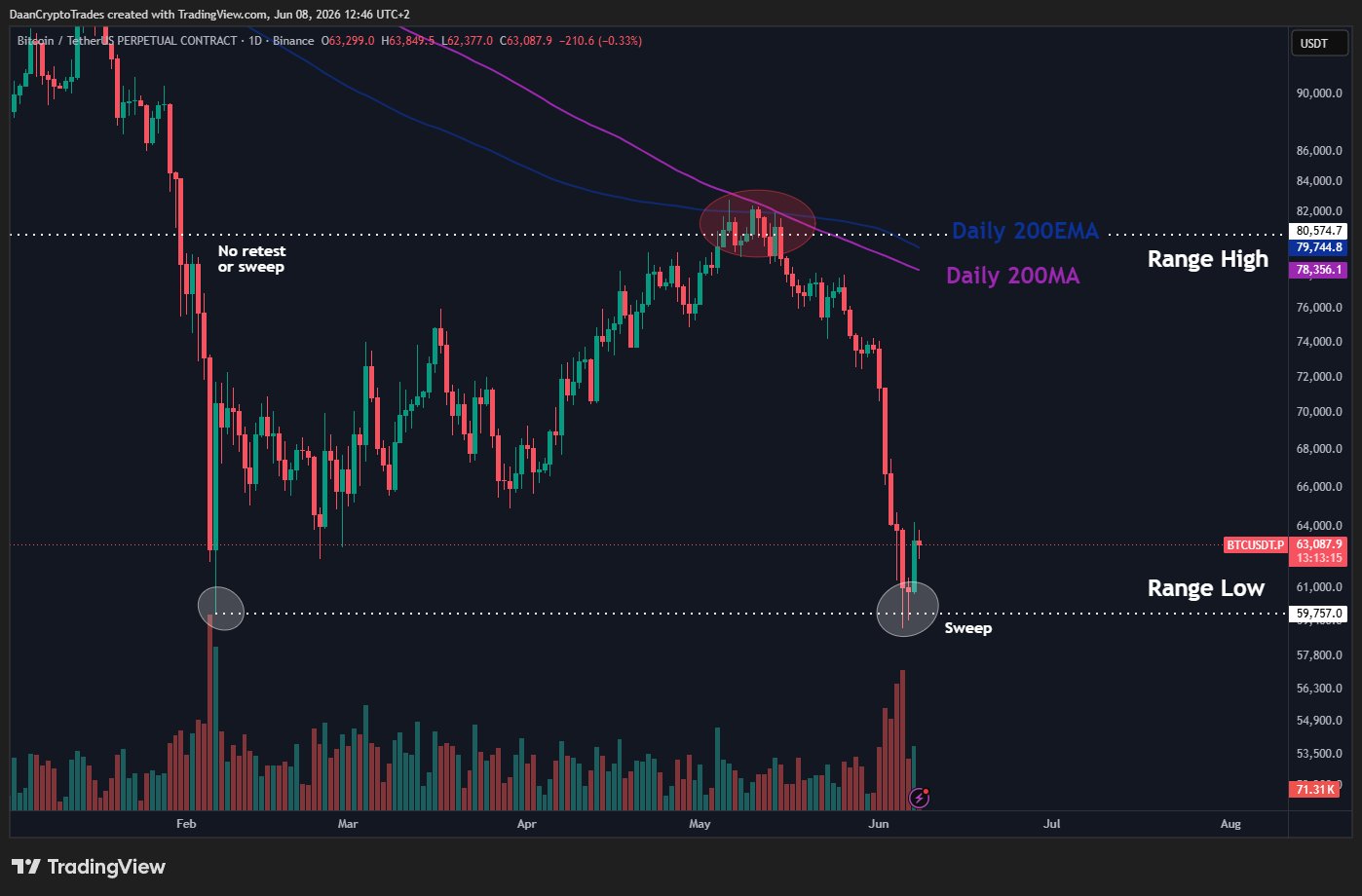
Attention focused on the $60,000 mark amid a broad lack of bullish sentiment on both shorter and longer time frames.
“Holding the $60K low and I will just assume this is a range for now,” trader Daan Crypto Trades forecast in his latest analysis on X.
“I can easily see us trade in this $60K-$80K region for quite a while. Just need to not turn bearish at the range low and not get too excited at the range high region.”
An accompanying chart showed Bitcoin’s 200-day simple moving average (SMA) now acting as low-time-frame resistance.
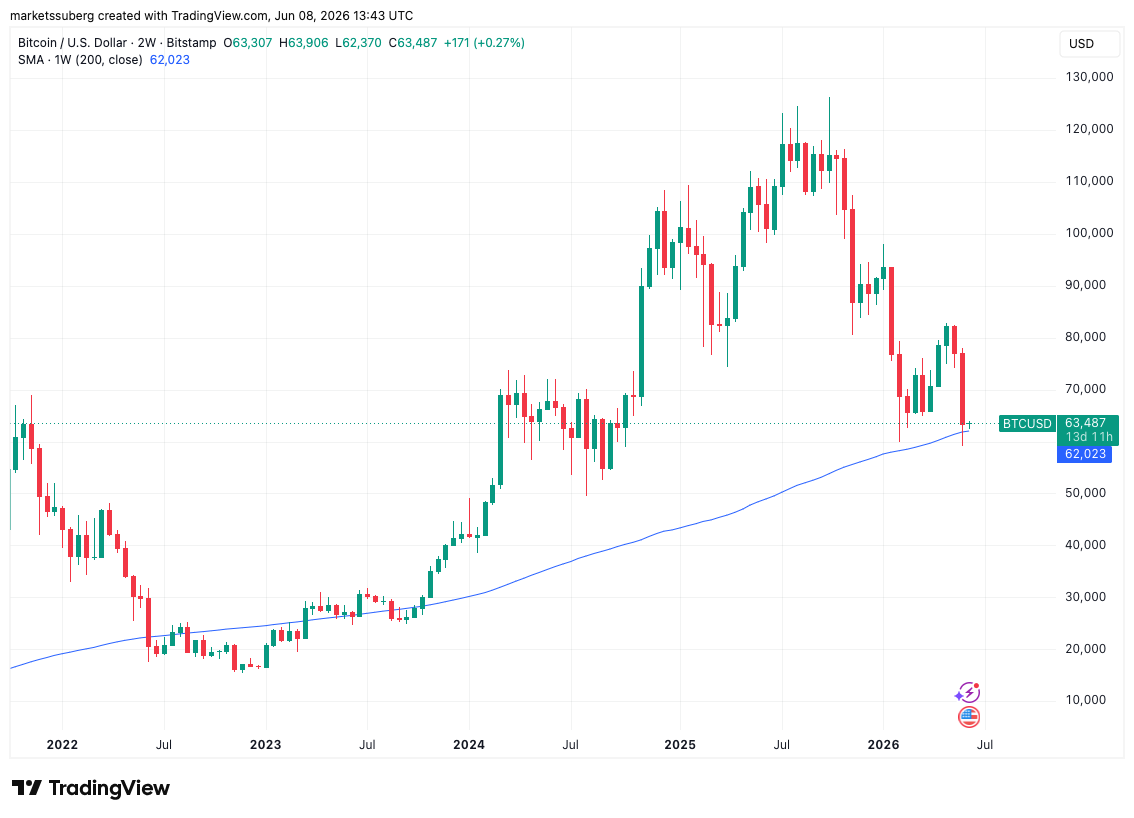
Among those seeing bearish continuation was trader and analyst Rekt Capital, who told X followers to watch for a failed rebound and subsequent weakening of support at $60,000.
“Bitcoin has now tagged the 200-week SMA for the first time in this Bear Cycle,” he added about another important bear-market feature late last week.
“Deviating below it has historically been the key to building out a Bear Market bottom formation.”
BTC/USD two-week chart with 200-week SMA. Source: Cointelegraph/TradingView
Bitcoin analysis says macro “tapping it on the shoulder”
On the macro front, analysis pointed to several key headwinds complicating the picture for crypto and risk assets.
Related: BTC price bottom not due until Q4? Five things to know in Bitcoin this week
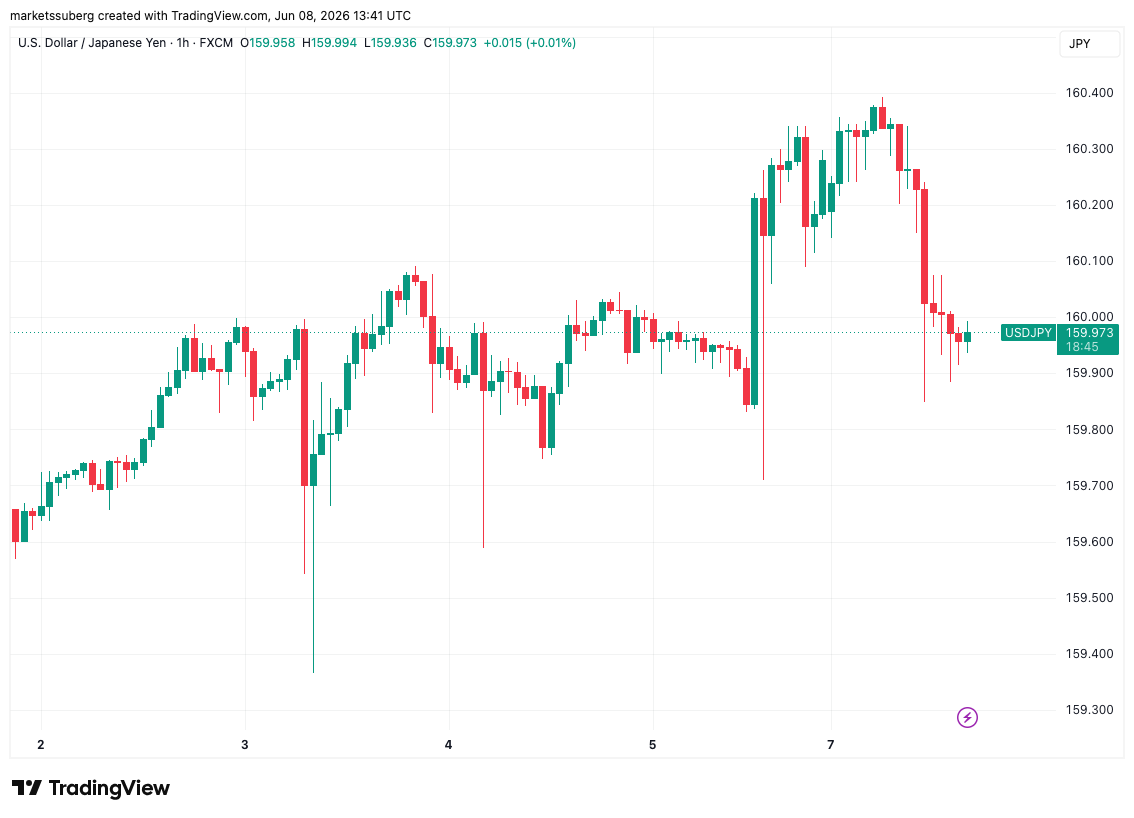
These were interest-rate plan expectations from the US Federal Reserve, the Japanese yen passing 160 per dollar and the US-Iran war.
“Taken together, these are not exactly ideal conditions for high-beta assets,” trading resource QCP Capital wrote in its latest Market Color bulletin.
“BTC is effectively being asked to perform while oil, rates, FX and geopolitics are all tapping it on the shoulder.”
QCP argued that given Asia equities weakness on Monday, Bitcoin’s next moves would be telling when it comes to its recent divergence from stocks.
“If crypto can hold while equities digest the AI-led correction, the market may start to rebuild a cleaner standalone narrative. If not, the apparent decoupling may prove to be less independence and more delayed reaction,” it suggested.