Home Blog Page 207

PCE, jobless claims and housing data test Fed cut hopes: Crypto Week Ahead

0

The coming week appears to be macro-led, with U.S. economic data carrying the main calendar risk. Inflation, growth, jobless claims and housing numbers all land before the open, giving markets insight on whether the Fed has room to cut rates.

Prediction markets and the CME’s FedWatch tool currently point to rates remaining unchanged in June’s meeting.

The data comes amid the ongoing Middle East war, which keeps oil prices and inflation risk in focus. Any move higher in energy costs could make softer inflation harder to sustain and weigh on risk assets.

What to Watch

(All times ET)

  • Crypto
    • May 26–June 1: Kevin Warsh officially begins his first week as Federal Reserve Chair following his confirmation.
  • Macro
    • May 26, 08:00 a.m.: U.S. S&P/Case-Shiller Home Price YoY for March est. 1.1% (Prev. 0.9%)
    • May 26, 08:00 a.m.: U.S. House Price Index YoY for March est. 1.8% (Prev. 1.7%)
    • May 26, 09:00 a.m.: U.S. CB Consumer Confidence for May est. 92 (Prev. 92.8)
    • May 26, 08:30 p.m.: Australia Consumer Price Index YoY for April est. 4.4% (Prev. 4.6%)
    • May 27, 08:00 p.m.: Bank of Korea Interest Rate Decision (Prev. 2.5%)
    • May 28, 04:00 a.m.: Eurozone Economic Sentiment for May est. 92 (Prev. 93)
    • May 28, 07:30 a.m.: U.S. PCE Price Index YoY for April (Prev. 3.5%); Core PCE (Prev. 3.2%)
    • May 28, 07:30 a.m.: U.S. Initial Jobless Claims for period ending May 23 est. 212K (Prev. 209K)
    • May 28, 08:00 a.m.: South Africa Reserve Bank Interest Rate Decision est. 7.0% (Prev. 6.75%)
    • May 28, 09:00 a.m.: U.S. New Home Sales for April est. 0.67M (Prev. 0.682M)
    • May 28, 03:30 p.m.: U.S. Fed Balance Sheet for period ending May 27 (Prev. $6.713T)
    • May 28, 06:30 p.m.: Japan Tokyo Consumer Price Index YoY Prel for May (Prev. 1.5%)
    • May 29, 07:30 a.m.: Canada GDP Growth Rate Annualized for Q1 (Prev. -0.6%); QoQ (Prev. -0.2%)
    • May 29, 08:45 a.m.: U.S. Chicago PMI for May est. 49.5 (Prev. 49.2)
    • May 30, 08:30 p.m.: China NBS Manufacturing PMI for May est. 50.5 (Prev. 50.3)
  • Earnings
  • Governance Votes & Calls
    • Compound DAO is voting on a proposal to update Compound III supply caps for USDC, USDT, and WETH across Optimism, Polygon, and Unichain. Voting ends on May 25.
    • Aave DAO is voting on a proposal to establish a 3-of-4 rewards operations multisig to manage third-party incentive funding for growth campaigns. Voting ends on May 25.
    • Instadapp DAO is voting on a proposal to rebalance wstUSR vaults, withdraw 750,000 FLUID to fund rewards, configure PST launch limits, and consolidate InstaConnectorsV2 administrative controls to the Team Multisig. Voting ends on May 26.
    • Bancor DAO is voting on a proposal to increase the vortex MaxSaleAmount parameter from 100 to 100,000 for the TAC and IOTA EVM blockchains. Voting ends on May 27.
    • Arbitrum DAO is voting on an amended proposal to transfer 30,765.66 frozen ETH, tied to the rsETH incident, to an Aave LLC-controlled wallet. Voting ends on May 29.
    • Unlock DAO is voting on a proposal to process the May constant payment roll, compensating contributors David Moderator, Ceci Sakura, and Trigs for their roles. Voting ends on May 30.
    • Uniswap DAO is voting on proposals to expand protocol fee infrastructure to BNB Chain, Polygon, and Celo, and to recall 12.5M delegated UNI from the Franchiser system to the Governance Timelock. Voting ends on May 30.
  • Unlocks
    • May 26: Plasma (XPL) to unlock 3.38% of its circulating supply worth $7.39 million.
    • May 26: Huma Finance (HUMA) to unlock 20.04% of its circulating supply worth $11.76 million
    • May 29: Grass (GRASS) to unlock 3.55% of its circulating supply worth $11.29 million.
    • May 30: Falcon Finance (FF) to unlock 4.06% of its circulating supply worth $8.26 million.
    • June 1: EigenCloud (EIGEN) to unlock 4.99% of its circulating supply worth $8.48 million.
  • Token Launches

Prometheum says tokenized securities need Wall Street distribution to scale

0

Prometheum is betting that the next phase of tokenized finance will be won not by crypto exchanges, but by traditional broker-dealers and registered investment advisers (RIAs).

“The story of tokenization so far has been about issuance, but no one has addressed the challenge of how to get those products to mainstream investors,” Aaron Kaplan, co-founder and co-CEO of Prometheum told CoinDesk in an interview.

“Until tokenized and digitally-native securities can reach investors through the broker-dealer channels they already use, tokenization is a solution without a market,” he added.

Tokenized securities are traditional financial assets such as stocks, bonds or funds that are issued and traded on blockchain networks as digital tokens representing ownership or investment rights.

The New York-based digital asset infrastructure firm recently launched Prometheum Capital’s Digital Brokerage Solutions, a suite of correspondent clearing, custody and trading services designed to let broker-dealers offer crypto assets, including tokenized securities and other blockchain-based financial products, directly through traditional brokerage accounts.

The launch marks Prometheum’s latest attempt to bridge the gap between the crypto industry and the regulated securities ecosystem.

“Crypto has solved tokenization, but it hasn’t solved distribution,” Kaplan says. “There are tens of billions of dollars of tokenized securities already issued on blockchain rails, but almost no mainstream distribution channel to reach investors at scale.”

Prometheum operates a network of SEC-registered and FINRA-member broker-dealers designed to support the full lifecycle of blockchain-based securities, including issuance, trading, custody, clearing and settlement.

The company positions itself as a bridge between traditional financial markets and digital assets, offering regulated infrastructure for tokenized securities, crypto assets and onchain financial products through existing brokerage and securities law frameworks.

It operates a network of regulated entities spanning the digital asset lifecycle, including a transfer agent, broker-dealer, alternative trading system (ATS), custody platform and correspondent clearing infrastructure. Kaplan described the firm’s clearing-enabled custodian as its “special sauce.”

Prometheum joined the Depository Trust & Clearing Corporation (DTCC) Industry Working Group in May as one of more than 50 financial firms helping shape the development of the Depository Trust Company’s (DTC’s) tokenization service.

Building a distribution flywheel

The company says its platform serves two primary functions: helping issuers distribute tokenized securities into the broader financial system and enabling traditional broker-dealers to build digital asset businesses without relying on crypto-native exchanges.

That creates what Kaplan calls a “flywheel effect,” connecting issuers with institutional distribution channels while giving traditional financial firms access to the growing market for blockchain-based assets.

Prometheum’s inaugural correspondent clearing clients include Arete Wealth Management, Network 1 Financial Securities and an unnamed clearing broker-dealer, according to a company statement.

Kaplan says the broader opportunity lies in opening the broker-dealer and RIA channel, long the dominant distribution network for traditional securities, to digital assets.

“The broker-dealer channel is how you reach investors at scale,” he says. “Now, for the first time, broker-dealers and RIAs can offer digital assets directly through their existing account structures and compete with crypto trading venues on a more level playing field.”

Competing with crypto platforms under securities rules

Prometheum argues that traditional securities firms have largely been sidelined during crypto’s rise because many digital asset platforms operated outside conventional securities regulation. By bringing blockchain-based assets into a regulated broker-dealer framework, Kaplan says firms can compete while maintaining investor protections such as asset segregation, custody controls and compliance oversight.

“It’s a tried-and-proven regulatory structure that has allowed investors to thrive for generations,” Kaplan says. “Now it can support digital assets as well.”

The company is positioning itself around the idea that the future of securities markets will ultimately move onchain. Kaplan points to growing industry projections that tokenized real-world assets (RWA) could become a major segment of capital markets over the next decade.

“The future of securities is onchain,” he says. “As these products become better, faster and cheaper, broker-dealers are going to need the infrastructure to compete and offer them to clients.”

More broker-dealers and RIAs expected to join

Prometheum says additional broker-dealers and RIAs are expected to onboard in the coming months as demand grows for regulated digital asset infrastructure. Kaplan also teased an upcoming institutional distribution partnership that he says will help attract larger issuers into the ecosystem.

The broader thesis reflects a shift underway across the digital asset industry, where firms are increasingly focused less on token creation and more on integrating blockchain-based assets into existing financial distribution networks.

For Prometheum, the bet is that tokenization alone is not enough. Without Wall Street’s distribution machinery, digital securities risk remaining a niche product despite the technology’s promise.

According to Kaplan, “integrating blockchain into capital markets isn’t about replacing the system, it’s about modernizing it so that issuers, broker-dealers, and investors all benefit from faster settlement, broader access, and more efficient distribution of investment products.”

“Realizing those benefits at scale depends on infrastructure that can move onchain products through the channels investors and advisors already use, and that is what Prometheum has built,” he added.

Read more: Crypto platform Bullish to buy Equiniti for $4.2 billion, building tokenized securities infrastructure

Hyperliquid (HYPE) is emerging as a challenger to traditional exchanges and prediction markets, says FalconX

0

Crypto trading platform Hyperliquid is beginning to compete with traditional exchanges and prediction market operators as it expands beyond perpetual futures trading, according to a new report from FalconX.

Senior crypto market strategist David Lawant outlined how Hyperliquid’s recent moves into pre-IPO markets, prediction contracts and tokenized real-world assets are broadening the platform’s appeal beyond crypto-native traders.

“Hyperliquid is seeing traction as demand for its HIP-3 markets expands to include pre-IPO markets,” the report said.

Hyperliquid first gained traction through crypto perpetual futures, a type of derivatives contract that dominates offshore digital asset trading. The platform’s native token, HYPE, has skyrocketed 94% over the past three months. But FalconX said newer products could push the platform into more direct competition with firms such as CME Group, Intercontinental Exchange-backed prediction market Kalshi and Polymarket.

The report pointed to growing activity in Hyperliquid’s HIP-3 markets, which allow users to trade assets including equities, commodities, forex and pre-IPO contracts around the clock. FalconX said those markets gained attention after traders used them to speculate on companies such as Cerebras, Anthropic and SpaceX before public listings.

The platform has also begun rolling out HIP-4 outcome markets, which function similarly to prediction markets by allowing traders to bet on binary outcomes tied to politics, economics and crypto events.

FalconX said the ability to trade prediction contracts alongside crypto and real-world asset positions on the same platform could become a major advantage.

“For example you could pair a HIP-3 perps position on NVDA with outcome markets that it could miss or beat earnings,” the report said.

The firm also highlighted strong early interest in newly launched exchange-traded funds tied to Hyperliquid’s HYPE token. Spot HYPE ETFs from 21Shares and Bitwise have attracted a combined $53 million in inflows after only a few trading sessions, according to Bloomberg data cited in the report.

FalconX said those inflows represented a larger percentage of HYPE’s market capitalization than early inflows into spot bitcoin, ether (ETH) and solana (SOL) ETFs at similar stages.

Meanwhile, Hyperliquid’s recent partnership with Coinbase (COIN) and Circle (CRCL) to integrate USDC as an aligned quote asset could significantly increase protocol revenue. FalconX estimated the arrangement could generate as much as $160 million in annualized revenue based on reserve yields tied to USDC balances on the platform.

The report also noted that regulatory developments in Washington could help accelerate adoption of tokenized real-world assets on decentralized trading venues. FalconX cited reports that the SEC is considering an innovation exemption framework for tokenized stocks.

At the same time, the firm warned that growing attention from traditional financial exchanges could bring regulatory scrutiny. CME and ICE have raised concerns with regulators about potential manipulation risks tied to Hyperliquid’s markets.

Even so, FalconX said Hyperliquid continues to lead decentralized perpetual futures markets in trading volumes, revenue and total value locked, positioning it as one of the fastest-growing trading platforms in crypto.

HYPE funds attract millions as investors dump bitcoin and ether ETFs

0

Crypto fund flows are starting to fracture, with investors exiting bitcoin and ether (ETH) exchange-traded funds (ETFs) while rotating into alternative tokens such as Hyperliquid’s hype (HYPE) and XRP (XRP).

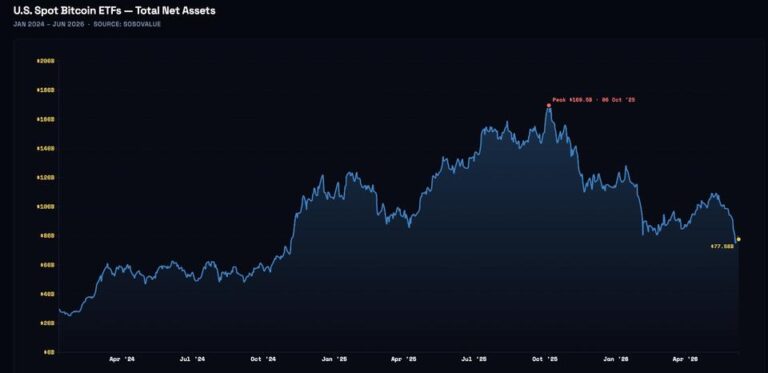
Bitcoin ETFs saw more than $1 billion in outflows last week, extending a sharp institutional pullback, while ether funds lost another $215 million, according to data source SoSoValue. The continued bleeding from the two largest assets signals a cooling appetite for broad, benchmark crypto exposure.

But the redemptions haven’t been uniform.

Spot products investing in Hyperliquid’s hype token, issued by Bitwise and 21Shares, attracted a combined $72.38 million, underscoring that capital is being redeployed with precision rather than exiting the market altogether. XRP and sol ETFs registered inflows worth $22 million and $15.6 million, respectively.

“The broader message: capital has not left crypto uniformly. It is rotating toward newer narratives and away from crowded large-cap exposure,” Timothy Misir, head of research at BRN, said in an email.

Hype is real

The strong uptake for hype ETFs, which went live a week ago, coincides with a sharp rally in the token’s price and robust network activity.

The token has been on a tear, jumping from $38 to $63 in the past 10 days, CoinDesk data show. It has gained 59% for the month, a staggering performance compared with market leader bitcoin’s 1% gain.

Decentralized platform Hyperliquid has generated $13.2 million in fees over the past seven days, the fifth-largest tally, trailing stablecoin behemoths such as Tether and Circle Internet (CRCL) as well as launchpad Pump. Canton Network ranks fourth, though, according to DeFiLlama, that is largely driven by substantial incentives.

Hyperliquid’s revenue is expected to rise further, thanks to its recent agreement with Coinbase and Circle to integrate stablecoin USDC as a quote asset.

Some analysts say Hyperliquid is rapidly emerging as a challenger to traditional trading platforms and prediction markets. And for good reasons: Since the Iran war began in late February, the platform’s HIP-3 market has consistently handled millions in trading volume in perpetual futures tied to traditional and real-world assets (RWA) such as oil, gold and U.S. equity indexes.

“Hyperliquid fundamental metrics continue to strengthen across the board as HIP-3 markets reached new weekly highs at 2.6B in open interest across RWA perp markets. HIP-4 launched outcome markets a couple of weeks ago to more modest growth,” data tracking website Artemis said in the weekly newsletter.

“Equity perpetuals, pre-IPO markets and prediction markets are all in the very early innings, and Hyperliquid is well positioned to capitalize on that momentum,” Artemis said.

Trump Iran Deal Lifts Crypto Markets By $75 Billion

0

Crypto markets have recovered around $75 billion in value after US President Donald Trump said on Saturday that a peace agreement with Iran was imminent.

Trump said in a post to his Truth Social platform on Saturday that a deal has been “largely negotiated” between the US and Iran, along with Saudi Arabia, the United Arab Emirates, Qatar, Pakistan, Turkey, Egypt, Jordan and Bahrain.

“An agreement has been largely negotiated, subject to finalization between the United States of America, the Islamic Republic of Iran, and the various other countries,” Trump said.

“Final aspects and details of the deal are currently being discussed and will be announced shortly. In addition to many other elements of the agreement, the Strait of Hormuz will be opened.”

The closure of the Strait of Hormuz has caused global energy prices to spike and has weighed on the cost of living in many nations. It has also hit investments in high-risk assets such as crypto, which have retreated recently.

Trump’s announcement comes amid a fragile ceasefire that began in early April with several failed attempts at reaching an agreement between the US and Iran.

US Secretary of ⁠State Marco Rubio reiterated Trump’s demands for a peace deal during a visit to India on Saturday. “Iran can never have a nuclear weapon. The straits need to be open without tolls. They need to turn over their enriched uranium,” he said. 

Related: Warsh will cut rates, despite consensus view of rate hikes: Analyst

Crypto markets react positively 

Bitcoin prices fell to a five-week low of $74,250 on Saturday, according to TradingView.

The asset recovered to tap the 50-day exponential moving average at $77,000 in early trading on Sunday before falling back to $76,800 at the time of publication.

BTC has resumed its downtrend after failing to break resistance at $82,000 and remains down 39% from its October peak.

BTC sees a minor recovery after Trump’s deal announcement. Source: TradingView

Magazine: Crypto scammers face death, Aussie CGT makes Asian hubs attractive: Asia Express

Cointelegraph is committed to independent, transparent journalism. This news article is produced in accordance with Cointelegraph’s Editorial Policy and aims to provide accurate and timely information. Readers are encouraged to verify information independently.

What next as bitcoin (BTC) and Asian equities cheer oil price slide?

0

Bitcoin was slightly higher on Monday as a sharp decline in oil prices helped lift Asian stock markets.

At 6:35 UTC, the leading cryptocurrency by market value traded near $77,200, up 0.4% from midnight UTC, according to CoinDesk data. At that level, bitcoin was trading just above its widely tracked 50-day simple moving average of around $76,940. Traders and chart analysts monitor this key level closely, with sustained breakouts above it typically viewed as bullish.Other major cryptocurrencies were also modestly higher.

XRP and Solana (SOL) rose 0.6% or more, while Ether (ETH) gained 0.4%. However, all three continued to trade below their respective 50-day moving averages, lagging Bitcoin on this metric.

Futures tied to West Texas Intermediate crude oil dropped more than 5% to around $91 per barrel, extending a steep slide from last Wednesday’s high above $104. Asian equities rallied, with India’s Nifty climbed over 1%, Japan’s Nikkei rose nearly 3% in early trade, and Australia’s S&P/ASX 200 added 0.4%.

These moves follow weekend reports that a deal to reopen the Strait of Hormuz, a critical chokepoint that accounted for over 20% of global oil flows before the Iran war began in late February, was in its final stages.

Last week, Iran’s IRGC claimed to have allowed passage of over 20 tankers through the strait, though that volume remains well below pre-war levels.

U.S. Secretary of State Marco Rubio said that Washington and Iranian negotiators have “a pretty solid thing on the table” and a deal to end the war between the two countries could be reached Monday. He said that the U.S. is ready top exhaust every diplomatic option but would pursue other means if a good deal could not be reached.

Analysts still maintained a cautious outlook on bitcoin, citing more than $2 billion in outflows from spot ETFs over the past two weeks.

“For crypto, the key signal is whether ETF outflows slow. Bitcoin can absorb some institutional selling if stablecoin liquidity remains firm and long-term holders stay patient. Sustained ETF redemptions would make every rally harder to hold,” Timothy Misir, head of research, BRN, said in an email.

India-based FIU-registered CoinSwitch exchange noted that finalization of a U.S.-Iran peace deal would be needed for further sustained gains.

“The sentiments improved after reports of progress in U.S.–Iran peace talks, including a possible reopening of the Strait of Hormuz, helping BTC rebound toward $77K. Still, the deal is not finalized, so traders are not fully risk-on yet. Exchange data also remains a watchpoint, with 18,528 BTC moving net into centralized exchanges, suggesting potential sell-side pressure,” the exchange said in an email.

Bitcoin options are coming to Nadaq. Here’s what it means for you.

0

Nasdaq has moved closer to offering cash-settled bitcoin index options, a move set to democratize crypto risk management and eliminate legacy operational barriers.

Last week, the U.S. Securities and Exchange Commission granted Nasdaq PHLX conditional approval to list European-style options under the ticker QBTC. These will be cash-settled, European-style options tracking the CME CF Bitcoin Real Time Index (BRTT).

Cash-settled means the options are settled in U.S. dollars. At expiration, the exchange credits or debits the cash difference between the strike price and the final index value and no actual bitcoin is delivered or received.

For the average market participant, the new product, still pending approval from the Commodity Futures Trading Commission (CFTC), removes operational friction. QBTC options will trade on the same Nasdaq platform as popular technology stocks, allowing participants to execute hedging strategies and bitcoin volatility bets directly through their existing brokerage accounts without needing a separate futures or derivatives account.

By contrast, CME’s bitcoin options, which have been available since 2020, are also cash-settled but track Bitcoin futures rather than the spot index. They also require a dedicated derivatives account, adding operational complexity.

The story doesn’t end there.

Each Nasdaq QBTC option contract delivers exposure equivalent to exactly 1 BTC, using a 1/100th index scaling factor with a standard $100 multiplier. By comparison, the CME’s standard Bitcoin option is sized at 5 BTC, often representing hundreds of thousands of dollars in notional exposure.

This much smaller contract size opens the door for precise hedging by smaller institutional managers and more affordable volatility trading for retail participants.

Options are derivative contracts that give the purchaser the right to buy or sell the underlying asset at a predetermined price on a later date. A call option gives the right to buy and represents a bullish bet, while a put offers protection against price slides.

Think of it like paying a small non-refundable deposit to lock in the right to buy/sell a house at today’s price anytime over the next few months. If property prices rise/fall, you can still purchase/sell at the pre-agreed price and benefit from the gain. If you change your mind, you simply walk away, losing only the initial deposit.

Crypto options, led by bitcoin contracts, have seen explosive growth in recent years, as institutionalization of the market triggered demand for sophisticated risk management and yield-enhancing strategies.

SEC Halts Innovation Exemption For Tokenized Stocks

The US Securities and Exchange Commission has reportedly postponed its plan to allow trading of tokenized stocks after stock exchange officials raised concerns over how the plan would be implemented.

Bloomberg reported on Friday, citing sources familiar with the matter, that the SEC’s “innovation exemption” for crypto-based stocks was expected to be released during the week, with SEC staffers having already reviewed a draft of the tokenized stock trading proposal.

The SEC has reportedly received input from hundreds of market participants on how to best implement the rules, but it has not made a decision to change its proposal.

Under the SEC’s proposal, platforms offering tokenized stocks would need to guarantee investors receive the same rights as traditional shareholders, including dividends and voting rights.

Market participants reportedly raised concerns to the SEC over the potential proliferation of unauthorized third parties issuing tokens without the consent of public companies and how ownership would be verified on semi-pseudonymous blockchains.

The SEC has been more open to crypto-powered financial products under the Trump administration, which has coincided with Wall Street having a growing interest in tokenization and stablecoins.

Data from RWA.xyz shows that $34 billion worth of real-world assets have been tokenized, including $1.55 billion in tokenized equities, but adoption has lagged expectations by Citibank and McKinsey, which respectively predicted in 2022 and 2024 that tokenization would become a multi-trillion-dollar market by 2030. 

Crypto industry supports decision to delay

Crypto industry executives have backed the SEC’s decision to delay the exemption. Carlos Domingo, the CEO of crypto tokenization platform Securitize, said in a post to X on Friday that it is important to ensure the “exemption applies to the right instruments.”

“Better delay it than get it wrong and unleash all sort of problems.”

Related: Kraken parent Payward sees revenue surge as tokenization expands 

Tom Farley, the CEO of crypto exchange Bullish posted to X that the SEC was “realizing that public companies are the only entity who can issue tokens that are a share of stock! Great job delaying and getting this right.”

Source: Tom Farley

The delay came after SEC Commissioner Hester Peirce said on Thursday that she expected the exemption to be “limited in scope” and would only support “digital representations” of equity securities, similar to what investors can currently purchase in the secondary market.

In January, the SEC made distinctions between types of tokenized securities, classifying them into “custodial” and “synthetic” forms.

Custodial tokenized securities are issuer-sponsored tokenized stocks custodied by regulated intermediaries and have full shareholder rights, while synthetic tokenized securities provide price exposure without actual ownership of the underlying shares.

Magazine: eToro founder timed Bitcoin top perfectly due to belief in 4 year cycles

Buterin Says Ethereum Foundation Is Not the ‘Center’ of Ethereum

0

Ethereum co-founder Vitalik Buterin responded to growing criticisms of the Ethereum Foundation’s role in the Ethereum ecosystem, pushing back against critics who want the organization to take a more active role in supporting token prices and marketing.

Buterin said the Foundation will continue to focus on promoting censorship-resistance, open source software code, long-range research, cybersecurity, and decentralization of the Ethereum Protocol, as outlined in its mandate. He said:

“EF is not a ‘center of Ethereum’, rather EF is ‘one node, with a defined purpose, alongside other nodes’. We have always said that the EF should be the latter, but many in the Ethereum ecosystem, and even within the EF, wanted us to be the former. 

The Ethereum Foundation’s mandate was published in March 2026. Source: Ethereum Foundation

“Now, we are taking action to ensure that we will be the latter,” he continued, adding that the Ethereum Foundation seeks to strengthen Ethereum’s cybersecurity and code base but not necessarily compete with high-throughput chains or scale to 1 million transactions per second.

The comments follow several large ETH holders selling their entire ETH position and high-profile departures from the Ethereum Foundation, as the current price of the cryptocurrency, about $2,094, sits more than 50% below its all-time high of nearly $5,000 reached in August 2025.

“The EF has only about 0.16% of all ETH,” he said, noting that it is common for other foundations to hold 10-50% of their native tokens.

Related: Blockchain researcher defends Ethereum Foundation, says it’s doing ‘exactly’ its job

Under pressure amid falling token price

“I think Ethereum’s original sin was not considering tokenomics with every move it made from Dencun on,” cryptocurrency journalist Laura Shin said.

The Dencun upgrade was a major protocol update released in March 2024, which significantly reduced network fees for layer-2 transactions and led to a subsequent collapse in Ethereum’s base layer revenue.

Fees on the Ethereum layer-1 blockchain network fell significantly after the Dencun upgrade in March 2024. Source: Token Terminal

Most investors “don’t want to believe in something that is not also putting up points on the scoreboard,” Shin said about ETH.

Buterin said on Sunday that the Foundation would focus on “longevity” and stretch its funds to finance research, meaning it would sell less ETH in the future. 

In May, the Foundation unstaked 21,270 ETH from the Lido liquid staking platform, as part of its treasury strategy.

Unstaking ETH means those holdings will no longer generate yield for the Ethereum Foundation, but it is not a confirmation that the organization will sell those tokens.

Magazine: Why is Ethereum Foundation selling? BTC futures warning signs: Market Moves

Coinbase does not fear competition from Wall Street, says exchange executive

0

Coinbase is not at all concerned with the increasing competition from Wall Street giants or other traditional financial institutions, the crypto exchange’s head of Policy for Europe told CoinDesk on Friday.

“We have always said that a rising tide lifts all ships,” said Katie Harries, adding that Coinbase is “not at all” worried about the increasing involvement of financial institutions in the United States and around the world in crypto.

The company recently posted a loss of $1.49 per share, compared with analyst expectations for a $0.27 profit. Also in the first week of May, Coinbase announced a 14% workforce reduction.

In a brief written interview regarding the Stand With Crypto (SWC) events on Friday, Harries said that the mobilization of people worldwide shows that the established crypto industry has a community behind it that no traditional financial institution can replicate.

“Millions of people around the world chose crypto because they believe in what it represents: open, accessible, peer-to-peer finance,” Harries said. “The people gathered today in London, Paris, New York, Sao Paulo and beyond are not here because a financial institution told them to be. They are here because they believe in this technology and want their governments to support it.”

‘Voters do care about crypto’

Harries also spoke of the American voter. While U.S. citizens do not have crypto top of mind going into the November midterm elections, voters do care about digital assets and have contacted their lawmakers millions of times to let them know, Harries said.

“Voters do care, and the numbers make that clear,” Harries said, refuting recent statements by senators expressing the contrary. “Stand With Crypto has over 3.7 million advocates across six markets. Its members have contacted their lawmakers more than 2.5 million times.”

The Coinbase executive also said that signals “the crypto voter is a permanent fixture in the political landscape, not just in the United States but across the world. Policymakers who have been slow to engage with this community should take note.”

A CoinDesk survey of 1,000 randomly selected U.S. voters across the country showed that just 1% ranked crypto as their top concern. The survey was evenly split between Republican and Democrat respondents (41% of respondents identified with each party to some degree), with a credibility interval of plus or minus 3.53%.

‘Time for sensible regulation is now’

Harries called on regulators worldwide to adopt sensible crypto frameworks, saying the time to do so is now. “The window to shape sensible crypto regulation is open, and the people gathering at the events on Friday are watching.”

SWC is, according to Coinbase, the world’s largest crypto-advocacy organization with over 3.7 million members globally.

Harries’ words come as SWC stages 500 events across four continents and six markets, including the United States, United Kingdom, Canada, Australia, Brazil and the European Union.

The events coincide with Bitcoin Pizza Day, said Coinbase in a statement shared with CoinDesk.

During the global event, a livestream will feature discussions on ecosystem and policy developments worldwide.

Coinbase’s statement notes the event takes place at a critical moment for crypto as market structure legislation advances through the U.S. Congress.

Faryar Shirzad, Chief Policy Officer at Coinbase, a Stand With Crypto partner, said that this Friday, the rally “proves that the crypto voter is a global phenomenon. People around the world want the freedom to exchange value peer-to-peer, and they want their governments to help make that a reality. This hunger for financial progress isn’t confined to any one nation.”

Shirzad also said that “getting crypto regulation right is one of the most critical policy challenges of our generation, and it requires a global effort, not just action in Washington. “

Bitcoin Pizza Day has become a celebrated moment for millions of crypto users, commemorating the first real-world bitcoin transaction. On May 22, 2010, Laszlo Hanyecz paid 10,000 BTC for two pizzas. That bitcoin at current prices is worth roughly over $770 million.