Unverified smart contracts were linked to at least $36.7 million in losses across four DeFi exploits over the past six months, as attackers increasingly target protocols whose source code is not publicly available, according to Chainalysis.
The largest incident involved Truebit, which lost $26.2 million after an attacker exploited an integer overflow vulnerability in a contract that had remained unverified on Ethereum since 2021. The other incidents involved Trusted Volumes, Aperture Finance and Ekubo, according to the report.
In each case, the exploited contract had not been verified on a blockchain explorer, meaning its source code was not publicly available for review. According to Chainalysis, that limited scrutiny from security researchers and excluded the contracts from many bug bounty programs despite controlling user funds.
Protocols saw exploits on unverified smart contracts. Source: Chainalysis
Chainalysis attributed the trend in part to advances in decompilation tools and artificial intelligence, which can help attackers reverse-engineer smart contract bytecode and identify vulnerabilities even when source code is not publicly available. According to the report, what once required “a skilled reverse engineer spending days on a single contract” can now be partially automated across large numbers of unverified contracts.
The report challenges a longstanding assumption in DeFi that keeping smart contract code private provides an additional layer of security. According to Chainalysis, protocols relying on hidden code are increasingly depending on “obscurity as a security measure,” an approach the company said is rapidly losing effectiveness.
Chainalysis recommended source code verification, broader bug bounty coverage and real-time monitoring tools as safeguards against future exploits.
DeFi security concerns persist after record April losses
The report comes amid a broader rise in crypto exploits. According to DeFiLlama, hackers stole $629.7 million in April alone, the highest monthly total since February 2025.
Two incidents accounted for most of the losses. KelpDAO lost $293 million and Drift Protocol suffered a $280 million exploit, together representing more than 80% of the month’s stolen funds.
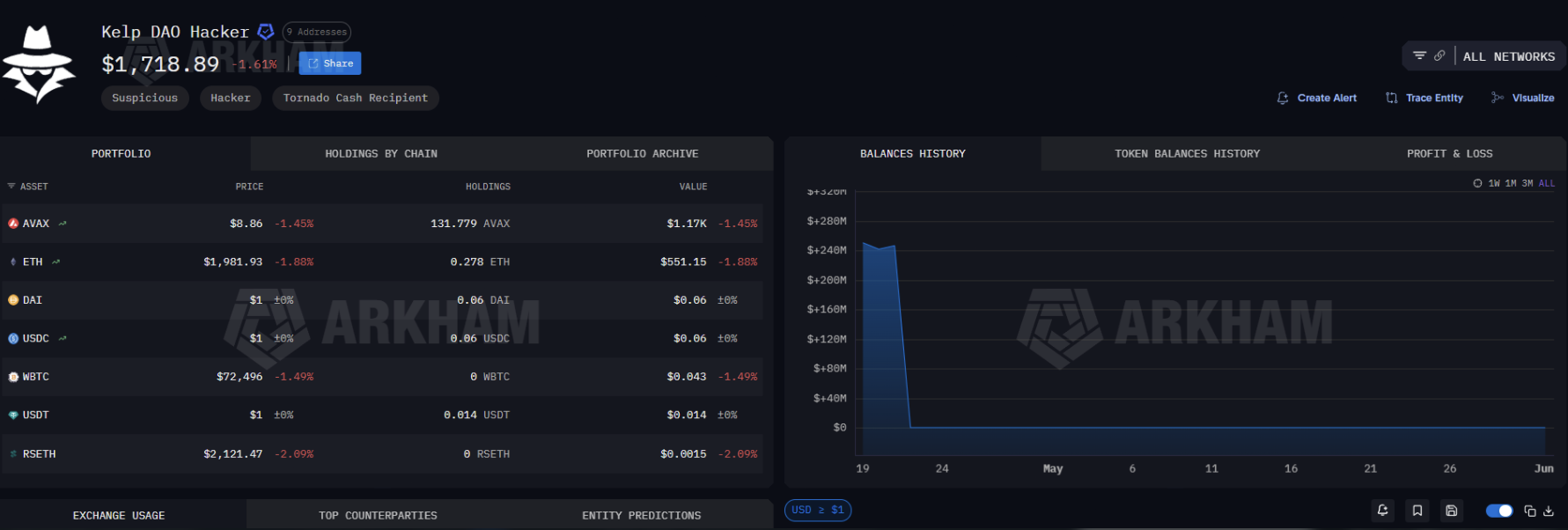
Although losses fell sharply in May, with CertiK reporting $68.3 million stolen from cryptocurrency exploits, the fallout from April’s largest attacks continued. In June, blockchain intelligence platform Arkham reported that the attacker behind the KelpDAO exploit had laundered nearly all of the roughly $220 million in unfrozen stolen funds.
Kelp DAO Hacker-tagged wallet, total balance. Source: Arkham
The KelpDAO exploit also prompted several DeFi protocols to review their security infrastructure, with projects including Solv Protocol announcing plans to migrate to Chainlink’s crosschain infrastructure following internal security reviews.
This month, Anthropic said 560 of the 832 accounts it banned for policy violations over a one-year period had used AI to help prepare cyberattacks, including writing malware and identifying vulnerabilities.
Magazine: The legal battle over who can claim DeFi’s stolen millions
Record-low Bitcoin mining margins and rising demand for AI infrastructure incentivize miners to reduce their BTC positions.
Institutional spot Bitcoin flows vastly surpass miner output, making macro trends more vital than miner profits alone.
Bitcoin’s price slide to $62,000 was paired with weak on-chain activity and declining BTC miner revenues, which have fallen to an all-time low. This revenue drop is fueling investor anxiety over potential sell pressure, especially since miners and mining pools still control over $110 billion in Bitcoin.
1 TH/second of hashing power per day returns, USD. Source: Luxor Hashrate Index
The estimated daily return for 1 terahash per second of hashing power plunged to an all-time low of $0.28 on Tuesday, down from $0.39 just a month ago. For context, the estimated monthly gross profit for an Antminer S21 XP Hydro (at an electricity cost of $0.07 per kilowatt-hour) has slid to $137, down from $192 last month.
This profitability crunch arrives as demand for AI capacity and infrastructure investments surged, dampening market sentiment just as the crucial $60,000 support level was put to the test.
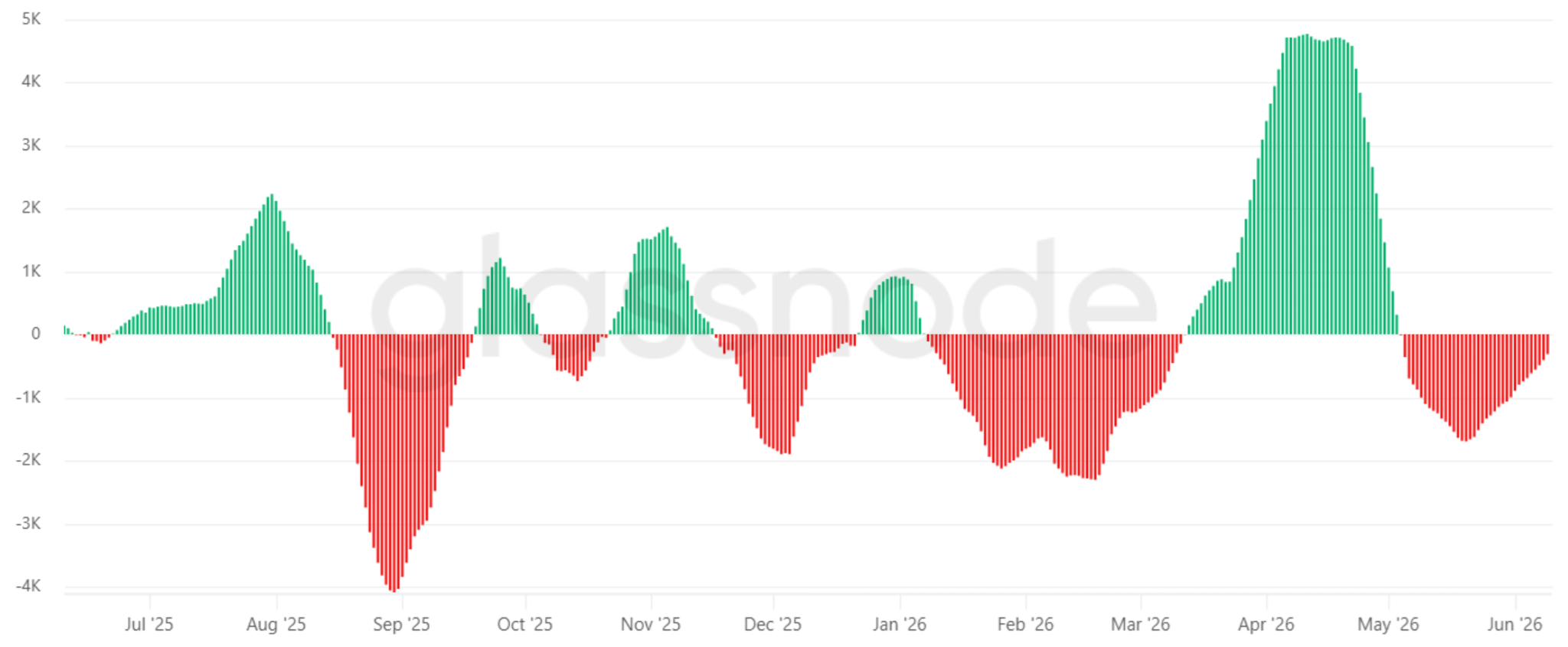
Bitcoin miners’ 30-day net position change, BTC. Source: Glassnode Studio
The 14-day average net position change for Bitcoin held in miner and mining pool addresses flipped negative in early May and has remained negative since. Whether these liquidations are intended to fund ongoing operations, reduce debt leverage, or bankroll expansion into AI data center computing, the net effect remains a heavy drag on Bitcoin’s price discovery.
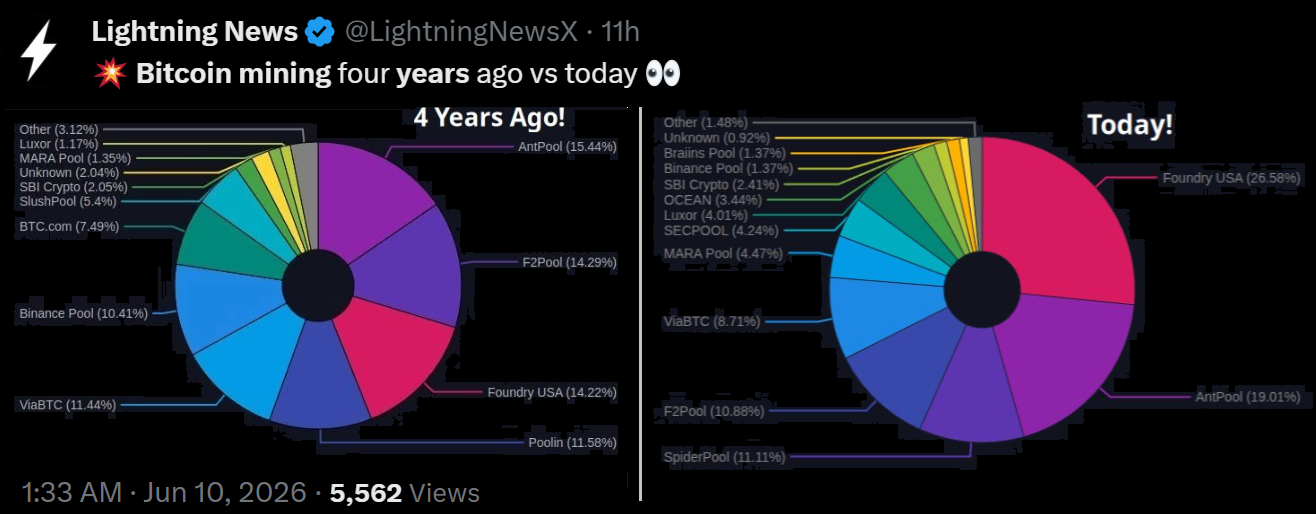
Source: X/LightningNewsX
The high concentration of Bitcoin hashrate among the three largest mining pools is a frequent target of analyst criticism. The latest 7-day data show that Foundry USA, AntPool, and F2Pool control a combined 59% market share. In contrast, the top three Bitcoin mining pools held a combined 44% hashrate market share back in 2022.
According to Bernstein analysts, the primary bottleneck for scaling AI data centers is access to electricity rather than chips. This constraint is prompting some Bitcoin miners to repurpose parts of their power infrastructure to support AI computing applications, a sector currently viewed as more stable and lucrative than traditional crypto mining.
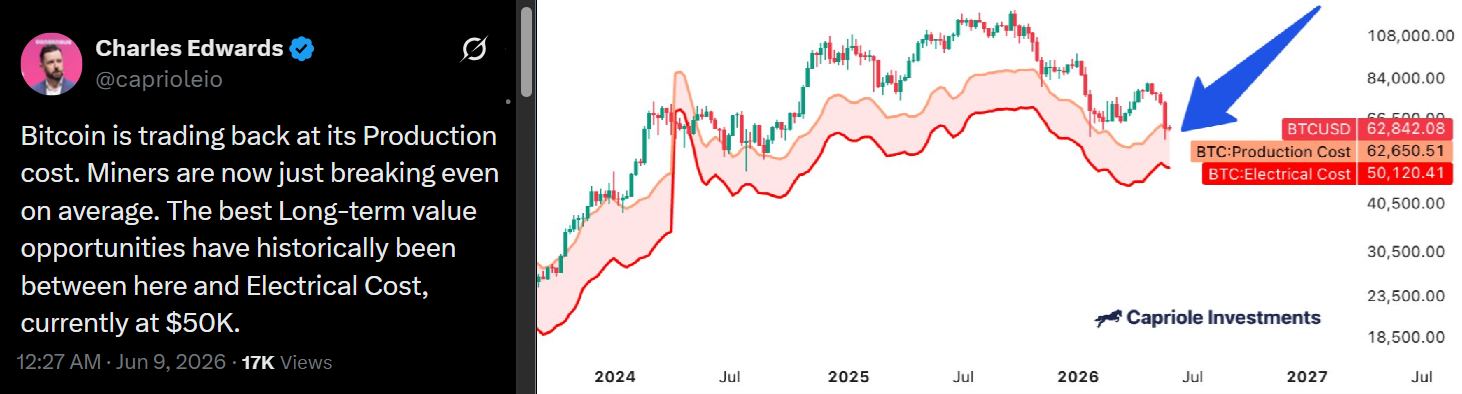
Source: X/Capriole Investments
According to Charles Edwards, founder of Capriole Investments, the Bitcoin mining production cost, including depreciation and amortization, stands at $62,650, while the absolute minimum to break even on electricity is $50,120. However, certain publicly listed companies leverage much more efficient ASIC models and industrial-scale energy contracts.
American Bitcoin Corp (ABTC US) reported gross operational costs near $36,200 per Bitcoin mined in the first quarter of 2026. Ultimately, pinning down a single, industry-wide production cost is impossible, and some operations choose to mine at a loss for specific tax benefits. Even if these high-cost miners temporarily shut down, spot institutional flows now vastly surpass miners’ output.
Related: Bitcoin may act as a ‘canary in the coal mine’ as risk-off pressure spreads–Bitwise
Bitcoin traded below its estimated production cost for more than six months in 2019 and again in 2023, based on Capriole Investments data. Whether the current market stagnation persists depends on investor risk perception amid broader macroeconomic uncertainty, rather than miner profitability alone.
Mastercard (MA) is betting that AI agents will soon become active participants in the economy and wants its payments network to sit at the center of that shift.
The payments giant on Tuesday unveiled Agent Pay for Machines (AP4M), a service enabling AI agents and software systems to make payments to each other securely and at scale. The platform supports automated transactions across cards, bank accounts and stablecoins, while providing identity verification, spending controls and guaranteed settlement through Mastercard’s network.
The service comes as companies across technology, payments and crypto race to build infrastructure for what many are calling agentic commerce, where AI systems complete tasks, purchase services and coordinate transactions on behalf of users. Agents could be involved in trillions of dollars worth of transactions by the end of the decade, according to some estimates.
“We are already seeing a number of services and agents popping up to provide a range of products and services,” Raj Dhamodharan, Mastercard’s executive vice president of blockchain and digital asset products and partnerships, told CoinDesk. Those services range from booking travel and building websites to creating artwork and completing other digital tasks.
Dhamodharan said the next challenge is creating trust between those systems.
Businesses and consumers need confidence that agents are interacting with legitimate counterparties and operating within authorized spending limits. Service providers, meanwhile, need assurance that they will be paid.
“These are problems that we’ve solved before in the B2B world and the carded world for decades,” Dhamodharan said. “We’re bringing the same level of trust and ability to find the right set of agents, ability to convey that you’re actually going to complete the payment and to make sure that people can get paid.”
The platform is designed to address those concerns through credentialing, permissioning and settlement services. The company said the system can authenticate agents, enforce spending rules and settle payments across multiple payment methods, including stablecoins.
More than 30 companies have joined the initiative, including Coinbase (COIN), Stripe, Adyen, Checkout.com, Cloudflare, RippleX, Polygon Labs, Solana Foundation and OKX. Mastercard said permissions and credentials associated with AI agents will initially be recorded on the Polygon, Solana and Base blockchains.
Although large-scale machine-to-machine commerce remains nascent, Dhamodharan said Mastercard is already seeing signs of demand. He pointed to increasing activity around HTTP 402, an emerging internet payment standard, where automated transactions often fail because no payment method is available.
“There are already transactions happening,” he said. “There are already many declines happening because there is no payment option available. That is a leading indicator in our view.”
Mastercard said it plans to expand access to Agent Pay for Machines later this year.
Second, a Bitcoin development lab, has officially launched Bark — its implementation of the Ark protocol — on the Bitcoin mainnet, opening up self-custodial bitcoin payments to developers and everyday users alike without the complexity traditionally associated with Lightning Network or on-chain transactions.
Bark is built on the Ark protocol, a layer-2 solution that allows large numbers of users to share on-chain UTXOs via trees of pre-signed, off-chain transactions, spreading fee costs across participants while preserving individual self-custody.
Unlike Lightning, Ark requires no channel management or liquidity pre-allocation, addressing pain points that have long kept mainstream users tethered to custodial alternatives.
“We wanted to make it ridiculously easy for users to get started with self-custodial bitcoin, hold it, and spend it, without surprise fees, and without having to manage channels or liquidity,” wrote CEO Steven Roose in a blog post.
As of today, Second’s Ark server is publicly accessible for payments. The launch includes a full developer toolkit — the Bark SDK — written in Rust with language bindings for Kotlin, Swift, React Native, Flutter, Go, Python, and WebAssembly. For server environments, Second also ships Barkd, a standalone wallet daemon exposing a REST interface with an OpenAPI spec.
Several applications are already mainnet-enabled at launch.
Noah is a full-stack mobile Ark wallet pairing a React Native frontend with a Rust backend. Arke is a design-led native iOS wallet built around open-source UX principles from bitcoin.design. Satsigner brings Sparrow-style UTXO management and multisig workflows to mobile users. Bark Wallet is an Umbrel app supporting Ark, Lightning, and on-chain payments.
A BTCPay Server plugin — also built by Second — lets merchants process self-custodial Lightning payments without opening channels or managing liquidity.
Second has raised $5.1 million from a private investor and operates with a team of 11. The company has drawn notable industry talent, including former Blockstream engineers.
The launch comes at a moment of heightened competition in the Bitcoin layer-2 space, with multiple protocols — including Ark Labs’ Arkade and statechain-based solutions — vying to close the gap between self-custody and user experience.
Second will also host a live AMA on Stacker News on June 9 at 10:00 AM EST.
The customer experience industry will become a $5 trillion market by 2030, according to Netomi founder and CEO Puneet Mehta, who says that growth will create demand for stablecoins and blockchain-based payment infrastructure rather than pull capital away from crypto.
Mehta said companies currently spend roughly $500 billion annually on customer experience-related knowledge work. As AI expands beyond customer support into sales, conversion, upselling and cross-selling, he expects the market opportunity to grow tenfold by 2030.
“Customer experience today is structured as a silo,” Mehta said. “That layer of technology and people does not fully talk to every system and every process autonomously in the company. Once that starts to happen, it unlocks a much bigger category.”
Mehta, whose company recently raised $110 million in a Series C round backed by Accenture Ventures and Adobe Ventures, argues that the rise of artificial intelligence and crypto should be viewed as complementary trends rather than competing sectors.
“The idea that AI is simply sucking capital away from crypto is a fundamental misunderstanding of where technology is heading,” said Mehta, who previously worked as an engineer and data scientist at IBM and later held similar roles at JPMorgan, Citi and Merrill Lynch. “We are not in a zero-sum battle for venture dollars.”
Mehta’s view that AI agents will require faster financial infrastructure aligns with a growing argument among crypto executives that autonomous software could become a major driver of stablecoin adoption.
Fiat-pegged cryptocurrencies are entering a new phase of adoption, with large corporations using them for cross-border treasury flows while AI agents begin using blockchain rails for autonomous payments, Bridge and Deus X Capital executives recently said at Consensus 2026. In April, Chainalysis said stablecoins are on track to become a foundational layer of global finance, with adjusted transaction volumes projected to reach $719 trillion by 2035
AI enabling crypto
The next phase of enterprise software will rely on autonomous AI agents capable of handling increasingly complex business functions, including financial transactions, according to Mehta.
“AI agents are moving money and assets faster than legacy enterprises can follow,” he said. “An autonomous agent cannot rely on traditional banking systems that take days to settle transactions via manual paperwork. ”
Mehta argues that fully automated software systems require two key components: AI systems capable of decision-making and blockchain payment infrastructure capable of moving money instantly.
“To achieve true end-to-end automation, these software systems require always-on capital rails that operate 24/7,” he said.
That requirement could drive greater demand for stablecoins and blockchain-based settlement networks that operate around the clock (24/7). Stablecoin issuers and crypto payment firms have increasingly positioned their products as tools for real-time settlement and cross-border transactions.
Still, many enterprise software companies continue to rely on traditional payment providers and banking networks, and it remains unclear how quickly blockchain-based settlement systems will become a standard component of AI-driven commerce.
Unicorn status
Netomi’s latest raise brings its total funding to $168 million. Mehta declined to disclose the company’s valuation but said the company is nearing unicorn status.
Netomi, whose clients include global giants such as Delta, United Airlines, MetLife, ESPN, and ATB Financial, is building a unified AI platform rather than a collection of disconnected tools, he said.
While many enterprise AI providers focus on individual functions such as customer service, legal operations or sales support, he explained, Netomi is building systems that work across those functions and share information between them.
“Most companies are building point solutions,” Mehta said. “They’re solving one problem at a time. We believe the future is a connected enterprise where AI systems aren’t operating in silos but working together across the entire organization.”
Strategy Inc. CEO Phong Le somewhat pushed back Tuesday against the wave of criticism that followed the company’s first Bitcoin sale since 2022, telling CNBC’s Power Lunch that the move was a deliberate, limited exercise designed to signal operational flexibility — not a philosophical reversal.
“We wanted to inoculate the market and we wanted to test our processes,” Le said in what the network described as a first-time interview. “We learned that everything works.”
Between May 26 and May 31, Strategy sold 32 Bitcoin for approximately $2.5 million at an average price of $77,135 per coin — a transaction that, despite representing just 0.004% of the company’s total holdings, set off an outsized market reaction and reignited debate over whether Michael Saylor’s famous “never sell” doctrine was being abandoned.
Le was careful to frame the disposal in terms of balance sheet management rather than conviction. He cited three reasons for the sale: establishing that Strategy can sell when necessary, confirming that internal systems for executing Bitcoin disposals are fully operational, and creating opportunities to capture tax losses on Bitcoin acquired at lower cost basis — the company has purchased BTC at prices ranging from $10,000 to $125,000 per coin.
Critically, he said the sale was not driven by financial distress. “We did not need to sell our Bitcoin to satisfy our dividends,” Le said. “We’re able to do that through other capital-raising activities.” Proceeds from the sale were directed toward distributions on the company’s STRC perpetual preferred stock.
Le also pointed out that Strategy remained a net buyer: on balance, the company purchased approximately 1,500 Bitcoin over the same period it sold the 32 coins.
The most pointed exchange came when the host pressed Le on the backlash from investors who believed Strategy had pledged never to liquidate its Bitcoin reserves. Le acknowledged the frustration but was unapologetic.
“We have a set of constituents that we have to be able to answer to,” he said, listing common stockholders, preferred shareholders, debt holders, and Bitcoin holders. “When it makes sense for our common stockholders for us to sell our Bitcoin, we will.”
Le suggested the loudest critics were retail investors and “crypto anarchists” ideologically committed to permanent hodling — not the institutional shareholders the company interacts with directly.
“Our institutional shareholders that we talked to don’t seem to be unnerved by it,” he said.
This was not Strategy’s first Bitcoin disposal. In December 2022, the company sold 704 BTC at $16,776 per coin and repurchased 810 BTC two days later — a tax-loss harvesting maneuver that exploited the lack of a crypto wash-sale rule.
Jeffrey’s chief market strategist David Zervos, who joined Le on set, asked about the macro picture around Bitcoin, noting weakness across traditional safe-haven assets. Le acknowledged the broader headwinds, citing three macro forces pressuring Bitcoin: uncertainty around the Federal Reserve’s interest rate path, two ongoing global wars, and a lack of regulatory clarity from Congress on pending crypto legislation.
Still, Le remained bullish on Bitcoin’s long-term thesis.
“I do think Bitcoin is a hedge against inflation. I think Bitcoin is a hedge against big government,” he said, adding that the current environment — potentially a cyclical drawdown — mirrors the roughly 75% pullback seen in May 2022, four years ago.
Bitcoin price and Strategy shares under pressure
The market, for now, is less sanguine. Bitcoin was trading around $61,600 on June 10, 2026 — down more than 40% from its all-time high of $126,198 reached in October 2025. The sell-off deepened after the Strategy announcement coincided with record spot ETF outflows estimated between $2.8 billion and $3.5 billion, triggering $1.8 billion in forced liquidations in a single day.
MSTR shares have been caught in the same downdraft, trading near $117–$127 as of this week — down roughly 67% from their 52-week high of $457.
Strategy has since resumed buying, acquiring 1,550 BTC at an average price of $65,332 between June 1 and June 7 in a move analysts characterized as an effort to restore market confidence.
As of late May, the company held 845,256 Bitcoin at a total cost basis of approximately $63.97 billion.
Stand With Crypto UK is urging its 286,000 members to challenge British banks restricting transfers to cryptocurrency exchanges, arguing that blanket limits on transactions to regulated platforms are restricting access to digital assets.
The new campaign cites a report from the UK Cryptoassets Business Council that found 40% of crypto transactions are blocked or restricted by UK banks. The group argues that many of the restrictions apply to transfers involving exchanges registered with the country’s Financial Conduct Authority and do not account for individual customer risk profiles.
According to the report, one exchange recorded nearly 1 billion British pounds in declined transactions over a one-year period due to bank-side rejections, while 80% of surveyed platforms reported an increase in blocked or restricted transfers.
Stand With Crypto said members can submit complaints through a tool on its website that generates letters challenging transfer restrictions, with responses from banks expected to inform the campaign’s next steps.
“Your money. Your choice.” is the tag line of Stand With Crypto UK’s advocacy campaign. Source: Stand With Crypto UK on X.com
Mark Fairless, CEO of UK clearing bank ClearBank, told Cointelegraph that banks should take a risk-based approach to crypto-related payments rather than imposing broad restrictions across the sector.
“Interventions should be targeted and proportionate, as broad blocks risk undermining competition and the ability of regulated firms to operate effectively in the UK,” Fairless said.
Related: EU proposes ban on 11 crypto platforms in Russia sanctions push
Stablecoin rules remain focus for UK policymakers
The campaign comes amid ongoing efforts by regulators to develop a UK-wide framework for stablecoins.
At the beginning of May, a House of Lords committee examined proposed stablecoin regulations, with lawmakers questioning industry executives on bank-run risks, anti-money laundering controls and the potential impact of stablecoins on traditional banking.
Later that month, the Bank of England said it was reconsidering proposed caps on stablecoin holdings and reserve requirements as it reviewed its framework for pound-denominated stablecoins.
The review comes as regulators seek to support the growth of a domestic stablecoin market while limiting potential risks to bank funding and financial stability, with non-dollar stablecoins currently accounting for only a small fraction of the global market.
Total stablecoin market cap. Source: DefiLlama
In June, a House of Lords committee said certain proposed stablecoin requirements, including reserve and holding rules, could limit the viability of pound-denominated tokens. The committee urged regulators to avoid measures that could inhibit the growth of the sector while finalizing the country’s stablecoin framework.
Beyond stablecoins, regulators have also advanced broader digital asset initiatives. In May, the central bank proposed extending operating hours for the country’s settlement infrastructure to support tokenized markets, while the Financial Conduct Authority proposed on June 8 allowing certain retail-focused investment funds to allocate up to 10% of their portfolios to crypto exchange-traded products.
Magazine: Does ‘Paper Bitcoin’ mean there’s an unlimited supply of BTC?
Welcome to our institutional newsletter, Crypto Long & Short. This week:
To win over big investors, DeFi builders must act like accountable money managers, not just software developers, writes Ben Nadareski.
Bitcoin holders can survive crashes and protect their assets by earning income through reinsurance, says Stephen Stonberg.
Top headlines institutions should pay attention to by Helene Braun.
“Hyperliquid’s 70% Rally: What Drove HYPE from $40 to $75 in Six Weeks” in Chart of the Week.
-Alexandra Levis
Expert Insights
Who answers the 3am call when DeFi breaks?
By Ben Nadareski, co-founder and CEO of Solstice
Last week, I shared something with CoinDesk that I want to sit with a little longer. A few minutes in an interview didn’t do it justice. My suggestion is that anyone building in DeFi should think of themselves as a financial asset manager who happens to write code, rather than as a software team that handles money.
A few people pushed back, so let me take one step further: the thing institutions really want from us has almost nothing to do with the code. They want to answer an age-old question: “When something goes wrong, who picks up the phone?”
So far, the answer has been nobody. The code is law: no company, no jurisdiction and no name on the door. For a while, we pushed that as the unique selling proposition (USP), and I understand the appeal. “Trust the contract, not the human” can feel like the safer bet, but if you spend time with a risk committee, you’ll see how strange it sounds to them.
They don’t underwrite code; they assess people and processes. They want to know who signed off, who can move funds, what happens at 3am when a key is compromised and whose responsibility it is to have considered those risks. If you hand them a brilliant protocol written by an anonymous team, with a multi-signature wallet (multisig) controlled by a group of people who have never met each other, the committee will not view it as an innovation. Instead, they will see it as an operational risk they can’t yet price.
And here’s where I’ve landed: the accountability they’re asking for is what lets decentralisation grow up. You get to keep the openness, the composability and the permissionless rails — all of it — while still answering the basic questions any serious financial steward should be able to address.
What does that look like in practice? It means having reserves you can verify in real time, allowing anyone to check solvency rather than relying on assertions in a blog post or press release. It includes controls to ensure that no single person can move significant amounts of money alone, because that’s standard practice in well-run institutions (and it should embarrass us that most protocols don’t adhere to this). None of this is a big ask; it’s the bare minimum.
I get the skepticism. People might say this is how you compromise on the speed that makes crypto alluring. I see it differently, though. Moving fast on what you build is a gift, whereas moving fast with other people’s money (with no one willing to be accountable for it) isn’t speed, it’s just risk waiting for a deadline. April showed us some of those deadlines, and there will be more.
The audience for getting this right has already changed. The institutions everyone keeps waiting for aren’t on their way. They’re already here, managing real money on these rails right now while half the industry debates whether they belong. The platforms that win in the next few years will be the ones that can include a Galaxy or Susquehanna alongside someone opening their first wallet in Lagos. Both should have the same access and the same protections, and both should know who is accountable when it counts.
That’s the bar I want us to be measured against, and I want it set higher than the banks — not on the same level. Not because regulators are coming, although they are. The harder question is whether we’ll build it ourselves or wait for someone else to force our hand.
Principled Perspectives
The centuries-old structure solving bitcoin’s yield problem
By Stephen Stonberg, CEO and co-founder, Tabit Insurance
Bitcoin holders face a dilemma: how do you preserve ownership through market stress without being forced into actions that destroy long-term value? The answer is not another “crypto yield wrapper”. As bitcoin BTC$61,803.24 adoption matures, a centuries-old financial structure is emerging as a compelling alternative: reinsurance.
BTC is currently trading well below its 2025 highs, and the drawdown is testing conviction across the investor spectrum. The investors who build lasting wealth are not those who predict bottoms or avoid drawdowns; they are the ones who can hold through corrections without being forced to sell. That requires a way to generate income from a long-term bitcoin position without relying on bitcoin’s price direction.
Why the traditional bitcoin yield playbook fails when you need it most
Most yield offerings fall into two buckets: options strategies that monetize volatility, and lending platforms that rehypothecate assets. Both tend to break precisely when stress arrives. Options strategies expose holders to path dependency, volatility regime shifts and counterparty risk, with yield that vanishes when margin calls hit. Lending platforms can be worse: bitcoin disappears into opaque collateral chains, and when liquidity dries up, so does the capital behind it.
Reinsurance is a different source of yield entirely
Reinsurance is insurance for insurance companies, allowing primary insurers to transfer portions of their risk portfolio to limit exposure to large-scale events. These contracts operate independently of financial markets, creating a structurally different return profile that combines underwriting profits with conservative leverage, a time-tested approach that predates cryptocurrency by centuries.
The key insight is that reinsurance returns are driven by real-world risk selection and pricing rather than bitcoin’s price direction. Hurricane risk in Florida does not care if bitcoin is trading at $40,000 or $100,000. This creates historically low correlation to both crypto markets and public equity beta with genuine diversification, rather than repackaging the same underlying exposures.
The mechanics
The structure is simple: post bitcoin as capital in a regulated (re)insurance vehicle, write USD-denominated policies and collect premiums in dollars. Reserves are held in cash and cash equivalents, using standard trust and custody mechanics, keeping the bitcoin ring-fenced as capital, not rehypothecated. Reinsurance is structurally advantaged here. BTC remains in institutional-grade custody within a corporate structure with legal segregation intended to isolate different investors’ assets, with investors able to have 24/7 on-chain proof of their bitcoin capital. This preserves the core objective: maintaining BTC exposure for long-term appreciation, while generating dollar cash flows from uncorrelated reinsurance premiums.
Why institutions should consider reinsurance
Recent 13F filings suggest that long-duration institutional investors are not all running for the exit. Select endowments, public pension plans and sovereign wealth-backed investors have added or maintained bitcoin ETF exposure through the drawdown, underscoring that sophisticated allocators are increasingly treating regulated bitcoin exposure as a long-term portfolio position rather than a purely tactical trade.
But staying the course is easier to justify when a bitcoin position can produce cash flow without depending on price appreciation alone. Reinsurance operates within established regulatory perimeters, supported by actuarial discipline, underwriting controls and capital adequacy standards. For institutions thinking in decades, that distinction matters. The objective is not to chase incremental yield by taking on more crypto-native risk. It is to keep bitcoin exposure intact, earn dollar-denominated income from an independent risk pool and reduce the likelihood that market stress forces a sale at precisely the wrong time.
Headlines of the week
By Helene Braun
A dormant Satoshi-era bitcoin wallet moved after 14 years as the owner became the target of a $285 billion lawsuit, with notice served through Bitcoin’s blockchain; institutional investors continued pulling money from bitcoin ETFs even as BTC revisited the $60,000 level that attracted buyers earlier this year; and DFG CEO James Wo, who built a billion-dollar crypto investment firm from a $20 million family-backed start, said he remains bullish on bitcoin while questioning some of the market’s most aggressive ether price forecasts.
Chart of the Week
Hyperliquid’s 70% rally: what drove HYPE from $40 to $75 in six weeks
HYPE ran from ~$44 to an ATH of $75.52 in six weeks (early May to June 3), as spot ETF launches from Bitwise and 21Shares drove over $130 million; the ATH broke on June 2–3 as TD Securities published the first major bank report documenting Hyperliquid beating CME to oil price discovery, with Grayscale’s HYPG ETF launching the same day.
Listen. Read. Watch. Engage.
Listen: $3 billion leaves Bitcoin ETFs. Why Wall Street isn’t panicking. Jennifer Sanasie is joined by David LaValle to unpack a $2.97 billion outflow streak from Bitcoin ETFs, Bloomberg’s Eric Balchunas explains why the recent outflows may be more noise than signal and Stellar Development Foundation CEO Denelle Dixon discusses DTCC’s decision to select Stellar.
Read: In “Crypto for Advisors”, Beth Haddock reviews the three due diligence questions advisors should be asking in 2026. Then, Aaron Brogan reviews the GENIUS Act implementation timeline and how things will change once it’s here.
Watch: “I will not vote for CLARITY until we address ethics.” Senator Angela Alsobrooks joins CoinDesk Policy Protocol hosts Rebecca Rettig and Renato Mariotti to discuss the three outstanding issues she needs resolved before voting the CLARITY Act off the Senate floor.
Engage: The CoinDesk: Policy & Regulation event is heading back to Washington, D.C. on September 24. This one-day event connects law makers with chief legal officers, compliance officers and policy experts to discuss the future of digital asset industry standards.
Looking for more? Receive the latest crypto news from coindesk.com and market updates from coindesk.com/institutions.
Note: The views expressed in this column are those of the author and do not necessarily reflect those of CoinDesk, Inc., CoinDesk Indices or its owners and affiliates.
Five years ago yesterday, El Salvador’s Congress voted 62-to-22 to pass the world’s first Bitcoin Law, making the small Central American nation the first country on earth to grant bitcoin legal tender status.
The date was June 8, 2021. Half a decade later, the government holds 7,677 BTC worth approximately $480 million — and it is still accumulating.
The country has run a dollar-cost averaging strategy since President Nayib Bukele announced a policy of purchasing one bitcoin per day in November 2022. In the 12 months since June 2025, El Salvador added more than 1,600 BTC to its stack, including a tactical purchase of over 1,000 BTC in a single week during a November market dip.
At the start of 2026, the Bitcoin Office declared the country was going “all in” on both bitcoin and artificial intelligence.
That conviction survived a major policy reversal. In January 2025, Bukele’s administration stripped bitcoin of its mandatory legal tender status as a condition of a $1.4 billion IMF loan package. Businesses are no longer legally required to accept it, and the government-issued Chivo wallet — the centerpiece of Bukele’s original pitch — is being phased out.
But the government has not sold a single coin from its treasury and BTC is still able to be used as a currency for those who wish to use it.
5 years ago, El Salvador passed the first ‘Bitcoin Law’ that regulated BTC as legal tender 🇸🇻
— Bitcoin Magazine (@BitcoinMagazine) June 9, 2026
El Salvador: No taxes on bitcoin
El Salvador offers no capital gains tax on bitcoin or cryptocurrency transactions, a policy the government doubled down on in early 2026 to court foreign investors. The country is also developing plans for a “Volcano Bond” backed by bitcoin and a proposed Bitcoin City powered by geothermal energy.
The remittance case that Bukele used to sell the law to the public has yet to materialize at scale. El Salvador is one of the most remittance-dependent economies in the world — personal transfers from abroad equal roughly 24 percent of GDP, with Q1 2026 totaling $2.43 billion. Crypto accounted for just $17.38 million of that figure, or 0.71 percent of the total.
The Coinbase-backed group Stand With Crypto UK called on its 286,000 members to file formal complaints against British retail banks over blanket restrictions on crypto transactions, it announced Wednesday.
The campaign is a demonstration against country-wide bank rules that block or cap customer transfers to exchanges, including those registered with the Financial Conduct Authority (FCA), the group said in a press release. Around 8% of UK adults hold cryptoassets, according to FCA research.
Stand With Crypto based its campaign on data from the U.K. Cryptoassets Business Council’s “Locked Out” report from January 2026. The report surveyed 10 exchanges: Coinbase, Kraken, Uphold, Xapo Bank, Zumo, Wirex, OKX, Luno, Bitpanda and Gemini.
A day after that report went out, a spokesperson for the HM Treasury, the country’s economic and finance ministry, told CoinDesk that government officials expected banks to treat all businesses fairly, including crypto services providers. “We would not expect such licensed firms to be subject to account or transaction restrictions by banking services providers,” a spokesperson said.
The FCA report found that British banks block or delay 40% of all domestic crypto transactions. Over the past 12 months, 80% of these exchanges reported a rise in the number of transfers blocked. One platform reported that banks rejected up to 1 million pounds (more than $1 million) in transactions in a single year.
The banking restrictions fall into two categories, Stand With Crypto UK said. Complete blocks are used by Chase UK, Starling, TSB, Virgin Money and Metro Bank, which stop all transfers and card payments to crypto exchanges. Hard transfer caps are set by Barclays, HSBC, Nationwide, NatWest, Santander and Monzo, which impose strict limits on the money users can transfer.
Last year, U.K.-based trading platform IG also released a damning survey saying millions of people were being locked out of crypto just because of they their banks anti-crypto stance. “Two in five (40%) UK crypto investors have had a payment blocked or delayed by their bank when trying to buy digital assets,” according to the IG report.
Advocates at SWC say these policies apply to everyone regardless of an individual’s actual risk profile. They also said that many of these same banks are hiring digital asset teams and exploring crypto products behind the scenes, making the retail customer blocks anti-competitive.
“People across the UK are being blocked from accessing a legal asset class because banks have chosen to impose blanket restrictions on an entire sector,” said Adriana Ennab, director at Stand With Crypto UK, in a statement. “From today, they are formally telling their banks that these restrictions are unacceptable.”
These blocks run counter to both local rules and the government’s stated plans to make the U.K. a global Web3 hub, SWC said. Under the Payment Services Regulations 2017, banks are obligated to execute payments that meet account conditions. In January 2026, HM Treasury explicitly stated it does not expect FCA-authorized firms to face transaction restrictions from banking providers, adding that firms must be treated fairly.
“The Government has set out a vision to make the UK a global hub for digital assets and Web3,” said Katie Harries, head of policy, Europe, at Coinbase, in a statement. “That vision requires retail participation — where every day people hold and engage with crypto assets. But the banks are choking off the crucial on-ramp from fiat (normal) money into crypto.”