Home Blog Page 197

The crypto industry’s massive political war chest is starting to lean Republican ahead of midterms

0

The U.S. cryptocurrency industry has flexed its campaign-finance might to help dethrone veteran incumbents and elevate new allies in Texas and other states as the congressional midterm season approaches full velocity, though the arrival of new political action committees may put the sector’s meticulous bipartisanship in question.

Fairshake is still an unrivaled channel for millions of old-fashioned U.S. dollars to steer primary elections, but other crypto super PAC names have crept into the conversation, getting louder in the wake of this week’s Texas primaries. And the collective crypto spending is already contributing to real consequences for the next Congress.

The most recent Texas runoff bouts illustrated the widening reach of the crypto industry in politics, with Fairshake targeting and helping oust a longtime Democrat member of the House of Representatives, crypto critic Al Green, and one of the new PACs throwing weight behind a Republican Senate candidate. The Fellowship super PAC, associated with Tether and Cantor Fitzgerald, backed Texas Attorney General Ken Paxton’s trouncing of the incumbent Republican with $500,000.

Though House races are often won or lost on funding in the hundreds of thousands of dollars, Fairshake spent $6.5 million to get U.S. Representative Christian Menefee advanced in place of Green. The Blockchain Leadership Fund (established recently with inaugural donations from Anchorage Digital and Chainlink) also endorsed and donated to Menefee, who won Tuesday’s unusual runoff of two incumbents pitted against each other by redistricting and is expected to win November’s general election in his Democratic-dominated district.

Across the Texas primaries, Fairshake also backed a list of Republicans seeking House seats, including Alex Mealer ($453,000), Tom Sell ($426,000), Carlos De La Cruz ($607,000) and Jon Bonck ($348,000) — turning in dominant wins in districts generally considered likely to come out for Republicans later this year.

But eliminating Al Green, a fixture on the House Financial Services Committee, is seen by crypto insiders as a major win. Green was a critic of the hazards the industry could pose to consumers, and he voted against crypto policy legislation while also co-sponsoring a bill seeking to ban President Trump from his personal crypto business interests.

Southern wins

The Texas successes join a recent Fairshake sweep from the $20 million it spent supporting candidates in Kentucky, Alabama and Georgia primaries. Two of the Republicans in those states were also backed by Fellowship: U.S. Representative Andy Barr in his Kentucky race for Senate and U.S. Representative Barry Moore’s campaign for Senate in Alabama, which still faces a runoff.

However, the industry has also seen setbacks — most notably in Illinois, where Fairshake spent more than $10 million trying to defeat Lt. Gov. Juliana Stratton on her way to her Democratic primary victory in March, meaning a crypto-crossed candidate is likely to arrive in the Senate next year.

For a crypto industry that maintains some two dozen distinct policy organizations in the lobbying and advocacy space and is continually establishing new ones, the dominance of a single super PAC has been noteworthy. However, it doesn’t really come from any unifying sentiment across the sector, but from the fact that a trio of core crypto businesses have been willing to devote so much money to politics — primary backers Coinbase, Ripple and a16z.

Those who run Fairshake have routinely declined to answer questions about its decision-making and strategy since the fund’s early days, and a spokesperson declined to comment for this article. But the mega PAC now has a significant record to demonstrate its strategy, which has involved carefully seeking a balance of Republican and Democratic candidates to throw its support behind. The organizers set up two affiliate PACs to operate through: Protect Progress (for Democrats) and Defend American Jobs (for Republicans). And those arms have sought to bolster primary election wins, especially in districts or states in which one party is dominant and the primary will essentially decide who will win the November general election.

The party balance may be tilting this year, though, judging from the greater funding of the Republican affiliate in the most recent Federal Election Commission filings. But even if its backing of GOP candidates becomes more heavily weighted, Fairshake has illustrated its goal has nothing to do with traditional political ideology and everything to do with friendly crypto policy. It buys ads for its favored candidates, using whatever political messaging helps the particular Republican or Democrat get elected — almost never mentioning crypto.

The crypto industry’s campaign funding isn’t lost on the members of Congress currently trying to hash out digital assets policy, including the Senate’s bipartisan effort to advance the Digital Asset Market Clarity Act that represents the leading policy goal of crypto lobbyists. But the strategy to build crypto support in both parties on Capitol Hill is not the apparent aim of a couple of the other PACs.

Republican lean

The brothers atop Gemini, Tyler and Cameron Winklevoss, set up the Digital Freedom Fund with $21 million to support Republican candidates and President Donald Trump’s crypto agenda, though the PAC hasn’t yet burst onto the political scene.

And the new Fellowship PAC, established with about $11 million — far short of an originally pledged $100 million — has solely contributed Republican support in several races. All but two of Fellowship’s chosen Republican candidates boast Trump’s personal endorsement, with the remaining two in crowded fields in which the president didn’t make a pick. The PAC’s alignment with the president’s politics was hinted in the first press release touting its foundation in support of what the administration had begun enacting in crypto policy. However, its chairman claimed it’s not dead-set on GOP support.

“Fellowship will also be providing bipartisan support,” Jesse Spiro, the super PAC’s chairman, said on stage at Consensus Miami 2026 earlier this month. “It’s not partisan. In that sense, it’s going to be candidates that support innovation in the U.S., that support crypto, that support the ecosystem.”

What’s less certain is the nature of its backing. Though foreign firms can’t engage directly in U.S. elections, the fund was associated with Tether since its beginnings, when an anonymous press release promised it would be a $100 million campaign-finance giant that championed transparency. Since then, a Tether executive, Spiro, emerged as its chairman, but its treasurer and its major opening contribution were from Cantor Fitzgerald, Tether’s U.S. financial partner that manages the stablecoin leader’s reserves.

So far, the millions in ads it’s bought for Republicans (the most, $629,000, going to Barr in Kentucky) has run through Nxum Group, a firm co-founded by Tether U.S. CEO Bo Hines (a former crypto adviser for Trump). Nxum has launched a number of ads across the country, and some of those produced by the fledgling political firm have apparently leaned into AI video production.

Spiro didn’t respond to messages seeking comment. The PAC’s federal filings indicate it may have spent the bulk of its opening funds.

The industry’s Republican emphasis outside of Fairshake comes at a time the party is beset by midterm election math. The declining popularity of Trump in the polls has dragged down the party’s already tenuous chances to keep its House majority next year. It’s possible that Republicans backed by the industry in this year’s races will find themselves in the congressional minority next year, and less able to direct crypto policy.

Betters at prediction markets platform Kalshi (whose own regulatory fate could be influenced by these political outcomes) put the Democrats at a 77% chance to win the House majority. They suggest the Democratic Party’s tougher road to win enough Senate seats put its chances for a majority in the upper chamber at 46%.

Hewing to the industry’s early strategy to support candidates from both parties, the Blockchain Leadership Fund backed by Anchorage Digital and Chainlink has so far had a modest beginning, focused on smaller, organic contributions directly to candidates’ own campaigns.

Its chairwoman, Jennifer Holdsworth, told CoinDesk that the fund was “proud to endorse several candidates who won their primaries yesterday.” She said the outcome made clear that “voters want leaders who will keep digital asset innovation, jobs and opportunity here at home.”

Anchorage Digital also contributed funds to Fellowship. Kevin Wysocki, head of policy at the crypto bank, said its engagement with both PACs is meant to reflect its “commitment to investing in bipartisan policy outcomes.”

“Crypto’s largest legislative wins — including the enactment of the GENIUS Act — have come from the thoughtful leadership of lawmakers on both sides of the aisle,” he said in a statement to CoinDesk.

Other crypto interests, the Solana Policy Institute and Multicoin Capital, have partially backed a separate PAC — the Sentinel Action Fund. Sentinel pitched an aggressive $8 million spending campaign against Ohio Democrat Sherrod Brown’s attempt to return to the U.S. Senate, where he’d previously run the Senate Banking Committee and stymied crypto legislation. More recently, it’s supporting Republican Mike Rogers’ Michigan Senate run with almost $900,000 in spending.

But none of the other PACs is remotely approaching the scale of Fairshake, which had boasted $193 million in spending power before the election season began. It’s not only the top crypto campaign fund but a leading super PAC across all U.S. industries and political organizations.

With U.S. House veteran Green going down in flames this week, a Fairshake spokesman, Geoff Vetter, called it proof that “anti-crypto hostility carries consequences.” It’s a message the industry’s money is spelling out clearly, even as lawmakers who are up for election this year continue to work on (or oppose) crypto legislation.

U.S. CFTC files request to erase Gemini settlement that it no longer considers fair

0

The U.S. Commodity Futures Trading Commission wants to tear up the remnants of an old dispute with crypto exchange Gemini, with the agency insisting that its own staff’s assertions about Gemini making misleading statements weren’t handled properly.

The CFTC filed a request alongside Gemini in federal court to negate a settlement secured at the start of last year, with the current agency essentially disputing the conclusions of the previous agency. After a review of the case, the CFTC “concluded the complaint should not have been filed — and would not have been under current enforcement standards,” it said in a Wednesday statement.

In January of 2025, Gemini agreed to resolve an enforcement action with a $5 million fine and other requirements, settling a matter that began in 2017. In meetings with the CFTC back then, its staff had determined that Gemini allegedly made false statements about the relative difficulty of manipulating bitcoin futures contracts and the regulator pursued an enforcement action in 2022.

If the U.S. District Court for the Southern District of New York grants the request to cancel the settlement and toss the case, the remainder of Gemini’s requirements under the agreement will be nullified — including its injunction preventing the company from making false or misleading statements to the commission in the future.

The CFTC has dramatically reversed its previous relationship with the crypto industry since the arrival of the administration of President Donald Trump just days after the Gemini settlement, and the subsequent appointment of CFTC Chairman Mike Selig, who has embraced digital assets as one of his top policy goals.

Trump has also sought to champion the industry, including specifically welcoming Gemini’s founders, the Winklevoss brothers, to White House events.

The president’s previous nominee to run the CFTC, former Commissioner Brian Quintenz, said last year in posts on X (formerly Twitter) that the Winklevoss brothers had asked him to review the settlement and suggested they were unhappy that he refused to commit to anything further than a review of the case. Trump withdrew his nomination just under three weeks later.

The president’s pro-crypto agenda was on display Wednesday in a posting on his social media platform, Truth Social, where he said, “The new Frontier of Finance is being Built in America, and ‘TRUMP’ will NEVER let Crypto down!”

PAC Lauds Texas Primary Wins, Says it will ‘Aggressively Back’ Pro-Crypto Candidates in Future Races

After six Republican and Democratic candidates supported by cryptocurrency-backed interest groups won primaries for US House of Representatives and Senate seats in Texas, one of the biggest political action committees (PACs) said it would “aggressively back leaders” supporting crypto policies in the future.

On Tuesday, candidates notched six wins for congressional runoff primaries in Texas, supported by media spending and endorsements by the crypto industry-affiliates Fairshake, Defend American Jobs, Protect Progress, Blockchain Leadership Fund and Fellowship PACs.

Democrat Christian Menefee primaried incumbent Al Green for Texas’ 18th congressional district and Republican state Attorney General Ken Paxton won against incumbent Senator John Cornyn with more than 63% of the vote. Four other Republican candidates — Tom Sell, Alex Mealer, Jon Bonck and Carlos De La Cruz — also won in smaller districts after being the beneficiaries of thousands of dollars in media spending by Defend American Jobs.

Source: Follow The Crypto

US Federal Election Commission (FEC) records showed more than $10 million combined was spent on supportive media and ads by the crypto-aligned PACs for the six candidates. The Fairshake PAC alone reported more than $193 million in its war chest as of January. Following its spending in the 2024 election cycle, the PAC said it would use the funds to support pro-crypto candidates in the 2026 midterms.

“Rep. Green’s defeat proves that anti-crypto hostility carries real electoral consequences, making him the first Democratic incumbent this cycle to lose his seat,” said Fairshake spokesperson Geoff Vetter. “Fairshake was the difference-maker in this race, and we will continue to aggressively back leaders like Rep. Menefee across the country.”

Six states offer next test for PACs

On June 2, California, Iowa, Montana, New Jersey, New Mexico and South Dakota will hold primaries for Democratic and Republican candidates for US House and Senate seats as well as several gubernatorial races.

As of Wednesday, FEC records showed about $500,000 on spending by Protect Progress to support Democrats across the six US states: $55,000 for Mike McGuire for California’s 1st congressional district, $54,000 for Lou Correa for California’s 46th, $53,000 for Ted Lieu for California’s 36th, $56,000 for Lateefah Simon for California’s 12th, $55,000 for Zoe Lofgren for California’s 18th, $54,000 for Dave Min for California’s 57th and $163,000 for Rob Menendez in New Jersey’s 8th congressional district.

Related: Trump backs CFTC authority over prediction markets

With the recent scandal and resignation of California gubernatorial candidate Eric Swalwell, the so-called jungle primary for governor, also on June 2, has widened the field to a variety of Democratic and Republican candidates.

Candidates for California governor. Source: CBS News

California’s jungle primary is a system where all candidates for an office, regardless of party affiliation, appear on the same primary ballot. The top two vote-getters then advance to the general election, even if they are from the same political party.

In 2024, Fairshake spent about $10 million on incendiary ads targeting Democrat Katie Porter as part of her run for US Senate in California. Porter lost her 2024 primary, but is on the ballot next Tuesday as a California gubernatorial candidate, raising the question of how the crypto industry will respond to her race.

Vetter told Cointelegraph in April that the PAC doesn’t “comment on strategic decision-making, including whether to enter or not enter a race,” referring to Porter’s candidacy. Cointelegraph sought comment from Porter’s campaign but did not receive an immediate response.

As of Wednesday, no FEC filings appeared to show crypto PAC spending on ads opposing Porter or other gubernatorial candidates. However, Ripple co-founder Chris Larsen told Politico in December that he would contribute $39,200 to Porter’s campaign and the same amount to support Republican Steve Hilton.

At last look on Wednesday, bets on prediction market Polymarket favored Hilton and Xavier Becerra, at 86% and 80%, respectively. Porter had a 1% chance to advance to one of the two spots in November’s general election.

Magazine: Big Questions: Do we really only need 2–5 cryptocurrencies?

South Korea Makes First Arrest Tied to Memecoin Rug Pull: report

0

South Korean prosecutors charged a group in an alleged rug pull involving the Solana-based memecoin Catpie, or CATFI, in what local media described as the country’s first decentralized exchange (DEX) rug-pull prosecution.

The group was reportedly apprehended by the Seoul Southern District Prosecutors’ Office’s Virtual Asset Crime Joint Investigation Division. The main suspect, surnamed Park, allegedly posed as “Eth Father” on social media platforms and falsely promoted CATFI as an independent third-party before executing a rug pull that caused about 900 million won ($599,000) in financial damage to at least 256 investors, local news outlet Digital Asset Works said Wednesday.

Prosecutors allege the group promoted CATFI on social media, drove the token’s price up more than 1,000-fold within 26 hours and then sold their holdings for about 400 million won ($260,000) in illegal profit.

The move marks South Korea’s first arrest tied to a memecoin rug pull under the Virtual Asset User Protection Act and signals that authorities are taking steps against coordinated crypto price manipulation. 

Rug pulls are deceptive exit scams where the token deployers promote a project to attract outside investment before suddenly abandoning it and selling their funds, causing significant financial losses to later buyers.

Cointelegraph reached out to the Supreme Prosecutors’ Office for comment but had not received a response by publication.

KOSPI trading volume versus volume on won-based domestic South Korean exchanges. Source: Digital Asset Works

The development comes amid a significant contraction of South Korea’s domestic digital asset trading market, which saw trading volume on major won-based cryptocurrency exchanges decline to just 8% of the KOSPI stock market’s trading volume, Digital Asset Works reported earlier on Wednesday.

Related: Bubblemaps flags MYSTERY token over 90-wallet launch sniping cluster

CATFI token crashes 99% after rug pull

Following its initial surge to an $8.99 million market capitalization in February 2025, the CATFI token has since crashed by 99% to an $57,000 market capitalization at the time of writing.

Despite the crash, 1,512 investors were still holding the token in hopes of recovery, with the largest holder, wallet “5Q54,” holding 18% of the token’s total supply, data from Pump.fun shows.

The X account that previously promoted the project has since been deleted.

CATFI/USD, all-time chart. Source: Pump/fun

Rug pulls and coordinated manipulation attempts continue threatening the wider cryptocurrency space.

Earlier in May, a Solana memecoin linked to Keith Gill’s Roaring Kitty X account suffered a similar rug pull, as the anonymous developer cashed out about $729,000 while the token lost most of its value, Cointelegraph reported.

One unfortunate cryptocurrency trader lost nearly $190,000 on the memecoin within an hour, underscoring the risks of memecoin trading.
Magazine: Bitcoiners eye ‘sell in May,’ SBF’s bid for new trial shut down: Hodler’s Digest, April 26 – May 2

ARK Invest Sets Bitcoin Base Case At $750,000 By 2030

0

ARK Invest CEO Cathie Wood reaffirmed her firm’s long-term bullish outlook for Bitcoin, projecting a base case of approximately $750,000 and a bull case of $1,250,000 within the next five years, even as critics question the asset’s performance amid volatility and geopolitical tensions.

In a recent interview with Fox Business, Wood addressed Bitcoin’s role as a maturing asset class, pushing back against skepticism that it has failed to serve as an effective hedge during periods of global uncertainty.

“Our base case is closer to $750,000. But the bull case involves a substitution for gold,” Wood said. “So as generational wealth transfer takes place, we think that younger people are more prone to adopting a digital store of value. So that would be Bitcoin.” Most of the world’s wealth is expected to be passed from the baby boomer generation to their children and younger heirs in the coming decades.

She outlined three primary drivers behind ARK’s forecasts: generational shifts toward digital assets, Bitcoin’s utility as an insurance policy in emerging markets, and accelerating institutional adoption.

“The second is Bitcoin is an insurance policy, particularly in emerging markets against fiscal and monetary neglect at best or corruption at worst,” Wood explained. “And so as wealth increases around the world, we think that individuals will shift from stablecoins… to Bitcoin, which has much more appreciation potential.”

“But the biggest reason is institutional adoption,” she added, “This is a new asset class. It has very low correlation to other asset classes in terms of risks and returns. And so every asset allocator has a responsibility to examine it because it will increase risk-adjusted returns over time.

Wood’s comments come as Bitcoin faces criticism, including from figures like Mark Cuban, who has suggested the asset has “lost the plot” and underperformed as a hedge amid recent geopolitical and economic turbulence. In events such as market stress tied to international conflicts, Bitcoin has at times decoupled from expectations, with gold outperforming in certain episodes.

Wood acknowledged short-term dynamics but pointed to longer-term structural advantages. She highlighted Bitcoin’s fixed supply schedule as a key differentiator.

“21 million units, we’re up to 20 million that have been minted. Only one more million to go. So the scarcity value is there,” Wood said. “Bitcoin is mathematically metered. There will be no supply response. It’s just mathematically metered. And right now it’s increasing at 0.9% roughly per year, the supply is, which is lower than gold’s long-term, and in the next two years, we’ll be down to 0.45% increase per year. So there’s real scarcity value evolving now.”

On the Bitcoin-gold relationship, Wood noted low historical correlation since institutional interest began in earnest around 2019. “You’ll find a very low correlation between gold and Bitcoin, digital gold — very low correlation, it’s 0.14,” she said. “So almost no correlation.” She observed recent shifts where Bitcoin has shown momentum while gold has retreated, partly tied to a strengthening U.S. dollar.

Recent developments in global finance further illustrate Bitcoin’s growing role as neutral money. Reports indicate Iran has implemented mechanisms to accept Bitcoin payments for safe passage through the Strait of Hormuz, including structured toll processes for shipping, highlighting the asset’s utility in sanctions-prone environments and cross-border transactions where traditional systems face friction. The corridor saw over 20% of global oil pass through it, before the war. 

On the national front, Wood emphasized that regulatory clarity will accelerate institutional participation. She pointed to pending U.S. legislation, such as the Clarity Act, as a catalyst.

“I think the Genius Act and soon, hopefully, the Clarity Act, will set the stage appropriately for this space to flourish and for institutions,” Wood said. “I think once we do, because the odds have gone up recently that it will be passed, that we will see much more of an institutional swoosh into the space.”

Wood also addressed the coexistence of Bitcoin with the U.S. dollar, noting stablecoins’ role in extending dollar influence globally while Bitcoin captures appreciation potential.

Despite near-term volatility, Wood maintained that Bitcoin’s characteristics position it for continued adoption across demographics, with younger users particularly drawn to its properties as both a store of value and transactional medium.

The ARK CEO’s outlook aligns with her firm’s updated models, which continue to center digital gold substitution and institutional flows as core drivers for Bitcoin’s trajectory through 2030.

Cash App Goes Live With Fee-Free USDC Transfers, Framing Stablecoins as a Path to Bitcoin

0

Block’s payments app, home to 59 million monthly active users, now supports sending and receiving USDC across four blockchain networks with no wallet setup required, even as Jack Dorsey admits he doesn’t like it.

Cash App, the payments platform owned by Block, the financial technology company co-founded by Jack Dorsey, launched support for sending and receiving USDC on Wednesday, offering fee-free stablecoin transfers across four blockchain networks with no separate wallet or crypto setup required.

Users can now send and receive USDC, the dollar-pegged stablecoin issued by Circle, on Solana, Ethereum, Polygon, and Arbitrum. Transfers settle directly from a user’s existing USD balance, with USDC auto-converting on both send and receive. The no-fee offer is available for a limited time only. The feature is not available to New York residents.

The launch marks the full rollout of a plan The Defiant first covered in November, when Cash App announced it would add stablecoin support early this year, making stablecoins “interoperable with a customer’s USD cash balance.”

Cash App had around 59 million monthly active users as of the fourth quarter of 2025, according to Block’s earnings filing.

Dorsey Doesn’t Like This

The stablecoin push has been an uncomfortable one for Dorsey, a longtime Bitcoin maximalist who has described Bitcoin as the internet’s native money protocol and predicted its price will hit at least $1 million by 2030.

In a March interview with WIRED, Dorsey acknowledged the expansion while making clear that it reflected customer demand rather than a change in his own views.

“I don’t like that we’re going to support stablecoins but our customers want to use them,” he said. “I don’t think it’s wise to go from one gatekeeper to another.”

Miles Suter, Bitcoin product lead at Block, struck a different tone on Wednesday.

“Making Bitcoin Everyday Money remains my top goal,” he wrote on X.

In a separate post, he described the integration as “the most seamless in the world,” noting that everything runs from a user’s existing USD balance with no separate wallet, no chain management, and no fees.

Suter positioned stablecoins as infrastructure that gets users comfortable with internet-native money rails, one step short of Bitcoin.

“Stablecoins upgrade the financial infrastructure that Cash App is already built on,” he wrote. “They get people comfortable moving money on internet-native rails. And once people are on open rails, bitcoin is a step away.”

How It Works

The feature requires no blockchain address management and no additional app.

The company said the underlying crypto infrastructure is hidden “as far away as possible within the app,” keeping Cash App’s interface clean.

Cash App’s own disclaimer warns that sending stablecoins to an address on an incompatible network, or sending an unsupported asset to any address, will result in permanent and irreversible loss of funds.

A Crowded Stablecoin Moment

The launch comes as dollar-pegged stablecoins push deeper into mainstream consumer finance.

The total stablecoin market cap exceeds $240 billion, with USDC holding roughly 27% of that market, according to DefiLlama data. USDC’s circulating supply has grown to approximately $76 billion across more than 30 blockchains, according to CoinGecko.

Earlier Wednesday, SoFi became the first US national bank to embed a proprietary stablecoin in a retail banking app, rolling out SoFiUSD to its 14.7 million members. PayPal launched its own dollar-pegged stablecoin, PYUSD, in 2023. Stripe re-added support for crypto payments, including stablecoins, in 2024.

The activity follows the GENIUS Act, signed into law by President Trump on July 18, 2025, the first federal framework for payment stablecoins in the US. Implementing regulations are required to be issued by July 18.

Google engineer insider-traded search results on Polymarket, Feds allege

0

A Google security engineer, Michele Spagnuolo, was arrested and charged over alleged insider trading by placing bets on Polymarket about what Google users were searching, U.S. officials alleged on Wednesday.

According to a complaint unsealed by the U.S. Attorney’s Office for the Southern District of New York, Spagnuolo used “material nonpublic information” to place bets on who would appear on Google’s list of most-searched for individuals for 2025, after Polymarket began offering these markets last fall.

Spagnuolo allegedly used an internal Google tool to track who the most-searched-for individuals were and transferred some $3.8 million in USDC to a Polymarket address, said the complaint, which was signed by FBI Special Agent Brandon Racz.

The account, which used the username “AlphaRaccoon,” bet on various contracts, such as one that D4vd (a rapper recently charged with murdering a 14-year-old girl) would be one of the most-searched for individuals in late November. Spagnuolo allegedly accessed Google’s internal tool, which showed D4vd trending, a few hours before the AlphaRaccoon account placed the bet.

The user AlphaRaccoon moved 5 million USDC.e from their Polymarket account to a wallet, before moving the funds through a swapping service and a privacy tool, the complaint said. Some of the funds were ultimately moved to an account at a payment processor in Italy, which had been opened by someone using Michele Spagnuolo’s government identification card.

“Unlike the counterparties to his trades, Spagnuolo knew the outcome of these wagers before the trading public did because he had accessed Google’s confidential, commercially valuable internal data,” the complaint said. “Spagnuolo personally profited more than approximately $1,200,000 from his trades based on nonpublic information. Once he won, Spagnuolo then took deliberate steps to conceal his unlawful use of nonpublic information by attempting to obscure the source and ownership of his unlawful proceeds.”

Spagnuolo is being charged with commodities fraud, wire fraud and money laundering, according to the complaint.

Wednesday’s charges mark the second major arrest of someone who allegedly traded on Polymarket using insider information, following an earlier arrest of a U.S. Army soldier who allegedly bet on the Nicolas Maduro raid he was part of.

In a statement, a Google spokesperson said, “We’re working with law enforcement on their investigation. The employee accessed our marketing material using a tool available to all employees, but using such confidential information to place bets is a serious breach of our policies. We’ve placed the employee on leave and will take the appropriate action.”

UPDATE (May 27, 2026, 22:30 UTC): Adds Google statement, additional context.

Bitcoin Miner Inflows Test BTC Demand Near $75K

0

Bitcoin (BTC) miner inflows to Binance crossed 20,000 BTC for only the second time this year, placing fresh pressure on Bitcoin’s daily uptrend near the $75,000 support zone. Will BTC defend its higher-timeframe bullish structure, or is the market on the verge of a broader bearish trend shift? 

BTC miner supply meets weaker demand

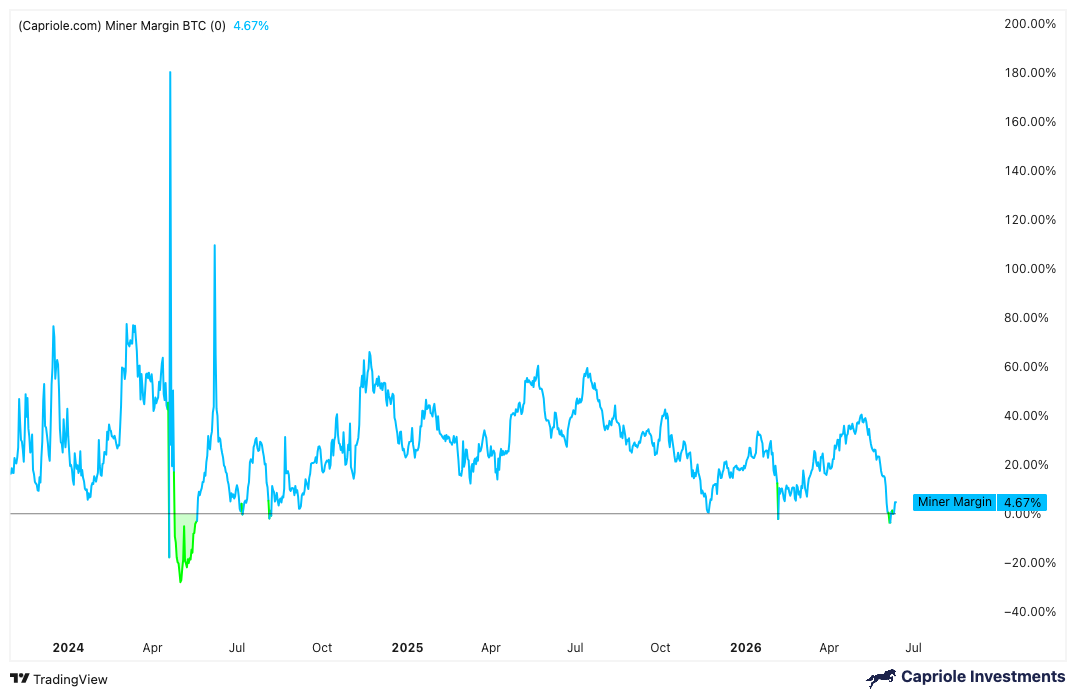
Crypto analyst Amr Taha said miners transferred roughly 21,000 BTC to Binance on May 18, close to the 23,150 BTC sent on Feb. 5. Large miner deposits are often tied to potential selling activity as miners move BTC to exchanges to cover operating costs.

BTC miners to exchange flow data. Source: CryptoQuant 

However, Taha explained that the market reaction has stayed relatively controlled so far. Bitcoin avoided a sharp breakdown after the transfer, while Binance’s BTC reserve climbed to nearly 634,000 BTC by May 26 from roughly 618,600 BTC on May 6. The exchange added around 15,400 BTC in reserves over the period without triggering aggressive downside continuation.

Glassnode’s onchain data painted a similar picture of slowing momentum rather than panic selling. The realized profit/loss ratio currently sits near 1.56, well below the 2-5 range commonly seen during stronger bull-market phases. The metric measures realized profits relative to losses across the network and points to moderate buying conviction during the recent rebound.

BTC realized profit/loss ratio 30-day moving average. Source: Glassnode

Additionally, Glassnode added that spot demand also weakened over the past two weeks. The spot volume delta slipped back into net sell-side territory after Bitcoin rejected near the low-$80,000 range. The analytics platform noted, 

“If BTC is going to push meaningfully higher from here, spot demand likely needs to step back in. Without that, the market risks drifting back into the same choppy, seller-dominated conditions that capped upside earlier in the year.”

Related: Bitcoin price threatens $75K loss as US-Iran peace progress sparks new stocks records

BTC uptrend faces key test at $75,000

Bitcoin’s higher-time-frame trend still depends on holding above the $75,000 level. The level served as a consistent demand zone throughout May and closely aligns with the neckline support on the daily chart.

However, a developing head-and-shoulders pattern has begun to form after repeated failures near the $80,000-$81,000 range. The latest lower high near $78,000 now shapes the potential right shoulder of the setup.

BTC/USDT, one-day chart. Source: Cointelegraph/TradingView

A momentum indicator also leans bearish. The daily relative strength index (RSI) has remained below the neutral 50 level for the past few days, indicating limited strength during recent rebounds. A decisive move below $75,000 could expose the next major support near $70,400.

Bitcoin researcher Axel Adler Jr. highlighted the $74,500 area as a critical support level, which currently aligns with the lower boundary of Bitcoin’s 21-day Donchian channel. The Donchian channel tracks the highest and lowest price range over a selected period and is often used to identify trend support and breakout zones. 

If the price is holding near the lower band, it usually signals that buyers are defending the recent trading range, while a breakdown below it can signal rising downside pressure.

Adler noted that Bitcoin’s composite trend signal recently shifted back into a “high bear” zone following a sharp three-week reversal from the May highs near $82,500. BTC now trades only slightly above the $74,500 support band, placing the $74,500-$75,000 region at the center of current market attention.

Bitcoin price structure. Source: CryptoQuant

Related: Sold in May and went away? Bitcoin risks another 10% drop as month turns red

What Choices Will You Make On The Way To A Multipolar World?

0

As I write this in 2026, the world is becoming more multipolar, and I expect that trend to continue over the next decade through 2036.

In reality, it was this recent unipolar period that was historically anomalous. Starting from the end of World War II in 1945 and especially since the fall of the Soviet Union in 1991, the United States has existed as the world’s sole hyperpower. For the first time in history, telecommunications and industry connected the whole world, enabling a truly global reach.

Prior to that point, multipolarity was the norm. Even during the height of the Roman Empire nearly two millennia ago, there were other similarly powerful regions of the world, including the Han Dynasty and other Asian kingdoms and empires. That was at a time when distance truly mattered, and great powers could exist simultaneously with only limited contact.

The other side of this multipolar aspect of power was the multipolar nature of money. For thousands of years, it was gold and silver, along with lesser commodities, that served as money. There was no sovereign ledger big enough to serve the whole world, and so only nature’s decentralized ledger could suffice.

But in the age of telecommunications, as commerce and money began to flow at the speed of light in the late 19th and early 20th centuries, even gold wasn’t good enough. The United States dollar became the primary currency for cross-border lending and contract pricing, while the United States treasury bond became the primary reserve asset for central banks. People often point to the existence of prior reserve currencies, such as the British pound sterling or the Dutch gilder, but they weren’t the same thing as the dollar. They were proxies for metal, and gold itself was the real reserve currency in those eras. But during this unipolar hyperpower era, the free-floating dollar and its bond market surpassed the known market capitalization of gold and became by far the largest holding in sovereign reserves.

Many people viewed this unipolar era as the end of history, even though of course history never does end. China and India gradually recovered their economic might from the depths of colonialism and war that defined their 19th and 20th centuries, with China in particular becoming the world’s largest steel producer, electricity generator, and manufacturer now in the early 21st century. The United States, meanwhile, suffered from the Triffin dilemma: in order to maintain the world’s reserve currency, the nation must supply the world with units of its currency, which they do by running deficits. Those deficits, and the associated hollowing-out of industry that they contribute to, is what eventually weakens the trust in that currency.

Now, many of those in power in the United States no longer want the costs of issuing the reserve currency, though few would say it out loud. The imbalances have become too great. Meanwhile, the rest of the world doesn’t want their assets to be devalued or frozen, or their liabilities hardened, at the whim of Washington DC. There are no other sovereign entities willing and able to serve as the world’s ledger either, with all the trust that’s required and all the burdens it entails.

And so, here it is that we witness the gradual trend shift back toward multipolarity of money. Gold is the obvious first choice; it’s the only other liquid and divisible store of value that’s big enough. It’s still not fast enough, but nations see that they didn’t have to go as all-in on the dollar as they did. They can hold gold in lieu of treasuries for a bigger chunk of their savings than they have been doing in recent decades. It may have its flaws, but gold can’t be hacked, can’t be unliterally debased or frozen, and lasts forever.

The second choice is a boring but obvious one: diversification. In a world where there are a handful of major economic powers, nations can diversify their fiat currency exposures. They can hold a plurality of currencies and bonds at roughly equal proportion to the size of their trading partners and capital providers. That spreads out risk, both in terms of debasement and in terms of confiscation. The problem here is about network effects: liquidity begets more liquidity, and entities don’t want assets and liabilities denominated in different units, and so money naturally trends toward one wherever possible. A patchwork combination of gold and two or three major fiat currencies collectively serving as the world’s ledger is a workable one, but not an ideal one.

The third potential choice, still in its relative infancy, is Bitcoin. Nature provided slow but decentralized ledgers, sovereigns provided fast but centralized ledgers, and this third method now provides a ledger that is both decentralized and fast. The hyperpower unipolar world occurred at a time when transaction speeds could move at the speed of light, but final settlement could not. Fast global transactions (i.e. IOUs) only require Morse code over telegraph connections, which are very simple and of low bandwidth, while fast global settlements (i.e. irreversible transfers) require much higher bandwidth communications and hard encryption. Now that fast settlement exists at scale, the reliance on central intermediaries to bridge the gap between fast transactions and slow settlements can be reduced.

However, the challenge from this point on is twofold: security and network effects.

Bitcoin’s ultimate security has been questioned from its inception. Will its economic incentives keep it permissionless and decentralized indefinitely, or will it eventually gravitate toward centralized capture? Will its cryptographic assumptions continue to hold? And related to both of those questions: will it be able to gradually update over time despite its decentralization, so that it can remain functional and secure as the world’s computer infrastructure evolves underneath it? At only seventeen years of age, these questions are still unanswered, but those of us who invest in the asset and participate in development either directly or through the financing of development believe that Bitcoin is the best shot we have, and so we try to create the reality we want to see.

Bitcoin’s network effects are strong, but are still limited. These network effects, along with its simple and robust design, have been sufficient to keep it as the largest cryptocurrency for seventeen straight years since inception, with no true competitors anywhere in sight. However, when looking more broadly, it’s still a minnow in an ocean of sharks. The direct user base is in the low millions, in a world of billions. The market cap is in the low trillions of dollars in a global world of assets that has reached roughly a quadrillion dollars. And speaking of dollars, people use the largest and most liquid money as their unit of account, and that remains the dollar globally and other fiat currencies locally. It’s what people’s paychecks are denominated in, it’s what their business contracts refer to, and it’s what fulfills their liabilities.

In order to grow very large, Bitcoin by definition requires upward volatility. With upward volatility comes euphoria and leverage, which create the conditions for periods of downward volatility. This volatile adoption period, which inevitably takes decades as it chips into the existing network effects of the dollar and other large monies, limits its attractiveness both as a unit of account and as a near-term savings device. It serves as an investable asset, as long-term savings, and as the most unstoppable payment and settlement method for products and services that are otherwise denominated in more stable incumbent monies. Bitcoin’s fate during this adoption period rests on the vision of early adopters whose plans are measured in decades. The larger it becomes, the more stable it can be and the more it can function as an accounting unit and near-term savings, but getting there is a long journey.

To the extent that Bitcoin continues to remain strong in the face of security threats, and continues to chip into the incumbent monetary networks, the more attractive it becomes to individuals, corporations, and sovereigns. In 2036, I believe gold will still be desired, as there is a natural tendency to want to own physical, immortal things. And I believe the largest fiat currencies, troubled as they may be, will still be in widespread use: those trains have quite a while to run yet. If it’s successful, Bitcoin in 2036 would be larger than any stock, and would rival the largest currencies and metals in market size.

The biggest challenge to Bitcoin is not governments, not quantum computers, not rogue developers, and not other digital assets. Instead, the biggest challenge, the biggest risk, is us. The people. All people.

In 2036, war, corruption, and tyranny will still exist. However, it’s a question of ratios and numbers. People imagine that governments impose all of these things on us, when in reality that’s only partially true. The way it works in practice is that people ask for it.

There is a perceived balance between liberty and security. War and tyranny, and the centralized ledgers that fuel them, come not just out of human evil, but also from human fear. When people are afraid of invaders, plagues, technology, and competition over scarce resources, they turn to their leaders for protection. They give up some of their liberty as long as they perceive that they’re under the collective security umbrella, and that the power of the state will be directed at others rather than themselves. This can work for a time, but it breeds corruption. Power begets power, and eventually turns inward. State failures, when they inevitably occur, must be covered up. Critics of the state, whether from without or from within, must be silenced. When liberty is gone, that system which promised security eventually and ironically becomes the biggest threat to it.

People who criticize ubiquitous surveillance and bureaucratic overreach when wielded by their political opponents often turn around to embrace those tools as soon as their political allies are in power. It’s a short-sighted strategy, relying either on staying in power forever, or in the lack of foresight about how those tools will be given back to their opponents at some point, stronger than ever and ready to be used against them yet again.

If Bitcoin fails to catch on by 2036, I think it will be because humanity didn’t want it, or wasn’t ready for it. The technology itself is robust. Proof of work helps keep the network secure. Tight limits on bandwidth and storage help keep the network decentralized. Layers built on top of it help provide scaling and privacy. There is more work to do, but the foundation is already strong, open for business, and being used at scale. To the extent that major challenges arise, the network is upgradable whenever sufficient consensus is achieved.

In this latest bull/bear cycle, Bitcoin further separated itself from other cryptocurrencies, but failed to attract many new users. AI services caught on with the public far more quickly, leapfrogging Bitcoin in adoption, because people and businesses could see AI’s immediate benefits to them, while Bitcoin’s benefits were unclear to many who haven’t gone down a rabbit hole of research.

There are many stores of value to choose from, and volatility is painful. In order for Bitcoin to truly catch on, it will need to be because people value financial sovereignty. It will need to be because hundreds of millions of people, not just several million as we have now, appreciate the importance of self-custodied savings, permissionless payments, and financial privacy. Those collectively are the attributes that Bitcoin uniquely provides at scale.

Prior to Bitcoin, during this century of fast transactions but without fast settlements, governments could impose their control over the financial system in the background. By regulating the banks, they could surveil and contain activities to a significant degree without restricting almost any end-user directly. Thus, most people didn’t see any direct threats to their financial liberty. After Bitcoin, people can run open-source code, can transact without permission, and can hold liquid savings in their own custody. To the extent that governments are threatened by this, they can’t just impose restrictions on thousands of banks anymore; they have to impose restrictions on millions of end-users and developers.

The question is, now that technology has pulled the mask off, will enough people resist and push forward through frictions, or will they comply without protest and move backward?

We have the tools now, but will we use them? That’s the main question to answer for 2036.

Don’t miss your chance to own The 2036 Issue — featuring articles written by many influential figures in the space pondering the challenges of the next decade!

This piece is featured in the latest Print edition of Bitcoin Magazine, The 2036 Issue. We’re sharing it here as an early look at the ideas explored throughout the full issue.

Bitcoin, Altcoins Selloff Amid Rising ETF Outflows

0

Key points:

  • Bitcoin is under pressure as net outflows from the BTC ETFs highlight a shift in institutional investor sentiment.
  • Most major altcoins look weak, suggesting the bears are in control.

Bitcoin (BTC) fell below $75,000 on Wednesday, indicating that the bears are slowly taking charge of the crypto market. Institutional investors seem to be on a selling spree, with BTC exchange-traded funds recording net outflows of $1.88 billion since May 15, per Farside Investors’ data. Glassnode said in a post on X that persistent net outflows from BTC ETFs on nearly every trading day since May 7 add “to the supply side without a visible demand offset.”

BTC’s weakness has sent it tumbling below its long-term valuation average, according to Bitwise. The asset management firm said in a recent report that in the past, only 36% of BTC’s market-value-to-realized-value (MVRV) readings were lower than the current level of 1.42. In comparison, roughly 99% of historical Nasdaq-100 price-to-book ratios were below their present levels, signaling the widest valuation gap on record between BTC and US tech stocks.

Crypto market data daily view. Source: TradingView

While others panic, a whale has used the drop as a buying opportunity. Blockstream CEO Adam Back said in a post on X that a BTC whale had hoovered up 450 “cheap Bitcoins” per day for the past eight and a half days using a time-weighted average price method.

Could BTC and select major altcoins bounce off their strong support levels? Let’s analyze the charts of the top 10 cryptocurrencies to find out.

Bitcoin price prediction

BTC turned down from the 20-day exponential moving average ($77,431) on Tuesday, signaling that the bears are selling on minor relief rallies.

BTC/USDT daily chart. Source: Cointelegraph/TradingView

The bulls will attempt to defend the crucial $76,000 to $74,289 support zone, while the bears will strive to pull the BTC price below it. If the support zone crumbles, the short-term advantage will tilt in favor of the bears. The BTC/USDT pair may then descend to the support line near $70,500, which is likely to attract buyers.

On the contrary, if the price bounces off the support zone, the bulls will again strive to drive the pair above the 20-day EMA. If they succeed, the pair may rally to $82,000 and then to $84,000.

Ether price prediction

Buyers have failed to push Ether (ETH) back above the support line, indicating that the bears are attempting to flip the level into resistance. 

ETH/USDT daily chart. Source: Cointelegraph/TradingView

There is psychological support at $2,000, but if that level cracks, the ETH/USDT pair may decline to the $1,916-$1,750 zone.

Buyers have an uphill task ahead of them. They will have to push the ETH price above the moving averages to signal strength. If they do that, it suggests that the market has rejected the breakdown below the channel. That increases the likelihood of a rally to $2,465, then to the channel’s resistance line.

BNB price prediction

Buyers are attempting to sustain BNB (BNB) above the 20-day EMA ($652), but the bears have kept up the pressure.

BNB/USDT daily chart. Source: Cointelegraph/TradingView

If the 20-day EMA gives way, the bears will strive to strengthen their position by pulling the BNB price below the 50-day SMA ($636). If they can pull it off, the BNB/USDT pair may tumble to $610, then to $570.

Conversely, if the price rebounds off the moving averages, it suggests demand at lower levels. The bulls will then again endeavor to clear the $687 overhead hurdle. If they do that, the pair may rally to $730 and then to $790.

XRP price prediction

XRP (XRP) continues to gradually slide toward the $1.27 support, indicating that the bears remain in control. 

XRP/USDT daily chart. Source: Cointelegraph/TradingView

Buyers are expected to mount a strong defense at $1.27, but the relief rally is likely to face selling at the 20-day EMA ($1.37) and then at the downtrend line. If the XRP price declines sharply from the 20-day EMA, it increases the likelihood of a break below $1.27. If that happens, the XRP/USDT pair may plunge to $1.11 and then to $1.

The first sign of strength will be a break and close above the downtrend line. The pair may then climb to the $1.61 resistance. Buyers will have to pierce the $1.61 level to signal a potential trend change.

Solana price prediction

Solana’s (SOL) has been getting squeezed between the 20-day EMA ($86.42) and the $82.65 support.

SOL/USDT daily chart. Source: Cointelegraph/TradingView

The 20-day EMA has started to turn down, and the RSI is in the negative territory, indicating a slight edge to the bears. If the price breaks below $82.65, the SOL/USDT pair may plummet to the $76 support.

Alternatively, if the SOL price rises sharply from the $82.65 level and breaks above the 20-day EMA, it suggests the pair may remain within the $76 to $98 range for a while longer.

Dogecoin price prediction

The failure of the bulls to push Dogecoin (DOGE) above the 20-day EMA ($0.10) suggests a negative sentiment.

DOGE/USDT daily chart. Source: Cointelegraph/TradingView

Sellers are attempting to sink the DOGE price below $0.10, opening the door to a retest of $0.09 support. Buyers are expected to defend the $0.09 level with all their might, as a close below it may sink the DOGE/USDT pair to $0.08.

Contrary to this assumption, if the price rises and closes above the 20-day EMA, it suggests the pair may extend its range-bound action between $0.09 and $0.12 for a few more days. Buyers will have to secure a close above $0.12 to start a new uptrend toward $0.14 and then $0.16.

Hyperliquid price prediction

Hyperliquid (HYPE) pulled back from $64.93 on Monday, signaling profit-booking by short-term traders.

HYPE/USDT daily chart. Source: Cointelegraph/TradingView

The bulls are attempting to arrest the pullback at the breakout level of $59.41. If they succeed, it suggests that the bulls have flipped the level into support. That improves the prospects of a break above the $64.93 level. The HYPE/USDT pair may then surge toward $77.

Instead, if the HYPE price breaks below $59.41, the correction may deepen to the 20-day EMA ($52.14). Buyers are expected to fiercely defend the 20-day EMA, as a slide below it would signal the start of a deeper correction toward the 50-day SMA ($44.92).

Related: Three key XRP metrics suggest ‘explosive price expansion’ is next

Zcash price prediction

Zcash (ZEC) declined from the $690 level on Monday, indicating profit-taking by short-term traders.

ZEC/USDT daily chart. Source: Cointelegraph/TradingView

Sellers are attempting to sustain the price below the 20-day EMA ($571), opening the door to a deeper correction. If they manage to do that, the ZEC price may plummet to $486 and then to the 50-day SMA ($457). 

The 20-day EMA is flattening, and the RSI has dropped toward the midpoint, indicating that the bulls are losing their grip. Buyers will have to thrust the ZEC/USDT pair above $690 to seize control.

Cardano price prediction

Cardano (ADA) remains below its moving averages, indicating that the bears have the advantage.

ADA/USDT daily chart. Source: Cointelegraph/TradingView

Sellers will endeavor to pull the ADA price to the $0.22 support. Any attempt by the bulls to start a recovery is expected to face strong selling at the 20-day EMA ($0.25). If the price declines sharply from the 20-day EMA, it increases the risk of a break below $0.22.

On the upside, a break and close above the moving averages suggests that the ADA/USDT pair may continue to oscillate inside the $0.22 to $0.31 range for some more time. The next trending move is expected to begin on a close above $0.31 or below $0.22.

Monero price prediction

Monero (XMR) has been trading within an ascending channel, suggesting buyers have the edge. 

XMR/USDT daily chart. Source: Cointelegraph/TradingView

The XMR price has bounced off the 50-day SMA ($378), indicating buying on dips. There is resistance at the downtrend line, but if the level is breached, the XMR/USDT pair may rise toward the resistance line. The bullish momentum may pick up if buyers drive and maintain the price above the resistance line.

Contrarily, if the price turns down from the downtrend line and breaks below the 50-day SMA, it suggests that the bears are selling on rallies. The pair may then drop to the support line.