“To put the argument in the plainest real-world terms: Senate Majority Leader Harry Reid of Nevada would never have consented to or passively accepted legislation displacing an activity so critical to his state’s economy and politics by permitting sports betting only under CFTC auspices,” Gensler’s brief said.
Courts have so far been split; some have ruled in favor of prediction market providers, while others have ruled in favor of states.
The Third Circuit Court of Appeals ruled in April that the state of New Jersey could not shut down prediction markets, but panel of the Ninth Circuit Court of Appeals seemed more inclined to rule for the states.
It is likely that the Supreme Court will ultimately take up the issue, and Congress is also poking around.
Amicus briefs
The CFTC, currently helmed by Chair Mike Selig, filed its own amicus brief in this case last month, arguing that any event contract traded by a designated contract market overseen by the regulator is a swap.
Congress’ definition of a swap was broad and the language in the statutes allows for the CFTC-regulated firms to offer their products, the regulator’s filing said.
Genler’s brief disagreed.
“The CFTC now posits hedging theories for some sports bets that are at best only tenuously connected to reliable hedges of commercial risks. That connection, however, is crucial, as Congress included only those event contracts that hedge risks in a manner similar to a swap and are sufficiently ‘associated with a potential financial, economic, or commercial consequence,'” Gensler’s brief said.
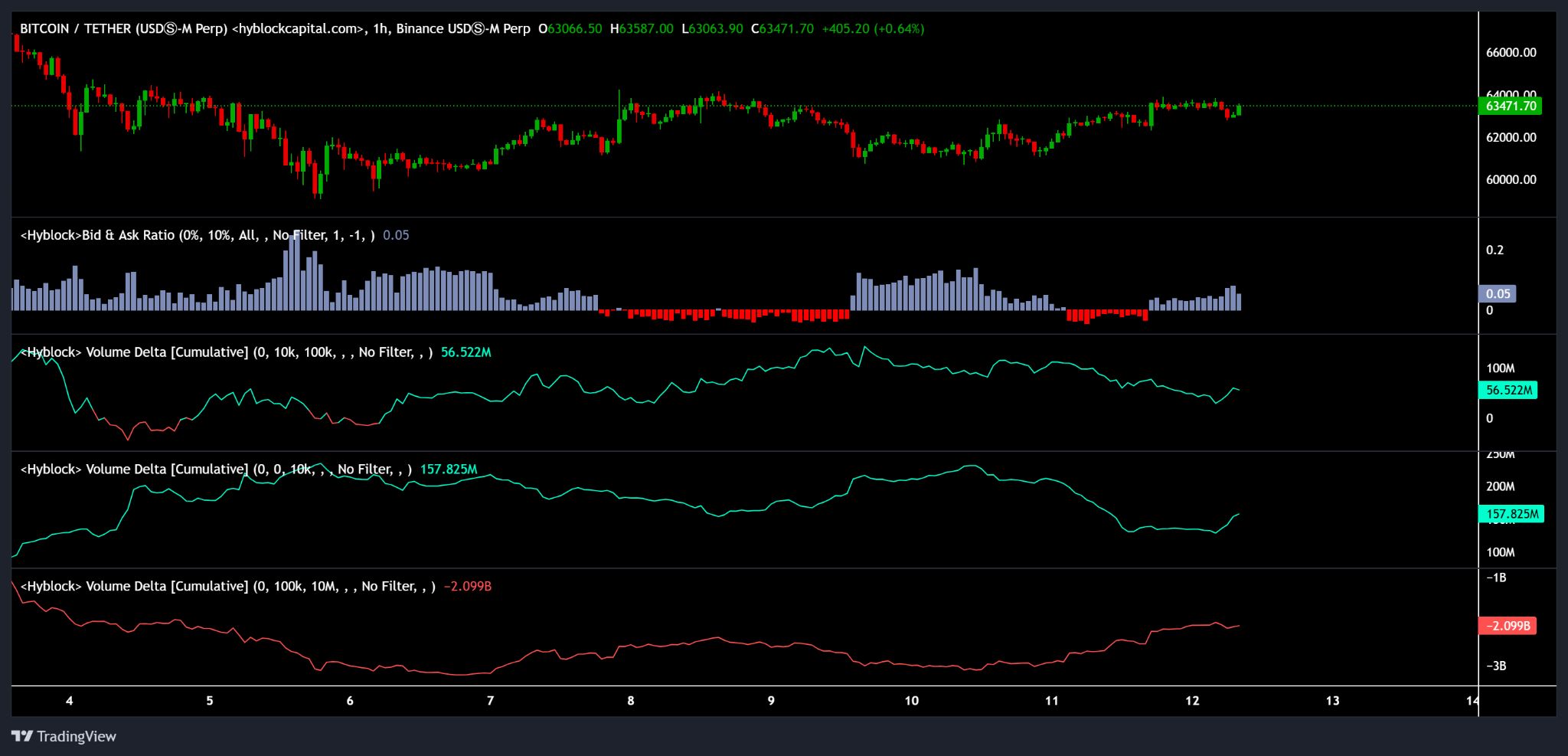
Bitcoin (BTC) is gaining buyers’ interest after setting a new yearly low at $59,000 last week. Order book data and liquidity suggest a rally is pending and more than $2 billion in short liquidity is concentrated near $65,000. BTC’s bid-ask ratio has remained positive since last Friday.
The shift in positioning and sentiment also aligns with a bullish chart pattern targeting the $67,000–$70,000 range.
BTC bulls attempt to regain control near support
Bitcoin’s recent rebound to $63,500 followed a bullish divergence between the price and the relative strength index (RSI) on the four-hour chart. The price printed a lower low during the early-June sell-off while the relative strength index (RSI) formed a higher low. The signal pointed to fading downside momentum before buyers stepped in.
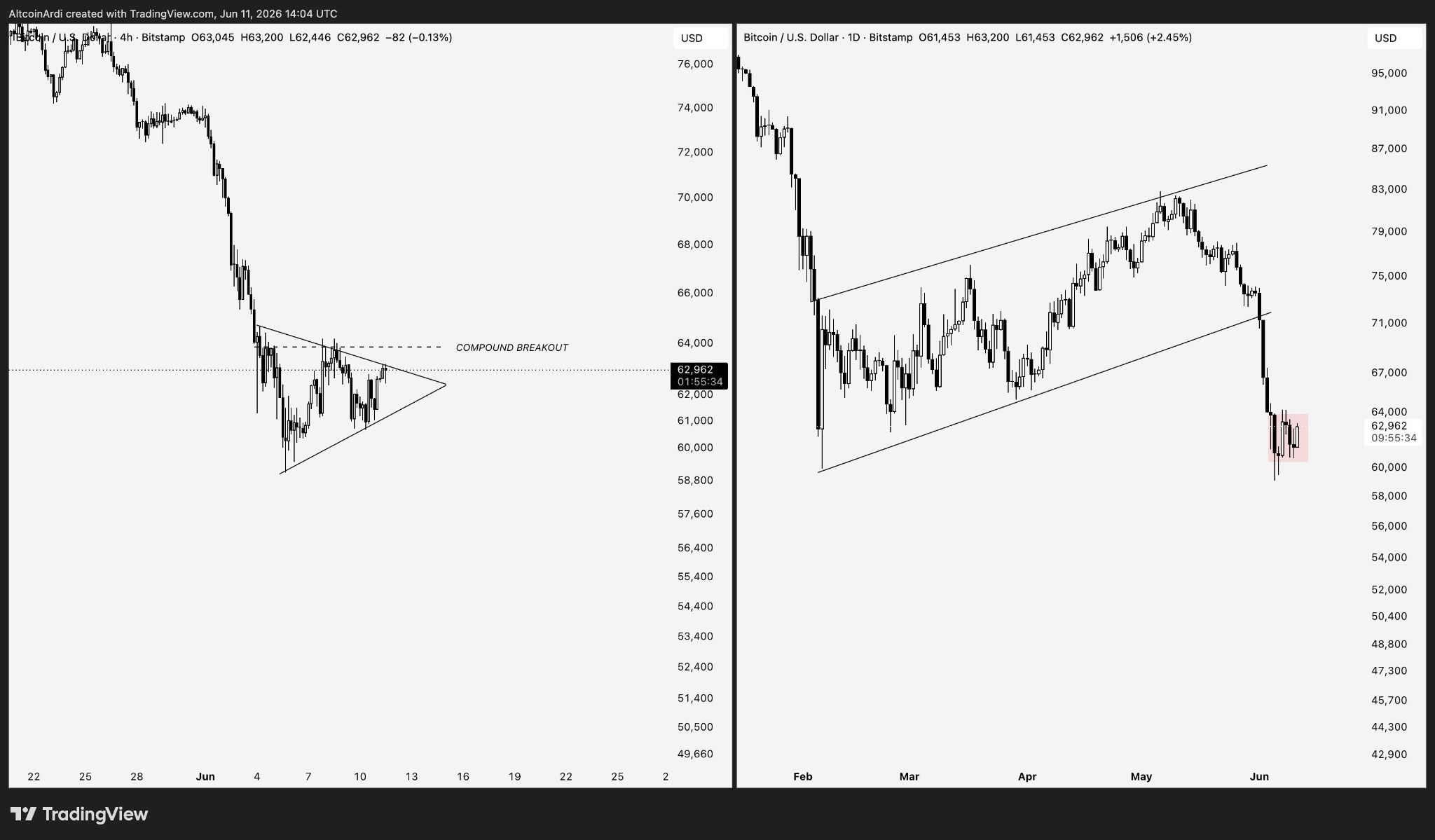
Bitcoin is also trading within an ascending triangle pattern. A confirmed breakout may target the daily fair value gap between $67,500 and $70,500, an area of trading imbalance or liquidity gap left behind during the recent market correction.
The order book activity supports the move. Data from Hyblock shows the bid-ask ratio remained positive at 0.05 after Bitcoin tagged its yearly low at $59,000 last Friday. The metric tracks aggressive buying and selling activity. A positive reading suggests buy-side market orders have been slightly outpacing sell-side orders.
The cumulative volume delta (CVD) data adds another layer of support. Smaller cohorts (up to $10,000 and $100,000 orders) have shown improving buying activity with $53 million and $157 million, respectively, while the largest participants ($100,000-$10 million) have significantly reduced net selling pressure by $900 million.
Crypto analyst Kripto Holder highlighted a $2.68 billion short-liquidity cluster near $64,600, calling it the primary upside liquidity pool.
The analyst said Bitcoin’s ability to hold above $63,000 following renewed conflict in the US-Iran war adds weight to the recovery case. Spot CVD inflows also indicate demand from spot buyers.
Related: Metaplanet to form securities arm through Siiibo acquisition
BTC needs to reclaim $66,000 soon: Analyst
Market analyst PILTR noted that BTC’s long exposure has gradually increased over the past five days. The current positioning tracks 237 long levels against 128 short levels, creating an estimated $4 billion positive imbalance.
Those price levels closely align with analysis from crypto trader Ardi, who argued that Bitcoin is still trading within a bear pennant following its decline from $83,000 to $59,000. The analyst identified $64,000 and $66,000 as the two most important levels for the current recovery.
BTC/USD, four-hour analysis by Ardi. Source: X
According to Ardi, a move above $64,000 would clear both horizontal resistance and the pennant structure, giving Bitcoin additional room to the upside. The next hurdle sits near $66,000, a former major range support level that now acts as resistance.
Reclaiming that area would strengthen the case for a move into the liquidity zone above the price and the unfilled fair value gap between $68,000 and $70,000.
However, PLTR also flagged weekend positioning as a near-term variable. The analyst noted that weekly profit-taking often creates opposing flows into weekends, especially after a sustained build-up in long exposure.
Related: Bitcoin miner ‘capitulation’ comes as trader sees later 2026 bear-market bottom
CFTC staff issued release 9252-26 on Friday, giving designated contract markets a no-action path to convert existing perpetual-style digital commodity futures into true perpetuals, advancing the agency’s buildout of a regulated US crypto derivatives market.
CFTC staff issued a no-action letter Friday enabling designated contract markets to convert existing perpetual-style digital commodity futures into true perpetual futures, the latest piece of regulatory plumbing in the agency’s construction of a domestic crypto derivatives market.
The letter, release 9252-26, was announced via the CFTC’s official X account. It allows DCMs holding perpetual-style contracts, which carry multi-year expiry dates rather than an open-ended structure, to relist them as true perpetuals without triggering full re-certification under Regulation 40.3. The practical effect is that exchanges already running the funding-rate mechanism on long-dated futures can drop the expiry and migrate open interest into the genuine perpetual structure the CFTC approved in May.
The Conversion Path
A true perpetual futures contract has no expiry. Instead of converging on a settlement date, it uses a periodic funding rate, typically paid between long and short holders, to keep the contract price anchored to the spot price of the underlying asset. Perpetual-style futures, the workaround US venues had used since at least December 2025, mimic that economic function through a long-dated cash-settled contract, usually with a 10-year maturity and a daily funding adjustment.
Cboe announced bitcoin (PBT) and ether (PET) continuous futures planned to begin trading December 15, 2025, subject to regulatory review, with a 10-year expiration at listing and a daily cash adjustment. That structure gave institutional participants a regulated proxy, but it was not the native perpetual structure that dominates offshore crypto derivatives trading.
Today’s no-action letter bridges the two. DCMs can now submit conversion plans without going through the full 40.3 case-by-case review that the CFTC’s May 29 policy statement on perpetual contracts prescribed for new perpetual listings on asset classes beyond bitcoin.
Three Weeks of Rulemaking
The CFTC has moved in a concentrated burst. On May 29, the agency approved KalshiEX’s BTCPERP contract, the first true perpetual futures product to receive Commission approval and list on a domestic DCM. The order was accompanied by the policy statement setting the Regulation 40.3 review standard for future applicants and a separate action clearing Coinbase Financial Markets to route customers to its offshore Deribit affiliate’s perpetuals as foreign futures.
Three days later, Kalshi filed to list perpetual futures on 12 altcoins, following the bitcoin approval with the first broad altcoin perp slate submitted for Commission review under the new 40.3 framework.
Today’s conversion-path letter adds a fourth piece: relief for incumbents already operating perpetual-style products, so they do not have to build a parallel listing from scratch to offer the true perpetual structure.
The CME Counterpoint
CME Group CEO Terry Duffy offered the incumbent view, calling US crypto perpetual futures “a disaster waiting to happen,” citing excessive leverage and retail risk.
CME has not announced plans to list a perpetual contract. Duffy’s framing positions CME’s existing crypto futures suite, which uses standard expiry and lower leverage, as the more conservative alternative in the regulated US perp debate.
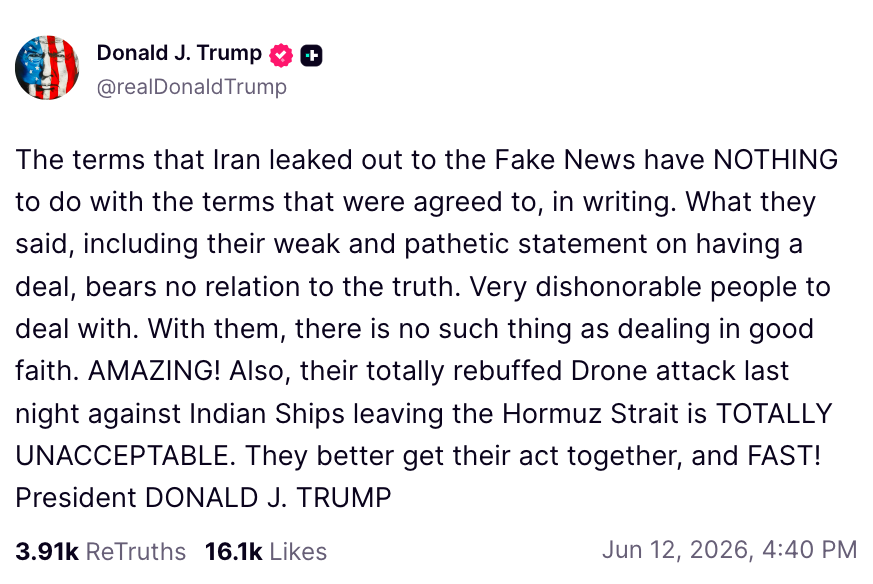
At the time of writing, there was no official information about whether a deal would go ahead, with US President Donald Trump rebutting details from the Iranian side.
“What they said, including their weak and pathetic statement on having a deal, bears no relation to the truth,” he wrote in his latest post on Truth Social.
Source: Truth Social
Stocks opted to tread water at the US open on the day that SpaceX launched the biggest initial public offering (IPO) in history. Shares were slated to debut at $170 — $45 above the initial IPO price.
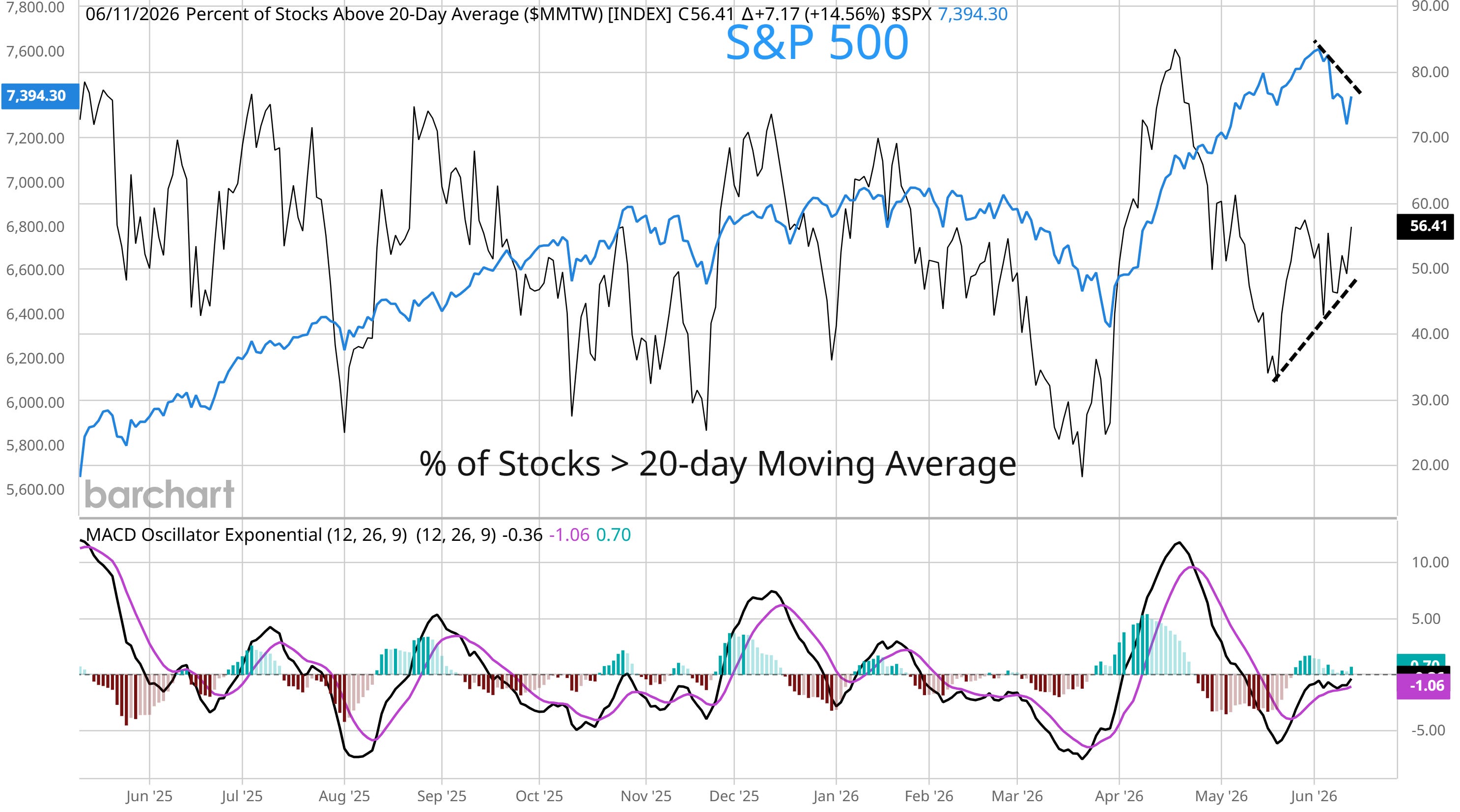
In a fresh analysis, trading resource Mosaic Asset Company said that markets now faced a combination of a strong labor market and high inflation.
“While equity markets seemed to shrug off inflation fears and the impact to valuations and monetary policy, better economic data is giving the average stock a reason to rally,” it summarized in its latest Mosaic Chart Alerts update.
“While some of the air is being released from the massive rally in AI infrastructure stocks, laggards off the late March lows are turning up recently.”
S&P 500 chart data. Source: Mosaic Asset Company
As Cointelegraph reported, this week’s US inflation data set new multi-year records on the back of the US-Iran war and its impact on oil prices.
BTC price 200-week trend line in focus
While Bitcoin saw new local highs near $64,000, market participants remained highly cautious on the outlook.
Related: Bitcoin miner ‘capitulation’ comes as trader sees later 2026 bear-market bottom
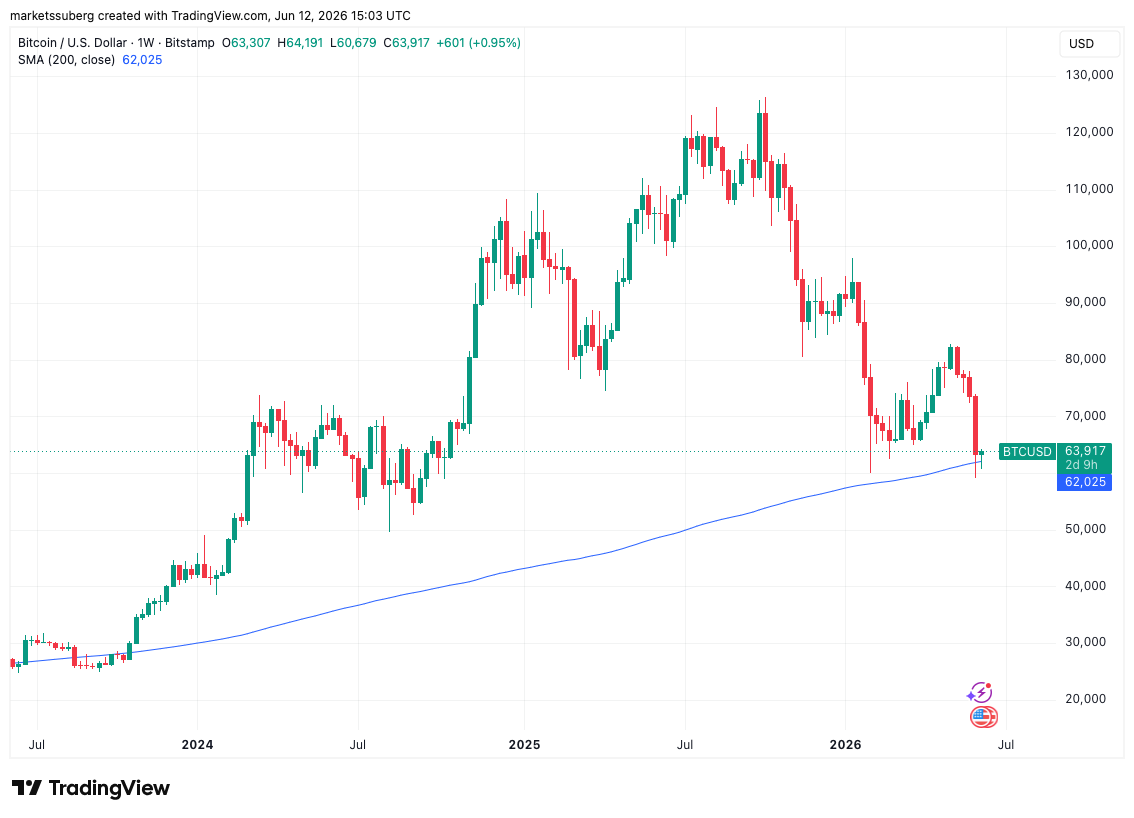
Trader and analyst Rekt Capital was suspicious of a long-term trend line holding up price — the 200-week simple moving average (SMA) at $62,025.
“Bitcoin is currently treating the 200-week SMA as support. But this SMA has historically proven to be an unreliable support, with price breaking down from it over time,” he warned X followers.
BTC/USD one-week chart with 200SMA. Source: Cointelegraph/TradingView
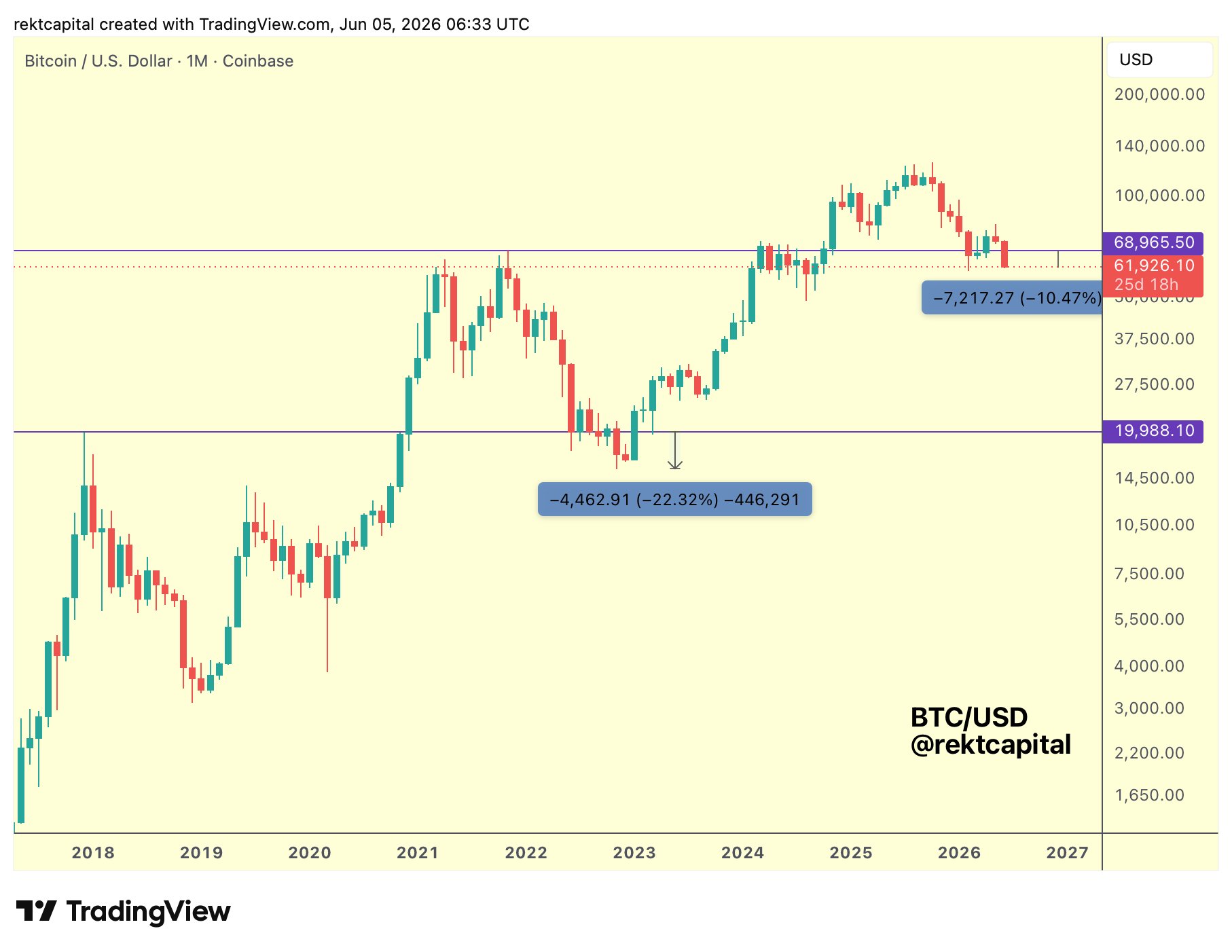
Rekt Capital saw additional friction coming from the fact that BTC/USD had dropped below old all-time highs from 2021.
“This deviation below old All Time Highs for Bitcoin tends to take months to fully develop to ultimately form a Bear Market bottom,” he commented.
“Though Bitcoin has deviated -14% below old ATHs thus far, this process is still technically ongoing and will be for a while.”
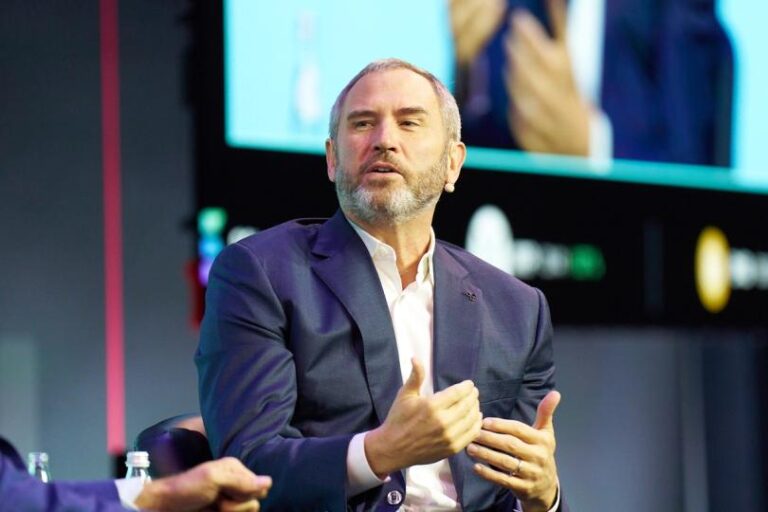
Ripple CEO Brad Garlinghouse called it “the moment” for the industry, saying the industry deserved “the same rules and protections as every other asset class.”
Standard Chartered projected $4 billion to $8 billion in additional inflows into U.S. spot XRP exchange-traded funds if the bill passes. They have attracted roughly $1.4 billion since January, according to SoSoValue data.
The same discrepancy shows up on the XRP Ledger blockchain. Payment counts, automated market making activity and tokenized real-world assets all hit records this year while the token’s price kept falling. Pilot projects kept stacking up, including one that had Ondo, JPMorgan’s Kinexys, Mastercard and Ripple settling tokenized Treasuries across the ledger in seconds.
Santiment pointed to the same split, with development activity, ledger usage and institutional products advancing as social enthusiasm faded.
The exhaustion has a history. Santiment noted that some of XRP’s strongest rebounds came when the crowd was at its most disinterested, with discussion volume falling and commentary overwhelmingly negative, the same setup as now.
Sentiment readings are a contrarian tool and not a timer, however. The signal indicates that the sellers who talk have mostly stopped talking. Whether that marks a turning point depends on whether the demand that years of waiting were supposed to unlock finally shows up.
This is why the most exposed institutional holders have been waiting. They are waiting for the coordination work to happen, which a research grant does not accomplish. The work needs an actor with the standing to convene the protocol communities, the custodians, and the regulators who must move together. No funded entity has taken on that role at the scale Bitcoin requires.
The geopolitical race
Government funding accelerated the offense. Every dollar that compounds into quantum hardware compresses the defense’s runway.
The day after the U.S. announcement, Emmanuel Macron committed €1 billion to France’s quantum strategy and called for Europe to “change the scale” of investment, naming the U.S. and China as its competitors.
China had already routed roughly $17.5 billion through three regional venture funds before the U.S. announcement landed; the U.S. move now gives Beijing the political cover to authorize another round. This is what a three-way industrial-policy race looks like, and it just compressed everyone’s planning horizon, whether they were ready or not.
What has to happen now
A serious response begins with coordinated migration work, started before the offense capability matures, because the migration has a long tail, and the runway just got shorter.
What is different about the post-quantum case is the scale of the coordination challenge. Bitcoin is uniquely exposed: any address that has ever spent funds has its public key sitting onchain in the clear, forgeable the moment elliptic curve cryptography breaks, with no way to recall it.
Latest developments: Kalshi’s launch of CFTC-regulated crypto perpetuals has reignited a long-running debate over financial market definitions.
John Lothian and Kalshi’s Udesh Jha joined The Policy Protocol to debate this topic.
John Lothian, publisher of John Lothian News, argued that perpetual contracts resemble swaps because they involve recurring bilateral cash-flow payments through funding-rate mechanisms.
Udesh Jha, Kalshi’s head of exchange analytics, countered that perpetuals function like futures because they are exchange-traded, centrally cleared and designed to track underlying spot markets.
The debate follows the recent approval and launch of crypto perpetuals on Kalshi under CFTC oversight.
The disagreement: Both sides view the same product through different regulatory lenses.
Lothian said perpetuals differ from traditional futures because funding-rate payments create ongoing cash flows between market participants, a feature he associates with swaps.
Jha argued that funding rates merely make financing costs explicit rather than embedding them in futures prices, making perpetuals a more efficient version of existing futures markets.
According to Jha, perpetuals also eliminate the need for traders to roll positions into new contract months, reducing friction and costs.
Why it matters: The classification could determine who can access the products and under what rules.
Standard Chartered’s head of digital asset research, Geoff Kendrick, declared Friday that the crypto market has seen its cycle low, with Bitcoin’s recent dip to approximately $59,000 marking the bottom of the latest downturn — a 53% drawdown from its October all-time high of $126,000.
“Winter is over. Welcome back to crypto spring,” Kendrick wrote in a Friday note, adding, “I think we have now seen the low in crypto asset prices for the cycle.”
Bitcoin had recovered to around $64,000 at the time of Kendrick’s note, representing a roughly 5% gain over the prior week. The bank maintains a $100,000 price target for Bitcoin by year-end — projections it first issued in February.
SpaceX IPO drains crypto liquidity — then frees it
One of the two primary catalysts Kendrick cited is the historic Nasdaq debut of Elon Musk’s SpaceX, which priced its $75 billion IPO at $135 per share under the ticker SPCX on June 12.
Shares opened sharply above their IPO price, gaining roughly 20% on debut day. Kendrick argued that a significant portion of recent Bitcoin ETF outflows — totaling more than $5.72 billion since the second week of May, among the sharpest “since inception” — was driven by investors liquidating crypto positions to secure SpaceX allocations. With the IPO now live, that specific selling pressure may lift, he said.
The overlap between crypto and SpaceX demand was already playing out in real time. On Hyperliquid, perpetual contracts for SpaceX (SPCX) had accumulated over $240 million in open interest and $220 million in 24-hour volume ahead of the debut — ranking it as the eighth-largest asset on the platform.
Iran is a wildcard
The second catalyst involves geopolitics. A potential peace deal between the U.S. and Iran, timed ahead of next week’s G7 summit, could reduce pressure on global oil supplies that have remained tight since Middle East hostilities began.
Lower oil prices would subsequently cool elevated U.S. Treasury yields — which have weighed on risk assets like crypto by making risk-free government debt more attractive.
West Texas Intermediate crude fell roughly 1.5% on Friday to around $85–$86 per barrel. However, the peace deal narrative remained fragile.
President Trump stated Thursday that a breakthrough could come this weekend, only to later post on Truth Social that the deal made public was not what had been agreed, warning Iranian officials to “get their act together” — adding uncertainty to the macro outlook.
Three bitcoin price signals to watch
Kendrick outlined three confirmation signals that would validate his call. First, he is watching for Strategy to announce an additional Bitcoin purchase on Monday, as CEO Michael Saylor’s buying history has served as a reliable demand signal for institutional appetite.
Second, he is expecting U.S. spot Bitcoin ETFs to return to net-positive daily inflows on Friday.
Third, he wants to see continued declines in global oil prices as the Iran diplomatic situation evolves.
If all three materialize, Kendrick’s crypto spring thesis gains its clearest validation yet — suggesting institutional and macro forces are finally aligning to push Bitcoin back toward the bank’s $100,000 year-end target.
The cryptocurrency market reached its definitive bottom for the currency cycle, Standard Chartered Analyst Geoffrey Kendrick said in a note on Friday.
The cycle low is now locked in at $59,000 for bitcoin, a 53% drop from its Oct. 6 all-time high of $126,000, according to Kendrick.
“Winter is over. Welcome back to crypto Spring, he said.
CoinDesk data shows bitcoin touched as low as $59,375 on June 5 in the evening, around 18:00 UTC. At the time of writing, bitcoin hovered just shy of $64,000.
Kendrick, who has $4,000 ether and a $100,000 bitcoin price target by the end of this year, identified two core drivers on Friday that support this market turnaround.
First, recent weeks saw some of the sharpest spot bitcoin ETF selling since inception. Total redemptions exceeded $5.72 billion since the second week of May. He also noted that ETF holders have anecdotally been liquidating their positions to free up cash to participate in the SpaceX initial public offering (IPO).
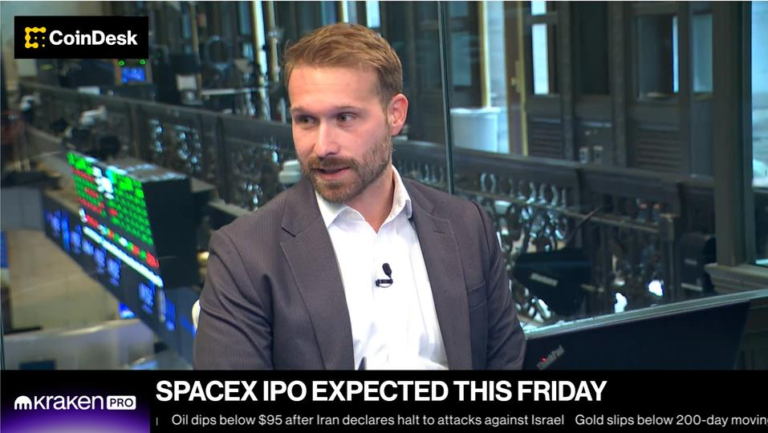
Elon Musk’s SpaceX shares began trading on Nasdaq at around $150 on Friday and are now about 26% above their IPO price.